
Request Free Sample ×

Kindly complete the form below to receive a free sample of this Report

* Please use a valid business email

Leading companies partner with us for data-driven Insights

clients tt-cursor
Hero Background
English
Chinese
French
Japanese
Korean
German
Spanish

Advanced Connectivity in E-Commerce and Retail Market Size

ID: MRFR/ICT/10644-HCR
215 Pages
Nirmit Biswas
March 2026

Advanced Connectivity in E-Commerce & Retail Market Research Report: Information By Type (Cellular, Low-Earth orbit satellites, Wireline/Fixed, Short range, LPWAN, Wireless Low-Power Networks, Optical fiber, and Others), Technology (Edge computing, Internet of Things (IoT), Artificial intelligence, Machine learning), Application, (Real-time inventory tracking, Order fulfillment, Personalized recommendations, Fraud detection, Supply Chain Management, E-Commerce Data Integration) By Regions-Forecast Till 2035.

Share:
Download PDF ×

We do not share your information with anyone. However, we may send you emails based on your report interest from time to time. You may contact us at any time to opt-out.

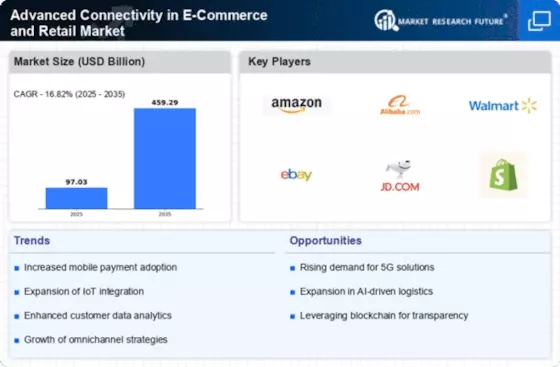
Advanced Connectivity in E-Commerce and Retail Market Infographic
Purchase Options

Advanced Connectivity In E Commerce And Retail Size

Advanced Connectivity in E-Commerce and Retail Market Growth Projections and Opportunities

Advanced Connectivity market in the e-commerce and retail industry has been experiencing significant growth and evolving dynamics in recent years. Advanced connectivity refers to the technologies and solutions that enable fast and seamless communication and data transfer between devices, networks, and systems. In electronic business and retail, the advanced connectivity is of great importance, making online transactions to be possible, optimizing the supply chains and also improving the whole customer experience. Two sets of market dynamics — advanced connectivity in the e-commerce and retail schema — are shaped by several different forces.

Advanced connectivity on e-commerce and retail industry are growing as the online shopping is widely adopted by the customers. Since the advent of retail sites and the internet, online shopping has become more popular than before with people switching to purchasing goods through the web from whatever place they can. Smart networks and high-speed connections are an inseparable element of a reliable online shopping approach. Hence, e-commerce companies and retailers are giving more importance to advanced connectivity infrastructures so that customers enjoy seamless access to their websites, easily check products and complete the purchases without straining.

Furthermore, the market place becomes more individualized and omnipresent customer contacts, which is disrupting the conventional way of advanced connectivity in the market of e-commerce and retail sector. Shoppers today demand on-demand and scalable engagements with no friction on online, mobile or physical store channels. Innovative connectivity solutions with modern technology give retailers the ability to gather and analyze customer data at multiple points such as their channels and social media platforms, in order to share a message, suggestion or an offer which is tailored to meet their individual needs. Through the utilization of cutting edge connectivity, retailers are capable of making the customer journey consistent and personalized which in turn leads to the resulting increased customer satisfaction and loyalty.

Besides that, the steadily increasing uptake of new emerging technologies, such as AI and ML, is conditioning the market position in the advanced connectivity in the e-commerce and retail industry. With the help of these technologies in addition to advanced connectivity solutions, retailers are able to derive data-based insights and automation to achieve higher levels of efficiency and contact with their customer base. For example, AI-powered chatbots can provide instant customer support and personalized recommendations, while ML algorithms can analyze customer data to predict buying patterns and optimize pricing strategies. The integration of advanced connectivity and emerging technologies offers retailers new opportunities to enhance their competitiveness and drive growth.
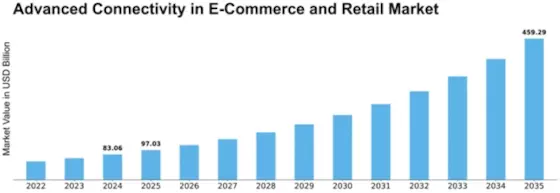

Advanced Connectivity in E-Commerce and Retail Market Size Graph
Author
Author Profile
Nirmit Biswas
Senior Research Analyst

With 5+ years of expertise in Market Intelligence and Strategic Research, Nirmit Biswas specializes in ICT, Semiconductors, and BFSI. Backed by an MBA in Financial Services and a Computer Science foundation, Nirmit blends technical depth with business acumen. He has successfully led 100+ projects for global enterprises and startups, including Amazon, Cisco, L&T and Huawei, delivering market estimations, competitive benchmarking, and GTM strategies. His focus lies in transforming complex data into clear, actionable insights that drive growth, innovation, and investment decisions. Recognized for bridging engineering innovation with executive strategy, Nirmit helps businesses navigate dynamic markets with confidence.

Leave a Comment

FAQs

What is the projected market valuation for advanced connectivity in e commerce retail by 2035?

<p>The projected market valuation for advanced connectivity in e commerce retail is expected to reach 150.0 USD Billion by 2035.</p>

What was the market valuation for advanced connectivity in e commerce retail in 2024?

<p>The overall market valuation for advanced connectivity in e commerce retail was 75.0 USD Billion in 2024.</p>

What is the expected CAGR for the advanced connectivity in e commerce retail market from 2025 to 2035?

<p>The expected CAGR for the advanced connectivity in e commerce retail market during the forecast period 2025 - 2035 is 6.5%.</p>

Which companies are considered key players in the advanced connectivity in e commerce retail market?

<p>Key players in the market include Amazon, Alibaba, Walmart, eBay, JD.com, Shopify, Rakuten, Target, and Zalando.</p>

What are the main segments of the advanced connectivity in e commerce retail market?

<p>The main segments include Mobile Commerce, Social Commerce, Marketplace Platforms, Subscription Services, and various technologies like 5G Connectivity and Artificial Intelligence.</p>

How much is the Mobile Commerce segment projected to grow by 2035?

<p>The Mobile Commerce segment is projected to grow from 30.0 USD Billion to 60.0 USD Billion by 2035.</p>

What is the expected growth for the Artificial Intelligence segment in the advanced connectivity market?

<p>The Artificial Intelligence segment is anticipated to grow from 25.0 USD Billion to 50.0 USD Billion by 2035.</p>

What payment methods are gaining traction in the advanced connectivity in e commerce retail market?

<p>Payment methods such as Digital Wallets, Cryptocurrency, Buy Now Pay Later, and Contactless Payments are gaining traction.</p>

What consumer behavior trends are influencing the advanced connectivity in e commerce retail market?

<p>Trends such as Personalization, Omnichannel Shopping, Sustainability Preferences, and Price Sensitivity are influencing consumer behavior.</p>

How does the Blockchain Technology segment compare to others in terms of growth?

<p>The Blockchain Technology segment is projected to grow from 15.0 USD Billion to 30.0 USD Billion, indicating a robust growth trajectory.</p>

Market Summary

As per MRFR analysis, the Advanced Connectivity in E-Commerce and Retail Market was estimated at 83.06 USD Billion in 2024. The Advanced Connectivity industry is projected to grow from 97.03 in 2025 to 459.29 by 2035, exhibiting a compound annual growth rate (CAGR) of 16.82% during the forecast period 2025 - 2035.

Key Market Trends & Highlights

The Advanced Connectivity in E-Commerce and Retail Market is experiencing transformative growth driven by technological advancements and evolving consumer behaviors.

  • Omnichannel integration is becoming increasingly prevalent, allowing retailers to provide seamless shopping experiences across various platforms.
  • Artificial intelligence utilization is enhancing customer personalization and operational efficiency, particularly in North America.
  • Enhanced data security measures are gaining traction as consumers demand greater protection of their personal information.
  • Rising consumer expectations and the expansion of mobile commerce are key drivers propelling market growth in both North America and Asia-Pacific.

Market Size & Forecast

2024 Market Size 83.06 (USD Billion)
2035 Market Size 459.29 (USD Billion)
CAGR (2025 - 2035) 16.82%
Largest Regional Market Share in 2024 North America

Major Players

<p>Amazon (US), Alibaba (CN), Walmart (US), eBay (US), JD.com (CN), Shopify (CA), Target (US), Rakuten (JP), Zalando (DE), Best Buy (US)</p>

Market Trends

The Advanced Connectivity in E-Commerce and Retail Market is currently experiencing a transformative phase, driven by the integration of cutting-edge technologies and evolving consumer expectations. As digital platforms continue to proliferate, businesses are increasingly adopting advanced connectivity solutions to enhance customer experiences and streamline operations. This shift appears to be fueled by the growing demand for seamless interactions across various channels, which necessitates robust infrastructure and innovative approaches to data management. Furthermore, the emphasis on personalization and real-time engagement suggests that companies are prioritizing connectivity as a means to foster loyalty and drive sales. In February 2026, the landscape of the Advanced Connectivity in E-Commerce and Retail Market is characterized by a heightened focus on omnichannel strategies and the utilization of artificial intelligence. Retailers are leveraging these technologies to create cohesive shopping experiences that transcend traditional boundaries. The potential for enhanced analytics and customer insights indicates that businesses are not only responding to current trends but are also preparing for future developments. As the market evolves, the interplay between technology and consumer behavior will likely shape the trajectory of connectivity solutions, making it imperative for stakeholders to remain agile and responsive to emerging opportunities.

Omnichannel Integration

The trend towards omnichannel integration is becoming increasingly prevalent, as businesses strive to provide a unified shopping experience across various platforms. This approach allows customers to engage with brands seamlessly, whether online or in-store, thereby enhancing satisfaction and loyalty.

Artificial Intelligence Utilization

The incorporation of artificial intelligence in the Advanced Connectivity in E-Commerce and Retail Market is gaining momentum. AI technologies are being employed to analyze consumer behavior, optimize inventory management, and personalize marketing efforts, which may lead to improved operational efficiency.

Enhanced Data Security Measures

As connectivity solutions expand, the importance of data security is becoming more pronounced. Retailers are investing in advanced security protocols to protect customer information and maintain trust, indicating a proactive approach to safeguarding sensitive data.

Advanced Connectivity in E-Commerce and Retail Market Market Drivers

Emergence of 5G Technology

The rollout of 5G technology is poised to revolutionize the Advanced Connectivity in E-Commerce and Retail Market. With its promise of faster data transfer speeds and lower latency, 5G enables retailers to enhance their online platforms and improve customer interactions. This technological advancement allows for richer multimedia content, such as augmented reality experiences, which can significantly enhance the shopping experience. As 5G networks become more widespread, retailers that leverage this technology are likely to gain a competitive edge, attracting tech-savvy consumers who seek innovative shopping experiences.

Expansion of Mobile Commerce

The proliferation of smartphones and mobile devices has significantly influenced the Advanced Connectivity in E-Commerce and Retail Market. Recent data indicates that mobile commerce accounts for over 50 percent of total e-commerce sales, highlighting the necessity for retailers to optimize their platforms for mobile users. This shift necessitates the implementation of advanced connectivity solutions that facilitate smooth transactions and enhance user experience on mobile devices. Retailers that adapt to this trend by investing in mobile-friendly technologies are likely to capture a larger share of the market, as consumers increasingly prefer shopping via their smartphones.

Rising Consumer Expectations

The Advanced Connectivity in E-Commerce and Retail Market is currently experiencing a shift in consumer expectations. Customers increasingly demand seamless and personalized shopping experiences across multiple channels. This trend is evidenced by a reported 70 percent of consumers expressing a preference for brands that offer integrated shopping experiences. Retailers are thus compelled to invest in advanced connectivity solutions to meet these expectations, ensuring that their platforms are not only user-friendly but also capable of providing real-time updates and personalized recommendations. As a result, businesses that prioritize advanced connectivity are likely to enhance customer satisfaction and loyalty, ultimately driving sales growth.

Integration of Internet of Things (IoT)

The integration of Internet of Things (IoT) technology is transforming the Advanced Connectivity in E-Commerce and Retail Market. IoT devices enable retailers to gather real-time data on consumer behavior, inventory levels, and supply chain logistics. This data-driven approach allows for more informed decision-making and enhances operational efficiency. For instance, retailers utilizing IoT solutions can optimize inventory management, reducing costs and improving customer satisfaction. As IoT technology continues to evolve, its role in enhancing connectivity and streamlining operations within the retail sector is expected to grow, potentially reshaping the competitive landscape.

Focus on Sustainability and Ethical Practices

The Advanced Connectivity in E-Commerce and Retail Market is increasingly influenced by a growing consumer focus on sustainability and ethical practices. Shoppers are becoming more conscious of the environmental impact of their purchases, prompting retailers to adopt sustainable practices and transparent supply chains. This shift is reflected in a survey indicating that 66 percent of consumers are willing to pay more for sustainable products. Retailers that prioritize advanced connectivity solutions to communicate their sustainability efforts effectively are likely to resonate with this conscientious consumer base, thereby enhancing brand loyalty and driving sales.

Market Segment Insights

By Application: Mobile Commerce (Largest) vs. Social Commerce (Fastest-Growing)

<p>In the Advanced Connectivity in E-Commerce and Retail Market, Mobile Commerce holds the largest share, driven by increased <a href="https://www.marketresearchfuture.com/reports/smartphone-market-8165" target="_blank" title="smartphone">smartphone</a> penetration and the convenience it offers consumers. It enables seamless shopping experiences and drives sales through applications. In contrast, Social Commerce is experiencing rapid growth as social media platforms enhance shopping functionalities, blending social interactions with purchasing decisions, appealing to younger demographics and influencers, fueling its expansion.</p>

<p>Mobile Commerce: Dominant vs. Augmented Reality Shopping: Emerging</p>

<p>Mobile Commerce is characterized by its dominance within the market, capitalizing on the widespread usage of smartphones, providing user-friendly and efficient shopping solutions. Its integration with payment processing technology further simplifies transactions, creating a compelling case for consumers. On the other hand, <a href="https://www.marketresearchfuture.com/reports/augmented-reality-market-1143" target="_blank" title="augmented reality">Augmented Reality</a> Shopping is an emerging trend that enhances the shopping experience by allowing customers to visualize products in their own environment before making a purchase. This technology is gaining traction as retailers recognize its potential to reduce returns and increase customer satisfaction, making it a valuable addition to traditional shopping methods.</p>

By Technology: 5G Connectivity (Largest) vs. Artificial Intelligence (Fastest-Growing)

<p>In the Advanced Connectivity in E-Commerce and Retail Market, 5G Connectivity emerges as the largest segment, significantly influencing the landscape with its robust infrastructure. The adoption of 5G technology has been pivotal for enhancing data transfer speeds and reducing latency, which are essential traits for improving online shopping experiences. Conversely, Artificial Intelligence is recognized as the fastest-growing segment, showcasing remarkable potential in personalizing customer interactions and streamlining retail operations. As retailers increasingly leverage AI for data analysis and customer service automation, its market presence expands rapidly. The growth of these technology segments is driven by the ever-evolving demands for faster, more reliable connectivity and smarter e-commerce solutions. 5G's ability to support numerous connected devices simultaneously enhances the Internet of Things (IoT) ecosystem, fueling innovations in smart retail environments and operational efficiencies. Meanwhile, AI's influence continues to burgeon as retailers seek advanced analytics and machine learning capabilities to understand consumer behavior better. Together, these technologies are reshaping the future of retail, creating dynamic and responsive shopping experiences.</p>

<p>Technology: 5G Connectivity (Dominant) vs. Artificial Intelligence (Emerging)</p>

<p>5G Connectivity stands as the dominant force in the Advanced Connectivity in E-Commerce and Retail Market due to its extensive deployment and ability to provide ultra-reliable, low-latency connections. This technology not only supports enhanced mobile broadband experiences but also plays a critical role in facilitating IoT applications, ensuring seamless interactions between devices. In contrast, Artificial Intelligence is an emerging segment that has rapidly gained traction for its ability to analyze data, predict consumer trends, and optimize inventory management. AI’s capabilities in personalizing customer experiences and improving supply chain efficiencies mark it as a significant player in transforming retail strategies. Both technologies complement each other, positioning 5G as essential infrastructure while AI drives intelligent automation in retail.</p>

By Consumer Behavior: Personalization (Largest) vs. Price Sensitivity (Fastest-Growing)

<p>In the advanced connectivity in e-commerce retail market, consumer behavior segments play a crucial role in shaping purchasing decisions. Personalization stands out as the largest segment, capturing significant market share due to its effectiveness in engaging consumers on an individual level. Retailers leverage data analytics to tailor content, offers, and recommendations, enhancing customer satisfaction and loyalty. Conversely, price sensitivity represents a fast-growing segment as consumers increasingly seek value for their money, particularly in uncertain economic climates, driving e-commerce strategies toward competitive pricing and promotions.</p>

<p>Personalization (Dominant) vs. Price Sensitivity (Emerging)</p>

<p>Personalization has become the dominant force in the advanced connectivity in e-commerce retail market, as consumers expect brands to anticipate their preferences and tailor the shopping experience accordingly. This segment focuses on utilizing technology and data insights to deliver customized product recommendations, targeted marketing campaigns, and personalized customer interactions. In contrast, price sensitivity is emerging rapidly, influenced by consumers' growing desire for affordable options and transparent pricing strategies. This trend is pushing retailers to adopt dynamic pricing models and special promotions to attract price-conscious shoppers. Together, these segments highlight the need for retailers to balance customization with competitive pricing to meet diverse consumer expectations.</p>

By Payment Methods: Digital Wallets (Largest) vs. Cryptocurrency (Fastest-Growing)

<p>In the advanced connectivity in e-commerce retail market, payment methods have seen significant diversification, with digital wallets emerging as the largest segment due to their convenience and growing consumer acceptance. This segment accounts for a substantial share of e-commerce transactions, driven primarily by mobile payment capabilities and the increasing adoption of e-wallet services by retailers. Meanwhile, cryptocurrency is making waves as the fastest-growing payment method, appealing to tech-savvy consumers and businesses looking for innovative ways to transact online.</p>

<p>Digital Wallets (Dominant) vs. Cryptocurrency (Emerging)</p>

<p>Digital wallets, characterized by their user-friendly interfaces and integration with various platforms, are becoming the dominant force in the e-commerce payment landscape. Their ability to securely store multiple payment methods and streamline transactions has made them highly favored among consumers. On the other hand, cryptocurrency is emerging as a disruptive payment method, attracting interest from early adopters and investors. Its decentralized nature and potential for lower transaction fees position cryptocurrencies as an attractive alternative, especially among younger consumers looking for flexibility and innovation in how they make purchases.</p>

By Logistics and Delivery Method: Same Day Delivery (Largest) vs. Drone Delivery (Fastest-Growing)

<p>In the US advanced connectivity in e-commerce retail market, logistics and delivery methods are critical to consumer satisfaction and operational efficiency. Same Day Delivery has emerged as the largest segment due to rising consumer demand for quick delivery solutions. Following closely are Next Day Delivery and Standard Shipping, which still hold significant portions of the market share. Click and Collect has also gained traction, allowing consumers to purchase items online and pick them up in-store, further enhancing convenience. Furthermore, the pandemic has accelerated the adoption of various delivery methods, with Same Day Delivery leading the charge. Drone Delivery is projected to become the fastest-growing segment as technology matures, allowing for efficient last-mile logistics. Other factors fueling growth include advancements in AI and automation, enabling smarter and faster delivery networks, thus reshaping consumer expectations in the e-commerce landscape.</p>

<p>Same Day Delivery (Dominant) vs. Drone Delivery (Emerging)</p>

<p>Same Day Delivery stands out as the dominant logistics method in the US advanced connectivity in e-commerce market, catering particularly to consumers who prioritize speed and convenience. Retailers offering this service are seen as more competitive, tapping into a significant consumer base seeking immediate gratification. In contrast, Drone Delivery has emerged as an exciting new alternative, promising to revolutionize the last-mile delivery process. With ongoing advancements in drone technology, this method holds the potential to streamline delivery operations significantly. While still in its infancy, the increasing investment in drone logistics indicates a strong belief in its future, as it addresses urban congestion and improves delivery times, appealing to tech-savvy consumers who are eager for innovative solutions.</p>

Get more detailed insights about Advanced Connectivity in E-Commerce & Retail Market Research Report – Forecast till 2035

Regional Insights

North America : Market Leader in Connectivity

North America leads the Advanced Connectivity in E-Commerce and Retail Market, holding a significant market share of 41.83% as of 2024. The region's growth is driven by high internet penetration, increasing smartphone usage, and a robust logistics infrastructure. Regulatory support for digital commerce and data protection laws further catalyze market expansion, fostering consumer trust and encouraging online shopping trends. The competitive landscape is characterized by major players such as Amazon, Walmart, and eBay, which dominate the market with innovative solutions and extensive product offerings. The U.S. remains the largest contributor, while Canada is also emerging as a key player with platforms like Shopify. The presence of these giants ensures a dynamic market environment, pushing for continuous advancements in connectivity and customer experience.

Europe : Emerging E-Commerce Hub

Europe's Advanced Connectivity in E-Commerce and Retail Market is valued at €25.0 billion, reflecting a growing demand for seamless online shopping experiences. Factors such as increasing digital literacy, favorable regulations, and a strong emphasis on sustainability are driving this growth. The European Union's Digital Single Market initiative aims to enhance connectivity and streamline cross-border e-commerce, further boosting market potential. Leading countries like Germany, the UK, and France are at the forefront, with companies such as Zalando and other local players enhancing their digital offerings. The competitive landscape is vibrant, with a mix of established retailers and innovative startups. The region's focus on consumer privacy and data protection also shapes the market, ensuring a secure shopping environment for consumers.

Asia-Pacific : Rapidly Growing Market

The Asia-Pacific region, with a market size of $14.23 billion, is witnessing rapid growth in the Advanced Connectivity in E-Commerce and Retail Market. Factors such as rising disposable incomes, urbanization, and increasing smartphone penetration are driving demand. Additionally, government initiatives to promote digital economies and improve internet infrastructure are significant catalysts for market expansion in this region. China and Japan are leading the charge, with major players like Alibaba and Rakuten dominating the landscape. The competitive environment is marked by aggressive strategies, including partnerships and technological innovations aimed at enhancing customer experience. As e-commerce continues to evolve, the region is expected to see further advancements in connectivity solutions, catering to a tech-savvy consumer base.

Middle East and Africa : Emerging Market Potential

The Middle East and Africa region, with a market size of $2.0 billion, is gradually emerging in the Advanced Connectivity in E-Commerce and Retail Market. Factors such as increasing internet access, mobile penetration, and a young population are driving growth. Governments are also investing in digital infrastructure, which is crucial for enhancing e-commerce capabilities and attracting foreign investment. Countries like South Africa and the UAE are leading the way, with local players and international companies exploring opportunities in this burgeoning market. The competitive landscape is evolving, with a focus on mobile commerce and innovative payment solutions. As the region continues to develop, the potential for advanced connectivity in e-commerce is significant, paving the way for future growth.

Key Players and Competitive Insights

The Advanced Connectivity in E-Commerce and Retail Market is characterized by a rapidly evolving competitive landscape, driven by technological advancements and shifting consumer preferences. Major players such as Amazon (US), Alibaba (CN), and Walmart (US) are at the forefront, each adopting distinct strategies to enhance their market positioning. Amazon (US) continues to innovate through its extensive logistics network and advanced AI capabilities, focusing on personalized shopping experiences. In contrast, Alibaba (CN) emphasizes its vast ecosystem, integrating e-commerce with cloud computing and digital payments, thereby enhancing customer engagement. Walmart (US) is strategically investing in its omnichannel capabilities, merging physical and digital shopping experiences to cater to a diverse consumer base. Collectively, these strategies not only bolster individual company performance but also intensify competition within the market.

Key business tactics employed by these companies include localized manufacturing and supply chain optimization, which are essential in meeting the demands of a global consumer base. The market structure appears moderately fragmented, with a mix of established giants and emerging players. This fragmentation allows for a dynamic competitive environment where innovation and adaptability are crucial. The influence of key players is significant, as their strategies often set benchmarks for operational excellence and customer satisfaction.

In January 2026, Amazon (US) announced the launch of its new drone delivery service, aimed at reducing delivery times to under 30 minutes for select urban areas. This strategic move is likely to enhance customer satisfaction and solidify Amazon's position as a leader in rapid delivery solutions. The integration of drone technology not only streamlines logistics but also reflects a broader trend towards automation in e-commerce.

In December 2025, Alibaba (CN) unveiled its latest AI-driven shopping assistant, designed to provide personalized recommendations based on user behavior and preferences. This innovation underscores Alibaba's commitment to leveraging technology to enhance the shopping experience, potentially increasing customer loyalty and driving sales. The deployment of AI in retail is indicative of a larger trend towards data-driven decision-making in the industry.

In February 2026, Walmart (US) expanded its partnership with various local farmers to enhance its supply chain sustainability. This initiative aims to reduce carbon emissions and promote local sourcing, aligning with growing consumer demand for environmentally responsible practices. Such strategic alliances not only improve supply chain reliability but also resonate with consumers increasingly concerned about sustainability.

As of February 2026, the competitive trends in the Advanced Connectivity in E-Commerce and Retail Market are heavily influenced by digitalization, sustainability, and AI integration. Strategic alliances are becoming increasingly vital, as companies seek to enhance their capabilities and market reach. The shift from price-based competition to a focus on innovation, technology, and supply chain reliability is evident, suggesting that future competitive differentiation will hinge on these factors. Companies that can effectively leverage technology and foster sustainable practices are likely to emerge as leaders in this dynamic market.

Key Companies in the Advanced Connectivity in E-Commerce and Retail Market include

Industry Developments

June 2023, For hybrid workforces, Cisco and AT&T have unveiled new technologies to improve connection and transform the calling environment. The modern worker is not bound to a particular space, technology, or geography, whether they are working on the ground level, the top floor, in a branch office, at home, or during their commute. With the new products, which include Cisco's Webex Calling and SD-WAN solutions in addition to AT&T mobile network, companies of any size can provide employees with a straightforward, secure, and consistent experience to thrive in any environment.

February 2023, Qualcomm Technologies, Inc. announced that it is working with SES-imagotag to create technology that would enable new electronic shelf labels (ESLs) based on the Bluetooth Special Interest Group's (SIG) recently established ESL wireless standards. ESL systems have utilised exclusive wireless communication protocols up to now. The Bluetooth SIG working group was led by Qualcomm Technologies and SES-imagotag with the aim of developing scalable, ultra-low power, highly secure, standard-based ESLs to enable retailers to increase operational effectiveness, empower staff, and improve customer experiences.

Future Outlook

Advanced Connectivity in E-Commerce and Retail Market Future Outlook

The Advanced Connectivity in E-Commerce and Retail Market is projected to grow at a 16.82% CAGR from 2024 to 2035, driven by technological advancements, consumer demand for seamless experiences, and enhanced logistics capabilities.

New opportunities lie in:

  • Integration of AI-driven customer analytics platforms
  • Development of IoT-enabled smart retail environments
  • Expansion of blockchain for secure supply chain management

By 2035, the market is expected to be robust, characterized by innovative solutions and enhanced consumer engagement.

Market Segmentation

Advanced Connectivity in E-Commerce and Retail Market Technology Outlook

  • 5G Connectivity
  • Internet of Things
  • Artificial Intelligence
  • Blockchain Technology
  • Cloud Computing

Advanced Connectivity in E-Commerce and Retail Market Application Outlook

  • Mobile Commerce
  • Social Commerce
  • Online Marketplaces
  • Augmented Reality Shopping
  • Virtual Reality Shopping

Advanced Connectivity in E-Commerce and Retail Market Payment Methods Outlook

  • Digital Wallets
  • Cryptocurrency Transactions
  • Buy Now Pay Later
  • Contactless Payments
  • Subscription Services

Advanced Connectivity in E-Commerce and Retail Market Consumer Behavior Outlook

  • Personalization
  • Omnichannel Shopping
  • Sustainability Preferences
  • Price Sensitivity
  • Brand Loyalty

Report Scope

MARKET SIZE 2024 83.06(USD Billion)
MARKET SIZE 2025 97.03(USD Billion)
MARKET SIZE 2035 459.29(USD Billion)
COMPOUND ANNUAL GROWTH RATE (CAGR) 16.82% (2024 - 2035)
REPORT COVERAGE Revenue Forecast, Competitive Landscape, Growth Factors, and Trends
BASE YEAR 2024
Market Forecast Period 2025 - 2035
Historical Data 2019 - 2024
Market Forecast Units USD Billion
Key Companies Profiled Amazon (US), Alibaba (CN), Walmart (US), eBay (US), JD.com (CN), Shopify (CA), Target (US), Rakuten (JP), Zalando (DE), Best Buy (US)
Segments Covered Application, Technology, Consumer Behavior, Payment Methods
Key Market Opportunities Integration of Internet of Things technology enhances personalized shopping experiences in Advanced Connectivity in E-Commerce and Retail Market.
Key Market Dynamics Rising demand for seamless digital experiences drives innovation in connectivity solutions for e-commerce and retail sectors.
Countries Covered North America, Europe, APAC, South America, MEA

FAQs

What is the projected market valuation for advanced connectivity in e commerce retail by 2035?

<p>The projected market valuation for advanced connectivity in e commerce retail is expected to reach 150.0 USD Billion by 2035.</p>

What was the market valuation for advanced connectivity in e commerce retail in 2024?

<p>The overall market valuation for advanced connectivity in e commerce retail was 75.0 USD Billion in 2024.</p>

What is the expected CAGR for the advanced connectivity in e commerce retail market from 2025 to 2035?

<p>The expected CAGR for the advanced connectivity in e commerce retail market during the forecast period 2025 - 2035 is 6.5%.</p>

Which companies are considered key players in the advanced connectivity in e commerce retail market?

<p>Key players in the market include Amazon, Alibaba, Walmart, eBay, JD.com, Shopify, Rakuten, Target, and Zalando.</p>

What are the main segments of the advanced connectivity in e commerce retail market?

<p>The main segments include Mobile Commerce, Social Commerce, Marketplace Platforms, Subscription Services, and various technologies like 5G Connectivity and Artificial Intelligence.</p>

How much is the Mobile Commerce segment projected to grow by 2035?

<p>The Mobile Commerce segment is projected to grow from 30.0 USD Billion to 60.0 USD Billion by 2035.</p>

What is the expected growth for the Artificial Intelligence segment in the advanced connectivity market?

<p>The Artificial Intelligence segment is anticipated to grow from 25.0 USD Billion to 50.0 USD Billion by 2035.</p>

What payment methods are gaining traction in the advanced connectivity in e commerce retail market?

<p>Payment methods such as Digital Wallets, Cryptocurrency, Buy Now Pay Later, and Contactless Payments are gaining traction.</p>

What consumer behavior trends are influencing the advanced connectivity in e commerce retail market?

<p>Trends such as Personalization, Omnichannel Shopping, Sustainability Preferences, and Price Sensitivity are influencing consumer behavior.</p>

How does the Blockchain Technology segment compare to others in terms of growth?

<p>The Blockchain Technology segment is projected to grow from 15.0 USD Billion to 30.0 USD Billion, indicating a robust growth trajectory.</p>

  1. SECTION I: EXECUTIVE SUMMARY AND KEY HIGHLIGHTS
    1. | 1.1 EXECUTIVE SUMMARY
    2. | | 1.1.1 Market Overview
    3. | | 1.1.2 Key Findings
    4. | | 1.1.3 Market Segmentation
    5. | | 1.1.4 Competitive Landscape
    6. | | 1.1.5 Challenges and Opportunities
    7. | | 1.1.6 Future Outlook
  2. SECTION II: SCOPING, METHODOLOGY AND MARKET STRUCTURE
    1. | 2.1 MARKET INTRODUCTION
    2. | | 2.1.1 Definition
    3. | | 2.1.2 Scope of the study
    4. | | | 2.1.2.1 Research Objective
    5. | | | 2.1.2.2 Assumption
    6. | | | 2.1.2.3 Limitations
    7. | 2.2 RESEARCH METHODOLOGY
    8. | | 2.2.1 Overview
    9. | | 2.2.2 Data Mining
    10. | | 2.2.3 Secondary Research
    11. | | 2.2.4 Primary Research
    12. | | | 2.2.4.1 Primary Interviews and Information Gathering Process
    13. | | | 2.2.4.2 Breakdown of Primary Respondents
    14. | | 2.2.5 Forecasting Model
    15. | | 2.2.6 Market Size Estimation
    16. | | | 2.2.6.1 Bottom-Up Approach
    17. | | | 2.2.6.2 Top-Down Approach
    18. | | 2.2.7 Data Triangulation
    19. | | 2.2.8 Validation
  3. SECTION III: QUALITATIVE ANALYSIS
    1. | 3.1 MARKET DYNAMICS
    2. | | 3.1.1 Overview
    3. | | 3.1.2 Drivers
    4. | | 3.1.3 Restraints
    5. | | 3.1.4 Opportunities
    6. | 3.2 MARKET FACTOR ANALYSIS
    7. | | 3.2.1 Value chain Analysis
    8. | | 3.2.2 Porter's Five Forces Analysis
    9. | | | 3.2.2.1 Bargaining Power of Suppliers
    10. | | | 3.2.2.2 Bargaining Power of Buyers
    11. | | | 3.2.2.3 Threat of New Entrants
    12. | | | 3.2.2.4 Threat of Substitutes
    13. | | | 3.2.2.5 Intensity of Rivalry
    14. | | 3.2.3 COVID-19 Impact Analysis
    15. | | | 3.2.3.1 Market Impact Analysis
    16. | | | 3.2.3.2 Regional Impact
    17. | | | 3.2.3.3 Opportunity and Threat Analysis
  4. SECTION IV: QUANTITATIVE ANALYSIS
    1. | 4.1 Information and Communications Technology, BY Application (USD Billion)
    2. | | 4.1.1 Mobile Commerce
    3. | | 4.1.2 Social Commerce
    4. | | 4.1.3 Marketplace Platforms
    5. | | 4.1.4 Subscription Services
    6. | 4.2 Information and Communications Technology, BY Technology (USD Billion)
    7. | | 4.2.1 5G Connectivity
    8. | | 4.2.2 Internet of Things
    9. | | 4.2.3 Artificial Intelligence
    10. | | 4.2.4 Blockchain Technology
    11. | 4.3 Information and Communications Technology, BY Consumer Behavior (USD Billion)
    12. | | 4.3.1 Personalization
    13. | | 4.3.2 Omnichannel Shopping
    14. | | 4.3.3 Sustainability Preferences
    15. | | 4.3.4 Price Sensitivity
    16. | 4.4 Information and Communications Technology, BY Payment Methods (USD Billion)
    17. | | 4.4.1 Digital Wallets
    18. | | 4.4.2 Cryptocurrency
    19. | | 4.4.3 Buy Now Pay Later
    20. | | 4.4.4 Contactless Payments
    21. | 4.5 Information and Communications Technology, BY Region (USD Billion)
    22. | | 4.5.1 North America
    23. | | | 4.5.1.1 US
    24. | | | 4.5.1.2 Canada
    25. | | 4.5.2 Europe
    26. | | | 4.5.2.1 Germany
    27. | | | 4.5.2.2 UK
    28. | | | 4.5.2.3 France
    29. | | | 4.5.2.4 Russia
    30. | | | 4.5.2.5 Italy
    31. | | | 4.5.2.6 Spain
    32. | | | 4.5.2.7 Rest of Europe
    33. | | 4.5.3 APAC
    34. | | | 4.5.3.1 China
    35. | | | 4.5.3.2 India
    36. | | | 4.5.3.3 Japan
    37. | | | 4.5.3.4 South Korea
    38. | | | 4.5.3.5 Malaysia
    39. | | | 4.5.3.6 Thailand
    40. | | | 4.5.3.7 Indonesia
    41. | | | 4.5.3.8 Rest of APAC
    42. | | 4.5.4 South America
    43. | | | 4.5.4.1 Brazil
    44. | | | 4.5.4.2 Mexico
    45. | | | 4.5.4.3 Argentina
    46. | | | 4.5.4.4 Rest of South America
    47. | | 4.5.5 MEA
    48. | | | 4.5.5.1 GCC Countries
    49. | | | 4.5.5.2 South Africa
    50. | | | 4.5.5.3 Rest of MEA
  5. SECTION V: COMPETITIVE ANALYSIS
    1. | 5.1 Competitive Landscape
    2. | | 5.1.1 Overview
    3. | | 5.1.2 Competitive Analysis
    4. | | 5.1.3 Market share Analysis
    5. | | 5.1.4 Major Growth Strategy in the Information and Communications Technology
    6. | | 5.1.5 Competitive Benchmarking
    7. | | 5.1.6 Leading Players in Terms of Number of Developments in the Information and Communications Technology
    8. | | 5.1.7 Key developments and growth strategies
    9. | | | 5.1.7.1 New Product Launch/Service Deployment
    10. | | | 5.1.7.2 Merger & Acquisitions
    11. | | | 5.1.7.3 Joint Ventures
    12. | | 5.1.8 Major Players Financial Matrix
    13. | | | 5.1.8.1 Sales and Operating Income
    14. | | | 5.1.8.2 Major Players R&D Expenditure. 2023
    15. | 5.2 Company Profiles
    16. | | 5.2.1 Amazon (US)
    17. | | | 5.2.1.1 Financial Overview
    18. | | | 5.2.1.2 Products Offered
    19. | | | 5.2.1.3 Key Developments
    20. | | | 5.2.1.4 SWOT Analysis
    21. | | | 5.2.1.5 Key Strategies
    22. | | 5.2.2 Alibaba (CN)
    23. | | | 5.2.2.1 Financial Overview
    24. | | | 5.2.2.2 Products Offered
    25. | | | 5.2.2.3 Key Developments
    26. | | | 5.2.2.4 SWOT Analysis
    27. | | | 5.2.2.5 Key Strategies
    28. | | 5.2.3 Walmart (US)
    29. | | | 5.2.3.1 Financial Overview
    30. | | | 5.2.3.2 Products Offered
    31. | | | 5.2.3.3 Key Developments
    32. | | | 5.2.3.4 SWOT Analysis
    33. | | | 5.2.3.5 Key Strategies
    34. | | 5.2.4 eBay (US)
    35. | | | 5.2.4.1 Financial Overview
    36. | | | 5.2.4.2 Products Offered
    37. | | | 5.2.4.3 Key Developments
    38. | | | 5.2.4.4 SWOT Analysis
    39. | | | 5.2.4.5 Key Strategies
    40. | | 5.2.5 JD.com (CN)
    41. | | | 5.2.5.1 Financial Overview
    42. | | | 5.2.5.2 Products Offered
    43. | | | 5.2.5.3 Key Developments
    44. | | | 5.2.5.4 SWOT Analysis
    45. | | | 5.2.5.5 Key Strategies
    46. | | 5.2.6 Shopify (CA)
    47. | | | 5.2.6.1 Financial Overview
    48. | | | 5.2.6.2 Products Offered
    49. | | | 5.2.6.3 Key Developments
    50. | | | 5.2.6.4 SWOT Analysis
    51. | | | 5.2.6.5 Key Strategies
    52. | | 5.2.7 Rakuten (JP)
    53. | | | 5.2.7.1 Financial Overview
    54. | | | 5.2.7.2 Products Offered
    55. | | | 5.2.7.3 Key Developments
    56. | | | 5.2.7.4 SWOT Analysis
    57. | | | 5.2.7.5 Key Strategies
    58. | | 5.2.8 Target (US)
    59. | | | 5.2.8.1 Financial Overview
    60. | | | 5.2.8.2 Products Offered
    61. | | | 5.2.8.3 Key Developments
    62. | | | 5.2.8.4 SWOT Analysis
    63. | | | 5.2.8.5 Key Strategies
    64. | | 5.2.9 Zalando (DE)
    65. | | | 5.2.9.1 Financial Overview
    66. | | | 5.2.9.2 Products Offered
    67. | | | 5.2.9.3 Key Developments
    68. | | | 5.2.9.4 SWOT Analysis
    69. | | | 5.2.9.5 Key Strategies
    70. | 5.3 Appendix
    71. | | 5.3.1 References
    72. | | 5.3.2 Related Reports
  6. LIST OF FIGURES
    1. | 6.1 MARKET SYNOPSIS
    2. | 6.2 NORTH AMERICA MARKET ANALYSIS
    3. | 6.3 US MARKET ANALYSIS BY APPLICATION
    4. | 6.4 US MARKET ANALYSIS BY TECHNOLOGY
    5. | 6.5 US MARKET ANALYSIS BY CONSUMER BEHAVIOR
    6. | 6.6 US MARKET ANALYSIS BY PAYMENT METHODS
    7. | 6.7 CANADA MARKET ANALYSIS BY APPLICATION
    8. | 6.8 CANADA MARKET ANALYSIS BY TECHNOLOGY
    9. | 6.9 CANADA MARKET ANALYSIS BY CONSUMER BEHAVIOR
    10. | 6.10 CANADA MARKET ANALYSIS BY PAYMENT METHODS
    11. | 6.11 EUROPE MARKET ANALYSIS
    12. | 6.12 GERMANY MARKET ANALYSIS BY APPLICATION
    13. | 6.13 GERMANY MARKET ANALYSIS BY TECHNOLOGY
    14. | 6.14 GERMANY MARKET ANALYSIS BY CONSUMER BEHAVIOR
    15. | 6.15 GERMANY MARKET ANALYSIS BY PAYMENT METHODS
    16. | 6.16 UK MARKET ANALYSIS BY APPLICATION
    17. | 6.17 UK MARKET ANALYSIS BY TECHNOLOGY
    18. | 6.18 UK MARKET ANALYSIS BY CONSUMER BEHAVIOR
    19. | 6.19 UK MARKET ANALYSIS BY PAYMENT METHODS
    20. | 6.20 FRANCE MARKET ANALYSIS BY APPLICATION
    21. | 6.21 FRANCE MARKET ANALYSIS BY TECHNOLOGY
    22. | 6.22 FRANCE MARKET ANALYSIS BY CONSUMER BEHAVIOR
    23. | 6.23 FRANCE MARKET ANALYSIS BY PAYMENT METHODS
    24. | 6.24 RUSSIA MARKET ANALYSIS BY APPLICATION
    25. | 6.25 RUSSIA MARKET ANALYSIS BY TECHNOLOGY
    26. | 6.26 RUSSIA MARKET ANALYSIS BY CONSUMER BEHAVIOR
    27. | 6.27 RUSSIA MARKET ANALYSIS BY PAYMENT METHODS
    28. | 6.28 ITALY MARKET ANALYSIS BY APPLICATION
    29. | 6.29 ITALY MARKET ANALYSIS BY TECHNOLOGY
    30. | 6.30 ITALY MARKET ANALYSIS BY CONSUMER BEHAVIOR
    31. | 6.31 ITALY MARKET ANALYSIS BY PAYMENT METHODS
    32. | 6.32 SPAIN MARKET ANALYSIS BY APPLICATION
    33. | 6.33 SPAIN MARKET ANALYSIS BY TECHNOLOGY
    34. | 6.34 SPAIN MARKET ANALYSIS BY CONSUMER BEHAVIOR
    35. | 6.35 SPAIN MARKET ANALYSIS BY PAYMENT METHODS
    36. | 6.36 REST OF EUROPE MARKET ANALYSIS BY APPLICATION
    37. | 6.37 REST OF EUROPE MARKET ANALYSIS BY TECHNOLOGY
    38. | 6.38 REST OF EUROPE MARKET ANALYSIS BY CONSUMER BEHAVIOR
    39. | 6.39 REST OF EUROPE MARKET ANALYSIS BY PAYMENT METHODS
    40. | 6.40 APAC MARKET ANALYSIS
    41. | 6.41 CHINA MARKET ANALYSIS BY APPLICATION
    42. | 6.42 CHINA MARKET ANALYSIS BY TECHNOLOGY
    43. | 6.43 CHINA MARKET ANALYSIS BY CONSUMER BEHAVIOR
    44. | 6.44 CHINA MARKET ANALYSIS BY PAYMENT METHODS
    45. | 6.45 INDIA MARKET ANALYSIS BY APPLICATION
    46. | 6.46 INDIA MARKET ANALYSIS BY TECHNOLOGY
    47. | 6.47 INDIA MARKET ANALYSIS BY CONSUMER BEHAVIOR
    48. | 6.48 INDIA MARKET ANALYSIS BY PAYMENT METHODS
    49. | 6.49 JAPAN MARKET ANALYSIS BY APPLICATION
    50. | 6.50 JAPAN MARKET ANALYSIS BY TECHNOLOGY
    51. | 6.51 JAPAN MARKET ANALYSIS BY CONSUMER BEHAVIOR
    52. | 6.52 JAPAN MARKET ANALYSIS BY PAYMENT METHODS
    53. | 6.53 SOUTH KOREA MARKET ANALYSIS BY APPLICATION
    54. | 6.54 SOUTH KOREA MARKET ANALYSIS BY TECHNOLOGY
    55. | 6.55 SOUTH KOREA MARKET ANALYSIS BY CONSUMER BEHAVIOR
    56. | 6.56 SOUTH KOREA MARKET ANALYSIS BY PAYMENT METHODS
    57. | 6.57 MALAYSIA MARKET ANALYSIS BY APPLICATION
    58. | 6.58 MALAYSIA MARKET ANALYSIS BY TECHNOLOGY
    59. | 6.59 MALAYSIA MARKET ANALYSIS BY CONSUMER BEHAVIOR
    60. | 6.60 MALAYSIA MARKET ANALYSIS BY PAYMENT METHODS
    61. | 6.61 THAILAND MARKET ANALYSIS BY APPLICATION
    62. | 6.62 THAILAND MARKET ANALYSIS BY TECHNOLOGY
    63. | 6.63 THAILAND MARKET ANALYSIS BY CONSUMER BEHAVIOR
    64. | 6.64 THAILAND MARKET ANALYSIS BY PAYMENT METHODS
    65. | 6.65 INDONESIA MARKET ANALYSIS BY APPLICATION
    66. | 6.66 INDONESIA MARKET ANALYSIS BY TECHNOLOGY
    67. | 6.67 INDONESIA MARKET ANALYSIS BY CONSUMER BEHAVIOR
    68. | 6.68 INDONESIA MARKET ANALYSIS BY PAYMENT METHODS
    69. | 6.69 REST OF APAC MARKET ANALYSIS BY APPLICATION
    70. | 6.70 REST OF APAC MARKET ANALYSIS BY TECHNOLOGY
    71. | 6.71 REST OF APAC MARKET ANALYSIS BY CONSUMER BEHAVIOR
    72. | 6.72 REST OF APAC MARKET ANALYSIS BY PAYMENT METHODS
    73. | 6.73 SOUTH AMERICA MARKET ANALYSIS
    74. | 6.74 BRAZIL MARKET ANALYSIS BY APPLICATION
    75. | 6.75 BRAZIL MARKET ANALYSIS BY TECHNOLOGY
    76. | 6.76 BRAZIL MARKET ANALYSIS BY CONSUMER BEHAVIOR
    77. | 6.77 BRAZIL MARKET ANALYSIS BY PAYMENT METHODS
    78. | 6.78 MEXICO MARKET ANALYSIS BY APPLICATION
    79. | 6.79 MEXICO MARKET ANALYSIS BY TECHNOLOGY
    80. | 6.80 MEXICO MARKET ANALYSIS BY CONSUMER BEHAVIOR
    81. | 6.81 MEXICO MARKET ANALYSIS BY PAYMENT METHODS
    82. | 6.82 ARGENTINA MARKET ANALYSIS BY APPLICATION
    83. | 6.83 ARGENTINA MARKET ANALYSIS BY TECHNOLOGY
    84. | 6.84 ARGENTINA MARKET ANALYSIS BY CONSUMER BEHAVIOR
    85. | 6.85 ARGENTINA MARKET ANALYSIS BY PAYMENT METHODS
    86. | 6.86 REST OF SOUTH AMERICA MARKET ANALYSIS BY APPLICATION
    87. | 6.87 REST OF SOUTH AMERICA MARKET ANALYSIS BY TECHNOLOGY
    88. | 6.88 REST OF SOUTH AMERICA MARKET ANALYSIS BY CONSUMER BEHAVIOR
    89. | 6.89 REST OF SOUTH AMERICA MARKET ANALYSIS BY PAYMENT METHODS
    90. | 6.90 MEA MARKET ANALYSIS
    91. | 6.91 GCC COUNTRIES MARKET ANALYSIS BY APPLICATION
    92. | 6.92 GCC COUNTRIES MARKET ANALYSIS BY TECHNOLOGY
    93. | 6.93 GCC COUNTRIES MARKET ANALYSIS BY CONSUMER BEHAVIOR
    94. | 6.94 GCC COUNTRIES MARKET ANALYSIS BY PAYMENT METHODS
    95. | 6.95 SOUTH AFRICA MARKET ANALYSIS BY APPLICATION
    96. | 6.96 SOUTH AFRICA MARKET ANALYSIS BY TECHNOLOGY
    97. | 6.97 SOUTH AFRICA MARKET ANALYSIS BY CONSUMER BEHAVIOR
    98. | 6.98 SOUTH AFRICA MARKET ANALYSIS BY PAYMENT METHODS
    99. | 6.99 REST OF MEA MARKET ANALYSIS BY APPLICATION
    100. | 6.100 REST OF MEA MARKET ANALYSIS BY TECHNOLOGY
    101. | 6.101 REST OF MEA MARKET ANALYSIS BY CONSUMER BEHAVIOR
    102. | 6.102 REST OF MEA MARKET ANALYSIS BY PAYMENT METHODS
    103. | 6.103 KEY BUYING CRITERIA OF INFORMATION AND COMMUNICATIONS TECHNOLOGY
    104. | 6.104 RESEARCH PROCESS OF MRFR
    105. | 6.105 DRO ANALYSIS OF INFORMATION AND COMMUNICATIONS TECHNOLOGY
    106. | 6.106 DRIVERS IMPACT ANALYSIS: INFORMATION AND COMMUNICATIONS TECHNOLOGY
    107. | 6.107 RESTRAINTS IMPACT ANALYSIS: INFORMATION AND COMMUNICATIONS TECHNOLOGY
    108. | 6.108 SUPPLY / VALUE CHAIN: INFORMATION AND COMMUNICATIONS TECHNOLOGY
    109. | 6.109 INFORMATION AND COMMUNICATIONS TECHNOLOGY, BY APPLICATION, 2024 (% SHARE)
    110. | 6.110 INFORMATION AND COMMUNICATIONS TECHNOLOGY, BY APPLICATION, 2024 TO 2035 (USD Billion)
    111. | 6.111 INFORMATION AND COMMUNICATIONS TECHNOLOGY, BY TECHNOLOGY, 2024 (% SHARE)
    112. | 6.112 INFORMATION AND COMMUNICATIONS TECHNOLOGY, BY TECHNOLOGY, 2024 TO 2035 (USD Billion)
    113. | 6.113 INFORMATION AND COMMUNICATIONS TECHNOLOGY, BY CONSUMER BEHAVIOR, 2024 (% SHARE)
    114. | 6.114 INFORMATION AND COMMUNICATIONS TECHNOLOGY, BY CONSUMER BEHAVIOR, 2024 TO 2035 (USD Billion)
    115. | 6.115 INFORMATION AND COMMUNICATIONS TECHNOLOGY, BY PAYMENT METHODS, 2024 (% SHARE)
    116. | 6.116 INFORMATION AND COMMUNICATIONS TECHNOLOGY, BY PAYMENT METHODS, 2024 TO 2035 (USD Billion)
    117. | 6.117 BENCHMARKING OF MAJOR COMPETITORS
  7. LIST OF TABLES
    1. | 7.1 LIST OF ASSUMPTIONS
    2. | | 7.1.1
    3. | 7.2 North America MARKET SIZE ESTIMATES; FORECAST
    4. | | 7.2.1 BY APPLICATION, 2025-2035 (USD Billion)
    5. | | 7.2.2 BY TECHNOLOGY, 2025-2035 (USD Billion)
    6. | | 7.2.3 BY CONSUMER BEHAVIOR, 2025-2035 (USD Billion)
    7. | | 7.2.4 BY PAYMENT METHODS, 2025-2035 (USD Billion)
    8. | 7.3 US MARKET SIZE ESTIMATES; FORECAST
    9. | | 7.3.1 BY APPLICATION, 2025-2035 (USD Billion)
    10. | | 7.3.2 BY TECHNOLOGY, 2025-2035 (USD Billion)
    11. | | 7.3.3 BY CONSUMER BEHAVIOR, 2025-2035 (USD Billion)
    12. | | 7.3.4 BY PAYMENT METHODS, 2025-2035 (USD Billion)
    13. | 7.4 Canada MARKET SIZE ESTIMATES; FORECAST
    14. | | 7.4.1 BY APPLICATION, 2025-2035 (USD Billion)
    15. | | 7.4.2 BY TECHNOLOGY, 2025-2035 (USD Billion)
    16. | | 7.4.3 BY CONSUMER BEHAVIOR, 2025-2035 (USD Billion)
    17. | | 7.4.4 BY PAYMENT METHODS, 2025-2035 (USD Billion)
    18. | 7.5 Europe MARKET SIZE ESTIMATES; FORECAST
    19. | | 7.5.1 BY APPLICATION, 2025-2035 (USD Billion)
    20. | | 7.5.2 BY TECHNOLOGY, 2025-2035 (USD Billion)
    21. | | 7.5.3 BY CONSUMER BEHAVIOR, 2025-2035 (USD Billion)
    22. | | 7.5.4 BY PAYMENT METHODS, 2025-2035 (USD Billion)
    23. | 7.6 Germany MARKET SIZE ESTIMATES; FORECAST
    24. | | 7.6.1 BY APPLICATION, 2025-2035 (USD Billion)
    25. | | 7.6.2 BY TECHNOLOGY, 2025-2035 (USD Billion)
    26. | | 7.6.3 BY CONSUMER BEHAVIOR, 2025-2035 (USD Billion)
    27. | | 7.6.4 BY PAYMENT METHODS, 2025-2035 (USD Billion)
    28. | 7.7 UK MARKET SIZE ESTIMATES; FORECAST
    29. | | 7.7.1 BY APPLICATION, 2025-2035 (USD Billion)
    30. | | 7.7.2 BY TECHNOLOGY, 2025-2035 (USD Billion)
    31. | | 7.7.3 BY CONSUMER BEHAVIOR, 2025-2035 (USD Billion)
    32. | | 7.7.4 BY PAYMENT METHODS, 2025-2035 (USD Billion)
    33. | 7.8 France MARKET SIZE ESTIMATES; FORECAST
    34. | | 7.8.1 BY APPLICATION, 2025-2035 (USD Billion)
    35. | | 7.8.2 BY TECHNOLOGY, 2025-2035 (USD Billion)
    36. | | 7.8.3 BY CONSUMER BEHAVIOR, 2025-2035 (USD Billion)
    37. | | 7.8.4 BY PAYMENT METHODS, 2025-2035 (USD Billion)
    38. | 7.9 Russia MARKET SIZE ESTIMATES; FORECAST
    39. | | 7.9.1 BY APPLICATION, 2025-2035 (USD Billion)
    40. | | 7.9.2 BY TECHNOLOGY, 2025-2035 (USD Billion)
    41. | | 7.9.3 BY CONSUMER BEHAVIOR, 2025-2035 (USD Billion)
    42. | | 7.9.4 BY PAYMENT METHODS, 2025-2035 (USD Billion)
    43. | 7.10 Italy MARKET SIZE ESTIMATES; FORECAST
    44. | | 7.10.1 BY APPLICATION, 2025-2035 (USD Billion)
    45. | | 7.10.2 BY TECHNOLOGY, 2025-2035 (USD Billion)
    46. | | 7.10.3 BY CONSUMER BEHAVIOR, 2025-2035 (USD Billion)
    47. | | 7.10.4 BY PAYMENT METHODS, 2025-2035 (USD Billion)
    48. | 7.11 Spain MARKET SIZE ESTIMATES; FORECAST
    49. | | 7.11.1 BY APPLICATION, 2025-2035 (USD Billion)
    50. | | 7.11.2 BY TECHNOLOGY, 2025-2035 (USD Billion)
    51. | | 7.11.3 BY CONSUMER BEHAVIOR, 2025-2035 (USD Billion)
    52. | | 7.11.4 BY PAYMENT METHODS, 2025-2035 (USD Billion)
    53. | 7.12 Rest of Europe MARKET SIZE ESTIMATES; FORECAST
    54. | | 7.12.1 BY APPLICATION, 2025-2035 (USD Billion)
    55. | | 7.12.2 BY TECHNOLOGY, 2025-2035 (USD Billion)
    56. | | 7.12.3 BY CONSUMER BEHAVIOR, 2025-2035 (USD Billion)
    57. | | 7.12.4 BY PAYMENT METHODS, 2025-2035 (USD Billion)
    58. | 7.13 APAC MARKET SIZE ESTIMATES; FORECAST
    59. | | 7.13.1 BY APPLICATION, 2025-2035 (USD Billion)
    60. | | 7.13.2 BY TECHNOLOGY, 2025-2035 (USD Billion)
    61. | | 7.13.3 BY CONSUMER BEHAVIOR, 2025-2035 (USD Billion)
    62. | | 7.13.4 BY PAYMENT METHODS, 2025-2035 (USD Billion)
    63. | 7.14 China MARKET SIZE ESTIMATES; FORECAST
    64. | | 7.14.1 BY APPLICATION, 2025-2035 (USD Billion)
    65. | | 7.14.2 BY TECHNOLOGY, 2025-2035 (USD Billion)
    66. | | 7.14.3 BY CONSUMER BEHAVIOR, 2025-2035 (USD Billion)
    67. | | 7.14.4 BY PAYMENT METHODS, 2025-2035 (USD Billion)
    68. | 7.15 India MARKET SIZE ESTIMATES; FORECAST
    69. | | 7.15.1 BY APPLICATION, 2025-2035 (USD Billion)
    70. | | 7.15.2 BY TECHNOLOGY, 2025-2035 (USD Billion)
    71. | | 7.15.3 BY CONSUMER BEHAVIOR, 2025-2035 (USD Billion)
    72. | | 7.15.4 BY PAYMENT METHODS, 2025-2035 (USD Billion)
    73. | 7.16 Japan MARKET SIZE ESTIMATES; FORECAST
    74. | | 7.16.1 BY APPLICATION, 2025-2035 (USD Billion)
    75. | | 7.16.2 BY TECHNOLOGY, 2025-2035 (USD Billion)
    76. | | 7.16.3 BY CONSUMER BEHAVIOR, 2025-2035 (USD Billion)
    77. | | 7.16.4 BY PAYMENT METHODS, 2025-2035 (USD Billion)
    78. | 7.17 South Korea MARKET SIZE ESTIMATES; FORECAST
    79. | | 7.17.1 BY APPLICATION, 2025-2035 (USD Billion)
    80. | | 7.17.2 BY TECHNOLOGY, 2025-2035 (USD Billion)
    81. | | 7.17.3 BY CONSUMER BEHAVIOR, 2025-2035 (USD Billion)
    82. | | 7.17.4 BY PAYMENT METHODS, 2025-2035 (USD Billion)
    83. | 7.18 Malaysia MARKET SIZE ESTIMATES; FORECAST
    84. | | 7.18.1 BY APPLICATION, 2025-2035 (USD Billion)
    85. | | 7.18.2 BY TECHNOLOGY, 2025-2035 (USD Billion)
    86. | | 7.18.3 BY CONSUMER BEHAVIOR, 2025-2035 (USD Billion)
    87. | | 7.18.4 BY PAYMENT METHODS, 2025-2035 (USD Billion)
    88. | 7.19 Thailand MARKET SIZE ESTIMATES; FORECAST
    89. | | 7.19.1 BY APPLICATION, 2025-2035 (USD Billion)
    90. | | 7.19.2 BY TECHNOLOGY, 2025-2035 (USD Billion)
    91. | | 7.19.3 BY CONSUMER BEHAVIOR, 2025-2035 (USD Billion)
    92. | | 7.19.4 BY PAYMENT METHODS, 2025-2035 (USD Billion)
    93. | 7.20 Indonesia MARKET SIZE ESTIMATES; FORECAST
    94. | | 7.20.1 BY APPLICATION, 2025-2035 (USD Billion)
    95. | | 7.20.2 BY TECHNOLOGY, 2025-2035 (USD Billion)
    96. | | 7.20.3 BY CONSUMER BEHAVIOR, 2025-2035 (USD Billion)
    97. | | 7.20.4 BY PAYMENT METHODS, 2025-2035 (USD Billion)
    98. | 7.21 Rest of APAC MARKET SIZE ESTIMATES; FORECAST
    99. | | 7.21.1 BY APPLICATION, 2025-2035 (USD Billion)
    100. | | 7.21.2 BY TECHNOLOGY, 2025-2035 (USD Billion)
    101. | | 7.21.3 BY CONSUMER BEHAVIOR, 2025-2035 (USD Billion)
    102. | | 7.21.4 BY PAYMENT METHODS, 2025-2035 (USD Billion)
    103. | 7.22 South America MARKET SIZE ESTIMATES; FORECAST
    104. | | 7.22.1 BY APPLICATION, 2025-2035 (USD Billion)
    105. | | 7.22.2 BY TECHNOLOGY, 2025-2035 (USD Billion)
    106. | | 7.22.3 BY CONSUMER BEHAVIOR, 2025-2035 (USD Billion)
    107. | | 7.22.4 BY PAYMENT METHODS, 2025-2035 (USD Billion)
    108. | 7.23 Brazil MARKET SIZE ESTIMATES; FORECAST
    109. | | 7.23.1 BY APPLICATION, 2025-2035 (USD Billion)
    110. | | 7.23.2 BY TECHNOLOGY, 2025-2035 (USD Billion)
    111. | | 7.23.3 BY CONSUMER BEHAVIOR, 2025-2035 (USD Billion)
    112. | | 7.23.4 BY PAYMENT METHODS, 2025-2035 (USD Billion)
    113. | 7.24 Mexico MARKET SIZE ESTIMATES; FORECAST
    114. | | 7.24.1 BY APPLICATION, 2025-2035 (USD Billion)
    115. | | 7.24.2 BY TECHNOLOGY, 2025-2035 (USD Billion)
    116. | | 7.24.3 BY CONSUMER BEHAVIOR, 2025-2035 (USD Billion)
    117. | | 7.24.4 BY PAYMENT METHODS, 2025-2035 (USD Billion)
    118. | 7.25 Argentina MARKET SIZE ESTIMATES; FORECAST
    119. | | 7.25.1 BY APPLICATION, 2025-2035 (USD Billion)
    120. | | 7.25.2 BY TECHNOLOGY, 2025-2035 (USD Billion)
    121. | | 7.25.3 BY CONSUMER BEHAVIOR, 2025-2035 (USD Billion)
    122. | | 7.25.4 BY PAYMENT METHODS, 2025-2035 (USD Billion)
    123. | 7.26 Rest of South America MARKET SIZE ESTIMATES; FORECAST
    124. | | 7.26.1 BY APPLICATION, 2025-2035 (USD Billion)
    125. | | 7.26.2 BY TECHNOLOGY, 2025-2035 (USD Billion)
    126. | | 7.26.3 BY CONSUMER BEHAVIOR, 2025-2035 (USD Billion)
    127. | | 7.26.4 BY PAYMENT METHODS, 2025-2035 (USD Billion)
    128. | 7.27 MEA MARKET SIZE ESTIMATES; FORECAST
    129. | | 7.27.1 BY APPLICATION, 2025-2035 (USD Billion)
    130. | | 7.27.2 BY TECHNOLOGY, 2025-2035 (USD Billion)
    131. | | 7.27.3 BY CONSUMER BEHAVIOR, 2025-2035 (USD Billion)
    132. | | 7.27.4 BY PAYMENT METHODS, 2025-2035 (USD Billion)
    133. | 7.28 GCC Countries MARKET SIZE ESTIMATES; FORECAST
    134. | | 7.28.1 BY APPLICATION, 2025-2035 (USD Billion)
    135. | | 7.28.2 BY TECHNOLOGY, 2025-2035 (USD Billion)
    136. | | 7.28.3 BY CONSUMER BEHAVIOR, 2025-2035 (USD Billion)
    137. | | 7.28.4 BY PAYMENT METHODS, 2025-2035 (USD Billion)
    138. | 7.29 South Africa MARKET SIZE ESTIMATES; FORECAST
    139. | | 7.29.1 BY APPLICATION, 2025-2035 (USD Billion)
    140. | | 7.29.2 BY TECHNOLOGY, 2025-2035 (USD Billion)
    141. | | 7.29.3 BY CONSUMER BEHAVIOR, 2025-2035 (USD Billion)
    142. | | 7.29.4 BY PAYMENT METHODS, 2025-2035 (USD Billion)
    143. | 7.30 Rest of MEA MARKET SIZE ESTIMATES; FORECAST
    144. | | 7.30.1 BY APPLICATION, 2025-2035 (USD Billion)
    145. | | 7.30.2 BY TECHNOLOGY, 2025-2035 (USD Billion)
    146. | | 7.30.3 BY CONSUMER BEHAVIOR, 2025-2035 (USD Billion)
    147. | | 7.30.4 BY PAYMENT METHODS, 2025-2035 (USD Billion)
    148. | 7.31 PRODUCT LAUNCH/PRODUCT DEVELOPMENT/APPROVAL
    149. | | 7.31.1
    150. | 7.32 ACQUISITION/PARTNERSHIP
    151. | | 7.32.1

Information and Communications Technology Market Segmentation

Information and Communications Technology By Application (USD Billion, 2025-2035)

  • Mobile Commerce
  • Social Commerce
  • Marketplace Platforms
  • Subscription Services

Information and Communications Technology By Technology (USD Billion, 2025-2035)

  • 5G Connectivity
  • Internet of Things
  • Artificial Intelligence
  • Blockchain Technology

Information and Communications Technology By Consumer Behavior (USD Billion, 2025-2035)

  • Personalization
  • Omnichannel Shopping
  • Sustainability Preferences
  • Price Sensitivity

Information and Communications Technology By Payment Methods (USD Billion, 2025-2035)

  • Digital Wallets
  • Cryptocurrency
  • Buy Now Pay Later
  • Contactless Payments
Infographic

Free Sample Request

Kindly complete the form below to receive a free sample of this Report

Get Free Sample

Customer Strories

Compare Licence

×
Features License Type
Single User Multiuser License Enterprise User
Price $4,950 $5,950 $7,250
Maximum User Access Limit 1 User Upto 10 Users Unrestricted Access Throughout the Organization
Free Customization
Direct Access to Analyst
Deliverable Format
Platform Access
Discount on Next Purchase 10% 15% 15%
Printable Versions
%>