Segmentation Quick Reference
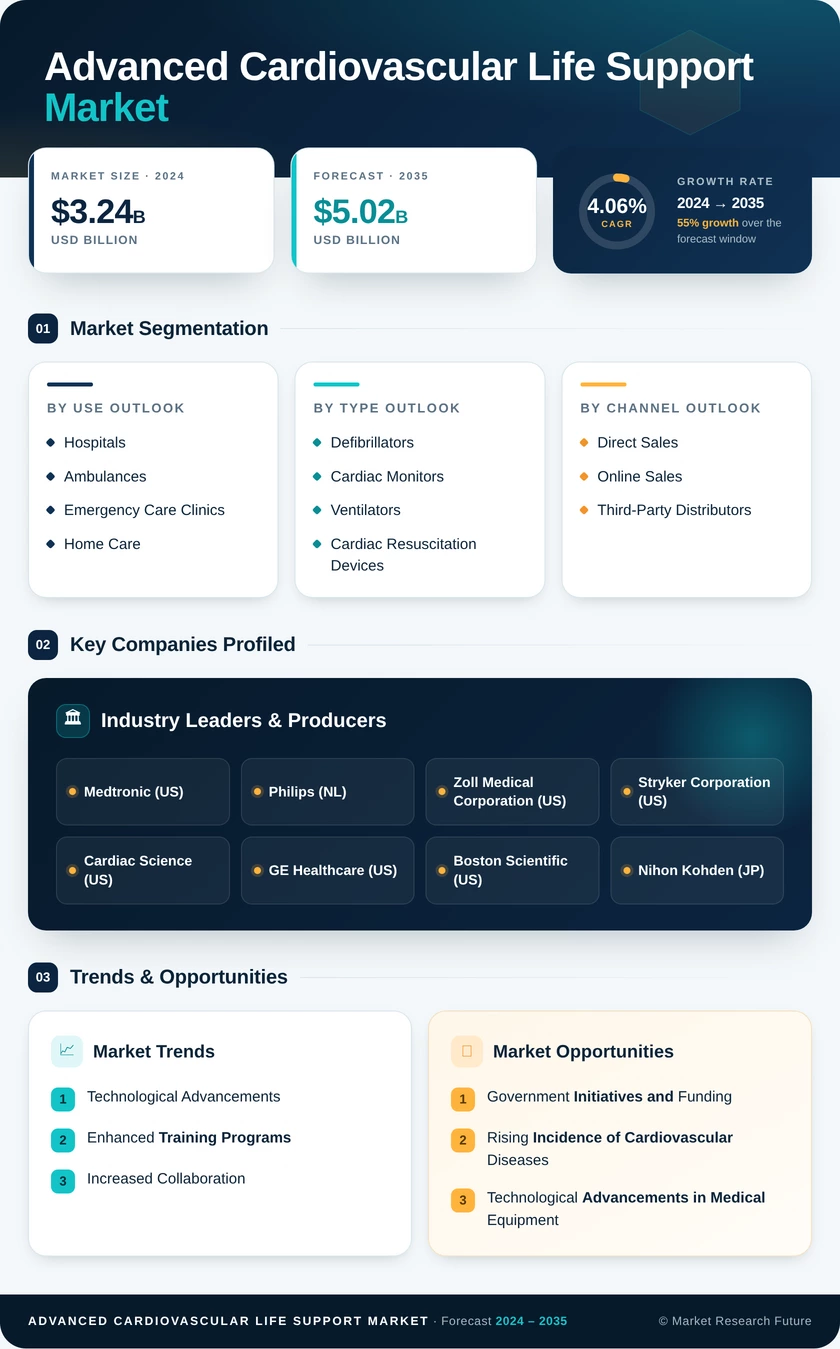
| Dimension | Sub-Segments | Dominant Segment | Fastest Growing Segment |
|---|
| By Technique | Airway Management; Electrotherapy; Non-invasive Airway; Endotracheal Intubation; Cardiopulmonary Resuscitation (CPR); Lethal Arrythmias; Others | Electrotherapy (31.5% share) | Cardiopulmonary Resuscitation (CPR) (9.6% CAGR) |
| By Product Type | Devices; Accessories | Devices (71.5% share) | Accessories (9.0% CAGR) |
| By Algorithm | Cardiac Arrest; Acute Coronary Syndromes; Bradycardia; Tachycardia; Suspected Stroke Algorithms; Others | Cardiac Arrest (38.0% share) | Suspected Stroke Algorithms (10.2% CAGR) |
| By End-user | Hospitals and Clinics; Cardiac Catheterization Labs; Medical Training Centers; Others | Hospitals and Clinics (58.5% share) | Medical Training Centers (9.8% CAGR) |
| By Region | North America; Europe; Asia-Pacific; South America; Middle East and Africa | North America (39.5% share) | Asia-Pacific (10.1% CAGR) |
Market Segmentation Overview
| Sub-Segment | Key Trend |
|---|
| Airway Management | Shift from direct to video laryngoscopy |
| Electrotherapy | Connected monitor/defibrillators with CPR-quality analytics |
| Non-invasive Airway | Wider pre-hospital use of CPAP and high-flow oxygen |
| Endotracheal Intubation | Single-use tubes and stylets for infection control |
| Cardiopulmonary Resuscitation (CPR) | Mechanical compression devices for transport and cath labs |
| Lethal Arrhythmias | Rhythm analysis during compressions |
| Others | Intraosseous access and oxygen therapy kits |
Electrotherapy leads this dimension because defibrillation remains the only definitive treatment for ventricular fibrillation, and monitor/defibrillators carry the highest unit prices. Cardiopulmonary Resuscitation (CPR) grows fastest as EMS agencies buy mechanical compression systems that maintain perfusion during transport, where manual compressions degrade. Airway Management sits between the two, with video laryngoscopes replacing direct blades.
| Sub-Segment | Key Trend |
|---|
| Devices | Replacement of decade-old platforms with connected models |
| Accessories | Proprietary pads and batteries tied to device approval |
Devices lead on value because each advanced monitor/defibrillator represents a large capital outlay with an eight-to-ten-year life. Accessories grow faster since electrode pads, batteries and capnography lines must be replaced on fixed schedules, and premarket approval rules keep most of that spend with the original manufacturer.
| Sub-Segment | Key Trend |
|---|
| Cardiac Arrest | High-quality CPR and early defibrillation emphasis in 2025 guidelines |
| Acute Coronary Syndromes | 12-lead ECG transmission for STEMI activation |
| Bradycardia | Transcutaneous pacing as a standard monitor feature |
| Tachycardia | Synchronized cardioversion in emergency departments |
| Suspected Stroke Algorithms | Ambulance-based stroke scales and telestroke links |
| Others | Post-arrest and trauma protocols |
Cardiac Arrest dominates because it requires the full ACLS equipment set, from defibrillators to advanced airways. Suspected Stroke Algorithms grow fastest as stroke networks push triage into ambulances, rewarding monitors that capture structured assessments. Acute Coronary Syndromes remain a high-value category through 12-lead transmission requirements.
| Sub-Segment | Key Trend |
|---|
| Hospitals and Clinics | Crash-cart standardization and quality reporting |
| Cardiac Catheterization Labs | Dedicated defibrillation and mechanical CPR during procedures |
| Medical Training Centers | Blended learning and feedback-enabled manikins |
| Others | EMS fleet upgrades and public-access deployments |
Hospitals and Clinics lead because every acute care unit must maintain ACLS-ready equipment and in-hospital arrests occur in large numbers. Medical Training Centers grow fastest as the 2025 guideline cycle forces course and instructor updates. Cardiac Catheterization Labs form a smaller but high-specification niche that favours mechanical CPR and advanced pacing.


 Noah Malgeri
Co-Founder

 Peter Groot koerkamp
Account and Business Manager

 Younghwan Choi
Senior Retail Manager

 Mark Irwin
Management Consultant

 Akif Moroglu
Strategy & Business Development Director

 Guilherme Gomes Martins
Product Management Director

 Joseph Aguayo
Sales Operations & Pricing Manager

 La Terria Dodd
Program Support Specialist

 Rob Kooiker
Group Product Manager HVAC & Fire Protection GMA