Request Free Sample ×

Kindly complete the form below to receive a free sample of this Report

* Please use a valid business email

Leading companies partner with us for data-driven Insights

clients tt-cursor
Hero Background
English
Chinese
French
Japanese
Korean
German
Spanish

Adrenocortical Carcinoma Treatment Market Analysis

ID: MRFR/Pharma/5105-HCR
100 Pages
Rahul Gotadki
March 2026

Adrenocortical Carcinoma Treatment Market Research Report Information By Type (Localized Adrenocortical Carcinoma, Metastatic Adrenocortical Carcinoma), Therapy (Radiation Therapy and Others), End-User (Hospitals and Clinics and Others) -Forecast till 2035

Share:
Download PDF ×

We do not share your information with anyone. However, we may send you emails based on your report interest from time to time. You may contact us at any time to opt-out.

Adrenocortical Carcinoma Treatment Market Infographic
Purchase Options

Market Analysis

In-depth Analysis of Adrenocortical Carcinoma Treatment Market Industry Landscape

Adrenocortical Carcinoma (ACC) Treatment Market is molded by different powerful factors that impact its growth and advancement. This rare and powerful cancer presents a novel arrangement of difficulties, driving a unique scene with regards to research, improvement, and market patterns. ACC is a rare cancer, and its pervasiveness assumes a vital part in market elements. The low occurrence rate makes a specialty market, inciting drug organizations to focus in on specific treatments. This extraordinariness likewise adds to a restricted patient pool, impacting evaluating methodologies and market rivalry. Progressing innovative work endeavors contribute altogether to the elements of the ACC Treatment Market. Novel treatments, designated medications, and immunotherapies are ceaselessly arising, carrying advancement to the market. Clinical preliminaries and cooperative endeavors among the scholarly community and industry players add to the development of treatment choices. ACC treatment envelops a scope of modalities, including surgery, chemotherapy, radiation therapy, and arising immunotherapies. The relative adequacy, security profiles, and patient results related with these modalities add to the market elements. Pushes in customized medication and designated treatments further expand the treatment scene. Market elements are not restricted to laid out markets but rather are additionally impacted by developing markets and globalization patterns. The accessibility of ACC treatments in creating districts, administrative harmonization endeavors, and worldwide organizations add to a more interconnected and dynamic market scene. Expecting the future direction of the ACC Treatment Market includes thinking about continuous exploration, mechanical progressions, and developing patient requirements. Apart from the difficulties, for example, drug advancement costs, market access hindrances, and the requirement for further developed biomarkers present continuous contemplations for partners in this powerful scene.

Author
Author Profile
Rahul Gotadki
Research Manager

He holds an experience of about 9+ years in Market Research and Business Consulting, working under the spectrum of Life Sciences and Healthcare domains. Rahul conceptualizes and implements a scalable business strategy and provides strategic leadership to the clients. His expertise lies in market estimation, competitive intelligence, pipeline analysis, customer assessment, etc.

Leave a Comment

FAQs

What is the projected market valuation for the Adrenocortical Carcinoma Treatment Market by 2035?

<p>The projected market valuation for the Adrenocortical Carcinoma Treatment Market is expected to reach 9.13 USD Billion by 2035.</p>

What was the market valuation for the Adrenocortical Carcinoma Treatment Market in 2024?

<p>The market valuation for the Adrenocortical Carcinoma Treatment Market was 3.94 USD Billion in 2024.</p>

What is the expected CAGR for the Adrenocortical Carcinoma Treatment Market during the forecast period 2025 - 2035?

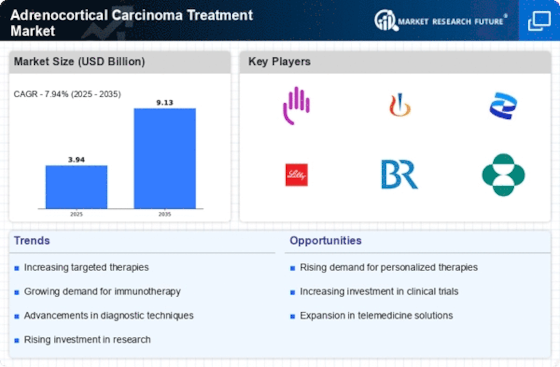
<p>The expected CAGR for the Adrenocortical Carcinoma Treatment Market during the forecast period 2025 - 2035 is 7.94%.</p>

Which companies are considered key players in the Adrenocortical Carcinoma Treatment Market?

<p>Key players in the Adrenocortical Carcinoma Treatment Market include Bristol-Myers Squibb, Novartis, Pfizer, Eli Lilly and Company, Bayer, Merck & Co., AstraZeneca, Sanofi, and Roche.</p>

What are the projected revenues for localized and metastatic adrenocortical carcinoma by 2035?

<p>By 2035, the projected revenues for localized adrenocortical carcinoma are expected to reach 3.63 USD Billion, while metastatic adrenocortical carcinoma may reach 5.5 USD Billion.</p>

How does the revenue from surgery compare to chemotherapy in the Adrenocortical Carcinoma Treatment Market?

In 2024, revenue from surgery was 0.79 USD Billion, while chemotherapy generated 0.66 USD Billion, indicating a slight lead for surgical interventions.

What is the expected revenue for targeted therapy in the Adrenocortical Carcinoma Treatment Market by 2035?

The expected revenue for targeted therapy in the Adrenocortical Carcinoma Treatment Market is projected to reach 1.38 USD Billion by 2035.

Which end-user segment is anticipated to generate the highest revenue by 2035?

By 2035, the cancer research institutes segment is anticipated to generate the highest revenue, projected at 3.67 USD Billion.

What is the revenue projection for radiation therapy in the Adrenocortical Carcinoma Treatment Market by 2035?

The revenue projection for radiation therapy in the Adrenocortical Carcinoma Treatment Market is expected to reach 1.14 USD Billion by 2035.

How does the revenue from ambulatory surgical centers compare to hospitals and clinics in 2024?

In 2024, ambulatory surgical centers generated 0.79 USD Billion, whereas hospitals and clinics generated 1.57 USD Billion, indicating a substantial difference in revenue.

Market Summary

As per Market Research Future analysis, the Adrenocortical Carcinoma Treatment Market Size was estimated at 3.94 USD Billion in 2024. The Adrenocortical Carcinoma Treatment industry is projected to grow from 4.253 USD Billion in 2025 to 9.13 USD Billion by 2035, exhibiting a compound annual growth rate (CAGR) of 7.94% during the forecast period 2025 - 2035

Key Market Trends & Highlights

The Adrenocortical Carcinoma Treatment Market is experiencing a transformative shift towards innovative therapies and personalized approaches.

  • The emergence of targeted therapies is reshaping treatment paradigms in the Adrenocortical Carcinoma market. North America remains the largest market, driven by advanced healthcare infrastructure and high treatment costs. The Asia-Pacific region is identified as the fastest-growing market, fueled by increasing healthcare investments and rising disease awareness. The increasing incidence of Adrenocortical Carcinoma and advancements in diagnostic technologies are key drivers propelling market growth.

Market Size & Forecast

2024 Market Size 3.94 (USD Billion)
2035 Market Size 9.13 (USD Billion)
CAGR (2025 - 2035) 7.94%
Largest Regional Market Share in 2024 Americas

Major Players

Bristol-Myers Squibb (US), Novartis (CH), Pfizer (US), Eli Lilly and Company (US), Bayer (DE), Merck &amp; Co. (US), AstraZeneca (GB), Sanofi (FR), <a href="https://lifescience.roche.com/global/en/products/product-category.html">Roche</a> (CH)

Market Trends

The Adrenocortical Carcinoma Treatment Market is currently experiencing a notable evolution, driven by advancements in therapeutic approaches and a growing understanding of the disease's biology. Innovative treatment modalities, including targeted therapies and immunotherapies, are emerging as potential game-changers in the management of this rare malignancy. The increasing prevalence of adrenocortical carcinoma, coupled with heightened awareness among healthcare professionals, is likely to propel the demand for effective treatment options. Furthermore, ongoing clinical trials and research initiatives are expected to yield promising results, potentially leading to new therapeutic agents entering the market. In addition to novel therapies, the Adrenocortical Carcinoma Treatment Market is witnessing a shift towards personalized medicine. Tailoring treatment regimens based on individual patient profiles may enhance therapeutic efficacy and minimize adverse effects. This trend aligns with broader movements in oncology, where precision medicine is becoming increasingly integral to patient care. As stakeholders, including pharmaceutical companies and research institutions, continue to invest in this area, the market is poised for growth, reflecting a commitment to improving outcomes for patients diagnosed with this challenging condition.

Emergence of Targeted Therapies

The introduction of targeted therapies represents a transformative shift in the Adrenocortical Carcinoma Treatment Market. These therapies aim to specifically attack cancer cells while sparing healthy tissue, potentially leading to improved patient outcomes and reduced side effects.

Rise of Immunotherapy

Immunotherapy is gaining traction as a promising treatment modality within the Adrenocortical Carcinoma Treatment Market. By harnessing the body's immune system to combat cancer, this approach may offer new hope for patients, particularly those with advanced disease.

Focus on Personalized Medicine

The trend towards personalized medicine is becoming increasingly prominent in the Adrenocortical Carcinoma Treatment Market. Tailoring treatment strategies to individual patient characteristics may enhance therapeutic effectiveness and improve overall patient care.

Adrenocortical Carcinoma Treatment Market Market Drivers

Emergence of Combination Therapies

The emergence of combination therapies represents a transformative trend within the Adrenocortical Carcinoma Treatment Market. Recent studies suggest that combining different therapeutic modalities, such as surgery, chemotherapy, and targeted therapies, may yield improved outcomes for patients with ACC. This approach aims to address the limitations of single-agent therapies, potentially leading to enhanced efficacy and reduced resistance. As clinical evidence supporting the benefits of combination therapies accumulates, healthcare providers are increasingly adopting these strategies in clinical practice. The market is likely to respond positively to this trend, as patients seek more effective treatment regimens. Furthermore, pharmaceutical companies are expected to invest in research focused on developing synergistic combinations, which could further drive innovation within the Adrenocortical Carcinoma Treatment Market.

Advancements in Diagnostic Technologies

Advancements in diagnostic technologies are significantly influencing the Adrenocortical Carcinoma Treatment Market. Enhanced imaging techniques, such as MRI and PET scans, have improved the accuracy of ACC diagnosis, allowing for earlier detection and intervention. The integration of molecular diagnostics has also emerged as a critical factor, enabling the identification of specific genetic mutations associated with ACC. This progress not only aids in the timely initiation of treatment but also facilitates the development of targeted therapies tailored to individual patient profiles. As diagnostic capabilities continue to evolve, the market is likely to witness an increase in the number of patients receiving appropriate treatment, thereby driving overall market growth. Moreover, the collaboration between diagnostic companies and pharmaceutical firms may lead to innovative solutions that further enhance patient outcomes in the Adrenocortical Carcinoma Treatment Market.

Growing Investment in Oncology Research

The growing investment in oncology research is a significant driver for the Adrenocortical Carcinoma Treatment Market. With an increasing focus on cancer research, funding from both public and private sectors has surged, leading to the development of novel therapeutic agents and treatment modalities. In recent years, the oncology sector has attracted substantial venture capital, with billions of dollars allocated to research initiatives aimed at understanding and treating various cancers, including ACC. This influx of capital is likely to accelerate the pace of clinical trials and the introduction of innovative therapies into the market. As a result, patients may benefit from a broader array of treatment options, which could enhance survival rates and quality of life. The commitment to advancing oncology research underscores the potential for significant breakthroughs in the Adrenocortical Carcinoma Treatment Market.

Rising Awareness and Education Initiatives

Rising awareness and education initiatives regarding adrenocortical carcinoma are crucial drivers for the Adrenocortical Carcinoma Treatment Market. Increased public and professional awareness about ACC symptoms, risk factors, and treatment options is likely to lead to earlier diagnosis and treatment. Various organizations and healthcare providers are actively engaged in educational campaigns aimed at informing both patients and clinicians about this rare cancer. As awareness grows, more individuals may seek medical attention for symptoms that could indicate ACC, resulting in a higher number of diagnosed cases. This trend may subsequently drive demand for innovative treatment solutions. Additionally, educational initiatives may foster collaboration among healthcare professionals, leading to improved treatment protocols and patient management strategies within the Adrenocortical Carcinoma Treatment Market.

Increasing Incidence of Adrenocortical Carcinoma

The rising incidence of adrenocortical carcinoma (ACC) is a pivotal driver for the Adrenocortical Carcinoma Treatment Market. Recent data indicates that the annual incidence rate of ACC is approximately 0.5 to 2 cases per million people, with a notable increase in diagnosed cases over the past decade. This trend is likely attributed to improved diagnostic techniques and heightened awareness among healthcare professionals. As more patients are diagnosed, the demand for effective treatment options escalates, thereby propelling market growth. Furthermore, the increasing prevalence of risk factors such as obesity and genetic predispositions may contribute to the rising incidence of ACC. Consequently, pharmaceutical companies are motivated to invest in research and development of novel therapies, which could further enhance the treatment landscape for this rare but aggressive cancer.


Market Segment Insights

By Type: Localized Adrenocortical Carcinoma (Largest) vs. Metastatic Adrenocortical Carcinoma (Fastest-Growing)

In the Adrenocortical Carcinoma Treatment Market, localized adrenocortical carcinoma holds the largest share, reflecting its prevalence and the effectiveness of available treatments. This segment is primarily driven by surgical interventions, which are the first line of treatment for localized cases, thereby establishing a strong market position. In contrast, the metastatic adrenocortical carcinoma segment is emerging rapidly, fueled by advancements in targeted therapies and immunotherapy that provide new options for patients with advanced disease.

Adrenocortical Carcinoma: Localized (Dominant) vs. Metastatic (Emerging)

Localized adrenocortical carcinoma represents a dominant segment in the treatment market due to its higher incidence rates and the successful outcomes associated with early-stage interventions. Surgical resection is often curative, which encourages its high share of treatment approaches. On the other hand, metastatic adrenocortical carcinoma is recognized as an emerging segment, characterized by a more complex treatment landscape requiring multimodal approaches including chemotherapy and novel therapeutics. The rise in research efforts and clinical trials aimed at addressing metastatic cases highlights its importance, making it a focus for pharmaceutical innovation as the demand for targeted treatments expands.

By Therapy: Surgery (Largest) vs. Targeted Therapy (Fastest-Growing)

In the Adrenocortical Carcinoma Treatment Market, the therapy segment is primarily led by Surgery, which holds the largest market share due to its potential for providing a definitive cure. This is followed by Chemotherapy and <a href="https://www.marketresearchfuture.com/reports/radiation-oncology-market-12350">Radiation</a> Therapy, which play crucial roles in managing the disease when surgery is not viable. Targeted Therapy is emerging strongly, capturing an increasing share as advancements in personalized medicine allow for more effective treatment strategies tailored to individual patients' needs. The growth of this segment is being driven by advancements in technology and increasing research and development in targeted treatments. The growing awareness among patients and healthcare providers regarding the efficacy of various therapy options is also contributing to the expansion of the market. As targeted therapies continue to demonstrate promising clinical outcomes, they are rapidly gaining traction, challenging traditional treatment modalities. Moreover, the development of new drugs and treatment protocols is expected to drive further growth in this segment, highlighting the dynamic nature of therapy options available for adrenocortical carcinoma.

Surgery (Dominant) vs. Targeted Therapy (Emerging)

Surgery remains the dominant therapeutic approach in the Adrenocortical Carcinoma Treatment Market, primarily due to its effectiveness in potentially curing the disease by removing tumors. It is often the first line of treatment for localized adrenocortical carcinoma, appealing to oncologists for its straightforward procedural nature and potentially life-saving outcomes. In contrast, Targeted Therapy is emerging as a vital treatment paradigm that utilizes drugs designed to specifically target cancer cells while sparing normal cells. This approach is heralded for its reduced side effects and personalized treatment plans, leveraging the molecular understanding of tumors to improve patient outcomes. As ongoing clinical trials continue to validate targeted therapies, their role in the treatment landscape is poised to expand, making them an essential consideration for future treatment regimens.

By End-User: Hospitals and Clinics (Largest) vs. Cancer Research Institutes (Fastest-Growing)

In the Adrenocortical Carcinoma Treatment Market, Hospitals and Clinics emerge as the largest segment, capturing a significant portion of patient treatment and care. These healthcare settings are equipped with advanced technology and specialized staff, enabling them to offer a wide range of treatment options. On the other hand, Cancer Research Institutes are gaining traction, reflecting their critical role in innovative treatment solutions and clinical trials, appealing to patients seeking cutting-edge therapies.

Hospitals and Clinics (Dominant) vs. Cancer Research Institutes (Emerging)

Hospitals and Clinics are the dominant players in the Adrenocortical Carcinoma Treatment Market, largely due to their immediate accessibility and comprehensive treatment services. They utilize well-established protocols and possess experience with a high volume of patients, which enhances treatment outcomes. In contrast, Cancer Research Institutes are emerging as key contributors to the market, focusing on developing novel therapies and conducting clinical trials. This segment is characterized by its emphasis on research, collaboration with pharmaceutical companies, and a strong pipeline of innovative treatments that cater to patients looking for advanced options in care.

Get more detailed insights about Adrenocortical Carcinoma Treatment Market Research Report – Forecast to 2035

Regional Insights

North America : Leading Market for Treatments

North America is the largest market for Adrenocortical Carcinoma treatment, holding approximately 45% of the global market share. The region benefits from advanced healthcare infrastructure, high R&D investments, and a growing prevalence of adrenal tumors. Regulatory support from agencies like the FDA accelerates the approval of innovative therapies, driving market growth. The increasing awareness and early diagnosis of adrenal cancers further contribute to demand trends. The United States is the primary contributor, with significant involvement from key players such as Bristol-Myers Squibb, Pfizer, and Merck & Co. Canada also plays a vital role, focusing on improving treatment accessibility. The competitive landscape is characterized by collaborations and partnerships among pharmaceutical companies, enhancing the availability of effective treatment options. The presence of leading firms ensures a robust pipeline of therapies, catering to the needs of patients.

Europe : Emerging Market Dynamics

Europe is witnessing a significant rise in the Adrenocortical Carcinoma treatment market, accounting for approximately 30% of the global share. The region's growth is driven by increasing healthcare expenditure, advancements in medical technology, and supportive regulatory frameworks. Countries like Germany and France are leading the market, with initiatives aimed at improving patient access to innovative therapies and clinical trials, thereby enhancing treatment outcomes. Germany stands out as a key player, with a strong presence of pharmaceutical companies such as Bayer and Roche. The competitive landscape is marked by strategic collaborations and research initiatives aimed at developing novel treatment options. The European Medicines Agency (EMA) plays a crucial role in regulating and approving new therapies, ensuring that patients have access to the latest advancements in treatment. This regulatory support fosters innovation and drives market growth.

Asia-Pacific : Rapidly Growing Market

Asia-Pacific is rapidly emerging as a significant market for Adrenocortical Carcinoma treatment, holding around 20% of the global market share. The region's growth is fueled by increasing healthcare investments, rising awareness of adrenal cancers, and a growing patient population. Countries like China and Japan are at the forefront, with expanding healthcare infrastructure and government initiatives aimed at improving cancer care and treatment accessibility. China is particularly noteworthy, with a rising number of clinical trials and collaborations with global pharmaceutical companies. The competitive landscape is evolving, with local firms partnering with international players to enhance treatment options. The presence of key players such as Novartis and Eli Lilly further strengthens the market, as they focus on developing innovative therapies tailored to the needs of the region's diverse population. The increasing focus on personalized medicine is expected to drive future growth in this market.

Middle East and Africa : Untapped Market Potential

The Middle East and Africa region represents an untapped market for Adrenocortical Carcinoma treatment, accounting for approximately 5% of the global share. The growth potential is significant, driven by increasing healthcare investments and a rising prevalence of cancer. However, challenges such as limited access to advanced treatments and healthcare disparities hinder market development. Countries like South Africa and the UAE are making strides in improving cancer care, supported by government initiatives and international collaborations. South Africa is emerging as a key player, with efforts to enhance treatment accessibility and awareness. The competitive landscape is characterized by a mix of local and international firms, with a focus on addressing the unique healthcare needs of the region. The presence of organizations like the World Health Organization is crucial in promoting cancer awareness and improving treatment standards, paving the way for future growth in the market.

Key Players and Competitive Insights

The Adrenocortical Carcinoma Treatment Market is characterized by a dynamic competitive landscape, driven by a confluence of innovation, strategic partnerships, and a growing emphasis on personalized medicine. Key players such as Bristol-Myers Squibb (US), Novartis (CH), and Merck & Co. (US) are actively shaping the market through their distinct operational focuses. Bristol-Myers Squibb (US) has been particularly aggressive in its research and development efforts, aiming to enhance treatment efficacy through novel therapeutic approaches. Meanwhile, Novartis (CH) is leveraging its extensive portfolio to expand its reach in emerging markets, indicating a strategic focus on regional growth. Merck & Co. (US), on the other hand, appears to be concentrating on digital transformation initiatives to streamline operations and improve patient engagement, collectively influencing the competitive environment towards a more integrated and patient-centric approach.

The market structure is moderately fragmented, with several players vying for market share. Key business tactics such as localizing manufacturing and optimizing supply chains are becoming increasingly prevalent. This fragmentation allows for a diverse range of treatment options, yet the collective influence of major players like AstraZeneca (GB) and Eli Lilly and Company (US) is significant, as they continue to innovate and expand their therapeutic offerings. The competitive dynamics suggest that while individual companies may pursue localized strategies, the overarching trend is towards collaboration and shared knowledge in addressing the complexities of adrenocortical carcinoma treatment.

In August 2025, AstraZeneca (GB) announced a strategic partnership with a leading biotechnology firm to co-develop a novel immunotherapy for adrenocortical carcinoma. This collaboration is poised to enhance AstraZeneca's capabilities in delivering cutting-edge treatments, potentially positioning the company as a leader in this niche market. The partnership underscores the importance of innovation and shared expertise in developing effective therapies, which could significantly impact patient outcomes.

In September 2025, Merck & Co. (US) launched a new digital platform aimed at improving patient access to clinical trials for adrenocortical carcinoma treatments. This initiative reflects a growing trend towards digitalization in healthcare, as it seeks to bridge the gap between patients and innovative therapies. By enhancing patient engagement and streamlining the trial process, Merck & Co. (US) is likely to strengthen its market position and foster a more inclusive approach to treatment development.

In October 2025, Novartis (CH) unveiled a new initiative focused on sustainability in its manufacturing processes for adrenocortical carcinoma treatments. This move not only aligns with global sustainability goals but also positions Novartis as a forward-thinking player in the market. The emphasis on environmentally friendly practices may resonate well with stakeholders and patients alike, potentially enhancing brand loyalty and market share.

As of October 2025, the competitive trends in the Adrenocortical Carcinoma Treatment Market are increasingly defined by digitalization, sustainability, and the integration of artificial intelligence in treatment development. Strategic alliances are becoming a cornerstone of competitive differentiation, as companies recognize the value of collaboration in navigating complex market dynamics. Looking ahead, the shift from price-based competition to a focus on innovation, technology, and supply chain reliability is likely to redefine the landscape, compelling companies to invest in research and development while fostering partnerships that enhance their therapeutic offerings.

Key Companies in the Adrenocortical Carcinoma Treatment Market include

Industry Developments

Future Outlook

Adrenocortical Carcinoma Treatment Market Future Outlook

The Adrenocortical Carcinoma Treatment Market is projected to grow at a 7.94% CAGR from 2025 to 2035, driven by advancements in targeted therapies and increasing awareness.

New opportunities lie in:

  • Development of personalized medicine approaches for treatment optimization.
  • Expansion of telehealth services for remote patient monitoring and consultations.
  • Investment in clinical trials for novel therapeutic agents and combination therapies.

By 2035, the market is expected to achieve substantial growth, reflecting evolving treatment paradigms.

Market Segmentation

Adrenocortical Carcinoma Treatment Market Type Outlook

  • Localized Adrenocortical Carcinoma
  • Metastatic Adrenocortical Carcinoma

Adrenocortical Carcinoma Treatment Market Therapy Outlook

  • Surgery
  • Chemotherapy
  • Targeted Therapy
  • Radiation Therapy
  • Adjuvant Therapy
  • Others

Adrenocortical Carcinoma Treatment Market End-User Outlook

  • Hospitals and Clinics
  • Ambulatory Surgical Centers
  • Cancer Research Institutes

Report Scope

MARKET SIZE 2024 3.94(USD Billion)
MARKET SIZE 2025 4.253(USD Billion)
MARKET SIZE 2035 9.13(USD Billion)
COMPOUND ANNUAL GROWTH RATE (CAGR) 7.94% (2025 - 2035)
REPORT COVERAGE Revenue Forecast, Competitive Landscape, Growth Factors, and Trends
BASE YEAR 2024
Market Forecast Period 2025 - 2035
Historical Data 2019 - 2024
Market Forecast Units USD Billion
Key Companies Profiled Bristol-Myers Squibb (US), Novartis (CH), Pfizer (US), Eli Lilly and Company (US), Bayer (DE), Merck & Co. (US), AstraZeneca (GB), Sanofi (FR), Roche (CH)
Segments Covered Type
Key Market Opportunities Advancements in targeted therapies and immunotherapies enhance treatment options in the Adrenocortical Carcinoma Treatment Market.
Key Market Dynamics Rising demand for targeted therapies drives innovation and competition in the Adrenocortical Carcinoma Treatment Market.
Countries Covered North America, Europe, APAC, South America, MEA

FAQs

What is the projected market valuation for the Adrenocortical Carcinoma Treatment Market by 2035?

<p>The projected market valuation for the Adrenocortical Carcinoma Treatment Market is expected to reach 9.13 USD Billion by 2035.</p>

What was the market valuation for the Adrenocortical Carcinoma Treatment Market in 2024?

<p>The market valuation for the Adrenocortical Carcinoma Treatment Market was 3.94 USD Billion in 2024.</p>

What is the expected CAGR for the Adrenocortical Carcinoma Treatment Market during the forecast period 2025 - 2035?

<p>The expected CAGR for the Adrenocortical Carcinoma Treatment Market during the forecast period 2025 - 2035 is 7.94%.</p>

Which companies are considered key players in the Adrenocortical Carcinoma Treatment Market?

<p>Key players in the Adrenocortical Carcinoma Treatment Market include Bristol-Myers Squibb, Novartis, Pfizer, Eli Lilly and Company, Bayer, Merck & Co., AstraZeneca, Sanofi, and Roche.</p>

What are the projected revenues for localized and metastatic adrenocortical carcinoma by 2035?

<p>By 2035, the projected revenues for localized adrenocortical carcinoma are expected to reach 3.63 USD Billion, while metastatic adrenocortical carcinoma may reach 5.5 USD Billion.</p>

How does the revenue from surgery compare to chemotherapy in the Adrenocortical Carcinoma Treatment Market?

In 2024, revenue from surgery was 0.79 USD Billion, while chemotherapy generated 0.66 USD Billion, indicating a slight lead for surgical interventions.

What is the expected revenue for targeted therapy in the Adrenocortical Carcinoma Treatment Market by 2035?

The expected revenue for targeted therapy in the Adrenocortical Carcinoma Treatment Market is projected to reach 1.38 USD Billion by 2035.

Which end-user segment is anticipated to generate the highest revenue by 2035?

By 2035, the cancer research institutes segment is anticipated to generate the highest revenue, projected at 3.67 USD Billion.

What is the revenue projection for radiation therapy in the Adrenocortical Carcinoma Treatment Market by 2035?

The revenue projection for radiation therapy in the Adrenocortical Carcinoma Treatment Market is expected to reach 1.14 USD Billion by 2035.

How does the revenue from ambulatory surgical centers compare to hospitals and clinics in 2024?

In 2024, ambulatory surgical centers generated 0.79 USD Billion, whereas hospitals and clinics generated 1.57 USD Billion, indicating a substantial difference in revenue.

  1. SECTION I: EXECUTIVE SUMMARY AND KEY HIGHLIGHTS
    1. | 1.1 EXECUTIVE SUMMARY
    2. | | 1.1.1 Market Overview
    3. | | 1.1.2 Key Findings
    4. | | 1.1.3 Market Segmentation
    5. | | 1.1.4 Competitive Landscape
    6. | | 1.1.5 Challenges and Opportunities
    7. | | 1.1.6 Future Outlook
  2. SECTION II: SCOPING, METHODOLOGY AND MARKET STRUCTURE
    1. | 2.1 MARKET INTRODUCTION
    2. | | 2.1.1 Definition
    3. | | 2.1.2 Scope of the study
    4. | | | 2.1.2.1 Research Objective
    5. | | | 2.1.2.2 Assumption
    6. | | | 2.1.2.3 Limitations
    7. | 2.2 RESEARCH METHODOLOGY
    8. | | 2.2.1 Overview
    9. | | 2.2.2 Data Mining
    10. | | 2.2.3 Secondary Research
    11. | | 2.2.4 Primary Research
    12. | | | 2.2.4.1 Primary Interviews and Information Gathering Process
    13. | | | 2.2.4.2 Breakdown of Primary Respondents
    14. | | 2.2.5 Forecasting Model
    15. | | 2.2.6 Market Size Estimation
    16. | | | 2.2.6.1 Bottom-Up Approach
    17. | | | 2.2.6.2 Top-Down Approach
    18. | | 2.2.7 Data Triangulation
    19. | | 2.2.8 Validation
  3. SECTION III: QUALITATIVE ANALYSIS
    1. | 3.1 MARKET DYNAMICS
    2. | | 3.1.1 Overview
    3. | | 3.1.2 Drivers
    4. | | 3.1.3 Restraints
    5. | | 3.1.4 Opportunities
    6. | 3.2 MARKET FACTOR ANALYSIS
    7. | | 3.2.1 Value chain Analysis
    8. | | 3.2.2 Porter's Five Forces Analysis
    9. | | | 3.2.2.1 Bargaining Power of Suppliers
    10. | | | 3.2.2.2 Bargaining Power of Buyers
    11. | | | 3.2.2.3 Threat of New Entrants
    12. | | | 3.2.2.4 Threat of Substitutes
    13. | | | 3.2.2.5 Intensity of Rivalry
    14. | | 3.2.3 COVID-19 Impact Analysis
    15. | | | 3.2.3.1 Market Impact Analysis
    16. | | | 3.2.3.2 Regional Impact
    17. | | | 3.2.3.3 Opportunity and Threat Analysis
  4. SECTION IV: QUANTITATIVE ANALYSIS
    1. | 4.1 Healthcare, BY Type (USD Billion)
    2. | | 4.1.1 Localized Adrenocortical Carcinoma
    3. | | 4.1.2 Metastatic Adrenocortical Carcinoma
    4. | 4.2 Healthcare, BY Therapy (USD Billion)
    5. | | 4.2.1 Surgery
    6. | | 4.2.2 Chemotherapy
    7. | | 4.2.3 Targeted Therapy
    8. | | 4.2.4 Radiation Therapy
    9. | | 4.2.5 Adjuvant Therapy
    10. | | 4.2.6 Others
    11. | 4.3 Healthcare, BY End-User (USD Billion)
    12. | | 4.3.1 Hospitals and Clinics
    13. | | 4.3.2 Ambulatory Surgical Centers
    14. | | 4.3.3 Cancer Research Institutes
    15. | 4.4 Healthcare, BY Region (USD Billion)
    16. | | 4.4.1 North America
    17. | | | 4.4.1.1 US
    18. | | | 4.4.1.2 Canada
    19. | | 4.4.2 Europe
    20. | | | 4.4.2.1 Germany
    21. | | | 4.4.2.2 UK
    22. | | | 4.4.2.3 France
    23. | | | 4.4.2.4 Russia
    24. | | | 4.4.2.5 Italy
    25. | | | 4.4.2.6 Spain
    26. | | | 4.4.2.7 Rest of Europe
    27. | | 4.4.3 APAC
    28. | | | 4.4.3.1 China
    29. | | | 4.4.3.2 India
    30. | | | 4.4.3.3 Japan
    31. | | | 4.4.3.4 South Korea
    32. | | | 4.4.3.5 Malaysia
    33. | | | 4.4.3.6 Thailand
    34. | | | 4.4.3.7 Indonesia
    35. | | | 4.4.3.8 Rest of APAC
    36. | | 4.4.4 South America
    37. | | | 4.4.4.1 Brazil
    38. | | | 4.4.4.2 Mexico
    39. | | | 4.4.4.3 Argentina
    40. | | | 4.4.4.4 Rest of South America
    41. | | 4.4.5 MEA
    42. | | | 4.4.5.1 GCC Countries
    43. | | | 4.4.5.2 South Africa
    44. | | | 4.4.5.3 Rest of MEA
  5. SECTION V: COMPETITIVE ANALYSIS
    1. | 5.1 Competitive Landscape
    2. | | 5.1.1 Overview
    3. | | 5.1.2 Competitive Analysis
    4. | | 5.1.3 Market share Analysis
    5. | | 5.1.4 Major Growth Strategy in the Healthcare
    6. | | 5.1.5 Competitive Benchmarking
    7. | | 5.1.6 Leading Players in Terms of Number of Developments in the Healthcare
    8. | | 5.1.7 Key developments and growth strategies
    9. | | | 5.1.7.1 New Product Launch/Service Deployment
    10. | | | 5.1.7.2 Merger & Acquisitions
    11. | | | 5.1.7.3 Joint Ventures
    12. | | 5.1.8 Major Players Financial Matrix
    13. | | | 5.1.8.1 Sales and Operating Income
    14. | | | 5.1.8.2 Major Players R&D Expenditure. 2023
    15. | 5.2 Company Profiles
    16. | | 5.2.1 Bristol-Myers Squibb (US)
    17. | | | 5.2.1.1 Financial Overview
    18. | | | 5.2.1.2 Products Offered
    19. | | | 5.2.1.3 Key Developments
    20. | | | 5.2.1.4 SWOT Analysis
    21. | | | 5.2.1.5 Key Strategies
    22. | | 5.2.2 Novartis (CH)
    23. | | | 5.2.2.1 Financial Overview
    24. | | | 5.2.2.2 Products Offered
    25. | | | 5.2.2.3 Key Developments
    26. | | | 5.2.2.4 SWOT Analysis
    27. | | | 5.2.2.5 Key Strategies
    28. | | 5.2.3 Pfizer (US)
    29. | | | 5.2.3.1 Financial Overview
    30. | | | 5.2.3.2 Products Offered
    31. | | | 5.2.3.3 Key Developments
    32. | | | 5.2.3.4 SWOT Analysis
    33. | | | 5.2.3.5 Key Strategies
    34. | | 5.2.4 Eli Lilly and Company (US)
    35. | | | 5.2.4.1 Financial Overview
    36. | | | 5.2.4.2 Products Offered
    37. | | | 5.2.4.3 Key Developments
    38. | | | 5.2.4.4 SWOT Analysis
    39. | | | 5.2.4.5 Key Strategies
    40. | | 5.2.5 Bayer (DE)
    41. | | | 5.2.5.1 Financial Overview
    42. | | | 5.2.5.2 Products Offered
    43. | | | 5.2.5.3 Key Developments
    44. | | | 5.2.5.4 SWOT Analysis
    45. | | | 5.2.5.5 Key Strategies
    46. | | 5.2.6 Merck & Co. (US)
    47. | | | 5.2.6.1 Financial Overview
    48. | | | 5.2.6.2 Products Offered
    49. | | | 5.2.6.3 Key Developments
    50. | | | 5.2.6.4 SWOT Analysis
    51. | | | 5.2.6.5 Key Strategies
    52. | | 5.2.7 AstraZeneca (GB)
    53. | | | 5.2.7.1 Financial Overview
    54. | | | 5.2.7.2 Products Offered
    55. | | | 5.2.7.3 Key Developments
    56. | | | 5.2.7.4 SWOT Analysis
    57. | | | 5.2.7.5 Key Strategies
    58. | | 5.2.8 Sanofi (FR)
    59. | | | 5.2.8.1 Financial Overview
    60. | | | 5.2.8.2 Products Offered
    61. | | | 5.2.8.3 Key Developments
    62. | | | 5.2.8.4 SWOT Analysis
    63. | | | 5.2.8.5 Key Strategies
    64. | | 5.2.9 Roche (CH)
    65. | | | 5.2.9.1 Financial Overview
    66. | | | 5.2.9.2 Products Offered
    67. | | | 5.2.9.3 Key Developments
    68. | | | 5.2.9.4 SWOT Analysis
    69. | | | 5.2.9.5 Key Strategies
    70. | 5.3 Appendix
    71. | | 5.3.1 References
    72. | | 5.3.2 Related Reports
  6. LIST OF FIGURES
    1. | 6.1 MARKET SYNOPSIS
    2. | 6.2 NORTH AMERICA MARKET ANALYSIS
    3. | 6.3 US MARKET ANALYSIS BY TYPE
    4. | 6.4 US MARKET ANALYSIS BY THERAPY
    5. | 6.5 US MARKET ANALYSIS BY END-USER
    6. | 6.6 CANADA MARKET ANALYSIS BY TYPE
    7. | 6.7 CANADA MARKET ANALYSIS BY THERAPY
    8. | 6.8 CANADA MARKET ANALYSIS BY END-USER
    9. | 6.9 EUROPE MARKET ANALYSIS
    10. | 6.10 GERMANY MARKET ANALYSIS BY TYPE
    11. | 6.11 GERMANY MARKET ANALYSIS BY THERAPY
    12. | 6.12 GERMANY MARKET ANALYSIS BY END-USER
    13. | 6.13 UK MARKET ANALYSIS BY TYPE
    14. | 6.14 UK MARKET ANALYSIS BY THERAPY
    15. | 6.15 UK MARKET ANALYSIS BY END-USER
    16. | 6.16 FRANCE MARKET ANALYSIS BY TYPE
    17. | 6.17 FRANCE MARKET ANALYSIS BY THERAPY
    18. | 6.18 FRANCE MARKET ANALYSIS BY END-USER
    19. | 6.19 RUSSIA MARKET ANALYSIS BY TYPE
    20. | 6.20 RUSSIA MARKET ANALYSIS BY THERAPY
    21. | 6.21 RUSSIA MARKET ANALYSIS BY END-USER
    22. | 6.22 ITALY MARKET ANALYSIS BY TYPE
    23. | 6.23 ITALY MARKET ANALYSIS BY THERAPY
    24. | 6.24 ITALY MARKET ANALYSIS BY END-USER
    25. | 6.25 SPAIN MARKET ANALYSIS BY TYPE
    26. | 6.26 SPAIN MARKET ANALYSIS BY THERAPY
    27. | 6.27 SPAIN MARKET ANALYSIS BY END-USER
    28. | 6.28 REST OF EUROPE MARKET ANALYSIS BY TYPE
    29. | 6.29 REST OF EUROPE MARKET ANALYSIS BY THERAPY
    30. | 6.30 REST OF EUROPE MARKET ANALYSIS BY END-USER
    31. | 6.31 APAC MARKET ANALYSIS
    32. | 6.32 CHINA MARKET ANALYSIS BY TYPE
    33. | 6.33 CHINA MARKET ANALYSIS BY THERAPY
    34. | 6.34 CHINA MARKET ANALYSIS BY END-USER
    35. | 6.35 INDIA MARKET ANALYSIS BY TYPE
    36. | 6.36 INDIA MARKET ANALYSIS BY THERAPY
    37. | 6.37 INDIA MARKET ANALYSIS BY END-USER
    38. | 6.38 JAPAN MARKET ANALYSIS BY TYPE
    39. | 6.39 JAPAN MARKET ANALYSIS BY THERAPY
    40. | 6.40 JAPAN MARKET ANALYSIS BY END-USER
    41. | 6.41 SOUTH KOREA MARKET ANALYSIS BY TYPE
    42. | 6.42 SOUTH KOREA MARKET ANALYSIS BY THERAPY
    43. | 6.43 SOUTH KOREA MARKET ANALYSIS BY END-USER
    44. | 6.44 MALAYSIA MARKET ANALYSIS BY TYPE
    45. | 6.45 MALAYSIA MARKET ANALYSIS BY THERAPY
    46. | 6.46 MALAYSIA MARKET ANALYSIS BY END-USER
    47. | 6.47 THAILAND MARKET ANALYSIS BY TYPE
    48. | 6.48 THAILAND MARKET ANALYSIS BY THERAPY
    49. | 6.49 THAILAND MARKET ANALYSIS BY END-USER
    50. | 6.50 INDONESIA MARKET ANALYSIS BY TYPE
    51. | 6.51 INDONESIA MARKET ANALYSIS BY THERAPY
    52. | 6.52 INDONESIA MARKET ANALYSIS BY END-USER
    53. | 6.53 REST OF APAC MARKET ANALYSIS BY TYPE
    54. | 6.54 REST OF APAC MARKET ANALYSIS BY THERAPY
    55. | 6.55 REST OF APAC MARKET ANALYSIS BY END-USER
    56. | 6.56 SOUTH AMERICA MARKET ANALYSIS
    57. | 6.57 BRAZIL MARKET ANALYSIS BY TYPE
    58. | 6.58 BRAZIL MARKET ANALYSIS BY THERAPY
    59. | 6.59 BRAZIL MARKET ANALYSIS BY END-USER
    60. | 6.60 MEXICO MARKET ANALYSIS BY TYPE
    61. | 6.61 MEXICO MARKET ANALYSIS BY THERAPY
    62. | 6.62 MEXICO MARKET ANALYSIS BY END-USER
    63. | 6.63 ARGENTINA MARKET ANALYSIS BY TYPE
    64. | 6.64 ARGENTINA MARKET ANALYSIS BY THERAPY
    65. | 6.65 ARGENTINA MARKET ANALYSIS BY END-USER
    66. | 6.66 REST OF SOUTH AMERICA MARKET ANALYSIS BY TYPE
    67. | 6.67 REST OF SOUTH AMERICA MARKET ANALYSIS BY THERAPY
    68. | 6.68 REST OF SOUTH AMERICA MARKET ANALYSIS BY END-USER
    69. | 6.69 MEA MARKET ANALYSIS
    70. | 6.70 GCC COUNTRIES MARKET ANALYSIS BY TYPE
    71. | 6.71 GCC COUNTRIES MARKET ANALYSIS BY THERAPY
    72. | 6.72 GCC COUNTRIES MARKET ANALYSIS BY END-USER
    73. | 6.73 SOUTH AFRICA MARKET ANALYSIS BY TYPE
    74. | 6.74 SOUTH AFRICA MARKET ANALYSIS BY THERAPY
    75. | 6.75 SOUTH AFRICA MARKET ANALYSIS BY END-USER
    76. | 6.76 REST OF MEA MARKET ANALYSIS BY TYPE
    77. | 6.77 REST OF MEA MARKET ANALYSIS BY THERAPY
    78. | 6.78 REST OF MEA MARKET ANALYSIS BY END-USER
    79. | 6.79 KEY BUYING CRITERIA OF HEALTHCARE
    80. | 6.80 RESEARCH PROCESS OF MRFR
    81. | 6.81 DRO ANALYSIS OF HEALTHCARE
    82. | 6.82 DRIVERS IMPACT ANALYSIS: HEALTHCARE
    83. | 6.83 RESTRAINTS IMPACT ANALYSIS: HEALTHCARE
    84. | 6.84 SUPPLY / VALUE CHAIN: HEALTHCARE
    85. | 6.85 HEALTHCARE, BY TYPE, 2024 (% SHARE)
    86. | 6.86 HEALTHCARE, BY TYPE, 2024 TO 2035 (USD Billion)
    87. | 6.87 HEALTHCARE, BY THERAPY, 2024 (% SHARE)
    88. | 6.88 HEALTHCARE, BY THERAPY, 2024 TO 2035 (USD Billion)
    89. | 6.89 HEALTHCARE, BY END-USER, 2024 (% SHARE)
    90. | 6.90 HEALTHCARE, BY END-USER, 2024 TO 2035 (USD Billion)
    91. | 6.91 BENCHMARKING OF MAJOR COMPETITORS
  7. LIST OF TABLES
    1. | 7.1 LIST OF ASSUMPTIONS
    2. | | 7.1.1
    3. | 7.2 North America MARKET SIZE ESTIMATES; FORECAST
    4. | | 7.2.1 BY TYPE, 2025-2035 (USD Billion)
    5. | | 7.2.2 BY THERAPY, 2025-2035 (USD Billion)
    6. | | 7.2.3 BY END-USER, 2025-2035 (USD Billion)
    7. | 7.3 US MARKET SIZE ESTIMATES; FORECAST
    8. | | 7.3.1 BY TYPE, 2025-2035 (USD Billion)
    9. | | 7.3.2 BY THERAPY, 2025-2035 (USD Billion)
    10. | | 7.3.3 BY END-USER, 2025-2035 (USD Billion)
    11. | 7.4 Canada MARKET SIZE ESTIMATES; FORECAST
    12. | | 7.4.1 BY TYPE, 2025-2035 (USD Billion)
    13. | | 7.4.2 BY THERAPY, 2025-2035 (USD Billion)
    14. | | 7.4.3 BY END-USER, 2025-2035 (USD Billion)
    15. | 7.5 Europe MARKET SIZE ESTIMATES; FORECAST
    16. | | 7.5.1 BY TYPE, 2025-2035 (USD Billion)
    17. | | 7.5.2 BY THERAPY, 2025-2035 (USD Billion)
    18. | | 7.5.3 BY END-USER, 2025-2035 (USD Billion)
    19. | 7.6 Germany MARKET SIZE ESTIMATES; FORECAST
    20. | | 7.6.1 BY TYPE, 2025-2035 (USD Billion)
    21. | | 7.6.2 BY THERAPY, 2025-2035 (USD Billion)
    22. | | 7.6.3 BY END-USER, 2025-2035 (USD Billion)
    23. | 7.7 UK MARKET SIZE ESTIMATES; FORECAST
    24. | | 7.7.1 BY TYPE, 2025-2035 (USD Billion)
    25. | | 7.7.2 BY THERAPY, 2025-2035 (USD Billion)
    26. | | 7.7.3 BY END-USER, 2025-2035 (USD Billion)
    27. | 7.8 France MARKET SIZE ESTIMATES; FORECAST
    28. | | 7.8.1 BY TYPE, 2025-2035 (USD Billion)
    29. | | 7.8.2 BY THERAPY, 2025-2035 (USD Billion)
    30. | | 7.8.3 BY END-USER, 2025-2035 (USD Billion)
    31. | 7.9 Russia MARKET SIZE ESTIMATES; FORECAST
    32. | | 7.9.1 BY TYPE, 2025-2035 (USD Billion)
    33. | | 7.9.2 BY THERAPY, 2025-2035 (USD Billion)
    34. | | 7.9.3 BY END-USER, 2025-2035 (USD Billion)
    35. | 7.10 Italy MARKET SIZE ESTIMATES; FORECAST
    36. | | 7.10.1 BY TYPE, 2025-2035 (USD Billion)
    37. | | 7.10.2 BY THERAPY, 2025-2035 (USD Billion)
    38. | | 7.10.3 BY END-USER, 2025-2035 (USD Billion)
    39. | 7.11 Spain MARKET SIZE ESTIMATES; FORECAST
    40. | | 7.11.1 BY TYPE, 2025-2035 (USD Billion)
    41. | | 7.11.2 BY THERAPY, 2025-2035 (USD Billion)
    42. | | 7.11.3 BY END-USER, 2025-2035 (USD Billion)
    43. | 7.12 Rest of Europe MARKET SIZE ESTIMATES; FORECAST
    44. | | 7.12.1 BY TYPE, 2025-2035 (USD Billion)
    45. | | 7.12.2 BY THERAPY, 2025-2035 (USD Billion)
    46. | | 7.12.3 BY END-USER, 2025-2035 (USD Billion)
    47. | 7.13 APAC MARKET SIZE ESTIMATES; FORECAST
    48. | | 7.13.1 BY TYPE, 2025-2035 (USD Billion)
    49. | | 7.13.2 BY THERAPY, 2025-2035 (USD Billion)
    50. | | 7.13.3 BY END-USER, 2025-2035 (USD Billion)
    51. | 7.14 China MARKET SIZE ESTIMATES; FORECAST
    52. | | 7.14.1 BY TYPE, 2025-2035 (USD Billion)
    53. | | 7.14.2 BY THERAPY, 2025-2035 (USD Billion)
    54. | | 7.14.3 BY END-USER, 2025-2035 (USD Billion)
    55. | 7.15 India MARKET SIZE ESTIMATES; FORECAST
    56. | | 7.15.1 BY TYPE, 2025-2035 (USD Billion)
    57. | | 7.15.2 BY THERAPY, 2025-2035 (USD Billion)
    58. | | 7.15.3 BY END-USER, 2025-2035 (USD Billion)
    59. | 7.16 Japan MARKET SIZE ESTIMATES; FORECAST
    60. | | 7.16.1 BY TYPE, 2025-2035 (USD Billion)
    61. | | 7.16.2 BY THERAPY, 2025-2035 (USD Billion)
    62. | | 7.16.3 BY END-USER, 2025-2035 (USD Billion)
    63. | 7.17 South Korea MARKET SIZE ESTIMATES; FORECAST
    64. | | 7.17.1 BY TYPE, 2025-2035 (USD Billion)
    65. | | 7.17.2 BY THERAPY, 2025-2035 (USD Billion)
    66. | | 7.17.3 BY END-USER, 2025-2035 (USD Billion)
    67. | 7.18 Malaysia MARKET SIZE ESTIMATES; FORECAST
    68. | | 7.18.1 BY TYPE, 2025-2035 (USD Billion)
    69. | | 7.18.2 BY THERAPY, 2025-2035 (USD Billion)
    70. | | 7.18.3 BY END-USER, 2025-2035 (USD Billion)
    71. | 7.19 Thailand MARKET SIZE ESTIMATES; FORECAST
    72. | | 7.19.1 BY TYPE, 2025-2035 (USD Billion)
    73. | | 7.19.2 BY THERAPY, 2025-2035 (USD Billion)
    74. | | 7.19.3 BY END-USER, 2025-2035 (USD Billion)
    75. | 7.20 Indonesia MARKET SIZE ESTIMATES; FORECAST
    76. | | 7.20.1 BY TYPE, 2025-2035 (USD Billion)
    77. | | 7.20.2 BY THERAPY, 2025-2035 (USD Billion)
    78. | | 7.20.3 BY END-USER, 2025-2035 (USD Billion)
    79. | 7.21 Rest of APAC MARKET SIZE ESTIMATES; FORECAST
    80. | | 7.21.1 BY TYPE, 2025-2035 (USD Billion)
    81. | | 7.21.2 BY THERAPY, 2025-2035 (USD Billion)
    82. | | 7.21.3 BY END-USER, 2025-2035 (USD Billion)
    83. | 7.22 South America MARKET SIZE ESTIMATES; FORECAST
    84. | | 7.22.1 BY TYPE, 2025-2035 (USD Billion)
    85. | | 7.22.2 BY THERAPY, 2025-2035 (USD Billion)
    86. | | 7.22.3 BY END-USER, 2025-2035 (USD Billion)
    87. | 7.23 Brazil MARKET SIZE ESTIMATES; FORECAST
    88. | | 7.23.1 BY TYPE, 2025-2035 (USD Billion)
    89. | | 7.23.2 BY THERAPY, 2025-2035 (USD Billion)
    90. | | 7.23.3 BY END-USER, 2025-2035 (USD Billion)
    91. | 7.24 Mexico MARKET SIZE ESTIMATES; FORECAST
    92. | | 7.24.1 BY TYPE, 2025-2035 (USD Billion)
    93. | | 7.24.2 BY THERAPY, 2025-2035 (USD Billion)
    94. | | 7.24.3 BY END-USER, 2025-2035 (USD Billion)
    95. | 7.25 Argentina MARKET SIZE ESTIMATES; FORECAST
    96. | | 7.25.1 BY TYPE, 2025-2035 (USD Billion)
    97. | | 7.25.2 BY THERAPY, 2025-2035 (USD Billion)
    98. | | 7.25.3 BY END-USER, 2025-2035 (USD Billion)
    99. | 7.26 Rest of South America MARKET SIZE ESTIMATES; FORECAST
    100. | | 7.26.1 BY TYPE, 2025-2035 (USD Billion)
    101. | | 7.26.2 BY THERAPY, 2025-2035 (USD Billion)
    102. | | 7.26.3 BY END-USER, 2025-2035 (USD Billion)
    103. | 7.27 MEA MARKET SIZE ESTIMATES; FORECAST
    104. | | 7.27.1 BY TYPE, 2025-2035 (USD Billion)
    105. | | 7.27.2 BY THERAPY, 2025-2035 (USD Billion)
    106. | | 7.27.3 BY END-USER, 2025-2035 (USD Billion)
    107. | 7.28 GCC Countries MARKET SIZE ESTIMATES; FORECAST
    108. | | 7.28.1 BY TYPE, 2025-2035 (USD Billion)
    109. | | 7.28.2 BY THERAPY, 2025-2035 (USD Billion)
    110. | | 7.28.3 BY END-USER, 2025-2035 (USD Billion)
    111. | 7.29 South Africa MARKET SIZE ESTIMATES; FORECAST
    112. | | 7.29.1 BY TYPE, 2025-2035 (USD Billion)
    113. | | 7.29.2 BY THERAPY, 2025-2035 (USD Billion)
    114. | | 7.29.3 BY END-USER, 2025-2035 (USD Billion)
    115. | 7.30 Rest of MEA MARKET SIZE ESTIMATES; FORECAST
    116. | | 7.30.1 BY TYPE, 2025-2035 (USD Billion)
    117. | | 7.30.2 BY THERAPY, 2025-2035 (USD Billion)
    118. | | 7.30.3 BY END-USER, 2025-2035 (USD Billion)
    119. | 7.31 PRODUCT LAUNCH/PRODUCT DEVELOPMENT/APPROVAL
    120. | | 7.31.1
    121. | 7.32 ACQUISITION/PARTNERSHIP
    122. | | 7.32.1

Healthcare Market Segmentation

Healthcare By Type (USD Billion, 2025-2035)

  • Localized Adrenocortical Carcinoma
  • Metastatic Adrenocortical Carcinoma

Healthcare By Therapy (USD Billion, 2025-2035)

  • Surgery
  • Chemotherapy
  • Targeted Therapy
  • Radiation Therapy
  • Adjuvant Therapy
  • Others

Healthcare By End-User (USD Billion, 2025-2035)

  • Hospitals and Clinics
  • Ambulatory Surgical Centers
  • Cancer Research Institutes
Infographic

Free Sample Request

Kindly complete the form below to receive a free sample of this Report

Get Free Sample

Customer Strories

Compare Licence

×
Features License Type
Single User Multiuser License Enterprise User
Price $4,950 $5,950 $7,250
Maximum User Access Limit 1 User Upto 10 Users Unrestricted Access Throughout the Organization
Free Customization
Direct Access to Analyst
Deliverable Format
Platform Access
Discount on Next Purchase 10% 15% 15%
Printable Versions