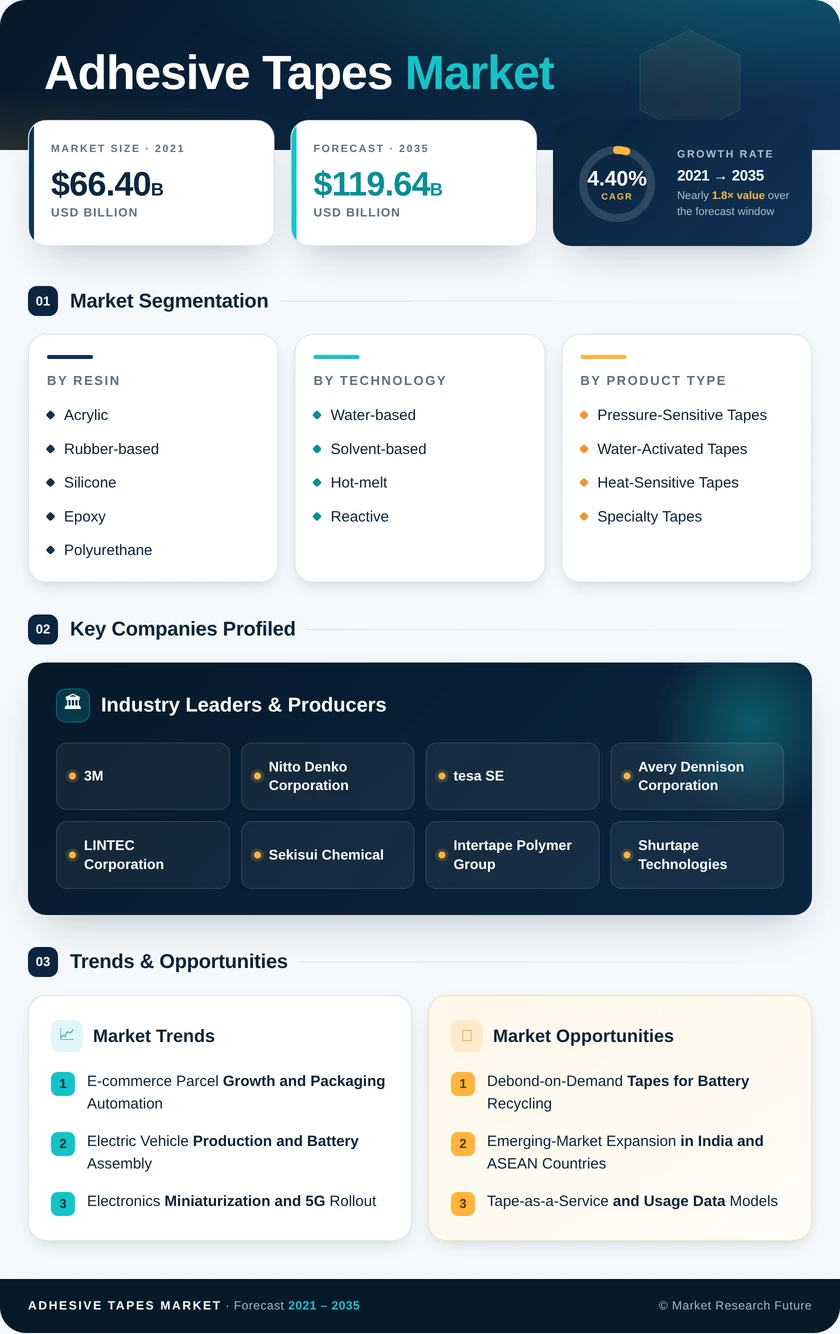
Segmentation Quick Reference
| Dimension | Sub-Segments | Dominant Segment | Fastest Growing Segment |
|---|
| By Resin | Acrylic, Rubber-based, Silicone, Epoxy, Polyurethane | Acrylic (44.0% share) | Rubber-based (4.6% CAGR) |
| By Technology | Water-based, Solvent-based, Hot-melt, Reactive | Water-based (48.4% share) | Water-based (48.4% share) |
| By Product Type | Pressure-Sensitive Tapes, Water-Activated Tapes, Heat-Sensitive Tapes, Specialty Tapes | Pressure-Sensitive Tapes (65.4% share) | Heat-Sensitive Tapes (4.9% CAGR) |
| By End-use Industry | Packaging, Automotive, Electrical and Electronics, Healthcare, Consumer/DIY, Others (Building and Construction, etc.) | Packaging (58.9% share) | Healthcare (5.0% CAGR) |
| By Region | North America, Europe, Asia-Pacific, South America, Middle-East and Africa | Asia-Pacific (45.6% share) | Asia-Pacific (45.6% share) |
Market Segmentation Overview
| Sub-Segment | Key Trend |
|---|
| Acrylic | Default choice for automotive trim and electronics bonding |
| Rubber-based | Fastest growth on high-speed logistics lines |
| Silicone | Expanding in medical wearables and high-heat masking |
| Epoxy | Structural niches in aerospace and wind blades |
| Polyurethane | Reactive hot-melts bridging packaging and structural use |
Acrylic leads because its UV and heat resistance suits long-life automotive and electronics bonds. Rubber-based grows fastest, since rubber chemistries grip dusty, uneven cartons at line speeds where acrylics hesitate. Silicone's growth depends on medical approvals, while Epoxy and Polyurethane stay specialist resins for structural joints.
| Sub-Segment | Key Trend |
|---|
| Water-based | Largest and fastest-growing as solvent limits tighten |
| Solvent-based | Retained where drying speed and low-energy adhesion matter |
| Hot-melt | Preferred for instant bonding on packaging lines |
| Reactive | Premium UV-curable and moisture-cure grades |
Water-based leads and also grows fastest, because emissions rules make solvent ovens costly to keep running and modern emulsions now match solvent peel strength. Hot-melt holds its position on fast packaging lines, while Solvent-based persists in automotive and aerospace programs where requalification is expensive. Reactive grades remain small but carry the highest prices.
| Sub-Segment | Key Trend |
|---|
| Pressure-Sensitive Tapes | Bond on contact; dominant across packaging and assembly |
| Water-Activated Tapes | Gaining in e-commerce on recyclability |
| Heat-Sensitive Tapes | Fastest growth in flexible circuits and wafer handling |
| Specialty Tapes | Conductive, magnetic and optically clear constructions |
Pressure-Sensitive Tapes lead because they need no activation step, which suits both manual and automated application. Heat-Sensitive Tapes grow fastest as electronics makers swap liquid adhesives for thermally activated films that reduce contamination. Water-Activated Tapes benefit from packaging recyclability rules, and Specialty Tapes earn high unit value in 5G and display assembly.
| Sub-Segment | Key Trend |
|---|
| Packaging | Largest volume, driven by parcel growth and automation |
| Automotive | Shift to battery bonding and wire harnessing |
| Electrical and Electronics | 5G, displays and data-center hardware |
| Healthcare | Fastest growth from wearable sensors |
| Consumer/DIY | Steady retail and home-improvement demand |
| Others (Building and Construction, etc.) | Insulation, vapor barriers and surface protection |
Packaging leads on tonnage because every parcel needs closure, though carton-sealing margins are thin. Healthcare grows fastest as glucose monitors and patch devices require validated skin-contact tape for up to 14 days of wear. Automotive and Electrical and Electronics add higher-value demand through EV batteries and thermal-management applications.


 Noah Malgeri
Co-Founder

 Peter Groot koerkamp
Account and Business Manager

 Younghwan Choi
Senior Retail Manager

 Mark Irwin
Management Consultant

 Akif Moroglu
Strategy & Business Development Director

 Guilherme Gomes Martins
Product Management Director

 Joseph Aguayo
Sales Operations & Pricing Manager

 La Terria Dodd
Program Support Specialist

 Rob Kooiker
Group Product Manager HVAC & Fire Protection GMA