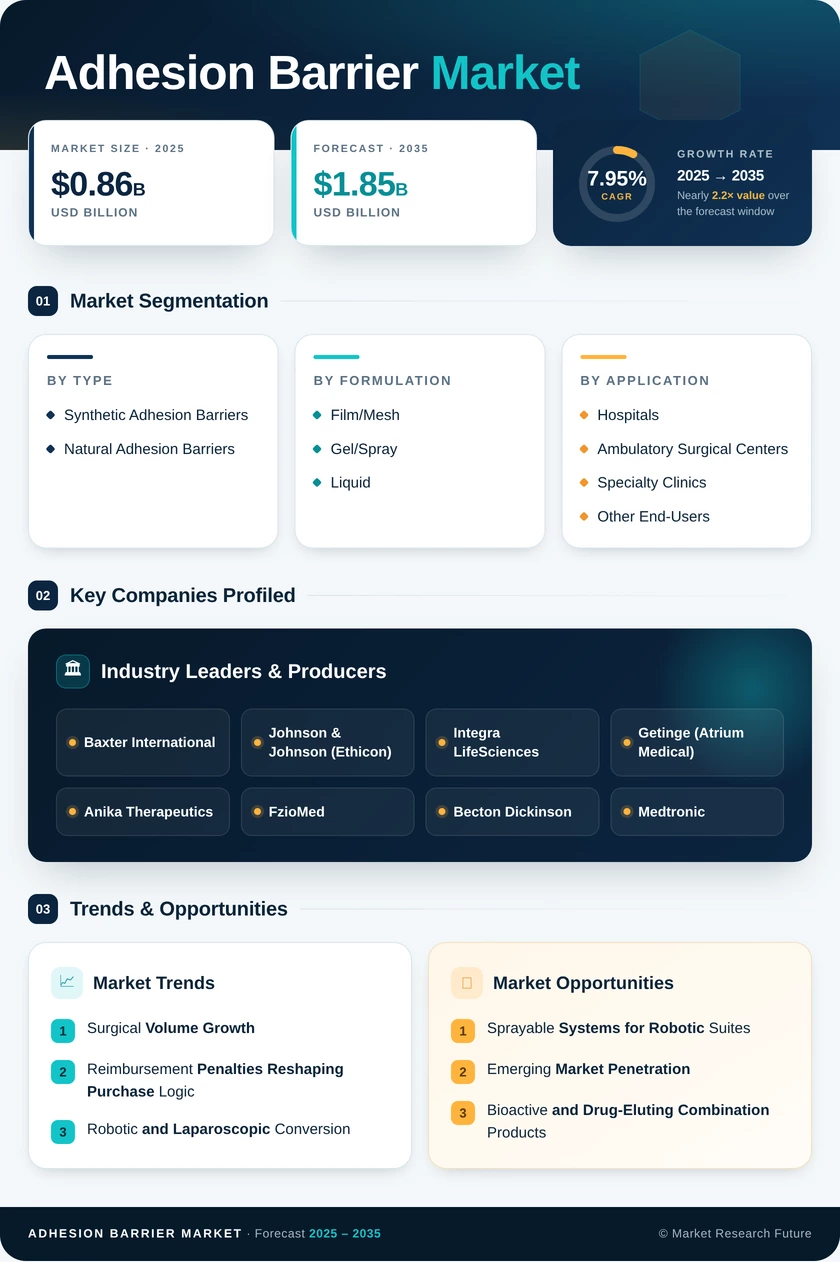
Segmentation Quick Reference
| Dimension | Sub-Segments | Dominant Segment | Fastest Growing Segment |
| By Product | Synthetic Adhesion Barriers; Natural Adhesion Barriers | Synthetic Adhesion Barriers | Natural Adhesion Barriers |
| By Formulation | Film/Mesh; Liquid; Gel/Spray | Film/Mesh | Gel/Spray |
| By Application | General/Abdominal Surgeries; Gynecological Surgeries; Orthopedic Surgeries; Cardiovascular Surgeries; Urological Surgeries; Neurological Surgeries; Other Applications | General/Abdominal Surgeries | Orthopedic Surgeries |
| By End-User | Hospitals; Ambulatory Surgical Centers; Specialty Clinics; Other End-Users | Hospitals | Ambulatory Surgical Centers |
| By Geography | North America; Europe; Asia-Pacific; South America; Middle East & Africa | North America | Asia-Pacific |
Market Segmentation Overview
By Product
| Sub-Segment | Key Trend |
| Synthetic Adhesion Barriers | Polymer engineering focused on tunable resorption windows matched to healing timelines |
| Natural Adhesion Barriers | Falling hyaluronate and collagen input costs improving price competitiveness |
Product choice increasingly reflects procedure duration rather than surgeon habit. Synthetic constructions win where sterilization stability and shelf life matter; natural chemistries hold ground in fertility-sensitive pelvic work where biocompatibility perception carries clinical weight.
By Formulation
| Sub-Segment | Key Trend |
| Film/Mesh | Thinner, more pliable sheets designed to reduce placement time in open procedures |
| Liquid | Instillation protocols standardizing across gynecologic day-surgery pathways |
| Gel/Spray | Applicator systems validated for narrow-port robotic and laparoscopic delivery |
Formulation is the dimension where competitive advantage is currently decided. Delivery device compatibility now influences purchasing conversations as strongly as the barrier chemistry itself.
By Application
| Sub-Segment | Key Trend |
| General/Abdominal Surgeries | Highest baseline adhesion incidence sustaining volume leadership |
| Gynecological Surgeries | Society guidance driving protocol-level adoption |
| Orthopedic Surgeries | Tendon repair and revision spine emerging as growth pockets |
| Cardiovascular Surgeries | Repeat sternotomy risk reduction gaining surgeon attention |
| Urological Surgeries | Robotic prostatectomy expanding addressable cases |
| Neurological Surgeries | Adjacency to dural repair portfolios creating cross-sell paths |
| Other Applications | Thoracic and paediatric niches served by specialist suppliers |
Application mix explains why portfolio breadth matters. Suppliers anchored only in abdominal surgery face slower growth than those able to follow adhesion risk into orthopedic and cardiothoracic theatres.
By End-User
| Sub-Segment | Key Trend |
| Hospitals | Formulary consolidation reducing SKU counts per facility |
| Ambulatory Surgical Centers | Preference for room-temperature-stable, single-SKU solutions |
| Specialty Clinics | Fertility and urology practices adopting protocol-driven usage |
| Other End-Users | Military and academic facilities purchasing outside standard tenders |
End-user economics diverge sharply. Hospitals buy on clinical breadth and contract leverage; ambulatory centers buy on throughput and inventory simplicity, and that difference is reshaping how manufacturers structure their commercial teams.


 Noah Malgeri
Co-Founder
Noah Malgeri
Co-Founder

 Peter Groot koerkamp
Account and Business Manager
Peter Groot koerkamp
Account and Business Manager

 Younghwan Choi
Senior Retail Manager
Younghwan Choi
Senior Retail Manager

 Mark Irwin
Management Consultant
Mark Irwin
Management Consultant

 Akif Moroglu
Strategy & Business Development Director
Akif Moroglu
Strategy & Business Development Director

 Guilherme Gomes Martins
Product Management Director
Guilherme Gomes Martins
Product Management Director

 Joseph Aguayo
Sales Operations & Pricing Manager
Joseph Aguayo
Sales Operations & Pricing Manager

 La Terria Dodd
Program Support Specialist
La Terria Dodd
Program Support Specialist

 Rob Kooiker
Group Product Manager HVAC & Fire Protection GMA
Rob Kooiker
Group Product Manager HVAC & Fire Protection GMA