Request Free Sample ×

Kindly complete the form below to receive a free sample of this Report

* Please use a valid business email

Leading companies partner with us for data-driven Insights

clients tt-cursor
Hero Background
English
Chinese
French
Japanese
Korean
German
Spanish

ADHD Therapeutics Market Size

ID: MRFR/HC/1044-HCR
200 Pages
Nidhi Mandole
March 2026

ADHD Therapeutics Market Research Report By Therapeutic Class (Stimulants, Non-Stimulants, Antidepressants, Antipsychotics), By Route of Administration (Oral, Injectable, Transdermal), By Age Group (Children, Adolescents, Adults), By Distribution Channel (Retail Pharmacy, Hospital Pharmacy, Online Pharmacy) and By Regional (North America, Europe, South America, Asia Pacific, Middle East and Africa) - Growth & Industry Forecast 2025 To 2035

Share:
Download PDF ×

We do not share your information with anyone. However, we may send you emails based on your report interest from time to time. You may contact us at any time to opt-out.

ADHD Therapeutics Market Infographic
Purchase Options

Adhd Therapeutics Size

ADHD Therapeutics Market Growth Projections and Opportunities

The ADHD therapeutics market is fundamentally affected by the rising pervasiveness of attention deficit hyperactivity disorder (ADHD) internationally. The rising awareness and analysis of ADHD among the two youngsters and grown-ups add to the developing interest for compelling helpful arrangements. Mechanical progressions in demonstrative devices and techniques assume a significant part in the ADHD therapeutics market. Improved and more exact symptomatic capacities empower healthcare experts to distinguish ADHD cases at a beginning phase, driving the requirement for remedial interventions. The market is moved by the extending patient pool, including different age gatherings. ADHD is not restricted to youth; a developing number of grown-ups are similarly being analyzed, prompting a more extensive segment looking for restorative arrangements and therefore adding to market growth. Continuous innovative work (Research and development) exercises in the field of ADHD therapeutics add to market extension. Drug organizations put fundamentally in creating imaginative medications with upgraded viability and diminished secondary effects, cultivating a competitive scene, and driving market development. Government drives pointed toward tending to psychological wellness issues, including ADHD, assume a fundamental part in forming the market. Strategies that advance awareness, analysis, and treatment openness add to the general growth of the ADHD therapeutics market. The general ascent in healthcare use worldwide is a huge market factor. As social orders allot more assets to healthcare, there is expanded subsidizing accessible for exploration, improvement, and openness of ADHD therapeutics, encouraging market growth. The section of conventional renditions of laid out ADHD drugs influences market elements. Conventional choices frequently lead to cost contest, giving practical choices to patients and impacting the market techniques of drug organizations.

ADHD Therapeutics Market Size Graph
Author
Author Profile
Nidhi Mandole
Senior Research Analyst

She is an extremely curious individual currently working in Healthcare and Medical Devices Domain. Nidhi is comfortably versed in data centric research backed by healthcare educational background. She leverages extensive data mining and analytics tools such as Primary and Secondary Research, Statistical Analysis, Machine Learning, Data Modelling. Her key role also involves Technical Sales Support, Client Interaction and Project management within the Healthcare team. Lastly, she showcases extensive affinity towards learning new skills and remain fascinated in implementing them.

Leave a Comment

FAQs

What is the projected market valuation of the ADHD Therapeutics Market by 2035?

<p>The projected market valuation of the ADHD Therapeutics Market is expected to reach 25.52 USD Billion by 2035.</p>

What was the overall market valuation of the ADHD Therapeutics Market in 2024?

<p>The overall market valuation of the ADHD Therapeutics Market was 13.74 USD Billion in 2024.</p>

What is the expected CAGR for the ADHD Therapeutics Market during the forecast period 2025 - 2035?

<p>The expected CAGR for the ADHD Therapeutics Market during the forecast period 2025 - 2035 is 5.79%.</p>

Which therapeutic class generated the highest revenue in the ADHD market in 2024?

<p>In 2024, the Stimulants therapeutic class generated the highest revenue, amounting to 8.22 USD Billion.</p>

How do the revenues of non-stimulants compare to stimulants in the ADHD Therapeutics Market?

<p>In 2024, non-stimulants generated 3.12 USD Billion, significantly lower than the 8.22 USD Billion generated by stimulants.</p>

What are the projected revenues for oral administration of ADHD therapeutics by 2035?

<p>The projected revenues for oral administration of ADHD therapeutics are expected to reach 15.0 USD Billion by 2035.</p>

Which age group is anticipated to contribute the most to the ADHD Therapeutics Market by 2035?

<p>The Children age group is anticipated to contribute the most, with projected revenues of 10.5 USD Billion by 2035.</p>

What distribution channel is expected to see the highest growth in the ADHD Therapeutics Market by 2035?

<p>The Online Pharmacy distribution channel is expected to see the highest growth, with projected revenues of 7.82 USD Billion by 2035.</p>

Which key players are leading the ADHD Therapeutics Market?

<p>Key players leading the ADHD Therapeutics Market include Johnson & Johnson, Novartis, Eli Lilly and Company, and Pfizer.</p>

What was the revenue generated by hospital pharmacies in the ADHD Therapeutics Market in 2024?

<p>In 2024, hospital pharmacies generated revenues of 4.12 USD Billion in the ADHD Therapeutics Market.</p>

Market Summary

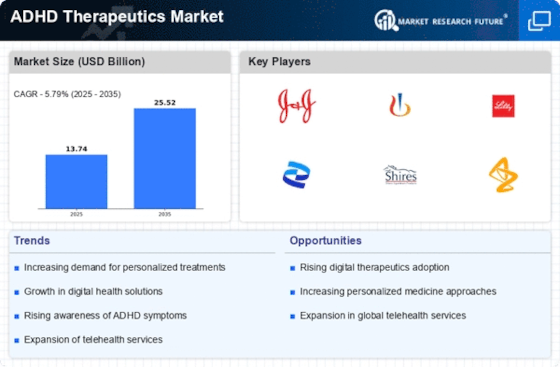
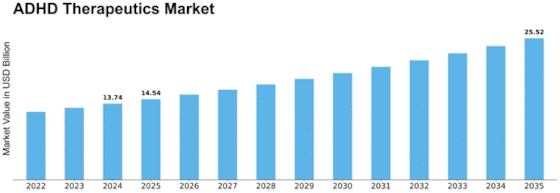
As per Market Research Future analysis, the ADHD Therapeutics Market Size was estimated at 13.74 USD Billion in 2024. The ADHD Therapeutics industry is projected to grow from 14.54 USD Billion in 2025 to 25.52 USD Billion by 2035, exhibiting a compound annual growth rate (CAGR) of 5.79% during the forecast period 2025 - 2035

Key Market Trends & Highlights

The ADHD Therapeutics Market is experiencing dynamic growth driven by innovative treatment approaches and increasing awareness.

  • The market is witnessing a rise in combination therapies, enhancing treatment efficacy for ADHD. There is a notable focus on pediatric populations, reflecting the need for tailored therapeutic solutions. Advancements in digital therapeutics are reshaping the landscape, offering new avenues for patient engagement and management. The increasing prevalence of ADHD and innovations in pharmacological treatments are key drivers, particularly in North America and the stimulants segment.

Market Size & Forecast

2024 Market Size 13.74 (USD Billion)
2035 Market Size 25.52 (USD Billion)
CAGR (2025 - 2035) 5.79%
Largest Regional Market Share in 2024 North America

Major Players

Johnson &amp; Johnson (US), Novartis (CH), Eli Lilly and Company (US), Pfizer (US), Shire (GB), <a href="https://www.astrazeneca.com/media-centre/press-releases/2009/AstraZeneca-to-Advance-AZD3480-in-ADHD-08072009.html">AstraZeneca</a> (GB), Ritalin (US), Amgen (US), Boehringer Ingelheim (DE)

Market Trends

The ADHD Therapeutics Market is currently experiencing a dynamic evolution, driven by a confluence of factors that shape treatment approaches and patient outcomes. The increasing recognition of Attention Deficit Hyperactivity Disorder as a significant public health concern has led to heightened awareness among healthcare professionals and caregivers. This awareness, coupled with advancements in pharmacological therapies, appears to enhance the accessibility and effectiveness of treatment options. Furthermore, the integration of behavioral therapies alongside medication is gaining traction, suggesting a more holistic approach to managing ADHD symptoms. In addition, the market is witnessing a surge in research and development activities aimed at discovering novel therapeutic agents. This trend indicates a potential shift towards personalized medicine, where treatments may be tailored to individual patient profiles. The growing emphasis on mental health, particularly in children and adolescents, is likely to further propel the ADHD Therapeutics Market. As stakeholders continue to prioritize innovative solutions, the landscape of ADHD treatment is poised for transformation, reflecting a commitment to improving the quality of life for those affected by this condition.

Rise of Combination Therapies

The ADHD Therapeutics Market is increasingly leaning towards combination therapies that integrate pharmacological and behavioral interventions. This trend suggests a more comprehensive approach to treatment, potentially enhancing overall efficacy and patient adherence.

Focus on Pediatric Populations

There is a notable emphasis on addressing ADHD in pediatric populations, as early diagnosis and intervention are recognized as crucial for long-term outcomes. This focus may lead to the development of age-appropriate formulations and tailored treatment strategies.

Advancements in Digital Therapeutics

The emergence of digital therapeutics is reshaping the ADHD Therapeutics Market. These innovative solutions, which may include mobile applications and online platforms, offer new avenues for monitoring symptoms and delivering interventions, thereby expanding treatment accessibility.

ADHD Therapeutics Market Market Drivers

Increasing Prevalence of ADHD

The rising prevalence of Attention Deficit Hyperactivity Disorder (ADHD) is a primary driver of the ADHD Therapeutics Market. Recent estimates indicate that approximately 5-10% of children are diagnosed with ADHD, with a notable increase in diagnoses among adults as awareness grows. This surge in prevalence necessitates effective therapeutic interventions, thereby propelling market growth. The increasing recognition of ADHD as a significant public health concern has led to enhanced screening and diagnostic practices, further contributing to the demand for ADHD therapeutics. As more individuals seek treatment, the market is likely to expand, with a diverse range of therapeutic options being developed to cater to varying patient needs. This trend underscores the importance of addressing ADHD comprehensively within the healthcare system.

Growing Awareness and Education

Growing awareness and education regarding ADHD are pivotal in shaping the ADHD Therapeutics Market. Increased public and professional understanding of ADHD has led to more individuals seeking diagnosis and treatment. Educational campaigns aimed at parents, educators, and healthcare providers have been instrumental in reducing stigma and promoting early intervention. As awareness rises, the demand for effective therapeutic options is expected to grow, driving market expansion. Additionally, healthcare professionals are increasingly trained to recognize ADHD symptoms, which facilitates timely referrals for treatment. This heightened awareness not only benefits patients but also encourages investment in research and development of new therapeutics, further propelling the market forward.

Integration of Behavioral Therapies

The integration of behavioral therapies into treatment plans is emerging as a significant driver in the ADHD Therapeutics Market. Evidence suggests that combining pharmacological treatments with behavioral interventions can lead to improved outcomes for individuals with ADHD. This holistic approach addresses not only the symptoms of ADHD but also the associated behavioral challenges, enhancing overall quality of life. As healthcare providers increasingly adopt this integrated model, the demand for comprehensive treatment options is expected to rise. Furthermore, the collaboration between mental health professionals and primary care providers is likely to facilitate the development of tailored therapeutic strategies, thereby expanding the market for ADHD therapeutics. This trend reflects a broader shift towards personalized medicine in the treatment of ADHD.

Regulatory Support for ADHD Treatments

Regulatory support for ADHD treatments plays a crucial role in the ADHD Therapeutics Market. Government agencies are increasingly recognizing the need for effective ADHD interventions, leading to streamlined approval processes for new medications. This regulatory environment fosters innovation and encourages pharmaceutical companies to invest in research and development. For instance, the expedited review pathways for ADHD therapeutics have resulted in faster access to new treatments for patients. Moreover, regulatory bodies are also focusing on ensuring the safety and efficacy of ADHD medications, which enhances public trust in these therapies. As a result, the market is likely to benefit from a steady influx of new and improved therapeutic options, catering to the diverse needs of individuals with ADHD.

Innovations in Pharmacological Treatments

Innovations in pharmacological treatments are significantly influencing the ADHD Therapeutics Market. The development of novel medications, including long-acting stimulants and non-stimulant options, has broadened the therapeutic landscape. For instance, recent advancements have led to the introduction of medications that offer improved efficacy and reduced side effects, enhancing patient adherence to treatment regimens. The market for ADHD therapeutics is projected to reach approximately USD 20 billion by 2026, driven by these innovations. Furthermore, ongoing research into the neurobiological underpinnings of ADHD is likely to yield new therapeutic targets, potentially leading to the emergence of groundbreaking treatments. This dynamic environment fosters competition among pharmaceutical companies, encouraging continuous improvement and diversification of ADHD therapeutics.


Market Segment Insights

By Therapeutic Class: Stimulants (Largest) vs. Non-Stimulants (Fastest-Growing)

In the ADHD therapeutics market, stimulants hold the largest share, making up a significant portion of the total market. Popular choices within this class include methylphenidate and amphetamines, which are widely recognized for their effectiveness in managing ADHD symptoms. Conversely, non-stimulants, though they currently represent a smaller portion of the market, are gaining increased attention and acceptance among healthcare providers and patients alike for their unique benefits and lower risk of abuse.

Stimulants (Dominant) vs. Non-Stimulants (Emerging)

Stimulants are the dominant class in the ADHD therapeutics market, favored for their rapid onset of action and proven efficacy in reducing hyperactivity and improving concentration. Despite concerns regarding side effects and potential for misuse, their long-standing success continues to propel their usage among patients. Non-stimulants, emerging as a crucial alternative, offer options like atomoxetine and guanfacine that cater to individuals who may experience adverse effects from stimulants or have a history of substance abuse. This growing acceptance of non-stimulants is fueled by increasing awareness and education surrounding ADHD treatment options.

By Route of Administration: Oral (Largest) vs. Injectable (Fastest-Growing)

In the ADHD Therapeutics Market, the route of administration plays a crucial role in determining the therapeutic options available for patients. Oral medications dominate the segment due to their ease of use, higher acceptance among patients, and cost-effectiveness. Patients and caregivers generally prefer oral formulations, as they offer a familiar and non-invasive method of treatment, which contributes to a significant market share. Conversely, injectable formulations are emerging as the fastest-growing segment. Their increasing adoption can be attributed to advanced delivery systems and prolonged action of the medication, which addresses the need for improved compliance and effectiveness in treatment. Growth trends in this market segment indicate a shifting preference towards injectable medications, especially in cases where oral treatments are ineffective or adherence is a concern. The trend is also fueled by innovations in drug delivery systems that enhance the convenience of injections, such as auto-injectors and pre-filled syringes. Additionally, the rising awareness about ADHD and the need for effective management strategies invite further exploration of alternative routes of administration, reflecting a forward-moving trajectory in the therapeutics landscape for ADHD.

Oral (Dominant) vs. Injectable (Emerging)

Oral administration remains the dominant method for delivering ADHD therapeutics due to its established efficacy and patient familiarity. This method encompasses a wide range of formulations, including tablets, capsules, and liquids, making it adaptable to diverse patient needs. On the other hand, injectable formulations are gaining traction as an emerging alternative. Though currently a smaller proportion of the market, they are recognized for their ability to provide sustained medication levels and reduce dosing frequency. This aspect makes injectables appealing, particularly for patients who struggle with adherence to traditional oral regimens. Both routes represent critical components in the ADHD treatment paradigm, each with unique benefits that cater to the varying preferences and compliance challenges faced by patients.

By Age Group: Children (Largest) vs. Adults (Fastest-Growing)

The ADHD therapeutics market shows a significant distribution among age groups, with children comprising the largest segment. Approximately, they dominate the market share due to a higher prevalence of ADHD diagnoses in early childhood. Adolescents also form a notable segment, as many continue therapeutic treatments initiated in childhood. Adults, while previously an underexplored area, are rapidly gaining recognition and share in the ADHD therapeutics landscape as awareness increases about adult ADHD and its treatment options.

Children (Dominant) vs. Adults (Emerging)

Children remain the dominant segment in the ADHD therapeutics market, driven by early diagnosis and intervention efforts. Pediatricians and mental health professionals emphasize the importance of addressing ADHD in childhood to improve academic and social outcomes. Despite being a smaller segment historically, adults represent an emerging group, fueled by increasing awareness and diagnosis rates. The growth of telehealth and digital therapy options has also facilitated access to treatment for adults, making this segment one of the fastest-growing in the market. As stigma reduces and education around adult ADHD expands, we expect to see a significant rise in treatment adoption among this demographic.

By Distribution Channel: Retail Pharmacy (Largest) vs. Online Pharmacy (Fastest-Growing)

In the ADHD therapeutics market, the distribution channels reveal a diverse landscape where retail pharmacies dominate, capturing the largest share of the market. This sector benefits from established consumer trust, convenience, and widespread accessibility. Meanwhile, the online pharmacy segment is witnessing rapid growth, driven by increasing digitalization and changing consumer preferences towards online shopping for healthcare products. Hospital pharmacies also play a crucial role in providing disbursement for in-patient care but lag behind the other two channels in overall market share.

Pharmacy Channel: Retail (Dominant) vs. Online (Emerging)

Retail pharmacies have been the backbone of the ADHD therapeutics distribution framework, offering easy access and personalized services, thereby ensuring high consumer engagement. Their well-established presence in communities has made them a trusted source for patients and healthcare professionals alike. In contrast, online pharmacies represent an emerging trend within the market. They appeal to younger, tech-savvy demographics who prefer the convenience and privacy that online shopping offers. As telehealth continues to expand, the online pharmacy segment is expected to capture an increasing share of the market, particularly among those seeking discretion and convenience in managing ADHD treatment.

Get more detailed insights about ADHD Therapeutics Market Research Report - Forecast till 2035

Regional Insights

The ADHD Therapeutics Market revenue showcases considerable diversity across its regional segmentation, with significant valuations in North America, Europe, South America, Asia Pacific, and the Middle East and Africa. In 2024, North America is set to dominate the region, valued at 5.5 USD Billion, and expected to grow to 10.5 USD Billion by 2035, holding the majority share in the market.

Europe follows closely, with a valuation of 3.5 USD Billion in 2024, expanding to 6.5 USD Billion by 2035, indicating its notable presence in ADHD treatment solutions.The Asia Pacific region, estimated at 3.0 USD Billion in 2024 and anticipated to reach 5.5 USD Billion in 2035, reflects a growing acknowledgment of ADHD awareness and treatment, driven by increasing parental awareness and access to healthcare services. South America, valued at 1.0 USD Billion in 2024, is expected to witness strong market growth, potentially reaching 2.0 USD Billion by 2035 due to improving healthcare facilities and the rise in ADHD diagnosis.

Finally, Middle East and Africa, while smaller at 0.74 USD Billion in 2024, is positioned for growth, suggesting an emerging market for ADHD treatments, emphasizing the increasing recognition of mental health issues within the region.Overall, these regional insights indicate varying growth potential driven by healthcare accessibility, social awareness, and therapeutic advancements in each area.

Key Players and Competitive Insights

The competitive landscape of the ADHD Therapeutics Market is characterized by a diverse array of players that contribute to the ongoing development of innovative treatment options for Attention Deficit Hyperactivity Disorder. This market encompasses a wide range of pharmaceutical companies that focus on the production and distribution of both stimulant and non-stimulant medications. The dynamics of this sector are largely influenced by an ever-increasing awareness of ADHD, rising diagnosis rates, and a growing push for effective management therapies.
As the market continues to expand, companies are focusing on advanced research and development, strategic partnerships, and mergers and acquisitions, aiming to enhance their product offerings and reach a broader patient base. The competition is fueled by the need for efficient therapies that not only alleviate symptoms but also improve the overall quality of life for individuals living with ADHD.Novartis holds a significant position in the ADHD Therapeutics Market, recognized for its robust portfolio that includes several key treatment options. The company’s strengths lie in its commitment to research and development, enabling it to deliver effective and innovative therapeutic solutions.
Novartis leverages its global presence and established distribution networks to ensure widespread availability of its products, which enhances its competitive edge. The firm emphasizes patient-centric approaches and collaborates with healthcare professionals to create more effective treatment regimes. By focusing on enhancing healthcare outcomes and investing in comprehensive marketing strategies, Novartis seeks to solidify its reputation as a leading entity within this market, ensuring that it remains at the forefront of ADHD management solutions.Hikma Pharmaceuticals, operating within the ADHD Therapeutics Market, is known for offering a range of generic and branded medications, catering to diverse patient needs.
The company focuses on providing accessible treatment options that are both affordable and effective. Hikma's strengths include its experience in the pharmaceutical industry and solid capabilities in product development, which have enabled it to introduce key products that target ADHD symptoms. The company has also been active in expanding its market presence through strategic collaborations and acquisitions, which bolster its portfolio and enhance its competitive position.
By focusing on innovation and maintaining high-quality standards in product manufacturing, Hikma Pharmaceuticals is positioned to support a broad spectrum of patients struggling with ADHD in various global regions, while persistently working on enhancing its offerings to meet changing market demands.

Key Companies in the ADHD Therapeutics Market include

Industry Developments

Recent developments in the ADHD Therapeutics Market indicate significant advancements and dynamics among key players such as Novartis, and Hikma Pharmaceuticals. In August 2023, Novartis announced a positive outcome from a pivotal clinical trial, enhancing the confidence in their ADHD product pipeline. Meanwhile, Hikma Pharmaceuticals expanded its portfolio by launching a generic version of a leading ADHD medication, responding to market demands for affordable options.

Furthermore, the market saw a keen interest in mergers, with Boehringer Ingelheim evaluating acquisition opportunities to bolster its ADHD therapeutic offerings, reflecting ongoing consolidation efforts within the industry. The market valuation for ADHD therapeutics has experienced significant growth, resulting in increased investment in Research and Development, driving innovations and expanding treatment options. Over the last few years, a notable trend has been the rise in prescriptions for non-stimulant ADHD medications, indicating shifting preferences among physicians and patients toward diverse treatment methodologies, enhancing the comprehensive management of ADHD globally.

Future Outlook

ADHD Therapeutics Market Future Outlook

The ADHD Therapeutics Market is projected to grow at a 5.79% CAGR from 2025 to 2035, driven by increasing awareness, innovative therapies, and expanding patient demographics.

New opportunities lie in:

  • Development of digital therapeutics platforms for <a href="https://www.marketresearchfuture.com/reports/remote-patient-monitoring-market-10905">remote patient monitoring</a>.
  • Expansion of personalized medicine approaches tailored to individual genetic profiles.
  • Strategic partnerships with educational institutions for awareness campaigns.

By 2035, the ADHD Therapeutics Market is expected to achieve substantial growth and innovation.

Market Segmentation

ADHD Therapeutics Market Age Group Outlook

  • Children
  • Adolescents
  • Adults

ADHD Therapeutics Market Therapeutic Class Outlook

  • Stimulants
  • Non-Stimulants
  • Antidepressants
  • Antipsychotics

ADHD Therapeutics Market Distribution Channel Outlook

  • Retail Pharmacy
  • Hospital Pharmacy
  • Online Pharmacy

ADHD Therapeutics Market Route of Administration Outlook

  • Oral
  • Injectable
  • Transdermal

Report Scope

MARKET SIZE 2024 13.74(USD Billion)
MARKET SIZE 2025 14.54(USD Billion)
MARKET SIZE 2035 25.52(USD Billion)
COMPOUND ANNUAL GROWTH RATE (CAGR) 5.79% (2025 - 2035)
REPORT COVERAGE Revenue Forecast, Competitive Landscape, Growth Factors, and Trends
BASE YEAR 2024
Market Forecast Period 2025 - 2035
Historical Data 2019 - 2024
Market Forecast Units USD Billion
Key Companies Profiled Johnson & Johnson (US), Novartis (CH), Eli Lilly and Company (US), Pfizer (US), Shire (GB), AstraZeneca (GB), Ritalin (US), Amgen (US), Boehringer Ingelheim (DE)
Segments Covered Therapeutic Class, Route of Administration, Age Group, Distribution Channel, Regional
Key Market Opportunities Integration of digital therapeutics and personalized medicine in the ADHD Therapeutics Market.
Key Market Dynamics Rising demand for personalized ADHD treatments drives innovation and competition among pharmaceutical companies.
Countries Covered North America, Europe, APAC, South America, MEA

FAQs

What is the projected market valuation of the ADHD Therapeutics Market by 2035?

<p>The projected market valuation of the ADHD Therapeutics Market is expected to reach 25.52 USD Billion by 2035.</p>

What was the overall market valuation of the ADHD Therapeutics Market in 2024?

<p>The overall market valuation of the ADHD Therapeutics Market was 13.74 USD Billion in 2024.</p>

What is the expected CAGR for the ADHD Therapeutics Market during the forecast period 2025 - 2035?

<p>The expected CAGR for the ADHD Therapeutics Market during the forecast period 2025 - 2035 is 5.79%.</p>

Which therapeutic class generated the highest revenue in the ADHD market in 2024?

<p>In 2024, the Stimulants therapeutic class generated the highest revenue, amounting to 8.22 USD Billion.</p>

How do the revenues of non-stimulants compare to stimulants in the ADHD Therapeutics Market?

<p>In 2024, non-stimulants generated 3.12 USD Billion, significantly lower than the 8.22 USD Billion generated by stimulants.</p>

What are the projected revenues for oral administration of ADHD therapeutics by 2035?

<p>The projected revenues for oral administration of ADHD therapeutics are expected to reach 15.0 USD Billion by 2035.</p>

Which age group is anticipated to contribute the most to the ADHD Therapeutics Market by 2035?

<p>The Children age group is anticipated to contribute the most, with projected revenues of 10.5 USD Billion by 2035.</p>

What distribution channel is expected to see the highest growth in the ADHD Therapeutics Market by 2035?

<p>The Online Pharmacy distribution channel is expected to see the highest growth, with projected revenues of 7.82 USD Billion by 2035.</p>

Which key players are leading the ADHD Therapeutics Market?

<p>Key players leading the ADHD Therapeutics Market include Johnson & Johnson, Novartis, Eli Lilly and Company, and Pfizer.</p>

What was the revenue generated by hospital pharmacies in the ADHD Therapeutics Market in 2024?

<p>In 2024, hospital pharmacies generated revenues of 4.12 USD Billion in the ADHD Therapeutics Market.</p>

  1. SECTION I: EXECUTIVE SUMMARY AND KEY HIGHLIGHTS
    1. | 1.1 EXECUTIVE SUMMARY
    2. | | 1.1.1 Market Overview
    3. | | 1.1.2 Key Findings
    4. | | 1.1.3 Market Segmentation
    5. | | 1.1.4 Competitive Landscape
    6. | | 1.1.5 Challenges and Opportunities
    7. | | 1.1.6 Future Outlook
  2. SECTION II: SCOPING, METHODOLOGY AND MARKET STRUCTURE
    1. | 2.1 MARKET INTRODUCTION
    2. | | 2.1.1 Definition
    3. | | 2.1.2 Scope of the study
    4. | | | 2.1.2.1 Research Objective
    5. | | | 2.1.2.2 Assumption
    6. | | | 2.1.2.3 Limitations
    7. | 2.2 RESEARCH METHODOLOGY
    8. | | 2.2.1 Overview
    9. | | 2.2.2 Data Mining
    10. | | 2.2.3 Secondary Research
    11. | | 2.2.4 Primary Research
    12. | | | 2.2.4.1 Primary Interviews and Information Gathering Process
    13. | | | 2.2.4.2 Breakdown of Primary Respondents
    14. | | 2.2.5 Forecasting Model
    15. | | 2.2.6 Market Size Estimation
    16. | | | 2.2.6.1 Bottom-Up Approach
    17. | | | 2.2.6.2 Top-Down Approach
    18. | | 2.2.7 Data Triangulation
    19. | | 2.2.8 Validation
  3. SECTION III: QUALITATIVE ANALYSIS
    1. | 3.1 MARKET DYNAMICS
    2. | | 3.1.1 Overview
    3. | | 3.1.2 Drivers
    4. | | 3.1.3 Restraints
    5. | | 3.1.4 Opportunities
    6. | 3.2 MARKET FACTOR ANALYSIS
    7. | | 3.2.1 Value chain Analysis
    8. | | 3.2.2 Porter's Five Forces Analysis
    9. | | | 3.2.2.1 Bargaining Power of Suppliers
    10. | | | 3.2.2.2 Bargaining Power of Buyers
    11. | | | 3.2.2.3 Threat of New Entrants
    12. | | | 3.2.2.4 Threat of Substitutes
    13. | | | 3.2.2.5 Intensity of Rivalry
    14. | | 3.2.3 COVID-19 Impact Analysis
    15. | | | 3.2.3.1 Market Impact Analysis
    16. | | | 3.2.3.2 Regional Impact
    17. | | | 3.2.3.3 Opportunity and Threat Analysis
  4. SECTION IV: QUANTITATIVE ANALYSIS
    1. | 4.1 Healthcare, BY Therapeutic Class (USD Billion)
    2. | | 4.1.1 Stimulants
    3. | | 4.1.2 Non-Stimulants
    4. | | 4.1.3 Antidepressants
    5. | | 4.1.4 Antipsychotics
    6. | 4.2 Healthcare, BY Route of Administration (USD Billion)
    7. | | 4.2.1 Oral
    8. | | 4.2.2 Injectable
    9. | | 4.2.3 Transdermal
    10. | 4.3 Healthcare, BY Age Group (USD Billion)
    11. | | 4.3.1 Children
    12. | | 4.3.2 Adolescents
    13. | | 4.3.3 Adults
    14. | 4.4 Healthcare, BY Distribution Channel (USD Billion)
    15. | | 4.4.1 Retail Pharmacy
    16. | | 4.4.2 Hospital Pharmacy
    17. | | 4.4.3 Online Pharmacy
    18. | 4.5 Healthcare, BY Region (USD Billion)
    19. | | 4.5.1 North America
    20. | | | 4.5.1.1 US
    21. | | | 4.5.1.2 Canada
    22. | | 4.5.2 Europe
    23. | | | 4.5.2.1 Germany
    24. | | | 4.5.2.2 UK
    25. | | | 4.5.2.3 France
    26. | | | 4.5.2.4 Russia
    27. | | | 4.5.2.5 Italy
    28. | | | 4.5.2.6 Spain
    29. | | | 4.5.2.7 Rest of Europe
    30. | | 4.5.3 APAC
    31. | | | 4.5.3.1 China
    32. | | | 4.5.3.2 India
    33. | | | 4.5.3.3 Japan
    34. | | | 4.5.3.4 South Korea
    35. | | | 4.5.3.5 Malaysia
    36. | | | 4.5.3.6 Thailand
    37. | | | 4.5.3.7 Indonesia
    38. | | | 4.5.3.8 Rest of APAC
    39. | | 4.5.4 South America
    40. | | | 4.5.4.1 Brazil
    41. | | | 4.5.4.2 Mexico
    42. | | | 4.5.4.3 Argentina
    43. | | | 4.5.4.4 Rest of South America
    44. | | 4.5.5 MEA
    45. | | | 4.5.5.1 GCC Countries
    46. | | | 4.5.5.2 South Africa
    47. | | | 4.5.5.3 Rest of MEA
  5. SECTION V: COMPETITIVE ANALYSIS
    1. | 5.1 Competitive Landscape
    2. | | 5.1.1 Overview
    3. | | 5.1.2 Competitive Analysis
    4. | | 5.1.3 Market share Analysis
    5. | | 5.1.4 Major Growth Strategy in the Healthcare
    6. | | 5.1.5 Competitive Benchmarking
    7. | | 5.1.6 Leading Players in Terms of Number of Developments in the Healthcare
    8. | | 5.1.7 Key developments and growth strategies
    9. | | | 5.1.7.1 New Product Launch/Service Deployment
    10. | | | 5.1.7.2 Merger & Acquisitions
    11. | | | 5.1.7.3 Joint Ventures
    12. | | 5.1.8 Major Players Financial Matrix
    13. | | | 5.1.8.1 Sales and Operating Income
    14. | | | 5.1.8.2 Major Players R&D Expenditure. 2023
    15. | 5.2 Company Profiles
    16. | | 5.2.1 Johnson & Johnson (US)
    17. | | | 5.2.1.1 Financial Overview
    18. | | | 5.2.1.2 Products Offered
    19. | | | 5.2.1.3 Key Developments
    20. | | | 5.2.1.4 SWOT Analysis
    21. | | | 5.2.1.5 Key Strategies
    22. | | 5.2.2 Novartis (CH)
    23. | | | 5.2.2.1 Financial Overview
    24. | | | 5.2.2.2 Products Offered
    25. | | | 5.2.2.3 Key Developments
    26. | | | 5.2.2.4 SWOT Analysis
    27. | | | 5.2.2.5 Key Strategies
    28. | | 5.2.3 Eli Lilly and Company (US)
    29. | | | 5.2.3.1 Financial Overview
    30. | | | 5.2.3.2 Products Offered
    31. | | | 5.2.3.3 Key Developments
    32. | | | 5.2.3.4 SWOT Analysis
    33. | | | 5.2.3.5 Key Strategies
    34. | | 5.2.4 Pfizer (US)
    35. | | | 5.2.4.1 Financial Overview
    36. | | | 5.2.4.2 Products Offered
    37. | | | 5.2.4.3 Key Developments
    38. | | | 5.2.4.4 SWOT Analysis
    39. | | | 5.2.4.5 Key Strategies
    40. | | 5.2.5 Shire (GB)
    41. | | | 5.2.5.1 Financial Overview
    42. | | | 5.2.5.2 Products Offered
    43. | | | 5.2.5.3 Key Developments
    44. | | | 5.2.5.4 SWOT Analysis
    45. | | | 5.2.5.5 Key Strategies
    46. | | 5.2.6 AstraZeneca (GB)
    47. | | | 5.2.6.1 Financial Overview
    48. | | | 5.2.6.2 Products Offered
    49. | | | 5.2.6.3 Key Developments
    50. | | | 5.2.6.4 SWOT Analysis
    51. | | | 5.2.6.5 Key Strategies
    52. | | 5.2.7 Ritalin (US)
    53. | | | 5.2.7.1 Financial Overview
    54. | | | 5.2.7.2 Products Offered
    55. | | | 5.2.7.3 Key Developments
    56. | | | 5.2.7.4 SWOT Analysis
    57. | | | 5.2.7.5 Key Strategies
    58. | | 5.2.8 Amgen (US)
    59. | | | 5.2.8.1 Financial Overview
    60. | | | 5.2.8.2 Products Offered
    61. | | | 5.2.8.3 Key Developments
    62. | | | 5.2.8.4 SWOT Analysis
    63. | | | 5.2.8.5 Key Strategies
    64. | | 5.2.9 Boehringer Ingelheim (DE)
    65. | | | 5.2.9.1 Financial Overview
    66. | | | 5.2.9.2 Products Offered
    67. | | | 5.2.9.3 Key Developments
    68. | | | 5.2.9.4 SWOT Analysis
    69. | | | 5.2.9.5 Key Strategies
    70. | 5.3 Appendix
    71. | | 5.3.1 References
    72. | | 5.3.2 Related Reports
  6. LIST OF FIGURES
    1. | 6.1 MARKET SYNOPSIS
    2. | 6.2 NORTH AMERICA MARKET ANALYSIS
    3. | 6.3 US MARKET ANALYSIS BY THERAPEUTIC CLASS
    4. | 6.4 US MARKET ANALYSIS BY ROUTE OF ADMINISTRATION
    5. | 6.5 US MARKET ANALYSIS BY AGE GROUP
    6. | 6.6 US MARKET ANALYSIS BY DISTRIBUTION CHANNEL
    7. | 6.7 CANADA MARKET ANALYSIS BY THERAPEUTIC CLASS
    8. | 6.8 CANADA MARKET ANALYSIS BY ROUTE OF ADMINISTRATION
    9. | 6.9 CANADA MARKET ANALYSIS BY AGE GROUP
    10. | 6.10 CANADA MARKET ANALYSIS BY DISTRIBUTION CHANNEL
    11. | 6.11 EUROPE MARKET ANALYSIS
    12. | 6.12 GERMANY MARKET ANALYSIS BY THERAPEUTIC CLASS
    13. | 6.13 GERMANY MARKET ANALYSIS BY ROUTE OF ADMINISTRATION
    14. | 6.14 GERMANY MARKET ANALYSIS BY AGE GROUP
    15. | 6.15 GERMANY MARKET ANALYSIS BY DISTRIBUTION CHANNEL
    16. | 6.16 UK MARKET ANALYSIS BY THERAPEUTIC CLASS
    17. | 6.17 UK MARKET ANALYSIS BY ROUTE OF ADMINISTRATION
    18. | 6.18 UK MARKET ANALYSIS BY AGE GROUP
    19. | 6.19 UK MARKET ANALYSIS BY DISTRIBUTION CHANNEL
    20. | 6.20 FRANCE MARKET ANALYSIS BY THERAPEUTIC CLASS
    21. | 6.21 FRANCE MARKET ANALYSIS BY ROUTE OF ADMINISTRATION
    22. | 6.22 FRANCE MARKET ANALYSIS BY AGE GROUP
    23. | 6.23 FRANCE MARKET ANALYSIS BY DISTRIBUTION CHANNEL
    24. | 6.24 RUSSIA MARKET ANALYSIS BY THERAPEUTIC CLASS
    25. | 6.25 RUSSIA MARKET ANALYSIS BY ROUTE OF ADMINISTRATION
    26. | 6.26 RUSSIA MARKET ANALYSIS BY AGE GROUP
    27. | 6.27 RUSSIA MARKET ANALYSIS BY DISTRIBUTION CHANNEL
    28. | 6.28 ITALY MARKET ANALYSIS BY THERAPEUTIC CLASS
    29. | 6.29 ITALY MARKET ANALYSIS BY ROUTE OF ADMINISTRATION
    30. | 6.30 ITALY MARKET ANALYSIS BY AGE GROUP
    31. | 6.31 ITALY MARKET ANALYSIS BY DISTRIBUTION CHANNEL
    32. | 6.32 SPAIN MARKET ANALYSIS BY THERAPEUTIC CLASS
    33. | 6.33 SPAIN MARKET ANALYSIS BY ROUTE OF ADMINISTRATION
    34. | 6.34 SPAIN MARKET ANALYSIS BY AGE GROUP
    35. | 6.35 SPAIN MARKET ANALYSIS BY DISTRIBUTION CHANNEL
    36. | 6.36 REST OF EUROPE MARKET ANALYSIS BY THERAPEUTIC CLASS
    37. | 6.37 REST OF EUROPE MARKET ANALYSIS BY ROUTE OF ADMINISTRATION
    38. | 6.38 REST OF EUROPE MARKET ANALYSIS BY AGE GROUP
    39. | 6.39 REST OF EUROPE MARKET ANALYSIS BY DISTRIBUTION CHANNEL
    40. | 6.40 APAC MARKET ANALYSIS
    41. | 6.41 CHINA MARKET ANALYSIS BY THERAPEUTIC CLASS
    42. | 6.42 CHINA MARKET ANALYSIS BY ROUTE OF ADMINISTRATION
    43. | 6.43 CHINA MARKET ANALYSIS BY AGE GROUP
    44. | 6.44 CHINA MARKET ANALYSIS BY DISTRIBUTION CHANNEL
    45. | 6.45 INDIA MARKET ANALYSIS BY THERAPEUTIC CLASS
    46. | 6.46 INDIA MARKET ANALYSIS BY ROUTE OF ADMINISTRATION
    47. | 6.47 INDIA MARKET ANALYSIS BY AGE GROUP
    48. | 6.48 INDIA MARKET ANALYSIS BY DISTRIBUTION CHANNEL
    49. | 6.49 JAPAN MARKET ANALYSIS BY THERAPEUTIC CLASS
    50. | 6.50 JAPAN MARKET ANALYSIS BY ROUTE OF ADMINISTRATION
    51. | 6.51 JAPAN MARKET ANALYSIS BY AGE GROUP
    52. | 6.52 JAPAN MARKET ANALYSIS BY DISTRIBUTION CHANNEL
    53. | 6.53 SOUTH KOREA MARKET ANALYSIS BY THERAPEUTIC CLASS
    54. | 6.54 SOUTH KOREA MARKET ANALYSIS BY ROUTE OF ADMINISTRATION
    55. | 6.55 SOUTH KOREA MARKET ANALYSIS BY AGE GROUP
    56. | 6.56 SOUTH KOREA MARKET ANALYSIS BY DISTRIBUTION CHANNEL
    57. | 6.57 MALAYSIA MARKET ANALYSIS BY THERAPEUTIC CLASS
    58. | 6.58 MALAYSIA MARKET ANALYSIS BY ROUTE OF ADMINISTRATION
    59. | 6.59 MALAYSIA MARKET ANALYSIS BY AGE GROUP
    60. | 6.60 MALAYSIA MARKET ANALYSIS BY DISTRIBUTION CHANNEL
    61. | 6.61 THAILAND MARKET ANALYSIS BY THERAPEUTIC CLASS
    62. | 6.62 THAILAND MARKET ANALYSIS BY ROUTE OF ADMINISTRATION
    63. | 6.63 THAILAND MARKET ANALYSIS BY AGE GROUP
    64. | 6.64 THAILAND MARKET ANALYSIS BY DISTRIBUTION CHANNEL
    65. | 6.65 INDONESIA MARKET ANALYSIS BY THERAPEUTIC CLASS
    66. | 6.66 INDONESIA MARKET ANALYSIS BY ROUTE OF ADMINISTRATION
    67. | 6.67 INDONESIA MARKET ANALYSIS BY AGE GROUP
    68. | 6.68 INDONESIA MARKET ANALYSIS BY DISTRIBUTION CHANNEL
    69. | 6.69 REST OF APAC MARKET ANALYSIS BY THERAPEUTIC CLASS
    70. | 6.70 REST OF APAC MARKET ANALYSIS BY ROUTE OF ADMINISTRATION
    71. | 6.71 REST OF APAC MARKET ANALYSIS BY AGE GROUP
    72. | 6.72 REST OF APAC MARKET ANALYSIS BY DISTRIBUTION CHANNEL
    73. | 6.73 SOUTH AMERICA MARKET ANALYSIS
    74. | 6.74 BRAZIL MARKET ANALYSIS BY THERAPEUTIC CLASS
    75. | 6.75 BRAZIL MARKET ANALYSIS BY ROUTE OF ADMINISTRATION
    76. | 6.76 BRAZIL MARKET ANALYSIS BY AGE GROUP
    77. | 6.77 BRAZIL MARKET ANALYSIS BY DISTRIBUTION CHANNEL
    78. | 6.78 MEXICO MARKET ANALYSIS BY THERAPEUTIC CLASS
    79. | 6.79 MEXICO MARKET ANALYSIS BY ROUTE OF ADMINISTRATION
    80. | 6.80 MEXICO MARKET ANALYSIS BY AGE GROUP
    81. | 6.81 MEXICO MARKET ANALYSIS BY DISTRIBUTION CHANNEL
    82. | 6.82 ARGENTINA MARKET ANALYSIS BY THERAPEUTIC CLASS
    83. | 6.83 ARGENTINA MARKET ANALYSIS BY ROUTE OF ADMINISTRATION
    84. | 6.84 ARGENTINA MARKET ANALYSIS BY AGE GROUP
    85. | 6.85 ARGENTINA MARKET ANALYSIS BY DISTRIBUTION CHANNEL
    86. | 6.86 REST OF SOUTH AMERICA MARKET ANALYSIS BY THERAPEUTIC CLASS
    87. | 6.87 REST OF SOUTH AMERICA MARKET ANALYSIS BY ROUTE OF ADMINISTRATION
    88. | 6.88 REST OF SOUTH AMERICA MARKET ANALYSIS BY AGE GROUP
    89. | 6.89 REST OF SOUTH AMERICA MARKET ANALYSIS BY DISTRIBUTION CHANNEL
    90. | 6.90 MEA MARKET ANALYSIS
    91. | 6.91 GCC COUNTRIES MARKET ANALYSIS BY THERAPEUTIC CLASS
    92. | 6.92 GCC COUNTRIES MARKET ANALYSIS BY ROUTE OF ADMINISTRATION
    93. | 6.93 GCC COUNTRIES MARKET ANALYSIS BY AGE GROUP
    94. | 6.94 GCC COUNTRIES MARKET ANALYSIS BY DISTRIBUTION CHANNEL
    95. | 6.95 SOUTH AFRICA MARKET ANALYSIS BY THERAPEUTIC CLASS
    96. | 6.96 SOUTH AFRICA MARKET ANALYSIS BY ROUTE OF ADMINISTRATION
    97. | 6.97 SOUTH AFRICA MARKET ANALYSIS BY AGE GROUP
    98. | 6.98 SOUTH AFRICA MARKET ANALYSIS BY DISTRIBUTION CHANNEL
    99. | 6.99 REST OF MEA MARKET ANALYSIS BY THERAPEUTIC CLASS
    100. | 6.100 REST OF MEA MARKET ANALYSIS BY ROUTE OF ADMINISTRATION
    101. | 6.101 REST OF MEA MARKET ANALYSIS BY AGE GROUP
    102. | 6.102 REST OF MEA MARKET ANALYSIS BY DISTRIBUTION CHANNEL
    103. | 6.103 KEY BUYING CRITERIA OF HEALTHCARE
    104. | 6.104 RESEARCH PROCESS OF MRFR
    105. | 6.105 DRO ANALYSIS OF HEALTHCARE
    106. | 6.106 DRIVERS IMPACT ANALYSIS: HEALTHCARE
    107. | 6.107 RESTRAINTS IMPACT ANALYSIS: HEALTHCARE
    108. | 6.108 SUPPLY / VALUE CHAIN: HEALTHCARE
    109. | 6.109 HEALTHCARE, BY THERAPEUTIC CLASS, 2024 (% SHARE)
    110. | 6.110 HEALTHCARE, BY THERAPEUTIC CLASS, 2024 TO 2035 (USD Billion)
    111. | 6.111 HEALTHCARE, BY ROUTE OF ADMINISTRATION, 2024 (% SHARE)
    112. | 6.112 HEALTHCARE, BY ROUTE OF ADMINISTRATION, 2024 TO 2035 (USD Billion)
    113. | 6.113 HEALTHCARE, BY AGE GROUP, 2024 (% SHARE)
    114. | 6.114 HEALTHCARE, BY AGE GROUP, 2024 TO 2035 (USD Billion)
    115. | 6.115 HEALTHCARE, BY DISTRIBUTION CHANNEL, 2024 (% SHARE)
    116. | 6.116 HEALTHCARE, BY DISTRIBUTION CHANNEL, 2024 TO 2035 (USD Billion)
    117. | 6.117 BENCHMARKING OF MAJOR COMPETITORS
  7. LIST OF TABLES
    1. | 7.1 LIST OF ASSUMPTIONS
    2. | | 7.1.1
    3. | 7.2 North America MARKET SIZE ESTIMATES; FORECAST
    4. | | 7.2.1 BY THERAPEUTIC CLASS, 2025-2035 (USD Billion)
    5. | | 7.2.2 BY ROUTE OF ADMINISTRATION, 2025-2035 (USD Billion)
    6. | | 7.2.3 BY AGE GROUP, 2025-2035 (USD Billion)
    7. | | 7.2.4 BY DISTRIBUTION CHANNEL, 2025-2035 (USD Billion)
    8. | 7.3 US MARKET SIZE ESTIMATES; FORECAST
    9. | | 7.3.1 BY THERAPEUTIC CLASS, 2025-2035 (USD Billion)
    10. | | 7.3.2 BY ROUTE OF ADMINISTRATION, 2025-2035 (USD Billion)
    11. | | 7.3.3 BY AGE GROUP, 2025-2035 (USD Billion)
    12. | | 7.3.4 BY DISTRIBUTION CHANNEL, 2025-2035 (USD Billion)
    13. | 7.4 Canada MARKET SIZE ESTIMATES; FORECAST
    14. | | 7.4.1 BY THERAPEUTIC CLASS, 2025-2035 (USD Billion)
    15. | | 7.4.2 BY ROUTE OF ADMINISTRATION, 2025-2035 (USD Billion)
    16. | | 7.4.3 BY AGE GROUP, 2025-2035 (USD Billion)
    17. | | 7.4.4 BY DISTRIBUTION CHANNEL, 2025-2035 (USD Billion)
    18. | 7.5 Europe MARKET SIZE ESTIMATES; FORECAST
    19. | | 7.5.1 BY THERAPEUTIC CLASS, 2025-2035 (USD Billion)
    20. | | 7.5.2 BY ROUTE OF ADMINISTRATION, 2025-2035 (USD Billion)
    21. | | 7.5.3 BY AGE GROUP, 2025-2035 (USD Billion)
    22. | | 7.5.4 BY DISTRIBUTION CHANNEL, 2025-2035 (USD Billion)
    23. | 7.6 Germany MARKET SIZE ESTIMATES; FORECAST
    24. | | 7.6.1 BY THERAPEUTIC CLASS, 2025-2035 (USD Billion)
    25. | | 7.6.2 BY ROUTE OF ADMINISTRATION, 2025-2035 (USD Billion)
    26. | | 7.6.3 BY AGE GROUP, 2025-2035 (USD Billion)
    27. | | 7.6.4 BY DISTRIBUTION CHANNEL, 2025-2035 (USD Billion)
    28. | 7.7 UK MARKET SIZE ESTIMATES; FORECAST
    29. | | 7.7.1 BY THERAPEUTIC CLASS, 2025-2035 (USD Billion)
    30. | | 7.7.2 BY ROUTE OF ADMINISTRATION, 2025-2035 (USD Billion)
    31. | | 7.7.3 BY AGE GROUP, 2025-2035 (USD Billion)
    32. | | 7.7.4 BY DISTRIBUTION CHANNEL, 2025-2035 (USD Billion)
    33. | 7.8 France MARKET SIZE ESTIMATES; FORECAST
    34. | | 7.8.1 BY THERAPEUTIC CLASS, 2025-2035 (USD Billion)
    35. | | 7.8.2 BY ROUTE OF ADMINISTRATION, 2025-2035 (USD Billion)
    36. | | 7.8.3 BY AGE GROUP, 2025-2035 (USD Billion)
    37. | | 7.8.4 BY DISTRIBUTION CHANNEL, 2025-2035 (USD Billion)
    38. | 7.9 Russia MARKET SIZE ESTIMATES; FORECAST
    39. | | 7.9.1 BY THERAPEUTIC CLASS, 2025-2035 (USD Billion)
    40. | | 7.9.2 BY ROUTE OF ADMINISTRATION, 2025-2035 (USD Billion)
    41. | | 7.9.3 BY AGE GROUP, 2025-2035 (USD Billion)
    42. | | 7.9.4 BY DISTRIBUTION CHANNEL, 2025-2035 (USD Billion)
    43. | 7.10 Italy MARKET SIZE ESTIMATES; FORECAST
    44. | | 7.10.1 BY THERAPEUTIC CLASS, 2025-2035 (USD Billion)
    45. | | 7.10.2 BY ROUTE OF ADMINISTRATION, 2025-2035 (USD Billion)
    46. | | 7.10.3 BY AGE GROUP, 2025-2035 (USD Billion)
    47. | | 7.10.4 BY DISTRIBUTION CHANNEL, 2025-2035 (USD Billion)
    48. | 7.11 Spain MARKET SIZE ESTIMATES; FORECAST
    49. | | 7.11.1 BY THERAPEUTIC CLASS, 2025-2035 (USD Billion)
    50. | | 7.11.2 BY ROUTE OF ADMINISTRATION, 2025-2035 (USD Billion)
    51. | | 7.11.3 BY AGE GROUP, 2025-2035 (USD Billion)
    52. | | 7.11.4 BY DISTRIBUTION CHANNEL, 2025-2035 (USD Billion)
    53. | 7.12 Rest of Europe MARKET SIZE ESTIMATES; FORECAST
    54. | | 7.12.1 BY THERAPEUTIC CLASS, 2025-2035 (USD Billion)
    55. | | 7.12.2 BY ROUTE OF ADMINISTRATION, 2025-2035 (USD Billion)
    56. | | 7.12.3 BY AGE GROUP, 2025-2035 (USD Billion)
    57. | | 7.12.4 BY DISTRIBUTION CHANNEL, 2025-2035 (USD Billion)
    58. | 7.13 APAC MARKET SIZE ESTIMATES; FORECAST
    59. | | 7.13.1 BY THERAPEUTIC CLASS, 2025-2035 (USD Billion)
    60. | | 7.13.2 BY ROUTE OF ADMINISTRATION, 2025-2035 (USD Billion)
    61. | | 7.13.3 BY AGE GROUP, 2025-2035 (USD Billion)
    62. | | 7.13.4 BY DISTRIBUTION CHANNEL, 2025-2035 (USD Billion)
    63. | 7.14 China MARKET SIZE ESTIMATES; FORECAST
    64. | | 7.14.1 BY THERAPEUTIC CLASS, 2025-2035 (USD Billion)
    65. | | 7.14.2 BY ROUTE OF ADMINISTRATION, 2025-2035 (USD Billion)
    66. | | 7.14.3 BY AGE GROUP, 2025-2035 (USD Billion)
    67. | | 7.14.4 BY DISTRIBUTION CHANNEL, 2025-2035 (USD Billion)
    68. | 7.15 India MARKET SIZE ESTIMATES; FORECAST
    69. | | 7.15.1 BY THERAPEUTIC CLASS, 2025-2035 (USD Billion)
    70. | | 7.15.2 BY ROUTE OF ADMINISTRATION, 2025-2035 (USD Billion)
    71. | | 7.15.3 BY AGE GROUP, 2025-2035 (USD Billion)
    72. | | 7.15.4 BY DISTRIBUTION CHANNEL, 2025-2035 (USD Billion)
    73. | 7.16 Japan MARKET SIZE ESTIMATES; FORECAST
    74. | | 7.16.1 BY THERAPEUTIC CLASS, 2025-2035 (USD Billion)
    75. | | 7.16.2 BY ROUTE OF ADMINISTRATION, 2025-2035 (USD Billion)
    76. | | 7.16.3 BY AGE GROUP, 2025-2035 (USD Billion)
    77. | | 7.16.4 BY DISTRIBUTION CHANNEL, 2025-2035 (USD Billion)
    78. | 7.17 South Korea MARKET SIZE ESTIMATES; FORECAST
    79. | | 7.17.1 BY THERAPEUTIC CLASS, 2025-2035 (USD Billion)
    80. | | 7.17.2 BY ROUTE OF ADMINISTRATION, 2025-2035 (USD Billion)
    81. | | 7.17.3 BY AGE GROUP, 2025-2035 (USD Billion)
    82. | | 7.17.4 BY DISTRIBUTION CHANNEL, 2025-2035 (USD Billion)
    83. | 7.18 Malaysia MARKET SIZE ESTIMATES; FORECAST
    84. | | 7.18.1 BY THERAPEUTIC CLASS, 2025-2035 (USD Billion)
    85. | | 7.18.2 BY ROUTE OF ADMINISTRATION, 2025-2035 (USD Billion)
    86. | | 7.18.3 BY AGE GROUP, 2025-2035 (USD Billion)
    87. | | 7.18.4 BY DISTRIBUTION CHANNEL, 2025-2035 (USD Billion)
    88. | 7.19 Thailand MARKET SIZE ESTIMATES; FORECAST
    89. | | 7.19.1 BY THERAPEUTIC CLASS, 2025-2035 (USD Billion)
    90. | | 7.19.2 BY ROUTE OF ADMINISTRATION, 2025-2035 (USD Billion)
    91. | | 7.19.3 BY AGE GROUP, 2025-2035 (USD Billion)
    92. | | 7.19.4 BY DISTRIBUTION CHANNEL, 2025-2035 (USD Billion)
    93. | 7.20 Indonesia MARKET SIZE ESTIMATES; FORECAST
    94. | | 7.20.1 BY THERAPEUTIC CLASS, 2025-2035 (USD Billion)
    95. | | 7.20.2 BY ROUTE OF ADMINISTRATION, 2025-2035 (USD Billion)
    96. | | 7.20.3 BY AGE GROUP, 2025-2035 (USD Billion)
    97. | | 7.20.4 BY DISTRIBUTION CHANNEL, 2025-2035 (USD Billion)
    98. | 7.21 Rest of APAC MARKET SIZE ESTIMATES; FORECAST
    99. | | 7.21.1 BY THERAPEUTIC CLASS, 2025-2035 (USD Billion)
    100. | | 7.21.2 BY ROUTE OF ADMINISTRATION, 2025-2035 (USD Billion)
    101. | | 7.21.3 BY AGE GROUP, 2025-2035 (USD Billion)
    102. | | 7.21.4 BY DISTRIBUTION CHANNEL, 2025-2035 (USD Billion)
    103. | 7.22 South America MARKET SIZE ESTIMATES; FORECAST
    104. | | 7.22.1 BY THERAPEUTIC CLASS, 2025-2035 (USD Billion)
    105. | | 7.22.2 BY ROUTE OF ADMINISTRATION, 2025-2035 (USD Billion)
    106. | | 7.22.3 BY AGE GROUP, 2025-2035 (USD Billion)
    107. | | 7.22.4 BY DISTRIBUTION CHANNEL, 2025-2035 (USD Billion)
    108. | 7.23 Brazil MARKET SIZE ESTIMATES; FORECAST
    109. | | 7.23.1 BY THERAPEUTIC CLASS, 2025-2035 (USD Billion)
    110. | | 7.23.2 BY ROUTE OF ADMINISTRATION, 2025-2035 (USD Billion)
    111. | | 7.23.3 BY AGE GROUP, 2025-2035 (USD Billion)
    112. | | 7.23.4 BY DISTRIBUTION CHANNEL, 2025-2035 (USD Billion)
    113. | 7.24 Mexico MARKET SIZE ESTIMATES; FORECAST
    114. | | 7.24.1 BY THERAPEUTIC CLASS, 2025-2035 (USD Billion)
    115. | | 7.24.2 BY ROUTE OF ADMINISTRATION, 2025-2035 (USD Billion)
    116. | | 7.24.3 BY AGE GROUP, 2025-2035 (USD Billion)
    117. | | 7.24.4 BY DISTRIBUTION CHANNEL, 2025-2035 (USD Billion)
    118. | 7.25 Argentina MARKET SIZE ESTIMATES; FORECAST
    119. | | 7.25.1 BY THERAPEUTIC CLASS, 2025-2035 (USD Billion)
    120. | | 7.25.2 BY ROUTE OF ADMINISTRATION, 2025-2035 (USD Billion)
    121. | | 7.25.3 BY AGE GROUP, 2025-2035 (USD Billion)
    122. | | 7.25.4 BY DISTRIBUTION CHANNEL, 2025-2035 (USD Billion)
    123. | 7.26 Rest of South America MARKET SIZE ESTIMATES; FORECAST
    124. | | 7.26.1 BY THERAPEUTIC CLASS, 2025-2035 (USD Billion)
    125. | | 7.26.2 BY ROUTE OF ADMINISTRATION, 2025-2035 (USD Billion)
    126. | | 7.26.3 BY AGE GROUP, 2025-2035 (USD Billion)
    127. | | 7.26.4 BY DISTRIBUTION CHANNEL, 2025-2035 (USD Billion)
    128. | 7.27 MEA MARKET SIZE ESTIMATES; FORECAST
    129. | | 7.27.1 BY THERAPEUTIC CLASS, 2025-2035 (USD Billion)
    130. | | 7.27.2 BY ROUTE OF ADMINISTRATION, 2025-2035 (USD Billion)
    131. | | 7.27.3 BY AGE GROUP, 2025-2035 (USD Billion)
    132. | | 7.27.4 BY DISTRIBUTION CHANNEL, 2025-2035 (USD Billion)
    133. | 7.28 GCC Countries MARKET SIZE ESTIMATES; FORECAST
    134. | | 7.28.1 BY THERAPEUTIC CLASS, 2025-2035 (USD Billion)
    135. | | 7.28.2 BY ROUTE OF ADMINISTRATION, 2025-2035 (USD Billion)
    136. | | 7.28.3 BY AGE GROUP, 2025-2035 (USD Billion)
    137. | | 7.28.4 BY DISTRIBUTION CHANNEL, 2025-2035 (USD Billion)
    138. | 7.29 South Africa MARKET SIZE ESTIMATES; FORECAST
    139. | | 7.29.1 BY THERAPEUTIC CLASS, 2025-2035 (USD Billion)
    140. | | 7.29.2 BY ROUTE OF ADMINISTRATION, 2025-2035 (USD Billion)
    141. | | 7.29.3 BY AGE GROUP, 2025-2035 (USD Billion)
    142. | | 7.29.4 BY DISTRIBUTION CHANNEL, 2025-2035 (USD Billion)
    143. | 7.30 Rest of MEA MARKET SIZE ESTIMATES; FORECAST
    144. | | 7.30.1 BY THERAPEUTIC CLASS, 2025-2035 (USD Billion)
    145. | | 7.30.2 BY ROUTE OF ADMINISTRATION, 2025-2035 (USD Billion)
    146. | | 7.30.3 BY AGE GROUP, 2025-2035 (USD Billion)
    147. | | 7.30.4 BY DISTRIBUTION CHANNEL, 2025-2035 (USD Billion)
    148. | 7.31 PRODUCT LAUNCH/PRODUCT DEVELOPMENT/APPROVAL
    149. | | 7.31.1
    150. | 7.32 ACQUISITION/PARTNERSHIP
    151. | | 7.32.1

Healthcare Market Segmentation

Healthcare By Therapeutic Class (USD Billion, 2025-2035)

  • Stimulants
  • Non-Stimulants
  • Antidepressants
  • Antipsychotics

Healthcare By Route of Administration (USD Billion, 2025-2035)

  • Oral
  • Injectable
  • Transdermal

Healthcare By Age Group (USD Billion, 2025-2035)

  • Children
  • Adolescents
  • Adults

Healthcare By Distribution Channel (USD Billion, 2025-2035)

  • Retail Pharmacy
  • Hospital Pharmacy
  • Online Pharmacy
Infographic

Free Sample Request

Kindly complete the form below to receive a free sample of this Report

Get Free Sample

Customer Strories

Compare Licence

×
Features License Type
Single User Multiuser License Enterprise User
Price $4,950 $5,950 $7,250
Maximum User Access Limit 1 User Upto 10 Users Unrestricted Access Throughout the Organization
Free Customization
Direct Access to Analyst
Deliverable Format
Platform Access
Discount on Next Purchase 10% 15% 15%
Printable Versions