
×
Request Free Sample ×

Kindly complete the form below to receive a free sample of this Report

* Please use a valid business email

Leading companies partner with us for data-driven Insights

clients tt-cursor
Hero Background
English
Chinese
French
Japanese
Korean
German
Spanish

Adaptive Optics Market Share

ID: MRFR/ICT/0697-HCR
110 Pages
Shubham Munde
February 2026

Adaptive Optics Market Size, Share and Research Report: By Application (Astronomy, Biomedical, Defense and Security, Industrial, Consumer Electronics), By Component (Wavefront Sensors, Deformable Mirrors, Control Systems, Software, Other Components), By End User (Research Institutions, Healthcare Providers, Military Organizations, Manufacturing Companies, Educational Institutions), By Technology (Closed-Loop Adaptive Optics, Open-Loop Adaptive Optics, Hybrid Adaptive Optics) and By Regional (North America, Europe, South America, Asia Pacific, Middle East and Africa) - Industry Forecast to 2035

Share:
Download PDF ×

We do not share your information with anyone. However, we may send you emails based on your report interest from time to time. You may contact us at any time to opt-out.

Adaptive Optics Market Infographic
Purchase Options

Market Share

Adaptive Optics Market Share Analysis

The growing need for high-resolution images and precise optical frameworks has driven the Adaptive Optics (AO) industry. Market share positioning tactics are crucial to an organization's success in this competitive environment. To gain market share, adaptive optics companies use many methods.

Mechanical progress is a common separating method. Companies strive to create cutting-edge AO frameworks with advanced features and capabilities to get an edge. This strategy attracts and retains clients. Wavefront detection and amendment developments directly affect the presentation and precision of Adaptive Optics frameworks.

Important alliances and coordinated activities help increase market share. Organizations can exploit reciprocal mastery and assets by forming coalitions with relevant firms or research institutions. Joint efforts create coordinated arrangements that serve specific market demands, boosting the client base and solidifying the organization's market position.

Cost positioning is another market share fundamental. Some companies use an extraordinary pricing strategy to highlight the quality and high-level features of their AO frameworks, while others use an expenditure endeavor to provide a larger client market. Cost and incentive must be balanced to influence customers' buying decisions and sustain market growth.

Market segmentation is often used to target certain customer groups. Companies study cosmology, microscopy, and clinical imaging needs and develop their AO systems accordingly. This targeted strategy allows companies to focus on clear market segments, better understand customer needs, and deliver solutions that fulfill them.

Market share geographical growth involves entering new districts or strengthening current ones. The global Adaptive Optics market offers companies enough opportunities to capitalize on growing markets and establish significant strengths. Organizations can capitalize on regional opportunities by understanding province preferences, administrative situations, and market factors.

Client relationships are crucial to market share growth. Giving excellent after-sales assistance, regular updates, and customization options builds strong customer relationships. Client feedback and satisfaction ratings help identify market trends and tailor products and services to changing demands.


Author
Shubham Munde
Team Lead - Research

Shubham brings over 7 years of expertise in Market Intelligence and Strategic Consulting, with a strong focus on the Automotive, Aerospace, and Defense sectors. Backed by a solid foundation in semiconductors, electronics, and software, he has successfully delivered high-impact syndicated and custom research on a global scale. His core strengths include market sizing, forecasting, competitive intelligence, consumer insights, and supply chain mapping. Widely recognized for developing scalable growth strategies, Shubham empowers clients to navigate complex markets and achieve a lasting competitive edge. Trusted by start-ups and Fortune 500 companies alike, he consistently converts challenges into strategic opportunities that drive sustainable growth.

Leave a Comment

FAQs

What is the projected market valuation of the Adaptive Optics Market by 2035?

<p>The Adaptive Optics Market is projected to reach a valuation of 4.332 USD Billion by 2035.</p>

What was the market valuation of the Adaptive Optics Market in 2024?

<p>In 2024, the overall market valuation was 1.996 USD Billion.</p>

What is the expected CAGR for the Adaptive Optics Market during the forecast period 2025 - 2035?

<p>The expected CAGR for the Adaptive Optics Market during the forecast period 2025 - 2035 is 7.3%.</p>

Which application segment is expected to show significant growth in the Adaptive Optics Market?

<p>The Biomedical application segment is anticipated to grow from 0.6 USD Billion in 2024 to 1.2 USD Billion by 2035.</p>

What are the key components driving the Adaptive Optics Market?

<p>Key components include Wavefront Sensors, Deformable Mirrors, and Control Systems, with Wavefront Sensors projected to grow from 0.6 USD Billion to 1.2 USD Billion by 2035.</p>

Who are the leading players in the Adaptive Optics Market?

<p>Key players in the Adaptive Optics Market include Boston Micromachines Corporation, Teledyne Technologies Incorporated, and Northrop Grumman Corporation.</p>

What end-user segments are expected to contribute to the growth of the Adaptive Optics Market?

<p>Healthcare Providers and Research Institutions are expected to significantly contribute, with Healthcare Providers projected to grow from 0.8 USD Billion to 1.6 USD Billion by 2035.</p>

How does the technology segment of Adaptive Optics Market perform?

<p>The Closed-Loop Adaptive Optics technology segment is expected to grow from 0.798 USD Billion in 2024 to 1.748 USD Billion by 2035.</p>

What is the growth outlook for the Consumer Electronics segment within the Adaptive Optics Market?

<p>The Consumer Electronics segment is projected to increase from 0.196 USD Billion in 2024 to 0.432 USD Billion by 2035.</p>

What role do companies like Raytheon Technologies Corporation play in the Adaptive Optics Market?

<p>Raytheon Technologies Corporation is among the key players, contributing to advancements and innovations within the Adaptive Optics Market.</p>

Market Summary

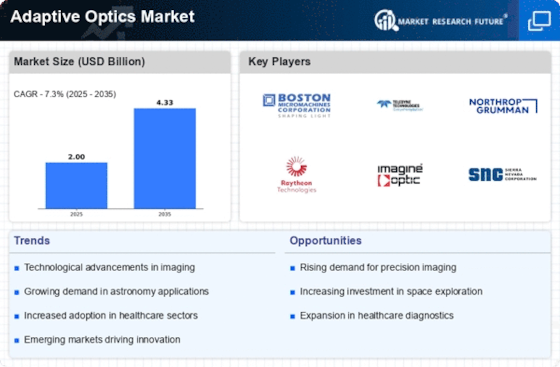
As per Market Research Future analysis, the Adaptive Optics Market Size was estimated at 1.996 USD Billion in 2024. The Adaptive Optics industry is projected to grow from 2.141 USD Billion in 2025 to 4.332 USD Billion by 2035, exhibiting a compound annual growth rate (CAGR) of 7.3% during the forecast period 2025 - 2035

Key Market Trends & Highlights

The Adaptive Optics Market is poised for substantial growth driven by technological advancements and increasing applications across various sectors.

  • Technological advancements are enhancing the performance and capabilities of adaptive optics systems. North America remains the largest market, while Asia-Pacific is emerging as the fastest-growing region in adaptive optics. The astronomy segment continues to dominate the market, whereas the biomedical segment is witnessing rapid growth. Rising demand in astronomy and increased research funding are key drivers propelling market expansion.

Market Size & Forecast

2024 Market Size 1.996 (USD Billion)
2035 Market Size 4.332 (USD Billion)
CAGR (2025 - 2035) 7.3%
Largest Regional Market Share in 2024 North America

Major Players

Boston Micromachines Corporation (US), Teledyne Technologies Incorporated (US), Northrop Grumman Corporation (US), Raytheon Technologies Corporation (US), Adaptive Optics Associates (US), Imagine Optic (FR), Sierra Nevada Corporation (US), Active Optical Systems (US), Optical Solutions (US)

Market Trends

The Adaptive Optics Market is currently experiencing a transformative phase, driven by advancements in technology and increasing applications across various sectors. This market encompasses systems designed to enhance image quality by compensating for distortions caused by atmospheric turbulence or optical imperfections. As industries such as astronomy, telecommunications, and biomedical imaging continue to evolve, the demand for adaptive optics solutions appears to be on the rise. Furthermore, the integration of artificial intelligence and machine learning into these systems is likely to enhance their performance and usability, suggesting a promising future for innovation in this field. In addition to technological advancements, the Adaptive Optics Market is influenced by growing investments in research and development. Organizations are increasingly recognizing the potential of adaptive optics in improving imaging systems, which could lead to breakthroughs in various applications. The collaboration between academic institutions and industry players seems to foster a conducive environment for innovation. As the market progresses, it may witness a shift towards more compact and cost-effective solutions, making adaptive optics accessible to a broader range of users and applications. This evolution indicates a dynamic landscape that is poised for growth and diversification in the coming years.

Technological Advancements

The Adaptive Optics Market is witnessing rapid technological advancements that enhance system capabilities. A comprehensive adaptive optics market analysis confirms that the integration of artificial intelligence for real-time wavefront correction is the primary driver of technological differentiation among major suppliers. This trend suggests a continuous evolution in performance, potentially leading to wider adoption across different sectors.

Increased Applications in Healthcare

There is a growing trend of utilizing adaptive optics in healthcare, particularly in ophthalmology and biomedical imaging. The ability to obtain high-resolution images of biological tissues is revolutionizing diagnostics and treatment planning. This expansion into healthcare indicates a significant opportunity for market growth as the demand for precise imaging solutions rises.

Collaboration and Partnerships

The Adaptive Optics Market is characterized by increasing collaboration between research institutions and industry players. These partnerships are fostering innovation and accelerating the development of new technologies. Such collaborations may lead to enhanced product offerings and a more competitive market landscape, suggesting a promising future for adaptive optics solutions.

Adaptive Optics Market Market Drivers

Increased Research Funding

The Adaptive Optics Market is positively influenced by increased funding for research and development across various sectors. Government and private institutions are investing heavily in projects that utilize adaptive optics for applications ranging from biomedical imaging to environmental monitoring. This influx of funding is expected to accelerate technological advancements and broaden the scope of adaptive optics applications. Recent reports indicate that research funding in optics-related fields has seen a rise of approximately 20% in the last two years, suggesting a robust future for the adaptive optics market as new applications emerge.

Rising Demand in Astronomy

The Adaptive Optics Market is experiencing a notable surge in demand, particularly within the field of astronomy. As telescopes become increasingly sophisticated, the need for adaptive optics systems to correct atmospheric distortions is paramount. This technology enhances image quality, allowing astronomers to observe celestial bodies with unprecedented clarity. Recent data indicates that the market for adaptive optics in astronomy is projected to grow at a compound annual growth rate (CAGR) of approximately 10% over the next five years. This growth is driven by advancements in telescope design and the increasing number of astronomical research projects that require high-resolution imaging capabilities.

Growth in Consumer Electronics

The Adaptive Optics Market is also benefiting from the growth in consumer electronics, particularly in high-end imaging devices. As consumers demand better image quality in cameras and smartphones, manufacturers are increasingly incorporating adaptive optics technology to meet these expectations. This trend is evident in the rising sales of devices equipped with advanced optical systems, which are projected to reach a market value of several billion dollars by 2026. The integration of adaptive optics in consumer products not only enhances user experience but also drives innovation in optical design and manufacturing.

Expansion in Defense and Security

The Adaptive Optics Market is witnessing significant expansion in the defense and security sectors. Military applications, such as surveillance and reconnaissance, increasingly rely on adaptive optics to improve the performance of optical systems. These systems enhance target detection and tracking capabilities, which are crucial for modern warfare. The defense sector's investment in advanced technologies is expected to drive the adaptive optics market, with estimates suggesting a potential market size increase of over 15% in the coming years. This trend reflects a broader shift towards integrating cutting-edge technologies to enhance operational effectiveness.

Emerging Applications in Biomedical Imaging

The Adaptive Optics Market is experiencing growth due to emerging applications in biomedical imaging. Adaptive optics technology is increasingly being utilized in medical devices to enhance imaging capabilities, particularly in ophthalmology and microscopy. This technology allows for high-resolution imaging of biological tissues, which is crucial for early disease detection and treatment planning. The market for adaptive optics in biomedical applications is projected to grow significantly, with estimates indicating a CAGR of around 12% over the next five years. This growth reflects the increasing recognition of adaptive optics as a vital tool in advancing medical imaging techniques.

Market Segment Insights

By Application: Astronomy (Largest) vs. Biomedical (Fastest-Growing)

The adaptive optics market is characterized by is segmentation across various applications such as astronomy, <a href="https://www.marketresearchfuture.com/reports/us-biomedical-textiles-market-16984">biomedical</a>, defense and security, industrial, and consumer electronics. Among these, astronomy holds the largest share, driven by increasing investments in space exploration and astronomical research. The enhancements in imaging capabilities provided by adaptive optics have made it essential for high-resolution observations of celestial objects, making this segment a key player in the market. On the other hand, the biomedical segment is being recognized as the fastest-growing due to the rising demand for advanced diagnostic and treatment technologies. Adaptive optics technology facilitates <a href="https://www.marketresearchfuture.com/reports/high-resolution-3d-x-ray-microscopy-market-1411">high-resolution</a> imaging in complex biological systems, leading to breakthroughs in medical research and improving patient outcomes. This growth trajectory showcases the transformative potential of adaptive optics in healthcare applications, making it a focal point for future developments.

Astronomy (Dominant) vs. Biomedical (Emerging)

Astronomy represents the dominant application of adaptive optics, primarily focused on enhancing telescope performance. Through the implementation of wavefront correction, astronomers can significantly improve image quality and reduce atmospheric distortion effects. This capability is pivotal for ground-based observatories aiming for detailed observations of astronomical phenomena. As investments in space exploration intensify, the need for cutting-edge adaptive optics solutions continues to grow, solidifying astronomy's leading position. In contrast, the biomedical sector is emerging rapidly thanks to innovations that leverage adaptive optics for improved imaging in microscopy and retinal imaging. This application plays a crucial role in advancing techniques that allow for real-time, high-resolution imaging of biological tissues. As healthcare increasingly adopts personalized medicine and early diagnosis, the demand for adaptive optics technologies in medical laboratories and clinics is set to soar, positioning this segment for substantial growth.

By Component: Wavefront Sensors (Largest) vs. Deformable Mirrors (Fastest-Growing)

In the Adaptive Optics Market, Wavefront Sensors dominate the component segment, holding a significant share due to their critical role in measuring wavefront distortion. Following closely, Deformable Mirrors are positioned as a fast-growing segment, driven by increasing applications in astronomy and vision science. Control Systems, Software, and Other Components collectively contribute to the market, yet they do not possess the same level of market share or growth potential as the leading segments.

Wavefront Sensors (Dominant) vs. Deformable Mirrors (Emerging)

Wavefront Sensors are integral to the Adaptive Optics Market, providing precise measurements essential for correcting optical aberrations. Their technology is widely adopted in various fields, including astronomy, military applications, and biomedical imaging, establishing them as the dominant component in this sector. Conversely, Deformable Mirrors are gaining traction as an emerging technology, driven by new advancements that enhance their performance and versatility. Their adaptability in dynamic systems, along with increased demand in emerging applications, marks them as a key focus for innovation and investment in the years ahead.

By End User: Research Institutions (Largest) vs. Healthcare Providers (Fastest-Growing)

In the Adaptive Optics Market, research institutions currently hold the largest market share, leveraging advanced optical technologies for various applications, including astrophysics and biomedical imaging. These institutions play a crucial role in the development and implementation of adaptive optics systems, significantly influencing market dynamics. In contrast, healthcare providers are emerging as the fastest-growing segment, driven by increasing demands for enhanced imaging and treatment technologies in medical fields, including ophthalmology and <a href="https://www.marketresearchfuture.com/reports/neurology-patient-monitoring-market-33918">neurology</a>.

Research Institutions (Dominant) vs. Healthcare Providers (Emerging)

Research institutions dominate the adaptive optics market as they are vital in technological advancements and practical applications. They focus on innovative research that leads to the integration of adaptive optics in numerous fields, including astronomy and clinical research. On the other hand, healthcare providers represent an emerging segment, experiencing rapid growth fueled by advancements in imaging techniques and the increasing prevalence of eye-related diseases. Their adaptation and implementation of adaptive optics enhance diagnostic capabilities, allowing for more precise interventions in patient care, thus driving demand in the healthcare space.

By Technology: Closed-Loop Adaptive Optics (Largest) vs. Open-Loop Adaptive Optics (Fastest-Growing)

<p>In the Adaptive Optics Market, Closed-Loop Adaptive Optics holds a significant share, primarily because of its effectiveness in real-time applications, particularly in astronomical imaging and medical instruments. This technology allows for precise corrections to wavefront distortions, making it integral for ensuring high-quality imaging and enhancing system performance. Open-Loop Adaptive Optics, while trailing in market share, is rapidly gaining traction due to recent technological advancements that have made this approach more viable in various applications, such as remote sensing and telecommunications. The growth of the Adaptive Optics Market is notably driven by increasing demand in astronomical observatories and ophthalmology. Closed-Loop Adaptive Optics is widely appreciated for its reliability and accuracy, which contributes to its market leadership. On the other hand, Open-Loop Adaptive Optics is emerging as the fastest-growing segment, propelled by innovations that reduce costs and enhance portability. Hybrid Adaptive Optics combines the strengths of both systems, catering to a varied range of applications and further influencing the market growth dynamics.</p>

<p>Technology: Closed-Loop Adaptive Optics (Dominant) vs. Hybrid Adaptive Optics (Emerging)</p>

<p>Closed-Loop Adaptive Optics is recognized as the dominant technology in the Adaptive Optics Market due to its unparalleled ability to deliver precise wavefront correction in real-time. This technology employs a feedback loop to continuously adjust optical elements, ensuring high fidelity in imaging applications across astronomy and biomedical fields. Conversely, Hybrid Adaptive Optics, which integrates elements of both closed-loop and open-loop systems, is emerging as a versatile solution for diverse applications. By combining the strengths of both approaches, Hybrid Adaptive Optics can adapt to various conditions and requirements, offering flexibility and enhanced performance. This adaptability makes it increasingly appealing to industries seeking efficient and effective imaging solutions.</p>

Get more detailed insights about Adaptive Optics Market Research Report - Global Forecast to 2035

Regional Insights

In the Regional segmentation of the Global Adaptive Optics Market, the landscape is characterized by varying growth dynamics across several regions. North America holds a majority share with market revenue of 0.8 USD Billion in 2023 and expected growth to 1.5 USD Billion by 2032, driven by advancements in healthcare technologies and a strong service sector, positioning it as a leader in adaptive optics applications.

Europe closely follows with a market valuation of 0.65 USD Billion in 2023, projected to reach 1.2 USD Billion in 2032, reflecting a significant emphasis on research and development in optical technologies. In this region, UK Adaptive Optics Market is benefiting from robust government funding for large-scale telescopes and advanced defense surveillance programs, which continue to foster innovation in local optical manufacturing. Home to several world-leading photonics innovators, the France Adaptive Optics Market remains a critical hub for the development of high-power laser beam control systems used in scientific and critical defense applications.

The APAC region shows promising growth potential, starting at 0.3 USD Billion in 2023 and increasing to 0.78 USD Billion by 2032, fueled by rising healthcare investments and technological upgrades.

South America and MEA are smaller markets, with revenues of 0.05 USD Billion and 0.06 USD Billion in 2023, respectively, but their growth trajectories are important as they signify increased investment in healthcare and optics, reaching 0.1 USD Billion and 0.12 USD Billion by 2032. Overall, the Global Adaptive Optics Market is witnessing robust growth, with North America and Europe dominating due to their established infrastructures and research capabilities, while APAC emerges as a key player with significant growth opportunities.

Fig 3: Adaptive Optics Market Regional Insights

Key Players and Competitive Insights

The Global Adaptive Optics Market is witnessing significant advancements and highly competitive dynamics as various stakeholders focus on improving the performance of optical systems across numerous applications. This market supports a diverse array of sectors, including biomedical imaging, astronomy, and telecommunications, all of which are driving demand for adaptive optics solutions. The competition in this space is primarily influenced by innovation, technological advancements, and the ability to cater to specific user requirements. As companies strive to differentiate their offerings, pricing strategies, partnerships, and product quality become critical factors in maintaining market share and attracting new clients. Furthermore, the increasing need for precision optics in both research institutions and commercial applications continuously reshapes the competitive landscape, prompting existing players to upgrade their technologies and explore new market opportunities.Zygo Corporation has carved a niche for itself in the Global Adaptive Optics Market due to its strong reputation for high-performance optical products and advanced metrology technology. The company is recognized for its expertise in manufacturing precision optical components and systems, which includes adaptive optics solutions tailored for applications such as laser communications and imaging. Zygo's commitment to research and development allows it to stay ahead of industry trends, enabling the introduction of innovative products that address the evolving demands of its customers. Additionally, the company's extensive experience and established presence in the optical component market further enhance its competitive strength, making it a preferred choice for organizations seeking reliable and cutting-edge adaptive optics solutions.Melles Griot is another key player in the Global Adaptive Optics Market, known for their extensive portfolio of optical and photonic products that cater to various applications. This company's strength lies in its focus on providing high-quality components, including lasers and opto-mechanical systems, which are essential for adaptive optics implementations. Melles Griot has built a robust presence in the scientific and industrial sectors, leveraging its technical expertise and long-standing credibility within the market. The company is committed to quality and customer satisfaction, which further strengthens its competitive position in the adaptive optics domain. By continuously innovating and adapting its product offerings to meet customer needs, Melles Griot is well-poised to maintain its relevance and competitiveness within the dynamic landscape of adaptive optics.

Key Companies in the Adaptive Optics Market include

Industry Developments

  • Q1 2024: Spotlight on Adaptive Optics Market: Wavefront Dynamics raises $12M Series A to advance ophthalmic imaging Wavefront Dynamics, a company specializing in adaptive optics for ophthalmic imaging, secured $12 million in Series A funding to accelerate product development and expand its team.
  • Q2 2024: Imagine Optic Announces Strategic Partnership with Thorlabs to Expand Adaptive Optics Market Solutions Imagine Optic entered a strategic partnership with Thorlabs to co-develop and distribute advanced adaptive optics components for scientific and industrial applications.
  • Q2 2024: Boston Micromachines Corporation Launches New 2K-DM Deformable Mirror for High-Resolution Imaging Boston Micromachines Corporation introduced its new 2K-DM deformable mirror, designed to enhance adaptive optics performance in astronomy and microscopy.
  • Q2 2024: Adaptive Optics Market Associates-Xinetics, a Northrop Grumman Company, Opens New Manufacturing Facility in Massachusetts Adaptive Optics Market Associates-Xinetics, a subsidiary of Northrop Grumman, inaugurated a new manufacturing facility in Massachusetts to increase production capacity for advanced optical systems.
  • Q2 2024: Cailabs secures €16 million in Series B funding to scale adaptive optics for laser communications French startup Cailabs raised €16 million in Series B funding to expand its adaptive optics technology for high-speed laser communication systems.
  • Q3 2024: Iris AO Announces Partnership with Hamamatsu Photonics for MEMS Deformable Mirror Integration Iris AO partnered with Hamamatsu Photonics to integrate its MEMS-based deformable mirrors into Hamamatsu’s imaging and laser systems.
  • Q3 2024: ALPAO Appoints Dr. Sophie Martin as Chief Technology Officer ALPAO, a provider of adaptive optics solutions, appointed Dr. Sophie Martin as its new Chief Technology Officer to lead R&D and product innovation.
  • Q3 2024: Flexible Optical B.V. Wins Contract to Supply Adaptive Optics Market for European Southern Observatory Flexible Optical B.V. was awarded a contract to deliver adaptive optics components for the European Southern Observatory’s next-generation telescopes.
  • Q4 2024: Imagine Optic Launches HASO4 Fast Wavefront Sensor for Real-Time Adaptive Optics Market Imagine Optic released the HASO4 Fast, a new wavefront sensor designed for real-time adaptive optics applications in microscopy and laser processing.
  • Q4 2024: Northrop Grumman’s Adaptive Optics Market Associates-Xinetics Secures NASA Contract for Space Telescope Project Adaptive Optics Market Associates-Xinetics, part of Northrop Grumman, secured a contract from NASA to supply adaptive optics technology for a major space telescope initiative.
  • Q1 2025: Cailabs partners with Airbus to develop adaptive optics for satellite laser communications Cailabs announced a partnership with Airbus to co-develop adaptive optics solutions aimed at improving satellite-based laser communication systems.
  • Q2 2025: Boston Micromachines Corporation Receives NIH Grant for Adaptive Optics Market Retinal Imaging Project Boston Micromachines Corporation was awarded a grant from the National Institutes of Health to advance adaptive optics technology for high-resolution retinal imaging.

Future Outlook

Adaptive Optics Market Future Outlook

The Adaptive Optics Market is projected to grow at a 7.3% CAGR from 2025 to 2035, driven by advancements in imaging technologies and increasing demand in astronomy and healthcare.

New opportunities lie in:

  • <p>Development of compact adaptive optics systems for consumer electronics. Expansion into telecommunication sectors for improved signal clarity. Partnerships with research institutions for innovative adaptive optics applications.</p>

By 2035, the Adaptive Optics Market is expected to achieve substantial growth, solidifying its role in various high-tech industries.

Market Segmentation

Adaptive Optics Market End User Outlook

  • Research Institutions
  • Healthcare Providers
  • Military Organizations
  • Manufacturing Companies
  • Educational Institutions

Adaptive Optics Market Component Outlook

  • Wavefront Sensors
  • Deformable Mirrors
  • Control Systems
  • Software
  • Other Components

Adaptive Optics Market Technology Outlook

  • Closed-Loop Adaptive Optics
  • Open-Loop Adaptive Optics
  • Hybrid Adaptive Optics

Adaptive Optics Market Application Outlook

  • Astronomy
  • Biomedical
  • Defense and Security
  • Industrial
  • Consumer Electronics

Report Scope

MARKET SIZE 2024 1.996(USD Billion)
MARKET SIZE 2025 2.141(USD Billion)
MARKET SIZE 2035 4.332(USD Billion)
COMPOUND ANNUAL GROWTH RATE (CAGR) 7.3% (2025 - 2035)
REPORT COVERAGE Revenue Forecast, Competitive Landscape, Growth Factors, and Trends
BASE YEAR 2024
Market Forecast Period 2025 - 2035
Historical Data 2019 - 2024
Market Forecast Units USD Billion
Key Companies Profiled Boston Micromachines Corporation (US), Teledyne Technologies Incorporated (US), Northrop Grumman Corporation (US), Raytheon Technologies Corporation (US), Adaptive Optics Associates (US), Imagine Optic (FR), Sierra Nevada Corporation (US), Active Optical Systems (US), Optical Solutions (US)
Segments Covered Application, Component, End User, Technology, Regional
Key Market Opportunities Advancements in imaging technologies drive demand for enhanced performance in the Adaptive Optics Market.
Key Market Dynamics Technological advancements drive demand for adaptive optics in astronomy, defense, and biomedical applications, enhancing imaging capabilities.
Countries Covered North America, Europe, APAC, South America, MEA

FAQs

What is the projected market valuation of the Adaptive Optics Market by 2035?

<p>The Adaptive Optics Market is projected to reach a valuation of 4.332 USD Billion by 2035.</p>

What was the market valuation of the Adaptive Optics Market in 2024?

<p>In 2024, the overall market valuation was 1.996 USD Billion.</p>

What is the expected CAGR for the Adaptive Optics Market during the forecast period 2025 - 2035?

<p>The expected CAGR for the Adaptive Optics Market during the forecast period 2025 - 2035 is 7.3%.</p>

Which application segment is expected to show significant growth in the Adaptive Optics Market?

<p>The Biomedical application segment is anticipated to grow from 0.6 USD Billion in 2024 to 1.2 USD Billion by 2035.</p>

What are the key components driving the Adaptive Optics Market?

<p>Key components include Wavefront Sensors, Deformable Mirrors, and Control Systems, with Wavefront Sensors projected to grow from 0.6 USD Billion to 1.2 USD Billion by 2035.</p>

Who are the leading players in the Adaptive Optics Market?

<p>Key players in the Adaptive Optics Market include Boston Micromachines Corporation, Teledyne Technologies Incorporated, and Northrop Grumman Corporation.</p>

What end-user segments are expected to contribute to the growth of the Adaptive Optics Market?

<p>Healthcare Providers and Research Institutions are expected to significantly contribute, with Healthcare Providers projected to grow from 0.8 USD Billion to 1.6 USD Billion by 2035.</p>

How does the technology segment of Adaptive Optics Market perform?

<p>The Closed-Loop Adaptive Optics technology segment is expected to grow from 0.798 USD Billion in 2024 to 1.748 USD Billion by 2035.</p>

What is the growth outlook for the Consumer Electronics segment within the Adaptive Optics Market?

<p>The Consumer Electronics segment is projected to increase from 0.196 USD Billion in 2024 to 0.432 USD Billion by 2035.</p>

What role do companies like Raytheon Technologies Corporation play in the Adaptive Optics Market?

<p>Raytheon Technologies Corporation is among the key players, contributing to advancements and innovations within the Adaptive Optics Market.</p>

  1. SECTION I: EXECUTIVE SUMMARY AND KEY HIGHLIGHTS
    1. | 1.1 EXECUTIVE SUMMARY
    2. | | 1.1.1 Market Overview
    3. | | 1.1.2 Key Findings
    4. | | 1.1.3 Market Segmentation
    5. | | 1.1.4 Competitive Landscape
    6. | | 1.1.5 Challenges and Opportunities
    7. | | 1.1.6 Future Outlook
  2. SECTION II: SCOPING, METHODOLOGY AND MARKET STRUCTURE
    1. | 2.1 MARKET INTRODUCTION
    2. | | 2.1.1 Definition
    3. | | 2.1.2 Scope of the study
    4. | | | 2.1.2.1 Research Objective
    5. | | | 2.1.2.2 Assumption
    6. | | | 2.1.2.3 Limitations
    7. | 2.2 RESEARCH METHODOLOGY
    8. | | 2.2.1 Overview
    9. | | 2.2.2 Data Mining
    10. | | 2.2.3 Secondary Research
    11. | | 2.2.4 Primary Research
    12. | | | 2.2.4.1 Primary Interviews and Information Gathering Process
    13. | | | 2.2.4.2 Breakdown of Primary Respondents
    14. | | 2.2.5 Forecasting Model
    15. | | 2.2.6 Market Size Estimation
    16. | | | 2.2.6.1 Bottom-Up Approach
    17. | | | 2.2.6.2 Top-Down Approach
    18. | | 2.2.7 Data Triangulation
    19. | | 2.2.8 Validation
  3. SECTION III: QUALITATIVE ANALYSIS
    1. | 3.1 MARKET DYNAMICS
    2. | | 3.1.1 Overview
    3. | | 3.1.2 Drivers
    4. | | 3.1.3 Restraints
    5. | | 3.1.4 Opportunities
    6. | 3.2 MARKET FACTOR ANALYSIS
    7. | | 3.2.1 Value chain Analysis
    8. | | 3.2.2 Porter's Five Forces Analysis
    9. | | | 3.2.2.1 Bargaining Power of Suppliers
    10. | | | 3.2.2.2 Bargaining Power of Buyers
    11. | | | 3.2.2.3 Threat of New Entrants
    12. | | | 3.2.2.4 Threat of Substitutes
    13. | | | 3.2.2.5 Intensity of Rivalry
    14. | | 3.2.3 COVID-19 Impact Analysis
    15. | | | 3.2.3.1 Market Impact Analysis
    16. | | | 3.2.3.2 Regional Impact
    17. | | | 3.2.3.3 Opportunity and Threat Analysis
  4. SECTION IV: QUANTITATIVE ANALYSIS
    1. | 4.1 Information and Communications Technology, BY Application (USD Billion)
    2. | | 4.1.1 Astronomy
    3. | | 4.1.2 Biomedical
    4. | | 4.1.3 Defense and Security
    5. | | 4.1.4 Industrial
    6. | | 4.1.5 Consumer Electronics
    7. | 4.2 Information and Communications Technology, BY Component (USD Billion)
    8. | | 4.2.1 Wavefront Sensors
    9. | | 4.2.2 Deformable Mirrors
    10. | | 4.2.3 Control Systems
    11. | | 4.2.4 Software
    12. | | 4.2.5 Other Components
    13. | 4.3 Information and Communications Technology, BY End User (USD Billion)
    14. | | 4.3.1 Research Institutions
    15. | | 4.3.2 Healthcare Providers
    16. | | 4.3.3 Military Organizations
    17. | | 4.3.4 Manufacturing Companies
    18. | | 4.3.5 Educational Institutions
    19. | 4.4 Information and Communications Technology, BY Technology (USD Billion)
    20. | | 4.4.1 Closed-Loop Adaptive Optics
    21. | | 4.4.2 Open-Loop Adaptive Optics
    22. | | 4.4.3 Hybrid Adaptive Optics
    23. | 4.5 Information and Communications Technology, BY Region (USD Billion)
    24. | | 4.5.1 North America
    25. | | | 4.5.1.1 US
    26. | | | 4.5.1.2 Canada
    27. | | 4.5.2 Europe
    28. | | | 4.5.2.1 Germany
    29. | | | 4.5.2.2 UK
    30. | | | 4.5.2.3 France
    31. | | | 4.5.2.4 Russia
    32. | | | 4.5.2.5 Italy
    33. | | | 4.5.2.6 Spain
    34. | | | 4.5.2.7 Rest of Europe
    35. | | 4.5.3 APAC
    36. | | | 4.5.3.1 China
    37. | | | 4.5.3.2 India
    38. | | | 4.5.3.3 Japan
    39. | | | 4.5.3.4 South Korea
    40. | | | 4.5.3.5 Malaysia
    41. | | | 4.5.3.6 Thailand
    42. | | | 4.5.3.7 Indonesia
    43. | | | 4.5.3.8 Rest of APAC
    44. | | 4.5.4 South America
    45. | | | 4.5.4.1 Brazil
    46. | | | 4.5.4.2 Mexico
    47. | | | 4.5.4.3 Argentina
    48. | | | 4.5.4.4 Rest of South America
    49. | | 4.5.5 MEA
    50. | | | 4.5.5.1 GCC Countries
    51. | | | 4.5.5.2 South Africa
    52. | | | 4.5.5.3 Rest of MEA
  5. SECTION V: COMPETITIVE ANALYSIS
    1. | 5.1 Competitive Landscape
    2. | | 5.1.1 Overview
    3. | | 5.1.2 Competitive Analysis
    4. | | 5.1.3 Market share Analysis
    5. | | 5.1.4 Major Growth Strategy in the Information and Communications Technology
    6. | | 5.1.5 Competitive Benchmarking
    7. | | 5.1.6 Leading Players in Terms of Number of Developments in the Information and Communications Technology
    8. | | 5.1.7 Key developments and growth strategies
    9. | | | 5.1.7.1 New Product Launch/Service Deployment
    10. | | | 5.1.7.2 Merger & Acquisitions
    11. | | | 5.1.7.3 Joint Ventures
    12. | | 5.1.8 Major Players Financial Matrix
    13. | | | 5.1.8.1 Sales and Operating Income
    14. | | | 5.1.8.2 Major Players R&D Expenditure. 2023
    15. | 5.2 Company Profiles
    16. | | 5.2.1 Boston Micromachines Corporation (US)
    17. | | | 5.2.1.1 Financial Overview
    18. | | | 5.2.1.2 Products Offered
    19. | | | 5.2.1.3 Key Developments
    20. | | | 5.2.1.4 SWOT Analysis
    21. | | | 5.2.1.5 Key Strategies
    22. | | 5.2.2 Teledyne Technologies Incorporated (US)
    23. | | | 5.2.2.1 Financial Overview
    24. | | | 5.2.2.2 Products Offered
    25. | | | 5.2.2.3 Key Developments
    26. | | | 5.2.2.4 SWOT Analysis
    27. | | | 5.2.2.5 Key Strategies
    28. | | 5.2.3 Northrop Grumman Corporation (US)
    29. | | | 5.2.3.1 Financial Overview
    30. | | | 5.2.3.2 Products Offered
    31. | | | 5.2.3.3 Key Developments
    32. | | | 5.2.3.4 SWOT Analysis
    33. | | | 5.2.3.5 Key Strategies
    34. | | 5.2.4 Raytheon Technologies Corporation (US)
    35. | | | 5.2.4.1 Financial Overview
    36. | | | 5.2.4.2 Products Offered
    37. | | | 5.2.4.3 Key Developments
    38. | | | 5.2.4.4 SWOT Analysis
    39. | | | 5.2.4.5 Key Strategies
    40. | | 5.2.5 Adaptive Optics Associates (US)
    41. | | | 5.2.5.1 Financial Overview
    42. | | | 5.2.5.2 Products Offered
    43. | | | 5.2.5.3 Key Developments
    44. | | | 5.2.5.4 SWOT Analysis
    45. | | | 5.2.5.5 Key Strategies
    46. | | 5.2.6 Imagine Optic (FR)
    47. | | | 5.2.6.1 Financial Overview
    48. | | | 5.2.6.2 Products Offered
    49. | | | 5.2.6.3 Key Developments
    50. | | | 5.2.6.4 SWOT Analysis
    51. | | | 5.2.6.5 Key Strategies
    52. | | 5.2.7 Sierra Nevada Corporation (US)
    53. | | | 5.2.7.1 Financial Overview
    54. | | | 5.2.7.2 Products Offered
    55. | | | 5.2.7.3 Key Developments
    56. | | | 5.2.7.4 SWOT Analysis
    57. | | | 5.2.7.5 Key Strategies
    58. | | 5.2.8 Active Optical Systems (US)
    59. | | | 5.2.8.1 Financial Overview
    60. | | | 5.2.8.2 Products Offered
    61. | | | 5.2.8.3 Key Developments
    62. | | | 5.2.8.4 SWOT Analysis
    63. | | | 5.2.8.5 Key Strategies
    64. | | 5.2.9 Optical Solutions (US)
    65. | | | 5.2.9.1 Financial Overview
    66. | | | 5.2.9.2 Products Offered
    67. | | | 5.2.9.3 Key Developments
    68. | | | 5.2.9.4 SWOT Analysis
    69. | | | 5.2.9.5 Key Strategies
    70. | 5.3 Appendix
    71. | | 5.3.1 References
    72. | | 5.3.2 Related Reports
  6. LIST OF FIGURES
    1. | 6.1 MARKET SYNOPSIS
    2. | 6.2 NORTH AMERICA MARKET ANALYSIS
    3. | 6.3 US MARKET ANALYSIS BY APPLICATION
    4. | 6.4 US MARKET ANALYSIS BY COMPONENT
    5. | 6.5 US MARKET ANALYSIS BY END USER
    6. | 6.6 US MARKET ANALYSIS BY TECHNOLOGY
    7. | 6.7 CANADA MARKET ANALYSIS BY APPLICATION
    8. | 6.8 CANADA MARKET ANALYSIS BY COMPONENT
    9. | 6.9 CANADA MARKET ANALYSIS BY END USER
    10. | 6.10 CANADA MARKET ANALYSIS BY TECHNOLOGY
    11. | 6.11 EUROPE MARKET ANALYSIS
    12. | 6.12 GERMANY MARKET ANALYSIS BY APPLICATION
    13. | 6.13 GERMANY MARKET ANALYSIS BY COMPONENT
    14. | 6.14 GERMANY MARKET ANALYSIS BY END USER
    15. | 6.15 GERMANY MARKET ANALYSIS BY TECHNOLOGY
    16. | 6.16 UK MARKET ANALYSIS BY APPLICATION
    17. | 6.17 UK MARKET ANALYSIS BY COMPONENT
    18. | 6.18 UK MARKET ANALYSIS BY END USER
    19. | 6.19 UK MARKET ANALYSIS BY TECHNOLOGY
    20. | 6.20 FRANCE MARKET ANALYSIS BY APPLICATION
    21. | 6.21 FRANCE MARKET ANALYSIS BY COMPONENT
    22. | 6.22 FRANCE MARKET ANALYSIS BY END USER
    23. | 6.23 FRANCE MARKET ANALYSIS BY TECHNOLOGY
    24. | 6.24 RUSSIA MARKET ANALYSIS BY APPLICATION
    25. | 6.25 RUSSIA MARKET ANALYSIS BY COMPONENT
    26. | 6.26 RUSSIA MARKET ANALYSIS BY END USER
    27. | 6.27 RUSSIA MARKET ANALYSIS BY TECHNOLOGY
    28. | 6.28 ITALY MARKET ANALYSIS BY APPLICATION
    29. | 6.29 ITALY MARKET ANALYSIS BY COMPONENT
    30. | 6.30 ITALY MARKET ANALYSIS BY END USER
    31. | 6.31 ITALY MARKET ANALYSIS BY TECHNOLOGY
    32. | 6.32 SPAIN MARKET ANALYSIS BY APPLICATION
    33. | 6.33 SPAIN MARKET ANALYSIS BY COMPONENT
    34. | 6.34 SPAIN MARKET ANALYSIS BY END USER
    35. | 6.35 SPAIN MARKET ANALYSIS BY TECHNOLOGY
    36. | 6.36 REST OF EUROPE MARKET ANALYSIS BY APPLICATION
    37. | 6.37 REST OF EUROPE MARKET ANALYSIS BY COMPONENT
    38. | 6.38 REST OF EUROPE MARKET ANALYSIS BY END USER
    39. | 6.39 REST OF EUROPE MARKET ANALYSIS BY TECHNOLOGY
    40. | 6.40 APAC MARKET ANALYSIS
    41. | 6.41 CHINA MARKET ANALYSIS BY APPLICATION
    42. | 6.42 CHINA MARKET ANALYSIS BY COMPONENT
    43. | 6.43 CHINA MARKET ANALYSIS BY END USER
    44. | 6.44 CHINA MARKET ANALYSIS BY TECHNOLOGY
    45. | 6.45 INDIA MARKET ANALYSIS BY APPLICATION
    46. | 6.46 INDIA MARKET ANALYSIS BY COMPONENT
    47. | 6.47 INDIA MARKET ANALYSIS BY END USER
    48. | 6.48 INDIA MARKET ANALYSIS BY TECHNOLOGY
    49. | 6.49 JAPAN MARKET ANALYSIS BY APPLICATION
    50. | 6.50 JAPAN MARKET ANALYSIS BY COMPONENT
    51. | 6.51 JAPAN MARKET ANALYSIS BY END USER
    52. | 6.52 JAPAN MARKET ANALYSIS BY TECHNOLOGY
    53. | 6.53 SOUTH KOREA MARKET ANALYSIS BY APPLICATION
    54. | 6.54 SOUTH KOREA MARKET ANALYSIS BY COMPONENT
    55. | 6.55 SOUTH KOREA MARKET ANALYSIS BY END USER
    56. | 6.56 SOUTH KOREA MARKET ANALYSIS BY TECHNOLOGY
    57. | 6.57 MALAYSIA MARKET ANALYSIS BY APPLICATION
    58. | 6.58 MALAYSIA MARKET ANALYSIS BY COMPONENT
    59. | 6.59 MALAYSIA MARKET ANALYSIS BY END USER
    60. | 6.60 MALAYSIA MARKET ANALYSIS BY TECHNOLOGY
    61. | 6.61 THAILAND MARKET ANALYSIS BY APPLICATION
    62. | 6.62 THAILAND MARKET ANALYSIS BY COMPONENT
    63. | 6.63 THAILAND MARKET ANALYSIS BY END USER
    64. | 6.64 THAILAND MARKET ANALYSIS BY TECHNOLOGY
    65. | 6.65 INDONESIA MARKET ANALYSIS BY APPLICATION
    66. | 6.66 INDONESIA MARKET ANALYSIS BY COMPONENT
    67. | 6.67 INDONESIA MARKET ANALYSIS BY END USER
    68. | 6.68 INDONESIA MARKET ANALYSIS BY TECHNOLOGY
    69. | 6.69 REST OF APAC MARKET ANALYSIS BY APPLICATION
    70. | 6.70 REST OF APAC MARKET ANALYSIS BY COMPONENT
    71. | 6.71 REST OF APAC MARKET ANALYSIS BY END USER
    72. | 6.72 REST OF APAC MARKET ANALYSIS BY TECHNOLOGY
    73. | 6.73 SOUTH AMERICA MARKET ANALYSIS
    74. | 6.74 BRAZIL MARKET ANALYSIS BY APPLICATION
    75. | 6.75 BRAZIL MARKET ANALYSIS BY COMPONENT
    76. | 6.76 BRAZIL MARKET ANALYSIS BY END USER
    77. | 6.77 BRAZIL MARKET ANALYSIS BY TECHNOLOGY
    78. | 6.78 MEXICO MARKET ANALYSIS BY APPLICATION
    79. | 6.79 MEXICO MARKET ANALYSIS BY COMPONENT
    80. | 6.80 MEXICO MARKET ANALYSIS BY END USER
    81. | 6.81 MEXICO MARKET ANALYSIS BY TECHNOLOGY
    82. | 6.82 ARGENTINA MARKET ANALYSIS BY APPLICATION
    83. | 6.83 ARGENTINA MARKET ANALYSIS BY COMPONENT
    84. | 6.84 ARGENTINA MARKET ANALYSIS BY END USER
    85. | 6.85 ARGENTINA MARKET ANALYSIS BY TECHNOLOGY
    86. | 6.86 REST OF SOUTH AMERICA MARKET ANALYSIS BY APPLICATION
    87. | 6.87 REST OF SOUTH AMERICA MARKET ANALYSIS BY COMPONENT
    88. | 6.88 REST OF SOUTH AMERICA MARKET ANALYSIS BY END USER
    89. | 6.89 REST OF SOUTH AMERICA MARKET ANALYSIS BY TECHNOLOGY
    90. | 6.90 MEA MARKET ANALYSIS
    91. | 6.91 GCC COUNTRIES MARKET ANALYSIS BY APPLICATION
    92. | 6.92 GCC COUNTRIES MARKET ANALYSIS BY COMPONENT
    93. | 6.93 GCC COUNTRIES MARKET ANALYSIS BY END USER
    94. | 6.94 GCC COUNTRIES MARKET ANALYSIS BY TECHNOLOGY
    95. | 6.95 SOUTH AFRICA MARKET ANALYSIS BY APPLICATION
    96. | 6.96 SOUTH AFRICA MARKET ANALYSIS BY COMPONENT
    97. | 6.97 SOUTH AFRICA MARKET ANALYSIS BY END USER
    98. | 6.98 SOUTH AFRICA MARKET ANALYSIS BY TECHNOLOGY
    99. | 6.99 REST OF MEA MARKET ANALYSIS BY APPLICATION
    100. | 6.100 REST OF MEA MARKET ANALYSIS BY COMPONENT
    101. | 6.101 REST OF MEA MARKET ANALYSIS BY END USER
    102. | 6.102 REST OF MEA MARKET ANALYSIS BY TECHNOLOGY
    103. | 6.103 KEY BUYING CRITERIA OF INFORMATION AND COMMUNICATIONS TECHNOLOGY
    104. | 6.104 RESEARCH PROCESS OF MRFR
    105. | 6.105 DRO ANALYSIS OF INFORMATION AND COMMUNICATIONS TECHNOLOGY
    106. | 6.106 DRIVERS IMPACT ANALYSIS: INFORMATION AND COMMUNICATIONS TECHNOLOGY
    107. | 6.107 RESTRAINTS IMPACT ANALYSIS: INFORMATION AND COMMUNICATIONS TECHNOLOGY
    108. | 6.108 SUPPLY / VALUE CHAIN: INFORMATION AND COMMUNICATIONS TECHNOLOGY
    109. | 6.109 INFORMATION AND COMMUNICATIONS TECHNOLOGY, BY APPLICATION, 2024 (% SHARE)
    110. | 6.110 INFORMATION AND COMMUNICATIONS TECHNOLOGY, BY APPLICATION, 2024 TO 2035 (USD Billion)
    111. | 6.111 INFORMATION AND COMMUNICATIONS TECHNOLOGY, BY COMPONENT, 2024 (% SHARE)
    112. | 6.112 INFORMATION AND COMMUNICATIONS TECHNOLOGY, BY COMPONENT, 2024 TO 2035 (USD Billion)
    113. | 6.113 INFORMATION AND COMMUNICATIONS TECHNOLOGY, BY END USER, 2024 (% SHARE)
    114. | 6.114 INFORMATION AND COMMUNICATIONS TECHNOLOGY, BY END USER, 2024 TO 2035 (USD Billion)
    115. | 6.115 INFORMATION AND COMMUNICATIONS TECHNOLOGY, BY TECHNOLOGY, 2024 (% SHARE)
    116. | 6.116 INFORMATION AND COMMUNICATIONS TECHNOLOGY, BY TECHNOLOGY, 2024 TO 2035 (USD Billion)
    117. | 6.117 BENCHMARKING OF MAJOR COMPETITORS
  7. LIST OF TABLES
    1. | 7.1 LIST OF ASSUMPTIONS
    2. | | 7.1.1
    3. | 7.2 North America MARKET SIZE ESTIMATES; FORECAST
    4. | | 7.2.1 BY APPLICATION, 2025-2035 (USD Billion)
    5. | | 7.2.2 BY COMPONENT, 2025-2035 (USD Billion)
    6. | | 7.2.3 BY END USER, 2025-2035 (USD Billion)
    7. | | 7.2.4 BY TECHNOLOGY, 2025-2035 (USD Billion)
    8. | 7.3 US MARKET SIZE ESTIMATES; FORECAST
    9. | | 7.3.1 BY APPLICATION, 2025-2035 (USD Billion)
    10. | | 7.3.2 BY COMPONENT, 2025-2035 (USD Billion)
    11. | | 7.3.3 BY END USER, 2025-2035 (USD Billion)
    12. | | 7.3.4 BY TECHNOLOGY, 2025-2035 (USD Billion)
    13. | 7.4 Canada MARKET SIZE ESTIMATES; FORECAST
    14. | | 7.4.1 BY APPLICATION, 2025-2035 (USD Billion)
    15. | | 7.4.2 BY COMPONENT, 2025-2035 (USD Billion)
    16. | | 7.4.3 BY END USER, 2025-2035 (USD Billion)
    17. | | 7.4.4 BY TECHNOLOGY, 2025-2035 (USD Billion)
    18. | 7.5 Europe MARKET SIZE ESTIMATES; FORECAST
    19. | | 7.5.1 BY APPLICATION, 2025-2035 (USD Billion)
    20. | | 7.5.2 BY COMPONENT, 2025-2035 (USD Billion)
    21. | | 7.5.3 BY END USER, 2025-2035 (USD Billion)
    22. | | 7.5.4 BY TECHNOLOGY, 2025-2035 (USD Billion)
    23. | 7.6 Germany MARKET SIZE ESTIMATES; FORECAST
    24. | | 7.6.1 BY APPLICATION, 2025-2035 (USD Billion)
    25. | | 7.6.2 BY COMPONENT, 2025-2035 (USD Billion)
    26. | | 7.6.3 BY END USER, 2025-2035 (USD Billion)
    27. | | 7.6.4 BY TECHNOLOGY, 2025-2035 (USD Billion)
    28. | 7.7 UK MARKET SIZE ESTIMATES; FORECAST
    29. | | 7.7.1 BY APPLICATION, 2025-2035 (USD Billion)
    30. | | 7.7.2 BY COMPONENT, 2025-2035 (USD Billion)
    31. | | 7.7.3 BY END USER, 2025-2035 (USD Billion)
    32. | | 7.7.4 BY TECHNOLOGY, 2025-2035 (USD Billion)
    33. | 7.8 France MARKET SIZE ESTIMATES; FORECAST
    34. | | 7.8.1 BY APPLICATION, 2025-2035 (USD Billion)
    35. | | 7.8.2 BY COMPONENT, 2025-2035 (USD Billion)
    36. | | 7.8.3 BY END USER, 2025-2035 (USD Billion)
    37. | | 7.8.4 BY TECHNOLOGY, 2025-2035 (USD Billion)
    38. | 7.9 Russia MARKET SIZE ESTIMATES; FORECAST
    39. | | 7.9.1 BY APPLICATION, 2025-2035 (USD Billion)
    40. | | 7.9.2 BY COMPONENT, 2025-2035 (USD Billion)
    41. | | 7.9.3 BY END USER, 2025-2035 (USD Billion)
    42. | | 7.9.4 BY TECHNOLOGY, 2025-2035 (USD Billion)
    43. | 7.10 Italy MARKET SIZE ESTIMATES; FORECAST
    44. | | 7.10.1 BY APPLICATION, 2025-2035 (USD Billion)
    45. | | 7.10.2 BY COMPONENT, 2025-2035 (USD Billion)
    46. | | 7.10.3 BY END USER, 2025-2035 (USD Billion)
    47. | | 7.10.4 BY TECHNOLOGY, 2025-2035 (USD Billion)
    48. | 7.11 Spain MARKET SIZE ESTIMATES; FORECAST
    49. | | 7.11.1 BY APPLICATION, 2025-2035 (USD Billion)
    50. | | 7.11.2 BY COMPONENT, 2025-2035 (USD Billion)
    51. | | 7.11.3 BY END USER, 2025-2035 (USD Billion)
    52. | | 7.11.4 BY TECHNOLOGY, 2025-2035 (USD Billion)
    53. | 7.12 Rest of Europe MARKET SIZE ESTIMATES; FORECAST
    54. | | 7.12.1 BY APPLICATION, 2025-2035 (USD Billion)
    55. | | 7.12.2 BY COMPONENT, 2025-2035 (USD Billion)
    56. | | 7.12.3 BY END USER, 2025-2035 (USD Billion)
    57. | | 7.12.4 BY TECHNOLOGY, 2025-2035 (USD Billion)
    58. | 7.13 APAC MARKET SIZE ESTIMATES; FORECAST
    59. | | 7.13.1 BY APPLICATION, 2025-2035 (USD Billion)
    60. | | 7.13.2 BY COMPONENT, 2025-2035 (USD Billion)
    61. | | 7.13.3 BY END USER, 2025-2035 (USD Billion)
    62. | | 7.13.4 BY TECHNOLOGY, 2025-2035 (USD Billion)
    63. | 7.14 China MARKET SIZE ESTIMATES; FORECAST
    64. | | 7.14.1 BY APPLICATION, 2025-2035 (USD Billion)
    65. | | 7.14.2 BY COMPONENT, 2025-2035 (USD Billion)
    66. | | 7.14.3 BY END USER, 2025-2035 (USD Billion)
    67. | | 7.14.4 BY TECHNOLOGY, 2025-2035 (USD Billion)
    68. | 7.15 India MARKET SIZE ESTIMATES; FORECAST
    69. | | 7.15.1 BY APPLICATION, 2025-2035 (USD Billion)
    70. | | 7.15.2 BY COMPONENT, 2025-2035 (USD Billion)
    71. | | 7.15.3 BY END USER, 2025-2035 (USD Billion)
    72. | | 7.15.4 BY TECHNOLOGY, 2025-2035 (USD Billion)
    73. | 7.16 Japan MARKET SIZE ESTIMATES; FORECAST
    74. | | 7.16.1 BY APPLICATION, 2025-2035 (USD Billion)
    75. | | 7.16.2 BY COMPONENT, 2025-2035 (USD Billion)
    76. | | 7.16.3 BY END USER, 2025-2035 (USD Billion)
    77. | | 7.16.4 BY TECHNOLOGY, 2025-2035 (USD Billion)
    78. | 7.17 South Korea MARKET SIZE ESTIMATES; FORECAST
    79. | | 7.17.1 BY APPLICATION, 2025-2035 (USD Billion)
    80. | | 7.17.2 BY COMPONENT, 2025-2035 (USD Billion)
    81. | | 7.17.3 BY END USER, 2025-2035 (USD Billion)
    82. | | 7.17.4 BY TECHNOLOGY, 2025-2035 (USD Billion)
    83. | 7.18 Malaysia MARKET SIZE ESTIMATES; FORECAST
    84. | | 7.18.1 BY APPLICATION, 2025-2035 (USD Billion)
    85. | | 7.18.2 BY COMPONENT, 2025-2035 (USD Billion)
    86. | | 7.18.3 BY END USER, 2025-2035 (USD Billion)
    87. | | 7.18.4 BY TECHNOLOGY, 2025-2035 (USD Billion)
    88. | 7.19 Thailand MARKET SIZE ESTIMATES; FORECAST
    89. | | 7.19.1 BY APPLICATION, 2025-2035 (USD Billion)
    90. | | 7.19.2 BY COMPONENT, 2025-2035 (USD Billion)
    91. | | 7.19.3 BY END USER, 2025-2035 (USD Billion)
    92. | | 7.19.4 BY TECHNOLOGY, 2025-2035 (USD Billion)
    93. | 7.20 Indonesia MARKET SIZE ESTIMATES; FORECAST
    94. | | 7.20.1 BY APPLICATION, 2025-2035 (USD Billion)
    95. | | 7.20.2 BY COMPONENT, 2025-2035 (USD Billion)
    96. | | 7.20.3 BY END USER, 2025-2035 (USD Billion)
    97. | | 7.20.4 BY TECHNOLOGY, 2025-2035 (USD Billion)
    98. | 7.21 Rest of APAC MARKET SIZE ESTIMATES; FORECAST
    99. | | 7.21.1 BY APPLICATION, 2025-2035 (USD Billion)
    100. | | 7.21.2 BY COMPONENT, 2025-2035 (USD Billion)
    101. | | 7.21.3 BY END USER, 2025-2035 (USD Billion)
    102. | | 7.21.4 BY TECHNOLOGY, 2025-2035 (USD Billion)
    103. | 7.22 South America MARKET SIZE ESTIMATES; FORECAST
    104. | | 7.22.1 BY APPLICATION, 2025-2035 (USD Billion)
    105. | | 7.22.2 BY COMPONENT, 2025-2035 (USD Billion)
    106. | | 7.22.3 BY END USER, 2025-2035 (USD Billion)
    107. | | 7.22.4 BY TECHNOLOGY, 2025-2035 (USD Billion)
    108. | 7.23 Brazil MARKET SIZE ESTIMATES; FORECAST
    109. | | 7.23.1 BY APPLICATION, 2025-2035 (USD Billion)
    110. | | 7.23.2 BY COMPONENT, 2025-2035 (USD Billion)
    111. | | 7.23.3 BY END USER, 2025-2035 (USD Billion)
    112. | | 7.23.4 BY TECHNOLOGY, 2025-2035 (USD Billion)
    113. | 7.24 Mexico MARKET SIZE ESTIMATES; FORECAST
    114. | | 7.24.1 BY APPLICATION, 2025-2035 (USD Billion)
    115. | | 7.24.2 BY COMPONENT, 2025-2035 (USD Billion)
    116. | | 7.24.3 BY END USER, 2025-2035 (USD Billion)
    117. | | 7.24.4 BY TECHNOLOGY, 2025-2035 (USD Billion)
    118. | 7.25 Argentina MARKET SIZE ESTIMATES; FORECAST
    119. | | 7.25.1 BY APPLICATION, 2025-2035 (USD Billion)
    120. | | 7.25.2 BY COMPONENT, 2025-2035 (USD Billion)
    121. | | 7.25.3 BY END USER, 2025-2035 (USD Billion)
    122. | | 7.25.4 BY TECHNOLOGY, 2025-2035 (USD Billion)
    123. | 7.26 Rest of South America MARKET SIZE ESTIMATES; FORECAST
    124. | | 7.26.1 BY APPLICATION, 2025-2035 (USD Billion)
    125. | | 7.26.2 BY COMPONENT, 2025-2035 (USD Billion)
    126. | | 7.26.3 BY END USER, 2025-2035 (USD Billion)
    127. | | 7.26.4 BY TECHNOLOGY, 2025-2035 (USD Billion)
    128. | 7.27 MEA MARKET SIZE ESTIMATES; FORECAST
    129. | | 7.27.1 BY APPLICATION, 2025-2035 (USD Billion)
    130. | | 7.27.2 BY COMPONENT, 2025-2035 (USD Billion)
    131. | | 7.27.3 BY END USER, 2025-2035 (USD Billion)
    132. | | 7.27.4 BY TECHNOLOGY, 2025-2035 (USD Billion)
    133. | 7.28 GCC Countries MARKET SIZE ESTIMATES; FORECAST
    134. | | 7.28.1 BY APPLICATION, 2025-2035 (USD Billion)
    135. | | 7.28.2 BY COMPONENT, 2025-2035 (USD Billion)
    136. | | 7.28.3 BY END USER, 2025-2035 (USD Billion)
    137. | | 7.28.4 BY TECHNOLOGY, 2025-2035 (USD Billion)
    138. | 7.29 South Africa MARKET SIZE ESTIMATES; FORECAST
    139. | | 7.29.1 BY APPLICATION, 2025-2035 (USD Billion)
    140. | | 7.29.2 BY COMPONENT, 2025-2035 (USD Billion)
    141. | | 7.29.3 BY END USER, 2025-2035 (USD Billion)
    142. | | 7.29.4 BY TECHNOLOGY, 2025-2035 (USD Billion)
    143. | 7.30 Rest of MEA MARKET SIZE ESTIMATES; FORECAST
    144. | | 7.30.1 BY APPLICATION, 2025-2035 (USD Billion)
    145. | | 7.30.2 BY COMPONENT, 2025-2035 (USD Billion)
    146. | | 7.30.3 BY END USER, 2025-2035 (USD Billion)
    147. | | 7.30.4 BY TECHNOLOGY, 2025-2035 (USD Billion)
    148. | 7.31 PRODUCT LAUNCH/PRODUCT DEVELOPMENT/APPROVAL
    149. | | 7.31.1
    150. | 7.32 ACQUISITION/PARTNERSHIP
    151. | | 7.32.1

Information and Communications Technology Market Segmentation

Information and Communications Technology By Application (USD Billion, 2025-2035)

  • Astronomy
  • Biomedical
  • Defense and Security
  • Industrial
  • Consumer Electronics

Information and Communications Technology By Component (USD Billion, 2025-2035)

  • Wavefront Sensors
  • Deformable Mirrors
  • Control Systems
  • Software
  • Other Components

Information and Communications Technology By End User (USD Billion, 2025-2035)

  • Research Institutions
  • Healthcare Providers
  • Military Organizations
  • Manufacturing Companies
  • Educational Institutions

Information and Communications Technology By Technology (USD Billion, 2025-2035)

  • Closed-Loop Adaptive Optics
  • Open-Loop Adaptive Optics
  • Hybrid Adaptive Optics
Infographic

Free Sample Request

Kindly complete the form below to receive a free sample of this Report

Get Free Sample

Customer Strories

Compare Licence

×
Features License Type
Single User Multiuser License Enterprise User
Price $4,950 $5,950 $7,250
Maximum User Access Limit 1 User Upto 10 Users Unrestricted Access Throughout the Organization
Free Customization
Direct Access to Analyst
Deliverable Format
Platform Access
Discount on Next Purchase 10% 15% 15%
Printable Versions