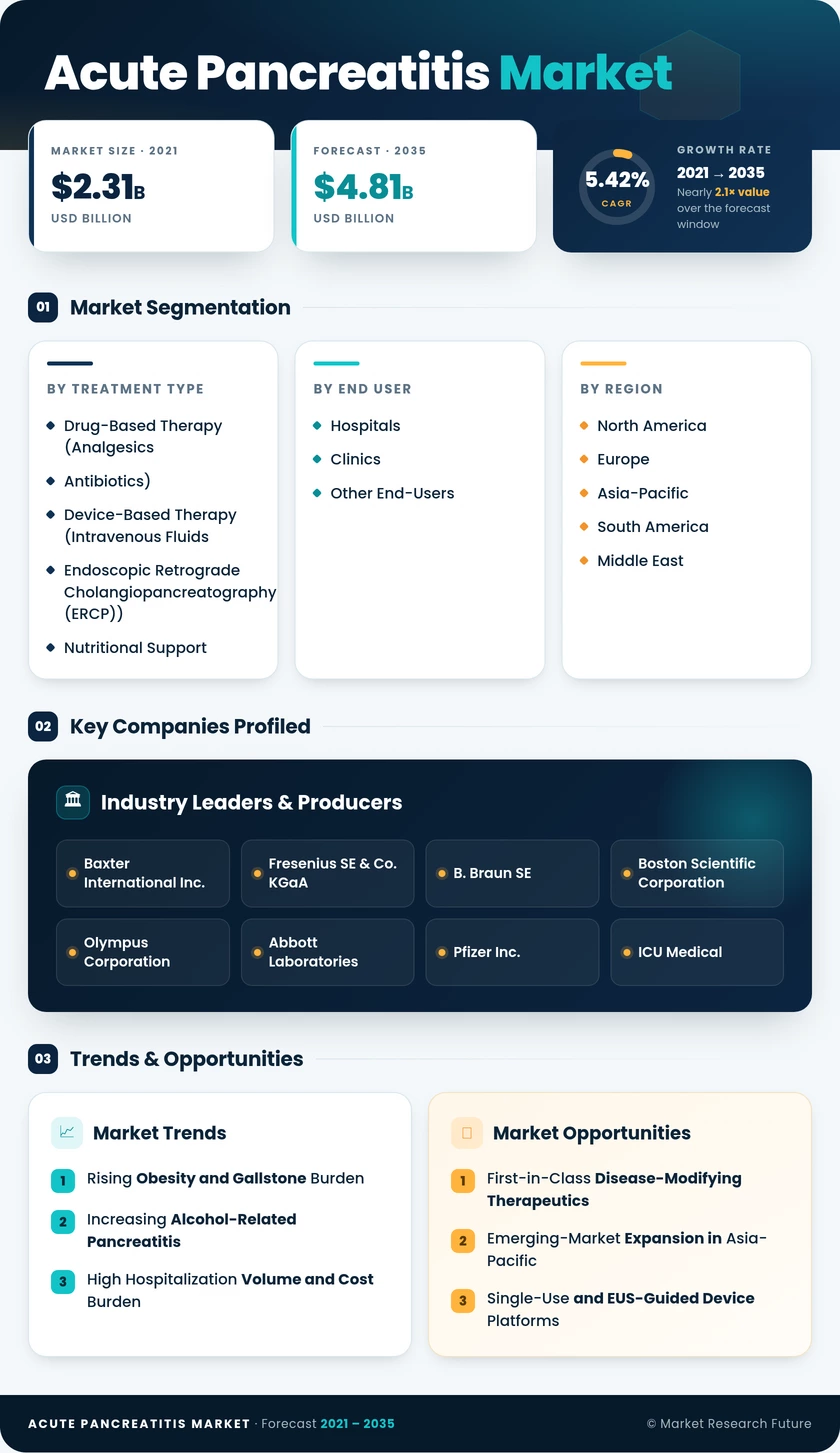
Segmentation Quick Reference
| Dimension | Sub-Segments | Dominant Segment | Fastest Growing Segment |
|---|---|---|---|
| By Treatment Type | Drug-Based Therapy (Analgesics, Antibiotics); Device-Based Therapy (Intravenous Fluids, Endoscopic Retrograde Cholangiopancreatography (ERCP)); Nutritional Support; Others (Surgery, Antioxidant Treatment) | Drug-Based Therapy (38.6% share) | Nutritional Support (6.3% CAGR) |
| By End User | Hospitals; Clinics; Other End-Users | Hospitals (68.4% share) | Clinics (6.0% CAGR) |
| By Region | North America; Europe; Asia-Pacific; South America; Middle East and Africa | North America (40.5% share) | Asia-Pacific (7.1% CAGR) |
Market Segmentation Overview
By Treatment Type
| Sub-Segment | Key Trend |
|---|---|
| Drug-Based Therapy | Opioid-sparing analgesia; antibiotics reserved for confirmed infection |
| Device-Based Therapy | Goal-directed lactated Ringer's protocols; ERCP and step-up drainage |
| Nutritional Support | Early oral and enteral feeding replacing prolonged fasting |
| Others (Surgery, Antioxidant Treatment) | Open necrosectomy giving way to minimally invasive approaches |
Drug-Based Therapy leads at a 38.6% share because nearly every patient needs analgesics, although stewardship rules are reducing antibiotic volume per admission. Nutritional Support grows fastest at a 6.3% CAGR, since current guidelines replace prolonged fasting with early enteral feeding that cuts infectious complications. Device-Based Therapy gains value as goal-directed fluid protocols and ERCP-led step-up care become standard at tertiary centers.
By End User
| Sub-Segment | Key Trend |
|---|---|
| Hospitals | Concentration of severe and necrotizing cases in ICUs |
| Clinics | Early discharge and outpatient follow-up for mild disease |
| Other End-Users | Ambulatory endoscopy and elective cholecystectomy |
Hospitals lead with a 68.4% share because acute episodes need inpatient monitoring, intravenous therapy and imaging. Clinics grow fastest at a 6.0% CAGR as payers reward early discharge for mild disease, which makes up most cases. Other End-Users benefit as ambulatory centers take on elective cholecystectomy and follow-up endoscopy.


 Noah Malgeri
Co-Founder

 Peter Groot koerkamp
Account and Business Manager

 Younghwan Choi
Senior Retail Manager

 Mark Irwin
Management Consultant

 Akif Moroglu
Strategy & Business Development Director

 Guilherme Gomes Martins
Product Management Director

 Joseph Aguayo
Sales Operations & Pricing Manager

 La Terria Dodd
Program Support Specialist

 Rob Kooiker
Group Product Manager HVAC & Fire Protection GMA