×
Request Free Sample ×

Kindly complete the form below to receive a free sample of this Report

* Please use a valid business email

Leading companies partner with us for data-driven Insights

clients tt-cursor
Hero Background

Acupuncture Market

ID: MRFR/Pharma/4681-CR
157 Pages
Rahul Gotadki
February 2021

Acupuncture Market Research Report Information by Product & Services (Services and Product), By Application (Pain Syndrome Illnesses, Gynecological Disorders, and Others), By End-User (Wellness Center, Hospitals & Specialty Clinics, and Others), And By Region (North America, Europe, Asia-Pacific, And Rest Of The World) –Market Forecast Till 2035

Share:
Download PDF ×

We do not share your information with anyone. However, we may send you emails based on your report interest from time to time. You may contact us at any time to opt-out.

Acupuncture Market Infographic
Purchase Options

Acupuncture Market Summary

As per MRFR analysis, the Acupuncture Market Size was estimated at 48.2 USD Billion in 2024. The Acupuncture industry is projected to grow from 51.68 USD Billion in 2025 to 103.77 USD Billion by 2035, exhibiting a compound annual growth rate (CAGR) of 7.22 during the forecast period 2025 - 2035.

Key Market Trends & Highlights

The Acupuncture Market is experiencing a dynamic evolution characterized by integration with conventional practices and technological advancements.

  • The market is witnessing a notable integration of acupuncture with conventional medicine, particularly in North America.
  • Digital health innovations are reshaping acupuncture practices, enhancing accessibility and patient engagement in the Asia-Pacific region.
  • Consumer awareness regarding the benefits of acupuncture is on the rise, driving demand across various demographics.
  • The increasing focus on preventive healthcare and the rising demand for alternative therapies are key drivers propelling market growth.

Market Size & Forecast

2024 Market Size 48.2 (USD Billion)
2035 Market Size 103.77 (USD Billion)
CAGR (2025 - 2035) 7.22%

Major Players

Acupuncture Health (US), Acupuncture Now (US), Acupuncture & Wellness Center (US), The Acupuncture Clinic (GB), Acupuncture Associates (AU), Acupuncture and Herbal Medicine (CA), Acupuncture and Wellness (US), Acupuncture and Integrative Medicine (US), Acupuncture and Traditional Chinese Medicine (US)

Acupuncture Market Trends

The Acupuncture Market is currently experiencing a notable evolution, driven by a growing acceptance of alternative therapies among consumers. This shift appears to stem from an increasing awareness of holistic health approaches, which emphasize the interconnectedness of body and mind. As individuals seek non-invasive treatments for various ailments, acupuncture is gaining traction as a viable option. Furthermore, the integration of acupuncture into conventional healthcare settings suggests a potential for broader recognition and utilization. This trend may lead to enhanced collaboration between acupuncturists and other healthcare professionals, fostering a more comprehensive approach to patient care. In addition, the rise of digital health technologies is influencing the Acupuncture Market. Telehealth platforms and mobile applications are making acupuncture services more accessible, allowing practitioners to reach a wider audience. This digital transformation could facilitate better patient engagement and education, ultimately promoting the benefits of acupuncture. As the market continues to evolve, it is likely that practitioners will adapt their strategies to align with these technological advancements, ensuring that they meet the changing needs of consumers seeking alternative therapies.

Integration with Conventional Medicine

The Acupuncture Market is witnessing a trend towards integration with conventional medical practices. This collaboration may enhance the credibility of acupuncture, as healthcare providers increasingly recognize its potential benefits. Such integration could lead to more comprehensive treatment plans that combine traditional and alternative approaches, ultimately improving patient outcomes.

Digital Health Innovations

The emergence of digital health technologies is reshaping the Acupuncture Market. Telehealth services and mobile applications are facilitating access to acupuncture treatments, allowing practitioners to connect with patients remotely. This trend may enhance patient engagement and education, making acupuncture more appealing to a broader audience.

Growing Consumer Awareness

There is a noticeable increase in consumer awareness regarding the benefits of acupuncture. As individuals become more informed about holistic health practices, they are more likely to seek out acupuncture as a treatment option. This heightened awareness could drive demand, prompting practitioners to expand their services and outreach efforts.

Acupuncture Market Drivers

Market Growth Projections

The Global Acupuncture Market Industry is projected to experience robust growth over the coming years. With a market value of 48.2 USD Billion in 2024, it is anticipated to reach 103.8 USD Billion by 2035, reflecting a compound annual growth rate of 7.22% from 2025 to 2035. This growth trajectory indicates a rising acceptance of acupuncture as a legitimate healthcare option, driven by increasing consumer awareness, integration with conventional medicine, and a focus on holistic health approaches. The market's expansion is likely to be supported by advancements in research and the growing number of practitioners worldwide.

Increased Research and Development

Increased research and development efforts in acupuncture are contributing to the growth of the Global Acupuncture Market Industry. Scientific studies are increasingly validating the efficacy of acupuncture, leading to greater acceptance among healthcare professionals and patients alike. This surge in research not only enhances the credibility of acupuncture but also encourages innovation in treatment techniques and modalities. As a result, the market is expected to experience substantial growth, with a projected value of 48.2 USD Billion in 2024. The ongoing exploration of acupuncture's benefits may lead to new applications and expanded usage in various healthcare settings.

Integration with Conventional Medicine

The integration of acupuncture with conventional medicine is becoming increasingly prevalent within the Global Acupuncture Market Industry. Healthcare providers are recognizing the potential benefits of combining acupuncture with traditional treatments, particularly for chronic pain management and rehabilitation. This collaborative approach not only enhances patient outcomes but also promotes a more comprehensive understanding of health. As a result, the market is expected to grow significantly, with projections indicating a rise to 103.8 USD Billion by 2035. This integration may also lead to increased insurance coverage for acupuncture services, further legitimizing its role in mainstream healthcare.

Aging Population and Chronic Conditions

The aging population worldwide is a significant driver of the Global Acupuncture Market Industry, as older adults often experience chronic conditions that can benefit from acupuncture treatment. Conditions such as arthritis, back pain, and migraines are prevalent among this demographic, leading to a higher demand for effective pain management solutions. As the global population ages, the market is poised for growth, with projections indicating a rise to 103.8 USD Billion by 2035. This demographic shift underscores the importance of acupuncture as a viable treatment option for managing chronic health issues in older adults.

Rising Demand for Alternative Therapies

The Global Acupuncture Market Industry is experiencing a notable increase in demand for alternative therapies as individuals seek holistic approaches to health and wellness. This trend is driven by a growing awareness of the benefits of acupuncture, including pain relief and stress reduction. As of 2024, the market is projected to reach 48.2 USD Billion, reflecting a shift in consumer preferences towards non-invasive treatments. This rising demand is likely to be fueled by an increasing number of practitioners and clinics offering acupuncture services, thereby enhancing accessibility and acceptance of this ancient practice in modern healthcare.

Growing Awareness of Mental Health Benefits

There is a growing recognition of the mental health benefits associated with acupuncture, contributing to the expansion of the Global Acupuncture Market Industry. Research suggests that acupuncture may help alleviate symptoms of anxiety and depression, making it an appealing option for individuals seeking alternative mental health treatments. As mental health awareness continues to rise globally, more individuals are likely to explore acupuncture as a complementary therapy. This trend could potentially drive market growth, with a projected compound annual growth rate of 7.22% from 2025 to 2035, reflecting the increasing acceptance of acupuncture in mental health care.

Market Segment Insights

By Application: Pain Management (Largest) vs. Stress Relief (Fastest-Growing)

In the Acupuncture Market, the application segment is characterized by its diverse functionalities, including Pain Management, Stress Relief, Rehabilitation, Preventive Care, and Wellness Enhancement. Pain Management holds the largest share, as it has been a primary driver for acupuncture's widespread acceptance among various demographics seeking relief from chronic pain and discomfort. Meanwhile, Stress Relief is experiencing rapid growth, driven by increasing awareness of mental health benefits associated with acupuncture therapies, attracting new users who are looking for holistic approaches to managing stress. The growth trends in this segment indicate a robust preference for integrative health solutions. Consumers are increasingly seeking alternative therapies that complement conventional medicine, especially for pain and stress-related issues. The rise in lifestyle-related stressors has consequently led to a surge in demand for acupuncture treatments focusing on Stress Relief and Wellness Enhancement. Rehabilitation and Preventive Care are also gaining traction, reflecting a shift toward proactive healthcare practices.

Pain Management (Dominant) vs. Stress Relief (Emerging)

Pain Management in the acupuncture market is recognized as the dominant application, addressing chronic pain conditions such as arthritis, migraines, and back pain. This segment has established itself through a wealth of research supporting its efficacy, appealing to patients disillusioned with pharmaceutical interventions. In contrast, Stress Relief has emerged as a compelling new focus within the market, gaining popularity among individuals seeking natural alternatives to manage anxiety and stress. The integration of acupuncture into wellness programs has thus enhanced its visibility, positioning Stress Relief as an innovative trend. Both segments underscore the versatile nature of acupuncture, catering to traditional pain relief while simultaneously adapting to contemporary wellness needs.

By End Use: Healthcare Facilities (Largest) vs. Home Care (Fastest-Growing)

The end-use segment of the acupuncture market shows significant diversity, with healthcare facilities leading in market share due to their well-established integration of acupuncture in medical practices. These facilities benefit from a steady demand driven by a focus on holistic treatment options within traditional health settings. Following healthcare facilities, the home care segment is gaining ground rapidly as patients seek convenience and personalized care. The growing acceptance of acupuncture for self-treatment at home is bolstering this shift.

Healthcare Facilities: Dominant vs. Home Care: Emerging

Healthcare facilities play a crucial role in the acupuncture market, serving as the dominant segment by offering professional and credentialed acupuncture services. These facilities capitalize on the credibility and trust associated with medical environments, where acupuncture is often used in conjunction with other medical treatments. On the other hand, the home care segment is considered an emerging segment, driven by increasing consumer interest in self-care and preventative health strategies. The availability of at-home acupuncture kits and the rise of telehealth consultations allow greater accessibility for consumers, further propelling its growth. As patients increasingly turn to home-based solutions, the home care segment is becoming a vital part of the acupuncture landscape.

By Type of Acupuncture: Traditional Acupuncture (Largest) vs. Electro-Acupuncture (Fastest-Growing)

The acupuncture market is segmented into various types, with Traditional Acupuncture holding the largest market share. It remains the most widely practiced form due to its long-established techniques and recognition in traditional healing practices. Following closely is Electro-Acupuncture, which is gaining popularity as it integrates modern technology with traditional practices, thus capturing a growing segment of health-conscious consumers. The growth trends in this segment are driven by increasing consumer awareness and acceptance of alternative therapies. Electro-Acupuncture, in particular, is experiencing rapid growth as it is often perceived as a more modern approach that combines the benefits of acupuncture with electrical stimulation. This blend appeals to younger demographics and those seeking comprehensive pain management solutions, positioning it as a leading trend in the industry.

Traditional Acupuncture (Dominant) vs. Dry Needling (Emerging)

Traditional Acupuncture is the dominant force in the acupuncture market, recognized for its deep historical roots and established methodologies, which focus on the flow of qi and the balance of energy within the body. Its techniques, including needle insertion and manipulation, have demonstrated efficacy and cultural significance, sustaining its popularity in both Eastern and Western societies. In contrast, Dry Needling is an emerging modality that targets muscle trigger points, often appealing to physical therapists and athletic circles for its innovative approach to pain relief and muscle recovery. While still gaining traction, Dry Needling showcases potential for growth, emphasizing the increasing acceptance of diverse acupuncture methodologies as part of holistic health practices.

By Patient Demographics: Age Group (Largest) vs. Income Level (Fastest-Growing)

The Patient Demographics segment in the Acupuncture Market reveals a diverse distribution among age groups, with mature adults aged 40-60 years representing the largest share. This demographic often seeks acupuncture for chronic pain management and wellness, contributing significantly to the market's growth. Younger adults, particularly those aged 20-30, also show a notable presence, indicating a shift toward holistic health practices among millennials and Gen Z consumers. This growing acceptance enhances market reach within these diverse age brackets.

Age Group: 40-60 (Dominant) vs. Income Level: Middle-Class (Emerging)

The dominant age group in the Acupuncture Market comprises individuals aged 40-60, who typically have a higher awareness of alternative medicine benefits. They seek acupuncture mainly for stress relief and chronic pain management, prioritizing health and wellness in their lifestyles. Conversely, the emerging middle-class income segment is becoming increasingly significant due to rising disposable incomes and greater access to wellness services. This demographic is drawn to acupuncture as a cost-effective means of maintaining wellness and preventing illness, driven by the trend towards preventative healthcare. This interplay between age and income levels shapes the market dynamics, illustrating the need for targeted outreach and service offerings.

By Treatment Duration: Short-Term Treatment (Largest) vs. Multiple Sessions (Fastest-Growing)

The Treatment Duration segment in the Acupuncture Market showcases diverse preferences among patients, with Short-Term Treatment leading in market share. This reflects a growing inclination towards quick relief solutions that address acute conditions effectively. As patients seek immediate results, Short-Term Treatment attracts a significant portion of users, promoting its dominance in the overall market landscape. In contrast, Multiple Sessions are gaining traction as practitioners and patients recognize the benefits of cumulative treatment effects, indicating a shift in perception towards sustained care. Increasing awareness and acceptance of acupuncture as a viable treatment option drives the growth of long-term and multiple session treatments. Patients are progressively understanding the importance of consistent therapy to manage chronic conditions and enhance overall wellness. This trend is further propelled by an increase in clinical studies endorsing the efficacy of sustained acupuncture, making it an appealing choice. Overall, the segment is evolving, with practitioners adapting to patient needs for both immediate and prolonged treatment solutions.

Short-Term Treatment (Dominant) vs. Multiple Sessions (Emerging)

Short-Term Treatment is characterized by its ability to provide quick relief for acute ailments, making it the most popular choice for patients with immediate health concerns. This segment thrives on the demand for fast results and convenient scheduling, as many individuals seek acupuncture to alleviate pain or discomfort rapidly. Conversely, Multiple Sessions represent the emerging trend within the market, appealing to patients looking for long-term healing and preventative care. This approach is increasingly recognized for its holistic benefits, as frequent sessions tend to yield cumulative therapeutic effects. Practitioners are embracing this model, promoting patient education around the value of regular treatments to achieve sustained health benefits, thus shaping a resilient market trajectory for both treatment types.

Get more detailed insights about Acupuncture Market

Regional Insights

North America : Leading Market Innovators

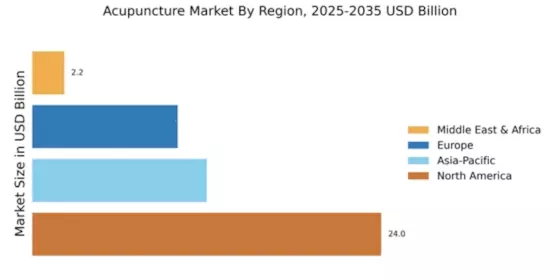
North America continues to lead the acupuncture market, holding a significant share of 24.0% in 2024. The growth is driven by increasing consumer awareness of alternative therapies, rising healthcare costs, and a growing preference for holistic health solutions. Regulatory support, including the recognition of acupuncture by various health insurance plans, further fuels demand. The region's focus on research and development in acupuncture techniques also contributes to its market leadership. The United States is the primary market player, with key companies like Acupuncture Health and Acupuncture Now leading the charge. The competitive landscape is characterized by a mix of established clinics and emerging wellness centers. Canada and Mexico are also witnessing growth, with increasing acceptance of acupuncture as a complementary treatment. The presence of numerous practitioners and educational institutions enhances the market's robustness.

Europe : Emerging Market Potential

Europe's acupuncture market is on the rise, with a market size of €10.0 million. The growth is attributed to a shift towards preventive healthcare and the integration of traditional practices into mainstream medicine. Increasing regulations supporting alternative therapies and a growing body of research validating acupuncture's efficacy are key drivers. Countries like Germany and the UK are leading this trend, with favorable policies promoting acupuncture as a viable treatment option. Germany stands out as a leader in the European acupuncture market, with a well-established network of practitioners and clinics. The UK is also witnessing a surge in acupuncture adoption, supported by organizations advocating for its benefits. The competitive landscape includes both independent practitioners and larger wellness centers, creating a diverse market. The presence of key players like The Acupuncture Clinic and Acupuncture Associates further strengthens the region's position.

Asia-Pacific : Rapidly Growing Market

The Asia-Pacific region, with a market size of $12.0 million, is experiencing rapid growth in acupuncture practices. This surge is driven by increasing health awareness, a cultural inclination towards traditional medicine, and government initiatives promoting alternative therapies. Countries like China and Australia are at the forefront, with significant investments in acupuncture education and practice. The region's diverse population is also contributing to the rising demand for personalized healthcare solutions. China remains the largest market for acupuncture, with a rich history and extensive integration into the healthcare system. Australia is emerging as a key player, with a growing number of practitioners and clinics. The competitive landscape is characterized by a mix of traditional practitioners and modern wellness centers. The presence of organizations advocating for acupuncture's benefits is also notable, enhancing its acceptance in the region.

Middle East and Africa : Niche Market Development

The Middle East and Africa region, with a market size of $2.2 million, is gradually recognizing the benefits of acupuncture. The growth is driven by increasing interest in alternative medicine and a shift towards holistic health approaches. Regulatory frameworks are slowly evolving to accommodate acupuncture practices, which is essential for market expansion. Countries like South Africa and the UAE are beginning to see a rise in acupuncture clinics and practitioners, reflecting changing consumer preferences. South Africa is leading the way in the region, with a growing number of trained acupuncturists and wellness centers. The UAE is also witnessing an increase in acupuncture's popularity, supported by a diverse expatriate population familiar with traditional practices. The competitive landscape is still developing, with opportunities for new entrants and established players to expand their services. The presence of educational institutions offering acupuncture training is crucial for future growth.

Key Players and Competitive Insights

The acupuncture market is currently characterized by a dynamic competitive landscape, driven by increasing consumer awareness of holistic health practices and the growing acceptance of alternative therapies. Key players are strategically positioning themselves through various operational focuses, including innovation in treatment methodologies, regional expansion, and partnerships with healthcare providers. Companies such as Acupuncture Health (US) and Acupuncture Now (US) are at the forefront, leveraging their established reputations to enhance service offerings and improve patient outcomes, thereby shaping the competitive environment in a manner that emphasizes quality and accessibility.

In terms of business tactics, companies are increasingly localizing their services to cater to specific demographic needs, optimizing their supply chains to ensure the availability of high-quality acupuncture supplies. The market appears moderately fragmented, with numerous small to medium-sized enterprises complementing the larger players. This structure allows for a diverse range of treatment options, fostering competition that encourages innovation and service differentiation among key players.

In November 2025, Acupuncture Health (US) announced a partnership with a leading wellness app to integrate acupuncture services into a broader health management platform. This strategic move is likely to enhance patient engagement and streamline access to acupuncture treatments, reflecting a trend towards digital health solutions that cater to the modern consumer's preferences. Such initiatives may not only improve patient retention but also attract a younger demographic increasingly interested in holistic health.

In October 2025, Acupuncture and Wellness (US) expanded its service offerings by introducing a new line of herbal supplements designed to complement acupuncture treatments. This diversification strategy appears to be aimed at enhancing the overall patient experience and increasing revenue streams. By integrating herbal medicine with acupuncture, the company positions itself as a comprehensive wellness provider, potentially setting a precedent for others in the market to follow.

In September 2025, The Acupuncture Clinic (GB) launched a series of community outreach programs aimed at educating the public about the benefits of acupuncture. This initiative not only serves to raise awareness but also positions the clinic as a thought leader in the field. By fostering community relationships and promoting the efficacy of acupuncture, the clinic may enhance its brand reputation and attract new clients, thereby reinforcing its competitive stance in the market.

As of December 2025, the acupuncture market is witnessing trends that emphasize digitalization, sustainability, and the integration of artificial intelligence in treatment protocols. Strategic alliances are increasingly shaping the landscape, as companies collaborate to enhance service delivery and patient care. The competitive differentiation is likely to evolve from traditional price-based competition towards a focus on innovation, technology integration, and reliable supply chains. This shift suggests that companies that prioritize these aspects may gain a competitive edge in the rapidly evolving market.

Key Companies in the Acupuncture Market market include

Industry Developments

May 2020:Lipoid Kosmetik AG launched PhytoCodine in May 2020, expanding its line of cutaneous messenger peptides. It is the globe's only anti-wrinkle focus derived from organic matriline-like peptides, and it changes fibroblasts to create parts of the extracellular matrix associated with skin that appears younger.

May 2020:Firmenich SA will open its 3rd Fragrance Atelier, named Villa Botanica, in Grasse in May 2020 to strengthen its position as a leader in organic and ecological product offerings.

October 2019:Modern Acupuncture Market secured investment from Strand Equity in October 2019, a business primarily investing in sophisticated and well-known services for customers and other brands. This funding arrangement was designed to improve the availability of alternative healthcare. The corporation intended to build 11 new locations across the United States through this funding.

Future Outlook

Acupuncture Market Future Outlook

The Acupuncture Market is projected to grow at a 7.22% CAGR from 2024 to 2035, driven by increasing consumer awareness, integration into wellness programs, and rising demand for alternative therapies.

New opportunities lie in:

  • Expansion of telehealth acupuncture services for remote consultations.
  • Development of acupuncture training programs for healthcare professionals.
  • Partnerships with wellness centers to offer integrated health packages.

By 2035, the Acupuncture Market is expected to be robust, reflecting substantial growth and diversification.

Market Segmentation

Acupuncture Market End Use Outlook

  • Healthcare Facilities
  • Home Care
  • Wellness Centers
  • Sports Clinics
  • Rehabilitation Centers

Acupuncture Market Application Outlook

  • Pain Management
  • Stress Relief
  • Rehabilitation
  • Preventive Care
  • Wellness Enhancement

Acupuncture Market Treatment Duration Outlook

  • Short-Term Treatment
  • Long-Term Treatment
  • Single Session
  • Multiple Sessions
  • Follow-Up Sessions

Acupuncture Market Type of Acupuncture Outlook

  • Traditional Acupuncture
  • Electro-Acupuncture
  • Auricular Acupuncture
  • Dry Needling
  • Laser Acupuncture

Acupuncture Market Patient Demographics Outlook

  • Age Group
  • Gender
  • Income Level
  • Health Status
  • Lifestyle Choices

Report Scope

MARKET SIZE 202448.2(USD Billion)
MARKET SIZE 202551.68(USD Billion)
MARKET SIZE 2035103.77(USD Billion)
COMPOUND ANNUAL GROWTH RATE (CAGR)7.22% (2024 - 2035)
REPORT COVERAGERevenue Forecast, Competitive Landscape, Growth Factors, and Trends
BASE YEAR2024
Market Forecast Period2025 - 2035
Historical Data2019 - 2024
Market Forecast UnitsUSD Billion
Key Companies ProfiledAcupuncture Health (US), Acupuncture Now (US), Acupuncture & Wellness Center (US), The Acupuncture Clinic (GB), Acupuncture Associates (AU), Acupuncture and Herbal Medicine (CA), Acupuncture and Wellness (US), Acupuncture and Integrative Medicine (US), Acupuncture and Traditional Chinese Medicine (US)
Segments CoveredApplication, End Use, Type of Acupuncture, Patient Demographics, Treatment Duration
Key Market OpportunitiesIntegration of digital health technologies enhances patient access and engagement in the Acupuncture Market.
Key Market DynamicsRising consumer interest in holistic health drives demand for acupuncture services and practitioners worldwide.
Countries CoveredNorth America, Europe, APAC, South America, MEA

Market Highlights

Author
Rahul Gotadki
Assistant Manager

He holds an experience of about 7+ years in Market Research and Business Consulting, working under the spectrum of Life Sciences and Healthcare domains. Rahul conceptualizes and implements a scalable business strategy and provides strategic leadership to the clients. His expertise lies in market estimation, competitive intelligence, pipeline analysis, customer assessment, etc. In addition to the above, his other responsibility includes strategic tracking of high growth markets & advising clients on the potential areas of focus they could direct their business initiatives

Leave a Comment

FAQs

What is the projected growth of the Acupuncture market?

The Acupuncture market is the expected increase in total market value of 103.77 USD billion over a defined forecast period 2025–2035. It is driven by factors such as demand trends, technological advances, regulatory changes, and geographic expansion.

What is the size of the Acupuncture market?

Acupuncture market size was valued at approximately 48.2 billion USD in 2024. This figure will reach 103.77 billion USD covering all regions (America, Europe, Asia, MEA and ROW), focusing its segments / services / distribution channels till 2035.

What is the CAGR of the Acupuncture market?

Acupuncture market is expected to grow at a CAGR of 7.22% between 2025 and 2035.

How much will the Acupuncture market be worth by 2035?

Acupuncture market is expected to be worth of 103.77 billion USD, reflecting growth driven by usage, technology and global demands by the end of 2035.

How will the Acupuncture market perform over the next 10 years?

Over the next 10 years the Acupuncture market is expected to shift from usd billion 48.2 to 103.77 billion USD, led by adoption of advanced tech, demographic trends, regulatory approvals, with potential headwinds from 2025 to 2035.

Which region holds the largest market share in the Acupuncture market?

European region holds the largest share of the market

Download Free Sample

Kindly complete the form below to receive a free sample of this Report

Compare Licence

×
Features License Type
Single User Multiuser License Enterprise User
Price $4,950 $5,950 $7,250
Maximum User Access Limit 1 User Upto 10 Users Unrestricted Access Throughout the Organization
Free Customization
Direct Access to Analyst
Deliverable Format
Platform Access
Discount on Next Purchase 10% 15% 15%
Printable Versions