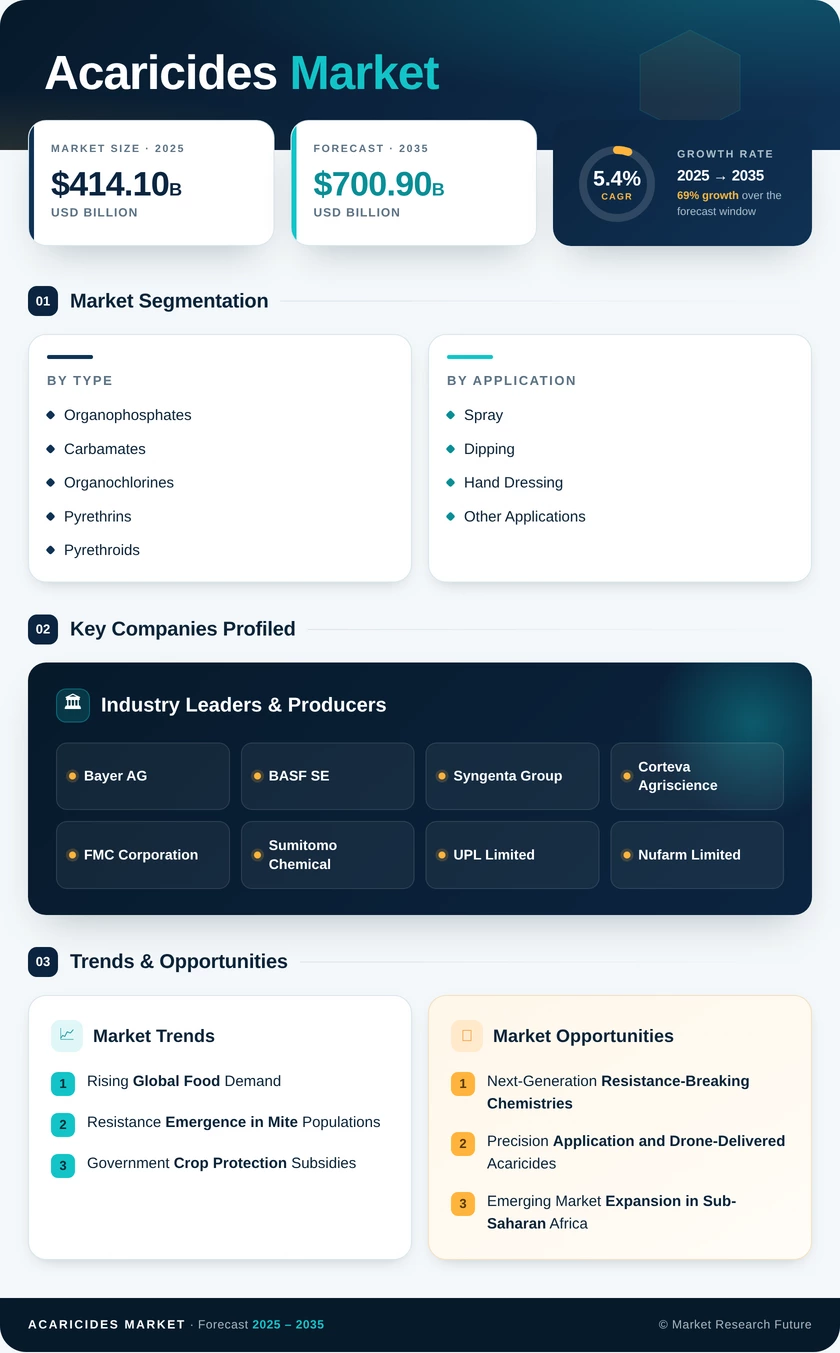
Segmentation Quick Reference
| Dimension | Sub-Segments | Dominant Segment | Fastest Growing Segment |
| By Type | Organophosphates, Carbamates, Organochlorines, Pyrethrins, Pyrethroids, Other Types | Organophosphates | Pyrethroids |
| By Application | Spray, Dipping, Hand Dressing, Other Applications | Spray | Dipping |
| By Geography | North America, Europe, Asia-Pacific, South America, Middle East & Africa | Asia-Pacific | Asia-Pacific |
Market Segmentation Overview
By Type
| Sub-Segment | Key Trend |
| Organophosphates | Steady demand in developing markets; declining registrations in the EU and North America |
| Carbamates | Cost-effective broad-spectrum control; moderate regulatory pressure |
| Organochlorines | Legacy use in limited markets; phasedown under Stockholm Convention obligations |
| Pyrethrins | Natural-origin active; growing demand from organic-certified crop programs. |
| Pyrethroids | Rapid growth driven by favorable toxicological profiles and regulatory preference |
| Other Types | Emerging bio-rational chemistries and novel modes of action are gaining commercial traction. |
The type segmentation reflects a market in transition. Established chemistries like organophosphates and carbamates continue to generate the majority of revenue. However, newer classes — particularly pyrethroids and bio-rational formulations — are capturing incremental growth as regulatory landscapes shift and resistance pressures demand rotation-compatible alternatives.
By Application
| Sub-Segment | Key Trend |
| Spray | Dominant method; reinforced by drone and precision sprayer adoption |
| Dipping | Growing in livestock regions, the communal dip tank infrastructure is expanding. |
| Hand Dressing | Smallholder and homestead use: stable but limited scalability |
| Other Applications | Pour-on, dust, and fumigation methods serve niche use cases. |
Application segmentation is driven primarily by the end-use context — crop versus livestock — and the scale of the operation. Spray dominates across mechanized commercial agriculture, while dipping maintains critical importance in tropical and subtropical livestock-rearing regions where tick control is a daily operational priority.

 Noah Malgeri
Co-Founder
Noah Malgeri
Co-Founder

 Peter Groot koerkamp
Account and Business Manager
Peter Groot koerkamp
Account and Business Manager

 Younghwan Choi
Senior Retail Manager
Younghwan Choi
Senior Retail Manager

 Mark Irwin
Management Consultant
Mark Irwin
Management Consultant

 Akif Moroglu
Strategy & Business Development Director
Akif Moroglu
Strategy & Business Development Director

 Guilherme Gomes Martins
Product Management Director
Guilherme Gomes Martins
Product Management Director

 Joseph Aguayo
Sales Operations & Pricing Manager
Joseph Aguayo
Sales Operations & Pricing Manager

 La Terria Dodd
Program Support Specialist
La Terria Dodd
Program Support Specialist

 Rob Kooiker
Group Product Manager HVAC & Fire Protection GMA
Rob Kooiker
Group Product Manager HVAC & Fire Protection GMA