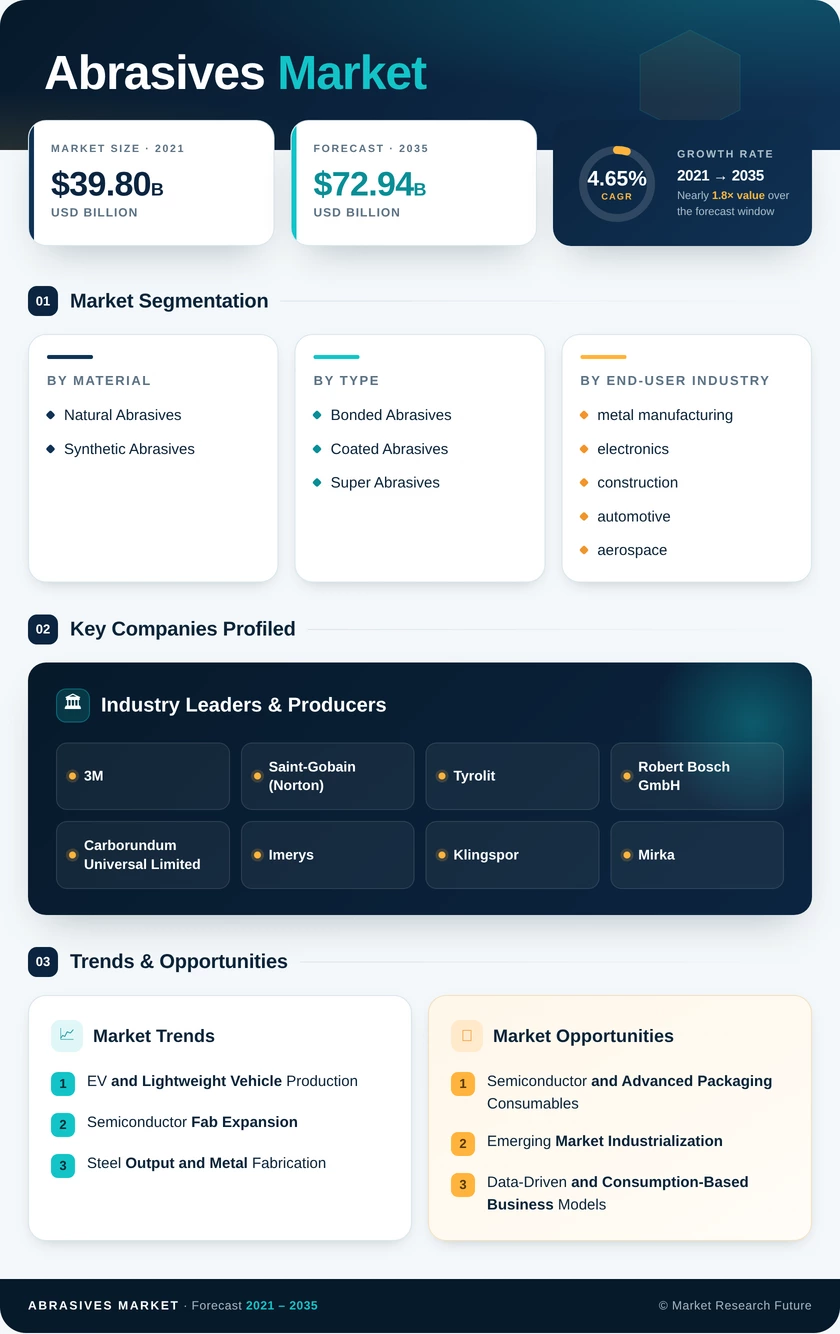
Segmentation Quick Reference
| Dimension | Sub-Segments | Dominant Segment | Fastest Growing Segment |
|---|
| By Material | Natural Abrasives; Synthetic Abrasives | Synthetic Abrasives (70.0% share) | Synthetic Abrasives (70.0% share) |
| By Type | Bonded Abrasives; Coated Abrasives; Super Abrasives | Bonded Abrasives (44.2% share) | Super Abrasives (9.4% CAGR (2026–2035)) |
| By End-user Industry | metal manufacturing; electronics; construction; automotive and aerospace; medical; oil and gas; other end-user industries | automotive and aerospace (26.6% share) | electronics (6.8% CAGR (2026–2035)) |
| By Region | North America; Europe; Asia-Pacific; South America; Middle East & Africa | Asia-Pacific (47.8% share) | Asia-Pacific (47.8% share) |
Market Segmentation Overview
| Sub-Segment | Key Trend |
|---|
| Natural Abrasives | Garnet gains in waterjet cutting and low-silica blasting under tighter dust rules |
| Synthetic Abrasives | Sol-gel ceramic, CBN and diamond grains displace commodity fused grades on automated lines |
Synthetic Abrasives lead and also grow faster than Natural Abrasives, because engineered grains offer the tight grit distribution and predictable fracture behavior that robotic and CNC grinding demand. Natural Abrasives keep a defensible niche in garnet waterjet and blasting work, where recyclability and low free-silica content help contractors comply with exposure limits. Renewable-powered fusion furnaces will further strengthen the synthetic position with carbon-conscious European buyers.
| Sub-Segment | Key Trend |
|---|
| Bonded Abrasives | Vitrified CBN and engineered-porosity wheels raise removal rates without burn |
| Coated Abrasives | Robotic sanding and film backings expand use in automotive and aerospace finishing |
| Super Abrasives | Diamond and CBN tools scale with EV gear grinding and silicon carbide wafers |
Bonded Abrasives lead by type, holding 44.2% share through cutting, sharpening and precision grinding on crankshafts, gears and turbine blades. Super Abrasives grow fastest at a 9.4% CAGR, as hardened EV gears, carbide tooling and silicon carbide wafers exceed what conventional grains can process economically. Coated Abrasives sit between the two, gaining from robotic sanding cells that require uniform backing and grit placement.
| Sub-Segment | Key Trend |
|---|
| metal manufacturing | Reshoring and infrastructure steel lift cut-off and flap disc volumes |
| electronics | CMP steps and wafer thinning multiply with advanced packaging |
| construction | Diamond blades and concrete grinding follow public capex programs |
| automotive and aerospace | EV drivetrains and turbine alloys raise premium wheel demand |
| medical | Implant and instrument finishing require micron-level surface quality |
| oil and gas | Pipeline refurbishment and rig maintenance sustain durable wheel demand |
| other end-user industries | Woodworking, glass and ceramics provide steady replacement demand |
Automotive and aerospace leads end-user demand with 26.6% share, buying CBN wheels for EV shafts and ceramic-grain belts for nickel turbine alloys. Electronics grows fastest at a 6.8% CAGR, since each new fab and packaging line adds planarization, backgrinding and dicing consumables. Metal manufacturing remains the volume backbone, while medical, construction, oil and gas, and other end-user industries supply steady, specification-driven replacement demand.


 Noah Malgeri
Co-Founder

 Peter Groot koerkamp
Account and Business Manager

 Younghwan Choi
Senior Retail Manager

 Mark Irwin
Management Consultant

 Akif Moroglu
Strategy & Business Development Director

 Guilherme Gomes Martins
Product Management Director

 Joseph Aguayo
Sales Operations & Pricing Manager

 La Terria Dodd
Program Support Specialist

 Rob Kooiker
Group Product Manager HVAC & Fire Protection GMA