Request Free Sample ×

Kindly complete the form below to receive a free sample of this Report

* Please use a valid business email

Leading companies partner with us for data-driven Insights

clients tt-cursor
Hero Background
English
Chinese
French
Japanese
Korean
German
Spanish

5G MM Wave Technology Market Trends

ID: MRFR/ICT/10883-HCR
128 Pages
Kiran Jinkalwad
April 2026

5G MM Wave Technology Market Size, Share and Trends Analysis Report By Application (Telecommunications, Automotive, Healthcare, Smart Cities, Consumer Electronics), By End Use (Residential, Commercial, Industrial), By Component (Antennas, Transceivers, Amplifiers, Filters), By Frequency Band (Millimeter Wave Frequency, Sub-6 GHz Frequency) and By Regional (North America, Europe, South America, Asia Pacific, Middle East and Africa) - Forecast to 2035

Share:
Download PDF ×

We do not share your information with anyone. However, we may send you emails based on your report interest from time to time. You may contact us at any time to opt-out.

5g mm wave technology Market Infographic
Purchase Options

Market Trends

Key Emerging Trends in the 5g mm wave technology Market

The market trends of 5G millimeter-wave (mmWave) technology are rapidly evolving, ushering in a new era of high-speed connectivity and unprecedented data transfer capabilities. As the demand for faster and more reliable wireless communication continues to surge, 5G mmWave technology has emerged as a key player in meeting these requirements.

One prominent trend in the market is the increasing adoption of 5G mmWave technology by telecommunications operators worldwide. The higher frequency bands, specifically those above 24 GHz, offer significantly greater bandwidth, enabling faster data transmission and reduced latency. This has paved the way for enhanced mobile broadband experiences, making it a critical element for telecom companies looking to upgrade their networks to support the growing data traffic and demand for higher data speeds.

The deployment of 5G mmWave technology is not limited to mobile networks alone; it is also gaining traction in various industries and sectors. One notable application is in the realm of smart cities, where the ultra-fast connectivity of 5G mmWave is crucial for powering applications like smart traffic management, remote healthcare monitoring, and advanced public safety systems. The ability of mmWave signals to support massive device connectivity is a driving force behind its integration into the infrastructure of smart cities.

Furthermore, the consumer electronics market is witnessing a surge in the integration of 5G mmWave technology. Smartphones, in particular, are increasingly equipped with mmWave capabilities, enabling users to experience faster download speeds and improved overall connectivity. This trend is expected to continue as consumer demand for seamless and high-performance connectivity becomes more pronounced.

Another significant market trend is the development of advanced technologies to address the challenges associated with 5G mmWave signals. While mmWave technology offers high-speed connectivity, it faces obstacles such as limited range and susceptibility to signal blockage by obstacles like buildings and foliage. To overcome these challenges, researchers and companies are actively working on beamforming technologies and advanced antenna systems, which enhance signal propagation and coverage, making 5G mmWave more practical for widespread deployment.

Security and privacy concerns also play a crucial role in shaping the market trends of 5G mmWave technology. As the volume of sensitive data transmitted over these networks increases, there is a growing emphasis on implementing robust security measures. This includes encryption protocols, secure network architectures, and compliance with stringent privacy regulations to ensure the protection of user data in the 5G mmWave ecosystem.


Author
Author Profile
Kiran Jinkalwad
Research Associate Level - II

Kiran Jinkalwad brings over four years of experience in market research, specializing in the ICT and Semiconductor sectors. She has worked on 50+ projects, including custom studies for companies like Microsoft and Huawei, addressing complex business challenges. With a background in Electronics and Telecommunication, Kiran excels in market estimation, forecasting, and strategic analysis. His sharp analytical skills and industry knowledge consistently deliver actionable insights for diverse clients.

Leave a Comment

FAQs

What is the projected market valuation of the 5G MM Wave Technology Market by 2035?

<p>The projected market valuation for the 5G MM Wave Technology Market is expected to reach 15.39 USD Billion by 2035.</p>

What was the market valuation of the 5G MM Wave Technology Market in 2024?

<p>The overall market valuation of the 5G MM Wave Technology Market was 3.306 USD Billion in 2024.</p>

What is the expected CAGR for the 5G MM Wave Technology Market during the forecast period 2025 - 2035?

<p>The expected CAGR for the 5G MM Wave Technology Market during the forecast period 2025 - 2035 is 15.0%.</p>

Which companies are considered key players in the 5G MM Wave Technology Market?

<p>Key players in the 5G MM Wave Technology Market include Qualcomm, Ericsson, Nokia, Samsung, Huawei, ZTE, Cisco, Intel, Broadcom, and Marvell Technology.</p>

What are the projected valuations for the telecommunications segment by 2035?

<p>The telecommunications segment is projected to grow from 1.5 USD Billion to 6.9 USD Billion by 2035.</p>

How is the automotive segment expected to perform in the 5G MM Wave Technology Market?

<p>The automotive segment is anticipated to increase from 0.5 USD Billion in 2024 to 2.5 USD Billion by 2035.</p>

What is the expected growth for the healthcare segment in the 5G MM Wave Technology Market?

<p>The healthcare segment is likely to expand from 0.4 USD Billion to 1.8 USD Billion by 2035.</p>

What are the projected valuations for the industrial end-use segment by 2035?

<p>The industrial end-use segment is expected to grow from 1.214 USD Billion to 5.69 USD Billion by 2035.</p>

What is the anticipated growth for antennas as a component in the 5G MM Wave Technology Market?

<p>Antennas are projected to increase from 0.831 USD Billion to 3.69 USD Billion by 2035.</p>

How is the millimeter wave frequency segment expected to perform by 2035?

<p>The millimeter wave frequency segment is expected to grow from 1.653 USD Billion to 7.695 USD Billion by 2035.</p>

Market Summary

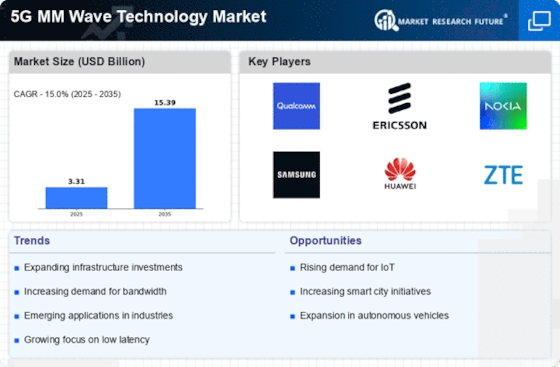
As per Market Research Future analysis, the 5G MM Wave Technology Market Size was estimated at 3.306 USD Billion in 2024. The 5G MM Wave Technology industry is projected to grow from 3.802 USD Billion in 2025 to 15.39 USD Billion by 2035, exhibiting a compound annual growth rate (CAGR) of 15.0% during the forecast period 2025 - 2035

Key Market Trends & Highlights

The 5G MM Wave Technology Market is poised for substantial growth driven by infrastructure investments and emerging applications.

  • North America remains the largest market for 5G MM Wave Technology, reflecting robust infrastructure investments. Asia-Pacific is recognized as the fastest-growing region, propelled by increasing demand for high-speed connectivity. The telecommunications segment dominates the market, while the automotive segment is rapidly gaining traction due to advancements in smart technologies. Rising demand for high-speed connectivity and support from government initiatives are key drivers fueling market expansion.

Market Size & Forecast

2024 Market Size 3.306 (USD Billion)
2035 Market Size 15.39 (USD Billion)
CAGR (2025 - 2035) 15.0%
Largest Regional Market Share in 2024 Asia Pacific

Major Players

Qualcomm (US), Ericsson (SE), Nokia (FI), Samsung (KR), Huawei (CN), ZTE (CN), Cisco (US), Intel (US), Broadcom (US), Marvell Technology (US)

Market Trends

The 5G MM Wave Technology Market is currently experiencing a transformative phase, characterized by rapid advancements and increasing adoption across various sectors. This technology, which utilizes millimeter wave frequencies, offers enhanced data transmission speeds and lower latency, making it particularly appealing for applications such as autonomous vehicles, smart cities, and augmented reality. As industries recognize the potential of 5G MM Wave Technology, investments in infrastructure and research are on the rise, indicating a robust growth trajectory. Furthermore, the integration of this technology into existing networks is likely to facilitate seamless connectivity and improve overall user experiences. In addition to the technological advancements, regulatory frameworks are evolving to support the deployment of 5G MM Wave Technology. Governments are actively working to allocate spectrum and establish guidelines that promote innovation while ensuring public safety. This collaborative effort between public and private sectors appears to be fostering an environment conducive to the expansion of 5G networks. As the market continues to mature, it is anticipated that new applications will emerge, further driving demand and shaping the future landscape of telecommunications and connectivity.

Increased Investment in Infrastructure

There is a noticeable trend towards heightened investment in the infrastructure necessary for 5G MM Wave Technology. Companies are allocating substantial resources to develop and enhance network capabilities, which is essential for supporting the high data rates and low latency that this technology promises. This investment is likely to facilitate the deployment of more base stations and antennas, thereby improving coverage and reliability.

Emergence of New Applications

The advent of 5G MM Wave Technology is paving the way for innovative applications across various industries. Sectors such as healthcare, entertainment, and transportation are beginning to explore how this technology can enhance their services. The potential for real-time data processing and improved connectivity is driving the development of applications that were previously unattainable.

Regulatory Support and Standardization

Regulatory bodies are increasingly recognizing the importance of 5G MM Wave Technology and are working towards creating supportive frameworks. This includes the allocation of necessary spectrum and the establishment of standards that ensure interoperability. Such regulatory support is crucial for fostering a stable environment where businesses can thrive and innovate.

5g mm wave technology Market Market Drivers

Emergence of New Business Models

The 5G MM Wave Technology Market is witnessing the emergence of new business models that leverage advanced connectivity solutions. As businesses explore innovative ways to enhance their operations, the capabilities offered by 5G MM Wave technology are becoming increasingly attractive. This technology enables the development of services such as ultra-reliable low-latency communications and massive machine-type communications, which can transform various sectors, including healthcare, transportation, and entertainment. Market analysts suggest that the adoption of these new business models could lead to a substantial increase in revenue streams for companies that effectively integrate 5G solutions. Consequently, this trend is likely to stimulate further investment in the 5G MM Wave Technology Market, as organizations seek to capitalize on the opportunities presented by this transformative technology.

Enhanced Mobile Broadband Services

The 5G MM Wave Technology Market is significantly influenced by the enhancement of mobile broadband services. As mobile users increasingly seek faster and more reliable internet access, telecommunications providers are compelled to upgrade their networks to 5G standards. The introduction of 5G MM Wave technology facilitates enhanced mobile broadband experiences, characterized by higher data rates and improved user experiences. Market data suggests that the average mobile data traffic per user is expected to increase substantially, reaching over 30 gigabytes per month by 2025. This trend underscores the necessity for advanced technologies that can accommodate growing data demands, positioning 5G MM Wave technology as a crucial component in the evolution of mobile broadband services.

Support from Government Initiatives

Government initiatives play a crucial role in shaping the 5G MM Wave Technology Market. Many governments are actively promoting the deployment of 5G infrastructure through funding, policy support, and regulatory frameworks. These initiatives aim to accelerate the rollout of 5G networks, which are essential for economic growth and technological advancement. For instance, various countries have established national strategies to enhance digital connectivity, which includes significant investments in 5G technology. This supportive environment is likely to encourage private sector participation and innovation, further driving the adoption of 5G MM Wave technology. As a result, the market is expected to witness robust growth, fueled by collaborative efforts between public and private entities.

Rising Demand for High-Speed Connectivity

The 5G MM Wave Technology Market is experiencing a surge in demand for high-speed connectivity, driven by the proliferation of data-intensive applications. As consumers and businesses increasingly rely on seamless internet access for activities such as streaming, gaming, and remote work, the need for faster and more reliable connections becomes paramount. According to recent estimates, the demand for high-speed internet is projected to grow at a compound annual growth rate of over 30% in the coming years. This trend is likely to propel investments in 5G MM Wave technology, as it offers the necessary bandwidth and low latency required to support these applications. Consequently, telecommunications companies are prioritizing the deployment of 5G infrastructure to meet this escalating demand, thereby enhancing the overall market landscape.

Advancements in IoT and Smart Technologies

The integration of Internet of Things (IoT) devices and smart technologies is a pivotal driver for the 5G MM Wave Technology Market. As industries adopt IoT solutions for automation and efficiency, the need for robust connectivity becomes increasingly critical. The 5G MM Wave technology, with its ability to support a vast number of connected devices simultaneously, is well-positioned to cater to this demand. Reports indicate that the number of connected IoT devices is expected to reach over 75 billion by 2025, necessitating advanced communication technologies. This proliferation of IoT applications, ranging from smart cities to industrial automation, is likely to stimulate investments in 5G infrastructure, thereby fostering growth within the 5G MM Wave Technology Market.

Market Segment Insights

By Application: Telecommunications (Largest) vs. Automotive (Fastest-Growing)

In the 5G MM Wave Technology Market, the telecommunications sector holds the largest share, driven by the demand for faster and more reliable wireless communication technologies. Telecommunications service providers are rapidly adopting 5G MM wave technology to enhance service delivery and cater to the increasing consumer needs for high-speed internet. The automotive sector, on the other hand, is emerging as the fastest-growing segment, propelled by advancements in connected vehicle technologies and <a href="https://www.marketresearchfuture.com/reports/autonomous-self-driving-cars-market-23099">autonomous driving</a> applications, which require robust and low-latency data transmission.

Automotive: Connected Vehicles (Dominant) vs. Smart Cities (Emerging)

The automotive segment is currently dominated by connected vehicles, which rely heavily on 5G MM wave technology for real-time data exchange, enhancing safety and driving experiences. As vehicle-to-everything (V2X) communication gains traction, manufacturers are integrating advanced connectivity features, positioning connected vehicles as a key player in the market. Meanwhile, the smart cities initiative is emerging, leveraging 5G connectivity for smart traffic management, public safety, and environmental monitoring. This segment is witnessing rapid developments as urban areas seek to optimize infrastructure and improve the quality of life for residents through innovative technologies.

By End Use: Residential (Largest) vs. Commercial (Fastest-Growing)

In the 5G MM Wave Technology Market, the end-use segments are primarily categorized into residential, commercial, and industrial sectors. Among these, the residential segment holds the largest market share, driven by rising consumer demand for high-speed internet and smart home devices. The commercial segment, however, is experiencing rapid growth as businesses seek to enhance operational efficiency and connectivity. Industrial applications are also gaining traction but are currently smaller in market share compared to the other segments.

Residential (Dominant) vs. Commercial (Emerging)

The residential segment is characterized by a high demand for seamless connectivity and enhanced internet speeds, making it a dominant force in the 5G MM Wave Technology Market. As consumers increasingly adopt smart home technologies, the need for reliable and speedy internet is paramount. In contrast, the commercial segment is emerging as a vital player, fueled by the need for robust <a href="https://www.marketresearchfuture.com/reports/cloud-network-infrastructure-market-5699">network infrastructures</a> that support IoT devices and data-heavy applications. Businesses are accelerating their transition to 5G to improve operational efficiencies and customer engagement, positioning the commercial sector as a significant driver of growth in this market.

By Component: Antennas (Largest) vs. Transceivers (Fastest-Growing)

In the 5G MM Wave Technology Market, the component segment is characterized by significant diversity among key players. Antennas currently hold the largest share, driven by their critical role in facilitating high-frequency communication. Transceivers, meanwhile, have emerged as the fastest-growing segment, thanks to advancements in technology that enhance data processing capabilities and promote efficient network performance. The competitive landscape sees amplifiers and filters steadily contributing, but they lag in comparison to the strong market presence of antennas and transceivers.

Antennas (Dominant) vs. Transceivers (Emerging)

Antennas are poised as the dominant component in the 5G MM Wave Technology Market, enabling efficient transmission and reception of high-frequency signals essential for <a href="https://www.marketresearchfuture.com/reports/ultra-low-power-microcontroller-market-10835">ultra-reliable low-latency</a> connectivity. They are continually evolving with advanced designs that enhance signal strength and coverage. On the other hand, transceivers represent the emerging segment, garnering interest due to their ability to combine transmission and reception functionalities, optimizing space within network infrastructure. Their growth is fueled by the rising demand for seamless data transfer and increased bandwidth, making them integral to the future of 5G networks.

By Frequency Band: Millimeter Wave Frequency (Largest) vs. Sub-6 GHz Frequency (Fastest-Growing)

In the 5G MM Wave Technology Market, the distribution of market share between the<a href="https://www.marketresearchfuture.com/reports/millimeter-wave-technology-market-3908"> Millimeter Wave Frequency </a>and the Sub-6 GHz Frequency showcases a clear delineation in preferences among telecom operators. The Millimeter Wave Frequency is currently the largest segment, benefiting from its high data transfer rates and extensive bandwidth capabilities, which are critical for applications requiring ultra-low latency and high-speed connections. In contrast, the Sub-6 GHz Frequency, while smaller in share, is rapidly gaining traction, driven by its ability to offer broader coverage and superior penetration through obstacles, making it attractive for more diverse applications.

Frequency: Millimeter Wave (Dominant) vs. Sub-6 GHz (Emerging)

The Millimeter Wave Frequency is recognized as the dominant segment in the 5G MM Wave Technology Market due to its advantages in delivering high-capacity connectivity and supporting advanced applications such as augmented reality and high-resolution video streaming. Its challenges include limited range and higher costs, which are offset by its performance benefits in urban environments. On the other hand, the<a href="https://www.marketresearchfuture.com/reports/sub-6ghz-ptp-and-ptmp-proprietary-solutions-market-11949"> Sub-6 GHz Frequency </a>is emerging as a favorable alternative, particularly for users who require extensive coverage and reliability in rural and suburban areas. As a result, it is increasingly being adopted for a variety of applications, blending performance with cost-effectiveness and allowing a more widespread rollout of 5G technology.

Get more detailed insights about 5g mm-wave Technology Market Research Report - Forecast till 2035

Regional Insights

The Global 5G MM Wave Technology Market exhibits robust growth across various regions, with an overall market valuation of 10.57 USD Billion in 2024. North America holds a significant portion of this market, valued at 3.2 USD Billion in 2024 and projected to grow to 28.0 USD Billion by 2035, attributed to advanced infrastructure and heightened consumer demand. Similarly, Europe begins at 2.5 USD Billion in 2024, advancing to 20.0 USD Billion by 2035, reflecting an increase in investment towards digital transformation.

The APAC region leads in potential with a valuation of 4.0 USD Billion in 2024 and a future estimation of 30.0 USD Billion in 2035, driven by a surge in telecommunications and government initiatives favoring 5G rollout.South America is emerging slowly, starting at 0.7 USD Billion in 2024 and rising to 4.0 USD Billion by 2035, highlighting a budding interest in connectivity improvements. The MEA region, beginning at 0.17 USD Billion in 2024 and rising to 3.0 USD Billion by 2035, is gradually adopting advanced network technologies.

The diverse conditions across these regions showcase significant opportunities and challenges, affecting the overall Global 5G MM Wave Technology Market growth trajectory. Each region's distinct value proposition reflects its capability to adopt innovative technologies, aiming to enhance connectivity and infrastructure, indicating its vital role within the market dynamics.

Key Players and Competitive Insights

The Global 5G MM Wave Technology Market has significantly evolved, driven by the increased demand for high-speed connectivity and the need for innovative solutions that accommodate the ever-growing data requirements across various sectors. This market, characterized by rapid technological advancements and increasing investments, has attracted key players who are vying for leadership by enhancing their product offerings, expanding their portfolios, and engaging in strategic collaborations. Competitive insights reveal a dynamic landscape where companies are exploring partnerships and acquisitions to enhance their capabilities in delivering advanced 5G solutions.Understanding the strategies employed by these players is crucial as the competition intensifies, underpinning the necessity for agility and innovation in this high-stakes environment.LitePoint holds a remarkable position in the Global 5G MM Wave Technology Market, recognized for its strengths in providing advanced testing solutions tailored for wireless communication technologies. The company is known for its dedicated focus on quality and performance, ensuring that its testing products meet the stringent requirements of 5G applications. With a robust technology platform, LitePoint is ideally positioned to address the challenges associated with testing the complexities of mmWave technologies. Their commitment to innovation and customer satisfaction has enabled them to forge long-term relationships with leading manufacturers and service providers. Moreover, LitePoint's global presence allows it to extend its services and support across various regions, reinforcing its reputation as a key player within the competitive landscape of the 5G market.ZTE Corporation is another influential entity in the Global 5G MM Wave Technology Market, boasting a diverse portfolio that includes key products and services such as radio access networks, core networks, and end-to-end solutions for network deployment.The company leverages its extensive research and development capabilities to create advanced technologies that power 5G infrastructure, positioning itself as a formidable force in the global telecommunications sector.ZTE Corporation benefits from a strong market presence and has established strategic partnerships and joint ventures that enhance its operational capabilities. The company has also engaged in several mergers and acquisitions, further solidifying its market position and expanding its technological assets. Through its commitment to innovation and customer-focused solutions, ZTE Corporation continues to strengthen its foothold in the competitive 5G MM Wave technology landscape while effectively addressing the demands of operators and enterprises seeking comprehensive connectivity solutions.

Key Companies in the 5g mm wave technology Market include

Industry Developments

The Global 5G MM Wave Technology Market is witnessing significant developments, particularly with advancements in technology and strategic collaborations. In October 2023, Qualcomm and Ericsson announced a partnership aimed at enhancing their 5G offerings, focusing on leveraging millimeter-wave technology to increase network capacity and performance. Recent updates show that a surge in demand for high-speed mobile broadband and IoT applications continues to drive market growth. Companies such as Huawei and Nokia are expanding their portfolios, investing heavily in Research and Development to optimize their 5G solutions.

Additionally, in July 2023, Marvell Technology completed its acquisition of Cavium, emphasizing the importance of integrating technologies to enhance its 5G services. The market is also seeing a rise in mergers, with Skyworks Solutions acquiring certain assets from a key competitor to bolster its mmWave solutions in August 2023. As nations continue to roll out 5G infrastructure, major industry players like Intel Corporation and Cisco Systems are also focusing on innovative solutions. With these developments, the Global 5G MM Wave Technology Market is on a robust growth trajectory, aligning with the increasing demand for connectivity across various sectors.

Future Outlook

5g mm wave technology Market Future Outlook

The 5G MM Wave Technology Market is projected to grow at a 15.0% CAGR from 2025 to 2035, driven by increasing demand for high-speed connectivity and IoT applications.

New opportunities lie in:

  • <p>Development of advanced mmWave antennas for urban environments.</p>
  • <p> </p>
  • <p>Integration of mmWave technology in autonomous vehicle communication systems.</p>
  • <p>Expansion of mmWave solutions in smart city infrastructure projects.</p>

By 2035, the market is expected to be robust, driven by technological advancements and widespread adoption.

Market Segmentation

5g mm wave technology Market End Use Outlook

  • Residential
  • Commercial
  • Industrial

5g mm wave technology Market Component Outlook

  • Antennas
  • Transceivers
  • Amplifiers
  • Filters

5g mm wave technology Market Application Outlook

  • Telecommunications
  • Automotive
  • Healthcare
  • Smart Cities
  • Consumer Electronics

5g mm wave technology Market Frequency Band Outlook

  • Millimeter Wave Frequency
  • Sub-6 GHz Frequency

Report Scope

MARKET SIZE 2024 3.306 (USD Billion)
MARKET SIZE 2025 3.802 (USD Billion)
MARKET SIZE 2035 15.39 (USD Billion)
COMPOUND ANNUAL GROWTH RATE (CAGR) 15.0% (2025 - 2035)
REPORT COVERAGE Revenue Forecast, Competitive Landscape, Growth Factors, and Trends
BASE YEAR 2024
Market Forecast Period 2025 - 2035
Historical Data 2019 - 2024
Market Forecast Units USD Billion
Key Companies Profiled Qualcomm (US), Ericsson (SE), Nokia (FI), Samsung (KR), Huawei (CN), ZTE (CN), Cisco (US), Intel (US), Broadcom (US), Marvell Technology (US)
Segments Covered Application, End Use, Component, Frequency Band, Regional
Key Market Opportunities Expansion of smart city infrastructure drives demand for 5G MM Wave Technology Market solutions.
Key Market Dynamics Intensifying competition and regulatory shifts drive innovation and deployment of 5G millimeter wave technology across various sectors.
Countries Covered North America, Europe, APAC, South America, MEA

FAQs

What is the projected market valuation of the 5G MM Wave Technology Market by 2035?

<p>The projected market valuation for the 5G MM Wave Technology Market is expected to reach 15.39 USD Billion by 2035.</p>

What was the market valuation of the 5G MM Wave Technology Market in 2024?

<p>The overall market valuation of the 5G MM Wave Technology Market was 3.306 USD Billion in 2024.</p>

What is the expected CAGR for the 5G MM Wave Technology Market during the forecast period 2025 - 2035?

<p>The expected CAGR for the 5G MM Wave Technology Market during the forecast period 2025 - 2035 is 15.0%.</p>

Which companies are considered key players in the 5G MM Wave Technology Market?

<p>Key players in the 5G MM Wave Technology Market include Qualcomm, Ericsson, Nokia, Samsung, Huawei, ZTE, Cisco, Intel, Broadcom, and Marvell Technology.</p>

What are the projected valuations for the telecommunications segment by 2035?

<p>The telecommunications segment is projected to grow from 1.5 USD Billion to 6.9 USD Billion by 2035.</p>

How is the automotive segment expected to perform in the 5G MM Wave Technology Market?

<p>The automotive segment is anticipated to increase from 0.5 USD Billion in 2024 to 2.5 USD Billion by 2035.</p>

What is the expected growth for the healthcare segment in the 5G MM Wave Technology Market?

<p>The healthcare segment is likely to expand from 0.4 USD Billion to 1.8 USD Billion by 2035.</p>

What are the projected valuations for the industrial end-use segment by 2035?

<p>The industrial end-use segment is expected to grow from 1.214 USD Billion to 5.69 USD Billion by 2035.</p>

What is the anticipated growth for antennas as a component in the 5G MM Wave Technology Market?

<p>Antennas are projected to increase from 0.831 USD Billion to 3.69 USD Billion by 2035.</p>

How is the millimeter wave frequency segment expected to perform by 2035?

<p>The millimeter wave frequency segment is expected to grow from 1.653 USD Billion to 7.695 USD Billion by 2035.</p>

  1. SECTION I: EXECUTIVE SUMMARY AND KEY HIGHLIGHTS
    1. | 1.1 EXECUTIVE SUMMARY
    2. | | 1.1.1 Market Overview
    3. | | 1.1.2 Key Findings
    4. | | 1.1.3 Market Segmentation
    5. | | 1.1.4 Competitive Landscape
    6. | | 1.1.5 Challenges and Opportunities
    7. | | 1.1.6 Future Outlook
  2. SECTION II: SCOPING, METHODOLOGY AND MARKET STRUCTURE
    1. | 2.1 MARKET INTRODUCTION
    2. | | 2.1.1 Definition
    3. | | 2.1.2 Scope of the study
    4. | | | 2.1.2.1 Research Objective
    5. | | | 2.1.2.2 Assumption
    6. | | | 2.1.2.3 Limitations
    7. | 2.2 RESEARCH METHODOLOGY
    8. | | 2.2.1 Overview
    9. | | 2.2.2 Data Mining
    10. | | 2.2.3 Secondary Research
    11. | | 2.2.4 Primary Research
    12. | | | 2.2.4.1 Primary Interviews and Information Gathering Process
    13. | | | 2.2.4.2 Breakdown of Primary Respondents
    14. | | 2.2.5 Forecasting Model
    15. | | 2.2.6 Market Size Estimation
    16. | | | 2.2.6.1 Bottom-Up Approach
    17. | | | 2.2.6.2 Top-Down Approach
    18. | | 2.2.7 Data Triangulation
    19. | | 2.2.8 Validation
  3. SECTION III: QUALITATIVE ANALYSIS
    1. | 3.1 MARKET DYNAMICS
    2. | | 3.1.1 Overview
    3. | | 3.1.2 Drivers
    4. | | 3.1.3 Restraints
    5. | | 3.1.4 Opportunities
    6. | 3.2 MARKET FACTOR ANALYSIS
    7. | | 3.2.1 Value chain Analysis
    8. | | 3.2.2 Porter's Five Forces Analysis
    9. | | | 3.2.2.1 Bargaining Power of Suppliers
    10. | | | 3.2.2.2 Bargaining Power of Buyers
    11. | | | 3.2.2.3 Threat of New Entrants
    12. | | | 3.2.2.4 Threat of Substitutes
    13. | | | 3.2.2.5 Intensity of Rivalry
    14. | | 3.2.3 COVID-19 Impact Analysis
    15. | | | 3.2.3.1 Market Impact Analysis
    16. | | | 3.2.3.2 Regional Impact
    17. | | | 3.2.3.3 Opportunity and Threat Analysis
  4. SECTION IV: QUANTITATIVE ANALYSIS
    1. | 4.1 Information and Communications Technology, BY Application (USD Billion)
    2. | | 4.1.1 Telecommunications
    3. | | 4.1.2 Automotive
    4. | | 4.1.3 Healthcare
    5. | | 4.1.4 Smart Cities
    6. | | 4.1.5 Consumer Electronics
    7. | 4.2 Information and Communications Technology, BY End Use (USD Billion)
    8. | | 4.2.1 Residential
    9. | | 4.2.2 Commercial
    10. | | 4.2.3 Industrial
    11. | 4.3 Information and Communications Technology, BY Component (USD Billion)
    12. | | 4.3.1 Antennas
    13. | | 4.3.2 Transceivers
    14. | | 4.3.3 Amplifiers
    15. | | 4.3.4 Filters
    16. | 4.4 Information and Communications Technology, BY Frequency Band (USD Billion)
    17. | | 4.4.1 Millimeter Wave Frequency
    18. | | 4.4.2 Sub-6 GHz Frequency
    19. | 4.5 Information and Communications Technology, BY Region (USD Billion)
    20. | | 4.5.1 North America
    21. | | | 4.5.1.1 US
    22. | | | 4.5.1.2 Canada
    23. | | 4.5.2 Europe
    24. | | | 4.5.2.1 Germany
    25. | | | 4.5.2.2 UK
    26. | | | 4.5.2.3 France
    27. | | | 4.5.2.4 Russia
    28. | | | 4.5.2.5 Italy
    29. | | | 4.5.2.6 Spain
    30. | | | 4.5.2.7 Rest of Europe
    31. | | 4.5.3 APAC
    32. | | | 4.5.3.1 China
    33. | | | 4.5.3.2 India
    34. | | | 4.5.3.3 Japan
    35. | | | 4.5.3.4 South Korea
    36. | | | 4.5.3.5 Malaysia
    37. | | | 4.5.3.6 Thailand
    38. | | | 4.5.3.7 Indonesia
    39. | | | 4.5.3.8 Rest of APAC
    40. | | 4.5.4 South America
    41. | | | 4.5.4.1 Brazil
    42. | | | 4.5.4.2 Mexico
    43. | | | 4.5.4.3 Argentina
    44. | | | 4.5.4.4 Rest of South America
    45. | | 4.5.5 MEA
    46. | | | 4.5.5.1 GCC Countries
    47. | | | 4.5.5.2 South Africa
    48. | | | 4.5.5.3 Rest of MEA
  5. SECTION V: COMPETITIVE ANALYSIS
    1. | 5.1 Competitive Landscape
    2. | | 5.1.1 Overview
    3. | | 5.1.2 Competitive Analysis
    4. | | 5.1.3 Market share Analysis
    5. | | 5.1.4 Major Growth Strategy in the Information and Communications Technology
    6. | | 5.1.5 Competitive Benchmarking
    7. | | 5.1.6 Leading Players in Terms of Number of Developments in the Information and Communications Technology
    8. | | 5.1.7 Key developments and growth strategies
    9. | | | 5.1.7.1 New Product Launch/Service Deployment
    10. | | | 5.1.7.2 Merger & Acquisitions
    11. | | | 5.1.7.3 Joint Ventures
    12. | | 5.1.8 Major Players Financial Matrix
    13. | | | 5.1.8.1 Sales and Operating Income
    14. | | | 5.1.8.2 Major Players R&D Expenditure. 2023
    15. | 5.2 Company Profiles
    16. | | 5.2.1 Qualcomm (US)
    17. | | | 5.2.1.1 Financial Overview
    18. | | | 5.2.1.2 Products Offered
    19. | | | 5.2.1.3 Key Developments
    20. | | | 5.2.1.4 SWOT Analysis
    21. | | | 5.2.1.5 Key Strategies
    22. | | 5.2.2 Ericsson (SE)
    23. | | | 5.2.2.1 Financial Overview
    24. | | | 5.2.2.2 Products Offered
    25. | | | 5.2.2.3 Key Developments
    26. | | | 5.2.2.4 SWOT Analysis
    27. | | | 5.2.2.5 Key Strategies
    28. | | 5.2.3 Nokia (FI)
    29. | | | 5.2.3.1 Financial Overview
    30. | | | 5.2.3.2 Products Offered
    31. | | | 5.2.3.3 Key Developments
    32. | | | 5.2.3.4 SWOT Analysis
    33. | | | 5.2.3.5 Key Strategies
    34. | | 5.2.4 Samsung (KR)
    35. | | | 5.2.4.1 Financial Overview
    36. | | | 5.2.4.2 Products Offered
    37. | | | 5.2.4.3 Key Developments
    38. | | | 5.2.4.4 SWOT Analysis
    39. | | | 5.2.4.5 Key Strategies
    40. | | 5.2.5 Huawei (CN)
    41. | | | 5.2.5.1 Financial Overview
    42. | | | 5.2.5.2 Products Offered
    43. | | | 5.2.5.3 Key Developments
    44. | | | 5.2.5.4 SWOT Analysis
    45. | | | 5.2.5.5 Key Strategies
    46. | | 5.2.6 ZTE (CN)
    47. | | | 5.2.6.1 Financial Overview
    48. | | | 5.2.6.2 Products Offered
    49. | | | 5.2.6.3 Key Developments
    50. | | | 5.2.6.4 SWOT Analysis
    51. | | | 5.2.6.5 Key Strategies
    52. | | 5.2.7 Cisco (US)
    53. | | | 5.2.7.1 Financial Overview
    54. | | | 5.2.7.2 Products Offered
    55. | | | 5.2.7.3 Key Developments
    56. | | | 5.2.7.4 SWOT Analysis
    57. | | | 5.2.7.5 Key Strategies
    58. | | 5.2.8 Intel (US)
    59. | | | 5.2.8.1 Financial Overview
    60. | | | 5.2.8.2 Products Offered
    61. | | | 5.2.8.3 Key Developments
    62. | | | 5.2.8.4 SWOT Analysis
    63. | | | 5.2.8.5 Key Strategies
    64. | | 5.2.9 Broadcom (US)
    65. | | | 5.2.9.1 Financial Overview
    66. | | | 5.2.9.2 Products Offered
    67. | | | 5.2.9.3 Key Developments
    68. | | | 5.2.9.4 SWOT Analysis
    69. | | | 5.2.9.5 Key Strategies
    70. | | 5.2.10 Marvell Technology (US)
    71. | | | 5.2.10.1 Financial Overview
    72. | | | 5.2.10.2 Products Offered
    73. | | | 5.2.10.3 Key Developments
    74. | | | 5.2.10.4 SWOT Analysis
    75. | | | 5.2.10.5 Key Strategies
    76. | 5.3 Appendix
    77. | | 5.3.1 References
    78. | | 5.3.2 Related Reports
  6. LIST OF FIGURES
    1. | 6.1 MARKET SYNOPSIS
    2. | 6.2 NORTH AMERICA MARKET ANALYSIS
    3. | 6.3 US MARKET ANALYSIS BY APPLICATION
    4. | 6.4 US MARKET ANALYSIS BY END USE
    5. | 6.5 US MARKET ANALYSIS BY COMPONENT
    6. | 6.6 US MARKET ANALYSIS BY FREQUENCY BAND
    7. | 6.7 CANADA MARKET ANALYSIS BY APPLICATION
    8. | 6.8 CANADA MARKET ANALYSIS BY END USE
    9. | 6.9 CANADA MARKET ANALYSIS BY COMPONENT
    10. | 6.10 CANADA MARKET ANALYSIS BY FREQUENCY BAND
    11. | 6.11 EUROPE MARKET ANALYSIS
    12. | 6.12 GERMANY MARKET ANALYSIS BY APPLICATION
    13. | 6.13 GERMANY MARKET ANALYSIS BY END USE
    14. | 6.14 GERMANY MARKET ANALYSIS BY COMPONENT
    15. | 6.15 GERMANY MARKET ANALYSIS BY FREQUENCY BAND
    16. | 6.16 UK MARKET ANALYSIS BY APPLICATION
    17. | 6.17 UK MARKET ANALYSIS BY END USE
    18. | 6.18 UK MARKET ANALYSIS BY COMPONENT
    19. | 6.19 UK MARKET ANALYSIS BY FREQUENCY BAND
    20. | 6.20 FRANCE MARKET ANALYSIS BY APPLICATION
    21. | 6.21 FRANCE MARKET ANALYSIS BY END USE
    22. | 6.22 FRANCE MARKET ANALYSIS BY COMPONENT
    23. | 6.23 FRANCE MARKET ANALYSIS BY FREQUENCY BAND
    24. | 6.24 RUSSIA MARKET ANALYSIS BY APPLICATION
    25. | 6.25 RUSSIA MARKET ANALYSIS BY END USE
    26. | 6.26 RUSSIA MARKET ANALYSIS BY COMPONENT
    27. | 6.27 RUSSIA MARKET ANALYSIS BY FREQUENCY BAND
    28. | 6.28 ITALY MARKET ANALYSIS BY APPLICATION
    29. | 6.29 ITALY MARKET ANALYSIS BY END USE
    30. | 6.30 ITALY MARKET ANALYSIS BY COMPONENT
    31. | 6.31 ITALY MARKET ANALYSIS BY FREQUENCY BAND
    32. | 6.32 SPAIN MARKET ANALYSIS BY APPLICATION
    33. | 6.33 SPAIN MARKET ANALYSIS BY END USE
    34. | 6.34 SPAIN MARKET ANALYSIS BY COMPONENT
    35. | 6.35 SPAIN MARKET ANALYSIS BY FREQUENCY BAND
    36. | 6.36 REST OF EUROPE MARKET ANALYSIS BY APPLICATION
    37. | 6.37 REST OF EUROPE MARKET ANALYSIS BY END USE
    38. | 6.38 REST OF EUROPE MARKET ANALYSIS BY COMPONENT
    39. | 6.39 REST OF EUROPE MARKET ANALYSIS BY FREQUENCY BAND
    40. | 6.40 APAC MARKET ANALYSIS
    41. | 6.41 CHINA MARKET ANALYSIS BY APPLICATION
    42. | 6.42 CHINA MARKET ANALYSIS BY END USE
    43. | 6.43 CHINA MARKET ANALYSIS BY COMPONENT
    44. | 6.44 CHINA MARKET ANALYSIS BY FREQUENCY BAND
    45. | 6.45 INDIA MARKET ANALYSIS BY APPLICATION
    46. | 6.46 INDIA MARKET ANALYSIS BY END USE
    47. | 6.47 INDIA MARKET ANALYSIS BY COMPONENT
    48. | 6.48 INDIA MARKET ANALYSIS BY FREQUENCY BAND
    49. | 6.49 JAPAN MARKET ANALYSIS BY APPLICATION
    50. | 6.50 JAPAN MARKET ANALYSIS BY END USE
    51. | 6.51 JAPAN MARKET ANALYSIS BY COMPONENT
    52. | 6.52 JAPAN MARKET ANALYSIS BY FREQUENCY BAND
    53. | 6.53 SOUTH KOREA MARKET ANALYSIS BY APPLICATION
    54. | 6.54 SOUTH KOREA MARKET ANALYSIS BY END USE
    55. | 6.55 SOUTH KOREA MARKET ANALYSIS BY COMPONENT
    56. | 6.56 SOUTH KOREA MARKET ANALYSIS BY FREQUENCY BAND
    57. | 6.57 MALAYSIA MARKET ANALYSIS BY APPLICATION
    58. | 6.58 MALAYSIA MARKET ANALYSIS BY END USE
    59. | 6.59 MALAYSIA MARKET ANALYSIS BY COMPONENT
    60. | 6.60 MALAYSIA MARKET ANALYSIS BY FREQUENCY BAND
    61. | 6.61 THAILAND MARKET ANALYSIS BY APPLICATION
    62. | 6.62 THAILAND MARKET ANALYSIS BY END USE
    63. | 6.63 THAILAND MARKET ANALYSIS BY COMPONENT
    64. | 6.64 THAILAND MARKET ANALYSIS BY FREQUENCY BAND
    65. | 6.65 INDONESIA MARKET ANALYSIS BY APPLICATION
    66. | 6.66 INDONESIA MARKET ANALYSIS BY END USE
    67. | 6.67 INDONESIA MARKET ANALYSIS BY COMPONENT
    68. | 6.68 INDONESIA MARKET ANALYSIS BY FREQUENCY BAND
    69. | 6.69 REST OF APAC MARKET ANALYSIS BY APPLICATION
    70. | 6.70 REST OF APAC MARKET ANALYSIS BY END USE
    71. | 6.71 REST OF APAC MARKET ANALYSIS BY COMPONENT
    72. | 6.72 REST OF APAC MARKET ANALYSIS BY FREQUENCY BAND
    73. | 6.73 SOUTH AMERICA MARKET ANALYSIS
    74. | 6.74 BRAZIL MARKET ANALYSIS BY APPLICATION
    75. | 6.75 BRAZIL MARKET ANALYSIS BY END USE
    76. | 6.76 BRAZIL MARKET ANALYSIS BY COMPONENT
    77. | 6.77 BRAZIL MARKET ANALYSIS BY FREQUENCY BAND
    78. | 6.78 MEXICO MARKET ANALYSIS BY APPLICATION
    79. | 6.79 MEXICO MARKET ANALYSIS BY END USE
    80. | 6.80 MEXICO MARKET ANALYSIS BY COMPONENT
    81. | 6.81 MEXICO MARKET ANALYSIS BY FREQUENCY BAND
    82. | 6.82 ARGENTINA MARKET ANALYSIS BY APPLICATION
    83. | 6.83 ARGENTINA MARKET ANALYSIS BY END USE
    84. | 6.84 ARGENTINA MARKET ANALYSIS BY COMPONENT
    85. | 6.85 ARGENTINA MARKET ANALYSIS BY FREQUENCY BAND
    86. | 6.86 REST OF SOUTH AMERICA MARKET ANALYSIS BY APPLICATION
    87. | 6.87 REST OF SOUTH AMERICA MARKET ANALYSIS BY END USE
    88. | 6.88 REST OF SOUTH AMERICA MARKET ANALYSIS BY COMPONENT
    89. | 6.89 REST OF SOUTH AMERICA MARKET ANALYSIS BY FREQUENCY BAND
    90. | 6.90 MEA MARKET ANALYSIS
    91. | 6.91 GCC COUNTRIES MARKET ANALYSIS BY APPLICATION
    92. | 6.92 GCC COUNTRIES MARKET ANALYSIS BY END USE
    93. | 6.93 GCC COUNTRIES MARKET ANALYSIS BY COMPONENT
    94. | 6.94 GCC COUNTRIES MARKET ANALYSIS BY FREQUENCY BAND
    95. | 6.95 SOUTH AFRICA MARKET ANALYSIS BY APPLICATION
    96. | 6.96 SOUTH AFRICA MARKET ANALYSIS BY END USE
    97. | 6.97 SOUTH AFRICA MARKET ANALYSIS BY COMPONENT
    98. | 6.98 SOUTH AFRICA MARKET ANALYSIS BY FREQUENCY BAND
    99. | 6.99 REST OF MEA MARKET ANALYSIS BY APPLICATION
    100. | 6.100 REST OF MEA MARKET ANALYSIS BY END USE
    101. | 6.101 REST OF MEA MARKET ANALYSIS BY COMPONENT
    102. | 6.102 REST OF MEA MARKET ANALYSIS BY FREQUENCY BAND
    103. | 6.103 KEY BUYING CRITERIA OF INFORMATION AND COMMUNICATIONS TECHNOLOGY
    104. | 6.104 RESEARCH PROCESS OF MRFR
    105. | 6.105 DRO ANALYSIS OF INFORMATION AND COMMUNICATIONS TECHNOLOGY
    106. | 6.106 DRIVERS IMPACT ANALYSIS: INFORMATION AND COMMUNICATIONS TECHNOLOGY
    107. | 6.107 RESTRAINTS IMPACT ANALYSIS: INFORMATION AND COMMUNICATIONS TECHNOLOGY
    108. | 6.108 SUPPLY / VALUE CHAIN: INFORMATION AND COMMUNICATIONS TECHNOLOGY
    109. | 6.109 INFORMATION AND COMMUNICATIONS TECHNOLOGY, BY APPLICATION, 2024 (% SHARE)
    110. | 6.110 INFORMATION AND COMMUNICATIONS TECHNOLOGY, BY APPLICATION, 2024 TO 2035 (USD Billion)
    111. | 6.111 INFORMATION AND COMMUNICATIONS TECHNOLOGY, BY END USE, 2024 (% SHARE)
    112. | 6.112 INFORMATION AND COMMUNICATIONS TECHNOLOGY, BY END USE, 2024 TO 2035 (USD Billion)
    113. | 6.113 INFORMATION AND COMMUNICATIONS TECHNOLOGY, BY COMPONENT, 2024 (% SHARE)
    114. | 6.114 INFORMATION AND COMMUNICATIONS TECHNOLOGY, BY COMPONENT, 2024 TO 2035 (USD Billion)
    115. | 6.115 INFORMATION AND COMMUNICATIONS TECHNOLOGY, BY FREQUENCY BAND, 2024 (% SHARE)
    116. | 6.116 INFORMATION AND COMMUNICATIONS TECHNOLOGY, BY FREQUENCY BAND, 2024 TO 2035 (USD Billion)
    117. | 6.117 BENCHMARKING OF MAJOR COMPETITORS
  7. LIST OF TABLES
    1. | 7.1 LIST OF ASSUMPTIONS
    2. | | 7.1.1
    3. | 7.2 North America MARKET SIZE ESTIMATES; FORECAST
    4. | | 7.2.1 BY APPLICATION, 2025-2035 (USD Billion)
    5. | | 7.2.2 BY END USE, 2025-2035 (USD Billion)
    6. | | 7.2.3 BY COMPONENT, 2025-2035 (USD Billion)
    7. | | 7.2.4 BY FREQUENCY BAND, 2025-2035 (USD Billion)
    8. | 7.3 US MARKET SIZE ESTIMATES; FORECAST
    9. | | 7.3.1 BY APPLICATION, 2025-2035 (USD Billion)
    10. | | 7.3.2 BY END USE, 2025-2035 (USD Billion)
    11. | | 7.3.3 BY COMPONENT, 2025-2035 (USD Billion)
    12. | | 7.3.4 BY FREQUENCY BAND, 2025-2035 (USD Billion)
    13. | 7.4 Canada MARKET SIZE ESTIMATES; FORECAST
    14. | | 7.4.1 BY APPLICATION, 2025-2035 (USD Billion)
    15. | | 7.4.2 BY END USE, 2025-2035 (USD Billion)
    16. | | 7.4.3 BY COMPONENT, 2025-2035 (USD Billion)
    17. | | 7.4.4 BY FREQUENCY BAND, 2025-2035 (USD Billion)
    18. | 7.5 Europe MARKET SIZE ESTIMATES; FORECAST
    19. | | 7.5.1 BY APPLICATION, 2025-2035 (USD Billion)
    20. | | 7.5.2 BY END USE, 2025-2035 (USD Billion)
    21. | | 7.5.3 BY COMPONENT, 2025-2035 (USD Billion)
    22. | | 7.5.4 BY FREQUENCY BAND, 2025-2035 (USD Billion)
    23. | 7.6 Germany MARKET SIZE ESTIMATES; FORECAST
    24. | | 7.6.1 BY APPLICATION, 2025-2035 (USD Billion)
    25. | | 7.6.2 BY END USE, 2025-2035 (USD Billion)
    26. | | 7.6.3 BY COMPONENT, 2025-2035 (USD Billion)
    27. | | 7.6.4 BY FREQUENCY BAND, 2025-2035 (USD Billion)
    28. | 7.7 UK MARKET SIZE ESTIMATES; FORECAST
    29. | | 7.7.1 BY APPLICATION, 2025-2035 (USD Billion)
    30. | | 7.7.2 BY END USE, 2025-2035 (USD Billion)
    31. | | 7.7.3 BY COMPONENT, 2025-2035 (USD Billion)
    32. | | 7.7.4 BY FREQUENCY BAND, 2025-2035 (USD Billion)
    33. | 7.8 France MARKET SIZE ESTIMATES; FORECAST
    34. | | 7.8.1 BY APPLICATION, 2025-2035 (USD Billion)
    35. | | 7.8.2 BY END USE, 2025-2035 (USD Billion)
    36. | | 7.8.3 BY COMPONENT, 2025-2035 (USD Billion)
    37. | | 7.8.4 BY FREQUENCY BAND, 2025-2035 (USD Billion)
    38. | 7.9 Russia MARKET SIZE ESTIMATES; FORECAST
    39. | | 7.9.1 BY APPLICATION, 2025-2035 (USD Billion)
    40. | | 7.9.2 BY END USE, 2025-2035 (USD Billion)
    41. | | 7.9.3 BY COMPONENT, 2025-2035 (USD Billion)
    42. | | 7.9.4 BY FREQUENCY BAND, 2025-2035 (USD Billion)
    43. | 7.10 Italy MARKET SIZE ESTIMATES; FORECAST
    44. | | 7.10.1 BY APPLICATION, 2025-2035 (USD Billion)
    45. | | 7.10.2 BY END USE, 2025-2035 (USD Billion)
    46. | | 7.10.3 BY COMPONENT, 2025-2035 (USD Billion)
    47. | | 7.10.4 BY FREQUENCY BAND, 2025-2035 (USD Billion)
    48. | 7.11 Spain MARKET SIZE ESTIMATES; FORECAST
    49. | | 7.11.1 BY APPLICATION, 2025-2035 (USD Billion)
    50. | | 7.11.2 BY END USE, 2025-2035 (USD Billion)
    51. | | 7.11.3 BY COMPONENT, 2025-2035 (USD Billion)
    52. | | 7.11.4 BY FREQUENCY BAND, 2025-2035 (USD Billion)
    53. | 7.12 Rest of Europe MARKET SIZE ESTIMATES; FORECAST
    54. | | 7.12.1 BY APPLICATION, 2025-2035 (USD Billion)
    55. | | 7.12.2 BY END USE, 2025-2035 (USD Billion)
    56. | | 7.12.3 BY COMPONENT, 2025-2035 (USD Billion)
    57. | | 7.12.4 BY FREQUENCY BAND, 2025-2035 (USD Billion)
    58. | 7.13 APAC MARKET SIZE ESTIMATES; FORECAST
    59. | | 7.13.1 BY APPLICATION, 2025-2035 (USD Billion)
    60. | | 7.13.2 BY END USE, 2025-2035 (USD Billion)
    61. | | 7.13.3 BY COMPONENT, 2025-2035 (USD Billion)
    62. | | 7.13.4 BY FREQUENCY BAND, 2025-2035 (USD Billion)
    63. | 7.14 China MARKET SIZE ESTIMATES; FORECAST
    64. | | 7.14.1 BY APPLICATION, 2025-2035 (USD Billion)
    65. | | 7.14.2 BY END USE, 2025-2035 (USD Billion)
    66. | | 7.14.3 BY COMPONENT, 2025-2035 (USD Billion)
    67. | | 7.14.4 BY FREQUENCY BAND, 2025-2035 (USD Billion)
    68. | 7.15 India MARKET SIZE ESTIMATES; FORECAST
    69. | | 7.15.1 BY APPLICATION, 2025-2035 (USD Billion)
    70. | | 7.15.2 BY END USE, 2025-2035 (USD Billion)
    71. | | 7.15.3 BY COMPONENT, 2025-2035 (USD Billion)
    72. | | 7.15.4 BY FREQUENCY BAND, 2025-2035 (USD Billion)
    73. | 7.16 Japan MARKET SIZE ESTIMATES; FORECAST
    74. | | 7.16.1 BY APPLICATION, 2025-2035 (USD Billion)
    75. | | 7.16.2 BY END USE, 2025-2035 (USD Billion)
    76. | | 7.16.3 BY COMPONENT, 2025-2035 (USD Billion)
    77. | | 7.16.4 BY FREQUENCY BAND, 2025-2035 (USD Billion)
    78. | 7.17 South Korea MARKET SIZE ESTIMATES; FORECAST
    79. | | 7.17.1 BY APPLICATION, 2025-2035 (USD Billion)
    80. | | 7.17.2 BY END USE, 2025-2035 (USD Billion)
    81. | | 7.17.3 BY COMPONENT, 2025-2035 (USD Billion)
    82. | | 7.17.4 BY FREQUENCY BAND, 2025-2035 (USD Billion)
    83. | 7.18 Malaysia MARKET SIZE ESTIMATES; FORECAST
    84. | | 7.18.1 BY APPLICATION, 2025-2035 (USD Billion)
    85. | | 7.18.2 BY END USE, 2025-2035 (USD Billion)
    86. | | 7.18.3 BY COMPONENT, 2025-2035 (USD Billion)
    87. | | 7.18.4 BY FREQUENCY BAND, 2025-2035 (USD Billion)
    88. | 7.19 Thailand MARKET SIZE ESTIMATES; FORECAST
    89. | | 7.19.1 BY APPLICATION, 2025-2035 (USD Billion)
    90. | | 7.19.2 BY END USE, 2025-2035 (USD Billion)
    91. | | 7.19.3 BY COMPONENT, 2025-2035 (USD Billion)
    92. | | 7.19.4 BY FREQUENCY BAND, 2025-2035 (USD Billion)
    93. | 7.20 Indonesia MARKET SIZE ESTIMATES; FORECAST
    94. | | 7.20.1 BY APPLICATION, 2025-2035 (USD Billion)
    95. | | 7.20.2 BY END USE, 2025-2035 (USD Billion)
    96. | | 7.20.3 BY COMPONENT, 2025-2035 (USD Billion)
    97. | | 7.20.4 BY FREQUENCY BAND, 2025-2035 (USD Billion)
    98. | 7.21 Rest of APAC MARKET SIZE ESTIMATES; FORECAST
    99. | | 7.21.1 BY APPLICATION, 2025-2035 (USD Billion)
    100. | | 7.21.2 BY END USE, 2025-2035 (USD Billion)
    101. | | 7.21.3 BY COMPONENT, 2025-2035 (USD Billion)
    102. | | 7.21.4 BY FREQUENCY BAND, 2025-2035 (USD Billion)
    103. | 7.22 South America MARKET SIZE ESTIMATES; FORECAST
    104. | | 7.22.1 BY APPLICATION, 2025-2035 (USD Billion)
    105. | | 7.22.2 BY END USE, 2025-2035 (USD Billion)
    106. | | 7.22.3 BY COMPONENT, 2025-2035 (USD Billion)
    107. | | 7.22.4 BY FREQUENCY BAND, 2025-2035 (USD Billion)
    108. | 7.23 Brazil MARKET SIZE ESTIMATES; FORECAST
    109. | | 7.23.1 BY APPLICATION, 2025-2035 (USD Billion)
    110. | | 7.23.2 BY END USE, 2025-2035 (USD Billion)
    111. | | 7.23.3 BY COMPONENT, 2025-2035 (USD Billion)
    112. | | 7.23.4 BY FREQUENCY BAND, 2025-2035 (USD Billion)
    113. | 7.24 Mexico MARKET SIZE ESTIMATES; FORECAST
    114. | | 7.24.1 BY APPLICATION, 2025-2035 (USD Billion)
    115. | | 7.24.2 BY END USE, 2025-2035 (USD Billion)
    116. | | 7.24.3 BY COMPONENT, 2025-2035 (USD Billion)
    117. | | 7.24.4 BY FREQUENCY BAND, 2025-2035 (USD Billion)
    118. | 7.25 Argentina MARKET SIZE ESTIMATES; FORECAST
    119. | | 7.25.1 BY APPLICATION, 2025-2035 (USD Billion)
    120. | | 7.25.2 BY END USE, 2025-2035 (USD Billion)
    121. | | 7.25.3 BY COMPONENT, 2025-2035 (USD Billion)
    122. | | 7.25.4 BY FREQUENCY BAND, 2025-2035 (USD Billion)
    123. | 7.26 Rest of South America MARKET SIZE ESTIMATES; FORECAST
    124. | | 7.26.1 BY APPLICATION, 2025-2035 (USD Billion)
    125. | | 7.26.2 BY END USE, 2025-2035 (USD Billion)
    126. | | 7.26.3 BY COMPONENT, 2025-2035 (USD Billion)
    127. | | 7.26.4 BY FREQUENCY BAND, 2025-2035 (USD Billion)
    128. | 7.27 MEA MARKET SIZE ESTIMATES; FORECAST
    129. | | 7.27.1 BY APPLICATION, 2025-2035 (USD Billion)
    130. | | 7.27.2 BY END USE, 2025-2035 (USD Billion)
    131. | | 7.27.3 BY COMPONENT, 2025-2035 (USD Billion)
    132. | | 7.27.4 BY FREQUENCY BAND, 2025-2035 (USD Billion)
    133. | 7.28 GCC Countries MARKET SIZE ESTIMATES; FORECAST
    134. | | 7.28.1 BY APPLICATION, 2025-2035 (USD Billion)
    135. | | 7.28.2 BY END USE, 2025-2035 (USD Billion)
    136. | | 7.28.3 BY COMPONENT, 2025-2035 (USD Billion)
    137. | | 7.28.4 BY FREQUENCY BAND, 2025-2035 (USD Billion)
    138. | 7.29 South Africa MARKET SIZE ESTIMATES; FORECAST
    139. | | 7.29.1 BY APPLICATION, 2025-2035 (USD Billion)
    140. | | 7.29.2 BY END USE, 2025-2035 (USD Billion)
    141. | | 7.29.3 BY COMPONENT, 2025-2035 (USD Billion)
    142. | | 7.29.4 BY FREQUENCY BAND, 2025-2035 (USD Billion)
    143. | 7.30 Rest of MEA MARKET SIZE ESTIMATES; FORECAST
    144. | | 7.30.1 BY APPLICATION, 2025-2035 (USD Billion)
    145. | | 7.30.2 BY END USE, 2025-2035 (USD Billion)
    146. | | 7.30.3 BY COMPONENT, 2025-2035 (USD Billion)
    147. | | 7.30.4 BY FREQUENCY BAND, 2025-2035 (USD Billion)
    148. | 7.31 PRODUCT LAUNCH/PRODUCT DEVELOPMENT/APPROVAL
    149. | | 7.31.1
    150. | 7.32 ACQUISITION/PARTNERSHIP
    151. | | 7.32.1

Information and Communications Technology Market Segmentation

Information and Communications Technology By Application (USD Billion, 2025-2035)

  • Telecommunications
  • Automotive
  • Healthcare
  • Smart Cities
  • Consumer Electronics

Information and Communications Technology By End Use (USD Billion, 2025-2035)

  • Residential
  • Commercial
  • Industrial

Information and Communications Technology By Component (USD Billion, 2025-2035)

  • Antennas
  • Transceivers
  • Amplifiers
  • Filters

Information and Communications Technology By Frequency Band (USD Billion, 2025-2035)

  • Millimeter Wave Frequency
  • Sub-6 GHz Frequency
Infographic

Free Sample Request

Kindly complete the form below to receive a free sample of this Report

Get Free Sample

Customer Strories

Compare Licence

×
Features License Type
Single User Multiuser License Enterprise User
Price $4,950 $5,950 $7,250
Maximum User Access Limit 1 User Upto 10 Users Unrestricted Access Throughout the Organization
Free Customization
Direct Access to Analyst
Deliverable Format
Platform Access
Discount on Next Purchase 10% 15% 15%
Printable Versions
%>