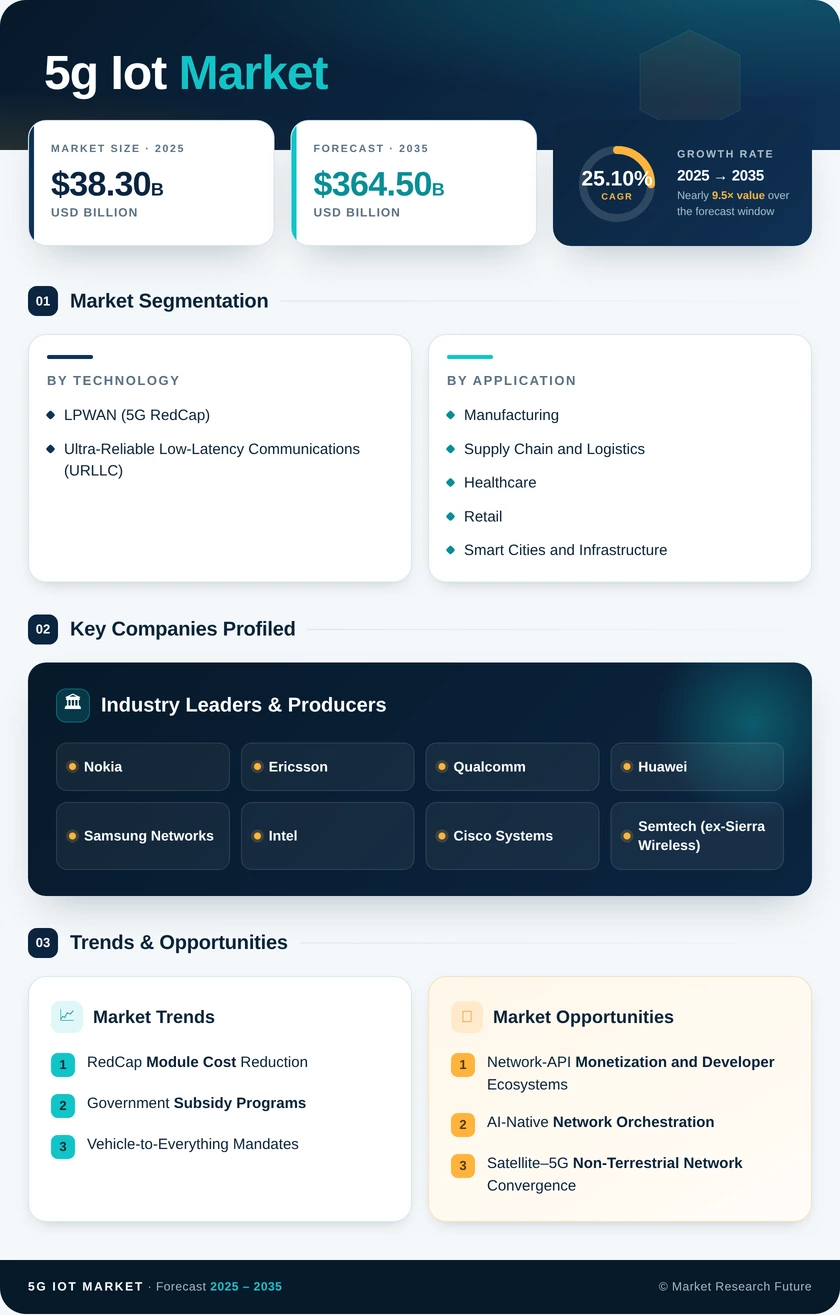
Segmentation Quick Reference
| Dimension | Sub-Segments | Dominant Segment (2025) | Fastest Growing Segment (2026–2035) |
| By Technology | LPWAN (5G RedCap); URLLC | LPWAN (5G RedCap) | URLLC |
| By End-User Industry | Manufacturing; Supply Chain and Logistics; Healthcare; Retail; Smart Cities and Infrastructure; Automotive and Transportation | Manufacturing | Automotive and Transportation |
| By Geography | North America; Europe; Asia-Pacific; South America; Middle East & Africa | Asia-Pacific | Asia-Pacific |
Market Segmentation Overview
By Technology
| Sub-Segment | Key Trend |
| LPWAN (5G RedCap) | Module cost parity with LTE Cat-1bis expected by 2028; dominant in high-density sensor deployments |
| Ultra-Reliable Low-Latency Communications (URLLC) | Expanding from pilot to production in robotics, autonomous driving, and remote surgery applications |
The technology segmentation reflects the dual nature of 5G IoT demand. LPWAN (5G RedCap) serves the volume-driven mass-connectivity tier where cost-per-device economics dominate procurement decisions. URLLC addresses the performance-driven tier where latency, reliability, and determinism justify premium pricing. As Release 18 chipsets mature, the boundary between these tiers will blur — integrated SoCs supporting both RedCap and URLLC profiles will enable single-SKU deployments across mixed-criticality environments.
By End-User Industry
| Sub-Segment | Key Trend |
| Manufacturing | Private 5G campus networks replacing Wi-Fi for deterministic shop-floor connectivity |
| Supply Chain and Logistics | Real-time container and fleet tracking driving module attach rates above 85% |
| Healthcare | Remote patient monitoring expanding from chronic-disease management to post-surgical care |
| Retail | Computer-vision checkout and in-store analytics shifting from edge servers to 5G-connected sensors |
| Smart Cities and Infrastructure | Utility metering and traffic-signal optimization migrating from LPWAN to 5G backhaul |
| Automotive and Transportation | V2X regulatory mandates in the US, EU, and China creating non-discretionary adoption cycles |
End-user segmentation captures the breadth of 5G IoT adoption across verticals with fundamentally different requirements for latency, density, and reliability. Manufacturing and automotive lead in absolute spend and growth rate respectively, while healthcare and smart cities represent high-potential segments where regulatory and reimbursement frameworks are still maturing. Supply chain and logistics sit at the intersection — high device volumes with moderate latency needs — making it an early and durable adopter of RedCap-based deployments.
By Geography
| Sub-Segment | Key Trend |
| North America | Hyperscaler edge-IoT partnerships and CHIPS Act subsidies anchoring enterprise demand |
| Europe | IPCEI funding and campus-network licensing driving industrial 5G adoption |
| Asia-Pacific | State-led factory digitization mandates in China and rapid greenfield rollouts in India |
| South America | Anatel 5G obligations and agritech adoption creating rural-connectivity demand |
| Middle East & Africa | Mega-project smart-city investments in Saudi Arabia and UAE leading regional adoption |
Geographic segmentation reveals a market where policy maturity, industrial base density, and spectrum allocation speed determine adoption velocity. Asia-Pacific dominates on all three dimensions, while North America and Europe compete on enterprise sophistication and ecosystem integration. South America and MEA remain nascent but benefit from leapfrog dynamics that bypass legacy cellular-IoT infrastructure entirely.


 Noah Malgeri
Co-Founder

 Peter Groot koerkamp
Account and Business Manager

 Younghwan Choi
Senior Retail Manager

 Mark Irwin
Management Consultant

 Akif Moroglu
Strategy & Business Development Director

 Guilherme Gomes Martins
Product Management Director

 Joseph Aguayo
Sales Operations & Pricing Manager

 La Terria Dodd
Program Support Specialist

 Rob Kooiker
Group Product Manager HVAC & Fire Protection GMA