
Request Free Sample ×

Kindly complete the form below to receive a free sample of this Report

* Please use a valid business email

Leading companies partner with us for data-driven Insights

clients tt-cursor
Hero Background
English
Chinese
French
Japanese
Korean
German
Spanish

5G Aviation Market Trends

ID: MRFR/AD/7073-CR
200 Pages
Abbas Raut
March 2023

5G in Aviation Market Size, Share, Industry Trend & Analysis Research Report By Application (Passenger Communications, Aircraft Maintenance, Air Traffic Management, In-Flight Entertainment), By End-use (Commercial Aviation, Cargo Aviation, Private Aviation), By Technology (Network Slicing, Massive Machine Type Communications, Ultra-Reliable Low Latency Communication), By Deployment Type (Private Network, Public Network, Hybrid Network), and By Regional (North America, Europe, South America, Asia Pacific, Middle East and Africa)-Forecast to 2035

Share:
Download PDF ×

We do not share your information with anyone. However, we may send you emails based on your report interest from time to time. You may contact us at any time to opt-out.

5G Aviation Market Infographic
Purchase Options

Market Trends

Key Emerging Trends in the 5G Aviation Market

The 5G in Aviation market is changing rapidly and companies have to adapt their strategies if they want to secure their market share or be recognized as pioneers of 5G technology integration within the aviation industry. In essence, it calls for an early adoption of 5G solutions. Companies that are investing in rapid integration of 5G technologies across various areas of aviation communication and connectivity would be seen as front-runners in this field. This move not only enables them to benefit from first-mover advantage but also demonstrates their commitment to taking on board cutting-edge solutions that are redefining the way we view the aviation scene.

Strategic partnerships and collaborations are crucial factors affecting share positioning in the 5G in Aviation market. The implementation process of 5G solutions is different for every airline thus this collaboration means working together with telecommunications providers, avionics manufacturers, and aviation service providers. In order to integrate smoothly into existing aviation systems, these relationships make sure that there is interoperability between 5G networks and current ones. Company’s position is strengthened by joint initiatives that create a web of knowledge, resources and technical capabilities leading to successful implementation of 5G within aviation.

There are other essential strategies aimed at positioning market shares for different segments within the airlines sector. Companies understand how important it is to apply 5G into aviation considering its multiple uses like commercial airlines’ entertainment or drone control by commanders from distant places etc. Adjusting a tailored path for each business application shall guarantee dominance over any part of air traffic ecosystem: commercial airliners; cargo logistics; unmanned aerial vehicles (UAVs) among others. Tailoring such solutions allows firms serving diverse interests audiences in this industry.

Moreover, companies concentrate on providing the end-to-end services as well as solutions in the field under discussion. Therefore, firms become holistic solution providers when they offer comprehensive packages including software, tools compatible with fifth generation wireless networks, connection plans and support whenever needed. This way, due to the fact that there is a one-stop shop for 5G services, it makes it easier for stewards of airspace to acquire them. In addition, an end-to-end solution has attractiveness in the market since it simplifies integration efforts for airlines as well as airports and other players within aviation seeking benefits from 5G technology.

A customer-oriented approach is core to dealing with market shares in 5G in Aviation industry. Therefore, companies should understand peculiar requirements and challenges experienced by all aviation stakeholders which include airlines, airports and regulatory bodies. By coming up with 5G tailored solutions addressing these needs processes can be improved leading to better experience of passengers. Developing strong relationships with aviation clients creates loyalty, positive word-of-mouth referrals, repeat business thus increasing customer trust and satisfaction hence widening their market base.

Market share positioning requires a strategic marketing and communications approach in 5G in Aviation industry. If companies can effectively communicate how superior their connectivity will be or how safe one’s flight will become or even more efficient operationally thanks to this new platform when compared against competitors then they are already standing out from other participants on this field. Creating brand recognition among stakeholders of the airline industry can be done through targeted marketing campaigns, participating in events organized by the sector as well as presenting success stories where necessary. Hence productive marketing techniques make these firms leaders within this segment influencing purchasing powers resulting into considerable market shares)

Moreover, as a strategic positioning factor for market share, corporations give priority to cybersecurity. In the aviation industry, cyber-attacks have become pervasive due to 5G network interconnectedness and data-sharing. Inclusion of modern cybersecurity measures in 5G solutions by organizations shows their dedication to securing aviation communication channels. This way not only does it solve industry concerns but also helps companies position themselves well as dependable partners within the 5G in Aviation market.”


Author
Author Profile
Abbas Raut
Research Analyst

Abbas Raut is a Senior Research Analyst with 5+ years of experience delivering data-driven insights and strategic recommendations across the Automotive and Aerospace & Defense sectors. He specializes in emerging technologies, industry value chains, and global market dynamics shaping the future of mobility and defense. In automotive, Abbas has led studies on EVs, charging stations, BMS, superchargers, and more, guiding stakeholders through electrification and regulatory shifts. In Aerospace & Defense, he has analyzed markets for military electronics, drones, radars, and electronic warfare solutions, supporting procurement and investment strategies. With expertise in market sizing, forecasting, benchmarking, and technology adoption, Abbas is known for transforming complex datasets into actionable insights that drive strategy, innovation, and growth.

Leave a Comment

FAQs

What is the projected market valuation of the 5G in Aviation Market by 2035?

<p>The projected market valuation for the 5G in Aviation Market by 2035 is 12.03 USD Billion.</p>

What was the market valuation of the 5G in Aviation Market in 2024?

<p>The overall market valuation of the 5G in Aviation Market was 1.354 USD Billion in 2024.</p>

What is the expected CAGR for the 5G in Aviation Market during the forecast period 2025 - 2035?

<p>The expected CAGR for the 5G in Aviation Market during the forecast period 2025 - 2035 is 21.97%.</p>

Which companies are considered key players in the 5G in Aviation Market?

<p>Key players in the 5G in Aviation Market include Ericsson, Huawei, Nokia, Qualcomm, Samsung, AT&T, Verizon, Thales Group, Airbus, and Boeing.</p>

What are the main application segments of the 5G in Aviation Market?

<p>The main application segments include Passenger Communications, Aircraft Maintenance, Air Traffic Management, and In-Flight Entertainment.</p>

What is the valuation range for Passenger Communications in the 5G in Aviation Market?

<p>The valuation range for Passenger Communications in the 5G in Aviation Market is projected to grow from 0.5 to 4.5 USD Billion.</p>

How does the 5G in Aviation Market segment by end-use?

<p>The 5G in Aviation Market segments by end-use into Commercial Aviation, Cargo Aviation, and Private Aviation.</p>

What is the projected valuation for Commercial Aviation in the 5G in Aviation Market?

<p>The projected valuation for Commercial Aviation in the 5G in Aviation Market is expected to rise from 0.8 to 6.5 USD Billion.</p>

What technologies are driving the 5G in Aviation Market?

<p>Key technologies driving the 5G in Aviation Market include Network Slicing, Massive Machine Type Communications, and Ultra-Reliable Low Latency Communication.</p>

What are the deployment types in the 5G in Aviation Market?

<p>The deployment types in the 5G in Aviation Market include Private Network, Public Network, and Hybrid Network.</p>

Market Summary

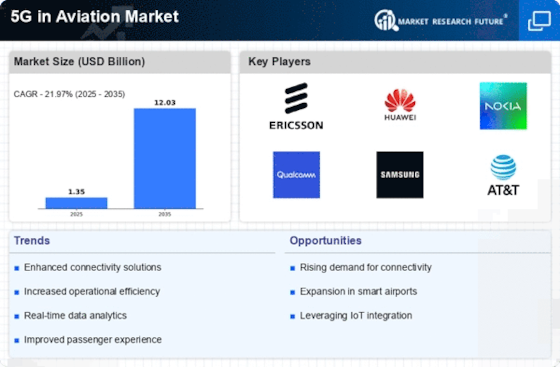
As per Market Research Future analysis, the 5G in Aviation Market Size was estimated at 1.354 USD Billion in 2024. The 5G in Aviation industry is projected to grow from 1.651 USD Billion in 2025 to 12.03 USD Billion by 2035, exhibiting a compound annual growth rate (CAGR) of 21.97% during the forecast period 2025 - 2035

Key Market Trends & Highlights

The 5G in Aviation Market is poised for substantial growth, driven by advancements in connectivity and operational efficiencies.

  • The North American region remains the largest market for 5G in aviation, showcasing robust demand for enhanced passenger communications. Asia-Pacific is emerging as the fastest-growing region, with rapid adoption of 5G technology in aviation operations. Passenger communications represent the largest segment, while in-flight entertainment is experiencing the fastest growth due to increasing consumer expectations. Key market drivers include increased connectivity and data transfer rates, which facilitate real-time data analytics and improved passenger services.

Market Size & Forecast

2024 Market Size 1.354 (USD Billion)
2035 Market Size 12.03 (USD Billion)
CAGR (2025 - 2035) 21.97%
Largest Regional Market Share in 2024 North America

Major Players

Ericsson (SE), Huawei (CN), Nokia (FI), Qualcomm (US), Samsung (KR), AT&amp;T (US), Verizon (US), Thales Group (FR), Airbus (FR), Boeing (US)

Market Trends

The 5G in Aviation Market is currently experiencing a transformative phase, driven by the increasing demand for enhanced connectivity and operational efficiency within the aviation sector. Airlines and airports are progressively adopting 5G technology to improve passenger experiences, streamline operations, and facilitate real-time data exchange. This shift appears to be influenced by the need for more reliable communication systems that can support advanced applications such as autonomous aircraft, smart baggage handling, and in-flight entertainment. As the aviation industry continues to evolve, the integration of 5G technology is likely to play a pivotal role in shaping future air travel experiences. Moreover, the potential for 5G to enable innovative solutions in air traffic management and safety protocols cannot be overlooked. Enhanced bandwidth and lower latency offered by 5G networks may lead to improved situational awareness for pilots and air traffic controllers, thereby increasing safety and efficiency. The ongoing collaboration between telecommunications providers and aviation stakeholders suggests a concerted effort to harness the capabilities of 5G technology. This synergy may result in a more connected and efficient aviation ecosystem, ultimately benefiting both operators and passengers alike.

Enhanced Passenger Experience

The integration of 5G technology in aviation is likely to significantly enhance the passenger experience. With faster internet speeds and improved connectivity, travelers may enjoy seamless access to in-flight entertainment, real-time updates, and personalized services. This trend indicates a shift towards a more customer-centric approach in air travel.

Operational Efficiency

5G technology appears to be a catalyst for operational efficiency within the aviation sector. Airlines and airports may leverage advanced data analytics and real-time communication to optimize flight schedules, reduce delays, and improve resource management. This trend suggests a move towards smarter operations that can adapt to dynamic conditions.

Safety and Security Enhancements

The implementation of 5G networks in aviation could lead to notable advancements in safety and security measures. Enhanced communication capabilities may facilitate better coordination among ground staff, pilots, and air traffic control, thereby improving overall safety protocols. This trend highlights the potential for 5G to contribute to a safer flying environment.

5G Aviation Market Market Drivers

Support for Autonomous Aircraft Operations

The emergence of autonomous aircraft operations is a key driver in the 5G in Aviation Market. 5G technology provides the necessary infrastructure to support the communication needs of autonomous systems, enabling them to operate safely and efficiently. With low latency and high reliability, 5G can facilitate real-time communication between autonomous aircraft and ground control, ensuring that safety protocols are adhered to. As the aviation industry moves towards automation, the demand for 5G connectivity is expected to rise, potentially leading to a new era of aviation where autonomous flights become commonplace.

Real-Time Data Analytics and Decision Making

The integration of 5G technology in the Aviation Market facilitates real-time data analytics, which is crucial for informed decision-making. Airlines can leverage high-speed data transmission to analyze flight data, weather conditions, and passenger preferences instantaneously. This capability may lead to optimized flight routes, reduced fuel consumption, and enhanced safety measures. Furthermore, the ability to process large volumes of data in real-time can improve maintenance schedules and reduce downtime for aircraft. As a result, airlines are likely to see a reduction in operational costs and an increase in overall efficiency, making 5G a vital component of modern aviation.

Enhanced Maintenance and Predictive Analytics

The 5G in Aviation Market is increasingly focusing on enhanced maintenance practices through predictive analytics. With the ability to transmit data at unprecedented speeds, airlines can monitor aircraft systems in real-time, identifying potential issues before they escalate into serious problems. This proactive approach to maintenance can lead to significant cost savings and improved safety. Industry reports suggest that predictive maintenance can reduce maintenance costs by up to 30%. As airlines adopt 5G technology, they are likely to invest in advanced analytics tools that utilize this data, thereby transforming their maintenance strategies and enhancing operational reliability.

Increased Connectivity and Data Transfer Rates

The 5G in Aviation Market is poised to benefit from the enhanced connectivity and data transfer rates that 5G technology offers. With speeds potentially reaching up to 10 Gbps, airlines can provide passengers with seamless internet access during flights. This capability not only enhances the passenger experience but also allows for real-time data sharing between aircraft and ground operations. According to industry estimates, the demand for in-flight connectivity is expected to grow significantly, with a projected increase in connected devices on aircraft. This trend indicates that airlines are likely to invest heavily in 5G infrastructure to meet passenger expectations and improve operational efficiency.

Improved Passenger Services and Personalization

The 5G in Aviation Market is likely to see a transformation in passenger services through enhanced personalization. With the capabilities of 5G, airlines can offer tailored services based on real-time data analytics of passenger preferences and behaviors. This could include personalized entertainment options, targeted promotions, and improved customer service interactions. As airlines strive to differentiate themselves in a competitive market, the ability to provide customized experiences may become a crucial factor in attracting and retaining customers. The integration of 5G technology is expected to play a pivotal role in shaping the future of passenger services in aviation.

Market Segment Insights

By Application: Passenger Communications (Largest) vs. In-Flight Entertainment (Fastest-Growing)

In the 5G in Aviation Market, the 'Application' segment shows a diverse range of values, with Passenger Communications commanding the largest share. This segment is primarily driven by the increasing demand for enhanced connectivity and real-time communication from passengers. Aircraft Maintenance and <a href="https://www.marketresearchfuture.com/reports/air-traffic-management-market-6775" target="_blank">air traffic management</a> also hold significant roles but do not match the prominence of Passenger Communications. Notably, In-Flight Entertainment is gaining traction and is positioned as a fast-growing area, as airlines innovate to attract tech-savvy travelers and enhance passenger experiences.

Aircraft Maintenance (Dominant) vs. <a href="https://www.marketresearchfuture.com/reports/air-traffic-market-33794" target="_blank">air traffic</a> Management (Emerging)

Aircraft Maintenance has established itself as a dominant application within the 5G in Aviation Market, leveraging real-time data analytics and remote monitoring to improve operational efficiency and safety standards. This segment encompasses predictive maintenance techniques that minimize downtimes and optimize maintenance schedules. Conversely, <a href="https://www.marketresearchfuture.com/reports/air-traffic-management-market-6775" target="_blank">air traffic management</a> represents an emerging application that is set to evolve significantly with the integration of 5G technology. As air travel demand rises, there is a pressing need for advanced management systems that can efficiently handle increased air traffic, reduce delays, and enhance safety, positioning Air Traffic Management for substantial growth.

By End-use: Commercial Aviation (Largest) vs. Cargo Aviation (Fastest-Growing)

In the 5G in Aviation market, the distribution of end-use segments showcases that commercial aviation holds a substantial share, leading the industry. Its widespread adoption facilitates improved connectivity and operational efficiency, making it a critical segment within the aviation landscape. Conversely, cargo aviation is witnessing rapid growth thanks to the increasing demand for high-speed data transfer and enhanced operational capabilities, especially in logistics and freight, signaling a dynamic shift in market priorities.

Commercial Aviation (Dominant) vs. Cargo Aviation (Emerging)

Commercial aviation stands as the dominant force in the 5G in Aviation market, leveraging advanced technology to enhance passenger experience and streamline operations. The segment is characterized by its vast network of airlines adopting 5G for various applications such as in-flight connectivity and real-time data analytics. In contrast, cargo aviation is emerging as a critical sector, driven by the increasing necessity for efficient supply chains and the rise of e-commerce. This segment is rapidly integrating 5G technology to optimize logistics, enabling real-time tracking and smarter logistics solutions, positioning it as a future powerhouse in aviation.

By Technology: Network Slicing (Largest) vs. Ultra-Reliable Low Latency Communication (Fastest-Growing)

The 5G in Aviation Market sees a significant distribution of market share across its key technologies. Network Slicing is the largest contributor, allowing multiple virtual networks to be created atop a shared infrastructure, enabling more flexibility and efficient use of resources. On the other hand, Ultra-Reliable Low Latency Communication (URLLC) is gaining traction due to its critical applications in mission-critical operations, which demand reliability and low latency in communications, marking it as the fastest-growing segment within this market. Current growth trends in the <a href="https://www.marketresearchfuture.com/reports/5g-aviation-market-8545" target="_blank">5g aviation</a> sector are propelled by the increasing need for enhanced connectivity and operational efficiency. The push for smart airports and connected aircraft is driving the adoption of technologies like Network Slicing, which facilitates seamless integration of various services and applications. Meanwhile, URLLC&rsquo;s growth is spurred by advancements in AI and IoT applications that necessitate ultra-reliable communication for safety-critical connectivity, especially in autonomous flight operations and real-time data exchanges.

Technology: Network Slicing (Dominant) vs. Massive Machine Type Communications (Emerging)

Network Slicing stands out as a dominant technology in the 5G in Aviation Market, offering tailored connectivity experiences that cater to various aviation applications. This approach allows service providers to allocate specific amounts of bandwidth and quality of service for different users and applications within the aviation sector. In contrast, Massive Machine Type Communications (mMTC) is considered an emerging technology, facilitating a vast number of IoT devices and sensors, which are increasingly being adopted in aviation for applications such as predictive maintenance and improved operational efficiencies. While Network Slicing is well-established and widely implemented, mMTC is expected to grow rapidly as the aviation industry increasingly integrates smart technologies.

By Deployment Type: Private Network (Largest) vs. Public Network (Fastest-Growing)

In the 5G in Aviation Market, the deployment type segment showcases a diverse landscape with Private Networks, Public Networks, and Hybrid Networks offering unique advantages. Private Networks currently hold the largest market share due to their tailored solutions that meet specific operational needs of aviation stakeholders. These networks provide robust security, low latency, and high performance, making them essential for critical aviation applications. In contrast, Public Networks are rapidly gaining momentum, driven by the extensive infrastructure and connectivity they offer across various regions. This segment is particularly appealing to smaller aviation companies seeking cost-effective solutions without heavy investment in infrastructure.

Private Network (Dominant) vs. Public Network (Emerging)

Private Networks are rapidly becoming the dominant force in the 5G in Aviation Market, owing to their ability to deliver customized solutions that address the stringent requirements of aviation operations. With enhanced security features and reliable connectivity, private networks ensure seamless communication and data transfer essential for aviation processes. On the other hand, Public Networks are viewed as an emerging option, especially for smaller aviation entities that are looking to leverage existing infrastructures. These networks provide a balance between connectivity and affordability, driving their adoption. The growing demand for real-time data access and advanced analytics capabilities in aviation is paving the way for hybrid deployment strategies, merging the strengths of both private and public networks to optimize operational efficiency.

Get more detailed insights about 5G in Aviation Market Research Report - Global Forecast till 2035

Regional Insights

The 5G in Aviation Market is poised for significant growth across various regions, revealing distinctive trends and insights. In 2024, North America held a majority share at 0.5 USD Billion, scaling up to 5.0 USD Billion by 2035, driven by advanced infrastructure and prevalence of technological innovation.

Europe followed with a market value of 0.3 USD Billion in 2024, expected to reach 3.0 USD Billion by 2035, emphasizing the region's commitment to enhancing aviation connectivity. Asia Pacific showed promising progress, valued at 0.4 USD Billion in 2024 and potentially hitting 2.5 USD Billion by 2035, as countries in this region expedite their 5G rollouts for improved operational efficiency.

South America held a smaller yet notable potential, with a 2024 valuation of 0.1 USD Billion and an expectation of 1.0 USD Billion by 2035, indicating gradual investment in aviation infrastructure. Meanwhile, the Middle East and Africa began with a modest value of 0.05 USD Billion in 2024, growing to 0.5 USD Billion by 2035 as air travel continues to expand in emerging markets.

Collectively, these regional dynamics present a compelling narrative where North America dominated, while the growth trajectory in Europe and Asia Pacific signaled substantial opportunities in the 5G in Aviation Market revenue through enhanced connectivity solutions.

Key Players and Competitive Insights

The 5G in Aviation Market presents a dynamic landscape characterized by rapid technological advancements and increasing connectivity demands within the aviation sector. As airlines and airports strive to enhance operational efficiency, improve passenger experience, and enable innovative services, the adoption of 5G technology is becoming a critical focus.
Competitive insights reveal that key players are investing significantly in research and development to stay ahead, leveraging partnerships and collaborations to expand their footprint in this evolving market. The competition is intense, driven by the necessity to provide faster, more reliable, and secure communication solutions tailored specifically for aviation applications.
Nokia holds a prominent position within the 5G in Aviation Market, showcasing its strengths in providing cutting-edge telecommunications infrastructure. The company is known for its robust portfolio of 5G network solutions, which are critical for achieving seamless connectivity in airports and on aircraft.
By focusing on operational technology and digitalization, Nokia has positioned itself as a key enabler for airlines looking to transform their services through high-speed data transmission. Moreover, Nokia has built strong relationships with various stakeholders in the aviation sector, ensuring that its services are tailored to meet the specific needs of this niche market.
This partnership approach enhances its market presence and provides a competitive edge as airlines increasingly adopt advanced technologies to improve efficiency and customer service.
Huawei also plays a significant role in the 5G in Aviation Market, offering a wide range of products and services that cater to the needs of the aviation industry. The company is distinguished by its focus on innovations such as intelligent airport solutions, remote control systems, and enhanced passenger services driven by 5G connectivity.
Huawei’s strengths lie in its ability to provide comprehensive solutions that encompass network infrastructure, data analytics, and security frameworks tailored for aviation applications.
The company maintains a strong market presence globally by engaging in strategic partnerships and collaborations with aviation stakeholders, enhancing the digital transformation efforts within airports and airlines.
Furthermore, Huawei has been involved in multiple mergers and acquisitions that bolster its capabilities in this sector, demonstrating a commitment to advancing its technological solutions and expanding its operational footprint in the global aviation market.

Key Companies in the 5G Aviation Market include

Industry Developments

The 5G in Aviation Market has witnessed significant developments recently, particularly with major players like Nokia, Huawei, Lockheed Martin, Airbus, and Boeing leading the charge in integrating 5G technologies.

In October 2023, industry discussions highlighted the growing role of 5G in enhancing in-flight connectivity and operational efficiency, fueling demand for low-latency communication systems. Meanwhile, General Dynamics and Thales are collaborating on 5G cybersecurity solutions to protect crucial aviation communications.

In terms of mergers and acquisitions, in September 2023, Airbus announced a strategic partnership with Panasonic to enhance their 5G network capabilities, aiming to provide better connectivity solutions for airlines.

Additionally, Qualcomm's ongoing cooperation with Ericsson has been pivotal to the deployment of advanced 5G infrastructure in airport operations, contributing to a surge in market valuation. The market has seen a valuation growth of approximately 15% year-on-year, attributed to increasing investments in digital transformation within the aviation sector.

Overall, the emphasis on secure and efficient 5G connectivity in aviation continues to shape the landscape as companies prioritize innovation and enhanced passenger experiences in the global market.

Future Outlook

5G Aviation Market Future Outlook

The 5G in Aviation Market is projected to grow at a 21.97% CAGR from 2025 to 2035, driven by enhanced connectivity, operational efficiency, and passenger experience improvements.

New opportunities lie in:

  • Development of advanced in-flight entertainment systems leveraging 5G technology.
  • Implementation of real-time aircraft health monitoring solutions.
  • Creation of smart airport infrastructure integrating 5G for seamless operations.

By 2035, the 5G in Aviation Market is expected to be a cornerstone of industry innovation and efficiency.

Market Segmentation

5G Aviation Market End-use Outlook

  • Commercial Aviation
  • Cargo Aviation
  • Private Aviation

5G Aviation Market Technology Outlook

  • Network Slicing
  • Massive Machine Type Communications
  • Ultra-Reliable Low Latency Communication

5G Aviation Market Application Outlook

  • Passenger Communications
  • Aircraft Maintenance
  • Air Traffic Management
  • In-Flight Entertainment

5G Aviation Market Deployment Type Outlook

  • Private Network
  • Public Network
  • Hybrid Network

Report Scope

MARKET SIZE 2024 1.354(USD Billion)
MARKET SIZE 2025 1.651(USD Billion)
MARKET SIZE 2035 12.03(USD Billion)
COMPOUND ANNUAL GROWTH RATE (CAGR) 21.97% (2025 - 2035)
REPORT COVERAGE Revenue Forecast, Competitive Landscape, Growth Factors, and Trends
BASE YEAR 2024
Market Forecast Period 2025 - 2035
Historical Data 2019 - 2024
Market Forecast Units USD Billion
Key Companies Profiled Ericsson (SE), Huawei (CN), Nokia (FI), Qualcomm (US), Samsung (KR), AT&T (US), Verizon (US), Thales Group (FR), Airbus (FR), Boeing (US)
Segments Covered Application, End-use, Technology, Deployment Type, Regional
Key Market Opportunities Integration of advanced data analytics and real-time communication in the 5G in Aviation Market.
Key Market Dynamics Rapid advancements in 5G technology are reshaping aviation operations and enhancing passenger connectivity experiences.
Countries Covered North America, Europe, APAC, South America, MEA

FAQs

What is the projected market valuation of the 5G in Aviation Market by 2035?

<p>The projected market valuation for the 5G in Aviation Market by 2035 is 12.03 USD Billion.</p>

What was the market valuation of the 5G in Aviation Market in 2024?

<p>The overall market valuation of the 5G in Aviation Market was 1.354 USD Billion in 2024.</p>

What is the expected CAGR for the 5G in Aviation Market during the forecast period 2025 - 2035?

<p>The expected CAGR for the 5G in Aviation Market during the forecast period 2025 - 2035 is 21.97%.</p>

Which companies are considered key players in the 5G in Aviation Market?

<p>Key players in the 5G in Aviation Market include Ericsson, Huawei, Nokia, Qualcomm, Samsung, AT&T, Verizon, Thales Group, Airbus, and Boeing.</p>

What are the main application segments of the 5G in Aviation Market?

<p>The main application segments include Passenger Communications, Aircraft Maintenance, Air Traffic Management, and In-Flight Entertainment.</p>

What is the valuation range for Passenger Communications in the 5G in Aviation Market?

<p>The valuation range for Passenger Communications in the 5G in Aviation Market is projected to grow from 0.5 to 4.5 USD Billion.</p>

How does the 5G in Aviation Market segment by end-use?

<p>The 5G in Aviation Market segments by end-use into Commercial Aviation, Cargo Aviation, and Private Aviation.</p>

What is the projected valuation for Commercial Aviation in the 5G in Aviation Market?

<p>The projected valuation for Commercial Aviation in the 5G in Aviation Market is expected to rise from 0.8 to 6.5 USD Billion.</p>

What technologies are driving the 5G in Aviation Market?

<p>Key technologies driving the 5G in Aviation Market include Network Slicing, Massive Machine Type Communications, and Ultra-Reliable Low Latency Communication.</p>

What are the deployment types in the 5G in Aviation Market?

<p>The deployment types in the 5G in Aviation Market include Private Network, Public Network, and Hybrid Network.</p>

  1. SECTION I: EXECUTIVE SUMMARY AND KEY HIGHLIGHTS
    1. | 1.1 EXECUTIVE SUMMARY
    2. | | 1.1.1 Market Overview
    3. | | 1.1.2 Key Findings
    4. | | 1.1.3 Market Segmentation
    5. | | 1.1.4 Competitive Landscape
    6. | | 1.1.5 Challenges and Opportunities
    7. | | 1.1.6 Future Outlook
  2. SECTION II: SCOPING, METHODOLOGY AND MARKET STRUCTURE
    1. | 2.1 MARKET INTRODUCTION
    2. | | 2.1.1 Definition
    3. | | 2.1.2 Scope of the study
    4. | | | 2.1.2.1 Research Objective
    5. | | | 2.1.2.2 Assumption
    6. | | | 2.1.2.3 Limitations
    7. | 2.2 RESEARCH METHODOLOGY
    8. | | 2.2.1 Overview
    9. | | 2.2.2 Data Mining
    10. | | 2.2.3 Secondary Research
    11. | | 2.2.4 Primary Research
    12. | | | 2.2.4.1 Primary Interviews and Information Gathering Process
    13. | | | 2.2.4.2 Breakdown of Primary Respondents
    14. | | 2.2.5 Forecasting Model
    15. | | 2.2.6 Market Size Estimation
    16. | | | 2.2.6.1 Bottom-Up Approach
    17. | | | 2.2.6.2 Top-Down Approach
    18. | | 2.2.7 Data Triangulation
    19. | | 2.2.8 Validation
  3. SECTION III: QUALITATIVE ANALYSIS
    1. | 3.1 MARKET DYNAMICS
    2. | | 3.1.1 Overview
    3. | | 3.1.2 Drivers
    4. | | 3.1.3 Restraints
    5. | | 3.1.4 Opportunities
    6. | 3.2 MARKET FACTOR ANALYSIS
    7. | | 3.2.1 Value chain Analysis
    8. | | 3.2.2 Porter's Five Forces Analysis
    9. | | | 3.2.2.1 Bargaining Power of Suppliers
    10. | | | 3.2.2.2 Bargaining Power of Buyers
    11. | | | 3.2.2.3 Threat of New Entrants
    12. | | | 3.2.2.4 Threat of Substitutes
    13. | | | 3.2.2.5 Intensity of Rivalry
    14. | | 3.2.3 COVID-19 Impact Analysis
    15. | | | 3.2.3.1 Market Impact Analysis
    16. | | | 3.2.3.2 Regional Impact
    17. | | | 3.2.3.3 Opportunity and Threat Analysis
  4. SECTION IV: QUANTITATIVE ANALYSIS
    1. | 4.1 Aerospace & Defense, BY Application (USD Billion)
    2. | | 4.1.1 Passenger Communications
    3. | | 4.1.2 Aircraft Maintenance
    4. | | 4.1.3 Air Traffic Management
    5. | | 4.1.4 In-Flight Entertainment
    6. | 4.2 Aerospace & Defense, BY End-use (USD Billion)
    7. | | 4.2.1 Commercial Aviation
    8. | | 4.2.2 Cargo Aviation
    9. | | 4.2.3 Private Aviation
    10. | 4.3 Aerospace & Defense, BY Technology (USD Billion)
    11. | | 4.3.1 Network Slicing
    12. | | 4.3.2 Massive Machine Type Communications
    13. | | 4.3.3 Ultra-Reliable Low Latency Communication
    14. | 4.4 Aerospace & Defense, BY Deployment Type (USD Billion)
    15. | | 4.4.1 Private Network
    16. | | 4.4.2 Public Network
    17. | | 4.4.3 Hybrid Network
    18. | 4.5 Aerospace & Defense, BY Region (USD Billion)
    19. | | 4.5.1 North America
    20. | | | 4.5.1.1 US
    21. | | | 4.5.1.2 Canada
    22. | | 4.5.2 Europe
    23. | | | 4.5.2.1 Germany
    24. | | | 4.5.2.2 UK
    25. | | | 4.5.2.3 France
    26. | | | 4.5.2.4 Russia
    27. | | | 4.5.2.5 Italy
    28. | | | 4.5.2.6 Spain
    29. | | | 4.5.2.7 Rest of Europe
    30. | | 4.5.3 APAC
    31. | | | 4.5.3.1 China
    32. | | | 4.5.3.2 India
    33. | | | 4.5.3.3 Japan
    34. | | | 4.5.3.4 South Korea
    35. | | | 4.5.3.5 Malaysia
    36. | | | 4.5.3.6 Thailand
    37. | | | 4.5.3.7 Indonesia
    38. | | | 4.5.3.8 Rest of APAC
    39. | | 4.5.4 South America
    40. | | | 4.5.4.1 Brazil
    41. | | | 4.5.4.2 Mexico
    42. | | | 4.5.4.3 Argentina
    43. | | | 4.5.4.4 Rest of South America
    44. | | 4.5.5 MEA
    45. | | | 4.5.5.1 GCC Countries
    46. | | | 4.5.5.2 South Africa
    47. | | | 4.5.5.3 Rest of MEA
  5. SECTION V: COMPETITIVE ANALYSIS
    1. | 5.1 Competitive Landscape
    2. | | 5.1.1 Overview
    3. | | 5.1.2 Competitive Analysis
    4. | | 5.1.3 Market share Analysis
    5. | | 5.1.4 Major Growth Strategy in the Aerospace & Defense
    6. | | 5.1.5 Competitive Benchmarking
    7. | | 5.1.6 Leading Players in Terms of Number of Developments in the Aerospace & Defense
    8. | | 5.1.7 Key developments and growth strategies
    9. | | | 5.1.7.1 New Product Launch/Service Deployment
    10. | | | 5.1.7.2 Merger & Acquisitions
    11. | | | 5.1.7.3 Joint Ventures
    12. | | 5.1.8 Major Players Financial Matrix
    13. | | | 5.1.8.1 Sales and Operating Income
    14. | | | 5.1.8.2 Major Players R&D Expenditure. 2023
    15. | 5.2 Company Profiles
    16. | | 5.2.1 Ericsson (SE)
    17. | | | 5.2.1.1 Financial Overview
    18. | | | 5.2.1.2 Products Offered
    19. | | | 5.2.1.3 Key Developments
    20. | | | 5.2.1.4 SWOT Analysis
    21. | | | 5.2.1.5 Key Strategies
    22. | | 5.2.2 Huawei (CN)
    23. | | | 5.2.2.1 Financial Overview
    24. | | | 5.2.2.2 Products Offered
    25. | | | 5.2.2.3 Key Developments
    26. | | | 5.2.2.4 SWOT Analysis
    27. | | | 5.2.2.5 Key Strategies
    28. | | 5.2.3 Nokia (FI)
    29. | | | 5.2.3.1 Financial Overview
    30. | | | 5.2.3.2 Products Offered
    31. | | | 5.2.3.3 Key Developments
    32. | | | 5.2.3.4 SWOT Analysis
    33. | | | 5.2.3.5 Key Strategies
    34. | | 5.2.4 Qualcomm (US)
    35. | | | 5.2.4.1 Financial Overview
    36. | | | 5.2.4.2 Products Offered
    37. | | | 5.2.4.3 Key Developments
    38. | | | 5.2.4.4 SWOT Analysis
    39. | | | 5.2.4.5 Key Strategies
    40. | | 5.2.5 Samsung (KR)
    41. | | | 5.2.5.1 Financial Overview
    42. | | | 5.2.5.2 Products Offered
    43. | | | 5.2.5.3 Key Developments
    44. | | | 5.2.5.4 SWOT Analysis
    45. | | | 5.2.5.5 Key Strategies
    46. | | 5.2.6 AT&T (US)
    47. | | | 5.2.6.1 Financial Overview
    48. | | | 5.2.6.2 Products Offered
    49. | | | 5.2.6.3 Key Developments
    50. | | | 5.2.6.4 SWOT Analysis
    51. | | | 5.2.6.5 Key Strategies
    52. | | 5.2.7 Verizon (US)
    53. | | | 5.2.7.1 Financial Overview
    54. | | | 5.2.7.2 Products Offered
    55. | | | 5.2.7.3 Key Developments
    56. | | | 5.2.7.4 SWOT Analysis
    57. | | | 5.2.7.5 Key Strategies
    58. | | 5.2.8 Thales Group (FR)
    59. | | | 5.2.8.1 Financial Overview
    60. | | | 5.2.8.2 Products Offered
    61. | | | 5.2.8.3 Key Developments
    62. | | | 5.2.8.4 SWOT Analysis
    63. | | | 5.2.8.5 Key Strategies
    64. | | 5.2.9 Airbus (FR)
    65. | | | 5.2.9.1 Financial Overview
    66. | | | 5.2.9.2 Products Offered
    67. | | | 5.2.9.3 Key Developments
    68. | | | 5.2.9.4 SWOT Analysis
    69. | | | 5.2.9.5 Key Strategies
    70. | | 5.2.10 Boeing (US)
    71. | | | 5.2.10.1 Financial Overview
    72. | | | 5.2.10.2 Products Offered
    73. | | | 5.2.10.3 Key Developments
    74. | | | 5.2.10.4 SWOT Analysis
    75. | | | 5.2.10.5 Key Strategies
    76. | 5.3 Appendix
    77. | | 5.3.1 References
    78. | | 5.3.2 Related Reports
  6. LIST OF FIGURES
    1. | 6.1 MARKET SYNOPSIS
    2. | 6.2 NORTH AMERICA MARKET ANALYSIS
    3. | 6.3 US MARKET ANALYSIS BY APPLICATION
    4. | 6.4 US MARKET ANALYSIS BY END-USE
    5. | 6.5 US MARKET ANALYSIS BY TECHNOLOGY
    6. | 6.6 US MARKET ANALYSIS BY DEPLOYMENT TYPE
    7. | 6.7 CANADA MARKET ANALYSIS BY APPLICATION
    8. | 6.8 CANADA MARKET ANALYSIS BY END-USE
    9. | 6.9 CANADA MARKET ANALYSIS BY TECHNOLOGY
    10. | 6.10 CANADA MARKET ANALYSIS BY DEPLOYMENT TYPE
    11. | 6.11 EUROPE MARKET ANALYSIS
    12. | 6.12 GERMANY MARKET ANALYSIS BY APPLICATION
    13. | 6.13 GERMANY MARKET ANALYSIS BY END-USE
    14. | 6.14 GERMANY MARKET ANALYSIS BY TECHNOLOGY
    15. | 6.15 GERMANY MARKET ANALYSIS BY DEPLOYMENT TYPE
    16. | 6.16 UK MARKET ANALYSIS BY APPLICATION
    17. | 6.17 UK MARKET ANALYSIS BY END-USE
    18. | 6.18 UK MARKET ANALYSIS BY TECHNOLOGY
    19. | 6.19 UK MARKET ANALYSIS BY DEPLOYMENT TYPE
    20. | 6.20 FRANCE MARKET ANALYSIS BY APPLICATION
    21. | 6.21 FRANCE MARKET ANALYSIS BY END-USE
    22. | 6.22 FRANCE MARKET ANALYSIS BY TECHNOLOGY
    23. | 6.23 FRANCE MARKET ANALYSIS BY DEPLOYMENT TYPE
    24. | 6.24 RUSSIA MARKET ANALYSIS BY APPLICATION
    25. | 6.25 RUSSIA MARKET ANALYSIS BY END-USE
    26. | 6.26 RUSSIA MARKET ANALYSIS BY TECHNOLOGY
    27. | 6.27 RUSSIA MARKET ANALYSIS BY DEPLOYMENT TYPE
    28. | 6.28 ITALY MARKET ANALYSIS BY APPLICATION
    29. | 6.29 ITALY MARKET ANALYSIS BY END-USE
    30. | 6.30 ITALY MARKET ANALYSIS BY TECHNOLOGY
    31. | 6.31 ITALY MARKET ANALYSIS BY DEPLOYMENT TYPE
    32. | 6.32 SPAIN MARKET ANALYSIS BY APPLICATION
    33. | 6.33 SPAIN MARKET ANALYSIS BY END-USE
    34. | 6.34 SPAIN MARKET ANALYSIS BY TECHNOLOGY
    35. | 6.35 SPAIN MARKET ANALYSIS BY DEPLOYMENT TYPE
    36. | 6.36 REST OF EUROPE MARKET ANALYSIS BY APPLICATION
    37. | 6.37 REST OF EUROPE MARKET ANALYSIS BY END-USE
    38. | 6.38 REST OF EUROPE MARKET ANALYSIS BY TECHNOLOGY
    39. | 6.39 REST OF EUROPE MARKET ANALYSIS BY DEPLOYMENT TYPE
    40. | 6.40 APAC MARKET ANALYSIS
    41. | 6.41 CHINA MARKET ANALYSIS BY APPLICATION
    42. | 6.42 CHINA MARKET ANALYSIS BY END-USE
    43. | 6.43 CHINA MARKET ANALYSIS BY TECHNOLOGY
    44. | 6.44 CHINA MARKET ANALYSIS BY DEPLOYMENT TYPE
    45. | 6.45 INDIA MARKET ANALYSIS BY APPLICATION
    46. | 6.46 INDIA MARKET ANALYSIS BY END-USE
    47. | 6.47 INDIA MARKET ANALYSIS BY TECHNOLOGY
    48. | 6.48 INDIA MARKET ANALYSIS BY DEPLOYMENT TYPE
    49. | 6.49 JAPAN MARKET ANALYSIS BY APPLICATION
    50. | 6.50 JAPAN MARKET ANALYSIS BY END-USE
    51. | 6.51 JAPAN MARKET ANALYSIS BY TECHNOLOGY
    52. | 6.52 JAPAN MARKET ANALYSIS BY DEPLOYMENT TYPE
    53. | 6.53 SOUTH KOREA MARKET ANALYSIS BY APPLICATION
    54. | 6.54 SOUTH KOREA MARKET ANALYSIS BY END-USE
    55. | 6.55 SOUTH KOREA MARKET ANALYSIS BY TECHNOLOGY
    56. | 6.56 SOUTH KOREA MARKET ANALYSIS BY DEPLOYMENT TYPE
    57. | 6.57 MALAYSIA MARKET ANALYSIS BY APPLICATION
    58. | 6.58 MALAYSIA MARKET ANALYSIS BY END-USE
    59. | 6.59 MALAYSIA MARKET ANALYSIS BY TECHNOLOGY
    60. | 6.60 MALAYSIA MARKET ANALYSIS BY DEPLOYMENT TYPE
    61. | 6.61 THAILAND MARKET ANALYSIS BY APPLICATION
    62. | 6.62 THAILAND MARKET ANALYSIS BY END-USE
    63. | 6.63 THAILAND MARKET ANALYSIS BY TECHNOLOGY
    64. | 6.64 THAILAND MARKET ANALYSIS BY DEPLOYMENT TYPE
    65. | 6.65 INDONESIA MARKET ANALYSIS BY APPLICATION
    66. | 6.66 INDONESIA MARKET ANALYSIS BY END-USE
    67. | 6.67 INDONESIA MARKET ANALYSIS BY TECHNOLOGY
    68. | 6.68 INDONESIA MARKET ANALYSIS BY DEPLOYMENT TYPE
    69. | 6.69 REST OF APAC MARKET ANALYSIS BY APPLICATION
    70. | 6.70 REST OF APAC MARKET ANALYSIS BY END-USE
    71. | 6.71 REST OF APAC MARKET ANALYSIS BY TECHNOLOGY
    72. | 6.72 REST OF APAC MARKET ANALYSIS BY DEPLOYMENT TYPE
    73. | 6.73 SOUTH AMERICA MARKET ANALYSIS
    74. | 6.74 BRAZIL MARKET ANALYSIS BY APPLICATION
    75. | 6.75 BRAZIL MARKET ANALYSIS BY END-USE
    76. | 6.76 BRAZIL MARKET ANALYSIS BY TECHNOLOGY
    77. | 6.77 BRAZIL MARKET ANALYSIS BY DEPLOYMENT TYPE
    78. | 6.78 MEXICO MARKET ANALYSIS BY APPLICATION
    79. | 6.79 MEXICO MARKET ANALYSIS BY END-USE
    80. | 6.80 MEXICO MARKET ANALYSIS BY TECHNOLOGY
    81. | 6.81 MEXICO MARKET ANALYSIS BY DEPLOYMENT TYPE
    82. | 6.82 ARGENTINA MARKET ANALYSIS BY APPLICATION
    83. | 6.83 ARGENTINA MARKET ANALYSIS BY END-USE
    84. | 6.84 ARGENTINA MARKET ANALYSIS BY TECHNOLOGY
    85. | 6.85 ARGENTINA MARKET ANALYSIS BY DEPLOYMENT TYPE
    86. | 6.86 REST OF SOUTH AMERICA MARKET ANALYSIS BY APPLICATION
    87. | 6.87 REST OF SOUTH AMERICA MARKET ANALYSIS BY END-USE
    88. | 6.88 REST OF SOUTH AMERICA MARKET ANALYSIS BY TECHNOLOGY
    89. | 6.89 REST OF SOUTH AMERICA MARKET ANALYSIS BY DEPLOYMENT TYPE
    90. | 6.90 MEA MARKET ANALYSIS
    91. | 6.91 GCC COUNTRIES MARKET ANALYSIS BY APPLICATION
    92. | 6.92 GCC COUNTRIES MARKET ANALYSIS BY END-USE
    93. | 6.93 GCC COUNTRIES MARKET ANALYSIS BY TECHNOLOGY
    94. | 6.94 GCC COUNTRIES MARKET ANALYSIS BY DEPLOYMENT TYPE
    95. | 6.95 SOUTH AFRICA MARKET ANALYSIS BY APPLICATION
    96. | 6.96 SOUTH AFRICA MARKET ANALYSIS BY END-USE
    97. | 6.97 SOUTH AFRICA MARKET ANALYSIS BY TECHNOLOGY
    98. | 6.98 SOUTH AFRICA MARKET ANALYSIS BY DEPLOYMENT TYPE
    99. | 6.99 REST OF MEA MARKET ANALYSIS BY APPLICATION
    100. | 6.100 REST OF MEA MARKET ANALYSIS BY END-USE
    101. | 6.101 REST OF MEA MARKET ANALYSIS BY TECHNOLOGY
    102. | 6.102 REST OF MEA MARKET ANALYSIS BY DEPLOYMENT TYPE
    103. | 6.103 KEY BUYING CRITERIA OF AEROSPACE & DEFENSE
    104. | 6.104 RESEARCH PROCESS OF MRFR
    105. | 6.105 DRO ANALYSIS OF AEROSPACE & DEFENSE
    106. | 6.106 DRIVERS IMPACT ANALYSIS: AEROSPACE & DEFENSE
    107. | 6.107 RESTRAINTS IMPACT ANALYSIS: AEROSPACE & DEFENSE
    108. | 6.108 SUPPLY / VALUE CHAIN: AEROSPACE & DEFENSE
    109. | 6.109 AEROSPACE & DEFENSE, BY APPLICATION, 2024 (% SHARE)
    110. | 6.110 AEROSPACE & DEFENSE, BY APPLICATION, 2024 TO 2035 (USD Billion)
    111. | 6.111 AEROSPACE & DEFENSE, BY END-USE, 2024 (% SHARE)
    112. | 6.112 AEROSPACE & DEFENSE, BY END-USE, 2024 TO 2035 (USD Billion)
    113. | 6.113 AEROSPACE & DEFENSE, BY TECHNOLOGY, 2024 (% SHARE)
    114. | 6.114 AEROSPACE & DEFENSE, BY TECHNOLOGY, 2024 TO 2035 (USD Billion)
    115. | 6.115 AEROSPACE & DEFENSE, BY DEPLOYMENT TYPE, 2024 (% SHARE)
    116. | 6.116 AEROSPACE & DEFENSE, BY DEPLOYMENT TYPE, 2024 TO 2035 (USD Billion)
    117. | 6.117 BENCHMARKING OF MAJOR COMPETITORS
  7. LIST OF TABLES
    1. | 7.1 LIST OF ASSUMPTIONS
    2. | | 7.1.1
    3. | 7.2 North America MARKET SIZE ESTIMATES; FORECAST
    4. | | 7.2.1 BY APPLICATION, 2025-2035 (USD Billion)
    5. | | 7.2.2 BY END-USE, 2025-2035 (USD Billion)
    6. | | 7.2.3 BY TECHNOLOGY, 2025-2035 (USD Billion)
    7. | | 7.2.4 BY DEPLOYMENT TYPE, 2025-2035 (USD Billion)
    8. | 7.3 US MARKET SIZE ESTIMATES; FORECAST
    9. | | 7.3.1 BY APPLICATION, 2025-2035 (USD Billion)
    10. | | 7.3.2 BY END-USE, 2025-2035 (USD Billion)
    11. | | 7.3.3 BY TECHNOLOGY, 2025-2035 (USD Billion)
    12. | | 7.3.4 BY DEPLOYMENT TYPE, 2025-2035 (USD Billion)
    13. | 7.4 Canada MARKET SIZE ESTIMATES; FORECAST
    14. | | 7.4.1 BY APPLICATION, 2025-2035 (USD Billion)
    15. | | 7.4.2 BY END-USE, 2025-2035 (USD Billion)
    16. | | 7.4.3 BY TECHNOLOGY, 2025-2035 (USD Billion)
    17. | | 7.4.4 BY DEPLOYMENT TYPE, 2025-2035 (USD Billion)
    18. | 7.5 Europe MARKET SIZE ESTIMATES; FORECAST
    19. | | 7.5.1 BY APPLICATION, 2025-2035 (USD Billion)
    20. | | 7.5.2 BY END-USE, 2025-2035 (USD Billion)
    21. | | 7.5.3 BY TECHNOLOGY, 2025-2035 (USD Billion)
    22. | | 7.5.4 BY DEPLOYMENT TYPE, 2025-2035 (USD Billion)
    23. | 7.6 Germany MARKET SIZE ESTIMATES; FORECAST
    24. | | 7.6.1 BY APPLICATION, 2025-2035 (USD Billion)
    25. | | 7.6.2 BY END-USE, 2025-2035 (USD Billion)
    26. | | 7.6.3 BY TECHNOLOGY, 2025-2035 (USD Billion)
    27. | | 7.6.4 BY DEPLOYMENT TYPE, 2025-2035 (USD Billion)
    28. | 7.7 UK MARKET SIZE ESTIMATES; FORECAST
    29. | | 7.7.1 BY APPLICATION, 2025-2035 (USD Billion)
    30. | | 7.7.2 BY END-USE, 2025-2035 (USD Billion)
    31. | | 7.7.3 BY TECHNOLOGY, 2025-2035 (USD Billion)
    32. | | 7.7.4 BY DEPLOYMENT TYPE, 2025-2035 (USD Billion)
    33. | 7.8 France MARKET SIZE ESTIMATES; FORECAST
    34. | | 7.8.1 BY APPLICATION, 2025-2035 (USD Billion)
    35. | | 7.8.2 BY END-USE, 2025-2035 (USD Billion)
    36. | | 7.8.3 BY TECHNOLOGY, 2025-2035 (USD Billion)
    37. | | 7.8.4 BY DEPLOYMENT TYPE, 2025-2035 (USD Billion)
    38. | 7.9 Russia MARKET SIZE ESTIMATES; FORECAST
    39. | | 7.9.1 BY APPLICATION, 2025-2035 (USD Billion)
    40. | | 7.9.2 BY END-USE, 2025-2035 (USD Billion)
    41. | | 7.9.3 BY TECHNOLOGY, 2025-2035 (USD Billion)
    42. | | 7.9.4 BY DEPLOYMENT TYPE, 2025-2035 (USD Billion)
    43. | 7.10 Italy MARKET SIZE ESTIMATES; FORECAST
    44. | | 7.10.1 BY APPLICATION, 2025-2035 (USD Billion)
    45. | | 7.10.2 BY END-USE, 2025-2035 (USD Billion)
    46. | | 7.10.3 BY TECHNOLOGY, 2025-2035 (USD Billion)
    47. | | 7.10.4 BY DEPLOYMENT TYPE, 2025-2035 (USD Billion)
    48. | 7.11 Spain MARKET SIZE ESTIMATES; FORECAST
    49. | | 7.11.1 BY APPLICATION, 2025-2035 (USD Billion)
    50. | | 7.11.2 BY END-USE, 2025-2035 (USD Billion)
    51. | | 7.11.3 BY TECHNOLOGY, 2025-2035 (USD Billion)
    52. | | 7.11.4 BY DEPLOYMENT TYPE, 2025-2035 (USD Billion)
    53. | 7.12 Rest of Europe MARKET SIZE ESTIMATES; FORECAST
    54. | | 7.12.1 BY APPLICATION, 2025-2035 (USD Billion)
    55. | | 7.12.2 BY END-USE, 2025-2035 (USD Billion)
    56. | | 7.12.3 BY TECHNOLOGY, 2025-2035 (USD Billion)
    57. | | 7.12.4 BY DEPLOYMENT TYPE, 2025-2035 (USD Billion)
    58. | 7.13 APAC MARKET SIZE ESTIMATES; FORECAST
    59. | | 7.13.1 BY APPLICATION, 2025-2035 (USD Billion)
    60. | | 7.13.2 BY END-USE, 2025-2035 (USD Billion)
    61. | | 7.13.3 BY TECHNOLOGY, 2025-2035 (USD Billion)
    62. | | 7.13.4 BY DEPLOYMENT TYPE, 2025-2035 (USD Billion)
    63. | 7.14 China MARKET SIZE ESTIMATES; FORECAST
    64. | | 7.14.1 BY APPLICATION, 2025-2035 (USD Billion)
    65. | | 7.14.2 BY END-USE, 2025-2035 (USD Billion)
    66. | | 7.14.3 BY TECHNOLOGY, 2025-2035 (USD Billion)
    67. | | 7.14.4 BY DEPLOYMENT TYPE, 2025-2035 (USD Billion)
    68. | 7.15 India MARKET SIZE ESTIMATES; FORECAST
    69. | | 7.15.1 BY APPLICATION, 2025-2035 (USD Billion)
    70. | | 7.15.2 BY END-USE, 2025-2035 (USD Billion)
    71. | | 7.15.3 BY TECHNOLOGY, 2025-2035 (USD Billion)
    72. | | 7.15.4 BY DEPLOYMENT TYPE, 2025-2035 (USD Billion)
    73. | 7.16 Japan MARKET SIZE ESTIMATES; FORECAST
    74. | | 7.16.1 BY APPLICATION, 2025-2035 (USD Billion)
    75. | | 7.16.2 BY END-USE, 2025-2035 (USD Billion)
    76. | | 7.16.3 BY TECHNOLOGY, 2025-2035 (USD Billion)
    77. | | 7.16.4 BY DEPLOYMENT TYPE, 2025-2035 (USD Billion)
    78. | 7.17 South Korea MARKET SIZE ESTIMATES; FORECAST
    79. | | 7.17.1 BY APPLICATION, 2025-2035 (USD Billion)
    80. | | 7.17.2 BY END-USE, 2025-2035 (USD Billion)
    81. | | 7.17.3 BY TECHNOLOGY, 2025-2035 (USD Billion)
    82. | | 7.17.4 BY DEPLOYMENT TYPE, 2025-2035 (USD Billion)
    83. | 7.18 Malaysia MARKET SIZE ESTIMATES; FORECAST
    84. | | 7.18.1 BY APPLICATION, 2025-2035 (USD Billion)
    85. | | 7.18.2 BY END-USE, 2025-2035 (USD Billion)
    86. | | 7.18.3 BY TECHNOLOGY, 2025-2035 (USD Billion)
    87. | | 7.18.4 BY DEPLOYMENT TYPE, 2025-2035 (USD Billion)
    88. | 7.19 Thailand MARKET SIZE ESTIMATES; FORECAST
    89. | | 7.19.1 BY APPLICATION, 2025-2035 (USD Billion)
    90. | | 7.19.2 BY END-USE, 2025-2035 (USD Billion)
    91. | | 7.19.3 BY TECHNOLOGY, 2025-2035 (USD Billion)
    92. | | 7.19.4 BY DEPLOYMENT TYPE, 2025-2035 (USD Billion)
    93. | 7.20 Indonesia MARKET SIZE ESTIMATES; FORECAST
    94. | | 7.20.1 BY APPLICATION, 2025-2035 (USD Billion)
    95. | | 7.20.2 BY END-USE, 2025-2035 (USD Billion)
    96. | | 7.20.3 BY TECHNOLOGY, 2025-2035 (USD Billion)
    97. | | 7.20.4 BY DEPLOYMENT TYPE, 2025-2035 (USD Billion)
    98. | 7.21 Rest of APAC MARKET SIZE ESTIMATES; FORECAST
    99. | | 7.21.1 BY APPLICATION, 2025-2035 (USD Billion)
    100. | | 7.21.2 BY END-USE, 2025-2035 (USD Billion)
    101. | | 7.21.3 BY TECHNOLOGY, 2025-2035 (USD Billion)
    102. | | 7.21.4 BY DEPLOYMENT TYPE, 2025-2035 (USD Billion)
    103. | 7.22 South America MARKET SIZE ESTIMATES; FORECAST
    104. | | 7.22.1 BY APPLICATION, 2025-2035 (USD Billion)
    105. | | 7.22.2 BY END-USE, 2025-2035 (USD Billion)
    106. | | 7.22.3 BY TECHNOLOGY, 2025-2035 (USD Billion)
    107. | | 7.22.4 BY DEPLOYMENT TYPE, 2025-2035 (USD Billion)
    108. | 7.23 Brazil MARKET SIZE ESTIMATES; FORECAST
    109. | | 7.23.1 BY APPLICATION, 2025-2035 (USD Billion)
    110. | | 7.23.2 BY END-USE, 2025-2035 (USD Billion)
    111. | | 7.23.3 BY TECHNOLOGY, 2025-2035 (USD Billion)
    112. | | 7.23.4 BY DEPLOYMENT TYPE, 2025-2035 (USD Billion)
    113. | 7.24 Mexico MARKET SIZE ESTIMATES; FORECAST
    114. | | 7.24.1 BY APPLICATION, 2025-2035 (USD Billion)
    115. | | 7.24.2 BY END-USE, 2025-2035 (USD Billion)
    116. | | 7.24.3 BY TECHNOLOGY, 2025-2035 (USD Billion)
    117. | | 7.24.4 BY DEPLOYMENT TYPE, 2025-2035 (USD Billion)
    118. | 7.25 Argentina MARKET SIZE ESTIMATES; FORECAST
    119. | | 7.25.1 BY APPLICATION, 2025-2035 (USD Billion)
    120. | | 7.25.2 BY END-USE, 2025-2035 (USD Billion)
    121. | | 7.25.3 BY TECHNOLOGY, 2025-2035 (USD Billion)
    122. | | 7.25.4 BY DEPLOYMENT TYPE, 2025-2035 (USD Billion)
    123. | 7.26 Rest of South America MARKET SIZE ESTIMATES; FORECAST
    124. | | 7.26.1 BY APPLICATION, 2025-2035 (USD Billion)
    125. | | 7.26.2 BY END-USE, 2025-2035 (USD Billion)
    126. | | 7.26.3 BY TECHNOLOGY, 2025-2035 (USD Billion)
    127. | | 7.26.4 BY DEPLOYMENT TYPE, 2025-2035 (USD Billion)
    128. | 7.27 MEA MARKET SIZE ESTIMATES; FORECAST
    129. | | 7.27.1 BY APPLICATION, 2025-2035 (USD Billion)
    130. | | 7.27.2 BY END-USE, 2025-2035 (USD Billion)
    131. | | 7.27.3 BY TECHNOLOGY, 2025-2035 (USD Billion)
    132. | | 7.27.4 BY DEPLOYMENT TYPE, 2025-2035 (USD Billion)
    133. | 7.28 GCC Countries MARKET SIZE ESTIMATES; FORECAST
    134. | | 7.28.1 BY APPLICATION, 2025-2035 (USD Billion)
    135. | | 7.28.2 BY END-USE, 2025-2035 (USD Billion)
    136. | | 7.28.3 BY TECHNOLOGY, 2025-2035 (USD Billion)
    137. | | 7.28.4 BY DEPLOYMENT TYPE, 2025-2035 (USD Billion)
    138. | 7.29 South Africa MARKET SIZE ESTIMATES; FORECAST
    139. | | 7.29.1 BY APPLICATION, 2025-2035 (USD Billion)
    140. | | 7.29.2 BY END-USE, 2025-2035 (USD Billion)
    141. | | 7.29.3 BY TECHNOLOGY, 2025-2035 (USD Billion)
    142. | | 7.29.4 BY DEPLOYMENT TYPE, 2025-2035 (USD Billion)
    143. | 7.30 Rest of MEA MARKET SIZE ESTIMATES; FORECAST
    144. | | 7.30.1 BY APPLICATION, 2025-2035 (USD Billion)
    145. | | 7.30.2 BY END-USE, 2025-2035 (USD Billion)
    146. | | 7.30.3 BY TECHNOLOGY, 2025-2035 (USD Billion)
    147. | | 7.30.4 BY DEPLOYMENT TYPE, 2025-2035 (USD Billion)
    148. | 7.31 PRODUCT LAUNCH/PRODUCT DEVELOPMENT/APPROVAL
    149. | | 7.31.1
    150. | 7.32 ACQUISITION/PARTNERSHIP
    151. | | 7.32.1

Aerospace & Defense Market Segmentation

Aerospace & Defense By Application (USD Billion, 2025-2035)

  • Passenger Communications
  • Aircraft Maintenance
  • Air Traffic Management
  • In-Flight Entertainment

Aerospace & Defense By End-use (USD Billion, 2025-2035)

  • Commercial Aviation
  • Cargo Aviation
  • Private Aviation

Aerospace & Defense By Technology (USD Billion, 2025-2035)

  • Network Slicing
  • Massive Machine Type Communications
  • Ultra-Reliable Low Latency Communication

Aerospace & Defense By Deployment Type (USD Billion, 2025-2035)

  • Private Network
  • Public Network
  • Hybrid Network
Infographic

Free Sample Request

Kindly complete the form below to receive a free sample of this Report

Get Free Sample

Customer Strories

Compare Licence

×
Features License Type
Single User Multiuser License Enterprise User
Price $4,950 $5,950 $7,250
Maximum User Access Limit 1 User Upto 10 Users Unrestricted Access Throughout the Organization
Free Customization
Direct Access to Analyst
Deliverable Format
Platform Access
Discount on Next Purchase 10% 15% 15%
Printable Versions