Request Free Sample ×

Kindly complete the form below to receive a free sample of this Report

* Please use a valid business email

Leading companies partner with us for data-driven Insights

clients tt-cursor
Hero Background
English
Chinese
French
Japanese
Korean
German
Spanish

3D XPoint Technology Market Trends

ID: MRFR/SEM/1826-HCR
100 Pages
Aarti Dhapte
Last Updated: April 06, 2026

3D XPoint Technology Market Size, Share and Research Report By Storage (1.5 TB, 750 GB), By End-User (Consumer Electronics, Healthcare, Telecommunication, Automotive & Transportation, Agricultural, Military & Aerospace, Enterprise Storage) And By Region (North America, Europe, Asia-Pacific, And Rest Of The World) –Industry Forecast Till 2035

Share:
Download PDF ×

We do not share your information with anyone. However, we may send you emails based on your report interest from time to time. You may contact us at any time to opt-out.

3D XPoint Technology Market Infographic
Purchase Options

Market Trends

Key Emerging Trends in the 3D XPoint Technology Market

Businesses and buyers are both making different decisions because of some big changes in the market. These trends are also making the market for 3D XPoint technology grow. 3D XPoint is being used more and more in apps that use a lot of data, which is an interesting trend. This is because there is a greater need for memory choices that work quickly. There is a fast and efficient type of storage called three-dimensional XPoint that is becoming more and more popular as industries like data centers, AI, and high-performance computers grow.

It's also important to remember that the 3D XPoint market is always getting better and cutting edge as new technologies come out. The people who make 3D XPoint technology are always finding ways to make it better. These changes mostly make things faster, more reliable, and able to handle more users. This trend not only brings in new users, but it also lets people use the technology in more than one way, which helps the market evolve overall.

The direction of the 3D XPoint market is being changed a great deal by cloud computing, which is the main force behind this change. Companies are moving more and more work to the cloud. This means they need more options for fast memory that can be used in the cloud. Cloud computing makes it easy to keep data and get to it fast. This change is likely to happen at the same time that 3D XPoint is used. Because of this, it's a great choice for apps that run in the cloud.

Businesses in the same field are also more likely to meet and work together. Businesses and people are learning how important it is to work together and use each other's skills. When companies share their resources and knowledge, they can make their products better, reach more people, and come up with new ideas. As part of these partnerships, businesses may work with technology providers, system engineers, or leaders in the field. 3D XPoint technology is being used by more and more people because it is getting cheaper and easier to get. This speeds up the process. Prices for 3D XPoint things are likely to go down as production methods get better and economies of scale are reached. More businesses and people will be able to buy better things because of this. It's possible that more businesses will use it now that it's cheap.

Author
Author Profile
Aarti Dhapte
AVP - Research

A consulting professional focused on helping businesses navigate complex markets through structured research and strategic insights. I partner with clients to solve high-impact business problems across market entry strategy, competitive intelligence, and opportunity assessment. Over the course of my experience, I have led and contributed to 100+ market research and consulting engagements, delivering insights across multiple industries and geographies, and supporting strategic decisions linked to $500M+ market opportunities. My core expertise lies in building robust market sizing, forecasting, and commercial models (top-down and bottom-up), alongside deep-dive competitive and industry analysis. I have played a key role in shaping go-to-market strategies, investment cases, and growth roadmaps, enabling clients to make confident, data-backed decisions in dynamic markets.

Leave a Comment

FAQs

What is the projected market valuation of the 3D XPoint Technology Market by 2035?

<p>The projected market valuation for the 3D XPoint Technology Market by 2035 is 8.169 USD Billion.</p>

What was the market valuation of the 3D XPoint Technology Market in 2024?

<p>The overall market valuation of the 3D XPoint Technology Market was 2.3 USD Billion in 2024.</p>

What is the expected CAGR for the 3D XPoint Technology Market during the forecast period 2025 - 2035?

<p>The expected CAGR for the 3D XPoint Technology Market during the forecast period 2025 - 2035 is 12.21%.</p>

Which companies are considered key players in the 3D XPoint Technology Market?

<p>Key players in the 3D XPoint Technology Market include Intel Corporation, Micron Technology, Inc., Western Digital Corporation, SK Hynix Inc., Samsung Electronics Co., Ltd., Seagate Technology Holdings PLC, Toshiba Corporation, and NVIDIA Corporation.</p>

What are the storage segments in the 3D XPoint Technology Market?

<p>The storage segments in the 3D XPoint Technology Market include 1.5 TB and 750 GB, with valuations ranging from 0.9 to 4.9 USD Billion.</p>

How does the 3D XPoint Technology Market perform in the consumer electronics sector?

<p>In the consumer electronics sector, the 3D XPoint Technology Market shows a valuation range of 0.5 to 1.5 USD Billion.</p>

What is the market performance of 3D XPoint Technology in the healthcare industry?

The market performance of 3D XPoint Technology in the healthcare industry indicates a valuation range of 0.4 to 1.2 USD Billion.

What is the projected growth for the automotive and transportation segment in the 3D XPoint Technology Market?

The automotive and transportation segment in the 3D XPoint Technology Market is projected to grow with a valuation range of 0.3 to 0.8 USD Billion.

How does the military and aerospace sector contribute to the 3D XPoint Technology Market?

The military and aerospace sector contributes to the 3D XPoint Technology Market with a valuation range of 0.4 to 1.1 USD Billion.

What is the expected valuation for enterprise storage in the 3D XPoint Technology Market?

The expected valuation for enterprise storage in the 3D XPoint Technology Market is projected to range from 0.2 to 0.5 USD Billion.

Market Summary

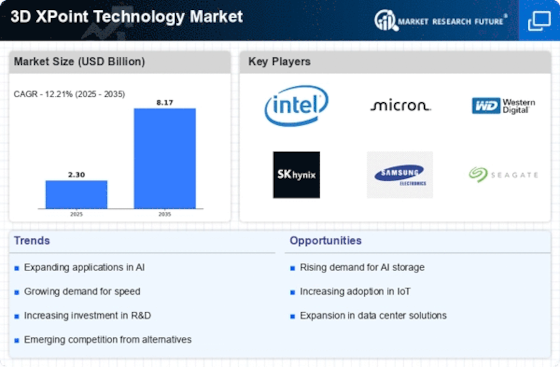
As per Market Research Future analysis, the 3D XPoint Technology Market Size was estimated at 2.3 USD Billion in 2024. The 3D XPoint Technology industry is projected to grow from 2.581 USD Billion in 2025 to 8.169 USD Billion by 2035, exhibiting a compound annual growth rate (CAGR) of 12.21% during the forecast period 2025 - 2035

Key Market Trends & Highlights

The 3D XPoint Technology Market is poised for substantial growth driven by diverse applications and regional dynamics.

  • The market experiences increased adoption in data centers, particularly in North America, which remains the largest market. Expansion into artificial intelligence applications is notable, especially in the rapidly growing Asia-Pacific region. The 1.5 TB segment leads in market share, while the 750 GB segment is emerging as the fastest-growing option. Rising demand for high-performance computing and advancements in artificial intelligence are key drivers propelling market growth.

Market Size & Forecast

2024 Market Size 2.3 (USD Billion)
2035 Market Size 8.169 (USD Billion)
CAGR (2025 - 2035) 12.21%
Largest Regional Market Share in 2024 North America

Major Players

Intel Corporation (US), Micron Technology, Inc. (US), Western Digital Corporation (US), SK Hynix Inc. (KR), Samsung Electronics Co., Ltd. (KR), Seagate Technology Holdings PLC (GB), Toshiba Corporation (JP), NVIDIA Corporation (US)

Market Trends

The 3D XPoint Technology Market is currently experiencing a transformative phase characterized by rapid advancements in memory technology. This innovative storage solution, which offers a unique blend of speed and endurance, is gaining traction across various sectors, including data centers, artificial intelligence, and high-performance computing. As organizations increasingly seek to enhance their data processing capabilities, the demand for 3D XPoint technology appears to be on the rise. This trend is likely driven by the need for faster data access and improved performance in applications that require real-time analytics and processing. Moreover, the competitive landscape of the 3D XPoint Technology Market is evolving, with several key players investing heavily in research and development. These investments aim to refine the technology and expand its applications, potentially leading to broader adoption in consumer electronics and enterprise solutions. As the market matures, it seems that partnerships and collaborations among technology firms may play a crucial role in accelerating innovation and addressing the challenges associated with scalability and cost-effectiveness. Overall, the future of the 3D XPoint Technology Market appears promising, with numerous opportunities for growth and development on the horizon.

Increased Adoption in Data Centers

The 3D XPoint Technology Market is witnessing a notable shift as data centers increasingly adopt this advanced memory solution. The technology's ability to provide faster data retrieval and enhanced performance aligns well with the growing demands for efficient data management and processing. As organizations strive to optimize their operations, the integration of 3D XPoint technology into data center infrastructures is likely to become more prevalent.

Expansion into Artificial Intelligence

There is a discernible trend of 3D XPoint technology being integrated into artificial intelligence applications. The unique characteristics of this memory solution, such as its speed and durability, make it particularly suitable for AI workloads that require rapid data access and processing. This trend suggests that as AI continues to evolve, the reliance on advanced memory technologies like 3D XPoint may increase significantly.

Focus on Cost Reduction and Scalability

A critical trend within the 3D XPoint Technology Market involves a concerted effort to reduce costs and enhance scalability. As the technology matures, stakeholders are likely to prioritize developing more cost-effective solutions that can be deployed at scale. This focus on affordability and scalability may facilitate broader adoption across various industries, ultimately driving market growth.

3D XPoint Technology Market Market Drivers

Emergence of Edge Computing Solutions

The rise of edge computing is significantly influencing the 3D XPoint Technology Market. As more devices become interconnected and data processing shifts closer to the source, the demand for efficient memory solutions at the edge is increasing. 3D XPoint technology, with its low latency and high performance, is well-suited for edge computing applications, where quick data access is essential. This technology can enhance the performance of edge devices, enabling real-time analytics and decision-making. The edge computing market is projected to grow substantially, with estimates suggesting a market size of over 15 billion dollars by 2025. As organizations seek to optimize their edge computing strategies, the adoption of 3D XPoint technology is likely to gain momentum.

Growing Need for Enhanced Storage Solutions

The 3D XPoint Technology Market is driven by the growing need for enhanced storage solutions across various sectors. As data generation continues to escalate, traditional storage technologies are often unable to keep pace with the demands for speed and capacity. 3D XPoint technology addresses these challenges by providing a unique combination of high speed, durability, and scalability. This technology is particularly beneficial for applications requiring rapid data access, such as big data analytics and real-time processing. The storage market is anticipated to expand significantly, with projections indicating a growth rate of around 8% annually. As organizations seek to improve their storage capabilities, the adoption of 3D XPoint technology is expected to rise, positioning it as a key player in the evolving storage landscape.

Rising Demand for High-Performance Computing

The 3D XPoint Technology Market is experiencing a surge in demand for high-performance computing solutions. As industries increasingly rely on data-intensive applications, the need for faster and more efficient memory technologies becomes paramount. 3D XPoint technology, with its unique architecture, offers significant advantages over traditional NAND flash memory, including lower latency and higher endurance. This technology is particularly appealing to sectors such as finance, healthcare, and scientific research, where rapid data processing is critical. According to recent estimates, the market for high-performance computing is projected to grow at a compound annual growth rate of over 10% in the coming years, further driving the adoption of 3D XPoint technology. The ability to handle large datasets efficiently positions this technology as a key player in the evolving landscape of computing.

Increased Focus on Data Security and Integrity

In the current landscape, the 3D XPoint Technology Market is witnessing an increased emphasis on data security and integrity. As organizations face growing threats from cyberattacks and data breaches, the need for reliable memory solutions that ensure data protection becomes critical. 3D XPoint technology, with its inherent durability and resilience, offers a compelling option for businesses seeking to safeguard sensitive information. The technology's ability to retain data without power enhances its appeal for applications requiring high reliability. Furthermore, as regulatory frameworks around data protection tighten, organizations are likely to invest in advanced memory technologies that comply with these standards. This trend is expected to drive the adoption of 3D XPoint technology, as companies prioritize secure data storage solutions.

Advancements in Artificial Intelligence and Machine Learning

The integration of 3D XPoint Technology Market into artificial intelligence and machine learning applications is a notable driver within the 3D XPoint Technology Market. As AI algorithms become more complex and data-driven, the need for faster data access and processing speeds intensifies. 3D XPoint technology provides a solution by enabling quicker data retrieval and improved performance in AI workloads. This technology's unique characteristics, such as its non-volatility and high endurance, make it suitable for training and inference tasks in AI systems. The AI market is expected to witness substantial growth, with projections indicating a market size exceeding 500 billion dollars by 2024. Consequently, the demand for memory solutions that can support these advancements is likely to bolster the 3D XPoint technology market.

Market Segment Insights

By Storage: 1.5 TB (Largest) vs. 750 GB (Fastest-Growing)

In the 3D XPoint Technology Market, the storage segment exhibits a dynamic distribution with the 1.5 TB storage capacity dominating the market. This segment captures significant attention due to its capability for high performance and large data handling, making it a preferred choice for enterprises requiring intensive data operations. Conversely, the 750 GB segment, while smaller, is rapidly gaining traction among emerging businesses and small to medium enterprises that seek an affordable yet effective storage solution. The growth trends within this segment are largely driven by the increasing demand for fast, reliable, and energy-efficient storage options in various applications including artificial intelligence, machine learning, and high-performance computing. The 750 GB storage option is particularly appealing as it offers an exquisite balance of performance and cost-efficiency, fueling its expansion in the market. As organizations continuously strive for innovation and efficiency in data storage, the adoption of both capacity options is expected to rise significantly.

Storage: 1.5 TB (Dominant) vs. 750 GB (Emerging)

The 1.5 TB storage option in the 3D XPoint Technology Market stands out as a dominant player, empowering organizations with vast capabilities to manage extensive data loads efficiently. This segment is particularly favored by sectors that focus on data-intensive applications, thanks to its impressive speed and enhanced durability compared to traditional storage solutions. On the other hand, the 750 GB segment is characterized as an emerging option tailored for smaller-scale operations, providing an ideal solution for businesses looking to upgrade from basic storage without incurring hefty costs. It offers sufficient capacity to handle moderate data loads while still benefiting from the advanced features inherent to 3D XPoint technology, thus ensuring a competitive edge for organizations making this transition.

By End-User: Consumer Electronics (Largest) vs. Healthcare (Fastest-Growing)

The 3D XPoint Technology Market is significantly influenced by its end-user segments, with Consumer Electronics commanding the largest share. This segment’s extensive use in devices such as SSDs, smartphones, and laptops leverages 3D XPoint's unique speed and performance attributes. Following Consumer Electronics, Healthcare is emerging strongly, reflecting a rising adoption rate in medical imaging and data storage systems, as healthcare providers seek faster, more reliable solutions for patient data management.

Healthcare (Dominant) vs. Automotive &amp; Transportation (Emerging)

Healthcare remains a dominant segment in the 3D XPoint Technology Market, driven by the need for efficient data storage and processing in managing electronic health records and advanced imaging technologies. The versatility of 3D XPoint offers quick data retrieval, which is vital for improving patient outcomes and operational efficiency. On the other hand, Automotive &amp; Transportation is an emerging segment, with growing interest as vehicles become increasingly reliant on advanced data management for navigation systems, driver-assist technologies, and connectivity features. This sector promises significant potential for future growth as the industry transitions towards more electric and autonomous vehicles.

Get more detailed insights about 3D XPoint Technology Market Research Report- Forecast 2035

Regional Insights

North America : Innovation and Leadership Hub

North America is the largest market for 3D XPoint technology, holding approximately 45% of the global share. The region's growth is driven by increasing demand for high-performance computing and data storage solutions, alongside significant investments in research and development. Regulatory support for technology innovation further catalyzes market expansion, with initiatives aimed at enhancing semiconductor manufacturing capabilities. The United States leads the market, with key players like Intel Corporation and Micron Technology driving advancements in 3D XPoint technology. The competitive landscape is characterized by rapid innovation and strategic partnerships, as companies aim to enhance performance and reduce costs. The presence of major tech firms and a robust supply chain solidify North America's position as a leader in this sector.

Europe : Emerging Market with Potential

Europe is witnessing a growing interest in 3D XPoint technology, accounting for approximately 25% of the global market share. The region's growth is fueled by increasing demand for advanced memory solutions in sectors such as automotive, healthcare, and cloud computing. Regulatory frameworks promoting digital transformation and sustainability initiatives are also key drivers of market growth, encouraging investments in innovative technologies. Germany and the United Kingdom are the leading countries in this market, with a strong presence of companies like Western Digital and Seagate Technology. The competitive landscape is evolving, with local startups and established firms collaborating to enhance product offerings. The European market is characterized by a focus on energy efficiency and performance, aligning with broader sustainability goals.

Asia-Pacific : Rapid Growth and Innovation

Asia-Pacific is emerging as a significant player in the 3D XPoint technology market, holding around 20% of the global share. The region's growth is driven by the rapid digitalization of industries, increasing data generation, and the demand for high-speed data processing. Government initiatives aimed at boosting semiconductor manufacturing and technology adoption are also contributing to market expansion, creating a favorable regulatory environment. Countries like South Korea, Japan, and China are at the forefront of this growth, with major companies such as SK Hynix and Samsung Electronics leading the charge. The competitive landscape is marked by intense innovation and collaboration among tech giants and startups, focusing on enhancing memory solutions for various applications, including AI and IoT.

Middle East and Africa : Emerging Frontier for Technology

The Middle East and Africa region is gradually emerging in the 3D XPoint technology market, currently holding about 10% of the global share. The growth is primarily driven by increasing investments in technology infrastructure and a rising demand for data storage solutions across various sectors. Government initiatives aimed at fostering innovation and technology adoption are also playing a crucial role in shaping the market landscape. Countries like South Africa and the UAE are leading the way, with a growing number of tech startups and investments from global players. The competitive landscape is still developing, with opportunities for growth as local companies seek to enhance their technological capabilities. The region's focus on digital transformation is expected to drive further adoption of advanced memory technologies.

Key Players and Competitive Insights

Leading market players are investing heavily in research and development in order to expand their product lines, which will help the 3D XPoint Technology Market, grow even more. Market participants are also undertaking a variety of strategic activities to expand their global footprint, with important market developments including new product launches, contractual agreements, mergers and acquisitions, higher investments, and collaboration with other organizations. To expand and survive in a more competitive and rising market climate, 3D XPoint Technologyindustry must offer cost-effective items.Manufacturing locally to minimize operational costs is one of the key business tactics used by manufacturers in the global 3D XPoint Technology industry to benefit clients and increase the market sector. In recent years, the 3D XPoint Technology industry has offered some of the most significant advantages to medicine. Major players in the 3D XPoint Technology Market, including Adesto Technologies Corporation (US), Sidense Corporation (Canada), Crossbar Inc. (US), Micron Technology (US), Sandisk Corporation (US), Mushkin Inc. and others, are attempting to increase market demand by investing in research and development operations.Western Digital Corporation (WDC, also known as Western Digital or WD) is a data storage and computer drive manufacturer based in San Jose, California. It develops, manufactures, and markets data technology products such as data storage devices, data centre systems, and cloud storage services. Western Digital has a lengthy history in the electronics sector as an integrated circuit manufacturer and storage goods manufacturer. It is one of the major makers of computer hard disc drives, as well as solid state drives and flash memory devices.Seagate Technology and Micron Technology are two of its competitors in the data management and storage space. In 2022, The Ultrastar DC SN840 is a new 3D XPoint-based SSD developed for data centre applications from Western Digital.SK hynix Inc. manufactures dynamic random-access memory (DRAM) and flash memory chips in South Korea. Hynix is the world's second-largest memory chip manufacturer (after Samsung Electronics) and third-largest semiconductor firm. Hyundai Electronics, founded in 1983 as Hyundai Electronic Industrial Co., Ltd., has production facilities in Korea, the United States, mainland China, and Taiwan. Hynix merged with SK Group (South Korea's third largest conglomerate) in 2012, after SK Telecom became its principal shareholder. Microsoft, Apple, Asus, Dell, MSI, HP Inc., and Hewlett Packard Enterprise (previously Hewlett-Packard) are among the company's biggest customers.DVD players, cellular phones, set-top boxes, personal digital assistants, networking equipment, and hard disc drives are among the other goods that employ Hynix memory. In 2023, SK Hynix has announced the development of a new 3D XPoint-based memory chip that outperforms existing alternatives in terms of performance and energy efficiency.

Key Companies in the 3D XPoint Technology Market include

Industry Developments

May 2021, Intel unveiled the Optane H20, a revolutionary 3D XPoint-based SSD optimized for thin and light notebooks.

July 2022, Micron announced the development of 3D XPoint-based memory modules with storage capacities of up to 2 TB.

March 2023, Samsung has announced the creation of a new 3D XPoint-based memory chip with higher read and write rates than existing options.

Future Outlook

3D XPoint Technology Market Future Outlook

The 3D XPoint Technology Market is projected to grow at a 12.21% CAGR from 2025 to 2035, driven by increasing demand for high-speed data storage and advanced computing solutions.

New opportunities lie in:

  • Development of specialized 3D XPoint memory modules for AI applications.</p><p>Integration of 3D XPoint technology in edge computing devices.</p><p>Partnerships with cloud service providers for enhanced data storage solutions.

By 2035, the 3D XPoint Technology Market is expected to be a pivotal player in high-performance computing.

Market Segmentation

3D XPoint Technology Market Storage Outlook

  • 1.5 TB
  • 750 GB

3D XPoint Technology Market End-User Outlook

  • Consumer electronics
  • Healthcare
  • Telecommunication
  • Automotive & Transportation
  • Agricultural
  • Military & Aerospace
  • Enterprise Storage

Report Scope

MARKET SIZE 2024 2.3(USD Billion)
MARKET SIZE 2025 2.581(USD Billion)
MARKET SIZE 2035 8.169(USD Billion)
COMPOUND ANNUAL GROWTH RATE (CAGR) 12.21% (2025 - 2035)
REPORT COVERAGE Revenue Forecast, Competitive Landscape, Growth Factors, and Trends
BASE YEAR 2024
Market Forecast Period 2025 - 2035
Historical Data 2019 - 2024
Market Forecast Units USD Billion
Key Companies Profiled Intel Corporation (US), Micron Technology, Inc. (US), Western Digital Corporation (US), SK Hynix Inc. (KR), Samsung Electronics Co., Ltd. (KR), Seagate Technology Holdings PLC (GB), Toshiba Corporation (JP), NVIDIA Corporation (US)
Segments Covered Storage, End-User, Region
Key Market Opportunities Growing demand for high-speed data storage solutions drives innovation in the 3D XPoint Technology Market.
Key Market Dynamics Rising demand for high-performance memory solutions drives innovation and competition in the 3D XPoint Technology market.
Countries Covered North America, Europe, APAC, South America, MEA

FAQs

What is the projected market valuation of the 3D XPoint Technology Market by 2035?

<p>The projected market valuation for the 3D XPoint Technology Market by 2035 is 8.169 USD Billion.</p>

What was the market valuation of the 3D XPoint Technology Market in 2024?

<p>The overall market valuation of the 3D XPoint Technology Market was 2.3 USD Billion in 2024.</p>

What is the expected CAGR for the 3D XPoint Technology Market during the forecast period 2025 - 2035?

<p>The expected CAGR for the 3D XPoint Technology Market during the forecast period 2025 - 2035 is 12.21%.</p>

Which companies are considered key players in the 3D XPoint Technology Market?

<p>Key players in the 3D XPoint Technology Market include Intel Corporation, Micron Technology, Inc., Western Digital Corporation, SK Hynix Inc., Samsung Electronics Co., Ltd., Seagate Technology Holdings PLC, Toshiba Corporation, and NVIDIA Corporation.</p>

What are the storage segments in the 3D XPoint Technology Market?

<p>The storage segments in the 3D XPoint Technology Market include 1.5 TB and 750 GB, with valuations ranging from 0.9 to 4.9 USD Billion.</p>

How does the 3D XPoint Technology Market perform in the consumer electronics sector?

<p>In the consumer electronics sector, the 3D XPoint Technology Market shows a valuation range of 0.5 to 1.5 USD Billion.</p>

What is the market performance of 3D XPoint Technology in the healthcare industry?

The market performance of 3D XPoint Technology in the healthcare industry indicates a valuation range of 0.4 to 1.2 USD Billion.

What is the projected growth for the automotive and transportation segment in the 3D XPoint Technology Market?

The automotive and transportation segment in the 3D XPoint Technology Market is projected to grow with a valuation range of 0.3 to 0.8 USD Billion.

How does the military and aerospace sector contribute to the 3D XPoint Technology Market?

The military and aerospace sector contributes to the 3D XPoint Technology Market with a valuation range of 0.4 to 1.1 USD Billion.

What is the expected valuation for enterprise storage in the 3D XPoint Technology Market?

The expected valuation for enterprise storage in the 3D XPoint Technology Market is projected to range from 0.2 to 0.5 USD Billion.

  1. SECTION I: EXECUTIVE SUMMARY AND KEY HIGHLIGHTS
    1. | 1.1 EXECUTIVE SUMMARY
    2. | | 1.1.1 Market Overview
    3. | | 1.1.2 Key Findings
    4. | | 1.1.3 Market Segmentation
    5. | | 1.1.4 Competitive Landscape
    6. | | 1.1.5 Challenges and Opportunities
    7. | | 1.1.6 Future Outlook
  2. SECTION II: SCOPING, METHODOLOGY AND MARKET STRUCTURE
    1. | 2.1 MARKET INTRODUCTION
    2. | | 2.1.1 Definition
    3. | | 2.1.2 Scope of the study
    4. | | | 2.1.2.1 Research Objective
    5. | | | 2.1.2.2 Assumption
    6. | | | 2.1.2.3 Limitations
    7. | 2.2 RESEARCH METHODOLOGY
    8. | | 2.2.1 Overview
    9. | | 2.2.2 Data Mining
    10. | | 2.2.3 Secondary Research
    11. | | 2.2.4 Primary Research
    12. | | | 2.2.4.1 Primary Interviews and Information Gathering Process
    13. | | | 2.2.4.2 Breakdown of Primary Respondents
    14. | | 2.2.5 Forecasting Model
    15. | | 2.2.6 Market Size Estimation
    16. | | | 2.2.6.1 Bottom-Up Approach
    17. | | | 2.2.6.2 Top-Down Approach
    18. | | 2.2.7 Data Triangulation
    19. | | 2.2.8 Validation
  3. SECTION III: QUALITATIVE ANALYSIS
    1. | 3.1 MARKET DYNAMICS
    2. | | 3.1.1 Overview
    3. | | 3.1.2 Drivers
    4. | | 3.1.3 Restraints
    5. | | 3.1.4 Opportunities
    6. | 3.2 MARKET FACTOR ANALYSIS
    7. | | 3.2.1 Value chain Analysis
    8. | | 3.2.2 Porter's Five Forces Analysis
    9. | | | 3.2.2.1 Bargaining Power of Suppliers
    10. | | | 3.2.2.2 Bargaining Power of Buyers
    11. | | | 3.2.2.3 Threat of New Entrants
    12. | | | 3.2.2.4 Threat of Substitutes
    13. | | | 3.2.2.5 Intensity of Rivalry
    14. | | 3.2.3 COVID-19 Impact Analysis
    15. | | | 3.2.3.1 Market Impact Analysis
    16. | | | 3.2.3.2 Regional Impact
    17. | | | 3.2.3.3 Opportunity and Threat Analysis
  4. SECTION IV: QUANTITATIVE ANALYSIS
    1. | 4.1 Semiconductor & Electronics, BY Storage (USD Billion)
    2. | | 4.1.1 1.5 TB
    3. | | 4.1.2 750 GB
    4. | 4.2 Semiconductor & Electronics, BY End-User (USD Billion)
    5. | | 4.2.1 Consumer electronics
    6. | | 4.2.2 Healthcare
    7. | | 4.2.3 Telecommunication
    8. | | 4.2.4 Automotive & Transportation
    9. | | 4.2.5 Agricultural
    10. | | 4.2.6 Military & Aerospace
    11. | | 4.2.7 Enterprise Storage
    12. | 4.3 Semiconductor & Electronics, BY Region (USD Billion)
    13. | | 4.3.1 North America
    14. | | | 4.3.1.1 US
    15. | | | 4.3.1.2 Canada
    16. | | 4.3.2 Europe
    17. | | | 4.3.2.1 Germany
    18. | | | 4.3.2.2 UK
    19. | | | 4.3.2.3 France
    20. | | | 4.3.2.4 Russia
    21. | | | 4.3.2.5 Italy
    22. | | | 4.3.2.6 Spain
    23. | | | 4.3.2.7 Rest of Europe
    24. | | 4.3.3 APAC
    25. | | | 4.3.3.1 China
    26. | | | 4.3.3.2 India
    27. | | | 4.3.3.3 Japan
    28. | | | 4.3.3.4 South Korea
    29. | | | 4.3.3.5 Malaysia
    30. | | | 4.3.3.6 Thailand
    31. | | | 4.3.3.7 Indonesia
    32. | | | 4.3.3.8 Rest of APAC
    33. | | 4.3.4 South America
    34. | | | 4.3.4.1 Brazil
    35. | | | 4.3.4.2 Mexico
    36. | | | 4.3.4.3 Argentina
    37. | | | 4.3.4.4 Rest of South America
    38. | | 4.3.5 MEA
    39. | | | 4.3.5.1 GCC Countries
    40. | | | 4.3.5.2 South Africa
    41. | | | 4.3.5.3 Rest of MEA
  5. SECTION V: COMPETITIVE ANALYSIS
    1. | 5.1 Competitive Landscape
    2. | | 5.1.1 Overview
    3. | | 5.1.2 Competitive Analysis
    4. | | 5.1.3 Market share Analysis
    5. | | 5.1.4 Major Growth Strategy in the Semiconductor & Electronics
    6. | | 5.1.5 Competitive Benchmarking
    7. | | 5.1.6 Leading Players in Terms of Number of Developments in the Semiconductor & Electronics
    8. | | 5.1.7 Key developments and growth strategies
    9. | | | 5.1.7.1 New Product Launch/Service Deployment
    10. | | | 5.1.7.2 Merger & Acquisitions
    11. | | | 5.1.7.3 Joint Ventures
    12. | | 5.1.8 Major Players Financial Matrix
    13. | | | 5.1.8.1 Sales and Operating Income
    14. | | | 5.1.8.2 Major Players R&D Expenditure. 2023
    15. | 5.2 Company Profiles
    16. | | 5.2.1 Intel Corporation (US)
    17. | | | 5.2.1.1 Financial Overview
    18. | | | 5.2.1.2 Products Offered
    19. | | | 5.2.1.3 Key Developments
    20. | | | 5.2.1.4 SWOT Analysis
    21. | | | 5.2.1.5 Key Strategies
    22. | | 5.2.2 Micron Technology, Inc. (US)
    23. | | | 5.2.2.1 Financial Overview
    24. | | | 5.2.2.2 Products Offered
    25. | | | 5.2.2.3 Key Developments
    26. | | | 5.2.2.4 SWOT Analysis
    27. | | | 5.2.2.5 Key Strategies
    28. | | 5.2.3 Western Digital Corporation (US)
    29. | | | 5.2.3.1 Financial Overview
    30. | | | 5.2.3.2 Products Offered
    31. | | | 5.2.3.3 Key Developments
    32. | | | 5.2.3.4 SWOT Analysis
    33. | | | 5.2.3.5 Key Strategies
    34. | | 5.2.4 SK Hynix Inc. (KR)
    35. | | | 5.2.4.1 Financial Overview
    36. | | | 5.2.4.2 Products Offered
    37. | | | 5.2.4.3 Key Developments
    38. | | | 5.2.4.4 SWOT Analysis
    39. | | | 5.2.4.5 Key Strategies
    40. | | 5.2.5 Samsung Electronics Co., Ltd. (KR)
    41. | | | 5.2.5.1 Financial Overview
    42. | | | 5.2.5.2 Products Offered
    43. | | | 5.2.5.3 Key Developments
    44. | | | 5.2.5.4 SWOT Analysis
    45. | | | 5.2.5.5 Key Strategies
    46. | | 5.2.6 Seagate Technology Holdings PLC (GB)
    47. | | | 5.2.6.1 Financial Overview
    48. | | | 5.2.6.2 Products Offered
    49. | | | 5.2.6.3 Key Developments
    50. | | | 5.2.6.4 SWOT Analysis
    51. | | | 5.2.6.5 Key Strategies
    52. | | 5.2.7 Toshiba Corporation (JP)
    53. | | | 5.2.7.1 Financial Overview
    54. | | | 5.2.7.2 Products Offered
    55. | | | 5.2.7.3 Key Developments
    56. | | | 5.2.7.4 SWOT Analysis
    57. | | | 5.2.7.5 Key Strategies
    58. | | 5.2.8 NVIDIA Corporation (US)
    59. | | | 5.2.8.1 Financial Overview
    60. | | | 5.2.8.2 Products Offered
    61. | | | 5.2.8.3 Key Developments
    62. | | | 5.2.8.4 SWOT Analysis
    63. | | | 5.2.8.5 Key Strategies
    64. | 5.3 Appendix
    65. | | 5.3.1 References
    66. | | 5.3.2 Related Reports
  6. LIST OF FIGURES
    1. | 6.1 MARKET SYNOPSIS
    2. | 6.2 NORTH AMERICA MARKET ANALYSIS
    3. | 6.3 US MARKET ANALYSIS BY STORAGE
    4. | 6.4 US MARKET ANALYSIS BY END-USER
    5. | 6.5 CANADA MARKET ANALYSIS BY STORAGE
    6. | 6.6 CANADA MARKET ANALYSIS BY END-USER
    7. | 6.7 EUROPE MARKET ANALYSIS
    8. | 6.8 GERMANY MARKET ANALYSIS BY STORAGE
    9. | 6.9 GERMANY MARKET ANALYSIS BY END-USER
    10. | 6.10 UK MARKET ANALYSIS BY STORAGE
    11. | 6.11 UK MARKET ANALYSIS BY END-USER
    12. | 6.12 FRANCE MARKET ANALYSIS BY STORAGE
    13. | 6.13 FRANCE MARKET ANALYSIS BY END-USER
    14. | 6.14 RUSSIA MARKET ANALYSIS BY STORAGE
    15. | 6.15 RUSSIA MARKET ANALYSIS BY END-USER
    16. | 6.16 ITALY MARKET ANALYSIS BY STORAGE
    17. | 6.17 ITALY MARKET ANALYSIS BY END-USER
    18. | 6.18 SPAIN MARKET ANALYSIS BY STORAGE
    19. | 6.19 SPAIN MARKET ANALYSIS BY END-USER
    20. | 6.20 REST OF EUROPE MARKET ANALYSIS BY STORAGE
    21. | 6.21 REST OF EUROPE MARKET ANALYSIS BY END-USER
    22. | 6.22 APAC MARKET ANALYSIS
    23. | 6.23 CHINA MARKET ANALYSIS BY STORAGE
    24. | 6.24 CHINA MARKET ANALYSIS BY END-USER
    25. | 6.25 INDIA MARKET ANALYSIS BY STORAGE
    26. | 6.26 INDIA MARKET ANALYSIS BY END-USER
    27. | 6.27 JAPAN MARKET ANALYSIS BY STORAGE
    28. | 6.28 JAPAN MARKET ANALYSIS BY END-USER
    29. | 6.29 SOUTH KOREA MARKET ANALYSIS BY STORAGE
    30. | 6.30 SOUTH KOREA MARKET ANALYSIS BY END-USER
    31. | 6.31 MALAYSIA MARKET ANALYSIS BY STORAGE
    32. | 6.32 MALAYSIA MARKET ANALYSIS BY END-USER
    33. | 6.33 THAILAND MARKET ANALYSIS BY STORAGE
    34. | 6.34 THAILAND MARKET ANALYSIS BY END-USER
    35. | 6.35 INDONESIA MARKET ANALYSIS BY STORAGE
    36. | 6.36 INDONESIA MARKET ANALYSIS BY END-USER
    37. | 6.37 REST OF APAC MARKET ANALYSIS BY STORAGE
    38. | 6.38 REST OF APAC MARKET ANALYSIS BY END-USER
    39. | 6.39 SOUTH AMERICA MARKET ANALYSIS
    40. | 6.40 BRAZIL MARKET ANALYSIS BY STORAGE
    41. | 6.41 BRAZIL MARKET ANALYSIS BY END-USER
    42. | 6.42 MEXICO MARKET ANALYSIS BY STORAGE
    43. | 6.43 MEXICO MARKET ANALYSIS BY END-USER
    44. | 6.44 ARGENTINA MARKET ANALYSIS BY STORAGE
    45. | 6.45 ARGENTINA MARKET ANALYSIS BY END-USER
    46. | 6.46 REST OF SOUTH AMERICA MARKET ANALYSIS BY STORAGE
    47. | 6.47 REST OF SOUTH AMERICA MARKET ANALYSIS BY END-USER
    48. | 6.48 MEA MARKET ANALYSIS
    49. | 6.49 GCC COUNTRIES MARKET ANALYSIS BY STORAGE
    50. | 6.50 GCC COUNTRIES MARKET ANALYSIS BY END-USER
    51. | 6.51 SOUTH AFRICA MARKET ANALYSIS BY STORAGE
    52. | 6.52 SOUTH AFRICA MARKET ANALYSIS BY END-USER
    53. | 6.53 REST OF MEA MARKET ANALYSIS BY STORAGE
    54. | 6.54 REST OF MEA MARKET ANALYSIS BY END-USER
    55. | 6.55 KEY BUYING CRITERIA OF SEMICONDUCTOR & ELECTRONICS
    56. | 6.56 RESEARCH PROCESS OF MRFR
    57. | 6.57 DRO ANALYSIS OF SEMICONDUCTOR & ELECTRONICS
    58. | 6.58 DRIVERS IMPACT ANALYSIS: SEMICONDUCTOR & ELECTRONICS
    59. | 6.59 RESTRAINTS IMPACT ANALYSIS: SEMICONDUCTOR & ELECTRONICS
    60. | 6.60 SUPPLY / VALUE CHAIN: SEMICONDUCTOR & ELECTRONICS
    61. | 6.61 SEMICONDUCTOR & ELECTRONICS, BY STORAGE, 2024 (% SHARE)
    62. | 6.62 SEMICONDUCTOR & ELECTRONICS, BY STORAGE, 2024 TO 2035 (USD Billion)
    63. | 6.63 SEMICONDUCTOR & ELECTRONICS, BY END-USER, 2024 (% SHARE)
    64. | 6.64 SEMICONDUCTOR & ELECTRONICS, BY END-USER, 2024 TO 2035 (USD Billion)
    65. | 6.65 BENCHMARKING OF MAJOR COMPETITORS
  7. LIST OF TABLES
    1. | 7.1 LIST OF ASSUMPTIONS
    2. | | 7.1.1
    3. | 7.2 North America MARKET SIZE ESTIMATES; FORECAST
    4. | | 7.2.1 BY STORAGE, 2025-2035 (USD Billion)
    5. | | 7.2.2 BY END-USER, 2025-2035 (USD Billion)
    6. | 7.3 US MARKET SIZE ESTIMATES; FORECAST
    7. | | 7.3.1 BY STORAGE, 2025-2035 (USD Billion)
    8. | | 7.3.2 BY END-USER, 2025-2035 (USD Billion)
    9. | 7.4 Canada MARKET SIZE ESTIMATES; FORECAST
    10. | | 7.4.1 BY STORAGE, 2025-2035 (USD Billion)
    11. | | 7.4.2 BY END-USER, 2025-2035 (USD Billion)
    12. | 7.5 Europe MARKET SIZE ESTIMATES; FORECAST
    13. | | 7.5.1 BY STORAGE, 2025-2035 (USD Billion)
    14. | | 7.5.2 BY END-USER, 2025-2035 (USD Billion)
    15. | 7.6 Germany MARKET SIZE ESTIMATES; FORECAST
    16. | | 7.6.1 BY STORAGE, 2025-2035 (USD Billion)
    17. | | 7.6.2 BY END-USER, 2025-2035 (USD Billion)
    18. | 7.7 UK MARKET SIZE ESTIMATES; FORECAST
    19. | | 7.7.1 BY STORAGE, 2025-2035 (USD Billion)
    20. | | 7.7.2 BY END-USER, 2025-2035 (USD Billion)
    21. | 7.8 France MARKET SIZE ESTIMATES; FORECAST
    22. | | 7.8.1 BY STORAGE, 2025-2035 (USD Billion)
    23. | | 7.8.2 BY END-USER, 2025-2035 (USD Billion)
    24. | 7.9 Russia MARKET SIZE ESTIMATES; FORECAST
    25. | | 7.9.1 BY STORAGE, 2025-2035 (USD Billion)
    26. | | 7.9.2 BY END-USER, 2025-2035 (USD Billion)
    27. | 7.10 Italy MARKET SIZE ESTIMATES; FORECAST
    28. | | 7.10.1 BY STORAGE, 2025-2035 (USD Billion)
    29. | | 7.10.2 BY END-USER, 2025-2035 (USD Billion)
    30. | 7.11 Spain MARKET SIZE ESTIMATES; FORECAST
    31. | | 7.11.1 BY STORAGE, 2025-2035 (USD Billion)
    32. | | 7.11.2 BY END-USER, 2025-2035 (USD Billion)
    33. | 7.12 Rest of Europe MARKET SIZE ESTIMATES; FORECAST
    34. | | 7.12.1 BY STORAGE, 2025-2035 (USD Billion)
    35. | | 7.12.2 BY END-USER, 2025-2035 (USD Billion)
    36. | 7.13 APAC MARKET SIZE ESTIMATES; FORECAST
    37. | | 7.13.1 BY STORAGE, 2025-2035 (USD Billion)
    38. | | 7.13.2 BY END-USER, 2025-2035 (USD Billion)
    39. | 7.14 China MARKET SIZE ESTIMATES; FORECAST
    40. | | 7.14.1 BY STORAGE, 2025-2035 (USD Billion)
    41. | | 7.14.2 BY END-USER, 2025-2035 (USD Billion)
    42. | 7.15 India MARKET SIZE ESTIMATES; FORECAST
    43. | | 7.15.1 BY STORAGE, 2025-2035 (USD Billion)
    44. | | 7.15.2 BY END-USER, 2025-2035 (USD Billion)
    45. | 7.16 Japan MARKET SIZE ESTIMATES; FORECAST
    46. | | 7.16.1 BY STORAGE, 2025-2035 (USD Billion)
    47. | | 7.16.2 BY END-USER, 2025-2035 (USD Billion)
    48. | 7.17 South Korea MARKET SIZE ESTIMATES; FORECAST
    49. | | 7.17.1 BY STORAGE, 2025-2035 (USD Billion)
    50. | | 7.17.2 BY END-USER, 2025-2035 (USD Billion)
    51. | 7.18 Malaysia MARKET SIZE ESTIMATES; FORECAST
    52. | | 7.18.1 BY STORAGE, 2025-2035 (USD Billion)
    53. | | 7.18.2 BY END-USER, 2025-2035 (USD Billion)
    54. | 7.19 Thailand MARKET SIZE ESTIMATES; FORECAST
    55. | | 7.19.1 BY STORAGE, 2025-2035 (USD Billion)
    56. | | 7.19.2 BY END-USER, 2025-2035 (USD Billion)
    57. | 7.20 Indonesia MARKET SIZE ESTIMATES; FORECAST
    58. | | 7.20.1 BY STORAGE, 2025-2035 (USD Billion)
    59. | | 7.20.2 BY END-USER, 2025-2035 (USD Billion)
    60. | 7.21 Rest of APAC MARKET SIZE ESTIMATES; FORECAST
    61. | | 7.21.1 BY STORAGE, 2025-2035 (USD Billion)
    62. | | 7.21.2 BY END-USER, 2025-2035 (USD Billion)
    63. | 7.22 South America MARKET SIZE ESTIMATES; FORECAST
    64. | | 7.22.1 BY STORAGE, 2025-2035 (USD Billion)
    65. | | 7.22.2 BY END-USER, 2025-2035 (USD Billion)
    66. | 7.23 Brazil MARKET SIZE ESTIMATES; FORECAST
    67. | | 7.23.1 BY STORAGE, 2025-2035 (USD Billion)
    68. | | 7.23.2 BY END-USER, 2025-2035 (USD Billion)
    69. | 7.24 Mexico MARKET SIZE ESTIMATES; FORECAST
    70. | | 7.24.1 BY STORAGE, 2025-2035 (USD Billion)
    71. | | 7.24.2 BY END-USER, 2025-2035 (USD Billion)
    72. | 7.25 Argentina MARKET SIZE ESTIMATES; FORECAST
    73. | | 7.25.1 BY STORAGE, 2025-2035 (USD Billion)
    74. | | 7.25.2 BY END-USER, 2025-2035 (USD Billion)
    75. | 7.26 Rest of South America MARKET SIZE ESTIMATES; FORECAST
    76. | | 7.26.1 BY STORAGE, 2025-2035 (USD Billion)
    77. | | 7.26.2 BY END-USER, 2025-2035 (USD Billion)
    78. | 7.27 MEA MARKET SIZE ESTIMATES; FORECAST
    79. | | 7.27.1 BY STORAGE, 2025-2035 (USD Billion)
    80. | | 7.27.2 BY END-USER, 2025-2035 (USD Billion)
    81. | 7.28 GCC Countries MARKET SIZE ESTIMATES; FORECAST
    82. | | 7.28.1 BY STORAGE, 2025-2035 (USD Billion)
    83. | | 7.28.2 BY END-USER, 2025-2035 (USD Billion)
    84. | 7.29 South Africa MARKET SIZE ESTIMATES; FORECAST
    85. | | 7.29.1 BY STORAGE, 2025-2035 (USD Billion)
    86. | | 7.29.2 BY END-USER, 2025-2035 (USD Billion)
    87. | 7.30 Rest of MEA MARKET SIZE ESTIMATES; FORECAST
    88. | | 7.30.1 BY STORAGE, 2025-2035 (USD Billion)
    89. | | 7.30.2 BY END-USER, 2025-2035 (USD Billion)
    90. | 7.31 PRODUCT LAUNCH/PRODUCT DEVELOPMENT/APPROVAL
    91. | | 7.31.1
    92. | 7.32 ACQUISITION/PARTNERSHIP
    93. | | 7.32.1

Semiconductor & Electronics Market Segmentation

Semiconductor & Electronics By Storage (USD Billion, 2025-2035)

  • 1.5 TB
  • 750 GB

Semiconductor & Electronics By End-User (USD Billion, 2025-2035)

  • Consumer electronics
  • Healthcare
  • Telecommunication
  • Automotive & Transportation
  • Agricultural
  • Military & Aerospace
  • Enterprise Storage
Infographic

Free Sample Request

Kindly complete the form below to receive a free sample of this Report

Get Free Sample

Customer Strories

Compare Licence

×
Features License Type
Single User Multiuser License Enterprise User
Price $4,950 $5,950 $7,250
Maximum User Access Limit 1 User Upto 10 Users Unrestricted Access Throughout the Organization
Free Customization
Direct Access to Analyst
Deliverable Format
Platform Access
Discount on Next Purchase 10% 15% 15%
Printable Versions