Request Free Sample ×

Kindly complete the form below to receive a free sample of this Report

* Please use a valid business email

Leading companies partner with us for data-driven Insights

clients tt-cursor
Hero Background
English
Chinese
French
Japanese
Korean
German
Spanish

3D Printing Metal Market Share

ID: MRFR/CnM/1302-CR
111 Pages
Chitranshi Jaiswal
February 2021

3D Printing Metals Market Research Report Information By Material (Titanium, Aluminum, Stainless Steel, Nickel, Inconel, and others), By Technology (Vat Photopolymerization, Material Extrusion, Sheet Lamination, Binder Jetting, Material Jetting, and others), By Application (Aerospace & Defense, Automotive, Healthcare, Building & Construction, Consumer Electronics, and others), And By Region (North America, Europe, Asia-Pacific, And Rest Of The World) – Market Forecast Till 2035

Share:
Download PDF ×

We do not share your information with anyone. However, we may send you emails based on your report interest from time to time. You may contact us at any time to opt-out.

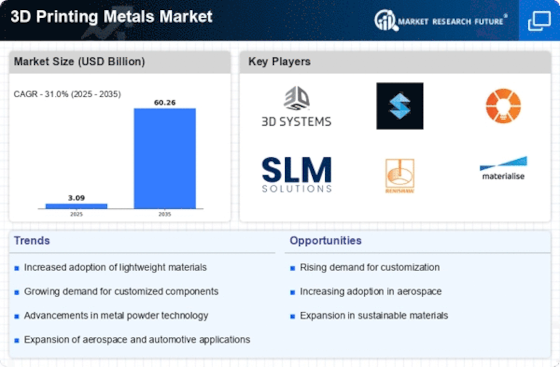
3D Printing Metal Market Infographic
Purchase Options

Market Share

3D Printing Metal Market Share Analysis

The market share positioning strategies of the 3D printing metals market involve various approaches aimed at gaining a competitive edge and capturing a larger portion of the market. One common strategy is differentiation, where companies aim to distinguish their products from those of competitors. This could involve offering unique alloys, superior quality, or innovative features that cater to specific customer needs. By differentiating their offerings, companies can attract customers looking for specialized solutions and establish themselves as leaders in certain niches within the 3D printing metals market.

As 3D printing of metals becomes more popular, the metal processing industry may enter its next era. Physicochemical properties combined with complex geometries make these products attractive. Market growth for 3D printing metals has been primarily driven by the demand for high-precision parts with complex architectures in the aerospace and defense sector.

Another key strategy is cost leadership, which involves becoming the low-cost provider in the market. This can be achieved through efficient production processes, economies of scale, and strategic sourcing of raw materials. By offering competitive prices, companies can appeal to price-sensitive customers and gain market share from competitors who are unable to match their pricing. However, it's important for companies to balance cost leadership with maintaining product quality and value to avoid commoditization and price wars.

Furthermore, market segmentation is a crucial strategy in positioning for market share in the 3D printing metals market. By dividing the market into distinct segments based on factors such as industry verticals, application requirements, or geographic regions, companies can tailor their products and marketing strategies to better meet the needs of each segment. This allows them to effectively target specific customer groups and capture market share in areas where they have a competitive advantage. For example, a company might focus on serving the aerospace industry with high-performance titanium alloys or target the medical sector with biocompatible materials for implant applications.

In addition to these strategies, partnerships and collaborations play a significant role in market share positioning within the 3D printing metals market. By forming strategic alliances with other companies, such as material suppliers, technology providers, or research institutions, companies can leverage complementary capabilities and resources to strengthen their market position. Collaborations can also facilitate access to new markets, technologies, or customer segments that would be difficult to reach independently. For example, a 3D printing company might partner with a metallurgy research institute to develop advanced metal powders with enhanced properties for additive manufacturing applications.

Moreover, continuous innovation is essential for maintaining and growing market share in the 3D printing metals market. Companies must invest in research and development to stay ahead of evolving customer needs and technological advancements. This could involve developing new metal alloys optimized for additive manufacturing, improving printing processes for higher efficiency and accuracy, or exploring novel applications for 3D printed metal parts. By staying at the forefront of innovation, companies can differentiate themselves from competitors and capture market share in emerging segments of the 3D printing metals market.

Lastly, effective marketing and branding strategies are critical for building awareness and credibility in the 3D printing metals market. Companies must invest in promoting their products and capabilities through various channels, such as trade shows, industry conferences, online platforms, and targeted advertising campaigns. Building a strong brand reputation for quality, reliability, and customer satisfaction can help companies attract new customers and retain existing ones, ultimately leading to increased market share. Additionally, providing excellent customer service and support can further differentiate a company from competitors and enhance its market positioning in the 3D printing metals market.


Author
Author Profile
Chitranshi Jaiswal
Team Lead - Research

Chitranshi is a Team Leader in the Chemicals & Materials (CnM) and Energy & Power (EnP) domains, with 6+ years of experience in market research. She leads and mentors teams to deliver cross-domain projects that equip clients with actionable insights and growth strategies. She is skilled in market estimation, forecasting, competitive benchmarking, and both primary & secondary research, enabling her to turn complex data into decision-ready insights. An engineer and MBA professional, she combines technical expertise with strategic acumen to solve dynamic market challenges. Chitranshi has successfully managed projects that support market entry, investment planning, and competitive positioning, while building strong client relationships. Certified in Advanced Excel & Power BI she leverages data-driven approaches to ensure accuracy, clarity, and impactful outcomes.

Leave a Comment

FAQs

What is the projected market valuation of the 3D Printing Metals Market by 2035?

<p>The projected market valuation for the 3D Printing Metals Market is expected to reach 60.26 USD Billion by 2035.</p>

What was the market valuation of the 3D Printing Metals Market in 2024?

<p>The overall market valuation of the 3D Printing Metals Market was 3.09 USD Billion in 2024.</p>

What is the expected CAGR for the 3D Printing Metals Market during the forecast period 2025 - 2035?

<p>The expected CAGR for the 3D Printing Metals Market during the forecast period 2025 - 2035 is 31.0%.</p>

Which materials are leading in the 3D Printing Metals Market and what are their valuations?

<p>Titanium, Aluminum, and Stainless Steel are leading materials, with valuations of 12.0, 8.0, and 15.0 USD Billion respectively by 2035.</p>

What technologies are utilized in the 3D Printing Metals Market and their projected growth?

<p>Technologies such as Material Extrusion and Vat Photopolymerization are projected to grow to 15.0 and 12.05 USD Billion respectively by 2035.</p>

Which applications are driving growth in the 3D Printing Metals Market?

<p>The Aerospace & Defense and Automotive sectors are driving growth, with projected valuations of 15.0 and 12.0 USD Billion respectively by 2035.</p>

Who are the key players in the 3D Printing Metals Market?

Key players in the 3D Printing Metals Market include 3D Systems, Stratasys, EOS, and GE Additive among others.

What is the projected valuation for Stainless Steel in the 3D Printing Metals Market by 2035?

The projected valuation for Stainless Steel in the 3D Printing Metals Market is expected to reach 15.0 USD Billion by 2035.

How does the valuation of Inconel compare to other materials in the market?

Inconel is projected to reach a valuation of 3.0 USD Billion by 2035, which is lower than Titanium and Stainless Steel.

What is the significance of the 3D Printing Metals Market's growth for industries?

The growth of the 3D Printing Metals Market indicates a transformative potential for industries such as Aerospace, Automotive, and Healthcare, enhancing manufacturing capabilities.

Market Summary

As per Market Research Future analysis, the 3D Printing Metals Market was estimated at 8.9 USD Billion in 2024. The 3D Printing Metals industry is projected to grow from 10.6 USD Billion in 2025 to 63.7 USD Billion by 2035, exhibiting a compound annual growth rate (CAGR) of 19.60% during the forecast period 2025 - 2035

Key Market Trends & Highlights

The 3D Printing Metals Market is poised for substantial growth driven by technological advancements and increasing customization demands.

  • The market experiences increased adoption in aerospace and defense sectors, particularly in North America. Sustainability and eco-friendly practices are becoming integral to 3D printing metal processes, especially in the Asia-Pacific region. Titanium remains the largest segment, while aluminum is rapidly gaining traction as the fastest-growing material. Technological advancements and rising demand for customization are key drivers propelling market expansion.

Market Size & Forecast

2024 Market Size 8.9 (USD Billion)
2035 Market Size 63.7 (USD Billion)
CAGR (2025 - 2035) 19.60%
Largest Regional Market Share in 2024 Asia Pacific

Major Players

By Metal Type (Titanium, Aluminum, Steel, Nickel); By Form (Powder, Wire); By Technology (SLM, EBM, DMLS); By End Use (Aerospace, Automotive, Medical, Industrial)

Market Trends

The 3D Printing Metals Market is currently experiencing a transformative phase, characterized by rapid advancements in technology and increasing adoption across various industries. This market encompasses a diverse range of applications, including aerospace, automotive, and medical sectors, where the demand for lightweight, durable, and complex components is on the rise. As manufacturers seek to enhance production efficiency and reduce material waste, the integration of additive manufacturing processes is becoming more prevalent. Furthermore, the growing emphasis on sustainability and environmental responsibility is driving innovations in metal printing techniques, which may lead to more eco-friendly practices in the future. In addition, the competitive landscape of the 3D Printing Metals Market is evolving, with numerous players striving to establish their presence through strategic partnerships and collaborations. Research and development efforts are intensifying, as companies aim to improve material properties and expand the range of metals suitable for printing. This dynamic environment suggests that the market will continue to grow, potentially leading to new applications and opportunities that have yet to be fully realized. As the technology matures, it appears that the 3D Printing Metals Market will play a crucial role in shaping the future of manufacturing and production processes across various sectors.

Increased Adoption in Aerospace and Defense

The aerospace and defense sectors are increasingly embracing 3D printing technologies for metal components. This trend is driven by the need for lightweight materials that can withstand extreme conditions while maintaining structural integrity. The ability to produce complex geometries that traditional manufacturing methods cannot achieve is particularly appealing in these industries.

Sustainability and Eco-Friendly Practices

There is a growing focus on sustainability within the 3D Printing Metals Market. Companies are exploring ways to minimize waste and reduce energy consumption during the printing process. Innovations in materials and techniques that promote recycling and the use of biodegradable substances are likely to gain traction as environmental concerns become more prominent.

Expansion of Material Options

The range of metals available for 3D printing is expanding, with ongoing research into new alloys and composites. This diversification allows for enhanced performance characteristics tailored to specific applications. As manufacturers continue to experiment with different materials, the potential for novel applications in various industries is likely to increase.

3D Printing Metal Market Market Drivers

Rising Demand for Customization

Customization is becoming a pivotal driver in the 3D Printing Metals Market. Industries are increasingly seeking tailored solutions to meet specific requirements, which traditional manufacturing methods often struggle to provide. The ability to produce bespoke metal parts on demand allows companies to respond swiftly to market changes and customer preferences. This trend is particularly evident in sectors like healthcare, where personalized implants and prosthetics are gaining traction. Market data indicates that the demand for customized metal components is expected to rise significantly, with projections suggesting a potential increase of 30% in the next five years. This shift towards customization not only enhances product offerings but also positions the 3D Printing Metals Market as a key player in the future of manufacturing.

Cost Efficiency and Waste Reduction

Cost efficiency and waste reduction are critical factors propelling the 3D Printing Metals Market forward. Traditional manufacturing processes often involve substantial material waste and high operational costs. In contrast, metal 3D printing allows for additive manufacturing, where materials are added layer by layer, significantly minimizing waste. This efficiency is particularly appealing to industries looking to optimize their production processes and reduce costs. Recent studies suggest that companies utilizing metal 3D printing can achieve up to 50% reduction in material waste compared to conventional methods. As businesses increasingly prioritize sustainability and cost-effectiveness, the 3D Printing Metals Market is likely to see a surge in adoption, further driving market growth.

Technological Advancements in 3D Printing

The 3D Printing Metals Market is experiencing rapid technological advancements that enhance the capabilities of metal 3D printing. Innovations in printing techniques, such as selective laser melting and electron beam melting, are improving the precision and efficiency of metal parts production. These advancements are likely to reduce production costs and lead times, making metal 3D printing more accessible to various sectors. According to recent data, the market for metal 3D printing is projected to grow at a compound annual growth rate of over 25% in the coming years. This growth is driven by the increasing demand for complex geometries and lightweight components, particularly in industries such as aerospace and automotive. As technology continues to evolve, the 3D Printing Metals Market is expected to witness further expansion and innovation.

Growing Applications Across Various Industries

The 3D Printing Metals Market is witnessing a surge in applications across diverse sectors, including aerospace, automotive, healthcare, and energy. Each of these industries is exploring the potential of metal 3D printing to enhance product performance and reduce manufacturing complexities. For instance, in aerospace, the ability to produce lightweight components with intricate designs is revolutionizing aircraft manufacturing. Market analysis shows that the aerospace sector alone is expected to account for a significant share of the metal 3D printing market, with projections indicating a growth rate of over 20% in the coming years. As more industries recognize the advantages of metal 3D printing, the 3D Printing Metals Market is likely to expand its reach and influence.

Increased Investment in Research and Development

Investment in research and development is a crucial driver for the 3D Printing Metals Market. Companies and research institutions are allocating significant resources to explore new materials, improve printing technologies, and enhance the overall performance of metal 3D printing. This focus on R&D is expected to yield innovative solutions that address current limitations in the industry, such as material properties and production speed. Data indicates that R&D spending in the metal 3D printing sector has increased by approximately 20% over the past few years, reflecting a strong commitment to advancing the technology. As breakthroughs emerge from these investments, the 3D Printing Metals Market is poised for substantial growth and transformation.

Market Segment Insights

By Material: Titanium (Largest) vs. Aluminum (Fastest-Growing)

In the 3D Printing Metals Market, the material segment displays a diverse distribution, with <a href="https://www.marketresearchfuture.com/reports/titanium-market-59394" target="_blank" title="titanium">Titanium</a> leading as the largest share contributor thanks to its exceptional strength-to-weight ratio and corrosion resistance. Aluminum follows closely, supported by its lightweight characteristics and suitability for various applications, positioning it as a compelling choice for rapid manufacturing needs. <a href="https://www.marketresearchfuture.com/reports/stainless-steel-market-16145">Stainless Steel</a>, Nickel, and Inconel also hold significant roles, albeit with smaller shares, appealing to specific industrial applications and advanced manufacturing technologies.

Material: Titanium (Dominant) vs. Aluminum (Emerging)

Titanium holds a dominant position in the 3D Printing Metals Market due to its remarkable mechanical properties, making it ideal for high-performance applications, particularly in aerospace and biomedical sectors. This material is renowned for its high strength, low density, and superior biocompatibility. On the other hand, <a href="https://www.marketresearchfuture.com/reports/aluminum-market-2031">Aluminum</a> is emerging rapidly in the market supported by its exceptional machinability and favorable cost-performance ratio. Its growing use in automotive and lightweight component applications signifies an exciting shift, driven by the demand for efficient production techniques and sustainable manufacturing practices, marking its transition from a secondary choice to a competitive option.

By Technology: Material Extrusion (Largest) vs. Binder Jetting (Fastest-Growing)

In the 3D Printing Metals Market, Material Extrusion continues to capture the largest share, standing out due to its widespread adoption across various industries. With its ability to efficiently produce complex geometries and the availability of a wide range of materials, this technology demonstrates significant market penetration. Meanwhile, Binder Jetting is recognized for its rapid growth, particularly in sectors where speed and cost-effectiveness are critical. Its adaptable nature allows for the use of various metal powders, making it an attractive choice for manufacturers aiming for faster production cycles.

Technology: Material Extrusion (Dominant) vs. Binder Jetting (Emerging)

Material Extrusion reigns supreme in the 3D Printing Metals Market, characterized by its ability to create detailed components with high precision and versatility. Companies across industries favor this technology for its compatibility with numerous materials and straightforward process. Conversely, Binder Jetting is emerging as a notable contender, appreciated for its rapid prototyping capabilities and lower production costs. This technology excels in applications where large volumes of parts are needed in a shorter timeframe, pushing companies to explore its potential despite the challenges related to post-processing and material limitations.

By Application: Aerospace & Defense (Largest) vs. Healthcare (Fastest-Growing)

In the 3D Printing Metals Market, the application segment is primarily dominated by Aerospace &amp; Defense, which holds a significant share due to the industry's reliance on advanced manufacturing techniques to produce lightweight yet durable components. This segment has shown stable growth driven by investments in military technology upgrades and the increasing demand for precision parts that 3D printing can offer. Healthcare follows closely with a rapidly increasing presence, as advancements in medical implants and bio-printing technologies present vast opportunities in this sector. Currently, the Healthcare application is witnessing the fastest growth in the 3D Printing Metals Market, owing to the need for customized solutions in medical devices and implants. Factors driving this expansion include the rapid development of personalized medicine and surgical tools that enhance patient outcomes. The push towards industry 4.0, focusing on in-house manufacturing and supply chain efficiencies, is further accelerating adoption across sectors, making Healthcare a significant growth driver within the application segment.

Aerospace &amp; Defense: Dominant vs. Healthcare: Emerging

Aerospace &amp; Defense is characterized by its robust demand for high-performance materials that can withstand extreme conditions, making it the dominant application in the 3D Printing Metals Market. The sector leverages advanced 3D printing technology to create components for aircraft, missiles, and other critical defense systems where precision and reliability are paramount. On the other side, the Healthcare application is an emerging segment, revolutionized by innovations in implant technology and customized surgical tools. This segment is rapidly evolving as hospitals and clinics increasingly adopt 3D printing for bespoke solutions, enhancing surgical outcomes with tailored implants. As such, while Aerospace &amp; Defense commands the market today, Healthcare's dynamic growth reflects an exciting shift towards personalized medical solutions.

Get more detailed insights about 3D Printing Metals Market Research Report - Global Forecast till 2035

Regional Insights

By region, the study provides market insights into North America, Europe, Asia-Pacific, and the Rest of the World. The Asia-Pacific region is expected to lead the global market for 3D printing metals in the coming years, driven by factors such as increasing industrialization, rising demand for 3D printing metals from various end-use industries, and supportive government initiatives. Countries such as China, Japan, and South Korea have been at the forefront of adopting 3D printing technology, and they are likely to continue to be major contributors to the growth of the 3D printing metals market in the region.

These countries have large manufacturing industries and are investing heavily in research and development to advance their capabilities in 3D printing. In addition, the healthcare industry in the Asia-Pacific region is also expected to be a major driver of growth in the 3D printing metals market. The region has a large population, and there is a growing demand for customized medical implants and prosthetics. 3D printing metals offer the ability to produce these products with greater precision and customization, leading to better patient outcomes.

Further, the major countries studied in the market report are The U.S., Canada, Germany, France, the UK, Italy, Spain, China, Japan, India, Australia, South Korea, and Brazil

Europe’s 3D Printing Metals market accounts for the third-largest market share. The region has a well-established manufacturing industry, with several leading companies in the aerospace, automotive, and healthcare sectors. The aerospace industry, in particular, has been a major driver of growth in the 3D printing metals market in Europe, with several companies using the technology to produce lightweight and complex components for aircraft. In addition, the European Union has been investing heavily in research and development in the 3D printing industry, with several initiatives aimed at advancing the technology and promoting its adoption in various industries.

The region has also been at the forefront of developing new 3D printing materials and techniques, which has helped to drive innovation in the industry. Further, the Germany 3D Printing Metals market held the largest market share, and the UK 3D Printing Metals market was the fastest-growing market in the European region.

North America, 3D Printing Metals market, is expected to grow at the fastest CAGR from 2023 to 2030. The region has a strong aerospace and defense industry, which has been a major driver of growth in the 3D printing metals market. In addition, the healthcare and automotive industries in North America have also shown significant potential for growth in the use of 3D printing metals. Moreover, the U.S. 3D Printing Metals market held the largest market share, and the Canada 3D Printing Metals market was the fastest-growing market in the North American region.

Key Players and Competitive Insights

Major market players are spending a lot of money on R&D to increase their product lines, which will help the 3D Printing Metals market grow even more. Market participants are also taking a range of strategic initiatives to grow their worldwide footprint, with key market developments such as new product launches, contractual agreements, mergers and acquisitions, increased investments, and collaboration with other organizations. Competitors in the 3D Printing Metals industry must offer cost-effective items to expand and survive in an increasingly competitive and rising market environment. The major market players are investing a lot of money in R&D to expand their product lines, which will spur further market growth for 3D Printing Metals. With significant market development like new product releases, contractual agreements, mergers and acquisitions, increased investments, and collaboration with other organizations, market participants are also undertaking various strategic activities to expand their global presence. To grow and thrive in a market climate that is becoming more competitive and growing, competitors in the 3D Printing Metals industry must offer affordable products. Manufacturing locally to cut operating costs is one of the main business tactics manufacturers use in the global 3D Printing Metals industry to benefit customers and expand the market sector. Major 3D Printing Metals market players, including Voxeljet AG, Renishaw plc, 3D Systems, Inc, GKN Aerospace,  CRS Holdings Inc (Carpenter Technology Corporation), Triditive, Incus, Materialise, Concept Laser GmbH, Optomec, Inc. SLM Solutions, and others, are attempting to increase market demand by funding R&D initiatives. Voxeljet AG is a German company that specializes in the production and sale of 3D printing systems and services. Voxeljet's primary focus is on the development and production of large-scale 3D printing systems for industrial applications, with a particular emphasis on the production of sand-casting molds and cores for automotive, aerospace, and other industries. The company also provides 3D printing services, including prototyping and production of parts for its customers. Voxeljet's 3D printing systems are based on binder jetting technology, which involves selectively depositing a binder material onto a bed of powder, layer by layer, to create a solid object. The company's systems are capable of producing parts with a high degree of accuracy and detail, as well as large-scale objects up to several meters in size. Renishaw is a UK-based global company that specializes in the production and sale of high-precision metrology and additive manufacturing (3D printing) systems. Renishaw's core business is in metrology, where it develops and produces precision measurement and control equipment used in industries such as aerospace, automotive, medical, and electronics. The company's products include coordinate measuring machines (CMMs), laser measurement systems, encoders, and calibration equipment. Renishaw's metrology products are used to measure and control critical dimensions and geometries in manufacturing processes, ensuring high quality and accuracy. In addition to its metrology business, Renishaw has also developed advanced additive manufacturing (3D printing) technology, which it markets under the brand name "RenAM." The company's metal 3D printing systems use a powder bed fusion technique to produce high-quality, complex metal parts for a variety of industries, including aerospace, medical, and industrial automation. Renishaw's 3D printing systems are known for their high precision and reliability, and the company has developed a range of software solutions to support the design and production of parts. Renishaw also offers a range of metal powders for use in its 3D printing systems.

Key Companies in the 3D Printing Metal Market include

Industry Developments

June 2023: Norsk Titanium, a leading provider of additive manufacturing solutions for the aerospace and defense industries, announced the opening of its new production facility in Norway. The new facility will be used to produce titanium parts for a variety of applications, including aircraft engines, landing gear, and structural components.

May 2023: GE Additive, a subsidiary of General Electric, announced the launch of its new GE Additive Binder Jetting 3D printing technology. The Binder Jetting technology is a powder bed fusion process that is used to create metal parts with high accuracy and surface finish.

April 2023: ExOne, a leading provider of industrial 3D printers, announces the launch of its new InnovateAM metal 3D printing system. This system boasts incre 

September 2023: Nexa3D, famous for its ultrafast polymer 3D printing technology, is attempting into the metal additive manufacturing field by incorporating Headmade Materials' extraordinary technology with its fast-cycle QLS SLS 3D printers, paving the way for better metal part production. The agreement here is how Nexa3D's deliberate collaboration with Headmade Materials will use its 3D printing know-how, allowing the production of high-performance metal components with unprecedented efficiency and precision. The partnership announcement states that Nexa3D joins the metal 3D printing world through ColdMetalFusion, flourishing its SLS capacities.

Developing on its earlier acquisition of XYZ's SLS technology, Nexa3D has now expanded its capabilities in metal additive production under the new collaboration with Headmade Materials. The deliberate partnership allows Nexa3D customers to harness the ColdMetalFusion ecosystem's merits, with the organization focusing on repeatability, speed, and precision. Nexa3D has a history of continually thrusting the 3D printing envelope; the company's engineering team was impressed with the company's XiP 3D printer. It will be willing to see how the organization displays its commitment to additive production excellence during Formnext in November.

Future Outlook

3D Printing Metal Market Future Outlook

The 3D Printing Metals Market is projected to grow at a 19.60% CAGR from 2025 to 2035, driven by advancements in technology, increased adoption across industries, and rising demand for customized solutions.

New opportunities lie in:

  • <p>Development of specialized metal powders for niche applications. Integration of AI-driven design software for optimized printing processes. Expansion of service-based models for on-demand metal printing solutions.</p>

By 2035, the market is expected to be robust, reflecting substantial growth and innovation.

Market Segmentation

3D Printing Metal Market Material Outlook

  • Titanium
  • Aluminum
  • Stainless Steel
  • Nickel
  • Inconel
  • Others

3D Printing Metal Market Technology Outlook

  • Vat Photopolymerization
  • Material Extrusion
  • Sheet Lamination
  • Binder Jetting
  • Material Jetting
  • Others

3D Printing Metal Market Application Outlook

  • Aerospace & Defense
  • Automotive
  • Healthcare
  • Building & Construction
  • Consumer Electronics
  • Others

Report Scope

MARKET SIZE 2024 8.9(USD Billion)
MARKET SIZE 2025 10.6(USD Billion)
MARKET SIZE 2035 63.7(USD Billion)
COMPOUND ANNUAL GROWTH RATE (CAGR) 19.60% (2025 - 2035)
REPORT COVERAGE Revenue Forecast, Competitive Landscape, Growth Factors, and Trends
BASE YEAR 2024
Market Forecast Period 2025 - 2035
Historical Data 2019 - 2024
Market Forecast Units USD Billion
Key Companies Profiled By Metal Type (Titanium, Aluminum, Steel, Nickel); By Form (Powder, Wire); By Technology (SLM, EBM, DMLS); By End Use (Aerospace, Automotive, Medical, Industrial)
Segments Covered Material, Technology, Application, Region
Key Market Opportunities Advancements in metal alloys and processes enhance customization in the 3D Printing Metals Market.
Key Market Dynamics Technological advancements and regulatory changes drive innovation and competition in the 3D printing metals sector.
Countries Covered North America, Europe, APAC, South America, MEA

FAQs

What is the projected market valuation of the 3D Printing Metals Market by 2035?

<p>The projected market valuation for the 3D Printing Metals Market is expected to reach 60.26 USD Billion by 2035.</p>

What was the market valuation of the 3D Printing Metals Market in 2024?

<p>The overall market valuation of the 3D Printing Metals Market was 3.09 USD Billion in 2024.</p>

What is the expected CAGR for the 3D Printing Metals Market during the forecast period 2025 - 2035?

<p>The expected CAGR for the 3D Printing Metals Market during the forecast period 2025 - 2035 is 31.0%.</p>

Which materials are leading in the 3D Printing Metals Market and what are their valuations?

<p>Titanium, Aluminum, and Stainless Steel are leading materials, with valuations of 12.0, 8.0, and 15.0 USD Billion respectively by 2035.</p>

What technologies are utilized in the 3D Printing Metals Market and their projected growth?

<p>Technologies such as Material Extrusion and Vat Photopolymerization are projected to grow to 15.0 and 12.05 USD Billion respectively by 2035.</p>

Which applications are driving growth in the 3D Printing Metals Market?

<p>The Aerospace & Defense and Automotive sectors are driving growth, with projected valuations of 15.0 and 12.0 USD Billion respectively by 2035.</p>

Who are the key players in the 3D Printing Metals Market?

Key players in the 3D Printing Metals Market include 3D Systems, Stratasys, EOS, and GE Additive among others.

What is the projected valuation for Stainless Steel in the 3D Printing Metals Market by 2035?

The projected valuation for Stainless Steel in the 3D Printing Metals Market is expected to reach 15.0 USD Billion by 2035.

How does the valuation of Inconel compare to other materials in the market?

Inconel is projected to reach a valuation of 3.0 USD Billion by 2035, which is lower than Titanium and Stainless Steel.

What is the significance of the 3D Printing Metals Market's growth for industries?

The growth of the 3D Printing Metals Market indicates a transformative potential for industries such as Aerospace, Automotive, and Healthcare, enhancing manufacturing capabilities.

  1. SECTION I: EXECUTIVE SUMMARY AND KEY HIGHLIGHTS
    1. | 1.1 EXECUTIVE SUMMARY
    2. | | 1.1.1 Market Overview
    3. | | 1.1.2 Key Findings
    4. | | 1.1.3 Market Segmentation
    5. | | 1.1.4 Competitive Landscape
    6. | | 1.1.5 Challenges and Opportunities
    7. | | 1.1.6 Future Outlook
  2. SECTION II: SCOPING, METHODOLOGY AND MARKET STRUCTURE
    1. | 2.1 MARKET INTRODUCTION
    2. | | 2.1.1 Definition
    3. | | 2.1.2 Scope of the study
    4. | | | 2.1.2.1 Research Objective
    5. | | | 2.1.2.2 Assumption
    6. | | | 2.1.2.3 Limitations
    7. | 2.2 RESEARCH METHODOLOGY
    8. | | 2.2.1 Overview
    9. | | 2.2.2 Data Mining
    10. | | 2.2.3 Secondary Research
    11. | | 2.2.4 Primary Research
    12. | | | 2.2.4.1 Primary Interviews and Information Gathering Process
    13. | | | 2.2.4.2 Breakdown of Primary Respondents
    14. | | 2.2.5 Forecasting Model
    15. | | 2.2.6 Market Size Estimation
    16. | | | 2.2.6.1 Bottom-Up Approach
    17. | | | 2.2.6.2 Top-Down Approach
    18. | | 2.2.7 Data Triangulation
    19. | | 2.2.8 Validation
  3. SECTION III: QUALITATIVE ANALYSIS
    1. | 3.1 MARKET DYNAMICS
    2. | | 3.1.1 Overview
    3. | | 3.1.2 Drivers
    4. | | 3.1.3 Restraints
    5. | | 3.1.4 Opportunities
    6. | 3.2 MARKET FACTOR ANALYSIS
    7. | | 3.2.1 Value chain Analysis
    8. | | 3.2.2 Porter's Five Forces Analysis
    9. | | | 3.2.2.1 Bargaining Power of Suppliers
    10. | | | 3.2.2.2 Bargaining Power of Buyers
    11. | | | 3.2.2.3 Threat of New Entrants
    12. | | | 3.2.2.4 Threat of Substitutes
    13. | | | 3.2.2.5 Intensity of Rivalry
    14. | | 3.2.3 COVID-19 Impact Analysis
    15. | | | 3.2.3.1 Market Impact Analysis
    16. | | | 3.2.3.2 Regional Impact
    17. | | | 3.2.3.3 Opportunity and Threat Analysis
  4. SECTION IV: QUANTITATIVE ANALYSIS
    1. | 4.1 Chemicals and Materials, BY Material (USD Billion)
    2. | | 4.1.1 Titanium
    3. | | 4.1.2 Aluminum
    4. | | 4.1.3 Stainless Steel
    5. | | 4.1.4 Nickel
    6. | | 4.1.5 Inconel
    7. | | 4.1.6 Others
    8. | 4.2 Chemicals and Materials, BY Technology (USD Billion)
    9. | | 4.2.1 Vat Photopolymerization
    10. | | 4.2.2 Material Extrusion
    11. | | 4.2.3 Sheet Lamination
    12. | | 4.2.4 Binder Jetting
    13. | | 4.2.5 Material Jetting
    14. | | 4.2.6 Others
    15. | 4.3 Chemicals and Materials, BY Application (USD Billion)
    16. | | 4.3.1 Aerospace & Defense
    17. | | 4.3.2 Automotive
    18. | | 4.3.3 Healthcare
    19. | | 4.3.4 Building & Construction
    20. | | 4.3.5 Consumer Electronics
    21. | | 4.3.6 Others
    22. | 4.4 Chemicals and Materials, BY Region (USD Billion)
    23. | | 4.4.1 North America
    24. | | | 4.4.1.1 US
    25. | | | 4.4.1.2 Canada
    26. | | 4.4.2 Europe
    27. | | | 4.4.2.1 Germany
    28. | | | 4.4.2.2 UK
    29. | | | 4.4.2.3 France
    30. | | | 4.4.2.4 Russia
    31. | | | 4.4.2.5 Italy
    32. | | | 4.4.2.6 Spain
    33. | | | 4.4.2.7 Rest of Europe
    34. | | 4.4.3 APAC
    35. | | | 4.4.3.1 China
    36. | | | 4.4.3.2 India
    37. | | | 4.4.3.3 Japan
    38. | | | 4.4.3.4 South Korea
    39. | | | 4.4.3.5 Malaysia
    40. | | | 4.4.3.6 Thailand
    41. | | | 4.4.3.7 Indonesia
    42. | | | 4.4.3.8 Rest of APAC
    43. | | 4.4.4 South America
    44. | | | 4.4.4.1 Brazil
    45. | | | 4.4.4.2 Mexico
    46. | | | 4.4.4.3 Argentina
    47. | | | 4.4.4.4 Rest of South America
    48. | | 4.4.5 MEA
    49. | | | 4.4.5.1 GCC Countries
    50. | | | 4.4.5.2 South Africa
    51. | | | 4.4.5.3 Rest of MEA
  5. SECTION V: COMPETITIVE ANALYSIS
    1. | 5.1 Competitive Landscape
    2. | | 5.1.1 Overview
    3. | | 5.1.2 Competitive Analysis
    4. | | 5.1.3 Market share Analysis
    5. | | 5.1.4 Major Growth Strategy in the Chemicals and Materials
    6. | | 5.1.5 Competitive Benchmarking
    7. | | 5.1.6 Leading Players in Terms of Number of Developments in the Chemicals and Materials
    8. | | 5.1.7 Key developments and growth strategies
    9. | | | 5.1.7.1 New Product Launch/Service Deployment
    10. | | | 5.1.7.2 Merger & Acquisitions
    11. | | | 5.1.7.3 Joint Ventures
    12. | | 5.1.8 Major Players Financial Matrix
    13. | | | 5.1.8.1 Sales and Operating Income
    14. | | | 5.1.8.2 Major Players R&D Expenditure. 2023
    15. | 5.2 Company Profiles
    16. | | 5.2.1 3D Systems (US)
    17. | | | 5.2.1.1 Financial Overview
    18. | | | 5.2.1.2 Products Offered
    19. | | | 5.2.1.3 Key Developments
    20. | | | 5.2.1.4 SWOT Analysis
    21. | | | 5.2.1.5 Key Strategies
    22. | | 5.2.2 Stratasys (US)
    23. | | | 5.2.2.1 Financial Overview
    24. | | | 5.2.2.2 Products Offered
    25. | | | 5.2.2.3 Key Developments
    26. | | | 5.2.2.4 SWOT Analysis
    27. | | | 5.2.2.5 Key Strategies
    28. | | 5.2.3 EOS (DE)
    29. | | | 5.2.3.1 Financial Overview
    30. | | | 5.2.3.2 Products Offered
    31. | | | 5.2.3.3 Key Developments
    32. | | | 5.2.3.4 SWOT Analysis
    33. | | | 5.2.3.5 Key Strategies
    34. | | 5.2.4 SLM Solutions (DE)
    35. | | | 5.2.4.1 Financial Overview
    36. | | | 5.2.4.2 Products Offered
    37. | | | 5.2.4.3 Key Developments
    38. | | | 5.2.4.4 SWOT Analysis
    39. | | | 5.2.4.5 Key Strategies
    40. | | 5.2.5 Renishaw (GB)
    41. | | | 5.2.5.1 Financial Overview
    42. | | | 5.2.5.2 Products Offered
    43. | | | 5.2.5.3 Key Developments
    44. | | | 5.2.5.4 SWOT Analysis
    45. | | | 5.2.5.5 Key Strategies
    46. | | 5.2.6 Materialise (BE)
    47. | | | 5.2.6.1 Financial Overview
    48. | | | 5.2.6.2 Products Offered
    49. | | | 5.2.6.3 Key Developments
    50. | | | 5.2.6.4 SWOT Analysis
    51. | | | 5.2.6.5 Key Strategies
    52. | | 5.2.7 Desktop Metal (US)
    53. | | | 5.2.7.1 Financial Overview
    54. | | | 5.2.7.2 Products Offered
    55. | | | 5.2.7.3 Key Developments
    56. | | | 5.2.7.4 SWOT Analysis
    57. | | | 5.2.7.5 Key Strategies
    58. | | 5.2.8 GE Additive (US)
    59. | | | 5.2.8.1 Financial Overview
    60. | | | 5.2.8.2 Products Offered
    61. | | | 5.2.8.3 Key Developments
    62. | | | 5.2.8.4 SWOT Analysis
    63. | | | 5.2.8.5 Key Strategies
    64. | | 5.2.9 HP (US)
    65. | | | 5.2.9.1 Financial Overview
    66. | | | 5.2.9.2 Products Offered
    67. | | | 5.2.9.3 Key Developments
    68. | | | 5.2.9.4 SWOT Analysis
    69. | | | 5.2.9.5 Key Strategies
    70. | 5.3 Appendix
    71. | | 5.3.1 References
    72. | | 5.3.2 Related Reports
  6. LIST OF FIGURES
    1. | 6.1 MARKET SYNOPSIS
    2. | 6.2 NORTH AMERICA MARKET ANALYSIS
    3. | 6.3 US MARKET ANALYSIS BY MATERIAL
    4. | 6.4 US MARKET ANALYSIS BY TECHNOLOGY
    5. | 6.5 US MARKET ANALYSIS BY APPLICATION
    6. | 6.6 CANADA MARKET ANALYSIS BY MATERIAL
    7. | 6.7 CANADA MARKET ANALYSIS BY TECHNOLOGY
    8. | 6.8 CANADA MARKET ANALYSIS BY APPLICATION
    9. | 6.9 EUROPE MARKET ANALYSIS
    10. | 6.10 GERMANY MARKET ANALYSIS BY MATERIAL
    11. | 6.11 GERMANY MARKET ANALYSIS BY TECHNOLOGY
    12. | 6.12 GERMANY MARKET ANALYSIS BY APPLICATION
    13. | 6.13 UK MARKET ANALYSIS BY MATERIAL
    14. | 6.14 UK MARKET ANALYSIS BY TECHNOLOGY
    15. | 6.15 UK MARKET ANALYSIS BY APPLICATION
    16. | 6.16 FRANCE MARKET ANALYSIS BY MATERIAL
    17. | 6.17 FRANCE MARKET ANALYSIS BY TECHNOLOGY
    18. | 6.18 FRANCE MARKET ANALYSIS BY APPLICATION
    19. | 6.19 RUSSIA MARKET ANALYSIS BY MATERIAL
    20. | 6.20 RUSSIA MARKET ANALYSIS BY TECHNOLOGY
    21. | 6.21 RUSSIA MARKET ANALYSIS BY APPLICATION
    22. | 6.22 ITALY MARKET ANALYSIS BY MATERIAL
    23. | 6.23 ITALY MARKET ANALYSIS BY TECHNOLOGY
    24. | 6.24 ITALY MARKET ANALYSIS BY APPLICATION
    25. | 6.25 SPAIN MARKET ANALYSIS BY MATERIAL
    26. | 6.26 SPAIN MARKET ANALYSIS BY TECHNOLOGY
    27. | 6.27 SPAIN MARKET ANALYSIS BY APPLICATION
    28. | 6.28 REST OF EUROPE MARKET ANALYSIS BY MATERIAL
    29. | 6.29 REST OF EUROPE MARKET ANALYSIS BY TECHNOLOGY
    30. | 6.30 REST OF EUROPE MARKET ANALYSIS BY APPLICATION
    31. | 6.31 APAC MARKET ANALYSIS
    32. | 6.32 CHINA MARKET ANALYSIS BY MATERIAL
    33. | 6.33 CHINA MARKET ANALYSIS BY TECHNOLOGY
    34. | 6.34 CHINA MARKET ANALYSIS BY APPLICATION
    35. | 6.35 INDIA MARKET ANALYSIS BY MATERIAL
    36. | 6.36 INDIA MARKET ANALYSIS BY TECHNOLOGY
    37. | 6.37 INDIA MARKET ANALYSIS BY APPLICATION
    38. | 6.38 JAPAN MARKET ANALYSIS BY MATERIAL
    39. | 6.39 JAPAN MARKET ANALYSIS BY TECHNOLOGY
    40. | 6.40 JAPAN MARKET ANALYSIS BY APPLICATION
    41. | 6.41 SOUTH KOREA MARKET ANALYSIS BY MATERIAL
    42. | 6.42 SOUTH KOREA MARKET ANALYSIS BY TECHNOLOGY
    43. | 6.43 SOUTH KOREA MARKET ANALYSIS BY APPLICATION
    44. | 6.44 MALAYSIA MARKET ANALYSIS BY MATERIAL
    45. | 6.45 MALAYSIA MARKET ANALYSIS BY TECHNOLOGY
    46. | 6.46 MALAYSIA MARKET ANALYSIS BY APPLICATION
    47. | 6.47 THAILAND MARKET ANALYSIS BY MATERIAL
    48. | 6.48 THAILAND MARKET ANALYSIS BY TECHNOLOGY
    49. | 6.49 THAILAND MARKET ANALYSIS BY APPLICATION
    50. | 6.50 INDONESIA MARKET ANALYSIS BY MATERIAL
    51. | 6.51 INDONESIA MARKET ANALYSIS BY TECHNOLOGY
    52. | 6.52 INDONESIA MARKET ANALYSIS BY APPLICATION
    53. | 6.53 REST OF APAC MARKET ANALYSIS BY MATERIAL
    54. | 6.54 REST OF APAC MARKET ANALYSIS BY TECHNOLOGY
    55. | 6.55 REST OF APAC MARKET ANALYSIS BY APPLICATION
    56. | 6.56 SOUTH AMERICA MARKET ANALYSIS
    57. | 6.57 BRAZIL MARKET ANALYSIS BY MATERIAL
    58. | 6.58 BRAZIL MARKET ANALYSIS BY TECHNOLOGY
    59. | 6.59 BRAZIL MARKET ANALYSIS BY APPLICATION
    60. | 6.60 MEXICO MARKET ANALYSIS BY MATERIAL
    61. | 6.61 MEXICO MARKET ANALYSIS BY TECHNOLOGY
    62. | 6.62 MEXICO MARKET ANALYSIS BY APPLICATION
    63. | 6.63 ARGENTINA MARKET ANALYSIS BY MATERIAL
    64. | 6.64 ARGENTINA MARKET ANALYSIS BY TECHNOLOGY
    65. | 6.65 ARGENTINA MARKET ANALYSIS BY APPLICATION
    66. | 6.66 REST OF SOUTH AMERICA MARKET ANALYSIS BY MATERIAL
    67. | 6.67 REST OF SOUTH AMERICA MARKET ANALYSIS BY TECHNOLOGY
    68. | 6.68 REST OF SOUTH AMERICA MARKET ANALYSIS BY APPLICATION
    69. | 6.69 MEA MARKET ANALYSIS
    70. | 6.70 GCC COUNTRIES MARKET ANALYSIS BY MATERIAL
    71. | 6.71 GCC COUNTRIES MARKET ANALYSIS BY TECHNOLOGY
    72. | 6.72 GCC COUNTRIES MARKET ANALYSIS BY APPLICATION
    73. | 6.73 SOUTH AFRICA MARKET ANALYSIS BY MATERIAL
    74. | 6.74 SOUTH AFRICA MARKET ANALYSIS BY TECHNOLOGY
    75. | 6.75 SOUTH AFRICA MARKET ANALYSIS BY APPLICATION
    76. | 6.76 REST OF MEA MARKET ANALYSIS BY MATERIAL
    77. | 6.77 REST OF MEA MARKET ANALYSIS BY TECHNOLOGY
    78. | 6.78 REST OF MEA MARKET ANALYSIS BY APPLICATION
    79. | 6.79 KEY BUYING CRITERIA OF CHEMICALS AND MATERIALS
    80. | 6.80 RESEARCH PROCESS OF MRFR
    81. | 6.81 DRO ANALYSIS OF CHEMICALS AND MATERIALS
    82. | 6.82 DRIVERS IMPACT ANALYSIS: CHEMICALS AND MATERIALS
    83. | 6.83 RESTRAINTS IMPACT ANALYSIS: CHEMICALS AND MATERIALS
    84. | 6.84 SUPPLY / VALUE CHAIN: CHEMICALS AND MATERIALS
    85. | 6.85 CHEMICALS AND MATERIALS, BY MATERIAL, 2024 (% SHARE)
    86. | 6.86 CHEMICALS AND MATERIALS, BY MATERIAL, 2024 TO 2035 (USD Billion)
    87. | 6.87 CHEMICALS AND MATERIALS, BY TECHNOLOGY, 2024 (% SHARE)
    88. | 6.88 CHEMICALS AND MATERIALS, BY TECHNOLOGY, 2024 TO 2035 (USD Billion)
    89. | 6.89 CHEMICALS AND MATERIALS, BY APPLICATION, 2024 (% SHARE)
    90. | 6.90 CHEMICALS AND MATERIALS, BY APPLICATION, 2024 TO 2035 (USD Billion)
    91. | 6.91 BENCHMARKING OF MAJOR COMPETITORS
  7. LIST OF TABLES
    1. | 7.1 LIST OF ASSUMPTIONS
    2. | | 7.1.1
    3. | 7.2 North America MARKET SIZE ESTIMATES; FORECAST
    4. | | 7.2.1 BY MATERIAL, 2025-2035 (USD Billion)
    5. | | 7.2.2 BY TECHNOLOGY, 2025-2035 (USD Billion)
    6. | | 7.2.3 BY APPLICATION, 2025-2035 (USD Billion)
    7. | 7.3 US MARKET SIZE ESTIMATES; FORECAST
    8. | | 7.3.1 BY MATERIAL, 2025-2035 (USD Billion)
    9. | | 7.3.2 BY TECHNOLOGY, 2025-2035 (USD Billion)
    10. | | 7.3.3 BY APPLICATION, 2025-2035 (USD Billion)
    11. | 7.4 Canada MARKET SIZE ESTIMATES; FORECAST
    12. | | 7.4.1 BY MATERIAL, 2025-2035 (USD Billion)
    13. | | 7.4.2 BY TECHNOLOGY, 2025-2035 (USD Billion)
    14. | | 7.4.3 BY APPLICATION, 2025-2035 (USD Billion)
    15. | 7.5 Europe MARKET SIZE ESTIMATES; FORECAST
    16. | | 7.5.1 BY MATERIAL, 2025-2035 (USD Billion)
    17. | | 7.5.2 BY TECHNOLOGY, 2025-2035 (USD Billion)
    18. | | 7.5.3 BY APPLICATION, 2025-2035 (USD Billion)
    19. | 7.6 Germany MARKET SIZE ESTIMATES; FORECAST
    20. | | 7.6.1 BY MATERIAL, 2025-2035 (USD Billion)
    21. | | 7.6.2 BY TECHNOLOGY, 2025-2035 (USD Billion)
    22. | | 7.6.3 BY APPLICATION, 2025-2035 (USD Billion)
    23. | 7.7 UK MARKET SIZE ESTIMATES; FORECAST
    24. | | 7.7.1 BY MATERIAL, 2025-2035 (USD Billion)
    25. | | 7.7.2 BY TECHNOLOGY, 2025-2035 (USD Billion)
    26. | | 7.7.3 BY APPLICATION, 2025-2035 (USD Billion)
    27. | 7.8 France MARKET SIZE ESTIMATES; FORECAST
    28. | | 7.8.1 BY MATERIAL, 2025-2035 (USD Billion)
    29. | | 7.8.2 BY TECHNOLOGY, 2025-2035 (USD Billion)
    30. | | 7.8.3 BY APPLICATION, 2025-2035 (USD Billion)
    31. | 7.9 Russia MARKET SIZE ESTIMATES; FORECAST
    32. | | 7.9.1 BY MATERIAL, 2025-2035 (USD Billion)
    33. | | 7.9.2 BY TECHNOLOGY, 2025-2035 (USD Billion)
    34. | | 7.9.3 BY APPLICATION, 2025-2035 (USD Billion)
    35. | 7.10 Italy MARKET SIZE ESTIMATES; FORECAST
    36. | | 7.10.1 BY MATERIAL, 2025-2035 (USD Billion)
    37. | | 7.10.2 BY TECHNOLOGY, 2025-2035 (USD Billion)
    38. | | 7.10.3 BY APPLICATION, 2025-2035 (USD Billion)
    39. | 7.11 Spain MARKET SIZE ESTIMATES; FORECAST
    40. | | 7.11.1 BY MATERIAL, 2025-2035 (USD Billion)
    41. | | 7.11.2 BY TECHNOLOGY, 2025-2035 (USD Billion)
    42. | | 7.11.3 BY APPLICATION, 2025-2035 (USD Billion)
    43. | 7.12 Rest of Europe MARKET SIZE ESTIMATES; FORECAST
    44. | | 7.12.1 BY MATERIAL, 2025-2035 (USD Billion)
    45. | | 7.12.2 BY TECHNOLOGY, 2025-2035 (USD Billion)
    46. | | 7.12.3 BY APPLICATION, 2025-2035 (USD Billion)
    47. | 7.13 APAC MARKET SIZE ESTIMATES; FORECAST
    48. | | 7.13.1 BY MATERIAL, 2025-2035 (USD Billion)
    49. | | 7.13.2 BY TECHNOLOGY, 2025-2035 (USD Billion)
    50. | | 7.13.3 BY APPLICATION, 2025-2035 (USD Billion)
    51. | 7.14 China MARKET SIZE ESTIMATES; FORECAST
    52. | | 7.14.1 BY MATERIAL, 2025-2035 (USD Billion)
    53. | | 7.14.2 BY TECHNOLOGY, 2025-2035 (USD Billion)
    54. | | 7.14.3 BY APPLICATION, 2025-2035 (USD Billion)
    55. | 7.15 India MARKET SIZE ESTIMATES; FORECAST
    56. | | 7.15.1 BY MATERIAL, 2025-2035 (USD Billion)
    57. | | 7.15.2 BY TECHNOLOGY, 2025-2035 (USD Billion)
    58. | | 7.15.3 BY APPLICATION, 2025-2035 (USD Billion)
    59. | 7.16 Japan MARKET SIZE ESTIMATES; FORECAST
    60. | | 7.16.1 BY MATERIAL, 2025-2035 (USD Billion)
    61. | | 7.16.2 BY TECHNOLOGY, 2025-2035 (USD Billion)
    62. | | 7.16.3 BY APPLICATION, 2025-2035 (USD Billion)
    63. | 7.17 South Korea MARKET SIZE ESTIMATES; FORECAST
    64. | | 7.17.1 BY MATERIAL, 2025-2035 (USD Billion)
    65. | | 7.17.2 BY TECHNOLOGY, 2025-2035 (USD Billion)
    66. | | 7.17.3 BY APPLICATION, 2025-2035 (USD Billion)
    67. | 7.18 Malaysia MARKET SIZE ESTIMATES; FORECAST
    68. | | 7.18.1 BY MATERIAL, 2025-2035 (USD Billion)
    69. | | 7.18.2 BY TECHNOLOGY, 2025-2035 (USD Billion)
    70. | | 7.18.3 BY APPLICATION, 2025-2035 (USD Billion)
    71. | 7.19 Thailand MARKET SIZE ESTIMATES; FORECAST
    72. | | 7.19.1 BY MATERIAL, 2025-2035 (USD Billion)
    73. | | 7.19.2 BY TECHNOLOGY, 2025-2035 (USD Billion)
    74. | | 7.19.3 BY APPLICATION, 2025-2035 (USD Billion)
    75. | 7.20 Indonesia MARKET SIZE ESTIMATES; FORECAST
    76. | | 7.20.1 BY MATERIAL, 2025-2035 (USD Billion)
    77. | | 7.20.2 BY TECHNOLOGY, 2025-2035 (USD Billion)
    78. | | 7.20.3 BY APPLICATION, 2025-2035 (USD Billion)
    79. | 7.21 Rest of APAC MARKET SIZE ESTIMATES; FORECAST
    80. | | 7.21.1 BY MATERIAL, 2025-2035 (USD Billion)
    81. | | 7.21.2 BY TECHNOLOGY, 2025-2035 (USD Billion)
    82. | | 7.21.3 BY APPLICATION, 2025-2035 (USD Billion)
    83. | 7.22 South America MARKET SIZE ESTIMATES; FORECAST
    84. | | 7.22.1 BY MATERIAL, 2025-2035 (USD Billion)
    85. | | 7.22.2 BY TECHNOLOGY, 2025-2035 (USD Billion)
    86. | | 7.22.3 BY APPLICATION, 2025-2035 (USD Billion)
    87. | 7.23 Brazil MARKET SIZE ESTIMATES; FORECAST
    88. | | 7.23.1 BY MATERIAL, 2025-2035 (USD Billion)
    89. | | 7.23.2 BY TECHNOLOGY, 2025-2035 (USD Billion)
    90. | | 7.23.3 BY APPLICATION, 2025-2035 (USD Billion)
    91. | 7.24 Mexico MARKET SIZE ESTIMATES; FORECAST
    92. | | 7.24.1 BY MATERIAL, 2025-2035 (USD Billion)
    93. | | 7.24.2 BY TECHNOLOGY, 2025-2035 (USD Billion)
    94. | | 7.24.3 BY APPLICATION, 2025-2035 (USD Billion)
    95. | 7.25 Argentina MARKET SIZE ESTIMATES; FORECAST
    96. | | 7.25.1 BY MATERIAL, 2025-2035 (USD Billion)
    97. | | 7.25.2 BY TECHNOLOGY, 2025-2035 (USD Billion)
    98. | | 7.25.3 BY APPLICATION, 2025-2035 (USD Billion)
    99. | 7.26 Rest of South America MARKET SIZE ESTIMATES; FORECAST
    100. | | 7.26.1 BY MATERIAL, 2025-2035 (USD Billion)
    101. | | 7.26.2 BY TECHNOLOGY, 2025-2035 (USD Billion)
    102. | | 7.26.3 BY APPLICATION, 2025-2035 (USD Billion)
    103. | 7.27 MEA MARKET SIZE ESTIMATES; FORECAST
    104. | | 7.27.1 BY MATERIAL, 2025-2035 (USD Billion)
    105. | | 7.27.2 BY TECHNOLOGY, 2025-2035 (USD Billion)
    106. | | 7.27.3 BY APPLICATION, 2025-2035 (USD Billion)
    107. | 7.28 GCC Countries MARKET SIZE ESTIMATES; FORECAST
    108. | | 7.28.1 BY MATERIAL, 2025-2035 (USD Billion)
    109. | | 7.28.2 BY TECHNOLOGY, 2025-2035 (USD Billion)
    110. | | 7.28.3 BY APPLICATION, 2025-2035 (USD Billion)
    111. | 7.29 South Africa MARKET SIZE ESTIMATES; FORECAST
    112. | | 7.29.1 BY MATERIAL, 2025-2035 (USD Billion)
    113. | | 7.29.2 BY TECHNOLOGY, 2025-2035 (USD Billion)
    114. | | 7.29.3 BY APPLICATION, 2025-2035 (USD Billion)
    115. | 7.30 Rest of MEA MARKET SIZE ESTIMATES; FORECAST
    116. | | 7.30.1 BY MATERIAL, 2025-2035 (USD Billion)
    117. | | 7.30.2 BY TECHNOLOGY, 2025-2035 (USD Billion)
    118. | | 7.30.3 BY APPLICATION, 2025-2035 (USD Billion)
    119. | 7.31 PRODUCT LAUNCH/PRODUCT DEVELOPMENT/APPROVAL
    120. | | 7.31.1
    121. | 7.32 ACQUISITION/PARTNERSHIP
    122. | | 7.32.1

Chemicals and Materials Market Segmentation

Chemicals and Materials By Material (USD Billion, 2025-2035)

  • Titanium
  • Aluminum
  • Stainless Steel
  • Nickel
  • Inconel
  • Others

Chemicals and Materials By Technology (USD Billion, 2025-2035)

  • Vat Photopolymerization
  • Material Extrusion
  • Sheet Lamination
  • Binder Jetting
  • Material Jetting
  • Others

Chemicals and Materials By Application (USD Billion, 2025-2035)

  • Aerospace & Defense
  • Automotive
  • Healthcare
  • Building & Construction
  • Consumer Electronics
  • Others
Infographic

Free Sample Request

Kindly complete the form below to receive a free sample of this Report

Get Free Sample

Customer Strories

Compare Licence

×
Features License Type
Single User Multiuser License Enterprise User
Price $4,950 $5,950 $7,250
Maximum User Access Limit 1 User Upto 10 Users Unrestricted Access Throughout the Organization
Free Customization
Direct Access to Analyst
Deliverable Format
Platform Access
Discount on Next Purchase 10% 15% 15%
Printable Versions