
×
Request Free Sample ×

Kindly complete the form below to receive a free sample of this Report

* Please use a valid business email

Leading companies partner with us for data-driven Insights

clients tt-cursor
Hero Background
English
Chinese
French
Japanese
Korean
German
Spanish

3D Printing Automotive Market Analysis

ID: MRFR/AT/2863-HCR
200 Pages
Sejal Akre
February 2026

3D Printing in Automotive Market Research Report By Application (Prototyping, Tooling, Production Parts, Custom Components), By Material Type (Plastic, Metal, Ceramics, Composites), By Technology (Fused Deposition Modeling, Selective Laser Sintering, Stereolithography, Digital Light Processing), By End Use (Passenger Vehicles, Commercial Vehicles, Motorcycles) and By Regional (North America, Europe, South America, Asia Pacific, Middle East and Africa) - Industry Trends & Forecast to 2035

Share:
Download PDF ×

We do not share your information with anyone. However, we may send you emails based on your report interest from time to time. You may contact us at any time to opt-out.

3D Printing Automotive Market Infographic
Purchase Options

Market Analysis

In-depth Analysis of 3D Printing Automotive Market Industry Landscape

The coming of 3D printing innovation inside the auto area has induced a change in perspective, making huge disturbances traditional assembling strategies and supply chains. A predetermined number of characterizing factors have impacted the quickly developing scene of 3D imprinting with regards to car makers. The steady mechanical headway of added substance fabricating processes is a huge component. Huge progressions in 3D printing devices, materials, and systems have significantly worked on the ability to deliver complex, customized auto parts. This mechanical advancement empowers sped up prototyping, part customization, and creation upon request, subsequently smoothing out the assembling system and shortening the time expected to put up new vehicles and parts for sale to the public. In the car business, 3D printing gives adaptability and cost-viability by empowering the development of particular or low-volume parts on request, without the requirement for expensive tooling or shape. Also, it smoothed out the item advancement process by taking into account plan cycles and adjustments to happen all the more rapidly. The car business is presently utilizing 3D printing to create mind boggling, lightweight plans that work on the exhibition and mileage of vehicles. This pattern is steady with the goal of the car area to diminish discharges and further develop eco-friendliness. The usage of 3D imprinting in the auto business is changing store network confinement and flexibility by working with decentralized creation in nearer vicinity to sequential construction systems and on location fabricating. Thus, strategic impediments are being diminished, and the organization is turning out to be more versatile and receptive to advertise requests. In the auto post-retail, the market elements are additionally affected by the reception of 3D printing for prototyping, tooling, and customization. The capacity of 3D printing innovation to manufacture models and instruments at a fast rate speeds up the most common way of creating and testing imaginative auto plans and ideas. Moreover, 3D printing empowers the creation of tweaked and scant parts for outdated vehicle models, consequently serving the auto post-retail and offering a monetarily suitable option for the assembling of extra parts. Auto grade 3D printing preliminaries consolidate material restrictions, quality affirmation, and adaptability contemplations, though progressions require thorough quality control methodology for printable materials. Because of innovative headways, cost viability, inventory network versatility, lightweight plan, limitation, and reseller's exchange applications, the auto business is taking on 3D printing. It is guessed that this innovation will reform producing by working with customization, advancement, and effectiveness.


Author
Sejal Akre
Senior Research Analyst

She has over 5 years of rich experience, in market research and consulting providing valuable market insights to client. Hands on expertise in management consulting, and extensive knowledge in domain including ICT, Automotive & Transportation and Aerospace & Defense. She is skilled in Go-to market strategy, industry analysis, market sizing, in depth company profiling, competitive intelligence & benchmarking and value chain amongst others.

Leave a Comment

FAQs

What is the projected market valuation for 3D printing in the automotive sector by 2035?

<p>The projected market valuation for 3D printing in the automotive sector is 24.99 USD Billion by 2035.</p>

What was the market valuation for 3D printing in automotive in 2024?

<p>The market valuation for 3D printing in automotive was 5.948 USD Billion in 2024.</p>

What is the expected CAGR for the 3D printing in automotive market from 2025 to 2035?

<p>The expected CAGR for the 3D printing in automotive market during the forecast period 2025 - 2035 is 13.94%.</p>

Which application segment is projected to have the highest growth in the 3D printing automotive market?

<p>The production parts segment is projected to grow from 2.5 USD Billion in 2024 to 10.0 USD Billion by 2035.</p>

What are the key materials used in 3D printing for the automotive industry?

<p>Key materials include plastic, metal, ceramics, and composites, with plastic projected to grow from 2.5 USD Billion to 10.5 USD Billion by 2035.</p>

Who are the leading companies in the 3D printing automotive market?

<p>Leading companies in the market include Stratasys, 3D Systems, HP, Materialise, and GE Additive.</p>

What technology segment is expected to see significant growth in the automotive 3D printing market?

<p>Fused Deposition Modeling is expected to grow from 1.5 USD Billion in 2024 to 6.5 USD Billion by 2035.</p>

How does the end-use segment of passenger vehicles compare to commercial vehicles in market valuation?

<p>Passenger vehicles are projected to grow from 2.5 USD Billion in 2024 to 10.5 USD Billion by 2035, surpassing commercial vehicles.</p>

What is the growth potential for custom components in the automotive 3D printing market?

<p>The custom components segment is expected to increase from 0.748 USD Billion in 2024 to 3.49 USD Billion by 2035.</p>

What role do companies like EOS and Renishaw play in the automotive 3D printing market?

<p>Companies like EOS and Renishaw contribute to advancements in technology and materials, enhancing the overall market landscape.</p>

Market Summary

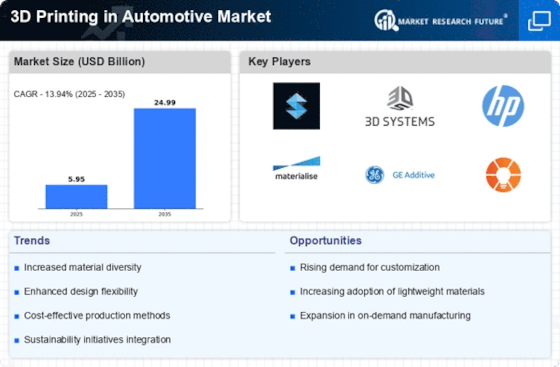
As per Market Research Future analysis, the 3D Printing in Automotive Market was estimated at 5.948 USD Billion in 2024. The 3D Printing in Automotive industry is projected to grow from 6.777 USD Billion in 2025 to 24.99 USD Billion by 2035, exhibiting a compound annual growth rate (CAGR) of 13.94% during the forecast period 2025 - 2035

Key Market Trends & Highlights

The 3D printing in automotive market is experiencing a transformative shift towards customization and sustainability.

  • Customization and personalization are becoming increasingly prevalent in automotive design, allowing manufacturers to cater to individual consumer preferences. Sustainability initiatives are driving the adoption of 3D printing technologies, as companies seek to reduce waste and environmental impact. North America remains the largest market for 3D printing in automotive, while Asia-Pacific is emerging as the fastest-growing region. The demand for cost efficiency in production and enhanced supply chain flexibility is propelling the growth of production parts in the automotive sector.

Market Size & Forecast

2024 Market Size 5.948 (USD Billion)
2035 Market Size 24.99 (USD Billion)
CAGR (2025 - 2035) 13.94%
Largest Regional Market Share in 2024 North America

Major Players

Stratasys (US), 3D Systems (US), HP (US), Materialise (BE), GE Additive (US), EOS (DE), Renishaw (GB), SLM Solutions (DE), Carbon (US)

Market Trends

The 3D Printing in Automotive Market is currently experiencing a transformative phase, characterized by rapid advancements in technology and increasing adoption across various segments. Manufacturers are increasingly leveraging additive manufacturing to enhance production efficiency, reduce waste, and enable the creation of complex geometries that traditional methods cannot achieve. This shift appears to be driven by the need for customization and the demand for lightweight components, which are essential for improving vehicle performance and fuel efficiency. Furthermore, the integration of 3D printing into supply chains is likely to streamline operations, allowing for on-demand production and reducing lead times significantly. In addition to operational benefits, the 3D Printing in Automotive Market is also fostering innovation in design and prototyping. Companies are utilizing this technology to create prototypes more rapidly, facilitating faster iterations and reducing time-to-market for new models. This trend suggests a growing emphasis on sustainability, as 3D printing can minimize material waste and energy consumption compared to conventional manufacturing processes. As the automotive industry continues to evolve, the potential for 3D printing to revolutionize production methods and contribute to more sustainable practices remains a focal point for stakeholders in the sector.

Customization and Personalization

The demand for tailored automotive solutions is rising, prompting manufacturers to explore 3D printing for bespoke components. This trend allows for unique designs that cater to individual customer preferences, enhancing user experience and satisfaction.

Sustainability Initiatives

There is a noticeable shift towards environmentally friendly practices within the automotive sector. 3D printing contributes to sustainability by reducing material waste and enabling the use of recycled materials, aligning with global efforts to minimize environmental impact.

Rapid Prototyping and Iteration

The ability to quickly produce prototypes is becoming increasingly vital in the automotive industry. 3D printing facilitates faster design iterations, allowing manufacturers to test and refine concepts more efficiently, ultimately accelerating the development process.

3D Printing Automotive Market Market Drivers

Cost Efficiency in Production

The 3D Printing in Automotive Market is witnessing a notable shift towards cost efficiency in production processes. Traditional manufacturing methods often involve high material waste and extensive labor costs. In contrast, 3D printing allows for additive manufacturing, which significantly reduces waste by using only the necessary amount of material. Reports indicate that companies utilizing 3D printing can reduce production costs by up to 30%. This cost-effectiveness is particularly appealing to automotive manufacturers looking to optimize their budgets while maintaining quality. As a result, the adoption of 3D printing technologies is likely to increase, enabling manufacturers to produce complex components at a fraction of the cost of traditional methods.

Enhanced Supply Chain Flexibility

The 3D Printing in Automotive Market is characterized by enhanced supply chain flexibility, which is becoming increasingly vital in today's fast-paced environment. Traditional supply chains often face challenges such as long lead times and dependency on multiple suppliers. However, 3D printing allows manufacturers to produce parts on-demand, reducing the need for extensive inventories. This capability can lead to a reduction in lead times by as much as 50%, enabling automotive companies to respond swiftly to market changes. Furthermore, localized production through 3D printing can mitigate risks associated with global supply chain disruptions, making it a strategic advantage for manufacturers aiming to maintain competitiveness.

Innovation in Design Capabilities

The 3D Printing in Automotive Market is fostering innovation in design capabilities, allowing for the creation of complex geometries that were previously unattainable with traditional manufacturing methods. This technology enables automotive designers to experiment with new shapes and structures, leading to lighter and more efficient vehicles. For instance, the ability to produce intricate lattice structures can enhance the performance of components while reducing weight. As a result, automotive manufacturers are increasingly investing in 3D printing technologies to push the boundaries of design, which could lead to the development of next-generation vehicles that are not only aesthetically pleasing but also functionally superior.

Sustainability and Environmental Impact

The 3D Printing in Automotive Market is increasingly aligned with sustainability goals, as manufacturers seek to minimize their environmental footprint. Traditional manufacturing processes often generate significant waste and consume large amounts of energy. In contrast, 3D printing is inherently more sustainable, as it produces parts layer by layer, resulting in less material waste. Additionally, the ability to use recycled materials in 3D printing processes further enhances its eco-friendliness. Reports suggest that automotive companies adopting 3D printing can reduce their carbon emissions by up to 40%. This commitment to sustainability not only meets regulatory requirements but also resonates with environmentally conscious consumers.

Rapid Prototyping and Product Development

The 3D Printing in Automotive Market is revolutionizing rapid prototyping and product development processes. Traditional prototyping methods can be time-consuming and costly, often requiring multiple iterations before arriving at a final design. In contrast, 3D printing allows for quick and cost-effective prototyping, enabling automotive manufacturers to test and refine designs in real-time. This capability can reduce the product development cycle by up to 70%, allowing companies to bring new vehicles to market faster. As competition intensifies, the ability to innovate rapidly becomes a crucial differentiator, making 3D printing an essential tool for automotive manufacturers aiming to stay ahead in the market.

Market Segment Insights

By Application: Prototyping (Largest) vs. Production Parts (Fastest-Growing)

In the 3D Printing in Automotive Market, the application segment predominantly features prototyping, which holds the largest market share due to its essential role in product development. This technique allows automotive manufacturers to create and test prototypes quickly and efficiently, leading to faster time-to-market and reduced costs. Other applications such as production parts and tooling also contribute to the market but have smaller shares comparatively. As the industry progresses, production parts are emerging as the fastest-growing segment. This growth is driven by the increasing demand for customized and lightweight components that 3D printing can efficiently produce. Moreover, advancements in materials and technologies are enabling higher volume production, thereby enhancing the viability of 3D printing in mass manufacturing processes within the automotive sector.

Prototyping (Dominant) vs. Custom Components (Emerging)

Prototyping stands out as the dominant application in the 3D Printing in Automotive Market, characterized by its extensive use in the early stages of vehicle design and development. Manufacturers leverage this application to create accurate and functional prototypes, which significantly reduce design iterations and enhance creativity. In contrast, custom components are emerging as a vital part of the market, driven by consumer demand for personalized vehicles. The growing trend of vehicle electrification and the need for specialized parts further fuel the rise of custom components. These applications enable manufacturers to tailor designs to meet specific performance requirements or aesthetic preferences, showcasing the adaptability of 3D printing technologies to a diverse range of automotive needs.

By Material Type: Plastic (Largest) vs. Metal (Fastest-Growing)

In the 3D Printing in Automotive Market, plastic holds the largest share among material types due to its versatility, lightweight nature, and cost-effectiveness. Commonly used in prototype development and end-use parts, plastic dominates applications where speed and production quantity are essential. Meanwhile, metal is gaining momentum as it becomes an increasingly viable option for producing high-strength components necessary for automotive applications, appealing to manufacturers aiming for competitive advantage.

Plastic (Dominant) vs. Metal (Emerging)

Plastic is the dominant material type in the 3D Printing in Automotive Market, prized for its adaptability and efficiency in mass production scenarios. Its properties allow for the creation of intricate designs with reduced weight, leading to improvements in automotive fuel efficiency. Conversely, metal is emerging rapidly due to advancements in additive manufacturing technology, allowing for the production of robust and durable parts that can withstand the rigors of automotive applications. This transition towards metal is driven by the automotive industry's demand for higher performance materials that can aid in reducing vehicle weight while enhancing strength and structural integrity.

By Technology: Fused Deposition Modeling (Largest) vs. Selective Laser Sintering (Fastest-Growing)

In the 3D Printing in Automotive Market, Fused Deposition Modeling (FDM) holds the largest market share due to its widespread adoption in prototyping and production applications. This technology offers a cost-effective and straightforward approach, making it attractive for many manufacturers. On the other hand, Selective Laser Sintering (SLS) is gaining traction, particularly in producing complex parts with high accuracy. While its share is smaller, the versatility and material options available with SLS are driving its growth.

Technology: Fused Deposition Modeling (Dominant) vs. Selective Laser Sintering (Emerging)

Fused Deposition Modeling (FDM) remains the dominant technology in 3D printing for the automotive industry, favored for its simplicity, accessibility, and ability to create functional prototypes rapidly. This method uses thermoplastic filaments, allowing a wide range of materials to be utilized, thus making it highly versatile. In contrast, Selective Laser Sintering (SLS) is emerging as a significant technology for its ability to produce functional parts with intricate geometries that were previously unachievable. SLS employs a laser to fuse powdered materials, offering improved mechanical properties and design freedom, which are increasingly appealing to automotive manufacturers seeking innovation in their production processes.

By End Use: Passenger Vehicles (Largest) vs. Commercial Vehicles (Fastest-Growing)

In the 3D Printing in Automotive Market, the distribution of market share among 'Passenger Vehicles', 'Commercial Vehicles', and 'Motorcycles' reveals a clear hierarchy in demand. Passenger Vehicles occupy the largest share, driven by the increasing consumer preference for customized and innovative designs. Commercial Vehicles, on the other hand, are rapidly gaining traction as manufacturers see the potential for weight reduction and efficiency improvements through 3D printing technologies.

Passenger Vehicles (Dominant) vs. Commercial Vehicles (Emerging)

Passenger Vehicles represent the dominant segment in the 3D Printing in Automotive Market, characterized by their need for customization, efficiency, and enhanced performance. With advancements in 3D printing techniques, manufacturers are able to create unique parts and components tailored to consumer preferences, significantly reducing production time. Meanwhile, Commercial Vehicles are emerging as a vital segment, driven by the need for lightweight materials and fast production capabilities that are enhanced by 3D printing technology. This segment is expected to see substantial growth as companies look to innovate and reduce operational costs.

Get more detailed insights about 3D Printing in Automotive Market Research Report — Global Forecast till 2035

Regional Insights

The 3D Printing in Automotive Market is projected to see significant expansion, with key regional markets playing distinct roles. In 2024, North America held a dominant position, valued at 2.2 USD Billion, and is expected to reach 10.5 USD Billion by 2035, reflecting its major influence through advanced manufacturing technologies and a strong automotive sector.

Europe followed, with a valuation of 1.6 USD Billion in 2024 and anticipated growth to 7.4 USD Billion in 2035, driven by robust technological advancements and sustainability initiatives. The APAC region also emerged notably, with a current value of 1.5 USD Billion, rising to 5.5 USD Billion by 2035, as countries like Japan and China invest heavily in automotive innovation.

South America and the Middle East and Africa (MEA) markets were smaller, valued at 0.45 USD Billion and 0.3 USD Billion respectively in 2024, yet they still showed potential for future growth, anticipated to reach 1.5 USD Billion and 0.8 USD Billion by 2035.

This regional segmentation highlighted not only the market growth potential but also the distinct drivers, including technological advancements, skilled labor availability, and growing end-user adoption across various regions, contributing to the overall market dynamics within the 3D Printing in Automotive Market.

Key Players and Competitive Insights

The 3D Printing in Automotive Market is a dynamic and rapidly evolving sector that relies on advancements in additive manufacturing technology. This market encompasses a wide range of applications, including prototyping, tooling, and end-use parts production, which are transforming traditional automotive manufacturing processes. As automation and customization demand increases, automotive companies are investing in 3D printing technologies to streamline production, reduce costs, and enhance design capabilities. Competitive insights reveal that key players are leveraging innovative approaches to material science and machine efficiency, making significant strides in not only enhancing their product offerings but also in creating sustainable manufacturing processes. Market competition is intensified by the emergence of new entrants and the continual improvement of existing technologies, positioning industry leaders to capitalize on various opportunities in this expanding market. HP, a major player in the 3D Printing in Automotive Market, has established a strong presence with its advanced multi-jet fusion technology, enabling the production of high-quality automotive parts. The company's strengths lie in its diverse portfolio of 3D printing solutions that cater effectively to the needs of automotive manufacturers looking for speed and efficiency. HP's additive manufacturing systems facilitate rapid prototyping and production scaling which increases their operational agility. Additionally, HP's robust ecosystem of materials and software ensures compatibility and ease of integration within existing automotive production lines. Their commitment to innovation and sustainability bolsters their positioning as a trusted partner in the automotive sector, allowing companies to achieve faster time-to-market and reduced production costs while maintaining high-performance standards. Renishaw, renowned for its expertise in precision engineering, has made significant inroads into the 3D Printing in Automotive Market with its metal additive manufacturing systems. The company focuses on delivering high-quality metal parts that serve critical automotive applications, emphasizing precision and reliability. Renishaw’s strengths include its advanced technology platforms that support advanced materials and provide solutions tailored to meet the specific needs of automotive clients. Moreover, Renishaw actively engages in mergers and acquisitions to enhance its product offerings and expand its technological capabilities in the sector. Their commitment to research and development ensures they remain at the forefront of innovation, addressing the growing demand for customized applications in the automotive industry. With a strong focus on quality assurance and engineering excellence, Renishaw aims to strengthen its global market presence by providing comprehensive solutions that drive efficiency and performance in automotive manufacturing.

Key Companies in the 3D Printing Automotive Market include

Industry Developments

The 3D Printing in Automotive Market has seen significant developments in recent months. In September 2023, Stratasys announced a partnership with an automotive manufacturer to enhance the production of lightweight components through additive manufacturing techniques.

Meanwhile, GE Additive launched a new metal additive manufacturing system designed specifically for automotive applications, which is expected to streamline production processes and reduce costs. Renishaw has been focusing on expanding its product offerings to support automotive clients, emphasizing the importance of precision in 3D printed components.

Additionally, in August 2023, Materialise completed the acquisition of a European 3D printing firm, enhancing its capabilities in automotive applications and expanding its market reach. This growth trend is propelled by an increasing demand for customized parts and rapid prototyping, with players like HP and 3D Systems investing heavily in Research and Development for innovative materials and technologies.

Over the past couple of years, the market has experienced a shift, with major automotive companies adopting 3D printing solutions to improve efficiency, as seen in initiatives by companies like Carbon and Formlabs, driving a robust change in manufacturing processes across the sector.

Future Outlook

3D Printing Automotive Market Future Outlook

The 3D Printing in Automotive Market is projected to grow at a 13.94% CAGR from 2025 to 2035, driven by advancements in materials, customization, and production efficiency.

New opportunities lie in:

  • <p>Development of lightweight, high-performance materials for automotive components. Integration of 3D printing in supply chain logistics for rapid prototyping. Establishment of partnerships with automotive OEMs for tailored 3D printing solutions.</p>

By 2035, the market is expected to be a cornerstone of automotive manufacturing innovation.

Market Segmentation

3D Printing Automotive Market End Use Outlook

  • Passenger Vehicles
  • Commercial Vehicles
  • Motorcycles

3D Printing Automotive Market Technology Outlook

  • Fused Deposition Modeling
  • Selective Laser Sintering
  • Stereolithography
  • Digital Light Processing

3D Printing Automotive Market Application Outlook

  • Prototyping
  • Tooling
  • Production Parts
  • Custom Components

3D Printing Automotive Market Material Type Outlook

  • Plastic
  • Metal
  • Ceramics
  • Composites

Report Scope

MARKET SIZE 2024 5.948(USD Billion)
MARKET SIZE 2025 6.777(USD Billion)
MARKET SIZE 2035 24.99(USD Billion)
COMPOUND ANNUAL GROWTH RATE (CAGR) 13.94% (2025 - 2035)
REPORT COVERAGE Revenue Forecast, Competitive Landscape, Growth Factors, and Trends
BASE YEAR 2024
Market Forecast Period 2025 - 2035
Historical Data 2019 - 2024
Market Forecast Units USD Billion
Key Companies Profiled Stratasys (US), 3D Systems (US), HP (US), Materialise (BE), GE Additive (US), EOS (DE), Renishaw (GB), SLM Solutions (DE), Carbon (US)
Segments Covered Application, Material Type, Technology, End Use, Regional
Key Market Opportunities Integration of advanced materials enhances customization and efficiency in the 3D Printing in Automotive Market.
Key Market Dynamics Rising adoption of 3D printing technologies enhances automotive design flexibility and reduces production lead times.
Countries Covered North America, Europe, APAC, South America, MEA

FAQs

What is the projected market valuation for 3D printing in the automotive sector by 2035?

<p>The projected market valuation for 3D printing in the automotive sector is 24.99 USD Billion by 2035.</p>

What was the market valuation for 3D printing in automotive in 2024?

<p>The market valuation for 3D printing in automotive was 5.948 USD Billion in 2024.</p>

What is the expected CAGR for the 3D printing in automotive market from 2025 to 2035?

<p>The expected CAGR for the 3D printing in automotive market during the forecast period 2025 - 2035 is 13.94%.</p>

Which application segment is projected to have the highest growth in the 3D printing automotive market?

<p>The production parts segment is projected to grow from 2.5 USD Billion in 2024 to 10.0 USD Billion by 2035.</p>

What are the key materials used in 3D printing for the automotive industry?

<p>Key materials include plastic, metal, ceramics, and composites, with plastic projected to grow from 2.5 USD Billion to 10.5 USD Billion by 2035.</p>

Who are the leading companies in the 3D printing automotive market?

<p>Leading companies in the market include Stratasys, 3D Systems, HP, Materialise, and GE Additive.</p>

What technology segment is expected to see significant growth in the automotive 3D printing market?

<p>Fused Deposition Modeling is expected to grow from 1.5 USD Billion in 2024 to 6.5 USD Billion by 2035.</p>

How does the end-use segment of passenger vehicles compare to commercial vehicles in market valuation?

<p>Passenger vehicles are projected to grow from 2.5 USD Billion in 2024 to 10.5 USD Billion by 2035, surpassing commercial vehicles.</p>

What is the growth potential for custom components in the automotive 3D printing market?

<p>The custom components segment is expected to increase from 0.748 USD Billion in 2024 to 3.49 USD Billion by 2035.</p>

What role do companies like EOS and Renishaw play in the automotive 3D printing market?

<p>Companies like EOS and Renishaw contribute to advancements in technology and materials, enhancing the overall market landscape.</p>

  1. SECTION I: EXECUTIVE SUMMARY AND KEY HIGHLIGHTS
    1. | 1.1 EXECUTIVE SUMMARY
    2. | | 1.1.1 Market Overview
    3. | | 1.1.2 Key Findings
    4. | | 1.1.3 Market Segmentation
    5. | | 1.1.4 Competitive Landscape
    6. | | 1.1.5 Challenges and Opportunities
    7. | | 1.1.6 Future Outlook
  2. SECTION II: SCOPING, METHODOLOGY AND MARKET STRUCTURE
    1. | 2.1 MARKET INTRODUCTION
    2. | | 2.1.1 Definition
    3. | | 2.1.2 Scope of the study
    4. | | | 2.1.2.1 Research Objective
    5. | | | 2.1.2.2 Assumption
    6. | | | 2.1.2.3 Limitations
    7. | 2.2 RESEARCH METHODOLOGY
    8. | | 2.2.1 Overview
    9. | | 2.2.2 Data Mining
    10. | | 2.2.3 Secondary Research
    11. | | 2.2.4 Primary Research
    12. | | | 2.2.4.1 Primary Interviews and Information Gathering Process
    13. | | | 2.2.4.2 Breakdown of Primary Respondents
    14. | | 2.2.5 Forecasting Model
    15. | | 2.2.6 Market Size Estimation
    16. | | | 2.2.6.1 Bottom-Up Approach
    17. | | | 2.2.6.2 Top-Down Approach
    18. | | 2.2.7 Data Triangulation
    19. | | 2.2.8 Validation
  3. SECTION III: QUALITATIVE ANALYSIS
    1. | 3.1 MARKET DYNAMICS
    2. | | 3.1.1 Overview
    3. | | 3.1.2 Drivers
    4. | | 3.1.3 Restraints
    5. | | 3.1.4 Opportunities
    6. | 3.2 MARKET FACTOR ANALYSIS
    7. | | 3.2.1 Value chain Analysis
    8. | | 3.2.2 Porter's Five Forces Analysis
    9. | | | 3.2.2.1 Bargaining Power of Suppliers
    10. | | | 3.2.2.2 Bargaining Power of Buyers
    11. | | | 3.2.2.3 Threat of New Entrants
    12. | | | 3.2.2.4 Threat of Substitutes
    13. | | | 3.2.2.5 Intensity of Rivalry
    14. | | 3.2.3 COVID-19 Impact Analysis
    15. | | | 3.2.3.1 Market Impact Analysis
    16. | | | 3.2.3.2 Regional Impact
    17. | | | 3.2.3.3 Opportunity and Threat Analysis
  4. SECTION IV: QUANTITATIVE ANALYSIS
    1. | 4.1 Automobile, BY Application (USD Billion)
    2. | | 4.1.1 Prototyping
    3. | | 4.1.2 Tooling
    4. | | 4.1.3 Production Parts
    5. | | 4.1.4 Custom Components
    6. | 4.2 Automobile, BY Material Type (USD Billion)
    7. | | 4.2.1 Plastic
    8. | | 4.2.2 Metal
    9. | | 4.2.3 Ceramics
    10. | | 4.2.4 Composites
    11. | 4.3 Automobile, BY Technology (USD Billion)
    12. | | 4.3.1 Fused Deposition Modeling
    13. | | 4.3.2 Selective Laser Sintering
    14. | | 4.3.3 Stereolithography
    15. | | 4.3.4 Digital Light Processing
    16. | 4.4 Automobile, BY End Use (USD Billion)
    17. | | 4.4.1 Passenger Vehicles
    18. | | 4.4.2 Commercial Vehicles
    19. | | 4.4.3 Motorcycles
    20. | 4.5 Automobile, BY Region (USD Billion)
    21. | | 4.5.1 North America
    22. | | | 4.5.1.1 US
    23. | | | 4.5.1.2 Canada
    24. | | 4.5.2 Europe
    25. | | | 4.5.2.1 Germany
    26. | | | 4.5.2.2 UK
    27. | | | 4.5.2.3 France
    28. | | | 4.5.2.4 Russia
    29. | | | 4.5.2.5 Italy
    30. | | | 4.5.2.6 Spain
    31. | | | 4.5.2.7 Rest of Europe
    32. | | 4.5.3 APAC
    33. | | | 4.5.3.1 China
    34. | | | 4.5.3.2 India
    35. | | | 4.5.3.3 Japan
    36. | | | 4.5.3.4 South Korea
    37. | | | 4.5.3.5 Malaysia
    38. | | | 4.5.3.6 Thailand
    39. | | | 4.5.3.7 Indonesia
    40. | | | 4.5.3.8 Rest of APAC
    41. | | 4.5.4 South America
    42. | | | 4.5.4.1 Brazil
    43. | | | 4.5.4.2 Mexico
    44. | | | 4.5.4.3 Argentina
    45. | | | 4.5.4.4 Rest of South America
    46. | | 4.5.5 MEA
    47. | | | 4.5.5.1 GCC Countries
    48. | | | 4.5.5.2 South Africa
    49. | | | 4.5.5.3 Rest of MEA
  5. SECTION V: COMPETITIVE ANALYSIS
    1. | 5.1 Competitive Landscape
    2. | | 5.1.1 Overview
    3. | | 5.1.2 Competitive Analysis
    4. | | 5.1.3 Market share Analysis
    5. | | 5.1.4 Major Growth Strategy in the Automobile
    6. | | 5.1.5 Competitive Benchmarking
    7. | | 5.1.6 Leading Players in Terms of Number of Developments in the Automobile
    8. | | 5.1.7 Key developments and growth strategies
    9. | | | 5.1.7.1 New Product Launch/Service Deployment
    10. | | | 5.1.7.2 Merger & Acquisitions
    11. | | | 5.1.7.3 Joint Ventures
    12. | | 5.1.8 Major Players Financial Matrix
    13. | | | 5.1.8.1 Sales and Operating Income
    14. | | | 5.1.8.2 Major Players R&D Expenditure. 2023
    15. | 5.2 Company Profiles
    16. | | 5.2.1 Stratasys (US)
    17. | | | 5.2.1.1 Financial Overview
    18. | | | 5.2.1.2 Products Offered
    19. | | | 5.2.1.3 Key Developments
    20. | | | 5.2.1.4 SWOT Analysis
    21. | | | 5.2.1.5 Key Strategies
    22. | | 5.2.2 3D Systems (US)
    23. | | | 5.2.2.1 Financial Overview
    24. | | | 5.2.2.2 Products Offered
    25. | | | 5.2.2.3 Key Developments
    26. | | | 5.2.2.4 SWOT Analysis
    27. | | | 5.2.2.5 Key Strategies
    28. | | 5.2.3 HP (US)
    29. | | | 5.2.3.1 Financial Overview
    30. | | | 5.2.3.2 Products Offered
    31. | | | 5.2.3.3 Key Developments
    32. | | | 5.2.3.4 SWOT Analysis
    33. | | | 5.2.3.5 Key Strategies
    34. | | 5.2.4 Materialise (BE)
    35. | | | 5.2.4.1 Financial Overview
    36. | | | 5.2.4.2 Products Offered
    37. | | | 5.2.4.3 Key Developments
    38. | | | 5.2.4.4 SWOT Analysis
    39. | | | 5.2.4.5 Key Strategies
    40. | | 5.2.5 GE Additive (US)
    41. | | | 5.2.5.1 Financial Overview
    42. | | | 5.2.5.2 Products Offered
    43. | | | 5.2.5.3 Key Developments
    44. | | | 5.2.5.4 SWOT Analysis
    45. | | | 5.2.5.5 Key Strategies
    46. | | 5.2.6 EOS (DE)
    47. | | | 5.2.6.1 Financial Overview
    48. | | | 5.2.6.2 Products Offered
    49. | | | 5.2.6.3 Key Developments
    50. | | | 5.2.6.4 SWOT Analysis
    51. | | | 5.2.6.5 Key Strategies
    52. | | 5.2.7 Renishaw (GB)
    53. | | | 5.2.7.1 Financial Overview
    54. | | | 5.2.7.2 Products Offered
    55. | | | 5.2.7.3 Key Developments
    56. | | | 5.2.7.4 SWOT Analysis
    57. | | | 5.2.7.5 Key Strategies
    58. | | 5.2.8 SLM Solutions (DE)
    59. | | | 5.2.8.1 Financial Overview
    60. | | | 5.2.8.2 Products Offered
    61. | | | 5.2.8.3 Key Developments
    62. | | | 5.2.8.4 SWOT Analysis
    63. | | | 5.2.8.5 Key Strategies
    64. | | 5.2.9 Carbon (US)
    65. | | | 5.2.9.1 Financial Overview
    66. | | | 5.2.9.2 Products Offered
    67. | | | 5.2.9.3 Key Developments
    68. | | | 5.2.9.4 SWOT Analysis
    69. | | | 5.2.9.5 Key Strategies
    70. | 5.3 Appendix
    71. | | 5.3.1 References
    72. | | 5.3.2 Related Reports
  6. LIST OF FIGURES
    1. | 6.1 MARKET SYNOPSIS
    2. | 6.2 NORTH AMERICA MARKET ANALYSIS
    3. | 6.3 US MARKET ANALYSIS BY APPLICATION
    4. | 6.4 US MARKET ANALYSIS BY MATERIAL TYPE
    5. | 6.5 US MARKET ANALYSIS BY TECHNOLOGY
    6. | 6.6 US MARKET ANALYSIS BY END USE
    7. | 6.7 CANADA MARKET ANALYSIS BY APPLICATION
    8. | 6.8 CANADA MARKET ANALYSIS BY MATERIAL TYPE
    9. | 6.9 CANADA MARKET ANALYSIS BY TECHNOLOGY
    10. | 6.10 CANADA MARKET ANALYSIS BY END USE
    11. | 6.11 EUROPE MARKET ANALYSIS
    12. | 6.12 GERMANY MARKET ANALYSIS BY APPLICATION
    13. | 6.13 GERMANY MARKET ANALYSIS BY MATERIAL TYPE
    14. | 6.14 GERMANY MARKET ANALYSIS BY TECHNOLOGY
    15. | 6.15 GERMANY MARKET ANALYSIS BY END USE
    16. | 6.16 UK MARKET ANALYSIS BY APPLICATION
    17. | 6.17 UK MARKET ANALYSIS BY MATERIAL TYPE
    18. | 6.18 UK MARKET ANALYSIS BY TECHNOLOGY
    19. | 6.19 UK MARKET ANALYSIS BY END USE
    20. | 6.20 FRANCE MARKET ANALYSIS BY APPLICATION
    21. | 6.21 FRANCE MARKET ANALYSIS BY MATERIAL TYPE
    22. | 6.22 FRANCE MARKET ANALYSIS BY TECHNOLOGY
    23. | 6.23 FRANCE MARKET ANALYSIS BY END USE
    24. | 6.24 RUSSIA MARKET ANALYSIS BY APPLICATION
    25. | 6.25 RUSSIA MARKET ANALYSIS BY MATERIAL TYPE
    26. | 6.26 RUSSIA MARKET ANALYSIS BY TECHNOLOGY
    27. | 6.27 RUSSIA MARKET ANALYSIS BY END USE
    28. | 6.28 ITALY MARKET ANALYSIS BY APPLICATION
    29. | 6.29 ITALY MARKET ANALYSIS BY MATERIAL TYPE
    30. | 6.30 ITALY MARKET ANALYSIS BY TECHNOLOGY
    31. | 6.31 ITALY MARKET ANALYSIS BY END USE
    32. | 6.32 SPAIN MARKET ANALYSIS BY APPLICATION
    33. | 6.33 SPAIN MARKET ANALYSIS BY MATERIAL TYPE
    34. | 6.34 SPAIN MARKET ANALYSIS BY TECHNOLOGY
    35. | 6.35 SPAIN MARKET ANALYSIS BY END USE
    36. | 6.36 REST OF EUROPE MARKET ANALYSIS BY APPLICATION
    37. | 6.37 REST OF EUROPE MARKET ANALYSIS BY MATERIAL TYPE
    38. | 6.38 REST OF EUROPE MARKET ANALYSIS BY TECHNOLOGY
    39. | 6.39 REST OF EUROPE MARKET ANALYSIS BY END USE
    40. | 6.40 APAC MARKET ANALYSIS
    41. | 6.41 CHINA MARKET ANALYSIS BY APPLICATION
    42. | 6.42 CHINA MARKET ANALYSIS BY MATERIAL TYPE
    43. | 6.43 CHINA MARKET ANALYSIS BY TECHNOLOGY
    44. | 6.44 CHINA MARKET ANALYSIS BY END USE
    45. | 6.45 INDIA MARKET ANALYSIS BY APPLICATION
    46. | 6.46 INDIA MARKET ANALYSIS BY MATERIAL TYPE
    47. | 6.47 INDIA MARKET ANALYSIS BY TECHNOLOGY
    48. | 6.48 INDIA MARKET ANALYSIS BY END USE
    49. | 6.49 JAPAN MARKET ANALYSIS BY APPLICATION
    50. | 6.50 JAPAN MARKET ANALYSIS BY MATERIAL TYPE
    51. | 6.51 JAPAN MARKET ANALYSIS BY TECHNOLOGY
    52. | 6.52 JAPAN MARKET ANALYSIS BY END USE
    53. | 6.53 SOUTH KOREA MARKET ANALYSIS BY APPLICATION
    54. | 6.54 SOUTH KOREA MARKET ANALYSIS BY MATERIAL TYPE
    55. | 6.55 SOUTH KOREA MARKET ANALYSIS BY TECHNOLOGY
    56. | 6.56 SOUTH KOREA MARKET ANALYSIS BY END USE
    57. | 6.57 MALAYSIA MARKET ANALYSIS BY APPLICATION
    58. | 6.58 MALAYSIA MARKET ANALYSIS BY MATERIAL TYPE
    59. | 6.59 MALAYSIA MARKET ANALYSIS BY TECHNOLOGY
    60. | 6.60 MALAYSIA MARKET ANALYSIS BY END USE
    61. | 6.61 THAILAND MARKET ANALYSIS BY APPLICATION
    62. | 6.62 THAILAND MARKET ANALYSIS BY MATERIAL TYPE
    63. | 6.63 THAILAND MARKET ANALYSIS BY TECHNOLOGY
    64. | 6.64 THAILAND MARKET ANALYSIS BY END USE
    65. | 6.65 INDONESIA MARKET ANALYSIS BY APPLICATION
    66. | 6.66 INDONESIA MARKET ANALYSIS BY MATERIAL TYPE
    67. | 6.67 INDONESIA MARKET ANALYSIS BY TECHNOLOGY
    68. | 6.68 INDONESIA MARKET ANALYSIS BY END USE
    69. | 6.69 REST OF APAC MARKET ANALYSIS BY APPLICATION
    70. | 6.70 REST OF APAC MARKET ANALYSIS BY MATERIAL TYPE
    71. | 6.71 REST OF APAC MARKET ANALYSIS BY TECHNOLOGY
    72. | 6.72 REST OF APAC MARKET ANALYSIS BY END USE
    73. | 6.73 SOUTH AMERICA MARKET ANALYSIS
    74. | 6.74 BRAZIL MARKET ANALYSIS BY APPLICATION
    75. | 6.75 BRAZIL MARKET ANALYSIS BY MATERIAL TYPE
    76. | 6.76 BRAZIL MARKET ANALYSIS BY TECHNOLOGY
    77. | 6.77 BRAZIL MARKET ANALYSIS BY END USE
    78. | 6.78 MEXICO MARKET ANALYSIS BY APPLICATION
    79. | 6.79 MEXICO MARKET ANALYSIS BY MATERIAL TYPE
    80. | 6.80 MEXICO MARKET ANALYSIS BY TECHNOLOGY
    81. | 6.81 MEXICO MARKET ANALYSIS BY END USE
    82. | 6.82 ARGENTINA MARKET ANALYSIS BY APPLICATION
    83. | 6.83 ARGENTINA MARKET ANALYSIS BY MATERIAL TYPE
    84. | 6.84 ARGENTINA MARKET ANALYSIS BY TECHNOLOGY
    85. | 6.85 ARGENTINA MARKET ANALYSIS BY END USE
    86. | 6.86 REST OF SOUTH AMERICA MARKET ANALYSIS BY APPLICATION
    87. | 6.87 REST OF SOUTH AMERICA MARKET ANALYSIS BY MATERIAL TYPE
    88. | 6.88 REST OF SOUTH AMERICA MARKET ANALYSIS BY TECHNOLOGY
    89. | 6.89 REST OF SOUTH AMERICA MARKET ANALYSIS BY END USE
    90. | 6.90 MEA MARKET ANALYSIS
    91. | 6.91 GCC COUNTRIES MARKET ANALYSIS BY APPLICATION
    92. | 6.92 GCC COUNTRIES MARKET ANALYSIS BY MATERIAL TYPE
    93. | 6.93 GCC COUNTRIES MARKET ANALYSIS BY TECHNOLOGY
    94. | 6.94 GCC COUNTRIES MARKET ANALYSIS BY END USE
    95. | 6.95 SOUTH AFRICA MARKET ANALYSIS BY APPLICATION
    96. | 6.96 SOUTH AFRICA MARKET ANALYSIS BY MATERIAL TYPE
    97. | 6.97 SOUTH AFRICA MARKET ANALYSIS BY TECHNOLOGY
    98. | 6.98 SOUTH AFRICA MARKET ANALYSIS BY END USE
    99. | 6.99 REST OF MEA MARKET ANALYSIS BY APPLICATION
    100. | 6.100 REST OF MEA MARKET ANALYSIS BY MATERIAL TYPE
    101. | 6.101 REST OF MEA MARKET ANALYSIS BY TECHNOLOGY
    102. | 6.102 REST OF MEA MARKET ANALYSIS BY END USE
    103. | 6.103 KEY BUYING CRITERIA OF AUTOMOBILE
    104. | 6.104 RESEARCH PROCESS OF MRFR
    105. | 6.105 DRO ANALYSIS OF AUTOMOBILE
    106. | 6.106 DRIVERS IMPACT ANALYSIS: AUTOMOBILE
    107. | 6.107 RESTRAINTS IMPACT ANALYSIS: AUTOMOBILE
    108. | 6.108 SUPPLY / VALUE CHAIN: AUTOMOBILE
    109. | 6.109 AUTOMOBILE, BY APPLICATION, 2024 (% SHARE)
    110. | 6.110 AUTOMOBILE, BY APPLICATION, 2024 TO 2035 (USD Billion)
    111. | 6.111 AUTOMOBILE, BY MATERIAL TYPE, 2024 (% SHARE)
    112. | 6.112 AUTOMOBILE, BY MATERIAL TYPE, 2024 TO 2035 (USD Billion)
    113. | 6.113 AUTOMOBILE, BY TECHNOLOGY, 2024 (% SHARE)
    114. | 6.114 AUTOMOBILE, BY TECHNOLOGY, 2024 TO 2035 (USD Billion)
    115. | 6.115 AUTOMOBILE, BY END USE, 2024 (% SHARE)
    116. | 6.116 AUTOMOBILE, BY END USE, 2024 TO 2035 (USD Billion)
    117. | 6.117 BENCHMARKING OF MAJOR COMPETITORS
  7. LIST OF TABLES
    1. | 7.1 LIST OF ASSUMPTIONS
    2. | | 7.1.1
    3. | 7.2 North America MARKET SIZE ESTIMATES; FORECAST
    4. | | 7.2.1 BY APPLICATION, 2025-2035 (USD Billion)
    5. | | 7.2.2 BY MATERIAL TYPE, 2025-2035 (USD Billion)
    6. | | 7.2.3 BY TECHNOLOGY, 2025-2035 (USD Billion)
    7. | | 7.2.4 BY END USE, 2025-2035 (USD Billion)
    8. | 7.3 US MARKET SIZE ESTIMATES; FORECAST
    9. | | 7.3.1 BY APPLICATION, 2025-2035 (USD Billion)
    10. | | 7.3.2 BY MATERIAL TYPE, 2025-2035 (USD Billion)
    11. | | 7.3.3 BY TECHNOLOGY, 2025-2035 (USD Billion)
    12. | | 7.3.4 BY END USE, 2025-2035 (USD Billion)
    13. | 7.4 Canada MARKET SIZE ESTIMATES; FORECAST
    14. | | 7.4.1 BY APPLICATION, 2025-2035 (USD Billion)
    15. | | 7.4.2 BY MATERIAL TYPE, 2025-2035 (USD Billion)
    16. | | 7.4.3 BY TECHNOLOGY, 2025-2035 (USD Billion)
    17. | | 7.4.4 BY END USE, 2025-2035 (USD Billion)
    18. | 7.5 Europe MARKET SIZE ESTIMATES; FORECAST
    19. | | 7.5.1 BY APPLICATION, 2025-2035 (USD Billion)
    20. | | 7.5.2 BY MATERIAL TYPE, 2025-2035 (USD Billion)
    21. | | 7.5.3 BY TECHNOLOGY, 2025-2035 (USD Billion)
    22. | | 7.5.4 BY END USE, 2025-2035 (USD Billion)
    23. | 7.6 Germany MARKET SIZE ESTIMATES; FORECAST
    24. | | 7.6.1 BY APPLICATION, 2025-2035 (USD Billion)
    25. | | 7.6.2 BY MATERIAL TYPE, 2025-2035 (USD Billion)
    26. | | 7.6.3 BY TECHNOLOGY, 2025-2035 (USD Billion)
    27. | | 7.6.4 BY END USE, 2025-2035 (USD Billion)
    28. | 7.7 UK MARKET SIZE ESTIMATES; FORECAST
    29. | | 7.7.1 BY APPLICATION, 2025-2035 (USD Billion)
    30. | | 7.7.2 BY MATERIAL TYPE, 2025-2035 (USD Billion)
    31. | | 7.7.3 BY TECHNOLOGY, 2025-2035 (USD Billion)
    32. | | 7.7.4 BY END USE, 2025-2035 (USD Billion)
    33. | 7.8 France MARKET SIZE ESTIMATES; FORECAST
    34. | | 7.8.1 BY APPLICATION, 2025-2035 (USD Billion)
    35. | | 7.8.2 BY MATERIAL TYPE, 2025-2035 (USD Billion)
    36. | | 7.8.3 BY TECHNOLOGY, 2025-2035 (USD Billion)
    37. | | 7.8.4 BY END USE, 2025-2035 (USD Billion)
    38. | 7.9 Russia MARKET SIZE ESTIMATES; FORECAST
    39. | | 7.9.1 BY APPLICATION, 2025-2035 (USD Billion)
    40. | | 7.9.2 BY MATERIAL TYPE, 2025-2035 (USD Billion)
    41. | | 7.9.3 BY TECHNOLOGY, 2025-2035 (USD Billion)
    42. | | 7.9.4 BY END USE, 2025-2035 (USD Billion)
    43. | 7.10 Italy MARKET SIZE ESTIMATES; FORECAST
    44. | | 7.10.1 BY APPLICATION, 2025-2035 (USD Billion)
    45. | | 7.10.2 BY MATERIAL TYPE, 2025-2035 (USD Billion)
    46. | | 7.10.3 BY TECHNOLOGY, 2025-2035 (USD Billion)
    47. | | 7.10.4 BY END USE, 2025-2035 (USD Billion)
    48. | 7.11 Spain MARKET SIZE ESTIMATES; FORECAST
    49. | | 7.11.1 BY APPLICATION, 2025-2035 (USD Billion)
    50. | | 7.11.2 BY MATERIAL TYPE, 2025-2035 (USD Billion)
    51. | | 7.11.3 BY TECHNOLOGY, 2025-2035 (USD Billion)
    52. | | 7.11.4 BY END USE, 2025-2035 (USD Billion)
    53. | 7.12 Rest of Europe MARKET SIZE ESTIMATES; FORECAST
    54. | | 7.12.1 BY APPLICATION, 2025-2035 (USD Billion)
    55. | | 7.12.2 BY MATERIAL TYPE, 2025-2035 (USD Billion)
    56. | | 7.12.3 BY TECHNOLOGY, 2025-2035 (USD Billion)
    57. | | 7.12.4 BY END USE, 2025-2035 (USD Billion)
    58. | 7.13 APAC MARKET SIZE ESTIMATES; FORECAST
    59. | | 7.13.1 BY APPLICATION, 2025-2035 (USD Billion)
    60. | | 7.13.2 BY MATERIAL TYPE, 2025-2035 (USD Billion)
    61. | | 7.13.3 BY TECHNOLOGY, 2025-2035 (USD Billion)
    62. | | 7.13.4 BY END USE, 2025-2035 (USD Billion)
    63. | 7.14 China MARKET SIZE ESTIMATES; FORECAST
    64. | | 7.14.1 BY APPLICATION, 2025-2035 (USD Billion)
    65. | | 7.14.2 BY MATERIAL TYPE, 2025-2035 (USD Billion)
    66. | | 7.14.3 BY TECHNOLOGY, 2025-2035 (USD Billion)
    67. | | 7.14.4 BY END USE, 2025-2035 (USD Billion)
    68. | 7.15 India MARKET SIZE ESTIMATES; FORECAST
    69. | | 7.15.1 BY APPLICATION, 2025-2035 (USD Billion)
    70. | | 7.15.2 BY MATERIAL TYPE, 2025-2035 (USD Billion)
    71. | | 7.15.3 BY TECHNOLOGY, 2025-2035 (USD Billion)
    72. | | 7.15.4 BY END USE, 2025-2035 (USD Billion)
    73. | 7.16 Japan MARKET SIZE ESTIMATES; FORECAST
    74. | | 7.16.1 BY APPLICATION, 2025-2035 (USD Billion)
    75. | | 7.16.2 BY MATERIAL TYPE, 2025-2035 (USD Billion)
    76. | | 7.16.3 BY TECHNOLOGY, 2025-2035 (USD Billion)
    77. | | 7.16.4 BY END USE, 2025-2035 (USD Billion)
    78. | 7.17 South Korea MARKET SIZE ESTIMATES; FORECAST
    79. | | 7.17.1 BY APPLICATION, 2025-2035 (USD Billion)
    80. | | 7.17.2 BY MATERIAL TYPE, 2025-2035 (USD Billion)
    81. | | 7.17.3 BY TECHNOLOGY, 2025-2035 (USD Billion)
    82. | | 7.17.4 BY END USE, 2025-2035 (USD Billion)
    83. | 7.18 Malaysia MARKET SIZE ESTIMATES; FORECAST
    84. | | 7.18.1 BY APPLICATION, 2025-2035 (USD Billion)
    85. | | 7.18.2 BY MATERIAL TYPE, 2025-2035 (USD Billion)
    86. | | 7.18.3 BY TECHNOLOGY, 2025-2035 (USD Billion)
    87. | | 7.18.4 BY END USE, 2025-2035 (USD Billion)
    88. | 7.19 Thailand MARKET SIZE ESTIMATES; FORECAST
    89. | | 7.19.1 BY APPLICATION, 2025-2035 (USD Billion)
    90. | | 7.19.2 BY MATERIAL TYPE, 2025-2035 (USD Billion)
    91. | | 7.19.3 BY TECHNOLOGY, 2025-2035 (USD Billion)
    92. | | 7.19.4 BY END USE, 2025-2035 (USD Billion)
    93. | 7.20 Indonesia MARKET SIZE ESTIMATES; FORECAST
    94. | | 7.20.1 BY APPLICATION, 2025-2035 (USD Billion)
    95. | | 7.20.2 BY MATERIAL TYPE, 2025-2035 (USD Billion)
    96. | | 7.20.3 BY TECHNOLOGY, 2025-2035 (USD Billion)
    97. | | 7.20.4 BY END USE, 2025-2035 (USD Billion)
    98. | 7.21 Rest of APAC MARKET SIZE ESTIMATES; FORECAST
    99. | | 7.21.1 BY APPLICATION, 2025-2035 (USD Billion)
    100. | | 7.21.2 BY MATERIAL TYPE, 2025-2035 (USD Billion)
    101. | | 7.21.3 BY TECHNOLOGY, 2025-2035 (USD Billion)
    102. | | 7.21.4 BY END USE, 2025-2035 (USD Billion)
    103. | 7.22 South America MARKET SIZE ESTIMATES; FORECAST
    104. | | 7.22.1 BY APPLICATION, 2025-2035 (USD Billion)
    105. | | 7.22.2 BY MATERIAL TYPE, 2025-2035 (USD Billion)
    106. | | 7.22.3 BY TECHNOLOGY, 2025-2035 (USD Billion)
    107. | | 7.22.4 BY END USE, 2025-2035 (USD Billion)
    108. | 7.23 Brazil MARKET SIZE ESTIMATES; FORECAST
    109. | | 7.23.1 BY APPLICATION, 2025-2035 (USD Billion)
    110. | | 7.23.2 BY MATERIAL TYPE, 2025-2035 (USD Billion)
    111. | | 7.23.3 BY TECHNOLOGY, 2025-2035 (USD Billion)
    112. | | 7.23.4 BY END USE, 2025-2035 (USD Billion)
    113. | 7.24 Mexico MARKET SIZE ESTIMATES; FORECAST
    114. | | 7.24.1 BY APPLICATION, 2025-2035 (USD Billion)
    115. | | 7.24.2 BY MATERIAL TYPE, 2025-2035 (USD Billion)
    116. | | 7.24.3 BY TECHNOLOGY, 2025-2035 (USD Billion)
    117. | | 7.24.4 BY END USE, 2025-2035 (USD Billion)
    118. | 7.25 Argentina MARKET SIZE ESTIMATES; FORECAST
    119. | | 7.25.1 BY APPLICATION, 2025-2035 (USD Billion)
    120. | | 7.25.2 BY MATERIAL TYPE, 2025-2035 (USD Billion)
    121. | | 7.25.3 BY TECHNOLOGY, 2025-2035 (USD Billion)
    122. | | 7.25.4 BY END USE, 2025-2035 (USD Billion)
    123. | 7.26 Rest of South America MARKET SIZE ESTIMATES; FORECAST
    124. | | 7.26.1 BY APPLICATION, 2025-2035 (USD Billion)
    125. | | 7.26.2 BY MATERIAL TYPE, 2025-2035 (USD Billion)
    126. | | 7.26.3 BY TECHNOLOGY, 2025-2035 (USD Billion)
    127. | | 7.26.4 BY END USE, 2025-2035 (USD Billion)
    128. | 7.27 MEA MARKET SIZE ESTIMATES; FORECAST
    129. | | 7.27.1 BY APPLICATION, 2025-2035 (USD Billion)
    130. | | 7.27.2 BY MATERIAL TYPE, 2025-2035 (USD Billion)
    131. | | 7.27.3 BY TECHNOLOGY, 2025-2035 (USD Billion)
    132. | | 7.27.4 BY END USE, 2025-2035 (USD Billion)
    133. | 7.28 GCC Countries MARKET SIZE ESTIMATES; FORECAST
    134. | | 7.28.1 BY APPLICATION, 2025-2035 (USD Billion)
    135. | | 7.28.2 BY MATERIAL TYPE, 2025-2035 (USD Billion)
    136. | | 7.28.3 BY TECHNOLOGY, 2025-2035 (USD Billion)
    137. | | 7.28.4 BY END USE, 2025-2035 (USD Billion)
    138. | 7.29 South Africa MARKET SIZE ESTIMATES; FORECAST
    139. | | 7.29.1 BY APPLICATION, 2025-2035 (USD Billion)
    140. | | 7.29.2 BY MATERIAL TYPE, 2025-2035 (USD Billion)
    141. | | 7.29.3 BY TECHNOLOGY, 2025-2035 (USD Billion)
    142. | | 7.29.4 BY END USE, 2025-2035 (USD Billion)
    143. | 7.30 Rest of MEA MARKET SIZE ESTIMATES; FORECAST
    144. | | 7.30.1 BY APPLICATION, 2025-2035 (USD Billion)
    145. | | 7.30.2 BY MATERIAL TYPE, 2025-2035 (USD Billion)
    146. | | 7.30.3 BY TECHNOLOGY, 2025-2035 (USD Billion)
    147. | | 7.30.4 BY END USE, 2025-2035 (USD Billion)
    148. | 7.31 PRODUCT LAUNCH/PRODUCT DEVELOPMENT/APPROVAL
    149. | | 7.31.1
    150. | 7.32 ACQUISITION/PARTNERSHIP
    151. | | 7.32.1

Automobile Market Segmentation

Automobile By Application (USD Billion, 2025-2035)

  • Prototyping
  • Tooling
  • Production Parts
  • Custom Components

Automobile By Material Type (USD Billion, 2025-2035)

  • Plastic
  • Metal
  • Ceramics
  • Composites

Automobile By Technology (USD Billion, 2025-2035)

  • Fused Deposition Modeling
  • Selective Laser Sintering
  • Stereolithography
  • Digital Light Processing

Automobile By End Use (USD Billion, 2025-2035)

  • Passenger Vehicles
  • Commercial Vehicles
  • Motorcycles
Infographic

Free Sample Request

Kindly complete the form below to receive a free sample of this Report

Get Free Sample

Customer Strories

Compare Licence

×
Features License Type
Single User Multiuser License Enterprise User
Price $4,950 $5,950 $7,250
Maximum User Access Limit 1 User Upto 10 Users Unrestricted Access Throughout the Organization
Free Customization
Direct Access to Analyst
Deliverable Format
Platform Access
Discount on Next Purchase 10% 15% 15%
Printable Versions