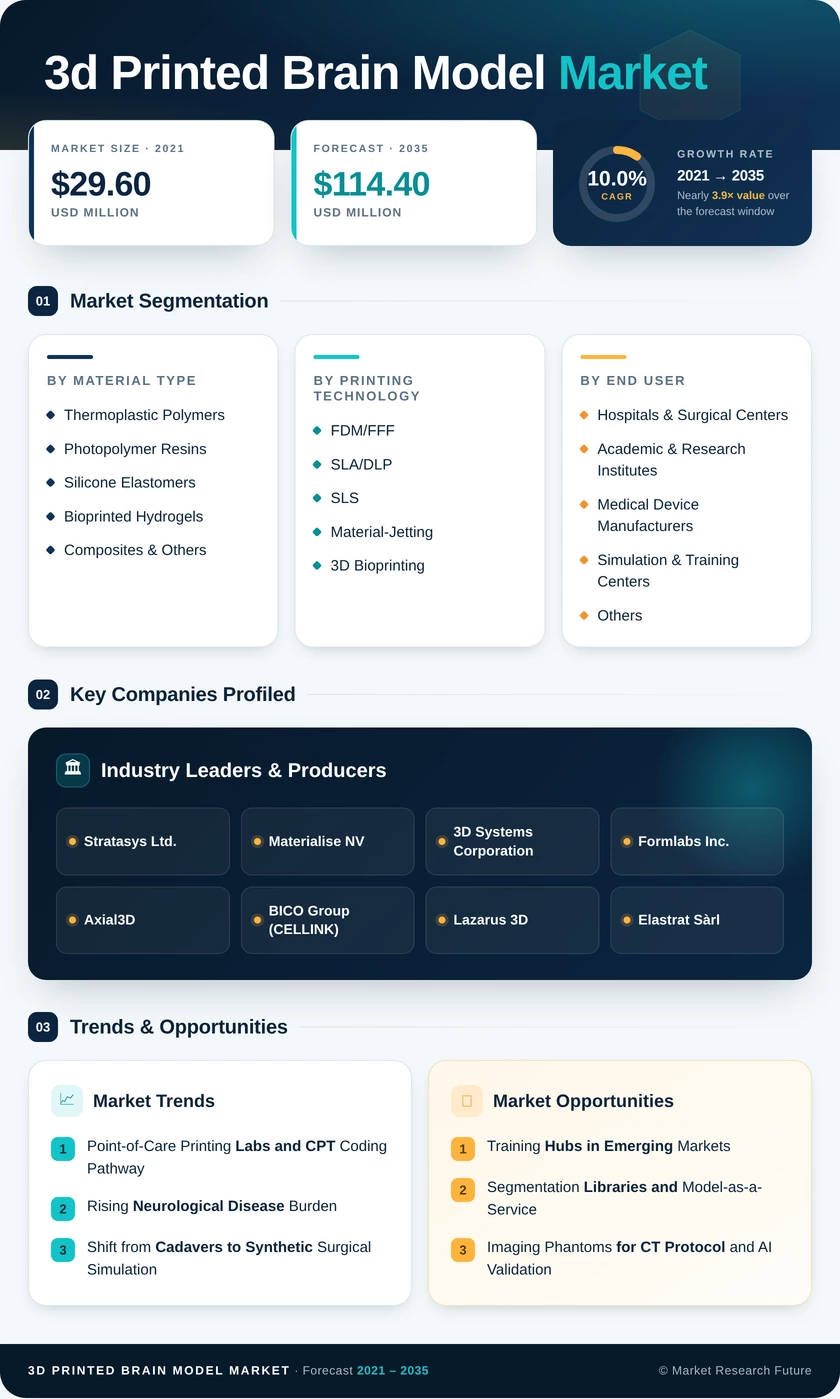
Segmentation Quick Reference
| Dimension | Sub-Segments | Dominant Segment | Fastest Growing Segment |
|---|
| By Material Type | Thermoplastic Polymers, Photopolymer Resins, Silicone Elastomers, Bioprinted Hydrogels, Composites & Others | Photopolymer Resins — 47.0% share | Bioprinted Hydrogels — 25.6% CAGR (2026–2035) |
| By Printing Technology | FDM/FFF, SLA/DLP, SLS, Material-Jetting, 3D Bioprinting | SLA/DLP — 41.3% share | 3D Bioprinting — 27.2% CAGR (2026–2035) |
| By End User | Hospitals & Surgical Centers, Academic & Research Institutes, Medical Device Manufacturers, Simulation & Training Centers, Others | Hospitals & Surgical Centers — 49.4% share | Medical Device Manufacturers — 26.6% CAGR (2026–2035) |
| By Region | North America, Europe, Asia-Pacific, South America, Middle East & Africa | North America — 39.8% share | Asia-Pacific — 12.6% CAGR (2026–2035) |
Market Segmentation Overview
| Sub-Segment | Key Trend |
|---|
| Thermoplastic Polymers | Low-cost filaments for teaching labs and patient education |
| Photopolymer Resins | Sub-100-micron accuracy for vascular and sulcal detail |
| Silicone Elastomers | Tactile realism for clipping and dissection practice |
| Bioprinted Hydrogels | Soft bio-inks supporting living, connected neural cultures |
| Composites & Others | Radiopaque formulations for fluoroscopy-guided training |
Photopolymer Resins lead because surgical planning buyers pay for sub-100-micron accuracy in vessels and sulci. Bioprinted Hydrogels grow fastest at a 25.6% CAGR as research labs adopt soft bio-inks that keep neurons alive and connected. Thermoplastic Polymers and Silicone Elastomers cover the low-cost and tactile ends of the range, while radiopaque Composites & Others remain a niche with rising training demand.
| Sub-Segment | Key Trend |
|---|
| FDM/FFF | Affordable models for education and consent discussions |
| SLA/DLP | Clinical-resolution capture of gyral and vascular anatomy |
| SLS | Durable skull and structural support components |
| Material-Jetting | Full-color, multi-durometer models for tumor margin visualization |
| 3D Bioprinting | Benchtop systems producing functionally connected neural tissue |
SLA/DLP leads with a 41.3% share because its resin curing resolves the fine anatomy surgeons need for vascular planning. 3D Bioprinting grows fastest at a 27.2% CAGR now that commercial benchtop printers can produce neural tissue with functional connectivity. Material-Jetting holds the premium multi-color tier, while FDM/FFF and SLS serve education and structural skull parts.
| Sub-Segment | Key Trend |
|---|
| Hospitals & Surgical Centers | Pre-operative planning for tumors, aneurysms and epilepsy surgery |
| Academic & Research Institutes | Mixed purchases of teaching models and living constructs |
| Medical Device Manufacturers | Anatomy-specific testing for adaptive neuromodulation and cranial implants |
| Simulation & Training Centers | Recurring bulk orders for certification courses |
| Others | Patient education, veterinary and consumer applications |
Hospitals & Surgical Centers lead with a 49.4% share, driven by pre-operative planning volume and residency training requirements. Medical Device Manufacturers grow fastest at a 26.6% CAGR because adaptive DBS systems and cranial implants need testing on real patient anatomy rather than averaged geometry. Academic & Research Institutes and Simulation & Training Centers add steady, recurring demand.


 Noah Malgeri
Co-Founder

 Peter Groot koerkamp
Account and Business Manager

 Younghwan Choi
Senior Retail Manager

 Mark Irwin
Management Consultant

 Akif Moroglu
Strategy & Business Development Director

 Guilherme Gomes Martins
Product Management Director

 Joseph Aguayo
Sales Operations & Pricing Manager

 La Terria Dodd
Program Support Specialist

 Rob Kooiker
Group Product Manager HVAC & Fire Protection GMA