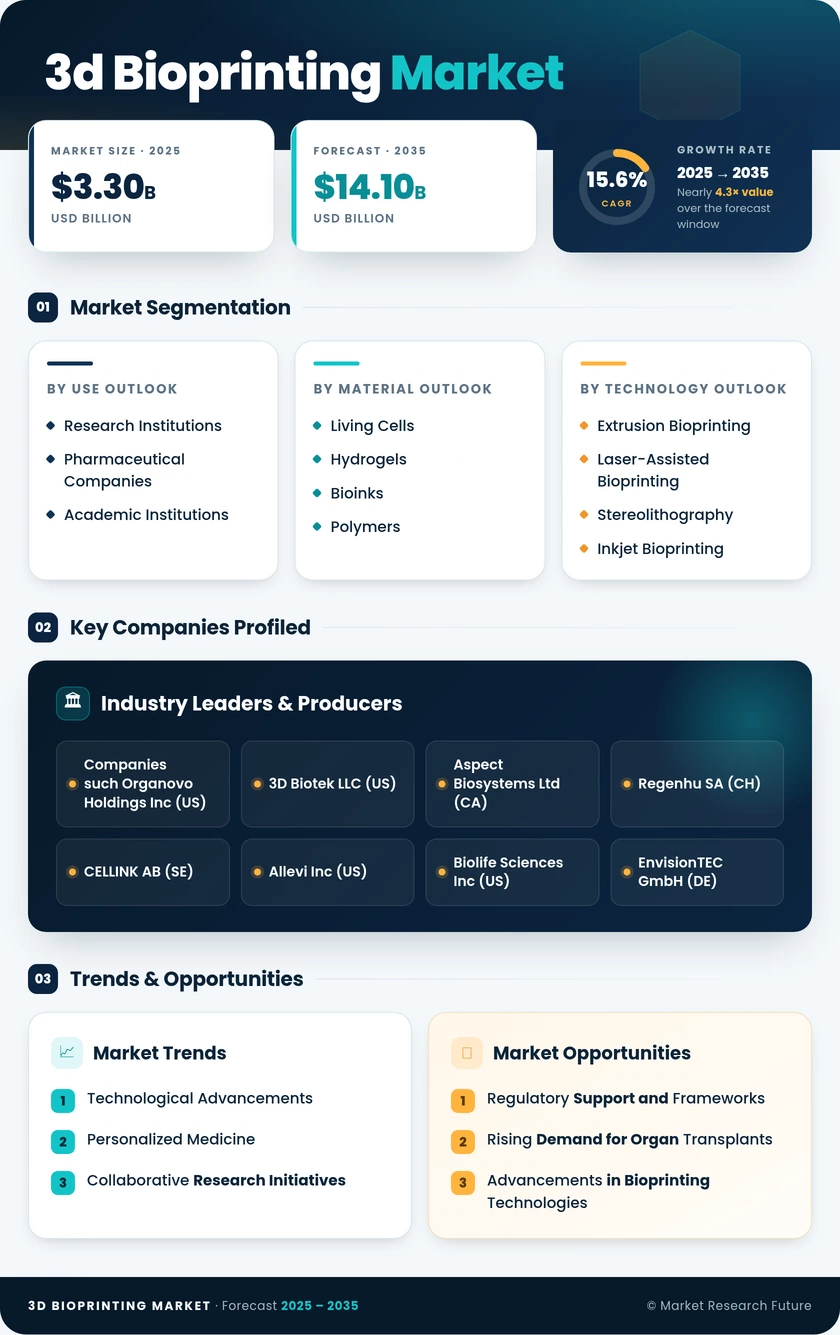
Segmentation Quick Reference
| Dimension | Sub-Segments | Dominant Segment | Fastest Growing Segment |
| By Technology | Syringe/Extrusion-based, Inkjet, Laser-Assisted, Digital Light Processing, Magnetic Levitation, Micro-Valve, Other Technologies | Syringe/Extrusion-based | Digital Light Processing |
| By Component | 3D Bioprinters, Biomaterials, Software & Services, Other Components | 3D Bioprinters | Biomaterials |
| By Application | Regenerative Medicine & Tissue Engineering, Drug Discovery & Toxicology Testing, Precision Medicine, 3D Cell Culture & Organ-on-Chip, Cosmetic & Cosmeceutical Testing, Other Applications | Regenerative Medicine & Tissue Engineering | Precision Medicine |
| By End User | Academic & Research Institutes, Pharmaceutical & Biotechnology Companies, Contract Research Organisations, Hospitals & Clinical Laboratories, Other End Users | Academic & Research Institutes | Contract Research Organisations |
| By Geography | North America, Europe, Asia-Pacific, South America, Middle East & Africa | North America | Asia-Pacific |
Market Segmentation Overview
By Technology
| Sub-Segment | Key Trend |
| Syringe/Extrusion-based | Multi-material coaxial heads enabling thicker perfusable constructs |
| Inkjet | Cost-efficient droplet deposition for high-throughput screening plates |
| Laser-Assisted | Nozzle-free placement preserving viability in sensitive primary cells |
| Digital Light Processing | Layerless curing compressing print times to seconds per layer. |
| Magnetic Levitation | Scaffold-free spheroid assembly for tumour and organoid models |
| Micro-Valve | Precise droplet metering for concentration-gradient constructs |
| Other Technologies | Hybrid platforms combining extrusion with photopolymerisation |
Technology selection tracks the trade-off between construct scale and resolution. Extrusion wins where surgeons need structural bulk; light-based methods win where microvasculature determines success. Hybrid systems combining both are moving from prototype to catalogue.
By Component
| Sub-Segment | Key Trend |
| 3D Bioprinters | Modular architectures allowing print-head upgrades without full replacement |
| Biomaterials | Migration from research-grade to GMP-grade formulations at premium pricing |
| Software & Services | Subscription analytics, protocol libraries and validation consulting |
| Other Components | Integrated perfusion, incubation and environmental control modules |
Revenue composition is shifting from one-time capital toward recurring consumables and software. Installed-base economics now determine vendor valuation more than annual instrument unit sales.
By Application
| Sub-Segment | Key Trend |
| Regenerative Medicine & Tissue Engineering | Cartilage, cornea and skin programmes entering pivotal clinical stages |
| Drug Discovery & Toxicology Testing | Human-relevant assays displacing animal models under new regulatory allowances |
| Precision Medicine | Patient-derived constructs guiding therapy selection within treatment windows |
| 3D Cell Culture & Organ-on-Chip | Perfused multi-tissue chips replacing static well-plate culture |
| Cosmetic & Cosmeceutical Testing | Reconstructed epidermis sustained by animal-testing prohibitions. |
| Other Applications | Cultivated protein scaffolding and surgical training models |
Application mix explains near-term revenue durability. Drug discovery and cosmetic testing generate cash today with minimal regulatory exposure, funding the longer, riskier march toward implantable therapeutics.
By End User
| Sub-Segment | Key Trend |
| Academic & Research Institutes | Consortium purchasing and shared core facilities lowering entry cost |
| Pharmaceutical & Biotechnology Companies | Internal preclinical modernisation budgets funding platform adoption |
| Contract Research Organisations | Rapid capacity expansion in Asia-Pacific to serve outsourced toxicology |
| Hospitals & Clinical Laboratories | Surgical planning models and early autologous graft programmes |
| Other End Users | Food-technology, defence medical logistics and education buyers |
Buyer composition is broadening beyond academia for the first time. Contract research organisations represent the pivotal shift, because their purchasing is driven by utilisation economics rather than grant cycles.


 Noah Malgeri
Co-Founder

 Peter Groot koerkamp
Account and Business Manager

 Younghwan Choi
Senior Retail Manager

 Mark Irwin
Management Consultant

 Akif Moroglu
Strategy & Business Development Director

 Guilherme Gomes Martins
Product Management Director

 Joseph Aguayo
Sales Operations & Pricing Manager

 La Terria Dodd
Program Support Specialist

 Rob Kooiker
Group Product Manager HVAC & Fire Protection GMA