Marché du suivi des actifs des consommateurs Résumé
Principales tendances et faits saillants du marché
Taille du marché et prévisions
| CAGR (2025 - 2035) | 9.74% |
| CAGR (2025 - 2035) | 9.74% |
The Consumer Asset Tracking Market is currently experiencing a notable evolution, driven by advancements in technology and increasing consumer demand for efficient asset management solutions. Companies are increasingly adopting innovative tracking systems that utilize Internet of Things (IoT) devices, enabling real-time monitoring and management of assets. This shift appears to be influenced by the growing need for transparency and accountability in supply chains, as businesses seek to enhance operational efficiency and reduce losses. Furthermore, the integration of artificial intelligence and machine learning into tracking systems is likely to provide deeper insights into asset utilization, thereby facilitating better decision-making processes. In addition, the Consumer Asset Tracking Market seems to be expanding due to the rising awareness of the benefits associated with asset tracking technologies. Organizations are recognizing the potential for improved inventory management, reduced operational costs, and enhanced customer satisfaction. As a result, there is a noticeable trend towards the adoption of cloud-based solutions, which offer scalability and flexibility. This market appears poised for continued growth, as more businesses explore the advantages of implementing comprehensive asset tracking systems to stay competitive in an increasingly dynamic environment.
The integration of Internet of Things (IoT) technologies into asset tracking systems is becoming increasingly prevalent. This trend indicates a shift towards real-time data collection and monitoring, allowing businesses to gain immediate insights into asset locations and conditions. Such advancements may enhance operational efficiency and reduce the risk of asset loss.
There is a growing inclination towards cloud-based asset tracking solutions among organizations. This trend suggests that businesses are seeking scalable and flexible options that can adapt to their evolving needs. Cloud solutions may facilitate easier access to data and improve collaboration across different departments.
The Consumer Asset Tracking Market is witnessing a heightened focus on sustainability and regulatory compliance. Companies are increasingly prioritizing tracking systems that not only improve efficiency but also align with environmental standards. This trend indicates a broader commitment to responsible asset management practices.
The growth of e-commerce and online retail is significantly impacting the Consumer Asset Tracking Market. As more consumers turn to online shopping, businesses are compelled to enhance their logistics and inventory management capabilities. The e-commerce sector is projected to reach USD 6 trillion by 2024, necessitating efficient asset tracking solutions to manage increased inventory levels and streamline operations. Companies are investing in technologies that provide real-time visibility into their assets, ensuring timely deliveries and improved customer satisfaction. This trend is likely to drive the demand for advanced tracking systems, positioning the Consumer Asset Tracking Market for substantial growth as businesses adapt to the evolving retail landscape.
Le marché du suivi des actifs des consommateurs a connu une croissance significative, avec diverses technologies jouant des rôles distincts. Parmi ces technologies, la RFID détient la plus grande part de marché, principalement en raison de son adoption généralisée dans les secteurs pour la gestion des stocks et le suivi des actifs. Le GPS suit de près, tirant parti de ses capacités de positionnement global pour améliorer encore la précision du suivi des actifs précieux, en particulier dans les secteurs de la logistique et du transport.
Technologie : RFID (Dominant) vs. GPS (Émergent)
La technologie RFID a dominé le marché du suivi des actifs de consommation en raison de sa fiabilité et de son efficacité dans la gestion de grands volumes d'actifs en temps réel. Elle permet aux entreprises de rationaliser leurs processus d'inventaire et d'améliorer l'efficacité opérationnelle. En revanche, la technologie GPS représente une force émergente dans ce marché, particulièrement avantageuse pour sa capacité à fournir un suivi de localisation précis sur de vastes distances. À mesure que la technologie GPS continue d'évoluer, intégrant des avancées telles que le traitement de signal amélioré et l'intégration avec des appareils mobiles, son adoption augmente rapidement, marquant son rôle crucial dans les solutions de suivi des actifs.
Dans le marché du suivi des actifs de consommation, l'électronique personnelle représente le plus grand segment, soutenu par la possession généralisée de smartphones, de tablettes et de technologies portables. Ce segment détient une part de marché substantielle alors que les consommateurs s'appuient de plus en plus sur des dispositifs de suivi pour la sécurité personnelle et la gestion des actifs. Les véhicules, bien qu'ils représentent actuellement une part plus petite par rapport à l'électronique personnelle, montrent une trajectoire prometteuse, alimentée par les avancées dans la technologie autonome et l'augmentation de la connectivité dans les transports.
Électronique personnelle : Dominant vs. Véhicules : Émergents
Les appareils électroniques personnels représentent le segment dominant du marché du suivi des actifs de consommation, principalement en raison de l'intégration des capacités de suivi dans des dispositifs quotidiens tels que les smartphones et les montres intelligentes. Ce segment capitalise sur la demande des consommateurs pour la sécurité et la commodité, offrant des fonctionnalités telles que la récupération en cas de vol et le suivi de localisation. D'autre part, le segment des véhicules émerge rapidement, stimulé par les innovations en télématique et un accent croissant sur la logistique et la gestion de flotte. À mesure que les véhicules connectés deviennent plus courants, leurs capacités de suivi devraient probablement s'étendre, les positionnant comme un acteur clé dans les développements futurs du marché.
Dans le marché du suivi des actifs de consommation, la distribution par utilisation finale révèle que le secteur de la vente au détail est le segment prédominant, affichant une part de marché substantielle en raison de l'adoption extensive des technologies de suivi pour la gestion des stocks et la prévention des pertes. Suivant de près, le secteur de la santé se distingue par sa dépendance croissante aux solutions de suivi des actifs pour améliorer les soins aux patients et l'efficacité opérationnelle. D'autres segments tels que la logistique, la fabrication et le personnel gagnent progressivement en traction, mais détiennent actuellement des parts plus petites par rapport à la vente au détail et à la santé.
Vente au détail : Dominant vs. Santé : Émergent
Le segment de la vente au détail émerge comme une force dominante sur le marché du suivi des actifs de consommation, poussé par le besoin d'une visibilité accrue dans les chaînes d'approvisionnement et l'engagement des clients. Les détaillants utilisent des solutions de suivi des actifs pour rationaliser les processus d'inventaire, réduire le vol à l'étalage et optimiser l'expérience client. En revanche, le secteur de la santé est reconnu comme un acteur émergent, reflétant une demande croissante pour le suivi des actifs afin d'assurer la bonne gestion des équipements médicaux et d'améliorer les résultats pour les patients. Cette croissance est propulsée par les avancées de la technologie IoT, permettant une surveillance en temps réel et une analyse des données, qui sont vitales tant pour la sécurité des patients que pour l'efficacité opérationnelle.
Dans le marché du suivi des actifs des consommateurs, le segment du mode de déploiement se caractérise par une distribution significative entre les modèles Cloud, sur site et hybrides. Le mode de déploiement Cloud détient la plus grande part, apprécié pour son accessibilité et son rapport coût-efficacité, permettant aux entreprises de suivre les actifs efficacement sans avoir besoin d'investissements matériels importants. Pendant ce temps, les solutions hybrides gagnent en popularité parmi les organisations cherchant à combiner la fiabilité des systèmes sur site avec la flexibilité de la technologie cloud, répondant à des besoins opérationnels divers.
Cloud (Dominant) vs. Hybride (Émergent)
Le mode de déploiement Cloud s'est imposé comme le leader sur le marché du suivi des actifs de consommation en raison de sa scalabilité, de sa commodité et de ses coûts initiaux réduits. Les organisations utilisant des solutions cloud bénéficient d'un accès aux données en temps réel, d'une collaboration améliorée et de capacités de déploiement rapide. D'autre part, le mode Hybride est perçu comme un segment émergent, attirant l'attention des entreprises qui nécessitent à la fois des capacités cloud et un contrôle des données sur site. Cette approche combinée permet aux entreprises d'optimiser leur suivi des actifs tout en respectant les exigences réglementaires et les mesures de sécurité, ce qui entraîne une demande accrue et des offres de services innovantes.
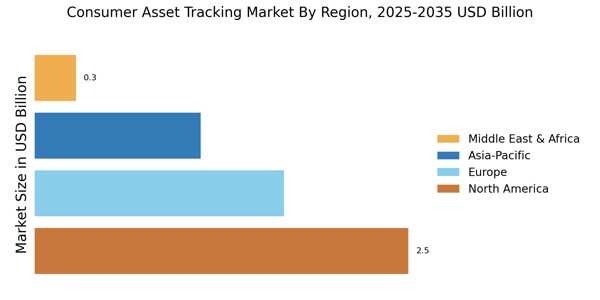
North America is the largest market for consumer asset tracking, holding approximately 45% of the global share. The region's growth is driven by rapid technological advancements, increasing demand for real-time tracking solutions, and stringent regulatory requirements. The U.S. leads this market, followed closely by Canada, which contributes around 15% to the overall market share. The emphasis on supply chain efficiency and inventory management further fuels demand for asset tracking technologies. The competitive landscape in North America is robust, featuring key players such as Zebra Technologies, Honeywell, and Impinj. These companies are at the forefront of innovation, offering advanced RFID and barcode solutions. The presence of established technology firms and a strong focus on research and development create a dynamic environment for growth. As businesses increasingly adopt IoT and automation, the consumer asset tracking market is expected to expand significantly in this region.
Europe is witnessing significant growth in the consumer asset tracking market, accounting for approximately 30% of the global share. The region's growth is propelled by stringent regulations aimed at enhancing supply chain transparency and efficiency. Countries like Germany and the UK are leading this market, with Germany holding about 12% of the market share. The increasing adoption of RFID technology in retail and logistics sectors is a key driver of demand in this region. The competitive landscape in Europe is characterized by a mix of established players and innovative startups. Companies such as Datalogic and Avery Dennison are prominent, focusing on advanced tracking solutions. The European market is also seeing increased collaboration between technology providers and end-users to develop tailored solutions. As regulations evolve, the demand for compliant tracking systems is expected to rise, further enhancing market growth.
Asia-Pacific is rapidly emerging as a significant player in the consumer asset tracking market, holding around 20% of the global share. The region's growth is driven by increasing urbanization, a booming e-commerce sector, and rising demand for efficient inventory management solutions. China and Japan are the leading countries, with China alone contributing approximately 10% to the market. The push for smart logistics and automation is further accelerating the adoption of asset tracking technologies in this region. The competitive landscape in Asia-Pacific is diverse, with both local and international players vying for market share. Companies like SATO Holdings and Cognex Corporation are making strides in providing innovative tracking solutions. The region is also witnessing a surge in investments in technology infrastructure, which is expected to bolster the growth of the consumer asset tracking market. As businesses increasingly recognize the value of real-time tracking, the market is poised for substantial expansion.
The Middle East and Africa region is gradually emerging in the consumer asset tracking market, currently holding about 5% of the global share. The growth is primarily driven by increasing investments in technology and infrastructure, alongside a growing awareness of the benefits of asset tracking solutions. Countries like South Africa and the UAE are leading the market, with South Africa contributing approximately 2% to the overall share. The region's focus on enhancing supply chain efficiency is a key driver for market growth. The competitive landscape in the Middle East and Africa is still developing, with several local and international players entering the market. The presence of companies like RFID Global Solution and Alien Technology is notable, as they offer tailored solutions to meet regional needs. As the region continues to invest in technology and improve logistics capabilities, the consumer asset tracking market is expected to grow, presenting numerous opportunities for stakeholders.
The Consumer Asset Tracking Market is currently characterized by a dynamic competitive landscape, driven by technological advancements and increasing demand for efficient asset management solutions. Key players such as Zebra Technologies (US), Honeywell (US), and Datalogic (IT) are strategically positioning themselves through innovation and partnerships. Zebra Technologies (US) focuses on enhancing its product offerings with advanced RFID solutions, while Honeywell (US) emphasizes the integration of IoT technologies to improve asset visibility. Datalogic (IT) is leveraging its expertise in data capture to expand its market presence, indicating a collective shift towards digital transformation and enhanced operational efficiency among these companies.In terms of business tactics, companies are increasingly localizing manufacturing and optimizing supply chains to respond to regional demands effectively. The market appears moderately fragmented, with several players vying for market share. However, the influence of major companies like Zebra Technologies (US) and Honeywell (US) is substantial, as they set benchmarks for innovation and operational excellence, thereby shaping the competitive structure of the market.
In August Zebra Technologies (US) announced a strategic partnership with a leading logistics firm to enhance its asset tracking capabilities through integrated solutions. This collaboration is expected to streamline supply chain operations and improve real-time asset visibility, which is crucial for businesses aiming to optimize their logistics processes. The partnership underscores Zebra's commitment to innovation and its proactive approach to addressing market needs.
In September Honeywell (US) launched a new suite of IoT-enabled asset tracking solutions designed to provide real-time insights into asset utilization and location. This launch reflects Honeywell's strategy to leverage cutting-edge technology to enhance operational efficiency for its clients. By integrating AI and machine learning into its offerings, Honeywell positions itself as a leader in the digital transformation of asset management, potentially reshaping customer expectations in the market.
In July Datalogic (IT) expanded its product line with the introduction of advanced barcode scanning technology aimed at improving inventory management for retail and logistics sectors. This move not only enhances Datalogic's competitive edge but also aligns with the growing trend of automation in asset tracking. The introduction of such innovative solutions indicates Datalogic's focus on meeting the evolving demands of its customers and maintaining relevance in a rapidly changing market.
As of October the Consumer Asset Tracking Market is witnessing significant trends such as digitalization, sustainability, and the integration of AI technologies. Strategic alliances among key players are increasingly shaping the competitive landscape, fostering innovation and collaboration. Looking ahead, it is likely that competitive differentiation will evolve, with a pronounced shift from price-based competition to a focus on technological innovation, supply chain reliability, and enhanced customer experiences. Companies that prioritize these aspects may gain a substantial advantage in the marketplace.



The Consumer Asset Tracking Market has seen significant recent developments, with companies like Zebra Technologies and Honeywell enhancing their technological offerings through advanced tracking solutions. Impinj and STMicroelectronics are focusing on IoT advancements to improve asset visibility in logistics and supply chain management. Notably, the acquisition of Terso Solutions by a larger entity has been a highlight in the market, aiming to bolster capabilities in RFID technology for tracking assets in real time. Firms such as Geotab and Fibocom Wireless are making strides in integrating GPS technology with asset-tracking solutions, fueling growth in the sector.
Market valuations for companies like Datalogic and Savi Technology have witnessed upward trends, reflecting increased demand for efficient asset management solutions. The overall focus on enhancing operational efficiencies and reducing losses is driving investments from major players, creating a competitive landscape that fosters innovation. As organizations strive to adapt to changing consumer demands, the collaboration between firms like Tracki and NXP Semiconductors for developing next-generation tracking devices signifies a forward momentum in the market.
Le marché du suivi des actifs de consommation devrait croître à un taux de croissance annuel composé (CAGR) de 9,74 % de 2024 à 2035, soutenu par les avancées technologiques, l'augmentation de la demande des consommateurs et l'amélioration des capacités d'analyse des données.
De nouvelles opportunités résident dans :
En 2035, le marché devrait connaître une croissance substantielle, consolidant sa position en tant qu'industrie clé.
| Parameter | Details |
|---|---|
| Market Scope | Consumer Asset Tracking Market covering devices and services by asset type, family and child tracking, vehicle tracking, and geography |
| Study Period | 2021–2035 (Historical: 2021–2024; Base Year: 2025; Forecast: 2026–2035) |
| CAGR | 13.2% (2026–2035) |
| Market Size checkpoints | USD 4.12 Billion (2025); USD 4.66 Billion (2026); USD 14.24 Billion (2035) |
| Fastest Growing Segments | Pet Tracking (16.2% CAGR); Family tracking (16.0% CAGR); Commercial Vehicle Tracking (12.7% CAGR) |
| Companies Profiled | Apple, Samsung, Life360 (Tile, Jiobit), Garmin, Google, Tractive, Chipolo, Pebblebee, Invoxia, Motorola (Lenovo), Trackimo |
| Valuation Currency | USD Billion |
 Aarti Dhapte

Veuillez remplir le formulaire ci-dessous pour recevoir un échantillon gratuit de ce rapport


“This is really good guys. Excellent work on a tight deadline. I will continue to use you going forward and recommend you to others. Nice job”
 Noah Malgeri
Co-Founder

“Thanks for sending the report it gives us a good global view of the Betaïne market.”
 Peter Groot koerkamp
Account and Business Manager

“We found the report very insightful! we found your research firm very helpful. I'm sending this email to secure our future business.”
 Younghwan Choi
Senior Retail Manager

“I am very pleased with how market segments have been defined in a relevant way for my purposes (such as "Portable Freezers & refrigerators" and "last-mile"). In general the report is well structured. Thanks very much for your efforts.”
 Mark Irwin
Management Consultant

“We got the report in time, we really thank you for your support in this process. I also thank to all of your team as they did a great job.”
 Akif Moroglu
Strategy & Business Development Director

“The Automotive 48V ECU Components Procurement Intelligence Study” was a complex project, but the Market Research Future (MRFR) team handled it with quality, agility, and customer-centricity. They delivered all requested data on time and within the agreed scope. The team, including Shubhendra Anand and Rahul Gotadki, was always readily available to clarify questions and swiftly implement necessary adjustments, driving the project to a successful conclusion within a very demanding timeframe.
I would also like to specifically commend Akshay Agarwal for his responsiveness and support at every stage—from our initial inquiry on May 6th through to final delivery on June 18th. His dedication made the entire process seamless.”
 Guilherme Gomes Martins
Product Management Director

“Thanks. It’s been a pleasure working with you, please use me as reference with any other Intel employees.”
 Joseph Aguayo
Sales Operations & Pricing Manager

“Thank you, this will be very helpful for OQS.”
 La Terria Dodd
Program Support Specialist

“I have been reading the first document or the study, ,the Global HVAC and FP market report 2021 till 2026. Must say, good info! I have not gone in depth at all parts, but got a good indication of the data inside!”
 Rob Kooiker
Group Product Manager HVAC & Fire Protection GMA