Request Free Sample ×

Kindly complete the form below to receive a free sample of this Report

* Please use a valid business email

Leading companies partner with us for data-driven Insights

clients tt-cursor
Hero Background
English
Chinese
French
Japanese
Korean
German
Spanish

Point of Care Diagnostics Testing Market Size

ID: MRFR/HC/9161-HCR
120 Pages
Rahul Gotadki
March 2026

Point of Care Diagnostics Testing Market Research Report: Size, Share, Trend Analysis By Product (Glucose Monitoring, Cardiometabolic Monitoring, Infectious Disease Testing, Coagulation Monitoring, Pregnancy & Fertility Testing, Hematology Testing, Cancer/Tumor Marker Testing, Urinalysis Testing, Cholesterol, Drugs-of-Abuse Testing), By End User (Hospitals & Clinics, Diagnostic Centers, Homecare/Self Testing), By Mode of Purchase (OTC, Prescription-based), By Platform (Immunoassays, Molecular Diagnostics, Dipsticks), and Region - Growth Outlook & Industry Forecast 2025 To 2035

Share:
Download PDF ×

We do not share your information with anyone. However, we may send you emails based on your report interest from time to time. You may contact us at any time to opt-out.

Point of Care Diagnostics Testing Market Infographic
Purchase Options

Point Of Care Diagnostics Testing Size

Point of Care Diagnostics Testing Market Growth Projections and Opportunities

The size of the market for point-of-care diagnostics/testing is at a CAGR of 11.5% with USD 19.12 Billion over the forecast period from 2022 to 2030. The market is driven by several factors that together define its outline and growth trajectory. One such major force driving this paradigm shift is an increased focus on personalized and patient-centric healthcare service delivery models. Point-of-care-diagnostic testing, as a rapid and decentralized test, goes along with the changing norm of providing accurate information when needed by patients. Technological advances are important influencers in shaping the POC diagnostic market. Innovations in diagnostic technologies like biosensors, molecular diagnostics, and portable imaging devices contribute to the development of faster and more accurate point-of-care test tools. Diagnostic devices are being made smaller while lab-on-a-chip technologies have been employed, leading to tests being carried out outside typical laboratories. Epidemiological factors also influence the demand for points-of-care diagnostics solutions. Infectious disease prevalence; increasing burden of chronic conditions like diabetes, hypertension, etc.; rapid screening required in emergency/urgent care settings drive adoption of POC testing solutions. Point Of Care Diagnostics Market depends on regulatory frameworks, and approval processes are key influences. Stringent adherence to regulatory standards ensures the safety & efficacy of such devices in POCT applications; Regulatory approvals must be secured for entry into the place requiring complex process navigation for companies before commercialization can take place through their products; Getting permissions from national regulators around the world has never been easy. The adoption rate for point-of-care diagnostics is significantly influenced by economic factors such as cost-effectiveness and affordability. Global collaboration on health infrastructure will support expansion in point-of-care diagnostics markets. It would be easy to integrate PoC diagnostics globally if governments collaborated with international organizations as well as industry players themselves. Market dynamics for the Point Of Care Diagnostics Market include competition and consolidation among companies. The landscape of this field is characterized by major players, the entry of new firms, and strategic alliances, among other factors, for market participants such as manufacturers; product portfolio expansion and company strengthening are done through acquisitions, mergers, and research partnerships.
Point of Care Diagnostics Testing Market Size Graph
Author
Author Profile
Rahul Gotadki
Research Manager

He holds an experience of about 9+ years in Market Research and Business Consulting, working under the spectrum of Life Sciences and Healthcare domains. Rahul conceptualizes and implements a scalable business strategy and provides strategic leadership to the clients. His expertise lies in market estimation, competitive intelligence, pipeline analysis, customer assessment, etc.

Leave a Comment

FAQs

What is the projected market valuation of the Point of Care Diagnostics Testing Market by 2035?

<p>The market is projected to reach approximately 157.87 USD Billion by 2035.</p>

What was the market valuation of the Point of Care Diagnostics Testing Market in 2024?

<p>The market valuation was 57.71 USD Billion in 2024.</p>

What is the expected CAGR for the market during the forecast period 2025 - 2035?

The expected CAGR for the market during this period is 9.58%.

Which segment is projected to have the highest valuation in the market by 2035?

The Homecare/Self Testing segment is projected to reach approximately 63.87 USD Billion by 2035.

What are the key players in the Point of Care Diagnostics Testing Market?

<p>Key players include Abbott Laboratories, Roche Diagnostics, Siemens Healthineers, and Danaher Corporation.</p>

How does the valuation of Infectious Disease Testing compare to other segments in 2035?

Infectious Disease Testing is projected to reach around 30.0 USD Billion, indicating strong growth relative to other segments.

What is the projected valuation for Prescription-based testing products by 2035?

Prescription-based testing products are expected to reach approximately 95.51 USD Billion by 2035.

Which platform segment is anticipated to show significant growth by 2035?

Molecular Diagnostics is anticipated to grow significantly, reaching about 70.0 USD Billion by 2035.

What is the expected valuation for the Coagulation Monitoring segment by 2035?

The Coagulation Monitoring segment is projected to reach approximately 12.0 USD Billion by 2035.

How does the market for OTC Testing Products compare to Prescription-based testing products in 2035?

OTC Testing Products are projected to reach around 62.36 USD Billion, while Prescription-based testing products are expected to reach 95.51 USD Billion by 2035.

Market Summary

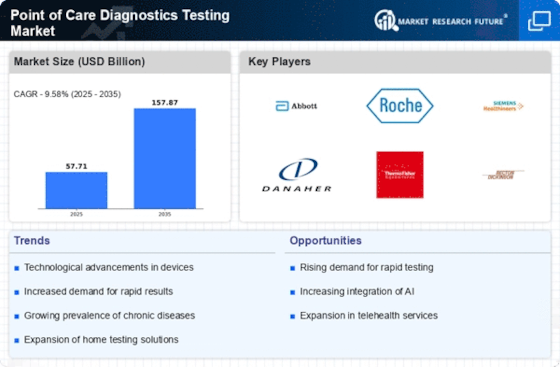
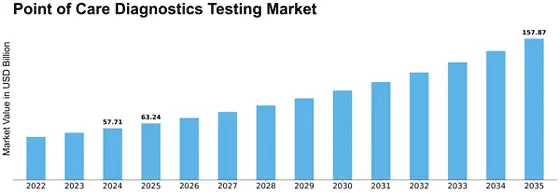
According to Market Research Future analysis, the Point of Care Diagnostics Testing Market Size was valued at USD 57.71 Billion in 2024 & the market is projected to grow from USD 63.24 Billion in 2025 to USD 157.87 Billion by 2035, registering a CAGR of 9.58% during the forecast period (2025–2035). North America led the market with over 44.88% share, generating around USD 25.9 billion in revenue.
 
Rising demand for rapid, accessible diagnostic solutions and increasing prevalence of chronic and infectious diseases are key growth drivers of the point of care diagnostics testing market. Advancements in portable technologies and decentralized healthcare delivery are accelerating global adoption significantly.
 
According to WHO, over 1 billion people require diagnostic testing annually for infectious diseases, while CDC reports that 6 in 10 adults in the U.S. have at least one chronic condition, driving strong demand for rapid point-of-care diagnostic solutions globally.

Key Market Trends & Highlights

The Point of Care Diagnostics Testing Market is experiencing robust growth driven by technological advancements and a shift towards decentralized healthcare.

  • North America accounts for over 44.88% market share in 2024, driven by high chronic disease prevalence. Europe market valued at USD 17.31 billion in 2024, holding 30% share with strong preventive healthcare initiatives. Over 1 billion diagnostic tests conducted annually globally, significantly driving demand for rapid point-of-care diagnostic solutions. Glucose monitoring dominates with 38% share due to rising diabetes prevalence and need for continuous monitoring solutions.

Market Size & Forecast

2024 Market Size 57.71 (USD Billion)
2035 Market Size 157.87 (USD Billion)
CAGR (2025 - 2035) 9.58%
Largest Regional Market Share in 2024 North America

Major Players

Companies such as Abbott Laboratories (US), Roche Diagnostics (CH), <a href="https://www.siemens-healthineers.com/en-in/point-of-care-testing">Siemens Healthineers</a> (DE), Danaher Corporation (US), <a href="https://www.thermofisher.com/search/browse/category/us/en/90223214" target="_blank" rel="noopener">Thermo Fisher Scientific</a> (US), Becton Dickinson and Company (US), Cepheid (US), Quidel Corporation (US), Hologic, Inc. (US) are some of the major participants in the global market.

Market Trends

The Point of Care Diagnostics Testing Market is currently experiencing a transformative phase, characterized by rapid advancements in technology and an increasing demand for immediate diagnostic solutions. This market encompasses a wide array of testing devices and methodologies that facilitate quick results, often at the site of patient care. The growing emphasis on personalized medicine and the need for efficient healthcare delivery systems are driving innovations in this sector.

Furthermore, the integration of digital health technologies, such as telemedicine and mobile health applications, appears to enhance the accessibility and efficiency of point-of-care testing, thereby expanding its reach across various healthcare settings. In addition, the market is likely to benefit from the rising prevalence of chronic diseases and the aging population, which necessitate regular monitoring and timely interventions.

The shift towards decentralized healthcare models, where testing occurs outside traditional laboratory environments, suggests a significant change in how healthcare services are delivered. As stakeholders continue to invest in research and development, the market is poised for sustained growth, with new products and solutions emerging to meet the evolving needs of patients and healthcare providers alike.

Technological Advancements

The Point of Care Diagnostics Testing Market is witnessing a surge in technological innovations, particularly in the development of portable and user-friendly devices. These advancements facilitate rapid testing and improve accuracy, thereby enhancing patient outcomes. The integration of artificial intelligence and machine learning into diagnostic tools is also becoming more prevalent, allowing for more precise interpretations of results.

WHO highlights that rapid diagnostic tests can deliver results within 15–30 minutes, significantly improving clinical decision-making, while global data indicates that adoption of AI-enabled diagnostic tools is increasing across over 50% of advanced healthcare systems, enhancing testing accuracy and efficiency.

Increased Demand for Decentralized Testing

There is a notable shift towards decentralized testing solutions within the Point of Care Diagnostics Testing Market. This trend is driven by the need for immediate results and the convenience of testing in non-traditional settings, such as homes and remote locations. As healthcare systems adapt to this model, the market is likely to expand, catering to a broader range of patient needs.

PAHO reports that decentralized healthcare models expanded significantly, with over 70% of primary healthcare facilities in some regions adopting rapid testing solutions, while WHO emphasizes that point-of-care testing improves access for millions in remote and underserved populations worldwide.

Focus on Personalized Medicine

The emphasis on personalized medicine is reshaping the Point of Care Diagnostics Testing Market. Tailoring diagnostic tests to individual patient profiles enhances treatment efficacy and fosters better health management. This trend indicates a growing recognition of the importance of individualized care, which is expected to influence product development and market strategies.

According to IHME and WHO insights, personalized diagnostics and targeted testing approaches are improving treatment outcomes by up to 25% in certain conditions, while increasing integration of precision diagnostics in clinical workflows is driving demand for tailored point-of-care testing solutions globally.

Point of Care Diagnostics Testing Market Market Drivers

Rising Prevalence of Chronic Diseases

The increasing prevalence of chronic diseases is a significant driver for the Point of Care Diagnostics Testing Market. Conditions such as diabetes, cardiovascular diseases, and respiratory disorders necessitate regular monitoring and timely interventions. As the global population ages, the demand for rapid diagnostic solutions that can be administered at home or in outpatient settings is likely to rise.
 
Market data suggests that the incidence of diabetes alone is expected to reach 700 million cases by 2045, underscoring the urgent need for effective point of care testing solutions. This trend not only emphasizes the importance of early detection but also highlights the potential for point of care diagnostics to improve patient outcomes through timely treatment. Consequently, healthcare providers are increasingly adopting these technologies to enhance patient management and reduce healthcare costs.

Shift Towards Decentralized Healthcare

The Point of Care Diagnostics Testing Market is witnessing a notable shift towards decentralized healthcare models. This transformation is driven by the need for accessible and efficient healthcare services, particularly in remote or underserved areas. Decentralized testing allows for immediate results, reducing the need for patients to travel to centralized laboratories.
 
Recent statistics indicate that the market for decentralized diagnostics is expected to grow at a compound annual growth rate of 10% over the next five years. This growth is fueled by the increasing adoption of telemedicine and home healthcare services, which are becoming integral to modern healthcare delivery. As a result, point of care diagnostics are positioned to play a crucial role in facilitating timely medical interventions and improving overall healthcare accessibility.

Increased Focus on Preventive Healthcare

The Point of Care Diagnostics Testing Market is significantly influenced by the growing emphasis on preventive healthcare. As healthcare systems worldwide shift from reactive to proactive approaches, the demand for early detection and monitoring tools is escalating. Preventive diagnostics enable healthcare providers to identify potential health issues before they escalate, thereby reducing the burden on healthcare systems.
 
Market analysis indicates that the preventive healthcare market is projected to reach USD 200 billion by 2027, with point of care testing being a vital component. This trend is further supported by public health initiatives aimed at promoting regular health screenings and awareness campaigns. Consequently, the integration of point of care diagnostics into routine healthcare practices is likely to enhance patient engagement and foster a culture of preventive care.

Regulatory Support and Reimbursement Policies

The Point of Care Diagnostics Testing Market is benefiting from favorable regulatory support and evolving reimbursement policies. Governments and health authorities are increasingly recognizing the value of point of care testing in improving healthcare outcomes and reducing costs. Recent policy changes have streamlined the approval processes for new diagnostic devices, facilitating quicker market entry. Additionally, reimbursement frameworks are adapting to include point of care tests, making them more financially viable for healthcare providers.
 
This regulatory environment is expected to encourage innovation and investment in point of care diagnostics, as evidenced by the projected growth of the market, which is anticipated to reach USD 60 billion by 2028. Such supportive measures are likely to enhance the adoption of point of care testing across various healthcare settings, ultimately benefiting patients and providers alike.

Technological Innovations in Point of Care Diagnostics

The Point of Care Diagnostics Testing Market is experiencing a surge in technological innovations that enhance testing accuracy and speed. Advancements in microfluidics, biosensors, and portable devices are transforming traditional diagnostic methods. For instance, the integration of artificial intelligence in diagnostic tools is streamlining data analysis, leading to quicker decision-making.
 
According to recent data, the market for point of care testing devices is projected to reach USD 50 billion by 2026, driven by these technological advancements. Furthermore, the development of multiplex testing capabilities allows for simultaneous detection of multiple pathogens, which is particularly beneficial in managing infectious diseases. This trend indicates a shift towards more efficient and user-friendly diagnostic solutions, making them increasingly accessible in various healthcare settings.

Market Segment Insights

By Product: Glucose Monitoring (Largest) vs. Infectious Disease Testing (Fastest-Growing)

In the Point of Care Diagnostics Testing Market, glucose monitoring stands out as the largest segment, capturing a substantial share of the market at 38% due to its widespread use in managing diabetes. Other significant segments include Cardiometabolic Monitoring and Coagulation Monitoring; however, their market shares are comparatively smaller. On the other hand, Infectious Disease Testing is emerging rapidly, driven by recent global health challenges, highlighting the demand for quick and reliable testing methods among healthcare providers and patients alike.

Glucose Monitoring (Dominant) vs. Infectious Disease Testing (Emerging)

Glucose Monitoring is a well-established segment in the market, primarily utilized by individuals with diabetes for managing blood sugar levels. Its dominance is fueled by technological advancements, such as continuous glucose monitoring systems that provide real-time data, enhancing patient compliance and outcomes. Conversely, Infectious Disease Testing is a rapidly emerging segment that has gained momentum, especially due to the urgent need for rapid testing solutions following global health crises. This segment encompasses innovations in testing methodologies and increased accessibility, focusing on delivering swift and accurate results for a wider array of infectious diseases, thus positioning it as a crucial player in the market.

By End User: Hospitals & Clinics (Largest) vs. Homecare/Self Testing (Fastest-Growing)

Hospitals and clinics stand out as the largest segment in the Point of Care Diagnostics Testing Market, with a 54% share, owing to their significant patient footfall and increasing demand for quick diagnostic solutions. Diagnostic centers follow closely, providing specialized services that cater to diverse testing needs. Meanwhile, homecare/self-testing is gaining traction among consumers who prefer convenience and immediate results, particularly in the wake of the growing emphasis on remote healthcare.

End User: Hospitals &amp; Clinics (Dominant) vs. Homecare/Self Testing (Emerging)

Hospitals and clinics dominate the market due to their established infrastructure and ability to manage high patient volumes efficiently. They frequently utilize advanced diagnostic technologies to facilitate timely decision-making and improve patient outcomes. On the other hand, homecare/self-testing is an emerging segment characterized by its accessibility and user-friendly nature, appealing primarily to health-conscious individuals seeking to monitor their conditions privately. This segment is witnessing rapid growth, driven by innovations in testing kits and the rising demand for at-home health solutions, ultimately reshaping traditional healthcare delivery.

By Mode of Purchase: OTC Testing Products (Largest) vs. Prescription-based Testing Products (Fastest-Growing)

The distribution of Point of Care Diagnostics Testing Market share between OTC testing products and prescription-based testing products reveals a clear dominance of OTC products. OTC testing products cater to the growing demand for self-testing and at-home diagnostics, which is increasingly preferred by consumers seeking convenience and accessibility. Prescription-based testing products, while smaller in market share, are rapidly gaining traction due to their specific applications and trusted results, favored by healthcare providers for accuracy and reliability. The growth trends in this segment are indicative of evolving consumer preferences and advancements in technology. The increase in health awareness and the shift towards personalized healthcare solutions drive the demand for OTC testing products, which are positioned for immediate use without needing a healthcare provider. Conversely, prescription-based testing products are experiencing a surge in demand as healthcare systems emphasize more accurate diagnostics and a move towards comprehensive patient management, signaling an emerging trend that is likely to expand in the coming years.

Mode of Purchase: OTC Testing Products (Dominant) vs. Prescription-based Testing Products (Emerging)

OTC testing products have established themselves as the dominant force in the market, thanks to their ease of use and accessibility. These products empower consumers to take charge of their health, offering the advantage of timely testing without the need for medical appointments. Their popularity is reinforced by a wide range of applications, including disease screening and health monitoring. In contrast, prescription-based testing products are emerging rapidly, showcasing a different set of characteristics. They are characterized by their accuracy and are often used in clinical settings where precise diagnostics are crucial. These products are supported by healthcare professionals and are gaining acceptance among patients who trust their reliability. Together, these two segments highlight a comprehensive approach to diagnostics, catering to diverse consumer needs.

By Platform: Immunoassays (Largest) vs. Molecular Diagnostics (Fastest-Growing)

Immunoassays hold the largest portion of the Point of Care Diagnostics Testing Market share at 49%. This is largely due to their established use in various diagnostic applications, making them a preferred choice for healthcare providers. In contrast, <a href="https://www.marketresearchfuture.com/reports/molecular-diagnostics-market-1171">Molecular Diagnostics</a>, while smaller in market share, are rapidly gaining traction owing to advancements in technology and increasing demand for precision testing. Dipsticks, although recognized, remain at the periphery of this growth in terms of overall market share compared to the other two platforms.

Immunoassays (Dominant) vs. Dipsticks (Emerging)

Immunoassays dominate the market due to their reliability, ease of use, and versatility across various medical conditions. They are highly sought after for their capacity to provide rapid and accurate results, which is paramount in urgent care settings. Dipsticks, on the other hand, represent an emerging platform that, while historically used for basic diagnostics like glucose monitoring, are innovating with new applications. They offer low-cost, portable solutions but lack the comprehensive capabilities of Immunoassays, positioning them as a supplementary rather than primary choice in the diagnostics landscape.

Get more detailed insights about Point of Care Diagnostics Testing Market Research Report - Global Forecast till 2035

Regional Insights

North America : Leading Innovation and Adoption

North America leads in the Point of Care Diagnostics Testing Market Size, accounting for over 44.88% of the global revenue in 2024. The region's growth is driven by increasing demand for rapid diagnostic tests, technological advancements, and supportive regulatory frameworks.

CDC reports that 60% of U.S. adults live with at least one chronic disease, while over 37 million Americans have diabetes, significantly increasing demand for point-of-care diagnostic testing and rapid monitoring solutions across healthcare systems.

The COVID-19 pandemic has further accelerated the adoption of point-of-care testing, leading to significant investments in healthcare infrastructure and innovation. The United States is the primary contributor to this market, with key players like Abbott Laboratories, Roche Diagnostics, and Thermo Fisher Scientific leading the charge. The competitive landscape is characterized by continuous innovation and strategic partnerships among these companies. The presence of advanced healthcare facilities and a focus on personalized medicine further bolster the market's growth in this region.

Europe : Regulatory Support and Growth

Europe Point of Care Diagnostics Testing Market size was valued at USD 17.31 Billion in 2024, making it the second-largest regional market with a 30% share. The region benefits from stringent regulatory standards that ensure the quality and reliability of diagnostic tests. Increasing prevalence of chronic diseases and a growing emphasis on preventive healthcare are key drivers of market growth.

WHO Europe reports that chronic diseases account for nearly 86% of all deaths in the region, while increasing adoption of early diagnostic and preventive healthcare measures is significantly boosting demand for point-of-care testing solutions.

The European Union's initiatives to enhance healthcare accessibility also play a significant role in shaping the market landscape. Leading countries in this region include Germany, France, and the UK, where companies like Siemens Healthineers and Roche Diagnostics are prominent. The competitive environment is marked by innovation and collaboration among various stakeholders, including healthcare providers and technology firms. The presence of robust healthcare systems and a focus on research and development further enhance the market's potential.

Asia-Pacific : Rapid Growth and Expansion

Asia-Pacific is witnessing rapid growth in the Point of Care Diagnostics Testing Market, holding approximately 20% of the global market share. The region's growth is fueled by rising healthcare expenditures, increasing awareness of early disease detection, and a growing aging population. Additionally, government initiatives aimed at improving healthcare infrastructure and access to diagnostic services are significant catalysts for market expansion.

Countries like China, India, and Japan are leading the charge, with a mix of local and international players such as Danaher Corporation and Becton Dickinson making significant inroads. The competitive landscape is evolving, with a focus on affordable and accessible testing solutions. The region's diverse healthcare needs and varying regulatory environments present both challenges and opportunities for market participants.

Middle East and Africa : Untapped Potential and Growth

The Middle East and Africa region is gradually emerging in the Point of Care Diagnostics Testing Market, holding about 5% of the global market share. The growth is driven by increasing investments in healthcare infrastructure, rising prevalence of infectious diseases, and a growing focus on improving healthcare access. Government initiatives aimed at enhancing diagnostic capabilities are also contributing to market development in this region.

Leading countries include South Africa, UAE, and Saudi Arabia, where local and international companies are beginning to establish a foothold. The competitive landscape is characterized by a mix of established players and new entrants, focusing on innovative solutions tailored to local needs. The region's unique challenges, such as varying healthcare standards and economic disparities, present both hurdles and opportunities for growth.

Key Players and Competitive Insights

The Point of Care Diagnostics Testing Market is characterized by a dynamic competitive landscape, driven by technological advancements and an increasing demand for rapid diagnostic solutions. Key players such as Abbott Laboratories (US), Roche Diagnostics (CH), and Siemens Healthineers (DE) are strategically positioned to leverage innovation and expand their market presence. Abbott Laboratories (US) focuses on enhancing its product portfolio through continuous innovation, particularly in the development of portable diagnostic devices.
 
Meanwhile, Roche Diagnostics (CH) emphasizes strategic partnerships to bolster its capabilities in molecular diagnostics, thereby enhancing its competitive edge. Siemens Healthineers (DE) is actively pursuing digital transformation initiatives, integrating AI and data analytics into its diagnostic solutions, which positions it favorably in a market that increasingly values technological integration.The competitive structure of the Point of Care Diagnostics Testing Market appears moderately fragmented, with several key players vying for market share.
 
Companies are adopting various business tactics, such as localizing manufacturing to reduce costs and optimize supply chains. This approach not only enhances operational efficiency but also allows for quicker response times to market demands. The collective influence of these major players shapes the market dynamics, as they continuously innovate and adapt to changing consumer needs and regulatory environments.
 
In August Roche Diagnostics (CH) announced a strategic partnership with a leading telehealth provider to integrate its point-of-care testing solutions into remote healthcare services. This collaboration is significant as it expands Roche's reach into the telehealth sector, allowing for seamless integration of diagnostic testing with virtual consultations. Such a move not only enhances patient access to diagnostics but also positions Roche as a leader in the evolving landscape of integrated healthcare solutions.
 
In September Abbott Laboratories (US) launched a new rapid diagnostic test for infectious diseases, which utilizes advanced molecular technology to deliver results in under 30 minutes. This innovation is crucial as it addresses the growing demand for quick and accurate testing solutions, particularly in outpatient settings. Abbott's focus on rapid diagnostics aligns with current healthcare trends that prioritize speed and efficiency, potentially solidifying its market position.
 
In October Siemens Healthineers (DE) unveiled a new AI-driven analytics platform designed to enhance the accuracy and efficiency of point-of-care testing. This platform aims to provide healthcare professionals with real-time insights, thereby improving patient outcomes. The introduction of such technology reflects Siemens' commitment to integrating advanced analytics into its diagnostic offerings, which is likely to resonate well with healthcare providers seeking to enhance their operational capabilities.
 
As of October the competitive trends in the Point of Care Diagnostics Testing Market are increasingly defined by digitalization, sustainability, and the integration of artificial intelligence. Strategic alliances are becoming more prevalent, as companies recognize the value of collaboration in enhancing their technological capabilities and market reach.
 
Looking ahead, competitive differentiation is expected to evolve, shifting from traditional price-based competition to a focus on innovation, technological advancement, and supply chain reliability. This transition underscores the importance of agility and responsiveness in a rapidly changing market environment.

Key Companies in the Point of Care Diagnostics Testing Market include

Industry Developments

  • In June 2021,DCN Dx(US) acquired the pointofcare diagnostics development company PortaScience Inc. (US). This acquisition will expand the point of care product portfolio of the company.
  • In April 2021,the Indian Institute of Technology Kharagpur (India), an Indian engineering institute,launched a nucleic acid-based pointof care diagnostic devicefor COVID-19 diagnosis.
  • In April 2021,LumiraDx (US), a next-generation point of care diagnostics testing company,announced its merger with CA Healthcare Acquisition (CAHC) (US)in a deal worth USD 5 billion.
  • In March 2021, MatMaCorp (US) launched MYRTA, a handheld real-time POCPCR device for molecular diagnostics.
  • In March 2020, Abbott(US) launched the fastest available molecular pointofcare test to detect the coronavirus in less than 5 minutes.

Future Outlook

Point of Care Diagnostics Testing Market Future Outlook

The Point of Care Diagnostics Testing Market size is projected to reach USD 157.87 Billion by 2035, growing at a CAGR of 9.58%, driven by technological advancements, increasing demand for rapid testing, and rising healthcare expenditures.

New opportunities lie in:

  • <p>Development of portable diagnostic devices for remote areas</p>
  • <p> </p>
  • <p>Integration of AI for enhanced diagnostic accuracy</p>
  • <p>Expansion of <a title="telehealth service" href="https://www.marketresearchfuture.com/reports/telehealth-service-market-43509" target="_blank" rel="noopener">telehealth services</a> incorporating POC testing</p>

By 2035, the market is expected to be robust, driven by innovation and increased accessibility.

Market Segmentation

Point of Care Diagnostics Testing Market Product Outlook

  • Glucose Monitoring
  • Cardiometabolic Monitoring
  • Infectious Disease Testing
  • Coagulation Monitoring
  • Pregnancy & Fertility Testing
  • Hematology Testing
  • Cancer/Tumor Marker Testing
  • Urinalysis Testing
  • Cholesterol
  • Drugs-of-Abuse Testing

Point of Care Diagnostics Testing Market End User Outlook

  • Hospitals & Clinics
  • Diagnostic Centers
  • Homecare/Self Testing

Point of Care Diagnostics Testing Market Platform Outlook

  • Immunoassays
  • Molecular Diagnostics
  • Dipsticks

Point of Care Diagnostics Testing Market Mode of Purchase Outlook

  • OTC Testing Products
  • Prescription-based testing products

Report Scope

MARKET SIZE 2024 57.71(USD Billion)
MARKET SIZE 2025 63.24(USD Billion)
MARKET SIZE 2035 157.87(USD Billion)
COMPOUND ANNUAL GROWTH RATE (CAGR) 9.58% (2025 - 2035)
REPORT COVERAGE Revenue Forecast, Competitive Landscape, Growth Factors, and Trends
BASE YEAR 2024
Market Forecast Period 2025 - 2035
Historical Data 2019 - 2024
Market Forecast Units USD Billion
Key Companies Profiled Abbott Laboratories (US), Roche Diagnostics (CH), Siemens Healthineers (DE), Danaher Corporation (US), Thermo Fisher Scientific (US), Becton Dickinson and Company (US), Cepheid (US), Quidel Corporation (US), Hologic, Inc. (US)
Segments Covered Product, End User, Mode of Purchase, Platform
Key Market Opportunities Integration of artificial intelligence enhances accuracy and efficiency in the market.
Key Market Dynamics Technological advancements and regulatory changes drive innovation and competition in the market.
Countries Covered North America, Europe, APAC, South America, MEA

FAQs

What is the projected market valuation of the Point of Care Diagnostics Testing Market by 2035?

<p>The market is projected to reach approximately 157.87 USD Billion by 2035.</p>

What was the market valuation of the Point of Care Diagnostics Testing Market in 2024?

<p>The market valuation was 57.71 USD Billion in 2024.</p>

What is the expected CAGR for the market during the forecast period 2025 - 2035?

The expected CAGR for the market during this period is 9.58%.

Which segment is projected to have the highest valuation in the market by 2035?

The Homecare/Self Testing segment is projected to reach approximately 63.87 USD Billion by 2035.

What are the key players in the Point of Care Diagnostics Testing Market?

<p>Key players include Abbott Laboratories, Roche Diagnostics, Siemens Healthineers, and Danaher Corporation.</p>

How does the valuation of Infectious Disease Testing compare to other segments in 2035?

Infectious Disease Testing is projected to reach around 30.0 USD Billion, indicating strong growth relative to other segments.

What is the projected valuation for Prescription-based testing products by 2035?

Prescription-based testing products are expected to reach approximately 95.51 USD Billion by 2035.

Which platform segment is anticipated to show significant growth by 2035?

Molecular Diagnostics is anticipated to grow significantly, reaching about 70.0 USD Billion by 2035.

What is the expected valuation for the Coagulation Monitoring segment by 2035?

The Coagulation Monitoring segment is projected to reach approximately 12.0 USD Billion by 2035.

How does the market for OTC Testing Products compare to Prescription-based testing products in 2035?

OTC Testing Products are projected to reach around 62.36 USD Billion, while Prescription-based testing products are expected to reach 95.51 USD Billion by 2035.

  1. SECTION I: EXECUTIVE SUMMARY AND KEY HIGHLIGHTS |
    1. EXECUTIVE SUMMARY | |
      1. Market Overview | |
      2. Key Findings | |
      3. Market Segmentation | |
      4. Competitive Landscape | |
      5. Challenges and Opportunities | |
      6. Future Outlook 2
  2. SECTION II: SCOPING, METHODOLOGY AND MARKET STRUCTURE |
    1. MARKET INTRODUCTION | |
      1. Definition | |
      2. Scope of the study | | |
    2. RESEARCH METHODOLOGY | |
      1. Overview | |
      2. Data Mining | |
      3. Secondary Research | |
      4. Primary Research | | |
      5. Forecasting Model | |
      6. Market Size Estimation | | |
      7. Data Triangulation | |
      8. Validation 3
  3. SECTION III: QUALITATIVE ANALYSIS |
    1. MARKET DYNAMICS | |
      1. Overview | |
      2. Drivers | |
      3. Restraints | |
      4. Opportunities |
    2. MARKET FACTOR ANALYSIS | |
      1. Value chain Analysis | |
      2. Porter's Five Forces Analysis | | |
      3. COVID-19 Impact Analysis | | |
  4. SECTION IV: QUANTITATIVE ANALYSIS |
    1. Healthcare, BY Product (USD Billion) | |
      1. Glucose Monitoring | |
      2. Cardiometabolic Monitoring | |
      3. Infectious Disease Testing | |
      4. Coagulation Monitoring | |
      5. Pregnancy & Fertility Testing | |
      6. Hematology Testing | |
      7. Cancer/Tumor Marker Testing | |
      8. Urinalysis Testing | |
      9. Cholesterol | |
      10. Drugs-of-Abuse Testing |
    2. Healthcare, BY End User (USD Billion) | |
      1. Hospitals & Clinics | |
      2. Diagnostic Centers | |
      3. Homecare/Self Testing |
    3. Healthcare, BY Mode of Purchase (USD Billion) | |
      1. OTC Testing Products | |
      2. Prescription-based testing products |
    4. Healthcare, BY Platform (USD Billion) | |
      1. Immunoassays | |
      2. Molecular Diagnostics | |
      3. Dipsticks |
    5. Healthcare, BY Region (USD Billion) | |
      1. North America | | |
      2. Europe | | |
      3. APAC | | |
      4. South America | | |
      5. MEA | | |
  5. SECTION V: COMPETITIVE ANALYSIS |
    1. Competitive Landscape | |
      1. Overview | |
      2. Competitive Analysis | |
      3. Market share Analysis | |
      4. Major Growth Strategy in the Healthcare | |
      5. Competitive Benchmarking | |
      6. Leading Players in Terms of Number of Developments in the Healthcare | |
      7. Key developments and growth strategies | | |
      8. Major Players Financial Matrix | | |
    2. Company Profiles | |
      1. Abbott Laboratories (US) | | |
      2. Roche Diagnostics (CH) | | |
      3. Siemens Healthineers (DE) | | |
      4. Danaher Corporation (US) | | |
      5. Thermo Fisher Scientific (US) | | |
      6. Becton Dickinson and Company (US) | | |
      7. Cepheid (US) | | |
      8. Quidel Corporation (US) | | |
      9. Hologic, Inc. (US) | | |
    3. Appendix | |
      1. References | |
      2. Related Reports 6 LIST OF FIGURES |
    4. MARKET SYNOPSIS |
    5. NORTH AMERICA MARKET ANALYSIS |
    6. US MARKET ANALYSIS BY PRODUCT |
    7. US MARKET ANALYSIS BY END USER |
    8. US MARKET ANALYSIS BY MODE OF PURCHASE |
    9. US MARKET ANALYSIS BY PLATFORM |
    10. CANADA MARKET ANALYSIS BY PRODUCT |
    11. CANADA MARKET ANALYSIS BY END USER |
    12. CANADA MARKET ANALYSIS BY MODE OF PURCHASE |
    13. CANADA MARKET ANALYSIS BY PLATFORM |
    14. EUROPE MARKET ANALYSIS |
    15. GERMANY MARKET ANALYSIS BY PRODUCT |
    16. GERMANY MARKET ANALYSIS BY END USER |
    17. GERMANY MARKET ANALYSIS BY MODE OF PURCHASE |
    18. GERMANY MARKET ANALYSIS BY PLATFORM |
    19. UK MARKET ANALYSIS BY PRODUCT |
    20. UK MARKET ANALYSIS BY END USER |
    21. UK MARKET ANALYSIS BY MODE OF PURCHASE |
    22. UK MARKET ANALYSIS BY PLATFORM |
    23. FRANCE MARKET ANALYSIS BY PRODUCT |
    24. FRANCE MARKET ANALYSIS BY END USER |
    25. FRANCE MARKET ANALYSIS BY MODE OF PURCHASE |
    26. FRANCE MARKET ANALYSIS BY PLATFORM |
    27. RUSSIA MARKET ANALYSIS BY PRODUCT |
    28. RUSSIA MARKET ANALYSIS BY END USER |
    29. RUSSIA MARKET ANALYSIS BY MODE OF PURCHASE |
    30. RUSSIA MARKET ANALYSIS BY PLATFORM |
    31. ITALY MARKET ANALYSIS BY PRODUCT |
    32. ITALY MARKET ANALYSIS BY END USER |
    33. ITALY MARKET ANALYSIS BY MODE OF PURCHASE |
    34. ITALY MARKET ANALYSIS BY PLATFORM |
    35. SPAIN MARKET ANALYSIS BY PRODUCT |
    36. SPAIN MARKET ANALYSIS BY END USER |
    37. SPAIN MARKET ANALYSIS BY MODE OF PURCHASE |
    38. SPAIN MARKET ANALYSIS BY PLATFORM |
    39. REST OF EUROPE MARKET ANALYSIS BY PRODUCT |
    40. REST OF EUROPE MARKET ANALYSIS BY END USER |
    41. REST OF EUROPE MARKET ANALYSIS BY MODE OF PURCHASE |
    42. REST OF EUROPE MARKET ANALYSIS BY PLATFORM |
    43. APAC MARKET ANALYSIS |
    44. CHINA MARKET ANALYSIS BY PRODUCT |
    45. CHINA MARKET ANALYSIS BY END USER |
    46. CHINA MARKET ANALYSIS BY MODE OF PURCHASE |
    47. CHINA MARKET ANALYSIS BY PLATFORM |
    48. INDIA MARKET ANALYSIS BY PRODUCT |
    49. INDIA MARKET ANALYSIS BY END USER |
    50. INDIA MARKET ANALYSIS BY MODE OF PURCHASE |
    51. INDIA MARKET ANALYSIS BY PLATFORM |
    52. JAPAN MARKET ANALYSIS BY PRODUCT |
    53. JAPAN MARKET ANALYSIS BY END USER |
    54. JAPAN MARKET ANALYSIS BY MODE OF PURCHASE |
    55. JAPAN MARKET ANALYSIS BY PLATFORM |
    56. SOUTH KOREA MARKET ANALYSIS BY PRODUCT |
    57. SOUTH KOREA MARKET ANALYSIS BY END USER |
    58. SOUTH KOREA MARKET ANALYSIS BY MODE OF PURCHASE |
    59. SOUTH KOREA MARKET ANALYSIS BY PLATFORM |
    60. MALAYSIA MARKET ANALYSIS BY PRODUCT |
    61. MALAYSIA MARKET ANALYSIS BY END USER |
    62. MALAYSIA MARKET ANALYSIS BY MODE OF PURCHASE |
    63. MALAYSIA MARKET ANALYSIS BY PLATFORM |
    64. THAILAND MARKET ANALYSIS BY PRODUCT |
    65. THAILAND MARKET ANALYSIS BY END USER |
    66. THAILAND MARKET ANALYSIS BY MODE OF PURCHASE |
    67. THAILAND MARKET ANALYSIS BY PLATFORM |
    68. INDONESIA MARKET ANALYSIS BY PRODUCT |
    69. INDONESIA MARKET ANALYSIS BY END USER |
    70. INDONESIA MARKET ANALYSIS BY MODE OF PURCHASE |
    71. INDONESIA MARKET ANALYSIS BY PLATFORM |
    72. REST OF APAC MARKET ANALYSIS BY PRODUCT |
    73. REST OF APAC MARKET ANALYSIS BY END USER |
    74. REST OF APAC MARKET ANALYSIS BY MODE OF PURCHASE |
    75. REST OF APAC MARKET ANALYSIS BY PLATFORM |
    76. SOUTH AMERICA MARKET ANALYSIS |
    77. BRAZIL MARKET ANALYSIS BY PRODUCT |
    78. BRAZIL MARKET ANALYSIS BY END USER |
    79. BRAZIL MARKET ANALYSIS BY MODE OF PURCHASE |
    80. BRAZIL MARKET ANALYSIS BY PLATFORM |
    81. MEXICO MARKET ANALYSIS BY PRODUCT |
    82. MEXICO MARKET ANALYSIS BY END USER |
    83. MEXICO MARKET ANALYSIS BY MODE OF PURCHASE |
    84. MEXICO MARKET ANALYSIS BY PLATFORM |
    85. ARGENTINA MARKET ANALYSIS BY PRODUCT |
    86. ARGENTINA MARKET ANALYSIS BY END USER |
    87. ARGENTINA MARKET ANALYSIS BY MODE OF PURCHASE |
    88. ARGENTINA MARKET ANALYSIS BY PLATFORM |
    89. REST OF SOUTH AMERICA MARKET ANALYSIS BY PRODUCT |
    90. REST OF SOUTH AMERICA MARKET ANALYSIS BY END USER |
    91. REST OF SOUTH AMERICA MARKET ANALYSIS BY MODE OF PURCHASE |
    92. REST OF SOUTH AMERICA MARKET ANALYSIS BY PLATFORM |
    93. MEA MARKET ANALYSIS |
    94. GCC COUNTRIES MARKET ANALYSIS BY PRODUCT |
    95. GCC COUNTRIES MARKET ANALYSIS BY END USER |
    96. GCC COUNTRIES MARKET ANALYSIS BY MODE OF PURCHASE |
    97. GCC COUNTRIES MARKET ANALYSIS BY PLATFORM |
    98. SOUTH AFRICA MARKET ANALYSIS BY PRODUCT |
    99. SOUTH AFRICA MARKET ANALYSIS BY END USER |
    100. SOUTH AFRICA MARKET ANALYSIS BY MODE OF PURCHASE |
    101. SOUTH AFRICA MARKET ANALYSIS BY PLATFORM |
    102. REST OF MEA MARKET ANALYSIS BY PRODUCT |
    103. REST OF MEA MARKET ANALYSIS BY END USER |
    104. REST OF MEA MARKET ANALYSIS BY MODE OF PURCHASE |
    105. REST OF MEA MARKET ANALYSIS BY PLATFORM |
    106. KEY BUYING CRITERIA OF HEALTHCARE |
    107. RESEARCH PROCESS OF MRFR |
    108. DRO ANALYSIS OF HEALTHCARE |
    109. DRIVERS IMPACT ANALYSIS: HEALTHCARE |
    110. RESTRAINTS IMPACT ANALYSIS: HEALTHCARE |
    111. SUPPLY / VALUE CHAIN: HEALTHCARE |
    112. HEALTHCARE, BY PRODUCT, 2024 (% SHARE) |
    113. HEALTHCARE, BY PRODUCT, 2024 TO 2035 (USD Billion) |
    114. HEALTHCARE, BY END USER, 2024 (% SHARE) |
    115. HEALTHCARE, BY END USER, 2024 TO 2035 (USD Billion) |
    116. HEALTHCARE, BY MODE OF PURCHASE, 2024 (% SHARE) |
    117. HEALTHCARE, BY MODE OF PURCHASE, 2024 TO 2035 (USD Billion) |
    118. HEALTHCARE, BY PLATFORM, 2024 (% SHARE) |
    119. HEALTHCARE, BY PLATFORM, 2024 TO 2035 (USD Billion) |
    120. BENCHMARKING OF MAJOR COMPETITORS 7 LIST OF TABLES |
    121. LIST OF ASSUMPTIONS | |
      1. |
    122. North America MARKET SIZE ESTIMATES; FORECAST | |
      1. BY PRODUCT, 2025-2035 (USD Billion) | |
      2. BY END USER, 2025-2035 (USD Billion) | |
      3. BY MODE OF PURCHASE, 2025-2035 (USD Billion) | |
      4. BY PLATFORM, 2025-2035 (USD Billion) |
    123. US MARKET SIZE ESTIMATES; FORECAST | |
      1. BY PRODUCT, 2025-2035 (USD Billion) | |
      2. BY END USER, 2025-2035 (USD Billion) | |
      3. BY MODE OF PURCHASE, 2025-2035 (USD Billion) | |
      4. BY PLATFORM, 2025-2035 (USD Billion) |
    124. Canada MARKET SIZE ESTIMATES; FORECAST | |
      1. BY PRODUCT, 2025-2035 (USD Billion) | |
      2. BY END USER, 2025-2035 (USD Billion) | |
      3. BY MODE OF PURCHASE, 2025-2035 (USD Billion) | |
      4. BY PLATFORM, 2025-2035 (USD Billion) |
    125. Europe MARKET SIZE ESTIMATES; FORECAST | |
      1. BY PRODUCT, 2025-2035 (USD Billion) | |
      2. BY END USER, 2025-2035 (USD Billion) | |
      3. BY MODE OF PURCHASE, 2025-2035 (USD Billion) | |
      4. BY PLATFORM, 2025-2035 (USD Billion) |
    126. Germany MARKET SIZE ESTIMATES; FORECAST | |
      1. BY PRODUCT, 2025-2035 (USD Billion) | |
      2. BY END USER, 2025-2035 (USD Billion) | |
      3. BY MODE OF PURCHASE, 2025-2035 (USD Billion) | |
      4. BY PLATFORM, 2025-2035 (USD Billion) |
    127. UK MARKET SIZE ESTIMATES; FORECAST | |
      1. BY PRODUCT, 2025-2035 (USD Billion) | |
      2. BY END USER, 2025-2035 (USD Billion) | |
      3. BY MODE OF PURCHASE, 2025-2035 (USD Billion) | |
      4. BY PLATFORM, 2025-2035 (USD Billion) |
    128. France MARKET SIZE ESTIMATES; FORECAST | |
      1. BY PRODUCT, 2025-2035 (USD Billion) | |
      2. BY END USER, 2025-2035 (USD Billion) | |
      3. BY MODE OF PURCHASE, 2025-2035 (USD Billion) | |
      4. BY PLATFORM, 2025-2035 (USD Billion) |
    129. Russia MARKET SIZE ESTIMATES; FORECAST | |
      1. BY PRODUCT, 2025-2035 (USD Billion) | |
      2. BY END USER, 2025-2035 (USD Billion) | |
      3. BY MODE OF PURCHASE, 2025-2035 (USD Billion) | |
      4. BY PLATFORM, 2025-2035 (USD Billion) |
    130. Italy MARKET SIZE ESTIMATES; FORECAST | |
      1. BY PRODUCT, 2025-2035 (USD Billion) | |
      2. BY END USER, 2025-2035 (USD Billion) | |
      3. BY MODE OF PURCHASE, 2025-2035 (USD Billion) | |
      4. BY PLATFORM, 2025-2035 (USD Billion) |
    131. Spain MARKET SIZE ESTIMATES; FORECAST | |
      1. BY PRODUCT, 2025-2035 (USD Billion) | |
      2. BY END USER, 2025-2035 (USD Billion) | |
      3. BY MODE OF PURCHASE, 2025-2035 (USD Billion) | |
      4. BY PLATFORM, 2025-2035 (USD Billion) |
    132. Rest of Europe MARKET SIZE ESTIMATES; FORECAST | |
      1. BY PRODUCT, 2025-2035 (USD Billion) | |
      2. BY END USER, 2025-2035 (USD Billion) | |
      3. BY MODE OF PURCHASE, 2025-2035 (USD Billion) | |
      4. BY PLATFORM, 2025-2035 (USD Billion) |
    133. APAC MARKET SIZE ESTIMATES; FORECAST | |
      1. BY PRODUCT, 2025-2035 (USD Billion) | |
      2. BY END USER, 2025-2035 (USD Billion) | |
      3. BY MODE OF PURCHASE, 2025-2035 (USD Billion) | |
      4. BY PLATFORM, 2025-2035 (USD Billion) |
    134. China MARKET SIZE ESTIMATES; FORECAST | |
      1. BY PRODUCT, 2025-2035 (USD Billion) | |
      2. BY END USER, 2025-2035 (USD Billion) | |
      3. BY MODE OF PURCHASE, 2025-2035 (USD Billion) | |
      4. BY PLATFORM, 2025-2035 (USD Billion) |
    135. India MARKET SIZE ESTIMATES; FORECAST | |
      1. BY PRODUCT, 2025-2035 (USD Billion) | |
      2. BY END USER, 2025-2035 (USD Billion) | |
      3. BY MODE OF PURCHASE, 2025-2035 (USD Billion) | |
      4. BY PLATFORM, 2025-2035 (USD Billion) |
    136. Japan MARKET SIZE ESTIMATES; FORECAST | |
      1. BY PRODUCT, 2025-2035 (USD Billion) | |
      2. BY END USER, 2025-2035 (USD Billion) | |
      3. BY MODE OF PURCHASE, 2025-2035 (USD Billion) | |
      4. BY PLATFORM, 2025-2035 (USD Billion) |
    137. South Korea MARKET SIZE ESTIMATES; FORECAST | |
      1. BY PRODUCT, 2025-2035 (USD Billion) | |
      2. BY END USER, 2025-2035 (USD Billion) | |
      3. BY MODE OF PURCHASE, 2025-2035 (USD Billion) | |
      4. BY PLATFORM, 2025-2035 (USD Billion) |
    138. Malaysia MARKET SIZE ESTIMATES; FORECAST | |
      1. BY PRODUCT, 2025-2035 (USD Billion) | |
      2. BY END USER, 2025-2035 (USD Billion) | |
      3. BY MODE OF PURCHASE, 2025-2035 (USD Billion) | |
      4. BY PLATFORM, 2025-2035 (USD Billion) |
    139. Thailand MARKET SIZE ESTIMATES; FORECAST | |
      1. BY PRODUCT, 2025-2035 (USD Billion) | |
      2. BY END USER, 2025-2035 (USD Billion) | |
      3. BY MODE OF PURCHASE, 2025-2035 (USD Billion) | |
      4. BY PLATFORM, 2025-2035 (USD Billion) |
    140. Indonesia MARKET SIZE ESTIMATES; FORECAST | |
      1. BY PRODUCT, 2025-2035 (USD Billion) | |
      2. BY END USER, 2025-2035 (USD Billion) | |
      3. BY MODE OF PURCHASE, 2025-2035 (USD Billion) | |
      4. BY PLATFORM, 2025-2035 (USD Billion) |
    141. Rest of APAC MARKET SIZE ESTIMATES; FORECAST | |
      1. BY PRODUCT, 2025-2035 (USD Billion) | |
      2. BY END USER, 2025-2035 (USD Billion) | |
      3. BY MODE OF PURCHASE, 2025-2035 (USD Billion) | |
      4. BY PLATFORM, 2025-2035 (USD Billion) |
    142. South America MARKET SIZE ESTIMATES; FORECAST | |
      1. BY PRODUCT, 2025-2035 (USD Billion) | |
      2. BY END USER, 2025-2035 (USD Billion) | |
      3. BY MODE OF PURCHASE, 2025-2035 (USD Billion) | |
      4. BY PLATFORM, 2025-2035 (USD Billion) |
    143. Brazil MARKET SIZE ESTIMATES; FORECAST | |
      1. BY PRODUCT, 2025-2035 (USD Billion) | |
      2. BY END USER, 2025-2035 (USD Billion) | |
      3. BY MODE OF PURCHASE, 2025-2035 (USD Billion) | |
      4. BY PLATFORM, 2025-2035 (USD Billion) |
    144. Mexico MARKET SIZE ESTIMATES; FORECAST | |
      1. BY PRODUCT, 2025-2035 (USD Billion) | |
      2. BY END USER, 2025-2035 (USD Billion) | |
      3. BY MODE OF PURCHASE, 2025-2035 (USD Billion) | |
      4. BY PLATFORM, 2025-2035 (USD Billion) |
    145. Argentina MARKET SIZE ESTIMATES; FORECAST | |
      1. BY PRODUCT, 2025-2035 (USD Billion) | |
      2. BY END USER, 2025-2035 (USD Billion) | |
      3. BY MODE OF PURCHASE, 2025-2035 (USD Billion) | |
      4. BY PLATFORM, 2025-2035 (USD Billion) |
    146. Rest of South America MARKET SIZE ESTIMATES; FORECAST | |
      1. BY PRODUCT, 2025-2035 (USD Billion) | |
      2. BY END USER, 2025-2035 (USD Billion) | |
      3. BY MODE OF PURCHASE, 2025-2035 (USD Billion) | |
      4. BY PLATFORM, 2025-2035 (USD Billion) |
    147. MEA MARKET SIZE ESTIMATES; FORECAST | |
      1. BY PRODUCT, 2025-2035 (USD Billion) | |
      2. BY END USER, 2025-2035 (USD Billion) | |
      3. BY MODE OF PURCHASE, 2025-2035 (USD Billion) | |
      4. BY PLATFORM, 2025-2035 (USD Billion) |
    148. GCC Countries MARKET SIZE ESTIMATES; FORECAST | |
      1. BY PRODUCT, 2025-2035 (USD Billion) | |
      2. BY END USER, 2025-2035 (USD Billion) | |
      3. BY MODE OF PURCHASE, 2025-2035 (USD Billion) | |
      4. BY PLATFORM, 2025-2035 (USD Billion) |
    149. South Africa MARKET SIZE ESTIMATES; FORECAST | |
      1. BY PRODUCT, 2025-2035 (USD Billion) | |
      2. BY END USER, 2025-2035 (USD Billion) | |
      3. BY MODE OF PURCHASE, 2025-2035 (USD Billion) | |
      4. BY PLATFORM, 2025-2035 (USD Billion) |
    150. Rest of MEA MARKET SIZE ESTIMATES; FORECAST | |
      1. BY PRODUCT, 2025-2035 (USD Billion) | |
      2. BY END USER, 2025-2035 (USD Billion) | |
      3. BY MODE OF PURCHASE, 2025-2035 (USD Billion) | |
      4. BY PLATFORM, 2025-2035 (USD Billion) |
    151. PRODUCT LAUNCH/PRODUCT DEVELOPMENT/APPROVAL | |
      1. |
    152. ACQUISITION/PARTNERSHIP | |

Healthcare Market Segmentation

Healthcare By Product (USD Billion, 2025-2035)

  • Glucose Monitoring
  • Cardiometabolic Monitoring
  • Infectious Disease Testing
  • Coagulation Monitoring
  • Pregnancy & Fertility Testing
  • Hematology Testing
  • Cancer/Tumor Marker Testing
  • Urinalysis Testing
  • Cholesterol
  • Drugs-of-Abuse Testing

Healthcare By End User (USD Billion, 2025-2035)

  • Hospitals & Clinics
  • Diagnostic Centers
  • Homecare/Self Testing

Healthcare By Mode of Purchase (USD Billion, 2025-2035)

  • OTC Testing Products
  • Prescription-based testing products

Healthcare By Platform (USD Billion, 2025-2035)

  • Immunoassays
  • Molecular Diagnostics
  • Dipsticks
Infographic

Free Sample Request

Kindly complete the form below to receive a free sample of this Report

Get Free Sample

Customer Strories

Compare Licence

×
Features License Type
Single User Multiuser License Enterprise User
Price $4,950 $5,950 $7,250
Maximum User Access Limit 1 User Upto 10 Users Unrestricted Access Throughout the Organization
Free Customization
Direct Access to Analyst
Deliverable Format
Platform Access
Discount on Next Purchase 10% 15% 15%
Printable Versions