×
Hero Background
English
Chinese
French
Japanese
Korean
German
Spanish

Pathological Microscopes Market Trends

ID: MRFR/HC/5850-CR
105 Pages
Kinjoll Dey
August 2019

Pathological Microscopes Market Research Report Information by Type (Electron Microscope, Optical Microscope, Compound Microscope, Digital Microscope, Fluorescence Microscope and others), Application (Bodily Fluids, Tissue Scanning and others) and End User (Pathology and Diagnostic Laboratories, Hospitals & Clinics, Forensic Laboratories and others) and Region (Americas, Europe, Asia-Pacific and Middle East & Africa) - Forecast till 2035

Share:
Download PDF ×

We do not share your information with anyone. However, we may send you emails based on your report interest from time to time. You may contact us at any time to opt-out.

Pathological Microscopes Market Infographic
Purchase Options

Market Trends

Key Emerging Trends in the Pathological Microscopes Market

Pathological microscopes have become indispensable tools in the diagnostic landscape, particularly within diagnostic centers where their precision and capabilities are harnessed for the identification and analysis of chronic and infectious diseases. The surge in demand for diagnostic services, propelled by the escalating prevalence of chronic conditions such as cancer, diabetes, and tuberculosis, is reshaping the healthcare landscape. This surge not only underscores the pressing need for accurate and timely diagnoses but also fuels the expansion of diagnostic centers, thereby intensifying the demand for a range of medical instruments, including pathological microscopes. Chronic diseases, comprising a spectrum from cancer to diabetes, have witnessed a concerning rise globally. This upswing has created a parallel surge in the demand for diagnostic services that can effectively identify and monitor these conditions. The pivotal role of pathological microscopes in this context lies in their ability to provide detailed insights into cellular structures, aiding in the accurate diagnosis of chronic diseases. As diagnostic services become increasingly critical, the proliferation of diagnostic centers becomes evident, each equipped with the essential arsenal of medical instruments, including the highly sought-after pathological microscopes. The growth of diagnostic centers is not only a response to the rising prevalence of chronic diseases but also a proactive step to address the broader healthcare needs of populations. With an increasing emphasis on early detection and preventive healthcare, diagnostic centers play a pivotal role in delivering timely and accurate diagnoses, enabling medical professionals to initiate appropriate treatment plans promptly. This paradigm shift towards proactive healthcare is, in turn, driving the demand for advanced medical instruments that can enhance diagnostic accuracy, and pathological microscopes stand at the forefront of this technological evolution. The prevalence of infectious diseases further amplifies the demand for diagnostic services and, consequently, pathological microscopes. According to data from the Centers for Disease Control and Prevention (CDC), in 2016 alone, over 16.8 million individuals sought medical attention for infectious diseases. The ability of pathological microscopes to delve into the microscopic realm facilitates the identification and characterization of pathogens responsible for infectious diseases. In the context of infectious diseases, timely and accurate diagnoses are not only crucial for individual patient outcomes but also for public health surveillance and management. The market for pathological microscopes is intricately linked to the broader landscape of healthcare services. The rise in chronic and infectious diseases is steering the trajectory of this market, with manufacturers responding to the escalating demand by innovating and enhancing the capabilities of these critical instruments. The integration of advanced imaging technologies in pathological microscopes not only expedites the diagnostic process but also contributes to the overall efficiency of healthcare systems. Moreover, the increasing prevalence of chronic and infectious diseases underscores the need for a comprehensive and interconnected healthcare infrastructure. Pathological microscopes, as integral components of diagnostic services, contribute to the development of a robust healthcare ecosystem capable of addressing the evolving health challenges faced by populations. The surge in chronic and infectious diseases globally has become a catalyst for the growth of pathological microscopes in diagnostic centers. As the demand for diagnostic services continues to escalate, the number of diagnostic centers proliferates, amplifying the need for advanced medical instruments. Pathological microscopes, with their unparalleled capabilities in cellular analysis, stand as crucial contributors to accurate diagnoses, enabling healthcare providers to initiate timely interventions. The intersection of technological innovation and healthcare needs positions pathological microscopes at the forefront of the evolving diagnostic landscape.


Author
Kinjoll Dey
Research Analyst Level I

He is an extremely curious individual currently working in Healthcare and Medical Devices Domain. Kinjoll is comfortably versed in data centric research backed by healthcare educational background. He leverages extensive data mining and analytics tools such as Primary and Secondary Research, Statistical Analysis, Machine Learning, Data Modelling. His key role also involves Technical Sales Support, Client Interaction and Project management within the Healthcare team. Lastly, he showcases extensive affinity towards learning new skills and remain fascinated in implementing them.

Leave a Comment

FAQs

What is the projected market valuation for the Pathological Microscopes Market in 2035?

The projected market valuation for the Pathological Microscopes Market in 2035 is expected to reach 0.234 USD Billion.

What was the overall market valuation for the Pathological Microscopes Market in 2024?

The overall market valuation for the Pathological Microscopes Market in 2024 was 0.1365 USD Billion.

What is the expected CAGR for the Pathological Microscopes Market during the forecast period 2025 - 2035?

The expected CAGR for the Pathological Microscopes Market during the forecast period 2025 - 2035 is 5.02%.

Which companies are considered key players in the Pathological Microscopes Market?

Key players in the Pathological Microscopes Market include Leica Biosystems, Thermo Fisher Scientific, Carl Zeiss AG, and Olympus Corporation.

What are the main applications of Pathological Microscopes and their market valuations?

Main applications include Tissue Scanning valued at 0.06825 to 0.1164 USD Billion and Bodily Fluids valued at 0.04515 to 0.0756 USD Billion.

Market Summary

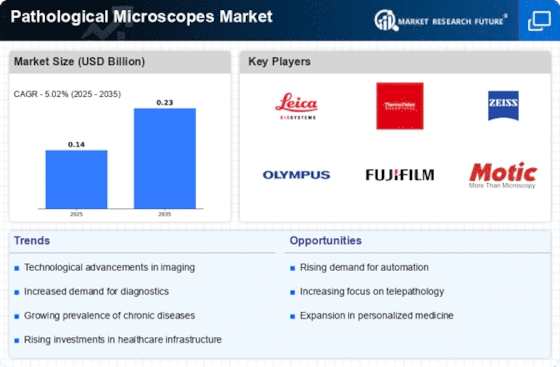
As per MRFR analysis, the Pathological Microscopes Market Size was estimated at 0.1365 USD Billion in 2024. The Pathological Microscopes industry is projected to grow from 0.1434 USD Billion in 2025 to 0.234 USD Billion by 2035, exhibiting a compound annual growth rate (CAGR) of 5.02 during the forecast period 2025 - 2035.

Key Market Trends & Highlights

The Pathological Microscopes Market is experiencing robust growth driven by technological advancements and increasing healthcare demands.

  • Technological advancements in imaging are reshaping the capabilities of pathological microscopes, enhancing diagnostic accuracy.
  • The integration of artificial intelligence is streamlining workflows and improving the efficiency of pathology labs.
  • North America remains the largest market, while the Asia-Pacific region is emerging as the fastest-growing area for pathological microscopes.
  • Rising incidence of chronic diseases and increased investment in healthcare infrastructure are key drivers propelling market expansion.

Market Size & Forecast

2024 Market Size 0.1365 (USD Billion)
2035 Market Size 0.234 (USD Billion)
CAGR (2025 - 2035) 5.02%
Largest Regional Market Share in 2024 North America

Major Players

<p>Leica Biosystems (DE), Thermo Fisher Scientific (US), Carl Zeiss AG (DE), Olympus Corporation (JP), Fujifilm Holdings Corporation (JP), Motic Instruments (CN), Bruker Corporation (US), Hirox Co., Ltd. (JP), Nikon Corporation (JP)</p>

Market Trends

The Pathological Microscopes Market is currently experiencing a dynamic evolution, driven by advancements in technology and increasing demand for precise diagnostic tools. The integration of digital imaging and artificial intelligence into microscopy is reshaping the landscape, enhancing the capabilities of pathologists in analyzing tissue samples. This shift towards digital solutions appears to facilitate improved accuracy and efficiency in diagnostics, potentially leading to better patient outcomes. Furthermore, the growing emphasis on personalized medicine and the need for rapid diagnosis in clinical settings are likely to propel the adoption of sophisticated microscopy systems. In addition, the rising prevalence of chronic diseases and the expanding geriatric population are contributing to the heightened demand for pathological microscopes. As healthcare providers seek to enhance their diagnostic capabilities, the market is poised for continued growth. The increasing focus on research and development in the field of pathology suggests that innovations will persist, further driving the evolution of the Pathological Microscopes Market. Overall, the interplay of technological advancements and changing healthcare needs indicates a promising future for this sector, with potential for significant developments in the coming years.

Technological Advancements in Imaging

The Pathological Microscopes Market is witnessing a surge in technological innovations, particularly in imaging techniques. Enhanced digital imaging capabilities are enabling pathologists to obtain high-resolution images, which facilitate more accurate diagnoses. This trend is likely to continue as manufacturers invest in research and development to create more sophisticated imaging solutions.

Integration of Artificial Intelligence

The incorporation of artificial intelligence into microscopy is transforming the Pathological Microscopes Market. AI algorithms are being utilized to assist in image analysis, thereby improving diagnostic accuracy and efficiency. This trend suggests a future where AI-driven tools become integral to pathology workflows, potentially revolutionizing the field.

Growing Demand for Personalized Medicine

The increasing focus on personalized medicine is influencing the Pathological Microscopes Market. As healthcare shifts towards tailored treatment approaches, the need for precise and rapid diagnostic tools becomes paramount. This trend indicates that pathological microscopes will play a crucial role in supporting personalized healthcare initiatives.

Pathological Microscopes Market Market Drivers

Rising Incidence of Chronic Diseases

The increasing prevalence of chronic diseases such as cancer, diabetes, and cardiovascular disorders is a primary driver for the Pathological Microscopes Market. As these conditions require extensive pathological analysis for diagnosis and treatment, the demand for advanced microscopes is likely to surge. According to recent data, the incidence of cancer is projected to rise, necessitating enhanced diagnostic tools. This trend indicates a growing need for sophisticated pathological microscopes that can provide accurate and detailed imaging, thereby facilitating timely and effective medical interventions. The Pathological Microscopes Market is thus positioned to expand significantly as healthcare providers seek to improve diagnostic accuracy and patient outcomes.

Technological Innovations in Microscopy

Technological advancements in microscopy, including the development of digital pathology and high-resolution imaging systems, are propelling the Pathological Microscopes Market forward. Innovations such as fluorescence microscopy and confocal microscopy enhance the ability to visualize cellular structures in unprecedented detail. The integration of these technologies into routine pathology practices is expected to increase efficiency and accuracy in diagnostics. Market data suggests that the adoption of digital pathology solutions is on the rise, with many laboratories transitioning to digital formats for better data management and analysis. This shift indicates a robust growth trajectory for the Pathological Microscopes Market as it adapts to these technological changes.

Growing Focus on Research and Development

The increasing emphasis on research and development in the biomedical field is driving the Pathological Microscopes Market. Academic institutions and research organizations are investing heavily in advanced microscopy techniques to facilitate groundbreaking studies in pathology and related fields. This focus on R&D is crucial for the development of new diagnostic methods and therapeutic strategies. Market data indicates that funding for biomedical research is on the rise, which in turn fuels the demand for high-quality pathological microscopes. As researchers seek to explore complex biological processes, the Pathological Microscopes Market is poised for growth, driven by the need for innovative imaging solutions.

Rising Awareness of Early Disease Detection

The growing awareness regarding the importance of early disease detection is significantly influencing the Pathological Microscopes Market. As healthcare providers and patients alike recognize the benefits of early diagnosis, the demand for effective diagnostic tools, including pathological microscopes, is likely to increase. Educational campaigns and initiatives aimed at promoting health screenings are contributing to this trend. Market data suggests that early detection can lead to better treatment outcomes, thereby driving the need for advanced microscopy solutions in clinical settings. Consequently, the Pathological Microscopes Market is expected to expand as healthcare systems prioritize early intervention strategies.

Increased Investment in Healthcare Infrastructure

The ongoing investment in healthcare infrastructure, particularly in emerging economies, is a significant driver for the Pathological Microscopes Market. Governments and private entities are allocating substantial resources to enhance healthcare facilities, which includes upgrading laboratory equipment. This trend is evident in various regions where healthcare reforms are being implemented to improve access to quality medical services. As a result, the demand for advanced pathological microscopes is expected to rise, as laboratories seek to equip themselves with state-of-the-art technology. The Pathological Microscopes Market stands to benefit from this influx of investment, which is likely to enhance diagnostic capabilities across diverse healthcare settings.

Market Segment Insights

By Application: Digital Microscope (Largest) vs. Fluorescence Microscope (Fastest-Growing)

<p>The Pathological Microscopes Market is predominantly led by the Digital Microscope, capturing a substantial market share due to its advanced imaging capabilities and ease of use in laboratory settings. This segment's appeal lies in its ability to enhance precision in diagnostics and facilitate remote analysis, making it a favored choice among laboratories and educational institutions. Following closely behind, the Fluorescence Microscope is gaining traction as a fast-growing segment, appealing to researchers for its unique applications in studying biological specimens by enabling the visualization of specific cellular components. Market growth in this segment is driven by technological advancements and a rise in research activities focused on cellular biology and pathology. As an increasing number of healthcare institutions adopt sophisticated imaging technologies to bolster diagnostic accuracy, the Electron and Optical Microscopes are also maintaining steady growth. The ongoing emphasis on personalized medicine and regenerative therapies is likely to further fuel interest in advanced systems, particularly for applications in drug development and clinical diagnostics.</p>

<p>Digital Microscope (Dominant) vs. Fluorescence Microscope (Emerging)</p>

<p>The Digital Microscope is firmly established as the dominant player within the Pathological Microscopes Market, credited with revolutionizing traditional microscopy through digitalization that enhances accessibility and collaboration in research and diagnostics. Its ability to integrate with various software platforms has made it indispensable for pathologists and researchers alike. Conversely, the Fluorescence Microscope is emerging as a key player, particularly in cellular and molecular biology, enabling researchers to study the localization of proteins and other biomolecules within cells. This segment is gaining popularity due to its specificity and effectiveness in targeted imaging, making it a valuable tool in cancer research and other biomedical applications. Both segments showcase distinct features while complementing each other’s growth trajectories in pathology.</p>

By Type: Tissue Scanning (Largest) vs. Bodily Fluids (Fastest-Growing)

<p>In the Pathological Microscopes Market, the 'Type' segment is primarily dominated by Tissue Scanning, which holds the largest share due to its critical role in diagnostic and research applications. Tissue Scanning systems are extensively utilized in understanding diseases through microscopic examination, leading to its substantial market presence. Bodily Fluids account for a growing share, driven by advancements in diagnostic technologies and an increasing focus on liquid biopsies, which allow for less invasive testing methodologies.</p>

<p>Tissue Scanning (Dominant) vs. Bodily Fluids (Emerging)</p>

<p>Tissue Scanning is recognized as the dominant segment within the Pathological Microscopes Market, characterized by its widespread adoption in laboratories and healthcare facilities for histopathological examinations. This segment thrives on the demand for precise diagnosis and effective treatment plans, particularly in cancer research and pathology. On the other hand, the Bodily Fluids segment is emerging rapidly, propelled by innovations in microscopic techniques and an emphasis on minimally invasive procedures. This segment is gaining traction due to the increasing prevalence of chronic diseases and the need for effective monitoring through fluid analysis, positioning it as a promising area for growth.</p>

By End-User: Clinics and Hospitals (Largest) vs. Diagnostic and Pathology Laboratories (Fastest-Growing)

<p>The End-User segment of the Pathological Microscopes Market is mainly distributed among Clinics and Hospitals, Forensic Laboratories, Diagnostic and Pathology Laboratories, and Others. Among these, Clinics and Hospitals capture the largest share due to their continuous demand for pathology services, driven by the need for accurate disease diagnosis and treatment plans. In contrast, Diagnostic and Pathology Laboratories represent a rapidly growing segment, benefiting from technological advancements in microscopy and increasing healthcare expenditure.</p>

<p>Clinics and Hospitals (Dominant) vs. Diagnostic and Pathology Laboratories (Emerging)</p>

<p>Clinics and Hospitals are critical players in the Pathological Microscopes Market, representing a dominant segment characterized by high volume usage of pathology services. They frequently employ advanced microscopic technologies for a range of applications including disease diagnostics, screening, and treatment monitoring. Conversely, Diagnostic and Pathology Laboratories are emerging as vital contributors to market growth, propelled by their focus on specialized testing services and innovations in laboratory practices. This segment is leveraging advanced imaging tools and automation, resulting in enhanced diagnostics efficiency and accuracy, meeting the soaring demand for pathology services.</p>

Get more detailed insights about Pathological Microscopes Market Research Report - Forecast till 2035

Regional Insights

Key Companies in the Pathological Microscopes Market market include

Industry Developments

    • Hitachi High Technologies Corporation announced the opening of a “Hitachi High-Tech Science Park” in Shanghai. This inauguration highly helped the company to sell and development of analytical instruments in the Chinese market.
    • Nikon Corporation in the year 2018 launched its product called A1R HD25 confocal microscope. It has a high throughput and a high resolution. This microscope is renowned as the largest view confocal microscope of 25mm field in the world.
    • Olympus Corporation in the year 2018 partnered with a company called MedTech for reducing the overall costs and improving the quality of clinical outcomes.

Future Outlook

Pathological Microscopes Market Future Outlook

<p>The Pathological Microscopes Market is projected to grow at a 5.02% CAGR from 2024 to 2035, driven by technological advancements, increasing healthcare expenditure, and rising demand for diagnostic accuracy.</p>

New opportunities lie in:

  • <p>Development of AI-integrated microscopy solutions for enhanced diagnostic capabilities.</p>
  • <p>Expansion into emerging markets with tailored product offerings.</p>
  • <p>Partnerships with healthcare providers for integrated pathology services.</p>

<p>By 2035, the market is expected to achieve robust growth, positioning itself as a leader in diagnostic technology.</p>

Market Segmentation

Pathological Microscopes Market Type Outlook

  • Tissue Scanning
  • Bodily Fluids
  • Others

Pathological Microscopes Market End-User Outlook

  • Forensic laboratories
  • Clinics and Hospitals
  • Diagnostic and Pathology Laboratories
  • Others

Pathological Microscopes Market Application Outlook

  • Digital Microscope
  • Electron Microscope
  • Fluorescence Microscope
  • Optical Microscope
  • Others

Report Scope

MARKET SIZE 20240.1365(USD Billion)
MARKET SIZE 20250.1434(USD Billion)
MARKET SIZE 20350.234(USD Billion)
COMPOUND ANNUAL GROWTH RATE (CAGR)5.02% (2024 - 2035)
REPORT COVERAGERevenue Forecast, Competitive Landscape, Growth Factors, and Trends
BASE YEAR2024
Market Forecast Period2025 - 2035
Historical Data2019 - 2024
Market Forecast UnitsUSD Billion
Key Companies ProfiledMarket analysis in progress
Segments CoveredMarket segmentation analysis in progress
Key Market OpportunitiesIntegration of artificial intelligence in the Pathological Microscopes Market enhances diagnostic accuracy and efficiency.
Key Market DynamicsTechnological advancements and regulatory changes drive innovation and competition in the pathological microscopes market.
Countries CoveredNorth America, Europe, APAC, South America, MEA

FAQs

What is the projected market valuation for the Pathological Microscopes Market in 2035?

The projected market valuation for the Pathological Microscopes Market in 2035 is expected to reach 0.234 USD Billion.

What was the overall market valuation for the Pathological Microscopes Market in 2024?

The overall market valuation for the Pathological Microscopes Market in 2024 was 0.1365 USD Billion.

What is the expected CAGR for the Pathological Microscopes Market during the forecast period 2025 - 2035?

The expected CAGR for the Pathological Microscopes Market during the forecast period 2025 - 2035 is 5.02%.

Which companies are considered key players in the Pathological Microscopes Market?

Key players in the Pathological Microscopes Market include Leica Biosystems, Thermo Fisher Scientific, Carl Zeiss AG, and Olympus Corporation.

What are the main applications of Pathological Microscopes and their market valuations?

Main applications include Tissue Scanning valued at 0.06825 to 0.1164 USD Billion and Bodily Fluids valued at 0.04515 to 0.0756 USD Billion.

  1. SECTION I: EXECUTIVE SUMMARY AND KEY HIGHLIGHTS
    1. EXECUTIVE SUMMARY
      1. Market Overview
      2. Key Findings
      3. Market Segmentation
      4. Competitive Landscape
      5. Challenges and Opportunities
      6. Future Outlook
  2. SECTION II: SCOPING, METHODOLOGY AND MARKET STRUCTURE
    1. MARKET INTRODUCTION
      1. Definition
      2. Scope of the study
    2. RESEARCH METHODOLOGY
      1. Overview
      2. Data Mining
      3. Secondary Research
      4. Primary Research
      5. Forecasting Model
      6. Market Size Estimation
      7. Data Triangulation
      8. Validation
  3. SECTION III: QUALITATIVE ANALYSIS
    1. MARKET DYNAMICS
      1. Overview
      2. Drivers
      3. Restraints
      4. Opportunities
    2. MARKET FACTOR ANALYSIS
      1. Value chain Analysis
      2. Porter's Five Forces Analysis
      3. COVID-19 Impact Analysis
  4. SECTION IV: QUANTITATIVE ANALYSIS
    1. Healthcare, BY Application (USD Billion)
      1. Digital Microscope
      2. Electron Microscope
      3. Fluorescence Microscope
      4. Optical Microscope
      5. Others
    2. Healthcare, BY Type (USD Billion)
      1. Tissue Scanning
      2. Bodily Fluids
      3. Others
    3. Healthcare, BY End-User (USD Billion)
      1. Forensic laboratories
      2. Clinics and Hospitals
      3. Diagnostic and Pathology Laboratories
      4. Others
    4. Healthcare, BY Region (USD Billion)
      1. North America
      2. Europe
      3. APAC
      4. South America
      5. MEA
  5. SECTION V: COMPETITIVE ANALYSIS
    1. Competitive Landscape
      1. Overview
      2. Competitive Analysis
      3. Market share Analysis
      4. Major Growth Strategy in the Healthcare
      5. Competitive Benchmarking
      6. Leading Players in Terms of Number of Developments in the Healthcare
      7. Key developments and growth strategies
      8. Major Players Financial Matrix
    2. Company Profiles
      1. Leica Biosystems (DE)
      2. Thermo Fisher Scientific (US)
      3. Carl Zeiss AG (DE)
      4. Olympus Corporation (JP)
      5. Fujifilm Holdings Corporation (JP)
      6. Motic Instruments (CN)
      7. Bruker Corporation (US)
      8. Hirox Co., Ltd. (JP)
      9. Nikon Corporation (JP)
    3. Appendix
      1. References
      2. Related Reports
  6. LIST OF FIGURES
    1. MARKET SYNOPSIS
    2. NORTH AMERICA MARKET ANALYSIS
    3. US MARKET ANALYSIS BY APPLICATION
    4. US MARKET ANALYSIS BY TYPE
    5. US MARKET ANALYSIS BY END-USER
    6. CANADA MARKET ANALYSIS BY APPLICATION
    7. CANADA MARKET ANALYSIS BY TYPE
    8. CANADA MARKET ANALYSIS BY END-USER
    9. EUROPE MARKET ANALYSIS
    10. GERMANY MARKET ANALYSIS BY APPLICATION
    11. GERMANY MARKET ANALYSIS BY TYPE
    12. GERMANY MARKET ANALYSIS BY END-USER
    13. UK MARKET ANALYSIS BY APPLICATION
    14. UK MARKET ANALYSIS BY TYPE
    15. UK MARKET ANALYSIS BY END-USER
    16. FRANCE MARKET ANALYSIS BY APPLICATION
    17. FRANCE MARKET ANALYSIS BY TYPE
    18. FRANCE MARKET ANALYSIS BY END-USER
    19. RUSSIA MARKET ANALYSIS BY APPLICATION
    20. RUSSIA MARKET ANALYSIS BY TYPE
    21. RUSSIA MARKET ANALYSIS BY END-USER
    22. ITALY MARKET ANALYSIS BY APPLICATION
    23. ITALY MARKET ANALYSIS BY TYPE
    24. ITALY MARKET ANALYSIS BY END-USER
    25. SPAIN MARKET ANALYSIS BY APPLICATION
    26. SPAIN MARKET ANALYSIS BY TYPE
    27. SPAIN MARKET ANALYSIS BY END-USER
    28. REST OF EUROPE MARKET ANALYSIS BY APPLICATION
    29. REST OF EUROPE MARKET ANALYSIS BY TYPE
    30. REST OF EUROPE MARKET ANALYSIS BY END-USER
    31. APAC MARKET ANALYSIS
    32. CHINA MARKET ANALYSIS BY APPLICATION
    33. CHINA MARKET ANALYSIS BY TYPE
    34. CHINA MARKET ANALYSIS BY END-USER
    35. INDIA MARKET ANALYSIS BY APPLICATION
    36. INDIA MARKET ANALYSIS BY TYPE
    37. INDIA MARKET ANALYSIS BY END-USER
    38. JAPAN MARKET ANALYSIS BY APPLICATION
    39. JAPAN MARKET ANALYSIS BY TYPE
    40. JAPAN MARKET ANALYSIS BY END-USER
    41. SOUTH KOREA MARKET ANALYSIS BY APPLICATION
    42. SOUTH KOREA MARKET ANALYSIS BY TYPE
    43. SOUTH KOREA MARKET ANALYSIS BY END-USER
    44. MALAYSIA MARKET ANALYSIS BY APPLICATION
    45. MALAYSIA MARKET ANALYSIS BY TYPE
    46. MALAYSIA MARKET ANALYSIS BY END-USER
    47. THAILAND MARKET ANALYSIS BY APPLICATION
    48. THAILAND MARKET ANALYSIS BY TYPE
    49. THAILAND MARKET ANALYSIS BY END-USER
    50. INDONESIA MARKET ANALYSIS BY APPLICATION
    51. INDONESIA MARKET ANALYSIS BY TYPE
    52. INDONESIA MARKET ANALYSIS BY END-USER
    53. REST OF APAC MARKET ANALYSIS BY APPLICATION
    54. REST OF APAC MARKET ANALYSIS BY TYPE
    55. REST OF APAC MARKET ANALYSIS BY END-USER
    56. SOUTH AMERICA MARKET ANALYSIS
    57. BRAZIL MARKET ANALYSIS BY APPLICATION
    58. BRAZIL MARKET ANALYSIS BY TYPE
    59. BRAZIL MARKET ANALYSIS BY END-USER
    60. MEXICO MARKET ANALYSIS BY APPLICATION
    61. MEXICO MARKET ANALYSIS BY TYPE
    62. MEXICO MARKET ANALYSIS BY END-USER
    63. ARGENTINA MARKET ANALYSIS BY APPLICATION
    64. ARGENTINA MARKET ANALYSIS BY TYPE
    65. ARGENTINA MARKET ANALYSIS BY END-USER
    66. REST OF SOUTH AMERICA MARKET ANALYSIS BY APPLICATION
    67. REST OF SOUTH AMERICA MARKET ANALYSIS BY TYPE
    68. REST OF SOUTH AMERICA MARKET ANALYSIS BY END-USER
    69. MEA MARKET ANALYSIS
    70. GCC COUNTRIES MARKET ANALYSIS BY APPLICATION
    71. GCC COUNTRIES MARKET ANALYSIS BY TYPE
    72. GCC COUNTRIES MARKET ANALYSIS BY END-USER
    73. SOUTH AFRICA MARKET ANALYSIS BY APPLICATION
    74. SOUTH AFRICA MARKET ANALYSIS BY TYPE
    75. SOUTH AFRICA MARKET ANALYSIS BY END-USER
    76. REST OF MEA MARKET ANALYSIS BY APPLICATION
    77. REST OF MEA MARKET ANALYSIS BY TYPE
    78. REST OF MEA MARKET ANALYSIS BY END-USER
    79. KEY BUYING CRITERIA OF HEALTHCARE
    80. RESEARCH PROCESS OF MRFR
    81. DRO ANALYSIS OF HEALTHCARE
    82. DRIVERS IMPACT ANALYSIS: HEALTHCARE
    83. RESTRAINTS IMPACT ANALYSIS: HEALTHCARE
    84. SUPPLY / VALUE CHAIN: HEALTHCARE
    85. HEALTHCARE, BY APPLICATION, 2024 (% SHARE)
    86. HEALTHCARE, BY APPLICATION, 2024 TO 2035 (USD Billion)
    87. HEALTHCARE, BY TYPE, 2024 (% SHARE)
    88. HEALTHCARE, BY TYPE, 2024 TO 2035 (USD Billion)
    89. HEALTHCARE, BY END-USER, 2024 (% SHARE)
    90. HEALTHCARE, BY END-USER, 2024 TO 2035 (USD Billion)
    91. BENCHMARKING OF MAJOR COMPETITORS
  7. LIST OF TABLES
    1. LIST OF ASSUMPTIONS
    2. North America MARKET SIZE ESTIMATES; FORECAST
      1. BY APPLICATION, 2025-2035 (USD Billion)
      2. BY TYPE, 2025-2035 (USD Billion)
      3. BY END-USER, 2025-2035 (USD Billion)
    3. US MARKET SIZE ESTIMATES; FORECAST
      1. BY APPLICATION, 2025-2035 (USD Billion)
      2. BY TYPE, 2025-2035 (USD Billion)
      3. BY END-USER, 2025-2035 (USD Billion)
    4. Canada MARKET SIZE ESTIMATES; FORECAST
      1. BY APPLICATION, 2025-2035 (USD Billion)
      2. BY TYPE, 2025-2035 (USD Billion)
      3. BY END-USER, 2025-2035 (USD Billion)
    5. Europe MARKET SIZE ESTIMATES; FORECAST
      1. BY APPLICATION, 2025-2035 (USD Billion)
      2. BY TYPE, 2025-2035 (USD Billion)
      3. BY END-USER, 2025-2035 (USD Billion)
    6. Germany MARKET SIZE ESTIMATES; FORECAST
      1. BY APPLICATION, 2025-2035 (USD Billion)
      2. BY TYPE, 2025-2035 (USD Billion)
      3. BY END-USER, 2025-2035 (USD Billion)
    7. UK MARKET SIZE ESTIMATES; FORECAST
      1. BY APPLICATION, 2025-2035 (USD Billion)
      2. BY TYPE, 2025-2035 (USD Billion)
      3. BY END-USER, 2025-2035 (USD Billion)
    8. France MARKET SIZE ESTIMATES; FORECAST
      1. BY APPLICATION, 2025-2035 (USD Billion)
      2. BY TYPE, 2025-2035 (USD Billion)
      3. BY END-USER, 2025-2035 (USD Billion)
    9. Russia MARKET SIZE ESTIMATES; FORECAST
      1. BY APPLICATION, 2025-2035 (USD Billion)
      2. BY TYPE, 2025-2035 (USD Billion)
      3. BY END-USER, 2025-2035 (USD Billion)
    10. Italy MARKET SIZE ESTIMATES; FORECAST
      1. BY APPLICATION, 2025-2035 (USD Billion)
      2. BY TYPE, 2025-2035 (USD Billion)
      3. BY END-USER, 2025-2035 (USD Billion)
    11. Spain MARKET SIZE ESTIMATES; FORECAST
      1. BY APPLICATION, 2025-2035 (USD Billion)
      2. BY TYPE, 2025-2035 (USD Billion)
      3. BY END-USER, 2025-2035 (USD Billion)
    12. Rest of Europe MARKET SIZE ESTIMATES; FORECAST
      1. BY APPLICATION, 2025-2035 (USD Billion)
      2. BY TYPE, 2025-2035 (USD Billion)
      3. BY END-USER, 2025-2035 (USD Billion)
    13. APAC MARKET SIZE ESTIMATES; FORECAST
      1. BY APPLICATION, 2025-2035 (USD Billion)
      2. BY TYPE, 2025-2035 (USD Billion)
      3. BY END-USER, 2025-2035 (USD Billion)
    14. China MARKET SIZE ESTIMATES; FORECAST
      1. BY APPLICATION, 2025-2035 (USD Billion)
      2. BY TYPE, 2025-2035 (USD Billion)
      3. BY END-USER, 2025-2035 (USD Billion)
    15. India MARKET SIZE ESTIMATES; FORECAST
      1. BY APPLICATION, 2025-2035 (USD Billion)
      2. BY TYPE, 2025-2035 (USD Billion)
      3. BY END-USER, 2025-2035 (USD Billion)
    16. Japan MARKET SIZE ESTIMATES; FORECAST
      1. BY APPLICATION, 2025-2035 (USD Billion)
      2. BY TYPE, 2025-2035 (USD Billion)
      3. BY END-USER, 2025-2035 (USD Billion)
    17. South Korea MARKET SIZE ESTIMATES; FORECAST
      1. BY APPLICATION, 2025-2035 (USD Billion)
      2. BY TYPE, 2025-2035 (USD Billion)
      3. BY END-USER, 2025-2035 (USD Billion)
    18. Malaysia MARKET SIZE ESTIMATES; FORECAST
      1. BY APPLICATION, 2025-2035 (USD Billion)
      2. BY TYPE, 2025-2035 (USD Billion)
      3. BY END-USER, 2025-2035 (USD Billion)
    19. Thailand MARKET SIZE ESTIMATES; FORECAST
      1. BY APPLICATION, 2025-2035 (USD Billion)
      2. BY TYPE, 2025-2035 (USD Billion)
      3. BY END-USER, 2025-2035 (USD Billion)
    20. Indonesia MARKET SIZE ESTIMATES; FORECAST
      1. BY APPLICATION, 2025-2035 (USD Billion)
      2. BY TYPE, 2025-2035 (USD Billion)
      3. BY END-USER, 2025-2035 (USD Billion)
    21. Rest of APAC MARKET SIZE ESTIMATES; FORECAST
      1. BY APPLICATION, 2025-2035 (USD Billion)
      2. BY TYPE, 2025-2035 (USD Billion)
      3. BY END-USER, 2025-2035 (USD Billion)
    22. South America MARKET SIZE ESTIMATES; FORECAST
      1. BY APPLICATION, 2025-2035 (USD Billion)
      2. BY TYPE, 2025-2035 (USD Billion)
      3. BY END-USER, 2025-2035 (USD Billion)
    23. Brazil MARKET SIZE ESTIMATES; FORECAST
      1. BY APPLICATION, 2025-2035 (USD Billion)
      2. BY TYPE, 2025-2035 (USD Billion)
      3. BY END-USER, 2025-2035 (USD Billion)
    24. Mexico MARKET SIZE ESTIMATES; FORECAST
      1. BY APPLICATION, 2025-2035 (USD Billion)
      2. BY TYPE, 2025-2035 (USD Billion)
      3. BY END-USER, 2025-2035 (USD Billion)
    25. Argentina MARKET SIZE ESTIMATES; FORECAST
      1. BY APPLICATION, 2025-2035 (USD Billion)
      2. BY TYPE, 2025-2035 (USD Billion)
      3. BY END-USER, 2025-2035 (USD Billion)
    26. Rest of South America MARKET SIZE ESTIMATES; FORECAST
      1. BY APPLICATION, 2025-2035 (USD Billion)
      2. BY TYPE, 2025-2035 (USD Billion)
      3. BY END-USER, 2025-2035 (USD Billion)
    27. MEA MARKET SIZE ESTIMATES; FORECAST
      1. BY APPLICATION, 2025-2035 (USD Billion)
      2. BY TYPE, 2025-2035 (USD Billion)
      3. BY END-USER, 2025-2035 (USD Billion)
    28. GCC Countries MARKET SIZE ESTIMATES; FORECAST
      1. BY APPLICATION, 2025-2035 (USD Billion)
      2. BY TYPE, 2025-2035 (USD Billion)
      3. BY END-USER, 2025-2035 (USD Billion)
    29. South Africa MARKET SIZE ESTIMATES; FORECAST
      1. BY APPLICATION, 2025-2035 (USD Billion)
      2. BY TYPE, 2025-2035 (USD Billion)
      3. BY END-USER, 2025-2035 (USD Billion)
    30. Rest of MEA MARKET SIZE ESTIMATES; FORECAST
      1. BY APPLICATION, 2025-2035 (USD Billion)
      2. BY TYPE, 2025-2035 (USD Billion)
      3. BY END-USER, 2025-2035 (USD Billion)
    31. PRODUCT LAUNCH/PRODUCT DEVELOPMENT/APPROVAL
    32. ACQUISITION/PARTNERSHIP

Pathological Microscopes Market Segmentation

Market Segmentation Overview

  • Detailed segmentation data will be available in the full report
  • Comprehensive analysis by multiple parameters
  • Regional and country-level breakdowns
  • Market size forecasts by segment
Infographic

Free Sample Request

Kindly complete the form below to receive a free sample of this Report

Get Free Sample

Customer Strories

Compare Licence

×
Features License Type
Single User Multiuser License Enterprise User
Price $4,950 $5,950 $7,250
Maximum User Access Limit 1 User Upto 10 Users Unrestricted Access Throughout the Organization
Free Customization
Direct Access to Analyst
Deliverable Format
Platform Access
Discount on Next Purchase 10% 15% 15%
Printable Versions