
×
  • Cat-intel
  • MedIntelliX
  • Resources
  • About Us
  • Hero Background
    English
    Chinese
    French
    Japanese
    Korean
    German
    Spanish

    Nanofiltration Membrane Market Trends

    ID: MRFR/CnM/11094-HCR
    128 Pages
    Anshula Mandaokar
    October 2025

    Nanofiltration Membrane Market Research Report Information By Type (Polymeric, Ceramic, Hybrid, and Others), By Module (Spiral Wound, Tubular, Hollow Fiber, Flat Sheet, and Others), By Application (Municipal and Industrial), And By Region (North America, Europe, Asia-Pacific, And Rest Of The World) –Market Forecast Till 2035

    Share:
    Download PDF ×

    We do not share your information with anyone. However, we may send you emails based on your report interest from time to time. You may contact us at any time to opt-out.

    Nanofiltration Membrane Market Infographic
    Purchase Options

    Market Trends

    Key Emerging Trends in the Nanofiltration Membrane Market

    The production of nanofiltration membrane market is currently seeing some of the key trends, which reflect the state of this technology importance in different industries. Nanofiltration membranes distinguished by their capability of size-selective filtration of the particles are being used in many fields such as water treatment, food and beverage, pharmaceutical sector, etc. The trending factor of water purification system supplies increasingly due to growing requirements of pure water and clean water planetwide. Vital to water treatment processes, nanofiltration membranes become effective in the process of removing contaminants and impurities to meet the high water quality standards.

    The fact that nanofiltration membranes are used in the food and beverage sector for separation and concentration purposes is one of the world trends of today. These membranes facilitate the selective extraction of specific molecules, for instance, color and flavor constituents, thereby improving the quality of the product. Also, it is being seen that nowadays the pharmaceutical sector uses the nanofiltration technology for purifying the drugs and pharmaceutical products. The capability of nanofiltration membranes, which is to separate molecules with accuracy and precision, also makes them so invaluable in pharmaceutical drug making process and helps produce high-purity and safe medications.

    Market tendencies additionally show that a rising number of consumers are putting more emphasis on ecologic sustainability, inspiring the companies to look for greener ways. Nanofiltration membranes, using their high efficiency in resource conservation, management and environmental friendliness, can well serve these sustainability needs. This way, businesses are turning to these membranes to optimize their operations, as well as to comply with environmental and regulatory standards.

    Moreover, technological developments make substantial contributions to the market dynamics. Research and development ongoing activities are all around the improvement of nanofiltration membranes as well as increasing their durability and application spectrum in different industries. The advent of better membranes materials and made with them membranes that are characterized with higher selectivity, permeability, and also resistance to fouling is the one that drives the invention of membranes for multiple purposes.

    Globalization as well as the elevated level of border trade are equally determining the progress of the nanofiltration membrane market trends. In the process of manufacturing, where companies are keen to uphold their products’ and processes’ high quality standards, nanofiltration membranes become a particularly useful tool for achieving consistency and dependability. The market is seeing the rise in interest from the areas where the industries are growing very fast and where the lack of a water access and environmental problems are the most acute.


    Author
    Anshula Mandaokar
    Team Lead - Research

    Anshula Mandaokar holds an academic degree in Chemical Engineering and has been contributing to the field for more than 5 years. She has expertise in Market Research and Business Consulting and serves as a Team Lead for a reputed Market Research firm under the Chemicals and Materials domain spectrum. She has worked on multiple projects, generating explicit results in a quick turnaround time. Her understanding of data interpretation justifies her role as a leader.

    Leave a Comment

    FAQs

    What is the projected market valuation of the Nanofiltration Membrane Market by 2035?

    The Nanofiltration Membrane Market is projected to reach approximately 4.373 USD Billion by 2035.

    What was the market valuation of the Nanofiltration Membrane Market in 2024?

    In 2024, the market valuation of the Nanofiltration Membrane Market was 1.36 USD Billion.

    What is the expected CAGR for the Nanofiltration Membrane Market during the forecast period 2025 - 2035?

    The expected CAGR for the Nanofiltration Membrane Market during the forecast period 2025 - 2035 is 11.2%.

    Which type segment had the highest valuation in 2024 within the Nanofiltration Membrane Market?

    The Polymeric type segment had the highest valuation of 0.68 USD Billion in 2024.

    What are the projected valuations for the Spiral Wound module segment by 2035?

    The Spiral Wound module segment is projected to reach approximately 1.75 USD Billion by 2035.

    Which application segment is expected to show significant growth in the Nanofiltration Membrane Market?

    Both the Municipal and Industrial application segments are expected to show significant growth, with valuations of 0.68 USD Billion each in 2024.

    Market Summary

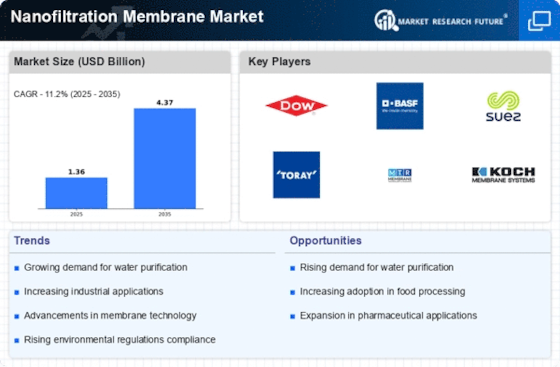
    As per MRFR analysis, the Nanofiltration Membrane Market Size was estimated at 1.36 USD Billion in 2024. The Nanofiltration Membrane industry is projected to grow from 1.512 USD Billion in 2025 to 4.373 USD Billion by 2035, exhibiting a compound annual growth rate (CAGR) of 11.2 during the forecast period 2025 - 2035.

    Key Market Trends & Highlights

    The Nanofiltration Membrane Market is poised for substantial growth driven by technological advancements and increasing sustainability efforts.

    • Technological advancements are enhancing the efficiency and performance of nanofiltration membranes across various applications.
    • North America remains the largest market, while the Asia-Pacific region is emerging as the fastest-growing area for nanofiltration technologies.
    • Polymeric membranes dominate the market, whereas ceramic membranes are gaining traction due to their superior durability and performance.
    • Rising water scarcity and the growing demand for water reuse are key drivers propelling the expansion of the nanofiltration membrane market.

    Market Size & Forecast

    2024 Market Size 1.36 (USD Billion)
    2035 Market Size 4.373 (USD Billion)
    CAGR (2025 - 2035) 11.2%
    Largest Regional Market Share in 2024 North America

    Major Players

    <p>Dow (US), BASF (DE), Suez (FR), Toray Industries (JP), Membrane Technology and Research (US), Koch Membrane Systems (US), Hydranautics (US), Parker Hannifin (US), GE Water & Process Technologies (US)</p>

    Market Trends

    The Nanofiltration Membrane Market is currently experiencing a notable evolution, driven by increasing demand for efficient water treatment solutions and advancements in membrane technology. This market segment appears to be gaining traction due to its ability to selectively remove contaminants while allowing essential minerals to pass through. As industries and municipalities seek sustainable practices, the adoption of nanofiltration membranes is likely to rise, reflecting a shift towards more environmentally friendly filtration methods. Furthermore, the growing awareness of water scarcity issues is propelling investments in innovative filtration technologies, which may enhance the overall market landscape. In addition, the Nanofiltration Membrane Market seems to be influenced by regulatory frameworks aimed at improving water quality standards. These regulations could potentially drive the need for advanced filtration systems across various sectors, including food and beverage, pharmaceuticals, and wastewater treatment. As companies strive to comply with stringent guidelines, the integration of nanofiltration membranes into their processes may become increasingly prevalent. Overall, the market appears poised for growth, with technological advancements and regulatory pressures shaping its future trajectory.

    Technological Advancements

    Recent innovations in membrane materials and manufacturing processes are enhancing the performance and efficiency of nanofiltration membranes. These advancements may lead to improved selectivity and reduced fouling, making them more attractive for various applications.

    Sustainability Focus

    There is a growing emphasis on sustainable practices within industries, which is likely to drive the demand for nanofiltration membranes. Their ability to conserve water and energy aligns with global sustainability goals, making them a preferred choice for many organizations.

    Regulatory Influences

    Stricter regulations regarding water quality and treatment are shaping the Nanofiltration Membrane Market. Compliance with these regulations may necessitate the adoption of advanced filtration technologies, thereby increasing the market's growth potential.

    Nanofiltration Membrane Market Market Drivers

    Rising Water Scarcity

    The increasing prevalence of water scarcity across various regions appears to be a primary driver for the Nanofiltration Membrane Market. As populations grow and industrial demands escalate, the need for efficient water treatment solutions intensifies. Nanofiltration membranes offer a viable solution for removing contaminants and improving water quality, thus addressing the urgent need for sustainable water resources. Reports indicate that the demand for advanced filtration technologies is projected to grow at a compound annual growth rate of approximately 8% over the next five years. This trend suggests that the Nanofiltration Membrane Market is poised for significant expansion as municipalities and industries seek to implement effective water management strategies.

    Environmental Regulations

    The tightening of environmental regulations regarding wastewater treatment and discharge is influencing the Nanofiltration Membrane Market. Governments and regulatory bodies are increasingly mandating stricter standards for water quality, compelling industries to adopt advanced filtration technologies to comply with these regulations. Nanofiltration membranes are particularly effective in removing pollutants and contaminants, making them a preferred choice for industries aiming to meet regulatory requirements. As compliance becomes more stringent, the demand for nanofiltration solutions is likely to rise, driving market growth. This trend indicates a shift towards more sustainable practices in various sectors, further solidifying the role of nanofiltration technologies in environmental management.

    Technological Innovations

    Technological innovations in membrane design and materials are anticipated to drive the Nanofiltration Membrane Market forward. Recent advancements, such as the development of more durable and efficient membrane materials, have enhanced the performance and longevity of nanofiltration systems. These innovations not only improve filtration efficiency but also reduce operational costs, making them more attractive to end-users. Furthermore, the integration of smart technologies, such as IoT-enabled monitoring systems, is likely to enhance the operational capabilities of nanofiltration systems. As a result, the market is expected to witness a surge in demand for these advanced solutions, reflecting a broader trend towards automation and efficiency in water treatment processes.

    Growing Demand for Water Reuse

    The growing emphasis on water reuse and recycling is emerging as a significant driver for the Nanofiltration Membrane Market. As water scarcity becomes a pressing issue, many regions are exploring innovative solutions to recycle wastewater for various applications, including irrigation and industrial processes. Nanofiltration membranes play a crucial role in this context, as they effectively remove contaminants while allowing for the recovery of valuable resources. Market forecasts suggest that the water reuse segment is expected to witness substantial growth, reflecting a broader trend towards sustainable water management practices. This shift not only supports environmental goals but also enhances the economic viability of water resources, further propelling the demand for nanofiltration technologies.

    Industrial Applications Expansion

    The expansion of industrial applications for nanofiltration membranes is likely to bolster the Nanofiltration Membrane Market. Industries such as food and beverage, pharmaceuticals, and textiles are increasingly adopting these membranes for their ability to selectively separate molecules, thereby enhancing product quality and process efficiency. For instance, in the food and beverage sector, nanofiltration is utilized for concentration and purification processes, which can lead to cost savings and improved product consistency. Market analysis indicates that the industrial segment is expected to account for a substantial share of the overall market, reflecting a growing recognition of the benefits offered by nanofiltration technologies.

    Market Segment Insights

    By Type: Polymeric (Largest) vs. Ceramic (Fastest-Growing)

    <p>The nanofiltration membrane market has witnessed a diverse distribution among its various types, primarily highlighting the significance of polymeric membranes, which hold the largest market share. These membranes are favored for their versatility, cost-effectiveness, and efficiency in a variety of applications, such as water treatment and food & beverage processing. On the other hand, ceramic membranes are rapidly gaining traction due to their robustness and durability, making them particularly suitable for harsh operating conditions. Their increasing implementation in industrial applications indicates a notable shift towards more reliable filtration solutions. Growth trends in the nanofiltration membrane market are primarily driven by the rising demand for water purification and the need for advanced filtration technologies. The substantial growth of the ceramic segment is attributed to its higher filtration capabilities and longer lifespan compared to polymeric membranes. Additionally, an increasing regulatory focus on water quality and stringent environmental standards further accelerates the adoption of both segments in various industries, indicating a positive outlook for the nanofiltration market as a whole.</p>

    <p>Polymeric (Dominant) vs. Ceramic (Emerging)</p>

    <p>Polymeric membranes dominate the nanofiltration membrane market due to their extensive versatility and cost efficiency. Widely used in diverse applications, these membranes provide effective separation capabilities while maintaining economic feasibility, leading to their preference in sectors like water treatment and food processing. However, ceramic membranes, classified as emerging, are gaining prominence due to their superior mechanical strength and resistance to chemical degradation. This position enables them to operate effectively in demanding environments, making them increasingly sought after in industrial applications where longevity and reliability are crucial. As environmental compliance becomes increasingly important, both polymeric and ceramic membranes are poised to play significant roles in the advancing filtration technologies.</p>

    By Module: Spiral Wound (Largest) vs. Hollow Fiber (Fastest-Growing)

    <p>In the Nanofiltration Membrane Market, the module segment showcases a diverse range of technologies, with Spiral Wound membranes commanding the largest market share. This configuration's widespread adoption is spurred by its high efficiency and adaptability for various applications, making it a favorite among industrial users. Conversely, Hollow Fiber membranes, while currently smaller in share, are emerging quickly with innovations that enhance their performance and applicability, particularly in water treatment and desalination processes.</p>

    <p>Spiral Wound (Dominant) vs. Tubular (Emerging)</p>

    <p>Spiral Wound membranes remain the dominant player within the Nanofiltration Membrane Market, known for their exceptional surface area and compact design, enabling efficient filtration with reduced energy consumption. Their versatility allows integration in various systems, such as reverse osmosis units and wastewater treatment facilities. On the other hand, Tubular membranes are classified as an emerging technology, offering advantages in handling viscous fluids and high particulate loads. Despite their smaller footprint in the market, their unique design provides potential for growth, especially within specific applications like dairy processing and food and beverage operations.</p>

    By Application: Municipal (Largest) vs. Industrial (Fastest-Growing)

    <p>In the Nanofiltration Membrane Market, the application segment is bifurcated into Municipal and Industrial sectors, each showcasing unique characteristics and market dynamics. The Municipal segment commands the largest share, driven by the escalating demand for water treatment solutions and the necessity for advanced filtration systems to ensure clean drinking water. This segment significantly utilizes nanofiltration membranes for various applications, including wastewater treatment and potable water solutions, making it a cornerstone of the market.</p>

    <p>Application: Municipal (Dominant) vs. Industrial (Emerging)</p>

    <p>The Municipal application sector remains the dominant force in the Nanofiltration Membrane Market, characterized by extensive utilization in public water treatment facilities and sewage systems. Municipalities increasingly adopt advanced membrane technologies to enhance the quality of treated water, reduce contaminants, and comply with stringent regulatory standards. In contrast, the Industrial application segment is emerging rapidly, propelled by a rise in demand for specialized filtration in sectors like food and beverage, pharmaceuticals, and chemical processing. Industrial facilities are increasingly recognizing the benefits of nanofiltration membranes for efficient separation processes, leading to increased adoption and innovation within this segment.</p>

    Get more detailed insights about Nanofiltration Membrane Market Research Report - Global Forecast 2035

    Regional Insights

    North America : Innovation and Sustainability Leader

    North America is the largest market for nanofiltration membranes, holding approximately 40% of the global market share. The region's growth is driven by increasing demand for water treatment solutions, stringent environmental regulations, and advancements in membrane technology. The U.S. leads this market, supported by investments in infrastructure and a focus on sustainable practices. Canada follows as the second-largest market, contributing around 15% to the overall share. The competitive landscape in North America is robust, featuring key players such as Dow, Suez, and Koch Membrane Systems. These companies are at the forefront of innovation, developing advanced membrane technologies to meet the growing demand for efficient water purification and industrial applications. The presence of established manufacturers and ongoing research initiatives further enhance the region's market dynamics.

    Europe : Regulatory-Driven Market Growth

    Europe is a significant player in the nanofiltration membrane market, accounting for approximately 30% of the global share. The region's growth is propelled by stringent regulations aimed at improving water quality and sustainability. Countries like Germany and France are leading the charge, with Germany holding the largest market share in Europe at around 12%. The European Union's commitment to environmental sustainability further catalyzes market expansion. Leading countries in Europe include Germany, France, and the Netherlands, where key players such as BASF and Suez are actively involved in developing innovative membrane technologies. The competitive landscape is characterized by a mix of established companies and emerging startups, all focused on enhancing efficiency and reducing environmental impact. The presence of regulatory bodies ensures that the market remains aligned with sustainability goals.

    Asia-Pacific : Emerging Market Potential

    Asia-Pacific is rapidly emerging as a key market for nanofiltration membranes, holding approximately 25% of the global market share. The region's growth is driven by increasing industrialization, urbanization, and a rising demand for clean water. Countries like China and India are at the forefront, with China being the largest market in the region, contributing around 15% to the global share. Government initiatives aimed at improving water quality and infrastructure are significant growth catalysts. The competitive landscape in Asia-Pacific is diverse, featuring both local and international players. Companies like Toray Industries and Hydranautics are leading the market, focusing on innovative solutions tailored to regional needs. The presence of a growing number of manufacturers and research institutions enhances the competitive environment, fostering advancements in membrane technology and applications across various sectors.

    Middle East and Africa : Resource-Rich Market Dynamics

    The Middle East and Africa (MEA) region is witnessing a growing demand for nanofiltration membranes, accounting for approximately 5% of the global market share. The region's growth is primarily driven by water scarcity issues and the need for efficient water treatment solutions. Countries like Saudi Arabia and South Africa are leading the market, with Saudi Arabia focusing on desalination projects to address water shortages, contributing significantly to the market dynamics. The competitive landscape in MEA is evolving, with both local and international players entering the market. Companies are increasingly investing in innovative technologies to meet the unique challenges of the region. The presence of key players and ongoing government initiatives aimed at improving water infrastructure further enhance the market's growth potential, making it an attractive area for investment and development.

    Key Players and Competitive Insights

    The Nanofiltration Membrane Market is currently characterized by a dynamic competitive landscape, driven by increasing demand for water treatment solutions and advancements in membrane technology. Key players such as Dow (US), BASF (DE), and Suez (FR) are strategically positioned to leverage their technological expertise and extensive distribution networks. Dow (US) focuses on innovation in membrane materials, while BASF (DE) emphasizes sustainable solutions, and Suez (FR) is enhancing its service offerings through digital transformation. Collectively, these strategies not only enhance their market presence but also foster a competitive environment that prioritizes technological advancement and sustainability.

    In terms of business tactics, companies are increasingly localizing manufacturing to reduce costs and improve supply chain efficiency. The market appears moderately fragmented, with several players vying for market share. However, the influence of major companies like Toray Industries (JP) and Koch Membrane Systems (US) is notable, as they continue to expand their operational capabilities and product offerings, thereby shaping the overall market structure.

    In August 2025, Toray Industries (JP) announced the launch of a new line of nanofiltration membranes designed specifically for industrial wastewater treatment. This strategic move is significant as it aligns with the growing regulatory pressures for sustainable waste management solutions, positioning Toray as a leader in addressing environmental challenges while expanding its product portfolio.

    In September 2025, Koch Membrane Systems (US) entered into a partnership with a leading technology firm to integrate AI-driven analytics into its membrane performance monitoring systems. This initiative is likely to enhance operational efficiency and predictive maintenance capabilities, thereby providing Koch with a competitive edge in the market by offering advanced solutions that meet the evolving needs of customers.

    In October 2025, Suez (FR) unveiled a new digital platform aimed at optimizing membrane filtration processes for municipal water treatment facilities. This development underscores Suez's commitment to digital transformation and reflects a broader trend in the industry towards leveraging technology to improve service delivery and operational efficiency.

    As of October 2025, the competitive trends in the Nanofiltration Membrane Market are increasingly defined by digitalization, sustainability, and the integration of advanced technologies such as AI. Strategic alliances are becoming more prevalent, enabling companies to pool resources and expertise to innovate more effectively. Looking ahead, the competitive differentiation is likely to shift from traditional price-based competition to a focus on innovation, technological advancements, and the reliability of supply chains, as companies strive to meet the growing demands for sustainable and efficient water treatment solutions.

    Key Companies in the Nanofiltration Membrane Market market include

    Industry Developments

    • Q3 2025: Recent investments, such as SepPure Technologies’ $12 million Series A funding and NALA Membranes’ $1.5 million for commercialization, underscore the sector’s growing significance. SepPure Technologies raised $12 million in Series A funding and NALA Membranes secured $1.5 million to support commercialization efforts, highlighting increased investor interest in advanced membrane filtration technologies for water treatment and industrial applications.

    Future Outlook

    Nanofiltration Membrane Market Future Outlook

    <p>The Nanofiltration Membrane Market is projected to grow at 11.2% CAGR from 2024 to 2035, driven by increasing demand for water treatment and industrial applications.</p>

    New opportunities lie in:

    • <p>Development of advanced nanofiltration systems for wastewater recycling</p>
    • <p>Expansion into emerging markets with tailored membrane solutions</p>
    • <p>Partnerships with technology firms for innovative filtration technologies</p>

    <p>By 2035, the market is expected to achieve substantial growth, solidifying its role in sustainable water management.</p>

    Market Segmentation

    Nanofiltration Membrane Market Type Outlook

    • Polymeric
    • Ceramic
    • Hybrid
    • Others

    Nanofiltration Membrane Market Module Outlook

    • Spiral Wound
    • Tubular
    • Hollow Fiber
    • Flat Sheet
    • Others

    Nanofiltration Membrane Market Application Outlook

    • Municipal
    • Industrial

    Report Scope

    MARKET SIZE 20241.36(USD Billion)
    MARKET SIZE 20251.512(USD Billion)
    MARKET SIZE 20354.373(USD Billion)
    COMPOUND ANNUAL GROWTH RATE (CAGR)11.2% (2024 - 2035)
    REPORT COVERAGERevenue Forecast, Competitive Landscape, Growth Factors, and Trends
    BASE YEAR2024
    Market Forecast Period2025 - 2035
    Historical Data2019 - 2024
    Market Forecast UnitsUSD Billion
    Key Companies ProfiledMarket analysis in progress
    Segments CoveredMarket segmentation analysis in progress
    Key Market OpportunitiesGrowing demand for water treatment solutions drives innovation in the Nanofiltration Membrane Market.
    Key Market DynamicsRising demand for water treatment solutions drives innovation and competition in the nanofiltration membrane market.
    Countries CoveredNorth America, Europe, APAC, South America, MEA

    FAQs

    What is the projected market valuation of the Nanofiltration Membrane Market by 2035?

    The Nanofiltration Membrane Market is projected to reach approximately 4.373 USD Billion by 2035.

    What was the market valuation of the Nanofiltration Membrane Market in 2024?

    In 2024, the market valuation of the Nanofiltration Membrane Market was 1.36 USD Billion.

    What is the expected CAGR for the Nanofiltration Membrane Market during the forecast period 2025 - 2035?

    The expected CAGR for the Nanofiltration Membrane Market during the forecast period 2025 - 2035 is 11.2%.

    Which type segment had the highest valuation in 2024 within the Nanofiltration Membrane Market?

    The Polymeric type segment had the highest valuation of 0.68 USD Billion in 2024.

    What are the projected valuations for the Spiral Wound module segment by 2035?

    The Spiral Wound module segment is projected to reach approximately 1.75 USD Billion by 2035.

    Which application segment is expected to show significant growth in the Nanofiltration Membrane Market?

    Both the Municipal and Industrial application segments are expected to show significant growth, with valuations of 0.68 USD Billion each in 2024.

    1. SECTION I: EXECUTIVE SUMMARY AND KEY HIGHLIGHTS
      1. | 1.1 EXECUTIVE SUMMARY
      2. | | 1.1.1 Market Overview
      3. | | 1.1.2 Key Findings
      4. | | 1.1.3 Market Segmentation
      5. | | 1.1.4 Competitive Landscape
      6. | | 1.1.5 Challenges and Opportunities
      7. | | 1.1.6 Future Outlook
    2. SECTION II: SCOPING, METHODOLOGY AND MARKET STRUCTURE
      1. | 2.1 MARKET INTRODUCTION
      2. | | 2.1.1 Definition
      3. | | 2.1.2 Scope of the study
      4. | | | 2.1.2.1 Research Objective
      5. | | | 2.1.2.2 Assumption
      6. | | | 2.1.2.3 Limitations
      7. | 2.2 RESEARCH METHODOLOGY
      8. | | 2.2.1 Overview
      9. | | 2.2.2 Data Mining
      10. | | 2.2.3 Secondary Research
      11. | | 2.2.4 Primary Research
      12. | | | 2.2.4.1 Primary Interviews and Information Gathering Process
      13. | | | 2.2.4.2 Breakdown of Primary Respondents
      14. | | 2.2.5 Forecasting Model
      15. | | 2.2.6 Market Size Estimation
      16. | | | 2.2.6.1 Bottom-Up Approach
      17. | | | 2.2.6.2 Top-Down Approach
      18. | | 2.2.7 Data Triangulation
      19. | | 2.2.8 Validation
    3. SECTION III: QUALITATIVE ANALYSIS
      1. | 3.1 MARKET DYNAMICS
      2. | | 3.1.1 Overview
      3. | | 3.1.2 Drivers
      4. | | 3.1.3 Restraints
      5. | | 3.1.4 Opportunities
      6. | 3.2 MARKET FACTOR ANALYSIS
      7. | | 3.2.1 Value chain Analysis
      8. | | 3.2.2 Porter's Five Forces Analysis
      9. | | | 3.2.2.1 Bargaining Power of Suppliers
      10. | | | 3.2.2.2 Bargaining Power of Buyers
      11. | | | 3.2.2.3 Threat of New Entrants
      12. | | | 3.2.2.4 Threat of Substitutes
      13. | | | 3.2.2.5 Intensity of Rivalry
      14. | | 3.2.3 COVID-19 Impact Analysis
      15. | | | 3.2.3.1 Market Impact Analysis
      16. | | | 3.2.3.2 Regional Impact
      17. | | | 3.2.3.3 Opportunity and Threat Analysis
    4. SECTION IV: QUANTITATIVE ANALYSIS
      1. | 4.1 Chemicals and Materials, BY Type (USD Billion)
      2. | | 4.1.1 Polymeric
      3. | | 4.1.2 Ceramic
      4. | | 4.1.3 Hybrid
      5. | | 4.1.4 Others
      6. | 4.2 Chemicals and Materials, BY Module (USD Billion)
      7. | | 4.2.1 Spiral Wound
      8. | | 4.2.2 Tubular
      9. | | 4.2.3 Hollow Fiber
      10. | | 4.2.4 Flat Sheet
      11. | | 4.2.5 Others
      12. | 4.3 Chemicals and Materials, BY Application (USD Billion)
      13. | | 4.3.1 Municipal
      14. | | 4.3.2 Industrial
      15. | 4.4 Chemicals and Materials, BY Region (USD Billion)
      16. | | 4.4.1 North America
      17. | | | 4.4.1.1 US
      18. | | | 4.4.1.2 Canada
      19. | | 4.4.2 Europe
      20. | | | 4.4.2.1 Germany
      21. | | | 4.4.2.2 UK
      22. | | | 4.4.2.3 France
      23. | | | 4.4.2.4 Russia
      24. | | | 4.4.2.5 Italy
      25. | | | 4.4.2.6 Spain
      26. | | | 4.4.2.7 Rest of Europe
      27. | | 4.4.3 APAC
      28. | | | 4.4.3.1 China
      29. | | | 4.4.3.2 India
      30. | | | 4.4.3.3 Japan
      31. | | | 4.4.3.4 South Korea
      32. | | | 4.4.3.5 Malaysia
      33. | | | 4.4.3.6 Thailand
      34. | | | 4.4.3.7 Indonesia
      35. | | | 4.4.3.8 Rest of APAC
      36. | | 4.4.4 South America
      37. | | | 4.4.4.1 Brazil
      38. | | | 4.4.4.2 Mexico
      39. | | | 4.4.4.3 Argentina
      40. | | | 4.4.4.4 Rest of South America
      41. | | 4.4.5 MEA
      42. | | | 4.4.5.1 GCC Countries
      43. | | | 4.4.5.2 South Africa
      44. | | | 4.4.5.3 Rest of MEA
    5. SECTION V: COMPETITIVE ANALYSIS
      1. | 5.1 Competitive Landscape
      2. | | 5.1.1 Overview
      3. | | 5.1.2 Competitive Analysis
      4. | | 5.1.3 Market share Analysis
      5. | | 5.1.4 Major Growth Strategy in the Chemicals and Materials
      6. | | 5.1.5 Competitive Benchmarking
      7. | | 5.1.6 Leading Players in Terms of Number of Developments in the Chemicals and Materials
      8. | | 5.1.7 Key developments and growth strategies
      9. | | | 5.1.7.1 New Product Launch/Service Deployment
      10. | | | 5.1.7.2 Merger & Acquisitions
      11. | | | 5.1.7.3 Joint Ventures
      12. | | 5.1.8 Major Players Financial Matrix
      13. | | | 5.1.8.1 Sales and Operating Income
      14. | | | 5.1.8.2 Major Players R&D Expenditure. 2023
      15. | 5.2 Company Profiles
      16. | | 5.2.1 Dow (US)
      17. | | | 5.2.1.1 Financial Overview
      18. | | | 5.2.1.2 Products Offered
      19. | | | 5.2.1.3 Key Developments
      20. | | | 5.2.1.4 SWOT Analysis
      21. | | | 5.2.1.5 Key Strategies
      22. | | 5.2.2 BASF (DE)
      23. | | | 5.2.2.1 Financial Overview
      24. | | | 5.2.2.2 Products Offered
      25. | | | 5.2.2.3 Key Developments
      26. | | | 5.2.2.4 SWOT Analysis
      27. | | | 5.2.2.5 Key Strategies
      28. | | 5.2.3 Suez (FR)
      29. | | | 5.2.3.1 Financial Overview
      30. | | | 5.2.3.2 Products Offered
      31. | | | 5.2.3.3 Key Developments
      32. | | | 5.2.3.4 SWOT Analysis
      33. | | | 5.2.3.5 Key Strategies
      34. | | 5.2.4 Toray Industries (JP)
      35. | | | 5.2.4.1 Financial Overview
      36. | | | 5.2.4.2 Products Offered
      37. | | | 5.2.4.3 Key Developments
      38. | | | 5.2.4.4 SWOT Analysis
      39. | | | 5.2.4.5 Key Strategies
      40. | | 5.2.5 Membrane Technology and Research (US)
      41. | | | 5.2.5.1 Financial Overview
      42. | | | 5.2.5.2 Products Offered
      43. | | | 5.2.5.3 Key Developments
      44. | | | 5.2.5.4 SWOT Analysis
      45. | | | 5.2.5.5 Key Strategies
      46. | | 5.2.6 Koch Membrane Systems (US)
      47. | | | 5.2.6.1 Financial Overview
      48. | | | 5.2.6.2 Products Offered
      49. | | | 5.2.6.3 Key Developments
      50. | | | 5.2.6.4 SWOT Analysis
      51. | | | 5.2.6.5 Key Strategies
      52. | | 5.2.7 Hydranautics (US)
      53. | | | 5.2.7.1 Financial Overview
      54. | | | 5.2.7.2 Products Offered
      55. | | | 5.2.7.3 Key Developments
      56. | | | 5.2.7.4 SWOT Analysis
      57. | | | 5.2.7.5 Key Strategies
      58. | | 5.2.8 Parker Hannifin (US)
      59. | | | 5.2.8.1 Financial Overview
      60. | | | 5.2.8.2 Products Offered
      61. | | | 5.2.8.3 Key Developments
      62. | | | 5.2.8.4 SWOT Analysis
      63. | | | 5.2.8.5 Key Strategies
      64. | | 5.2.9 GE Water & Process Technologies (US)
      65. | | | 5.2.9.1 Financial Overview
      66. | | | 5.2.9.2 Products Offered
      67. | | | 5.2.9.3 Key Developments
      68. | | | 5.2.9.4 SWOT Analysis
      69. | | | 5.2.9.5 Key Strategies
      70. | 5.3 Appendix
      71. | | 5.3.1 References
      72. | | 5.3.2 Related Reports
    6. LIST OF FIGURES
      1. | 6.1 MARKET SYNOPSIS
      2. | 6.2 NORTH AMERICA MARKET ANALYSIS
      3. | 6.3 US MARKET ANALYSIS BY TYPE
      4. | 6.4 US MARKET ANALYSIS BY MODULE
      5. | 6.5 US MARKET ANALYSIS BY APPLICATION
      6. | 6.6 CANADA MARKET ANALYSIS BY TYPE
      7. | 6.7 CANADA MARKET ANALYSIS BY MODULE
      8. | 6.8 CANADA MARKET ANALYSIS BY APPLICATION
      9. | 6.9 EUROPE MARKET ANALYSIS
      10. | 6.10 GERMANY MARKET ANALYSIS BY TYPE
      11. | 6.11 GERMANY MARKET ANALYSIS BY MODULE
      12. | 6.12 GERMANY MARKET ANALYSIS BY APPLICATION
      13. | 6.13 UK MARKET ANALYSIS BY TYPE
      14. | 6.14 UK MARKET ANALYSIS BY MODULE
      15. | 6.15 UK MARKET ANALYSIS BY APPLICATION
      16. | 6.16 FRANCE MARKET ANALYSIS BY TYPE
      17. | 6.17 FRANCE MARKET ANALYSIS BY MODULE
      18. | 6.18 FRANCE MARKET ANALYSIS BY APPLICATION
      19. | 6.19 RUSSIA MARKET ANALYSIS BY TYPE
      20. | 6.20 RUSSIA MARKET ANALYSIS BY MODULE
      21. | 6.21 RUSSIA MARKET ANALYSIS BY APPLICATION
      22. | 6.22 ITALY MARKET ANALYSIS BY TYPE
      23. | 6.23 ITALY MARKET ANALYSIS BY MODULE
      24. | 6.24 ITALY MARKET ANALYSIS BY APPLICATION
      25. | 6.25 SPAIN MARKET ANALYSIS BY TYPE
      26. | 6.26 SPAIN MARKET ANALYSIS BY MODULE
      27. | 6.27 SPAIN MARKET ANALYSIS BY APPLICATION
      28. | 6.28 REST OF EUROPE MARKET ANALYSIS BY TYPE
      29. | 6.29 REST OF EUROPE MARKET ANALYSIS BY MODULE
      30. | 6.30 REST OF EUROPE MARKET ANALYSIS BY APPLICATION
      31. | 6.31 APAC MARKET ANALYSIS
      32. | 6.32 CHINA MARKET ANALYSIS BY TYPE
      33. | 6.33 CHINA MARKET ANALYSIS BY MODULE
      34. | 6.34 CHINA MARKET ANALYSIS BY APPLICATION
      35. | 6.35 INDIA MARKET ANALYSIS BY TYPE
      36. | 6.36 INDIA MARKET ANALYSIS BY MODULE
      37. | 6.37 INDIA MARKET ANALYSIS BY APPLICATION
      38. | 6.38 JAPAN MARKET ANALYSIS BY TYPE
      39. | 6.39 JAPAN MARKET ANALYSIS BY MODULE
      40. | 6.40 JAPAN MARKET ANALYSIS BY APPLICATION
      41. | 6.41 SOUTH KOREA MARKET ANALYSIS BY TYPE
      42. | 6.42 SOUTH KOREA MARKET ANALYSIS BY MODULE
      43. | 6.43 SOUTH KOREA MARKET ANALYSIS BY APPLICATION
      44. | 6.44 MALAYSIA MARKET ANALYSIS BY TYPE
      45. | 6.45 MALAYSIA MARKET ANALYSIS BY MODULE
      46. | 6.46 MALAYSIA MARKET ANALYSIS BY APPLICATION
      47. | 6.47 THAILAND MARKET ANALYSIS BY TYPE
      48. | 6.48 THAILAND MARKET ANALYSIS BY MODULE
      49. | 6.49 THAILAND MARKET ANALYSIS BY APPLICATION
      50. | 6.50 INDONESIA MARKET ANALYSIS BY TYPE
      51. | 6.51 INDONESIA MARKET ANALYSIS BY MODULE
      52. | 6.52 INDONESIA MARKET ANALYSIS BY APPLICATION
      53. | 6.53 REST OF APAC MARKET ANALYSIS BY TYPE
      54. | 6.54 REST OF APAC MARKET ANALYSIS BY MODULE
      55. | 6.55 REST OF APAC MARKET ANALYSIS BY APPLICATION
      56. | 6.56 SOUTH AMERICA MARKET ANALYSIS
      57. | 6.57 BRAZIL MARKET ANALYSIS BY TYPE
      58. | 6.58 BRAZIL MARKET ANALYSIS BY MODULE
      59. | 6.59 BRAZIL MARKET ANALYSIS BY APPLICATION
      60. | 6.60 MEXICO MARKET ANALYSIS BY TYPE
      61. | 6.61 MEXICO MARKET ANALYSIS BY MODULE
      62. | 6.62 MEXICO MARKET ANALYSIS BY APPLICATION
      63. | 6.63 ARGENTINA MARKET ANALYSIS BY TYPE
      64. | 6.64 ARGENTINA MARKET ANALYSIS BY MODULE
      65. | 6.65 ARGENTINA MARKET ANALYSIS BY APPLICATION
      66. | 6.66 REST OF SOUTH AMERICA MARKET ANALYSIS BY TYPE
      67. | 6.67 REST OF SOUTH AMERICA MARKET ANALYSIS BY MODULE
      68. | 6.68 REST OF SOUTH AMERICA MARKET ANALYSIS BY APPLICATION
      69. | 6.69 MEA MARKET ANALYSIS
      70. | 6.70 GCC COUNTRIES MARKET ANALYSIS BY TYPE
      71. | 6.71 GCC COUNTRIES MARKET ANALYSIS BY MODULE
      72. | 6.72 GCC COUNTRIES MARKET ANALYSIS BY APPLICATION
      73. | 6.73 SOUTH AFRICA MARKET ANALYSIS BY TYPE
      74. | 6.74 SOUTH AFRICA MARKET ANALYSIS BY MODULE
      75. | 6.75 SOUTH AFRICA MARKET ANALYSIS BY APPLICATION
      76. | 6.76 REST OF MEA MARKET ANALYSIS BY TYPE
      77. | 6.77 REST OF MEA MARKET ANALYSIS BY MODULE
      78. | 6.78 REST OF MEA MARKET ANALYSIS BY APPLICATION
      79. | 6.79 KEY BUYING CRITERIA OF CHEMICALS AND MATERIALS
      80. | 6.80 RESEARCH PROCESS OF MRFR
      81. | 6.81 DRO ANALYSIS OF CHEMICALS AND MATERIALS
      82. | 6.82 DRIVERS IMPACT ANALYSIS: CHEMICALS AND MATERIALS
      83. | 6.83 RESTRAINTS IMPACT ANALYSIS: CHEMICALS AND MATERIALS
      84. | 6.84 SUPPLY / VALUE CHAIN: CHEMICALS AND MATERIALS
      85. | 6.85 CHEMICALS AND MATERIALS, BY TYPE, 2024 (% SHARE)
      86. | 6.86 CHEMICALS AND MATERIALS, BY TYPE, 2024 TO 2035 (USD Billion)
      87. | 6.87 CHEMICALS AND MATERIALS, BY MODULE, 2024 (% SHARE)
      88. | 6.88 CHEMICALS AND MATERIALS, BY MODULE, 2024 TO 2035 (USD Billion)
      89. | 6.89 CHEMICALS AND MATERIALS, BY APPLICATION, 2024 (% SHARE)
      90. | 6.90 CHEMICALS AND MATERIALS, BY APPLICATION, 2024 TO 2035 (USD Billion)
      91. | 6.91 BENCHMARKING OF MAJOR COMPETITORS
    7. LIST OF TABLES
      1. | 7.1 LIST OF ASSUMPTIONS
      2. | | 7.1.1
      3. | 7.2 North America MARKET SIZE ESTIMATES; FORECAST
      4. | | 7.2.1 BY TYPE, 2025-2035 (USD Billion)
      5. | | 7.2.2 BY MODULE, 2025-2035 (USD Billion)
      6. | | 7.2.3 BY APPLICATION, 2025-2035 (USD Billion)
      7. | 7.3 US MARKET SIZE ESTIMATES; FORECAST
      8. | | 7.3.1 BY TYPE, 2025-2035 (USD Billion)
      9. | | 7.3.2 BY MODULE, 2025-2035 (USD Billion)
      10. | | 7.3.3 BY APPLICATION, 2025-2035 (USD Billion)
      11. | 7.4 Canada MARKET SIZE ESTIMATES; FORECAST
      12. | | 7.4.1 BY TYPE, 2025-2035 (USD Billion)
      13. | | 7.4.2 BY MODULE, 2025-2035 (USD Billion)
      14. | | 7.4.3 BY APPLICATION, 2025-2035 (USD Billion)
      15. | 7.5 Europe MARKET SIZE ESTIMATES; FORECAST
      16. | | 7.5.1 BY TYPE, 2025-2035 (USD Billion)
      17. | | 7.5.2 BY MODULE, 2025-2035 (USD Billion)
      18. | | 7.5.3 BY APPLICATION, 2025-2035 (USD Billion)
      19. | 7.6 Germany MARKET SIZE ESTIMATES; FORECAST
      20. | | 7.6.1 BY TYPE, 2025-2035 (USD Billion)
      21. | | 7.6.2 BY MODULE, 2025-2035 (USD Billion)
      22. | | 7.6.3 BY APPLICATION, 2025-2035 (USD Billion)
      23. | 7.7 UK MARKET SIZE ESTIMATES; FORECAST
      24. | | 7.7.1 BY TYPE, 2025-2035 (USD Billion)
      25. | | 7.7.2 BY MODULE, 2025-2035 (USD Billion)
      26. | | 7.7.3 BY APPLICATION, 2025-2035 (USD Billion)
      27. | 7.8 France MARKET SIZE ESTIMATES; FORECAST
      28. | | 7.8.1 BY TYPE, 2025-2035 (USD Billion)
      29. | | 7.8.2 BY MODULE, 2025-2035 (USD Billion)
      30. | | 7.8.3 BY APPLICATION, 2025-2035 (USD Billion)
      31. | 7.9 Russia MARKET SIZE ESTIMATES; FORECAST
      32. | | 7.9.1 BY TYPE, 2025-2035 (USD Billion)
      33. | | 7.9.2 BY MODULE, 2025-2035 (USD Billion)
      34. | | 7.9.3 BY APPLICATION, 2025-2035 (USD Billion)
      35. | 7.10 Italy MARKET SIZE ESTIMATES; FORECAST
      36. | | 7.10.1 BY TYPE, 2025-2035 (USD Billion)
      37. | | 7.10.2 BY MODULE, 2025-2035 (USD Billion)
      38. | | 7.10.3 BY APPLICATION, 2025-2035 (USD Billion)
      39. | 7.11 Spain MARKET SIZE ESTIMATES; FORECAST
      40. | | 7.11.1 BY TYPE, 2025-2035 (USD Billion)
      41. | | 7.11.2 BY MODULE, 2025-2035 (USD Billion)
      42. | | 7.11.3 BY APPLICATION, 2025-2035 (USD Billion)
      43. | 7.12 Rest of Europe MARKET SIZE ESTIMATES; FORECAST
      44. | | 7.12.1 BY TYPE, 2025-2035 (USD Billion)
      45. | | 7.12.2 BY MODULE, 2025-2035 (USD Billion)
      46. | | 7.12.3 BY APPLICATION, 2025-2035 (USD Billion)
      47. | 7.13 APAC MARKET SIZE ESTIMATES; FORECAST
      48. | | 7.13.1 BY TYPE, 2025-2035 (USD Billion)
      49. | | 7.13.2 BY MODULE, 2025-2035 (USD Billion)
      50. | | 7.13.3 BY APPLICATION, 2025-2035 (USD Billion)
      51. | 7.14 China MARKET SIZE ESTIMATES; FORECAST
      52. | | 7.14.1 BY TYPE, 2025-2035 (USD Billion)
      53. | | 7.14.2 BY MODULE, 2025-2035 (USD Billion)
      54. | | 7.14.3 BY APPLICATION, 2025-2035 (USD Billion)
      55. | 7.15 India MARKET SIZE ESTIMATES; FORECAST
      56. | | 7.15.1 BY TYPE, 2025-2035 (USD Billion)
      57. | | 7.15.2 BY MODULE, 2025-2035 (USD Billion)
      58. | | 7.15.3 BY APPLICATION, 2025-2035 (USD Billion)
      59. | 7.16 Japan MARKET SIZE ESTIMATES; FORECAST
      60. | | 7.16.1 BY TYPE, 2025-2035 (USD Billion)
      61. | | 7.16.2 BY MODULE, 2025-2035 (USD Billion)
      62. | | 7.16.3 BY APPLICATION, 2025-2035 (USD Billion)
      63. | 7.17 South Korea MARKET SIZE ESTIMATES; FORECAST
      64. | | 7.17.1 BY TYPE, 2025-2035 (USD Billion)
      65. | | 7.17.2 BY MODULE, 2025-2035 (USD Billion)
      66. | | 7.17.3 BY APPLICATION, 2025-2035 (USD Billion)
      67. | 7.18 Malaysia MARKET SIZE ESTIMATES; FORECAST
      68. | | 7.18.1 BY TYPE, 2025-2035 (USD Billion)
      69. | | 7.18.2 BY MODULE, 2025-2035 (USD Billion)
      70. | | 7.18.3 BY APPLICATION, 2025-2035 (USD Billion)
      71. | 7.19 Thailand MARKET SIZE ESTIMATES; FORECAST
      72. | | 7.19.1 BY TYPE, 2025-2035 (USD Billion)
      73. | | 7.19.2 BY MODULE, 2025-2035 (USD Billion)
      74. | | 7.19.3 BY APPLICATION, 2025-2035 (USD Billion)
      75. | 7.20 Indonesia MARKET SIZE ESTIMATES; FORECAST
      76. | | 7.20.1 BY TYPE, 2025-2035 (USD Billion)
      77. | | 7.20.2 BY MODULE, 2025-2035 (USD Billion)
      78. | | 7.20.3 BY APPLICATION, 2025-2035 (USD Billion)
      79. | 7.21 Rest of APAC MARKET SIZE ESTIMATES; FORECAST
      80. | | 7.21.1 BY TYPE, 2025-2035 (USD Billion)
      81. | | 7.21.2 BY MODULE, 2025-2035 (USD Billion)
      82. | | 7.21.3 BY APPLICATION, 2025-2035 (USD Billion)
      83. | 7.22 South America MARKET SIZE ESTIMATES; FORECAST
      84. | | 7.22.1 BY TYPE, 2025-2035 (USD Billion)
      85. | | 7.22.2 BY MODULE, 2025-2035 (USD Billion)
      86. | | 7.22.3 BY APPLICATION, 2025-2035 (USD Billion)
      87. | 7.23 Brazil MARKET SIZE ESTIMATES; FORECAST
      88. | | 7.23.1 BY TYPE, 2025-2035 (USD Billion)
      89. | | 7.23.2 BY MODULE, 2025-2035 (USD Billion)
      90. | | 7.23.3 BY APPLICATION, 2025-2035 (USD Billion)
      91. | 7.24 Mexico MARKET SIZE ESTIMATES; FORECAST
      92. | | 7.24.1 BY TYPE, 2025-2035 (USD Billion)
      93. | | 7.24.2 BY MODULE, 2025-2035 (USD Billion)
      94. | | 7.24.3 BY APPLICATION, 2025-2035 (USD Billion)
      95. | 7.25 Argentina MARKET SIZE ESTIMATES; FORECAST
      96. | | 7.25.1 BY TYPE, 2025-2035 (USD Billion)
      97. | | 7.25.2 BY MODULE, 2025-2035 (USD Billion)
      98. | | 7.25.3 BY APPLICATION, 2025-2035 (USD Billion)
      99. | 7.26 Rest of South America MARKET SIZE ESTIMATES; FORECAST
      100. | | 7.26.1 BY TYPE, 2025-2035 (USD Billion)
      101. | | 7.26.2 BY MODULE, 2025-2035 (USD Billion)
      102. | | 7.26.3 BY APPLICATION, 2025-2035 (USD Billion)
      103. | 7.27 MEA MARKET SIZE ESTIMATES; FORECAST
      104. | | 7.27.1 BY TYPE, 2025-2035 (USD Billion)
      105. | | 7.27.2 BY MODULE, 2025-2035 (USD Billion)
      106. | | 7.27.3 BY APPLICATION, 2025-2035 (USD Billion)
      107. | 7.28 GCC Countries MARKET SIZE ESTIMATES; FORECAST
      108. | | 7.28.1 BY TYPE, 2025-2035 (USD Billion)
      109. | | 7.28.2 BY MODULE, 2025-2035 (USD Billion)
      110. | | 7.28.3 BY APPLICATION, 2025-2035 (USD Billion)
      111. | 7.29 South Africa MARKET SIZE ESTIMATES; FORECAST
      112. | | 7.29.1 BY TYPE, 2025-2035 (USD Billion)
      113. | | 7.29.2 BY MODULE, 2025-2035 (USD Billion)
      114. | | 7.29.3 BY APPLICATION, 2025-2035 (USD Billion)
      115. | 7.30 Rest of MEA MARKET SIZE ESTIMATES; FORECAST
      116. | | 7.30.1 BY TYPE, 2025-2035 (USD Billion)
      117. | | 7.30.2 BY MODULE, 2025-2035 (USD Billion)
      118. | | 7.30.3 BY APPLICATION, 2025-2035 (USD Billion)
      119. | 7.31 PRODUCT LAUNCH/PRODUCT DEVELOPMENT/APPROVAL
      120. | | 7.31.1
      121. | 7.32 ACQUISITION/PARTNERSHIP
      122. | | 7.32.1


    Nanofiltration Membrane Market Segmentation

    Nanofiltration Membrane Type Outlook (USD Billion, 2018-2032)

    • Polymeric
    • Ceramic
    • Hybrid
    • Others

    Nanofiltration Membrane Module Outlook (USD Billion, 2018-2032)

    • Spiral Wound
    • Tubular
    • Hollow Fiber
    • Flat Sheet
    • Others

    Nanofiltration Membrane Application Outlook (USD Billion, 2018-2032)

    • Municipal
    • Industrial

    Nanofiltration Membrane Regional Outlook (USD Billion, 2018-2032)

    • North America Outlook (USD Billion, 2018-2032)

      • North America Nanofiltration Membrane by Type
        • Polymeric
        • Ceramic
        • Hybrid
        • Others
      • North America Nanofiltration Membrane by Module
        • Spiral Wound
        • Tubular
        • Hollow Fiber
        • Flat Sheet
        • Others
      • North America Nanofiltration Membrane by Application
        • Municipal
        • Industrial
      • US Outlook (USD Billion, 2018-2032)

      • US Nanofiltration Membrane by Type
        • Polymeric
        • Ceramic
        • Hybrid
        • Others
      • US Nanofiltration Membrane by Module
        • Spiral Wound
        • Tubular
        • Hollow Fiber
        • Flat Sheet
        • Others
      • US Nanofiltration Membrane by Application
        • Municipal
        • Industrial
      • CANADA Outlook (USD Billion, 2018-2032)

      • CANADA Nanofiltration Membrane by Type
        • Polymeric
        • Ceramic
        • Hybrid
        • Others
      • CANADA Nanofiltration Membrane by Module
        • Spiral Wound
        • Tubular
        • Hollow Fiber
        • Flat Sheet
        • Others
      • CANADA Nanofiltration Membrane by Application
        • Municipal
        • Industrial
    • Europe Outlook (USD Billion, 2018-2032)

      • Europe Nanofiltration Membrane by Type
        • Polymeric
        • Ceramic
        • Hybrid
        • Others
      • Europe Nanofiltration Membrane by Module
        • Spiral Wound
        • Tubular
        • Hollow Fiber
        • Flat Sheet
        • Others
      • Europe Nanofiltration Membrane by Application
        • Municipal
        • Industrial
      • Germany Outlook (USD Billion, 2018-2032)

      • Germany Nanofiltration Membrane by Type
        • Polymeric
        • Ceramic
        • Hybrid
        • Others
      • Germany Nanofiltration Membrane by Module
        • Spiral Wound
        • Tubular
        • Hollow Fiber
        • Flat Sheet
        • Others
      • Germany Nanofiltration Membrane by Application
        • Municipal
        • Industrial
      • France Outlook (USD Billion, 2018-2032)

      • France Nanofiltration Membrane by Type
        • Polymeric
        • Ceramic
        • Hybrid
        • Others
      • France Nanofiltration Membrane by Module
        • Spiral Wound
        • Tubular
        • Hollow Fiber
        • Flat Sheet
        • Others
      • France Nanofiltration Membrane by Application
        • Municipal
        • Industrial
      • UK Outlook (USD Billion, 2018-2032)

      • UK Nanofiltration Membrane by Type
        • Polymeric
        • Ceramic
        • Hybrid
        • Others
      • UK Nanofiltration Membrane by Module
        • Spiral Wound
        • Tubular
        • Hollow Fiber
        • Flat Sheet
        • Others
      • UK Nanofiltration Membrane by Application
        • Municipal
        • Industrial
      • ITALY Outlook (USD Billion, 2018-2032)

      • ITALY Nanofiltration Membrane by Type
        • Polymeric
        • Ceramic
        • Hybrid
        • Others
      • ITALY Nanofiltration Membrane by Module
        • Spiral Wound
        • Tubular
        • Hollow Fiber
        • Flat Sheet
        • Others
      • ITALY Nanofiltration Membrane by Application
        • Municipal
        • Industrial
      • SPAIN Outlook (USD Billion, 2018-2032)

      • Spain Nanofiltration Membrane by Type
        • Polymeric
        • Ceramic
        • Hybrid
        • Others
      • Spain Nanofiltration Membrane by Module
        • Spiral Wound
        • Tubular
        • Hollow Fiber
        • Flat Sheet
        • Others
      • Spain Nanofiltration Membrane by Application
        • Municipal
        • Industrial
      • Rest Of Europe Outlook (USD Billion, 2018-2032)

      • Rest Of Europe Nanofiltration Membrane by Type
        • Polymeric
        • Ceramic
        • Hybrid
        • Others
      • REST OF EUROPE Nanofiltration Membrane by Module
        • Spiral Wound
        • Tubular
        • Hollow Fiber
        • Flat Sheet
        • Others
      • REST OF EUROPE Nanofiltration Membrane by Application
        • Municipal
        • Industrial
    • Asia-Pacific Outlook (USD Billion, 2018-2032)

      • Asia-Pacific Nanofiltration Membrane by Type
        • Polymeric
        • Ceramic
        • Hybrid
        • Others
      • Asia-Pacific Nanofiltration Membrane by Module
        • Spiral Wound
        • Tubular
        • Hollow Fiber
        • Flat Sheet
        • Others
      • Asia-Pacific Nanofiltration Membrane by Application
        • Municipal
        • Industrial
      • China Outlook (USD Billion, 2018-2032)

      • China Nanofiltration Membrane by Type
        • Polymeric
        • Ceramic
        • Hybrid
        • Others
      • China Nanofiltration Membrane by Module
        • Spiral Wound
        • Tubular
        • Hollow Fiber
        • Flat Sheet
        • Others
      • China Nanofiltration Membrane by Application
        • Municipal
        • Industrial
      • Japan Outlook (USD Billion, 2018-2032)

      • Japan Nanofiltration Membrane by Type
        • Polymeric
        • Ceramic
        • Hybrid
        • Others
      • Japan Nanofiltration Membrane by Module
        • Spiral Wound
        • Tubular
        • Hollow Fiber
        • Flat Sheet
        • Others
      • Japan Nanofiltration Membrane by Application
        • Municipal
        • Industrial
      • India Outlook (USD Billion, 2018-2032)

      • India Nanofiltration Membrane by Type
        • Polymeric
        • Ceramic
        • Hybrid
        • Others
      • India Nanofiltration Membrane by Module
        • Spiral Wound
        • Tubular
        • Hollow Fiber
        • Flat Sheet
        • Others
      • India Nanofiltration Membrane by Application
        • Municipal
        • Industrial
      • Australia Outlook (USD Billion, 2018-2032)

      • Australia Nanofiltration Membrane by Type
        • Polymeric
        • Ceramic
        • Hybrid
        • Others
      • Australia Nanofiltration Membrane by Module
        • Spiral Wound
        • Tubular
        • Hollow Fiber
        • Flat Sheet
        • Others
      • Australia Nanofiltration Membrane by Application
        • Municipal
        • Industrial
      • Rest of Asia-Pacific Outlook (USD Billion, 2018-2032)

      • Rest of Asia-Pacific Nanofiltration Membrane by Type
        • Polymeric
        • Ceramic
        • Hybrid
        • Others
      • Rest of Asia-Pacific Nanofiltration Membrane by Module
        • Spiral Wound
        • Tubular
        • Hollow Fiber
        • Flat Sheet
        • Others
      • Rest of Asia-Pacific Nanofiltration Membrane by Application
        • Municipal
        • Industrial
    • Rest of the World Outlook (USD Billion, 2018-2032)

      • Rest of the World Nanofiltration Membrane by Type
        • Polymeric
        • Ceramic
        • Hybrid
        • Others
      • Rest of the World Nanofiltration Membrane by Module
        • Spiral Wound
        • Tubular
        • Hollow Fiber
        • Flat Sheet
        • Others
      • Rest of the World Nanofiltration Membrane by Application
        • Municipal
        • Industrial
      • Middle East Outlook (USD Billion, 2018-2032)

      • Middle East Nanofiltration Membrane by Type
        • Polymeric
        • Ceramic
        • Hybrid
        • Others
      • Middle East Nanofiltration Membrane by Module
        • Spiral Wound
        • Tubular
        • Hollow Fiber
        • Flat Sheet
        • Others
      • Middle East Nanofiltration Membrane by Application
        • Municipal
        • Industrial
      • Africa Outlook (USD Billion, 2018-2032)

      • Africa Nanofiltration Membrane by Type
        • Polymeric
        • Ceramic
        • Hybrid
        • Others
      • Africa Nanofiltration Membrane by Module
        • Spiral Wound
        • Tubular
        • Hollow Fiber
        • Flat Sheet
        • Others
      • Africa Nanofiltration Membrane by Application
        • Municipal
        • Industrial
      • Latin America Outlook (USD Billion, 2018-2032)

      • Latin America Nanofiltration Membrane by Type
        • Polymeric
        • Ceramic
        • Hybrid
        • Others
      • Latin America Nanofiltration Membrane by Module
        • Spiral Wound
        • Tubular
        • Hollow Fiber
        • Flat Sheet
        • Others
      • Latin America Nanofiltration Membrane by Application
        • Municipal
        • Industrial
    Infographic

    Free Sample Request

    Kindly complete the form below to receive a free sample of this Report

    Get Free Sample

    Customer Strories

    “I am very pleased with how market segments have been defined in a relevant way for my purposes (such as "Portable Freezers & refrigerators" and "last-mile"). In general the report is well structured. Thanks very much for your efforts.”

    Victoria Milne

    Founder
    Case Study
    Chemicals and Materials

    Compare Licence

    ×
    Features License Type
    Single User Multiuser License Enterprise User
    Price $4,950 $5,950 $7,250
    Maximum User Access Limit 1 User Upto 10 Users Unrestricted Access Throughout the Organization
    Free Customization
    Direct Access to Analyst
    Deliverable Format
    Platform Access
    Discount on Next Purchase 10% 15% 15%
    Printable Versions