Request Free Sample ×

Kindly complete the form below to receive a free sample of this Report

* Please use a valid business email

Leading companies partner with us for data-driven Insights

clients tt-cursor
Hero Background
English
Chinese
French
Japanese
Korean
German
Spanish

Green Data Center Market Trends

ID: MRFR/SEM/1005-HCR
110 Pages
Aarti Dhapte
Last Updated: April 28, 2026

Green Data Center Market Size, Share and Research Report By Component (Hardware {Servers, Cooling Equipment, Power Units, and Networking Components}, and Software), By Organization Size (Small & Medium Enterprises, and Large Enterprises), By Verticals (Healthcare & Life Science, BFSI, IT & Telecom, Public Sector, and Others), By End Users (Cloud Service Providers, and Colocation Providers) And By Region (North America, Europe, Asia-Pacific, And Rest Of The World) –Industry Forecast Till 2035

Share:
Download PDF ×

We do not share your information with anyone. However, we may send you emails based on your report interest from time to time. You may contact us at any time to opt-out.

Green Data Center Market Infographic
Purchase Options

Market Trends

Key Emerging Trends in the Green Data Center Market

As the meaning of maintainability in the innovation area develops, the market patterns in green data center area show an eminent advancement. The rising utilization of environmentally friendly power sources is one significant pattern. With an end goal to turn out to be less subject to regular power networks, green server farms are moving their energy sources from petroleum products to sustainable ones like sun oriented and wind. This change assists organizations with turning out to be more energy free and less reliant upon energy cost swings, as well as being in accordance with natural objectives. An extra imperative advancement is the emphasis on energy-effective plans. Inventive plans are turning out to be increasingly more famous as server farms keep on focusing on energy effectiveness.

The use of energy-productive equipment, modern power conveyance procedures, and fluid cooling frameworks all add to the general adequacy of green data center. By decreasing working expenses, this pattern assists organizations with setting aside cash while at the same time tending to ecological worries. The possibility of roundabout economy strategies is additionally affecting the improvements in the green data center market. To make a shut circle framework, this involves limiting waste, reutilizing materials, and reusing parts. Server farm framework fashioners and administrators are focusing on making durable, effectively upgradeable, and recyclable plans. This pattern upholds the general goal of empowering a more supportable lifecycle for the server farm hardware and bringing down electronic waste. Measured server farm arrangements are turning out to be increasingly more well known as a significant pattern in light of the developing necessity for adaptability and versatility.

On account of these particular plans' speedy organization and development abilities, organizations can undoubtedly scale the server farm framework to meet their evolving needs. The particular methodology decreases superfluous power utilization by permitting parts to be taken out or added in light of interest, which further develops adaptability while likewise further developing energy effectiveness. Green data center market patterns are additionally being affected by cloud and edge registering. The ubiquity of such registering models has expanded interest for geologically scattered server farms that are close to end clients. This example diminishes idleness and further develops information handling effectiveness all around. Via cautiously setting their structures to work with cloud and edge processing, green data center is acclimating to this pattern and reducing the natural impact of significant distance information transmission. The utilization of AI and ML in data center is a conspicuous pattern.

Proactive checking, the prescient support, and ideal asset distribution are made conceivable by these innovations, which raise functional viability and lower energy utilization. Ongoing information investigation by artificial intelligence and ML calculations can find regions for energy reserve funds and improve the overall presentation of the green data center. Solid safety efforts are turning out to be more normal in the green data center as security worries in the advanced circle develop. High level security conventions are being executed by server farms to safeguard classified information and assure the trustworthiness of the activities. To shield against evolving dangers, this incorporates encryption innovations, biometric access controls, and broad online protection measures. Regardless, there are still issues with the market patterns for green data center. For specific associations, the underlying capital expense important to embrace green innovations keeps on being an obstruction. Defeating this hindrance requires convincing partners of long-haul benefits and profit from venture. Moreover, it is hard to decently contrast and evaluate different arrangements due with the shortfall of standard measurements for checking the ecological presentation of the green data center.


Author
Author Profile
Aarti Dhapte
AVP - Research

A consulting professional focused on helping businesses navigate complex markets through structured research and strategic insights. I partner with clients to solve high-impact business problems across market entry strategy, competitive intelligence, and opportunity assessment. Over the course of my experience, I have led and contributed to 100+ market research and consulting engagements, delivering insights across multiple industries and geographies, and supporting strategic decisions linked to $500M+ market opportunities. My core expertise lies in building robust market sizing, forecasting, and commercial models (top-down and bottom-up), alongside deep-dive competitive and industry analysis. I have played a key role in shaping go-to-market strategies, investment cases, and growth roadmaps, enabling clients to make confident, data-backed decisions in dynamic markets.

Leave a Comment

FAQs

What is the current valuation of the Green Data Center Market as of 2024?

<p>The Green Data Center Market was valued at 28.71 USD Billion in 2024.</p>

What is the projected market size for the Green Data Center Market by 2035?

<p>The market is projected to reach 632.99 USD Billion by 2035.</p>

What is the expected CAGR for the Green Data Center Market during the forecast period 2025 - 2035?

<p>The expected CAGR for the Green Data Center Market during 2025 - 2035 is 32.47%.</p>

Which organizations are leading the Green Data Center Market?

<p>Key players in the market include Amazon Web Services, Microsoft Corporation, Google LLC, and IBM Corporation.</p>

How does the market valuation for hardware compare to software in the Green Data Center Market?

<p>In 2024, hardware was valued at 10.0 USD Billion, while software reached 18.71 USD Billion.</p>

What are the projected valuations for small and medium enterprises in the Green Data Center Market?

<p>The market for small and medium enterprises was valued at 8.57 USD Billion in 2024 and is projected to grow to 198.25 USD Billion by 2035.</p>

What is the market size for large enterprises in the Green Data Center Market?

<p>The valuation for large enterprises was 20.14 USD Billion in 2024, with a projection of 434.74 USD Billion by 2035.</p>

Which verticals are contributing to the growth of the Green Data Center Market?

Key verticals include IT &amp; Telecom, which was valued at 10.0 USD Billion in 2024, and BFSI, valued at 6.0 USD Billion.

What is the expected market size for cloud service providers in the Green Data Center Market?

Cloud service providers were valued at 20.0 USD Billion in 2024, with projections reaching 480.0 USD Billion by 2035.

How do colocation providers compare to cloud service providers in terms of market valuation?

Colocation providers had a valuation of 8.71 USD Billion in 2024, significantly lower than the 20.0 USD Billion for cloud service providers.

Market Summary

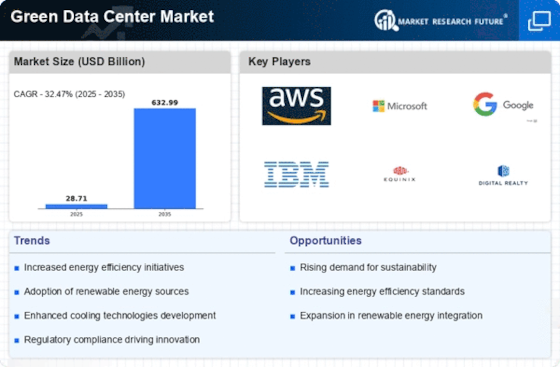
As per Market Research Future analysis, the Green Data Center Market Size was estimated at 28.71 USD Billion in 2024. The Green Data Center industry is projected to grow from 38.03 USD Billion in 2025 to 632.99 USD Billion by 2035, exhibiting a compound annual growth rate (CAGR) of 32.47% during the forecast period 2025 - 2035

Key Market Trends & Highlights

The Green Data Center Market is experiencing robust growth driven by sustainability initiatives and technological advancements.

  • The market is witnessing increased adoption of renewable energy sources, particularly in North America. Enhanced energy efficiency technologies are becoming pivotal in optimizing data center operations across various sectors. Regulatory support and incentives are fostering a conducive environment for green data center investments in the Asia-Pacific region. Rising demand for sustainable practices and technological advancements in cooling solutions are key drivers propelling market growth.

Market Size & Forecast

2024 Market Size 28.71 (USD Billion)
2035 Market Size 632.99 (USD Billion)
CAGR (2025 - 2035) 32.47%
Largest Regional Market Share in 2024 North America

Major Players

Amazon Web Services (US), Microsoft Corporation (US), Google LLC (US), IBM Corporation (US), Equinix Inc. (US), Digital Realty Trust (US), Alibaba Cloud (CN), Oracle Corporation (US), NTT Communications (JP) are actively investing in green data center solutions and next-generation green data centre infrastructure.

Market Trends

The green data center market is currently experiencing a transformative phase, driven by the increasing emphasis on sustainability, data center green initiatives, and energy efficiency. Organizations are progressively recognizing the environmental impact of traditional data centers and are transitioning toward green IT data center strategies that minimize energy consumption and utilize renewable energy sources. . This shift is not merely a trend but appears to be a fundamental change in how data management is approached, with a focus on reducing the carbon footprint and enhancing operational efficiency. Moreover, advancements in technology are facilitating the development of more efficient cooling systems, energy management tools, and virtualization techniques. These innovations are likely to play a crucial role in shaping the future of the Green Data Center Market. Companies are increasingly investing in infrastructure that supports sustainable practices, which may lead to a competitive advantage in an evolving marketplace. The integration of artificial intelligence and machine learning into data center operations also suggests a potential for optimizing resource allocation and improving overall performance. As the global community continues to prioritize environmental responsibility, the Green Data Center Market is poised for substantial growth and evolution in the coming years.

Increased Adoption of Renewable Energy

The green data center market is witnessing a notable shift toward renewable energy usage. Solar and wind power adoption across green data centers reduces fossil fuel dependency and strengthens sustainability objectives.The Green Data Center Market is witnessing a notable shift towards the utilization of renewable energy sources. Organizations are increasingly investing in solar, wind, and other sustainable energy options to power their data centers. This trend not only reduces reliance on fossil fuels but also aligns with global sustainability goals, enhancing corporate responsibility and public image.

Enhanced Energy Efficiency Technologies

Technological advancements are driving the development of energy-efficient solutions within the Green Data Center Market. Innovations such as advanced cooling systems, energy managementsoftware, and server virtualization are becoming more prevalent. These technologies aim to optimize energy consumption, thereby reducing operational costs and environmental impact.

Regulatory Support and Incentives

Government regulations increasingly favor green data centre development. Incentives encourage organizations to invest in green datacenter infrastructure, accelerating adoption across regions. Government policies and regulations are increasingly favoring the establishment of green data centers. Incentives for adopting sustainable practices, such as tax breaks and grants, are encouraging organizations to transition towards greener operations. This regulatory support is likely to accelerate the growth of the Green Data Center Market, as companies seek to comply with environmental standards.

Green Data Center Market Market Drivers

Growing Demand for Cloud Services

The growing demand for cloud services is driving the expansion of the Green Data Center Market. As more businesses migrate to cloud-based solutions, the need for efficient and sustainable data centers becomes increasingly critical. Cloud service providers are under pressure to enhance their sustainability practices, leading to investments in green technologies and infrastructure. This shift is evident in the increasing number of cloud providers committing to renewable energy sources and energy-efficient operations. According to market forecasts, the cloud computing market is expected to grow significantly, which will likely result in a corresponding increase in the demand for green data centers. This trend underscores the importance of sustainability in the technology sector and highlights the role of the Green Data Center Market in meeting the needs of modern businesses.

Government Regulations and Policies

Government regulations and policies aimed at promoting sustainability are significantly influencing the Green Data Center Market. Many countries are implementing stringent regulations to reduce greenhouse gas emissions and encourage the adoption of renewable energy sources. These policies often include incentives for businesses that invest in green technologies, which can lead to substantial cost savings. For example, tax credits and grants for energy-efficient upgrades are becoming more common, motivating companies to transition to greener data center solutions. As regulatory frameworks evolve, they are likely to create a more favorable environment for the growth of the Green Data Center Market. This regulatory support not only drives investment in sustainable technologies but also fosters innovation within the sector.

Increased Focus on Energy Efficiency

The increased focus on energy efficiency is a major driver of the Green Data Center Market. Organizations are recognizing that energy-efficient data centers not only reduce operational costs but also contribute to sustainability goals. The implementation of energy-efficient practices, such as virtualization and server consolidation, can lead to significant reductions in energy consumption. Recent studies indicate that energy-efficient data centers can reduce energy usage by up to 40%, which is a compelling incentive for businesses looking to optimize their operations. As energy prices continue to rise, the emphasis on energy efficiency is expected to intensify, further propelling the growth of the Green Data Center Market. This trend reflects a broader commitment to sustainable practices and responsible resource management.

Rising Demand for Sustainable Practices

The increasing awareness of environmental issues has led to a rising demand for sustainable practices across various industries. Organizations are now prioritizing sustainability in their operations, which has a direct impact on the Green Data Center Market. Companies are seeking to reduce their carbon footprints and enhance their corporate social responsibility profiles. This shift is reflected in the growing number of businesses committing to net-zero emissions targets. According to recent data, the market for green data centers is projected to grow at a compound annual growth rate of over 20% in the coming years, driven by this demand for sustainable solutions. As organizations strive to align with consumer expectations and regulatory requirements, the Green Data Center Market is likely to experience significant growth.

Technological Advancements in Cooling Solutions

Technological advancements in cooling solutions are playing a pivotal role in the Green Data Center Market. Innovative cooling technologies, such as liquid cooling and free-air cooling, are being adopted to enhance energy efficiency and reduce operational costs. These advancements not only lower energy consumption but also contribute to the overall sustainability of data centers. For instance, the implementation of advanced cooling systems can reduce energy usage by up to 30%, which is crucial in an industry where energy costs are a significant concern. As data centers continue to expand, the need for efficient cooling solutions becomes increasingly critical, thereby driving the growth of the Green Data Center Market. The integration of these technologies is expected to be a key factor in meeting the rising demand for energy-efficient data center operations.

Market Segment Insights

By Component: Hardware (Largest) vs. Software (Fastest-Growing)

In the Green Data Center Market, the component segment showcases a competitive landscape, with hardware taking the lead due to its significant share in driving efficiency and sustainability. Companies are increasingly investing in high-performance hardware systems designed to minimize energy consumption and carbon footprint, solidifying hardware's dominance in the market. Meanwhile, software solutions, which focus on optimizing data management and resource allocation, are rapidly gaining attention, accounting for an increasing share of market interest as businesses recognize the importance of software in managing and operating energy-efficient data centers.

Component: Hardware (Dominant) vs. Software (Emerging)

Hardware remains the dominant force in the component segment of the Green Data Center Market, largely due to its critical role in establishing energy efficiency and low environmental impact. This segment includes advanced servers, cooling systems, and power management devices, specifically designed for high performance with minimal power usage. Conversely, software has emerged as a vital force, leveraging cloud solutions and AI to drive data center optimization. As businesses shift towards fully integrated energy management systems, software solutions are becoming crucial for energy monitoring and predictive analytics, marking it as an emerging segment poised for rapid growth.

By Organization Size: Large Enterprises (Largest) vs. Small & Medium Enterprises (Fastest-Growing)

In the Green Data Center Market, the distribution of market share among different organization sizes reveals a significant dominance of large enterprises. These organizations account for a substantial portion of the overall market due to their extensive resources and larger-scale operations aimed at sustainability. On the other hand, small and medium enterprises (SMEs) are emerging as a noteworthy segment, gradually increasing their share in response to rising environmental awareness and regulatory pressures.

Organization Size: Large Enterprises (Dominant) vs. Small &amp; Medium Enterprises (Emerging)

Large enterprises in the Green Data Center Market leverage their access to advanced technologies and substantial investments to deploy energy-efficient infrastructure and sustainable practices. Their dominance is characterized by dedicated and sophisticated strategies to reduce carbon footprints and comply with stringent regulations. In contrast, small and medium enterprises are becoming increasingly relevant as they adopt green technologies faster due to more agile decision-making processes. These SMEs are driven by the need to enhance their competitive position and respond to customer demand for sustainability, thus making significant strides in the market.

By Verticals: Healthcare & Life Science (Largest) vs. BFSI (Fastest-Growing)

The Green Data Center Market reflects a diverse distribution of market share among its verticals, with Healthcare &amp; Life Science being the dominant player. This segment accounts for a considerable portion of the market, driven by the increasing need for sustainable practices and data security in handling sensitive health information. Following closely is the BFSI sector, which is gaining momentum as more financial institutions commit to reducing their carbon footprint through green initiatives and data center innovations.

Healthcare &amp; Life Science: Dominant vs. BFSI: Emerging

The Healthcare &amp; Life Science sector stands at the forefront of the Green Data Center Market due to its critical importance in managing vast amounts of sensitive data while adhering to regulatory compliance. This segment prioritizes energy efficiency and sustainable operations, viewing Green Data Centers as a strategic asset for improving patient care and operational costs. On the other hand, BFSI is emerging rapidly in this landscape, granting attention to eco-friendly solutions in its data handling processes. Financial institutions are actively investing in green technologies to enhance their corporate sustainability profiles, thereby creating an accelerating demand for green data center capabilities in the financial services sector.

By End Users: Cloud Service Providers (Largest) vs. Colocation Providers (Fastest-Growing)

In the Green Data Center Market, Cloud Service Providers are currently the largest segment, holding a significant share due to their extensive infrastructure and broad customer base. They leverage green technology to enhance sustainability while meeting the increasing demand for cloud services. On the other hand, Colocation Providers, while currently smaller in market share, show remarkable growth potential. Their ability to house multiple clients' hardware in energy-efficient facilities positions them favorably among businesses seeking eco-friendly solutions.

Cloud Service Providers: Dominant vs. Colocation Providers: Emerging

Cloud Service Providers dominate the Green Data Center Market by offering scalable and flexible data hosting solutions that are increasingly aligned with sustainability goals. They have adopted renewable energy sources and advanced cooling technologies, thereby reducing their carbon footprints while satisfying customer demand for energy efficiency. Meanwhile, Colocation Providers, as an emerging segment, are growing rapidly as they provide businesses with a viable solution to reduce upfront costs and enable faster deployment of services. Their facilities are designed to optimize energy consumption, attracting enterprises keen on sustainability, even as they grapple with operational costs.

Get more detailed insights about Global Green Data Center Market Research Report- Forecast to 2035

Regional Insights

North America : Innovation and Leadership Hub

North America leads the green data center market, driven by sustainability mandates and large-scale investments in green data center design by hyperscale operators. North America is the largest market for green data centers, holding approximately 45% of the global market share. The region's growth is driven by increasing demand for sustainable IT solutions, stringent regulations on carbon emissions, and significant investments in renewable energy. The U.S. government has implemented various initiatives to promote energy efficiency, further catalyzing market expansion. Leading the charge are the United States and Canada, with the U.S. accounting for the majority of the market. Major players like Amazon Web Services, Microsoft, and Google are heavily investing in green technologies, enhancing their competitive edge. The presence of advanced infrastructure and a strong focus on innovation solidify North America's position as a leader in the green data center market.

Europe : Sustainability and Compliance Focus

Europe emphasizes compliance-driven green data centre development, supported by EU sustainability regulations. Europe is the second-largest market for green data centers, capturing around 30% of the global market share. The region's growth is fueled by stringent EU regulations aimed at reducing carbon footprints and promoting energy efficiency. Initiatives like the European Green Deal are pivotal in driving investments in sustainable technologies, making Europe a key player in the green data center landscape. Countries like Germany, the UK, and France are at the forefront, with significant investments in renewable energy and green technologies. The competitive landscape features major players such as IBM and Equinix, who are adapting to regulatory demands by enhancing their green offerings. The focus on sustainability is reshaping the market, encouraging innovation and collaboration among industry leaders.

Asia-Pacific : Emerging Market Potential

Asia-Pacific is rapidly adopting green data centers, fueled by digital transformation and renewable energy initiatives. Asia-Pacific is witnessing rapid growth in the green data center market, holding approximately 20% of the global share. The region's expansion is driven by increasing digitalization, rising energy demands, and government initiatives promoting sustainable practices. Countries like China and Japan are leading the charge, with significant investments in renewable energy and energy-efficient technologies. China is the largest market in the region, followed by Japan, where major players like Alibaba Cloud and NTT Communications are making strides in green technology. The competitive landscape is evolving, with local and international companies vying for market share. The focus on sustainability is becoming a key differentiator, pushing companies to innovate and adopt greener practices.

Middle East and Africa : Resource-Rich and Growing Demand

The Middle East and Africa region is emerging as a significant player in the green data center market, holding about 5% of the global share. The region is gradually embracing data center green practices, supported by investments in renewable energy infrastructure. The growth is driven by increasing investments in digital infrastructure and a rising demand for sustainable energy solutions. Countries like the UAE and South Africa are leading the way, with government initiatives aimed at promoting renewable energy and energy efficiency. The competitive landscape is characterized by a mix of local and international players, with companies like Oracle and Digital Realty Trust expanding their presence. The region's focus on sustainability is gradually reshaping the market, encouraging investments in green technologies and infrastructure development. As the demand for data centers grows, the emphasis on eco-friendly solutions is becoming increasingly important.

Key Players and Competitive Insights

Market leaders are expanding their portfolios through investments in green data center solutions and localized manufacturing to reduce emissions and operational costs. Market participants are also undertaking various strategic activities to expand their global footprint, with important market developments including new product launches, contractual agreements, mergers and acquisitions, higher investments, and collaboration with other organizations. To expand and survive in a more competitive and rising market climate, the green data center industry must offer cost-effective items.Manufacturing locally to minimize operational costs is one of the key business tactics manufacturers use in the global green data center industry to benefit clients and increase the market sector. Major players in the green data center market, including Schneider Electric SE, Hewlett Packard Enterprise Company, Green Revolution Cooling, Inc., Eaton Corporation PLC, Dell Technologies, Inc., and others, are attempting to increase market demand by investing in R&D operations.Dell Technologies Inc provides desktop personal computers, software, and peripherals. The firm designs, manufactures, markets, sells, develops, and supports information technology infrastructure such as laptops, mobiles, desktops, workstations, storage devices, cloud solutions, software, and notebooks. It markets products under Dell, Pivotal, Dell EMC, SecureWorks, and Alienware, brand names. Dell also delivers a range of financial services, such as collecting, originating, and servicing customer receivables financing agreements related to the usage of its products, software, and service solutions. Dell serves corporate businesses, educational institutions, government, healthcare organizations, law enforcement agencies, and small and medium-sized businesses.
In November Dell Technologies partnered with FedEx Corp and Switch Inc.; the companies developed a series of data centers all over the US to support low-latency edge workloads. Under this partnership, FedEx provides real estate and emerges as the first customer. In contrast, Switch develops the data center infrastructure, and Dell Technologies delivers storage, cloud computing, networking, and support services.Volkswagen AG (Volkswagen), a Porsche Automobil Holding SE subsidiary, is an automobile manufacturer. The company develops vehicles and engines and produces and sells passenger cars, trucks, buses and motorcycles, light commercial vehicles, genuine parts, turbomachinery, large-bore diesel engines, propulsion components, special gear units and testing systems. It also provides leasing, banking and insurance, dealer and customer financing, fleet management and mobility services. Volkswagen markets products under brands such as Volkswagen, Porsche, Bugatti, Lamborghini, Bentley, Audi, Ducati, Scania and Cupra. In November 2022, Volkswagen AG aims to make its data center operations net carbon neutral by 2027. The company has enhanced its computing capacities at the Norwegian operator of CO₂-neutral data centers to reach this goal by partnering with Green Mountain. The partnership with Green Mountain will allow Volkswagen to hit this target, with all servers at Green Mountain running on 100% renewable electricity generated by hydropower. At the same time, they are naturally cooled by the adjacent fjord.

Key Companies in the Green Data Center Market include

Industry Developments

Recent developments highlight the adoption of nuclear PPAs and sustainable building materials, reinforcing the shift toward greenest data center standards globally.

  • Q1 2025: 2025 Global Data Center Outlook In 2024, multiple nuclear power purchase agreements (PPAs) were signed by data center operators, including deals involving both active and decommissioned nuclear plants, to supply clean energy for data centers. This marks a significant shift toward nuclear as a green energy source for the sector.
  • Q3 2025: ESG & Green Data Centres | KR A hyperscale data center operator in North America began piloting the use of cross-laminated timber (CLT) in data center construction in 2025, aiming for a carbon-negative footprint and advancing sustainable building practices in the sector.

Future Outlook

Green Data Center Market Future Outlook

The Green Data Center Market is projected to grow at a 32.47% CAGR from 2025 to 2035, driven by sustainability initiatives, energy efficiency demands, and technological advancements.

New opportunities lie in:

  • <p>Development of AI-driven energy management systems</p>
  • <p> </p>
  • <p>Expansion of renewable energy sourcing partnerships</p>
  • <p>Implementation of advanced cooling technologies for efficiency</p>

By 2035, the market is expected to be robust, driven by innovation and sustainability.

Market Segmentation

Green Data Center Market Component Outlook

  • Hardware
  • Software

Green Data Center Market End Users Outlook

  • Cloud Service Providers
  • Colocation Providers

Green Data Center Market Verticals Outlook

  • Healthcare & Life Science
  • BFSI
  • IT & Telecom
  • Public Sector
  • Others

Green Data Center Market Organization Size Outlook

  • Small & Medium Enterprises
  • Large Enterprises

Report Scope

MARKET SIZE 2024 28.71(USD Billion)
MARKET SIZE 2025 38.03(USD Billion)
MARKET SIZE 2035 632.99(USD Billion)
COMPOUND ANNUAL GROWTH RATE (CAGR) 32.47% (2025 - 2035)
REPORT COVERAGE Revenue Forecast, Competitive Landscape, Growth Factors, and Trends
BASE YEAR 2024
Market Forecast Period 2025 - 2035
Historical Data 2019 - 2024
Market Forecast Units USD Billion
Key Companies Profiled Amazon Web Services (US), Microsoft Corporation (US), Google LLC (US), IBM Corporation (US), Equinix Inc. (US), Digital Realty Trust (US), Alibaba Cloud (CN), Oracle Corporation (US), NTT Communications (JP)
Segments Covered Component, Organization Size, Verticals, End Users, Region
Key Market Opportunities Integration of renewable energy sources enhances sustainability in the Green Data Center Market.
Key Market Dynamics Rising demand for energy efficiency drives innovation and competition in the Green Data Center Market.
Countries Covered North America, Europe, APAC, South America, MEA

FAQs

What is the current valuation of the Green Data Center Market as of 2024?

<p>The Green Data Center Market was valued at 28.71 USD Billion in 2024.</p>

What is the projected market size for the Green Data Center Market by 2035?

<p>The market is projected to reach 632.99 USD Billion by 2035.</p>

What is the expected CAGR for the Green Data Center Market during the forecast period 2025 - 2035?

<p>The expected CAGR for the Green Data Center Market during 2025 - 2035 is 32.47%.</p>

Which organizations are leading the Green Data Center Market?

<p>Key players in the market include Amazon Web Services, Microsoft Corporation, Google LLC, and IBM Corporation.</p>

How does the market valuation for hardware compare to software in the Green Data Center Market?

<p>In 2024, hardware was valued at 10.0 USD Billion, while software reached 18.71 USD Billion.</p>

What are the projected valuations for small and medium enterprises in the Green Data Center Market?

<p>The market for small and medium enterprises was valued at 8.57 USD Billion in 2024 and is projected to grow to 198.25 USD Billion by 2035.</p>

What is the market size for large enterprises in the Green Data Center Market?

<p>The valuation for large enterprises was 20.14 USD Billion in 2024, with a projection of 434.74 USD Billion by 2035.</p>

Which verticals are contributing to the growth of the Green Data Center Market?

Key verticals include IT &amp; Telecom, which was valued at 10.0 USD Billion in 2024, and BFSI, valued at 6.0 USD Billion.

What is the expected market size for cloud service providers in the Green Data Center Market?

Cloud service providers were valued at 20.0 USD Billion in 2024, with projections reaching 480.0 USD Billion by 2035.

How do colocation providers compare to cloud service providers in terms of market valuation?

Colocation providers had a valuation of 8.71 USD Billion in 2024, significantly lower than the 20.0 USD Billion for cloud service providers.

  1. SECTION I: EXECUTIVE SUMMARY AND KEY HIGHLIGHTS |
    1. EXECUTIVE SUMMARY | |
      1. Market Overview | |
      2. Key Findings | |
      3. Market Segmentation | |
      4. Competitive Landscape | |
      5. Challenges and Opportunities | |
      6. Future Outlook 2
  2. SECTION II: SCOPING, METHODOLOGY AND MARKET STRUCTURE |
    1. MARKET INTRODUCTION | |
      1. Definition | |
      2. Scope of the study | | |
    2. RESEARCH METHODOLOGY | |
      1. Overview | |
      2. Data Mining | |
      3. Secondary Research | |
      4. Primary Research | | |
      5. Forecasting Model | |
      6. Market Size Estimation | | |
      7. Data Triangulation | |
      8. Validation 3
  3. SECTION III: QUALITATIVE ANALYSIS |
    1. MARKET DYNAMICS | |
      1. Overview | |
      2. Drivers | |
      3. Restraints | |
      4. Opportunities |
    2. MARKET FACTOR ANALYSIS | |
      1. Value chain Analysis | |
      2. Porter's Five Forces Analysis | | |
      3. COVID-19 Impact Analysis | | |
  4. SECTION IV: QUANTITATIVE ANALYSIS |
    1. Semiconductor & Electronics, BY Component (USD Billion) | |
      1. Hardware | |
      2. Software |
    2. Semiconductor & Electronics, BY Organization Size (USD Billion) | |
      1. Small & Medium Enterprises | |
      2. Large Enterprises |
    3. Semiconductor & Electronics, BY Verticals (USD Billion) | |
      1. Healthcare & Life Science | |
      2. BFSI | |
      3. IT & Telecom | |
      4. Public Sector | |
      5. Others |
    4. Semiconductor & Electronics, BY End Users (USD Billion) | |
      1. Cloud Service Providers | |
      2. Colocation Providers |
    5. Semiconductor & Electronics, BY Region (USD Billion) | |
      1. North America | | |
      2. Europe | | |
      3. APAC | | |
      4. South America | | |
      5. MEA | | |
  5. SECTION V: COMPETITIVE ANALYSIS |
    1. Competitive Landscape | |
      1. Overview | |
      2. Competitive Analysis | |
      3. Market share Analysis | |
      4. Major Growth Strategy in the Semiconductor & Electronics | |
      5. Competitive Benchmarking | |
      6. Leading Players in Terms of Number of Developments in the Semiconductor & Electronics | |
      7. Key developments and growth strategies | | |
      8. Major Players Financial Matrix | | |
    2. Company Profiles | |
      1. Amazon Web Services (US) | | |
      2. Microsoft Corporation (US) | | |
      3. Google LLC (US) | | |
      4. IBM Corporation (US) | | |
      5. Equinix Inc. (US) | | |
      6. Digital Realty Trust (US) | | |
      7. Alibaba Cloud (CN) | | |
      8. Oracle Corporation (US) | | |
      9. NTT Communications (JP) | | |
    3. Appendix | |
      1. References | |
      2. Related Reports 6 LIST OF FIGURES |
    4. MARKET SYNOPSIS |
    5. NORTH AMERICA MARKET ANALYSIS |
    6. US MARKET ANALYSIS BY COMPONENT |
    7. US MARKET ANALYSIS BY ORGANIZATION SIZE |
    8. US MARKET ANALYSIS BY VERTICALS |
    9. US MARKET ANALYSIS BY END USERS |
    10. CANADA MARKET ANALYSIS BY COMPONENT |
    11. CANADA MARKET ANALYSIS BY ORGANIZATION SIZE |
    12. CANADA MARKET ANALYSIS BY VERTICALS |
    13. CANADA MARKET ANALYSIS BY END USERS |
    14. EUROPE MARKET ANALYSIS |
    15. GERMANY MARKET ANALYSIS BY COMPONENT |
    16. GERMANY MARKET ANALYSIS BY ORGANIZATION SIZE |
    17. GERMANY MARKET ANALYSIS BY VERTICALS |
    18. GERMANY MARKET ANALYSIS BY END USERS |
    19. UK MARKET ANALYSIS BY COMPONENT |
    20. UK MARKET ANALYSIS BY ORGANIZATION SIZE |
    21. UK MARKET ANALYSIS BY VERTICALS |
    22. UK MARKET ANALYSIS BY END USERS |
    23. FRANCE MARKET ANALYSIS BY COMPONENT |
    24. FRANCE MARKET ANALYSIS BY ORGANIZATION SIZE |
    25. FRANCE MARKET ANALYSIS BY VERTICALS |
    26. FRANCE MARKET ANALYSIS BY END USERS |
    27. RUSSIA MARKET ANALYSIS BY COMPONENT |
    28. RUSSIA MARKET ANALYSIS BY ORGANIZATION SIZE |
    29. RUSSIA MARKET ANALYSIS BY VERTICALS |
    30. RUSSIA MARKET ANALYSIS BY END USERS |
    31. ITALY MARKET ANALYSIS BY COMPONENT |
    32. ITALY MARKET ANALYSIS BY ORGANIZATION SIZE |
    33. ITALY MARKET ANALYSIS BY VERTICALS |
    34. ITALY MARKET ANALYSIS BY END USERS |
    35. SPAIN MARKET ANALYSIS BY COMPONENT |
    36. SPAIN MARKET ANALYSIS BY ORGANIZATION SIZE |
    37. SPAIN MARKET ANALYSIS BY VERTICALS |
    38. SPAIN MARKET ANALYSIS BY END USERS |
    39. REST OF EUROPE MARKET ANALYSIS BY COMPONENT |
    40. REST OF EUROPE MARKET ANALYSIS BY ORGANIZATION SIZE |
    41. REST OF EUROPE MARKET ANALYSIS BY VERTICALS |
    42. REST OF EUROPE MARKET ANALYSIS BY END USERS |
    43. APAC MARKET ANALYSIS |
    44. CHINA MARKET ANALYSIS BY COMPONENT |
    45. CHINA MARKET ANALYSIS BY ORGANIZATION SIZE |
    46. CHINA MARKET ANALYSIS BY VERTICALS |
    47. CHINA MARKET ANALYSIS BY END USERS |
    48. INDIA MARKET ANALYSIS BY COMPONENT |
    49. INDIA MARKET ANALYSIS BY ORGANIZATION SIZE |
    50. INDIA MARKET ANALYSIS BY VERTICALS |
    51. INDIA MARKET ANALYSIS BY END USERS |
    52. JAPAN MARKET ANALYSIS BY COMPONENT |
    53. JAPAN MARKET ANALYSIS BY ORGANIZATION SIZE |
    54. JAPAN MARKET ANALYSIS BY VERTICALS |
    55. JAPAN MARKET ANALYSIS BY END USERS |
    56. SOUTH KOREA MARKET ANALYSIS BY COMPONENT |
    57. SOUTH KOREA MARKET ANALYSIS BY ORGANIZATION SIZE |
    58. SOUTH KOREA MARKET ANALYSIS BY VERTICALS |
    59. SOUTH KOREA MARKET ANALYSIS BY END USERS |
    60. MALAYSIA MARKET ANALYSIS BY COMPONENT |
    61. MALAYSIA MARKET ANALYSIS BY ORGANIZATION SIZE |
    62. MALAYSIA MARKET ANALYSIS BY VERTICALS |
    63. MALAYSIA MARKET ANALYSIS BY END USERS |
    64. THAILAND MARKET ANALYSIS BY COMPONENT |
    65. THAILAND MARKET ANALYSIS BY ORGANIZATION SIZE |
    66. THAILAND MARKET ANALYSIS BY VERTICALS |
    67. THAILAND MARKET ANALYSIS BY END USERS |
    68. INDONESIA MARKET ANALYSIS BY COMPONENT |
    69. INDONESIA MARKET ANALYSIS BY ORGANIZATION SIZE |
    70. INDONESIA MARKET ANALYSIS BY VERTICALS |
    71. INDONESIA MARKET ANALYSIS BY END USERS |
    72. REST OF APAC MARKET ANALYSIS BY COMPONENT |
    73. REST OF APAC MARKET ANALYSIS BY ORGANIZATION SIZE |
    74. REST OF APAC MARKET ANALYSIS BY VERTICALS |
    75. REST OF APAC MARKET ANALYSIS BY END USERS |
    76. SOUTH AMERICA MARKET ANALYSIS |
    77. BRAZIL MARKET ANALYSIS BY COMPONENT |
    78. BRAZIL MARKET ANALYSIS BY ORGANIZATION SIZE |
    79. BRAZIL MARKET ANALYSIS BY VERTICALS |
    80. BRAZIL MARKET ANALYSIS BY END USERS |
    81. MEXICO MARKET ANALYSIS BY COMPONENT |
    82. MEXICO MARKET ANALYSIS BY ORGANIZATION SIZE |
    83. MEXICO MARKET ANALYSIS BY VERTICALS |
    84. MEXICO MARKET ANALYSIS BY END USERS |
    85. ARGENTINA MARKET ANALYSIS BY COMPONENT |
    86. ARGENTINA MARKET ANALYSIS BY ORGANIZATION SIZE |
    87. ARGENTINA MARKET ANALYSIS BY VERTICALS |
    88. ARGENTINA MARKET ANALYSIS BY END USERS |
    89. REST OF SOUTH AMERICA MARKET ANALYSIS BY COMPONENT |
    90. REST OF SOUTH AMERICA MARKET ANALYSIS BY ORGANIZATION SIZE |
    91. REST OF SOUTH AMERICA MARKET ANALYSIS BY VERTICALS |
    92. REST OF SOUTH AMERICA MARKET ANALYSIS BY END USERS |
    93. MEA MARKET ANALYSIS |
    94. GCC COUNTRIES MARKET ANALYSIS BY COMPONENT |
    95. GCC COUNTRIES MARKET ANALYSIS BY ORGANIZATION SIZE |
    96. GCC COUNTRIES MARKET ANALYSIS BY VERTICALS |
    97. GCC COUNTRIES MARKET ANALYSIS BY END USERS |
    98. SOUTH AFRICA MARKET ANALYSIS BY COMPONENT |
    99. SOUTH AFRICA MARKET ANALYSIS BY ORGANIZATION SIZE |
    100. SOUTH AFRICA MARKET ANALYSIS BY VERTICALS |
    101. SOUTH AFRICA MARKET ANALYSIS BY END USERS |
    102. REST OF MEA MARKET ANALYSIS BY COMPONENT |
    103. REST OF MEA MARKET ANALYSIS BY ORGANIZATION SIZE |
    104. REST OF MEA MARKET ANALYSIS BY VERTICALS |
    105. REST OF MEA MARKET ANALYSIS BY END USERS |
    106. KEY BUYING CRITERIA OF SEMICONDUCTOR & ELECTRONICS |
    107. RESEARCH PROCESS OF MRFR |
    108. DRO ANALYSIS OF SEMICONDUCTOR & ELECTRONICS |
    109. DRIVERS IMPACT ANALYSIS: SEMICONDUCTOR & ELECTRONICS |
    110. RESTRAINTS IMPACT ANALYSIS: SEMICONDUCTOR & ELECTRONICS |
    111. SUPPLY / VALUE CHAIN: SEMICONDUCTOR & ELECTRONICS |
    112. SEMICONDUCTOR & ELECTRONICS, BY COMPONENT, 2024 (% SHARE) |
    113. SEMICONDUCTOR & ELECTRONICS, BY COMPONENT, 2024 TO 2035 (USD Billion) |
    114. SEMICONDUCTOR & ELECTRONICS, BY ORGANIZATION SIZE, 2024 (% SHARE) |
    115. SEMICONDUCTOR & ELECTRONICS, BY ORGANIZATION SIZE, 2024 TO 2035 (USD Billion) |
    116. SEMICONDUCTOR & ELECTRONICS, BY VERTICALS, 2024 (% SHARE) |
    117. SEMICONDUCTOR & ELECTRONICS, BY VERTICALS, 2024 TO 2035 (USD Billion) |
    118. SEMICONDUCTOR & ELECTRONICS, BY END USERS, 2024 (% SHARE) |
    119. SEMICONDUCTOR & ELECTRONICS, BY END USERS, 2024 TO 2035 (USD Billion) |
    120. BENCHMARKING OF MAJOR COMPETITORS 7 LIST OF TABLES |
    121. LIST OF ASSUMPTIONS | |
      1. |
    122. North America MARKET SIZE ESTIMATES; FORECAST | |
      1. BY COMPONENT, 2025-2035 (USD Billion) | |
      2. BY ORGANIZATION SIZE, 2025-2035 (USD Billion) | |
      3. BY VERTICALS, 2025-2035 (USD Billion) | |
      4. BY END USERS, 2025-2035 (USD Billion) |
    123. US MARKET SIZE ESTIMATES; FORECAST | |
      1. BY COMPONENT, 2025-2035 (USD Billion) | |
      2. BY ORGANIZATION SIZE, 2025-2035 (USD Billion) | |
      3. BY VERTICALS, 2025-2035 (USD Billion) | |
      4. BY END USERS, 2025-2035 (USD Billion) |
    124. Canada MARKET SIZE ESTIMATES; FORECAST | |
      1. BY COMPONENT, 2025-2035 (USD Billion) | |
      2. BY ORGANIZATION SIZE, 2025-2035 (USD Billion) | |
      3. BY VERTICALS, 2025-2035 (USD Billion) | |
      4. BY END USERS, 2025-2035 (USD Billion) |
    125. Europe MARKET SIZE ESTIMATES; FORECAST | |
      1. BY COMPONENT, 2025-2035 (USD Billion) | |
      2. BY ORGANIZATION SIZE, 2025-2035 (USD Billion) | |
      3. BY VERTICALS, 2025-2035 (USD Billion) | |
      4. BY END USERS, 2025-2035 (USD Billion) |
    126. Germany MARKET SIZE ESTIMATES; FORECAST | |
      1. BY COMPONENT, 2025-2035 (USD Billion) | |
      2. BY ORGANIZATION SIZE, 2025-2035 (USD Billion) | |
      3. BY VERTICALS, 2025-2035 (USD Billion) | |
      4. BY END USERS, 2025-2035 (USD Billion) |
    127. UK MARKET SIZE ESTIMATES; FORECAST | |
      1. BY COMPONENT, 2025-2035 (USD Billion) | |
      2. BY ORGANIZATION SIZE, 2025-2035 (USD Billion) | |
      3. BY VERTICALS, 2025-2035 (USD Billion) | |
      4. BY END USERS, 2025-2035 (USD Billion) |
    128. France MARKET SIZE ESTIMATES; FORECAST | |
      1. BY COMPONENT, 2025-2035 (USD Billion) | |
      2. BY ORGANIZATION SIZE, 2025-2035 (USD Billion) | |
      3. BY VERTICALS, 2025-2035 (USD Billion) | |
      4. BY END USERS, 2025-2035 (USD Billion) |
    129. Russia MARKET SIZE ESTIMATES; FORECAST | |
      1. BY COMPONENT, 2025-2035 (USD Billion) | |
      2. BY ORGANIZATION SIZE, 2025-2035 (USD Billion) | |
      3. BY VERTICALS, 2025-2035 (USD Billion) | |
      4. BY END USERS, 2025-2035 (USD Billion) |
    130. Italy MARKET SIZE ESTIMATES; FORECAST | |
      1. BY COMPONENT, 2025-2035 (USD Billion) | |
      2. BY ORGANIZATION SIZE, 2025-2035 (USD Billion) | |
      3. BY VERTICALS, 2025-2035 (USD Billion) | |
      4. BY END USERS, 2025-2035 (USD Billion) |
    131. Spain MARKET SIZE ESTIMATES; FORECAST | |
      1. BY COMPONENT, 2025-2035 (USD Billion) | |
      2. BY ORGANIZATION SIZE, 2025-2035 (USD Billion) | |
      3. BY VERTICALS, 2025-2035 (USD Billion) | |
      4. BY END USERS, 2025-2035 (USD Billion) |
    132. Rest of Europe MARKET SIZE ESTIMATES; FORECAST | |
      1. BY COMPONENT, 2025-2035 (USD Billion) | |
      2. BY ORGANIZATION SIZE, 2025-2035 (USD Billion) | |
      3. BY VERTICALS, 2025-2035 (USD Billion) | |
      4. BY END USERS, 2025-2035 (USD Billion) |
    133. APAC MARKET SIZE ESTIMATES; FORECAST | |
      1. BY COMPONENT, 2025-2035 (USD Billion) | |
      2. BY ORGANIZATION SIZE, 2025-2035 (USD Billion) | |
      3. BY VERTICALS, 2025-2035 (USD Billion) | |
      4. BY END USERS, 2025-2035 (USD Billion) |
    134. China MARKET SIZE ESTIMATES; FORECAST | |
      1. BY COMPONENT, 2025-2035 (USD Billion) | |
      2. BY ORGANIZATION SIZE, 2025-2035 (USD Billion) | |
      3. BY VERTICALS, 2025-2035 (USD Billion) | |
      4. BY END USERS, 2025-2035 (USD Billion) |
    135. India MARKET SIZE ESTIMATES; FORECAST | |
      1. BY COMPONENT, 2025-2035 (USD Billion) | |
      2. BY ORGANIZATION SIZE, 2025-2035 (USD Billion) | |
      3. BY VERTICALS, 2025-2035 (USD Billion) | |
      4. BY END USERS, 2025-2035 (USD Billion) |
    136. Japan MARKET SIZE ESTIMATES; FORECAST | |
      1. BY COMPONENT, 2025-2035 (USD Billion) | |
      2. BY ORGANIZATION SIZE, 2025-2035 (USD Billion) | |
      3. BY VERTICALS, 2025-2035 (USD Billion) | |
      4. BY END USERS, 2025-2035 (USD Billion) |
    137. South Korea MARKET SIZE ESTIMATES; FORECAST | |
      1. BY COMPONENT, 2025-2035 (USD Billion) | |
      2. BY ORGANIZATION SIZE, 2025-2035 (USD Billion) | |
      3. BY VERTICALS, 2025-2035 (USD Billion) | |
      4. BY END USERS, 2025-2035 (USD Billion) |
    138. Malaysia MARKET SIZE ESTIMATES; FORECAST | |
      1. BY COMPONENT, 2025-2035 (USD Billion) | |
      2. BY ORGANIZATION SIZE, 2025-2035 (USD Billion) | |
      3. BY VERTICALS, 2025-2035 (USD Billion) | |
      4. BY END USERS, 2025-2035 (USD Billion) |
    139. Thailand MARKET SIZE ESTIMATES; FORECAST | |
      1. BY COMPONENT, 2025-2035 (USD Billion) | |
      2. BY ORGANIZATION SIZE, 2025-2035 (USD Billion) | |
      3. BY VERTICALS, 2025-2035 (USD Billion) | |
      4. BY END USERS, 2025-2035 (USD Billion) |
    140. Indonesia MARKET SIZE ESTIMATES; FORECAST | |
      1. BY COMPONENT, 2025-2035 (USD Billion) | |
      2. BY ORGANIZATION SIZE, 2025-2035 (USD Billion) | |
      3. BY VERTICALS, 2025-2035 (USD Billion) | |
      4. BY END USERS, 2025-2035 (USD Billion) |
    141. Rest of APAC MARKET SIZE ESTIMATES; FORECAST | |
      1. BY COMPONENT, 2025-2035 (USD Billion) | |
      2. BY ORGANIZATION SIZE, 2025-2035 (USD Billion) | |
      3. BY VERTICALS, 2025-2035 (USD Billion) | |
      4. BY END USERS, 2025-2035 (USD Billion) |
    142. South America MARKET SIZE ESTIMATES; FORECAST | |
      1. BY COMPONENT, 2025-2035 (USD Billion) | |
      2. BY ORGANIZATION SIZE, 2025-2035 (USD Billion) | |
      3. BY VERTICALS, 2025-2035 (USD Billion) | |
      4. BY END USERS, 2025-2035 (USD Billion) |
    143. Brazil MARKET SIZE ESTIMATES; FORECAST | |
      1. BY COMPONENT, 2025-2035 (USD Billion) | |
      2. BY ORGANIZATION SIZE, 2025-2035 (USD Billion) | |
      3. BY VERTICALS, 2025-2035 (USD Billion) | |
      4. BY END USERS, 2025-2035 (USD Billion) |
    144. Mexico MARKET SIZE ESTIMATES; FORECAST | |
      1. BY COMPONENT, 2025-2035 (USD Billion) | |
      2. BY ORGANIZATION SIZE, 2025-2035 (USD Billion) | |
      3. BY VERTICALS, 2025-2035 (USD Billion) | |
      4. BY END USERS, 2025-2035 (USD Billion) |
    145. Argentina MARKET SIZE ESTIMATES; FORECAST | |
      1. BY COMPONENT, 2025-2035 (USD Billion) | |
      2. BY ORGANIZATION SIZE, 2025-2035 (USD Billion) | |
      3. BY VERTICALS, 2025-2035 (USD Billion) | |
      4. BY END USERS, 2025-2035 (USD Billion) |
    146. Rest of South America MARKET SIZE ESTIMATES; FORECAST | |
      1. BY COMPONENT, 2025-2035 (USD Billion) | |
      2. BY ORGANIZATION SIZE, 2025-2035 (USD Billion) | |
      3. BY VERTICALS, 2025-2035 (USD Billion) | |
      4. BY END USERS, 2025-2035 (USD Billion) |
    147. MEA MARKET SIZE ESTIMATES; FORECAST | |
      1. BY COMPONENT, 2025-2035 (USD Billion) | |
      2. BY ORGANIZATION SIZE, 2025-2035 (USD Billion) | |
      3. BY VERTICALS, 2025-2035 (USD Billion) | |
      4. BY END USERS, 2025-2035 (USD Billion) |
    148. GCC Countries MARKET SIZE ESTIMATES; FORECAST | |
      1. BY COMPONENT, 2025-2035 (USD Billion) | |
      2. BY ORGANIZATION SIZE, 2025-2035 (USD Billion) | |
      3. BY VERTICALS, 2025-2035 (USD Billion) | |
      4. BY END USERS, 2025-2035 (USD Billion) |
    149. South Africa MARKET SIZE ESTIMATES; FORECAST | |
      1. BY COMPONENT, 2025-2035 (USD Billion) | |
      2. BY ORGANIZATION SIZE, 2025-2035 (USD Billion) | |
      3. BY VERTICALS, 2025-2035 (USD Billion) | |
      4. BY END USERS, 2025-2035 (USD Billion) |
    150. Rest of MEA MARKET SIZE ESTIMATES; FORECAST | |
      1. BY COMPONENT, 2025-2035 (USD Billion) | |
      2. BY ORGANIZATION SIZE, 2025-2035 (USD Billion) | |
      3. BY VERTICALS, 2025-2035 (USD Billion) | |
      4. BY END USERS, 2025-2035 (USD Billion) |
    151. PRODUCT LAUNCH/PRODUCT DEVELOPMENT/APPROVAL | |
      1. |
    152. ACQUISITION/PARTNERSHIP | |

Semiconductor & Electronics Market Segmentation

Semiconductor & Electronics By Component (USD Billion, 2025-2035)

  • Hardware
  • Software

Semiconductor & Electronics By Organization Size (USD Billion, 2025-2035)

  • Small & Medium Enterprises
  • Large Enterprises

Semiconductor & Electronics By Verticals (USD Billion, 2025-2035)

  • Healthcare & Life Science
  • BFSI
  • IT & Telecom
  • Public Sector
  • Others

Semiconductor & Electronics By End Users (USD Billion, 2025-2035)

  • Cloud Service Providers
  • Colocation Providers
Infographic

Free Sample Request

Kindly complete the form below to receive a free sample of this Report

Get Free Sample

Customer Strories

Compare Licence

×
Features License Type
Single User Multiuser License Enterprise User
Price $4,950 $5,950 $7,250
Maximum User Access Limit 1 User Upto 10 Users Unrestricted Access Throughout the Organization
Free Customization
Direct Access to Analyst
Deliverable Format
Platform Access
Discount on Next Purchase 10% 15% 15%
Printable Versions