×
  • Cat-intel
  • MedIntelliX
  • Resources
  • About Us
  • Hero Background
    English
    Chinese
    French
    Japanese
    Korean
    German
    Spanish

    Foamed Plastics Market Trends

    ID: MRFR/CnM/10491-HCR
    128 Pages
    Anshula Mandaokar
    October 2025

    Foamed Plastics Market Research Report Information By Type (Polyurethane, Polystyrene, Polyolefin, Phenolic, and Others), By Application (Building & Construction, Packaging, Automotive, Furniture & Bedding, Footwear, Sports, & Recreational, and Others), and By Region (North America, Europe, Asia-Pacific, and Rest Of The World) – Market Forecast Till 2035

    Share:
    Download PDF ×

    We do not share your information with anyone. However, we may send you emails based on your report interest from time to time. You may contact us at any time to opt-out.

    Foamed Plastics Market Infographic
    Purchase Options

    Market Trends

    Key Emerging Trends in the Foamed Plastics Market

    The Foamed Plastics Market nowadays has got different trends, including the demand for lightweight and multipurpose materials by many numerous industries. Lightweight foamed plastics with their low density and cellular structure have many uses in building, packaging, automotive, and domestic goods. The area of plastics that has experienced the greatest increase in use is foamed plastics in the construction industry. The use of foamed plastics, owing to their lightweight nature and insulation capabilities, is widely sought after for applications ranging from insulation boards to roofing materials and energy-efficient buildings. This trend is in support of the construction industry's focus on building materials that are renewable and energy efficient.

    In addition to that, the demand for foamed plastics in packaging industry is expected to increase significantly. The foamed plastics, which include expanded polystyrene (EPS) and polyethylene foam, are mainly used for protective packaging, cushioning materials and disposable foodservice items. Foam plastics are highly adaptive in the provision of shock absorption, insulation, and cost-efficientness and hence a vital component of the packaging industry. The development of new lines of packaging materials and designing is a direct response to the ever changing needs of eCommerce, transportation, and food packaging among others.

    Furthermore, the automotive sector is a driver for the market demand for foamed plastics. The need for foam plastics for car interior components such as the seats, headrests, door panels, is for the weight reduction, better fuel efficiency, and improved comfort. Automotive industry is gradually shifting its focus towards sustainability as the standards of emissions and fuel efficiency are becoming stricter. This provides an opportunity for the wide-spread use of foamed plastic like plastics.

    In particular, the foam plastic market is undergoing creativity in material composition and recycling methods. The manufacturers are doing the testing on the foamed plastics with the improved performance features like fire resistance, durability and recyclability. Beyond that, the industry is researching on the use of sophisticated recycling techniques to tackle foam plastic issues which include the environmental degradation. This happens in line with the bigger industry ambition of constructing a circular economy, in which the waste is reduced and unnecessary materials are reused.

    The government's regulations and standards concerning the environmental sustainability, recycling and product safety are now at the core of the market trends of the foamed plastics. The regulatory bodies throughout the world are imposing standards that will guarantee that the manufacturers use environmentally friendly materials, and there are mechanisms for recycling of foamed plastics. Manufacturers must adhere to these regulations to stay updated with market needs, prioritize product safety, and promote eco-friendly production as well as use of foamed plastics.
    Author
    Anshula Mandaokar
    Team Lead - Research

    Anshula Mandaokar holds an academic degree in Chemical Engineering and has been contributing to the field for more than 5 years. She has expertise in Market Research and Business Consulting and serves as a Team Lead for a reputed Market Research firm under the Chemicals and Materials domain spectrum. She has worked on multiple projects, generating explicit results in a quick turnaround time. Her understanding of data interpretation justifies her role as a leader.

    Leave a Comment

    FAQs

    How much is the Foamed Plastics market?

    The Foamed Plastics Market size was valued at USD 58.59 Billion in 2024.

    What is the growth rate of the Foamed Plastics market?

    Foamed Plastics Market is projected to register a CAGR of 5% from 2025-2035

    Which region held the largest market share in the Foamed Plastics market?

    North America had the largest share in the global market

    Who are the key players in the Foamed Plastics market?

    The key players in the market are Hexion Inc., COVESTRO AG, BASF SE, Total SE, Wanhua Chemical Group Co., Ltd., SABIC, Alchemie Ltd., The Dow Chemical Company, HUNTSMAN CORPORATION, and Repsol

    Which Type led the Foamed Plastics market?

    The Polyurethane Type dominated the market in 2022.

    Which Application had the largest market share in the Foamed Plastics market?

    The Building & Construction Application had the largest share in the global market.

    Market Summary

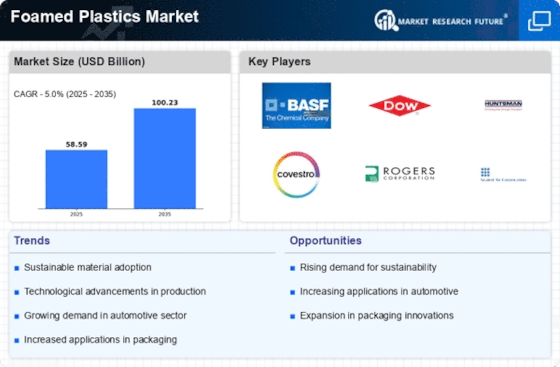
    As per MRFR analysis, the Foamed Plastics Market Size was estimated at 58.59 USD Billion in 2024. The Foamed Plastics industry is projected to grow from 61.52 USD Billion in 2025 to 100.23 USD Billion by 2035, exhibiting a compound annual growth rate (CAGR) of 5.0 during the forecast period 2025 - 2035.

    Key Market Trends & Highlights

    The foamed plastics market is poised for robust growth driven by sustainability and technological advancements.

    • North America remains the largest market for foamed plastics, driven by significant demand in the automotive and construction sectors.
    • The Asia-Pacific region is emerging as the fastest-growing market, fueled by rapid industrialization and urbanization.
    • Polyurethane continues to dominate the market, while polystyrene is witnessing the fastest growth due to its versatility and cost-effectiveness.
    • Key market drivers include rising demand in the automotive sector and increased focus on sustainable packaging solutions.

    Market Size & Forecast

    2024 Market Size 58.59 (USD Billion)
    2035 Market Size 100.23 (USD Billion)
    CAGR (2025 - 2035) 5.0%
    Largest Regional Market Share in 2024 North America

    Major Players

    <p>BASF SE (DE), Dow Inc. (US), Huntsman Corporation (US), Covestro AG (DE), Rogers Corporation (US), Sealed Air Corporation (US), Armacell International S.A. (LU), Zotefoams plc (GB), Recticel SA (BE)</p>

    Market Trends

    The Foamed Plastics Market is currently experiencing a dynamic evolution, driven by various factors that influence its growth trajectory. The increasing demand for lightweight materials across multiple industries, including automotive, construction, and packaging, appears to be a primary catalyst. As manufacturers seek to enhance energy efficiency and reduce overall weight in their products, foamed plastics offer an attractive solution. Furthermore, the ongoing advancements in technology and material science suggest that innovations in foamed plastics could lead to enhanced performance characteristics, thereby expanding their applications. In addition to technological advancements, environmental considerations are becoming increasingly prominent within the Foamed Plastics Market. The push for sustainable materials and practices is prompting manufacturers to explore bio-based and recyclable options. This shift not only aligns with global sustainability goals but also caters to the evolving preferences of consumers who are more environmentally conscious. As a result, the market landscape is likely to witness a transformation, with a growing emphasis on eco-friendly alternatives that do not compromise on performance or cost-effectiveness.

    Sustainability Initiatives

    The Foamed Plastics Market is witnessing a notable shift towards sustainability, as manufacturers increasingly prioritize eco-friendly materials. This trend is driven by consumer demand for greener products and regulatory pressures aimed at reducing environmental impact. Companies are exploring bio-based foams and recyclable options, which may enhance their market appeal and align with global sustainability goals.

    Technological Advancements

    Innovations in material science are significantly influencing the Foamed Plastics Market. New manufacturing techniques and formulations are emerging, leading to improved performance characteristics such as enhanced durability and thermal insulation. These advancements could potentially expand the range of applications for foamed plastics, making them more attractive to various industries.

    Lightweighting Trends

    The ongoing trend of lightweighting across industries is propelling the demand for foamed plastics. As sectors like automotive and aerospace seek to improve fuel efficiency and reduce emissions, the lightweight properties of foamed plastics are becoming increasingly desirable. This trend suggests a growing reliance on these materials to meet stringent performance and regulatory standards.

    Foamed Plastics Market Market Drivers

    Growth in Construction Activities

    The construction industry is a significant driver for the foamed plastics market, as these materials are increasingly employed in insulation and structural applications. The demand for energy-efficient buildings has surged, leading to a greater reliance on foamed plastics for thermal insulation, soundproofing, and lightweight construction. In 2025, the market for foamed plastics in construction is expected to grow by approximately 6.5%, reflecting the industry's commitment to sustainability and energy efficiency. Additionally, the versatility of foamed plastics allows for innovative designs and applications, further enhancing their appeal in modern construction projects. This growth trajectory indicates a robust future for the foamed plastics market, as it aligns with global trends towards sustainable building practices.

    Rising Demand in Automotive Sector

    The automotive sector is experiencing a notable increase in the adoption of foamed plastics, driven by the need for lightweight materials that enhance fuel efficiency. Foamed plastics, such as polyurethane and polystyrene, are increasingly utilized in vehicle interiors and exteriors, contributing to weight reduction and improved performance. In 2025, the foamed plastics market is projected to witness a growth rate of approximately 5.2%, largely attributed to the automotive industry's shift towards sustainable and efficient materials. This trend is further supported by stringent regulations aimed at reducing emissions, compelling manufacturers to seek innovative solutions. As a result, the foamed plastics market is likely to expand, catering to the evolving demands of automotive manufacturers seeking to balance performance with environmental responsibility.

    Increased Focus on Packaging Solutions

    The packaging sector is witnessing a transformative shift, with foamed plastics emerging as a preferred choice for protective packaging solutions. The foamed plastics market benefits from the rising demand for lightweight, durable, and cost-effective packaging materials. In 2025, the market is anticipated to expand by around 4.8%, driven by the e-commerce boom and the need for efficient shipping solutions. Foamed plastics provide excellent cushioning and protection for products during transit, reducing damage and waste. Furthermore, the growing emphasis on sustainable packaging options is likely to propel the adoption of biodegradable foamed plastics, thereby enhancing the market's appeal. This trend underscores the foamed plastics market's adaptability to changing consumer preferences and environmental considerations.

    Technological Innovations in Material Science

    Technological advancements in material science are significantly influencing the foamed plastics market, leading to the development of new formulations and applications. Innovations such as bio-based foamed plastics and enhanced manufacturing processes are paving the way for more sustainable and efficient products. In 2025, the market is projected to grow by approximately 5.5%, as manufacturers increasingly invest in research and development to create high-performance foamed plastics. These innovations not only improve the physical properties of foamed plastics but also expand their applicability across various sectors, including automotive, construction, and consumer goods. The ongoing evolution in material science suggests a promising future for the foamed plastics market, as it adapts to meet the demands of diverse industries.

    Environmental Regulations and Sustainability Goals

    The foamed plastics market is significantly influenced by the increasing implementation of environmental regulations and sustainability goals across various sectors. Governments and organizations are actively promoting the use of eco-friendly materials, which has led to a heightened interest in recyclable and biodegradable foamed plastics. In 2025, the market is expected to grow by approximately 5.0%, driven by these regulatory frameworks that encourage manufacturers to adopt sustainable practices. The push for reduced carbon footprints and waste management solutions is likely to propel the development of innovative foamed plastics that align with these goals. This trend indicates a transformative shift within the foamed plastics market, as it embraces sustainability as a core principle.

    Market Segment Insights

    By Type: Polyurethane (Largest) vs. Polystyrene (Fastest-Growing)

    <p>In the Foamed Plastics Market, the segment distribution reveals that Polyurethane holds the largest market share among the various types due to its versatility and superior properties. Polystyrene follows closely, benefiting from its applicability in lightweight, cost-effective packaging solutions. The other segments, including Polyolefin, Phenolic, and Others, account for a smaller share, yet contribute uniquely to the diversity of applications. This distribution highlights the strong demand for Polyurethane, driven by various industries ranging from automotive to insulation, while Polystyrene rapidly gains traction in consumer goods packaging.</p>

    <p>Polyurethane (Dominant) vs. Phenolic (Emerging)</p>

    <p>Polyurethane represents a dominant force in the Foamed Plastics Market, known for its exceptional resilience and insulation properties, making it a preferred choice in construction, automotive, and furniture applications. Its ability to be tailored for specific performance needs reinforces its market leadership. In contrast, Phenolic foams are emerging as a significant contender, appreciated for their fire-resistant properties and low thermal conductivity. These characteristics make Phenolic foams increasingly attractive for applications requiring strict fire safety measures, such as in the building and aerospace sectors. As sustainability and safety become ever more essential, the reputation and demand for both segments will continue to evolve.</p>

    By Application: Building & Construction (Largest) vs. Packaging (Fastest-Growing)

    <p>In the Foamed Plastics Market, the application segment is primarily dominated by the Building & Construction sector, which accounts for a substantial share of the overall market. This sector's demand is driven by increasing infrastructural developments and a growing preference for lightweight, energy-efficient materials. Subsequently, the Packaging industry is experiencing rapid growth, embracing foamed plastics for their protective qualities, light weight, and cost-efficiency, thus capturing a significant share of the market rapidly.</p>

    <p>Building & Construction (Dominant) vs. Packaging (Emerging)</p>

    <p>Building & Construction is a dominant segment in the Foamed Plastics Market, leveraging properties such as insulation, durability, and soundproofing. This segment is influenced by ongoing urbanization and the increasing need for sustainable building materials. Conversely, the Packaging segment is emerging rapidly, driven by the growing e-commerce sector and the need for protective packaging solutions that retain product integrity. The foamed materials used in this sector offer advantages such as reduced weight and enhanced shock absorption, catering to the increased demand from consumer goods manufacturers who seek sustainable and efficient packaging solutions.</p>

    Get more detailed insights about Foamed Plastics Market Research Report—Global Forecast till 2035

    Regional Insights

    North America : Innovation and Demand Surge

    North America is witnessing significant growth in the foamed plastics market, driven by increasing demand in automotive, construction, and packaging sectors. The region holds approximately 40% of the global market share, making it the largest market. Regulatory support for sustainable materials and innovations in manufacturing processes are key catalysts for this growth. The rising focus on lightweight materials is further propelling demand. The United States leads the North American market, with major players like Dow Inc. and BASF SE dominating the landscape. The competitive environment is characterized by continuous innovation and strategic partnerships among key players. Canada also contributes significantly, focusing on eco-friendly solutions and advanced manufacturing technologies. The presence of established companies ensures a robust supply chain and market stability.

    Europe : Sustainability and Innovation Focus

    Europe is emerging as a strong player in the foamed plastics market, driven by stringent regulations promoting sustainability and innovation. The region accounts for approximately 30% of the global market share, making it the second-largest market. The European Union's commitment to reducing plastic waste and promoting recycling is a significant driver for the adoption of foamed plastics in various applications, including automotive and construction. Germany and France are leading countries in this market, with key players like Covestro AG and Huntsman Corporation actively investing in sustainable technologies. The competitive landscape is marked by a focus on R&D and collaboration among industry stakeholders to develop eco-friendly products. The presence of regulatory bodies ensures compliance and fosters innovation, making Europe a hub for advanced foamed plastics solutions.

    Asia-Pacific : Emerging Markets and Growth Potential

    Asia-Pacific is rapidly expanding in the foamed plastics market, driven by increasing industrialization and urbanization. The region holds about 25% of the global market share, with countries like China and India leading the charge. The growing demand for lightweight materials in automotive and packaging sectors is a significant growth driver, alongside favorable government policies supporting manufacturing and innovation. China is the largest market in the region, with a strong presence of local manufacturers and international players like Sealed Air Corporation. India is also emerging as a key player, focusing on sustainable solutions and expanding its manufacturing capabilities. The competitive landscape is characterized by a mix of established companies and new entrants, fostering innovation and market growth. The region's potential for growth is immense, driven by increasing consumer demand and technological advancements.

    Middle East and Africa : Resource-Rich and Growing Demand

    The Middle East and Africa region is witnessing a gradual increase in the foamed plastics market, driven by growing demand in construction and packaging sectors. The region holds approximately 5% of the global market share, with significant potential for growth. Factors such as urbanization and infrastructure development are key drivers, alongside government initiatives to promote local manufacturing and reduce import dependency. Countries like South Africa and the UAE are leading the market, with a focus on sustainable materials and innovative applications. The competitive landscape is evolving, with both local and international players vying for market share. The presence of key players like Armacell International S.A. is enhancing the region's capabilities, while ongoing investments in technology and infrastructure are expected to boost market growth significantly.

    Key Players and Competitive Insights

    Leading market players are investing heavily in research and development in order to expand their product lines, which will help the Foamed Plastics market, grow even more. Market participants are also undertaking a variety of strategic activities to expand their global footprint, with important market developments including new product launches, contractual agreements, mergers and acquisitions, higher investments, and collaboration with other organizations. To expand and survive in a more competitive and rising market climate, Foamed Plastics industry must offer cost-effective items.

    Manufacturing locally to minimize Typeal costs is one of the key business tactics used by manufacturers in the global Foamed Plastics industry to benefit clients and increase the market sector. In recent years, the Foamed Plastics industry has offered some of the most significant advantages to medicine. Major players in the Foamed Plastics market, including Hexion Inc., COVESTRO AG, BASF SE, Total SE, Wanhua Chemical Group Co., Ltd., SABIC, Alchemie Ltd., The Dow Chemical Company, HUNTSMAN CORPORATION, and Repsol, are attempting to increase market demand by investing in research and development Types.

    BASF SE (BASF) is a company that produces chemicals. It manufactures, markets, and sells chemicals, polymers, crop protection products, and performance items. The company's product line includes solvents, adhesives, surfactants, fuel additives, electronic chemicals, pigments, paints, food additives, fungicides, and herbicides. The company works with a wide range of industries, including those related to building, woodworking, agriculture, electronics and electrical, paints and coatings, transportation, home care, nutrition, and chemicals. In partnership with international customers, partners, and researchers, BASF carries out R&D. The company's operations are supported by a global network of production facilities.

    It can be found all over the world, including in North America, Europe, Asia, South America, Africa, and the Middle East. The BASF corporate headquarters are in Ludwigshafen, Germany. In March 2019, BASF improved its regional innovation capabilities with new facilities at the Innovation Campus Shanghai in order to further develop partnership with the automobile industry and offer cutting-edge process catalysts to the chemical industry.

    Manufacturer of unique organic chemical compounds is Huntsman Corp (Huntsman). A wide variety of chemicals and formulations are available, including amines, maleic anhydride, MDI, formulations for epoxy-based polymers, textile chemicals, and dyes. The business markets its goods to a variety of retail and business clients. The adhesives, aerospace, personal care and hygiene, automotive, construction, durable and non-durable consumer goods, digital inks, electronics, power generation, refining, medical, packaging, coatings and construction, synthetic fibre, textile chemicals, and dyes industries are just a few industries where Huntsman products are used.

    The business is run through a worldwide network of administrative, R&D, and production facilities located in North America, the Middle East, Europe, and Asia. Huntsman's US headquarters are in Texas. Icynene-Lapolla, a top North American manufacturer and distributor of spray polyurethane foam (SPF) insulation products for residential and commercial applications, was acquired by Huntsman Corporation in February 2020, according to a press release.

    Key Companies in the Foamed Plastics Market market include

    Industry Developments

    June 2022: DualPakECOâ, a certified biodegradable and dual ovenable food tray made of paper, was created in partnership by Confoil and BASF SE.

    Future Outlook

    Foamed Plastics Market Future Outlook

    <p>The Foamed Plastics Market is projected to grow at a 5.0% CAGR from 2024 to 2035, driven by increasing demand in automotive, construction, and packaging sectors.</p>

    New opportunities lie in:

    • <p>Development of bio-based foamed plastics for sustainable packaging solutions.</p>
    • <p>Expansion into emerging markets with tailored product offerings.</p>
    • <p>Investment in advanced manufacturing technologies to enhance production efficiency.</p>

    <p>By 2035, the Foamed Plastics Market is expected to achieve robust growth, reflecting evolving industry demands.</p>

    Market Segmentation

    Foamed Plastics Type Outlook

    • Polyurethane
    • Polystyrene
    • Polyolefin
    • Phenolic
    • Others

    Foamed Plastics Regional Outlook

    North America
    • US
    • Canada

    Foamed Plastics Application Outlook

    • Building & Construction
    • Packaging
    • Automotive
    • Furniture & Bedding
    • Footwear, Sports, & Recreational
    • Others

    Report Scope

    MARKET SIZE 202458.59(USD Billion)
    MARKET SIZE 202561.52(USD Billion)
    MARKET SIZE 2035100.23(USD Billion)
    COMPOUND ANNUAL GROWTH RATE (CAGR)5.0% (2024 - 2035)
    REPORT COVERAGERevenue Forecast, Competitive Landscape, Growth Factors, and Trends
    BASE YEAR2024
    Market Forecast Period2025 - 2035
    Historical Data2019 - 2024
    Market Forecast UnitsUSD Billion
    Key Companies ProfiledMarket analysis in progress
    Segments CoveredMarket segmentation analysis in progress
    Key Market OpportunitiesGrowing demand for sustainable foamed plastics driven by environmental regulations and consumer preferences.
    Key Market DynamicsRising demand for lightweight materials drives innovation and competition in the foamed plastics sector.
    Countries CoveredNorth America, Europe, APAC, South America, MEA

    FAQs

    How much is the Foamed Plastics market?

    The Foamed Plastics Market size was valued at USD 58.59 Billion in 2024.

    What is the growth rate of the Foamed Plastics market?

    Foamed Plastics Market is projected to register a CAGR of 5% from 2025-2035

    Which region held the largest market share in the Foamed Plastics market?

    North America had the largest share in the global market

    Who are the key players in the Foamed Plastics market?

    The key players in the market are Hexion Inc., COVESTRO AG, BASF SE, Total SE, Wanhua Chemical Group Co., Ltd., SABIC, Alchemie Ltd., The Dow Chemical Company, HUNTSMAN CORPORATION, and Repsol

    Which Type led the Foamed Plastics market?

    The Polyurethane Type dominated the market in 2022.

    Which Application had the largest market share in the Foamed Plastics market?

    The Building &amp; Construction Application had the largest share in the global market.

    1. SECTION I: EXECUTIVE SUMMARY AND KEY HIGHLIGHTS
      1. | 1.1 EXECUTIVE SUMMARY
      2. | | 1.1.1 Market Overview
      3. | | 1.1.2 Key Findings
      4. | | 1.1.3 Market Segmentation
      5. | | 1.1.4 Competitive Landscape
      6. | | 1.1.5 Challenges and Opportunities
      7. | | 1.1.6 Future Outlook
    2. SECTION II: SCOPING, METHODOLOGY AND MARKET STRUCTURE
      1. | 2.1 MARKET INTRODUCTION
      2. | | 2.1.1 Definition
      3. | | 2.1.2 Scope of the study
      4. | | | 2.1.2.1 Research Objective
      5. | | | 2.1.2.2 Assumption
      6. | | | 2.1.2.3 Limitations
      7. | 2.2 RESEARCH METHODOLOGY
      8. | | 2.2.1 Overview
      9. | | 2.2.2 Data Mining
      10. | | 2.2.3 Secondary Research
      11. | | 2.2.4 Primary Research
      12. | | | 2.2.4.1 Primary Interviews and Information Gathering Process
      13. | | | 2.2.4.2 Breakdown of Primary Respondents
      14. | | 2.2.5 Forecasting Model
      15. | | 2.2.6 Market Size Estimation
      16. | | | 2.2.6.1 Bottom-Up Approach
      17. | | | 2.2.6.2 Top-Down Approach
      18. | | 2.2.7 Data Triangulation
      19. | | 2.2.8 Validation
    3. SECTION III: QUALITATIVE ANALYSIS
      1. | 3.1 MARKET DYNAMICS
      2. | | 3.1.1 Overview
      3. | | 3.1.2 Drivers
      4. | | 3.1.3 Restraints
      5. | | 3.1.4 Opportunities
      6. | 3.2 MARKET FACTOR ANALYSIS
      7. | | 3.2.1 Value chain Analysis
      8. | | 3.2.2 Porter's Five Forces Analysis
      9. | | | 3.2.2.1 Bargaining Power of Suppliers
      10. | | | 3.2.2.2 Bargaining Power of Buyers
      11. | | | 3.2.2.3 Threat of New Entrants
      12. | | | 3.2.2.4 Threat of Substitutes
      13. | | | 3.2.2.5 Intensity of Rivalry
      14. | | 3.2.3 COVID-19 Impact Analysis
      15. | | | 3.2.3.1 Market Impact Analysis
      16. | | | 3.2.3.2 Regional Impact
      17. | | | 3.2.3.3 Opportunity and Threat Analysis
    4. SECTION IV: QUANTITATIVE ANALYSIS
      1. | 4.1 Chemicals and Materials, BY Type (USD Billion)
      2. | | 4.1.1 Polyurethane
      3. | | 4.1.2 Polystyrene
      4. | | 4.1.3 Polyolefin
      5. | | 4.1.4 Phenolic
      6. | | 4.1.5 Others
      7. | 4.2 Chemicals and Materials, BY Application (USD Billion)
      8. | | 4.2.1 Building & Construction
      9. | | 4.2.2 Packaging
      10. | | 4.2.3 Automotive
      11. | | 4.2.4 Furniture & Bedding
      12. | | 4.2.5 Footwear, Sports, & Recreational
      13. | | 4.2.6 Others
      14. | 4.3 Chemicals and Materials, BY Region (USD Billion)
      15. | | 4.3.1 North America
      16. | | | 4.3.1.1 US
      17. | | | 4.3.1.2 Canada
      18. | | 4.3.2 Europe
      19. | | | 4.3.2.1 Germany
      20. | | | 4.3.2.2 UK
      21. | | | 4.3.2.3 France
      22. | | | 4.3.2.4 Russia
      23. | | | 4.3.2.5 Italy
      24. | | | 4.3.2.6 Spain
      25. | | | 4.3.2.7 Rest of Europe
      26. | | 4.3.3 APAC
      27. | | | 4.3.3.1 China
      28. | | | 4.3.3.2 India
      29. | | | 4.3.3.3 Japan
      30. | | | 4.3.3.4 South Korea
      31. | | | 4.3.3.5 Malaysia
      32. | | | 4.3.3.6 Thailand
      33. | | | 4.3.3.7 Indonesia
      34. | | | 4.3.3.8 Rest of APAC
      35. | | 4.3.4 South America
      36. | | | 4.3.4.1 Brazil
      37. | | | 4.3.4.2 Mexico
      38. | | | 4.3.4.3 Argentina
      39. | | | 4.3.4.4 Rest of South America
      40. | | 4.3.5 MEA
      41. | | | 4.3.5.1 GCC Countries
      42. | | | 4.3.5.2 South Africa
      43. | | | 4.3.5.3 Rest of MEA
    5. SECTION V: COMPETITIVE ANALYSIS
      1. | 5.1 Competitive Landscape
      2. | | 5.1.1 Overview
      3. | | 5.1.2 Competitive Analysis
      4. | | 5.1.3 Market share Analysis
      5. | | 5.1.4 Major Growth Strategy in the Chemicals and Materials
      6. | | 5.1.5 Competitive Benchmarking
      7. | | 5.1.6 Leading Players in Terms of Number of Developments in the Chemicals and Materials
      8. | | 5.1.7 Key developments and growth strategies
      9. | | | 5.1.7.1 New Product Launch/Service Deployment
      10. | | | 5.1.7.2 Merger & Acquisitions
      11. | | | 5.1.7.3 Joint Ventures
      12. | | 5.1.8 Major Players Financial Matrix
      13. | | | 5.1.8.1 Sales and Operating Income
      14. | | | 5.1.8.2 Major Players R&D Expenditure. 2023
      15. | 5.2 Company Profiles
      16. | | 5.2.1 BASF SE (DE)
      17. | | | 5.2.1.1 Financial Overview
      18. | | | 5.2.1.2 Products Offered
      19. | | | 5.2.1.3 Key Developments
      20. | | | 5.2.1.4 SWOT Analysis
      21. | | | 5.2.1.5 Key Strategies
      22. | | 5.2.2 Dow Inc. (US)
      23. | | | 5.2.2.1 Financial Overview
      24. | | | 5.2.2.2 Products Offered
      25. | | | 5.2.2.3 Key Developments
      26. | | | 5.2.2.4 SWOT Analysis
      27. | | | 5.2.2.5 Key Strategies
      28. | | 5.2.3 Huntsman Corporation (US)
      29. | | | 5.2.3.1 Financial Overview
      30. | | | 5.2.3.2 Products Offered
      31. | | | 5.2.3.3 Key Developments
      32. | | | 5.2.3.4 SWOT Analysis
      33. | | | 5.2.3.5 Key Strategies
      34. | | 5.2.4 Covestro AG (DE)
      35. | | | 5.2.4.1 Financial Overview
      36. | | | 5.2.4.2 Products Offered
      37. | | | 5.2.4.3 Key Developments
      38. | | | 5.2.4.4 SWOT Analysis
      39. | | | 5.2.4.5 Key Strategies
      40. | | 5.2.5 Rogers Corporation (US)
      41. | | | 5.2.5.1 Financial Overview
      42. | | | 5.2.5.2 Products Offered
      43. | | | 5.2.5.3 Key Developments
      44. | | | 5.2.5.4 SWOT Analysis
      45. | | | 5.2.5.5 Key Strategies
      46. | | 5.2.6 Sealed Air Corporation (US)
      47. | | | 5.2.6.1 Financial Overview
      48. | | | 5.2.6.2 Products Offered
      49. | | | 5.2.6.3 Key Developments
      50. | | | 5.2.6.4 SWOT Analysis
      51. | | | 5.2.6.5 Key Strategies
      52. | | 5.2.7 Armacell International S.A. (LU)
      53. | | | 5.2.7.1 Financial Overview
      54. | | | 5.2.7.2 Products Offered
      55. | | | 5.2.7.3 Key Developments
      56. | | | 5.2.7.4 SWOT Analysis
      57. | | | 5.2.7.5 Key Strategies
      58. | | 5.2.8 Zotefoams plc (GB)
      59. | | | 5.2.8.1 Financial Overview
      60. | | | 5.2.8.2 Products Offered
      61. | | | 5.2.8.3 Key Developments
      62. | | | 5.2.8.4 SWOT Analysis
      63. | | | 5.2.8.5 Key Strategies
      64. | | 5.2.9 Recticel SA (BE)
      65. | | | 5.2.9.1 Financial Overview
      66. | | | 5.2.9.2 Products Offered
      67. | | | 5.2.9.3 Key Developments
      68. | | | 5.2.9.4 SWOT Analysis
      69. | | | 5.2.9.5 Key Strategies
      70. | 5.3 Appendix
      71. | | 5.3.1 References
      72. | | 5.3.2 Related Reports
    6. LIST OF FIGURES
      1. | 6.1 MARKET SYNOPSIS
      2. | 6.2 NORTH AMERICA MARKET ANALYSIS
      3. | 6.3 US MARKET ANALYSIS BY TYPE
      4. | 6.4 US MARKET ANALYSIS BY APPLICATION
      5. | 6.5 CANADA MARKET ANALYSIS BY TYPE
      6. | 6.6 CANADA MARKET ANALYSIS BY APPLICATION
      7. | 6.7 EUROPE MARKET ANALYSIS
      8. | 6.8 GERMANY MARKET ANALYSIS BY TYPE
      9. | 6.9 GERMANY MARKET ANALYSIS BY APPLICATION
      10. | 6.10 UK MARKET ANALYSIS BY TYPE
      11. | 6.11 UK MARKET ANALYSIS BY APPLICATION
      12. | 6.12 FRANCE MARKET ANALYSIS BY TYPE
      13. | 6.13 FRANCE MARKET ANALYSIS BY APPLICATION
      14. | 6.14 RUSSIA MARKET ANALYSIS BY TYPE
      15. | 6.15 RUSSIA MARKET ANALYSIS BY APPLICATION
      16. | 6.16 ITALY MARKET ANALYSIS BY TYPE
      17. | 6.17 ITALY MARKET ANALYSIS BY APPLICATION
      18. | 6.18 SPAIN MARKET ANALYSIS BY TYPE
      19. | 6.19 SPAIN MARKET ANALYSIS BY APPLICATION
      20. | 6.20 REST OF EUROPE MARKET ANALYSIS BY TYPE
      21. | 6.21 REST OF EUROPE MARKET ANALYSIS BY APPLICATION
      22. | 6.22 APAC MARKET ANALYSIS
      23. | 6.23 CHINA MARKET ANALYSIS BY TYPE
      24. | 6.24 CHINA MARKET ANALYSIS BY APPLICATION
      25. | 6.25 INDIA MARKET ANALYSIS BY TYPE
      26. | 6.26 INDIA MARKET ANALYSIS BY APPLICATION
      27. | 6.27 JAPAN MARKET ANALYSIS BY TYPE
      28. | 6.28 JAPAN MARKET ANALYSIS BY APPLICATION
      29. | 6.29 SOUTH KOREA MARKET ANALYSIS BY TYPE
      30. | 6.30 SOUTH KOREA MARKET ANALYSIS BY APPLICATION
      31. | 6.31 MALAYSIA MARKET ANALYSIS BY TYPE
      32. | 6.32 MALAYSIA MARKET ANALYSIS BY APPLICATION
      33. | 6.33 THAILAND MARKET ANALYSIS BY TYPE
      34. | 6.34 THAILAND MARKET ANALYSIS BY APPLICATION
      35. | 6.35 INDONESIA MARKET ANALYSIS BY TYPE
      36. | 6.36 INDONESIA MARKET ANALYSIS BY APPLICATION
      37. | 6.37 REST OF APAC MARKET ANALYSIS BY TYPE
      38. | 6.38 REST OF APAC MARKET ANALYSIS BY APPLICATION
      39. | 6.39 SOUTH AMERICA MARKET ANALYSIS
      40. | 6.40 BRAZIL MARKET ANALYSIS BY TYPE
      41. | 6.41 BRAZIL MARKET ANALYSIS BY APPLICATION
      42. | 6.42 MEXICO MARKET ANALYSIS BY TYPE
      43. | 6.43 MEXICO MARKET ANALYSIS BY APPLICATION
      44. | 6.44 ARGENTINA MARKET ANALYSIS BY TYPE
      45. | 6.45 ARGENTINA MARKET ANALYSIS BY APPLICATION
      46. | 6.46 REST OF SOUTH AMERICA MARKET ANALYSIS BY TYPE
      47. | 6.47 REST OF SOUTH AMERICA MARKET ANALYSIS BY APPLICATION
      48. | 6.48 MEA MARKET ANALYSIS
      49. | 6.49 GCC COUNTRIES MARKET ANALYSIS BY TYPE
      50. | 6.50 GCC COUNTRIES MARKET ANALYSIS BY APPLICATION
      51. | 6.51 SOUTH AFRICA MARKET ANALYSIS BY TYPE
      52. | 6.52 SOUTH AFRICA MARKET ANALYSIS BY APPLICATION
      53. | 6.53 REST OF MEA MARKET ANALYSIS BY TYPE
      54. | 6.54 REST OF MEA MARKET ANALYSIS BY APPLICATION
      55. | 6.55 KEY BUYING CRITERIA OF CHEMICALS AND MATERIALS
      56. | 6.56 RESEARCH PROCESS OF MRFR
      57. | 6.57 DRO ANALYSIS OF CHEMICALS AND MATERIALS
      58. | 6.58 DRIVERS IMPACT ANALYSIS: CHEMICALS AND MATERIALS
      59. | 6.59 RESTRAINTS IMPACT ANALYSIS: CHEMICALS AND MATERIALS
      60. | 6.60 SUPPLY / VALUE CHAIN: CHEMICALS AND MATERIALS
      61. | 6.61 CHEMICALS AND MATERIALS, BY TYPE, 2024 (% SHARE)
      62. | 6.62 CHEMICALS AND MATERIALS, BY TYPE, 2024 TO 2035 (USD Billion)
      63. | 6.63 CHEMICALS AND MATERIALS, BY APPLICATION, 2024 (% SHARE)
      64. | 6.64 CHEMICALS AND MATERIALS, BY APPLICATION, 2024 TO 2035 (USD Billion)
      65. | 6.65 BENCHMARKING OF MAJOR COMPETITORS
    7. LIST OF TABLES
      1. | 7.1 LIST OF ASSUMPTIONS
      2. | | 7.1.1
      3. | 7.2 North America MARKET SIZE ESTIMATES; FORECAST
      4. | | 7.2.1 BY TYPE, 2025-2035 (USD Billion)
      5. | | 7.2.2 BY APPLICATION, 2025-2035 (USD Billion)
      6. | 7.3 US MARKET SIZE ESTIMATES; FORECAST
      7. | | 7.3.1 BY TYPE, 2025-2035 (USD Billion)
      8. | | 7.3.2 BY APPLICATION, 2025-2035 (USD Billion)
      9. | 7.4 Canada MARKET SIZE ESTIMATES; FORECAST
      10. | | 7.4.1 BY TYPE, 2025-2035 (USD Billion)
      11. | | 7.4.2 BY APPLICATION, 2025-2035 (USD Billion)
      12. | 7.5 Europe MARKET SIZE ESTIMATES; FORECAST
      13. | | 7.5.1 BY TYPE, 2025-2035 (USD Billion)
      14. | | 7.5.2 BY APPLICATION, 2025-2035 (USD Billion)
      15. | 7.6 Germany MARKET SIZE ESTIMATES; FORECAST
      16. | | 7.6.1 BY TYPE, 2025-2035 (USD Billion)
      17. | | 7.6.2 BY APPLICATION, 2025-2035 (USD Billion)
      18. | 7.7 UK MARKET SIZE ESTIMATES; FORECAST
      19. | | 7.7.1 BY TYPE, 2025-2035 (USD Billion)
      20. | | 7.7.2 BY APPLICATION, 2025-2035 (USD Billion)
      21. | 7.8 France MARKET SIZE ESTIMATES; FORECAST
      22. | | 7.8.1 BY TYPE, 2025-2035 (USD Billion)
      23. | | 7.8.2 BY APPLICATION, 2025-2035 (USD Billion)
      24. | 7.9 Russia MARKET SIZE ESTIMATES; FORECAST
      25. | | 7.9.1 BY TYPE, 2025-2035 (USD Billion)
      26. | | 7.9.2 BY APPLICATION, 2025-2035 (USD Billion)
      27. | 7.10 Italy MARKET SIZE ESTIMATES; FORECAST
      28. | | 7.10.1 BY TYPE, 2025-2035 (USD Billion)
      29. | | 7.10.2 BY APPLICATION, 2025-2035 (USD Billion)
      30. | 7.11 Spain MARKET SIZE ESTIMATES; FORECAST
      31. | | 7.11.1 BY TYPE, 2025-2035 (USD Billion)
      32. | | 7.11.2 BY APPLICATION, 2025-2035 (USD Billion)
      33. | 7.12 Rest of Europe MARKET SIZE ESTIMATES; FORECAST
      34. | | 7.12.1 BY TYPE, 2025-2035 (USD Billion)
      35. | | 7.12.2 BY APPLICATION, 2025-2035 (USD Billion)
      36. | 7.13 APAC MARKET SIZE ESTIMATES; FORECAST
      37. | | 7.13.1 BY TYPE, 2025-2035 (USD Billion)
      38. | | 7.13.2 BY APPLICATION, 2025-2035 (USD Billion)
      39. | 7.14 China MARKET SIZE ESTIMATES; FORECAST
      40. | | 7.14.1 BY TYPE, 2025-2035 (USD Billion)
      41. | | 7.14.2 BY APPLICATION, 2025-2035 (USD Billion)
      42. | 7.15 India MARKET SIZE ESTIMATES; FORECAST
      43. | | 7.15.1 BY TYPE, 2025-2035 (USD Billion)
      44. | | 7.15.2 BY APPLICATION, 2025-2035 (USD Billion)
      45. | 7.16 Japan MARKET SIZE ESTIMATES; FORECAST
      46. | | 7.16.1 BY TYPE, 2025-2035 (USD Billion)
      47. | | 7.16.2 BY APPLICATION, 2025-2035 (USD Billion)
      48. | 7.17 South Korea MARKET SIZE ESTIMATES; FORECAST
      49. | | 7.17.1 BY TYPE, 2025-2035 (USD Billion)
      50. | | 7.17.2 BY APPLICATION, 2025-2035 (USD Billion)
      51. | 7.18 Malaysia MARKET SIZE ESTIMATES; FORECAST
      52. | | 7.18.1 BY TYPE, 2025-2035 (USD Billion)
      53. | | 7.18.2 BY APPLICATION, 2025-2035 (USD Billion)
      54. | 7.19 Thailand MARKET SIZE ESTIMATES; FORECAST
      55. | | 7.19.1 BY TYPE, 2025-2035 (USD Billion)
      56. | | 7.19.2 BY APPLICATION, 2025-2035 (USD Billion)
      57. | 7.20 Indonesia MARKET SIZE ESTIMATES; FORECAST
      58. | | 7.20.1 BY TYPE, 2025-2035 (USD Billion)
      59. | | 7.20.2 BY APPLICATION, 2025-2035 (USD Billion)
      60. | 7.21 Rest of APAC MARKET SIZE ESTIMATES; FORECAST
      61. | | 7.21.1 BY TYPE, 2025-2035 (USD Billion)
      62. | | 7.21.2 BY APPLICATION, 2025-2035 (USD Billion)
      63. | 7.22 South America MARKET SIZE ESTIMATES; FORECAST
      64. | | 7.22.1 BY TYPE, 2025-2035 (USD Billion)
      65. | | 7.22.2 BY APPLICATION, 2025-2035 (USD Billion)
      66. | 7.23 Brazil MARKET SIZE ESTIMATES; FORECAST
      67. | | 7.23.1 BY TYPE, 2025-2035 (USD Billion)
      68. | | 7.23.2 BY APPLICATION, 2025-2035 (USD Billion)
      69. | 7.24 Mexico MARKET SIZE ESTIMATES; FORECAST
      70. | | 7.24.1 BY TYPE, 2025-2035 (USD Billion)
      71. | | 7.24.2 BY APPLICATION, 2025-2035 (USD Billion)
      72. | 7.25 Argentina MARKET SIZE ESTIMATES; FORECAST
      73. | | 7.25.1 BY TYPE, 2025-2035 (USD Billion)
      74. | | 7.25.2 BY APPLICATION, 2025-2035 (USD Billion)
      75. | 7.26 Rest of South America MARKET SIZE ESTIMATES; FORECAST
      76. | | 7.26.1 BY TYPE, 2025-2035 (USD Billion)
      77. | | 7.26.2 BY APPLICATION, 2025-2035 (USD Billion)
      78. | 7.27 MEA MARKET SIZE ESTIMATES; FORECAST
      79. | | 7.27.1 BY TYPE, 2025-2035 (USD Billion)
      80. | | 7.27.2 BY APPLICATION, 2025-2035 (USD Billion)
      81. | 7.28 GCC Countries MARKET SIZE ESTIMATES; FORECAST
      82. | | 7.28.1 BY TYPE, 2025-2035 (USD Billion)
      83. | | 7.28.2 BY APPLICATION, 2025-2035 (USD Billion)
      84. | 7.29 South Africa MARKET SIZE ESTIMATES; FORECAST
      85. | | 7.29.1 BY TYPE, 2025-2035 (USD Billion)
      86. | | 7.29.2 BY APPLICATION, 2025-2035 (USD Billion)
      87. | 7.30 Rest of MEA MARKET SIZE ESTIMATES; FORECAST
      88. | | 7.30.1 BY TYPE, 2025-2035 (USD Billion)
      89. | | 7.30.2 BY APPLICATION, 2025-2035 (USD Billion)
      90. | 7.31 PRODUCT LAUNCH/PRODUCT DEVELOPMENT/APPROVAL
      91. | | 7.31.1
      92. | 7.32 ACQUISITION/PARTNERSHIP
      93. | | 7.32.1

    Foamed Plastics Market Segmentation

    Foamed Plastics Market Type Outlook (USD Billion, 2018-2032)

    • Polyurethane
    • Polystyrene
    • Polyolefin
    • Phenolic
    • Others

    Foamed Plastics Market Application Outlook (USD Billion, 2018-2032)

    • Building & Construction
    • Packaging
    • Automotive
    • Furniture & Bedding
    • Footwear, Sports, & Recreational
    • Others

    Foamed Plastics Market Regional Outlook (USD Billion, 2018-2032)

    • North America Outlook (USD Billion, 2018-2032)

      • Foamed Plastics Market by Type
        • Polyurethane
        • Polystyrene
        • Polyolefin
        • Phenolic
        • Others
      • Foamed Plastics Market by Application
        • Building & Construction
        • Packaging
        • Automotive
        • Furniture & Bedding
        • Footwear, Sports, & Recreational
        • Others
      • US Outlook (USD Billion, 2018-2032)

      • Foamed Plastics Market by Type
        • Polyurethane
        • Polystyrene
        • Polyolefin
        • Phenolic
        • Others
      • Foamed Plastics Market by Application
        • Building & Construction
        • Packaging
        • Automotive
        • Furniture & Bedding
        • Footwear, Sports, & Recreational
        • Others
      • Canada Outlook (USD Billion, 2018-2032)

      • Foamed Plastics Market by Type
        • Polyurethane
        • Polystyrene
        • Polyolefin
        • Phenolic
        • Others
      • Foamed Plastics Market by Application
        • Building & Construction
        • Packaging
        • Automotive
        • Furniture & Bedding
        • Footwear, Sports, & Recreational
        • Others
    • Europe Outlook (USD Billion, 2018-2032)

      • Foamed Plastics Market by Type
        • Polyurethane
        • Polystyrene
        • Polyolefin
        • Phenolic
        • Others
      • Foamed Plastics Market by Application
        • Building & Construction
        • Packaging
        • Automotive
        • Furniture & Bedding
        • Footwear, Sports, & Recreational
        • Others
      • Germany Outlook (USD Billion, 2018-2032)

      • Foamed Plastics Market by Type
        • Polyurethane
        • Polystyrene
        • Polyolefin
        • Phenolic
        • Others
      • Foamed Plastics Market by Application
        • Building & Construction
        • Packaging
        • Automotive
        • Furniture & Bedding
        • Footwear, Sports, & Recreational
        • Others
      • France Outlook (USD Billion, 2018-2032)

      • Foamed Plastics Market by Type
        • Polyurethane
        • Polystyrene
        • Polyolefin
        • Phenolic
        • Others
      • Foamed Plastics Market by Application
        • Building & Construction
        • Packaging
        • Automotive
        • Furniture & Bedding
        • Footwear, Sports, & Recreational
        • Others
      • UK Outlook (USD Billion, 2018-2032)

      • Foamed Plastics Market by Type
        • Polyurethane
        • Polystyrene
        • Polyolefin
        • Phenolic
        • Others
      • Foamed Plastics Market by Application
        • Building & Construction
        • Packaging
        • Automotive
        • Furniture & Bedding
        • Footwear, Sports, & Recreational
        • Others
      • Italy Outlook (USD Billion, 2018-2032)

      • Foamed Plastics Market by Type
        • Polyurethane
        • Polystyrene
        • Polyolefin
        • Phenolic
        • Others
      • Foamed Plastics Market by Application
        • Building & Construction
        • Packaging
        • Automotive
        • Furniture & Bedding
        • Footwear, Sports, & Recreational
        • Others
      • Spain Outlook (USD Billion, 2018-2032)

      • Foamed Plastics Market by Type
        • Polyurethane
        • Polystyrene
        • Polyolefin
        • Phenolic
        • Others
      • Foamed Plastics Market by Application
        • Building & Construction
        • Packaging
        • Automotive
        • Furniture & Bedding
        • Footwear, Sports, & Recreational
        • Others
      • Rest Of Europe Outlook (USD Billion, 2018-2032)

      • Foamed Plastics Market by Type
        • Polyurethane
        • Polystyrene
        • Polyolefin
        • Phenolic
        • Others
      • Foamed Plastics Market by Application
        • Building & Construction
        • Packaging
        • Automotive
        • Furniture & Bedding
        • Footwear, Sports, & Recreational
        • Others
    • Asia-Pacific Outlook (USD Billion, 2018-2032)

      • Foamed Plastics Market by Type
        • Polyurethane
        • Polystyrene
        • Polyolefin
        • Phenolic
        • Others
      • Foamed Plastics Market by Application
        • Building & Construction
        • Packaging
        • Automotive
        • Furniture & Bedding
        • Footwear, Sports, & Recreational
        • Others
      • China Outlook (USD Billion, 2018-2032)

      • Foamed Plastics Market by Type
        • Polyurethane
        • Polystyrene
        • Polyolefin
        • Phenolic
        • Others
      • Foamed Plastics Market by Application
        • Building & Construction
        • Packaging
        • Automotive
        • Furniture & Bedding
        • Footwear, Sports, & Recreational
        • Others
      • Japan Outlook (USD Billion, 2018-2032)

      • Foamed Plastics Market by Type
        • Polyurethane
        • Polystyrene
        • Polyolefin
        • Phenolic
        • Others
      • Foamed Plastics Market by Application
        • Building & Construction
        • Packaging
        • Automotive
        • Furniture & Bedding
        • Footwear, Sports, & Recreational
        • Others
      • India Outlook (USD Billion, 2018-2032)

      • Foamed Plastics Market by Type
        • Polyurethane
        • Polystyrene
        • Polyolefin
        • Phenolic
        • Others
      • Foamed Plastics Market by Application
        • Building & Construction
        • Packaging
        • Automotive
        • Furniture & Bedding
        • Footwear, Sports, & Recreational
        • Others
      • Australia Outlook (USD Billion, 2018-2032)

      • Foamed Plastics Market by Type
        • Polyurethane
        • Polystyrene
        • Polyolefin
        • Phenolic
        • Others
      • Foamed Plastics Market by Application
        • Building & Construction
        • Packaging
        • Automotive
        • Furniture & Bedding
        • Footwear, Sports, & Recreational
        • Others
      • Rest of Asia-Pacific Outlook (USD Billion, 2018-2032)

      • Foamed Plastics Market by Type
        • Polyurethane
        • Polystyrene
        • Polyolefin
        • Phenolic
        • Others
      • Foamed Plastics Market by Application
        • Building & Construction
        • Packaging
        • Automotive
        • Furniture & Bedding
        • Footwear, Sports, & Recreational
        • Others
    • Rest of the World Outlook (USD Billion, 2018-2032)

      • Foamed Plastics Market by Type
        • Polyurethane
        • Polystyrene
        • Polyolefin
        • Phenolic
        • Others
      • Foamed Plastics Market by Application
        • Building & Construction
        • Packaging
        • Automotive
        • Furniture & Bedding
        • Footwear, Sports, & Recreational
        • Others
      • Middle East Outlook (USD Billion, 2018-2032)

      • Foamed Plastics Market by Type
        • Polyurethane
        • Polystyrene
        • Polyolefin
        • Phenolic
        • Others
      • Foamed Plastics Market by Application
        • Building & Construction
        • Packaging
        • Automotive
        • Furniture & Bedding
        • Footwear, Sports, & Recreational
        • Others
      • Africa Outlook (USD Billion, 2018-2032)

      • Foamed Plastics Market by Type
        • Polyurethane
        • Polystyrene
        • Polyolefin
        • Phenolic
        • Others
      • Foamed Plastics Market by Application
        • Building & Construction
        • Packaging
        • Automotive
        • Furniture & Bedding
        • Footwear, Sports, & Recreational
        • Others
      • Latin America Outlook (USD Billion, 2018-2032)

      • Foamed Plastics Market by Type
        • Polyurethane
        • Polystyrene
        • Polyolefin
        • Phenolic
        • Others
      • Foamed Plastics Market by Application
        • Building & Construction
        • Packaging
        • Automotive
        • Furniture & Bedding
        • Footwear, Sports, & Recreational
        • Others
    Infographic

    Free Sample Request

    Kindly complete the form below to receive a free sample of this Report

    Get Free Sample

    Customer Strories

    “I am very pleased with how market segments have been defined in a relevant way for my purposes (such as "Portable Freezers & refrigerators" and "last-mile"). In general the report is well structured. Thanks very much for your efforts.”

    Victoria Milne

    Founder
    Case Study
    Chemicals and Materials

    Compare Licence

    ×
    Features License Type
    Single User Multiuser License Enterprise User
    Price $4,950 $5,950 $7,250
    Maximum User Access Limit 1 User Upto 10 Users Unrestricted Access Throughout the Organization
    Free Customization
    Direct Access to Analyst
    Deliverable Format
    Platform Access
    Discount on Next Purchase 10% 15% 15%
    Printable Versions