• Cat-intel
  • MedIntelliX
  • Resources
  • About Us
  • Hero Background
    English
    Chinese
    French
    Japanese
    Korean
    German
    Spanish

    Foamed Plastics Market Size

    ID: MRFR/CnM/10491-HCR
    128 Pages
    Anshula Mandaokar
    October 2025

    Foamed Plastics Market Research Report Information By Type (Polyurethane, Polystyrene, Polyolefin, Phenolic, and Others), By Application (Building & Construction, Packaging, Automotive, Furniture & Bedding, Footwear, Sports, & Recreational, and Others), and By Region (North America, Europe, Asia-Pacific, and Rest Of The World) – Market Forecast Till 2035

    Share:
    Download PDF ×

    We do not share your information with anyone. However, we may send you emails based on your report interest from time to time. You may contact us at any time to opt-out.

    Foamed Plastics Market Infographic
    Purchase Options

    Foamed Plastics Size

    Foamed Plastics Market Growth Projections and Opportunities

    Foamed Plastics market size was worth USD 53.1 Billion in 2022. The Foamed Plastics industry is expected to increase from USD 55.8 Billion in 2023 to USD 82.4 Billion in 2032, at the compound annual growth rate (CAGR) of 5.00%.

    The market of Foamed Plastics is greatly affected by various aspects which cumulatively determine the market dynamics. Foamed plastics, e.g. expanded polystyrene (EPS) and polyurethane and polyethylene foams, are frequently used in packaging, construction, automotive, and consumer goods manufacturing industries. The Foamed Plastics market is largely driven by the consequent demand for lighter and more energy-efficient materials. The market considers companies which would like to bring innovations to reduce weight, improve insulation properties, and increase the energy efficiency in areas of packaging materials and construction insulation.

    Technological advancements in foam producing is the core factor for Foamed Plastics market trends. An important part of the ongoing research and development process is to keep optimizing foaming processes, improving material properties, and coming up with eco-friendly and sustainable foam formulations. Innovations in blowing agents, manufacturing equipment, and recycling techniques target resolving environmental problems, improving performance and meeting the wants of the markets using foamed plastics.

    The Foamed Plastics market is greatly impacted by government regulations and environmental rules. Compliance with regulations concerning material safety, recycling, and emissions is crucial in foam manufacturers. Changes in regulations are likely to particularly target single-use plastics and recyclability and eventually cause the integrating of environmental friendly foamed plastic solutions into the market.

    The Foamed Plastics market is highly influenced by the construction industry, mainly through the employing of foamed insulation materials. The growing trend of smart building practices and the sustainable construction contribute to the demand for foamed plastics in insulation applications. Increasingly, innovative construction methods, together with more knowledge of insulation benefits for the environment, lead the market to rise.

    Economic factors, including consumer spending and the industrial activities affect the Foamed Plastics market. Economic expansion and income are some of the factors that lead to the demand for consumer goods and unexpanded plastics. While economic downturns may affect the market as consumers and industrial production adjust with the changing economic conditions, the market gets supported by rising stock prices.

    Competition between the plastics and materials industry influences the dynamic force of the Foamed Plastics market. The companies spends money on the research and development in order to come up with the different foam formulas, improve the manufacturing efficiency and satisfy the different needs of the end-users.
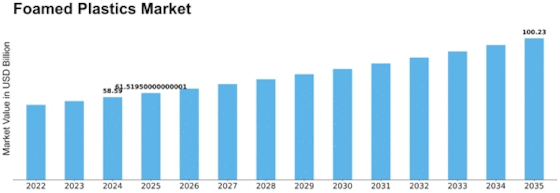
    Foamed Plastics Market Size Graph
    Author
    Anshula Mandaokar
    Team Lead - Research

    Anshula Mandaokar holds an academic degree in Chemical Engineering and has been contributing to the field for more than 5 years. She has expertise in Market Research and Business Consulting and serves as a Team Lead for a reputed Market Research firm under the Chemicals and Materials domain spectrum. She has worked on multiple projects, generating explicit results in a quick turnaround time. Her understanding of data interpretation justifies her role as a leader.

    Leave a Comment

    FAQs

    How much is the Foamed Plastics market?

    The Foamed Plastics Market size was valued at USD 58.59 Billion in 2024.

    What is the growth rate of the Foamed Plastics market?

    Foamed Plastics Market is projected to register a CAGR of 5% from 2025-2035

    Which region held the largest market share in the Foamed Plastics market?

    North America had the largest share in the global market

    Who are the key players in the Foamed Plastics market?

    The key players in the market are Hexion Inc., COVESTRO AG, BASF SE, Total SE, Wanhua Chemical Group Co., Ltd., SABIC, Alchemie Ltd., The Dow Chemical Company, HUNTSMAN CORPORATION, and Repsol

    Which Type led the Foamed Plastics market?

    The Polyurethane Type dominated the market in 2022.

    Which Application had the largest market share in the Foamed Plastics market?

    The Building & Construction Application had the largest share in the global market.

    Market Summary

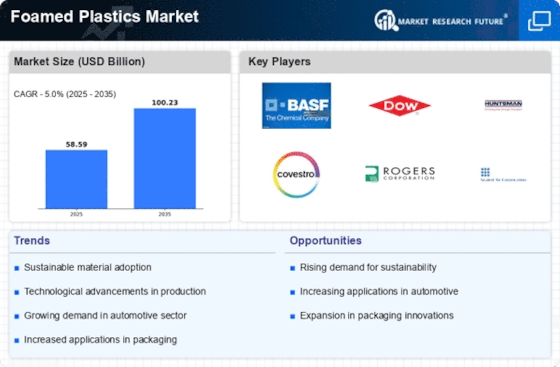
    As per Market Research Future Analysis, the Global Foamed Plastics Market was valued at USD 58.59 Billion in 2024 and is projected to reach USD 100.23 Billion by 2035, growing at a CAGR of 5.00% from 2025 to 2035. The market is driven by increasing demand for polyurethane foam in building insulation and expanding end-use industries such as automotive, packaging, and furniture.

    Key Market Trends & Highlights

    The foamed plastics market is witnessing significant growth due to various factors.

    • The polyurethane segment accounted for the largest revenue share in 2022, driven by its extensive use in the automotive sector.
    • The building & construction segment dominated the market in 2022, utilizing foam for sealing and thermal insulation.
    • North America held the largest market share at 45.80% in 2022, with the U.S. being the leading country.
    • The Asia-Pacific region is expected to register significant growth, particularly in China and India, due to rising disposable incomes.

    Market Size & Forecast

    2024 Market Size USD 58.59 Billion
    2035 Market Size USD 100.23 Billion
    CAGR (2025-2035) 5.00%
    Largest Regional Market Share in 2022 North America.

    Major Players

    Key players include Hexion Inc., COVESTRO AG, BASF SE, Total SE, Wanhua Chemical Group Co., Ltd., SABIC, Alchemie Ltd., The Dow Chemical Company, HUNTSMAN CORPORATION, and Repsol.

    Market Trends

    The growing demand for polyurethane foam in building insulation is driving the market growth

    The building and construction, telecommunications, and automobile industries all use polyurethane foam. Flexible polyurethane foam is frequently used as a cushion in the automotive industry. It is one of the best insulating materials available, which makes it perfect for usage in the electronics sector, especially in freezers and refrigerators. The construction industry is the main user of polyurethane foam since it may be used as coatings, sealants, rigid insulation, and adhesives. Highly flexible polyurethane foams save overall infrastructure costs by lowering building energy consumption. Foam is used for sealing and thermal insulating in the industrial and construction sectors.

    Due to its flexibility and lack of fibrous qualities, it makes a perfect thermal and acoustic insulator. Additionally, because foam helps maintain heat during cold periods, it is increasingly employed in domestic housing in cold areas where internal and exterior temperatures range significantly. This kind of foam aids in dampening noise in structures. As a result, these elements support the growth of the Foamed Plastics Market.

    Because they can be moulded into any shape and offer comfort and support, PU foams, also known as polyurethane foam, are extensively utilised in the production of mattresses and other furniture items. In comparison to other types of foam, polyurethane foam is produced employing procedures like coring and contouring foam, which result in a completed product that provides a more supportive sleeping surface. Consumer demand in luxury and designer furniture is expected to increase, which will fuel the industry's revenue growth. New polyurethane foams have been created as a result of numerous chemistry advancements.

    These foams will self-adjust to each individual's body form and offer a very high level of comfort. As a result, the market for foamed plastics is expanding.

    The expanding end-use industries are contributing to the rapid growth of the worldwide foamed plastics market. The market is expanding as a result of economic expansion in developing nations and expansion in important end-use sectors like the automobile, packaging, furniture, and bedding industries. Manufacturers and merchants are searching for packaging options that can protect the goods while keeping the entire cost of packaging and shipping within reason. This aspect has increased demand for foamed plastics in recent years. Foamed plastics can also be burned to be disposed of.

    The Global Foamed Plastics Market is poised for robust growth, driven by increasing demand across various industries, including automotive and construction, which are increasingly adopting lightweight materials for enhanced energy efficiency.

    U.S. Department of Commerce

    Foamed Plastics Market Market Drivers

    Market Growth Projections

    The Global Foamed Plastics Market Industry is poised for substantial growth, with projections indicating a market size of 58.6 USD Billion in 2024 and an anticipated increase to 100.2 USD Billion by 2035. This growth trajectory suggests a compound annual growth rate (CAGR) of 5.0% from 2025 to 2035. Such projections reflect the increasing adoption of foamed plastics across various sectors, driven by their lightweight, insulating, and protective properties. As industries continue to seek innovative solutions that enhance performance and sustainability, the Global Foamed Plastics Market Industry is likely to experience robust expansion in the coming years.

    Growth in Construction Activities

    The Global Foamed Plastics Market Industry is significantly influenced by the burgeoning construction sector, where foamed plastics are employed for insulation and structural applications. The increasing focus on energy efficiency in buildings has led to a higher demand for materials that provide superior thermal insulation. For instance, expanded polystyrene is widely used in wall and roof insulation, contributing to energy savings. As global construction activities escalate, particularly in emerging economies, the market for foamed plastics is expected to flourish. This trend aligns with the projected growth of the market, anticipated to reach 100.2 USD Billion by 2035, reflecting a robust CAGR of 5.0% from 2025 to 2035.

    Rising Demand in Automotive Sector

    The Global Foamed Plastics Market Industry experiences a notable surge in demand from the automotive sector, driven by the need for lightweight materials that enhance fuel efficiency. Foamed plastics, such as polyurethane and polystyrene, are increasingly utilized in vehicle interiors and exteriors due to their excellent insulation properties and impact resistance. In 2024, the market is projected to reach 58.6 USD Billion, with automotive applications accounting for a significant share. As manufacturers seek to comply with stringent environmental regulations, the adoption of foamed plastics is likely to grow, contributing to the overall expansion of the Global Foamed Plastics Market Industry.

    Diverse Applications Across Industries

    The versatility of foamed plastics is a key driver for the Global Foamed Plastics Market Industry, as these materials find applications across a multitude of sectors. From packaging to consumer goods, foamed plastics are integral in providing cushioning, insulation, and structural support. The packaging industry, in particular, benefits from the lightweight and protective characteristics of foamed plastics, leading to increased demand. As industries continue to innovate and expand their product offerings, the reliance on foamed plastics is likely to grow. This broad applicability not only supports the current market size but also indicates a promising future for the Global Foamed Plastics Market Industry.

    Technological Advancements in Manufacturing

    Technological advancements in the manufacturing processes of foamed plastics are reshaping the Global Foamed Plastics Market Industry. Innovations such as improved blowing agents and enhanced processing techniques have led to the production of foamed plastics with superior properties, including reduced density and increased strength. These advancements enable manufacturers to create customized solutions for various applications, from packaging to insulation. As industries increasingly prioritize performance and sustainability, the demand for technologically advanced foamed plastics is likely to rise. This trend not only supports the growth of the market but also enhances the competitive landscape within the Global Foamed Plastics Market Industry.

    Sustainability Initiatives and Eco-Friendly Products

    The Global Foamed Plastics Market Industry is witnessing a shift towards sustainability, with manufacturers increasingly focusing on eco-friendly products. The rising awareness of environmental issues has prompted the development of biodegradable foamed plastics and recycling initiatives. For example, companies are exploring bio-based foams derived from renewable resources, which could potentially reduce the carbon footprint associated with traditional foamed plastics. This shift towards sustainable practices is likely to attract environmentally conscious consumers and businesses, thereby expanding the market. As sustainability becomes a core value in various industries, the Global Foamed Plastics Market Industry is expected to adapt and thrive in this evolving landscape.

    Market Segment Insights

    Foamed Plastics Type Insights

    The Foamed Plastics Market segmentation, based on type, includes polyurethane, polystyrene, polyolefin, phenolic, and others. Polyurethane segment accounted for the largest revenue share in 2022. This is explained by the fact that polyurethane foam is frequently used in the automotive sector to produce vehicles and their parts. Additionally, growing industrialization fuels demand for flexible foams in a variety of sectors, including the automotive, home furnishings, transportation, and packaging industries.

    Foamed Plastics Application Insights

    The Foamed Plastics Market segmentation, based on application, includes building & construction, packaging, automotive, furniture & bedding, footwear, sports, & recreational, and others. Building & construction segment dominated the Foamed Plastics Market in 2022. Foam is utilised in the building and construction industry for sealing and thermal insulating due to its light weight and resilience. It is the ideal thermal and acoustic insulator due to its flexibility and lack of fibrous characteristics. Stiff polyurethane foam is a good material to use for home walls and roofing since it can be made in a wide range of densities.

    It is widely used in freezing places where temperatures vary greatly and aids in keeping people warm during periods of extreme cold. This foam reduces interior noise levels by insulating sound in the original rooms. The building and construction industry regularly uses rigid polyurethane foam due to its closed-cell structure, high crosslink density, and superior insulating properties.

    Figure 1: Foamed Plastics Market, by Application, 2022 & 2032 (USD Billion)

    Source: Secondary Research, Primary Research, Market Research Future Database and Analyst Review

    Get more detailed insights about Foamed Plastics Market Research Report—Global Forecast till 2035

    Regional Insights

    By region, the study provides the market insights into North America, Europe, Asia-Pacific and Rest of the World. The North America Foamed Plastics Market dominated this market in 2022 (45.80%). Numerous growing economies are now developing their infrastructure, which supports industrial growth. In numerous construction projects, EPE (expanded polyethylene) foam is the main acoustic material. It is projected that US real estate growth will boost product demand. EPE foam is also being used increasingly frequently as reusable floor protection for interior construction projects, which is promoting industry growth. Further, the U.S.

    Foamed Plastics market held the largest market share, and the Canada Foamed Plastics market was the fastest growing market in the North America region.

    Further, the major countries studied in the market report are The US, Canada, German, France, the UK, Italy, Spain, China, Japan, India, Australia, South Korea, and Brazil.

    Figure 2: FOAMED PLASTICS MARKET SHARE BY REGION 2022 (USD Billion)

    FOAMED PLASTICS MARKET SHARE BY REGION 2022

    Source: Secondary Research, Primary Research, Market Research Future Database and Analyst Review

    Europe Foamed Plastics market accounted for the healthy market share in 2022. The expansion of significant end-use segments, such as automotive components and furniture & bedding, particularly in the United Kingdom, as well as polyurethane's versatility as a product in new applications, as well as its uses and qualities, such as sustainability and lightness, are expected to drive consumption in Europe. Further, the German Foamed Plastics market held the largest market share, and the U.K Foamed Plastics market was the fastest growing market in the European region

    The Asia Pacific Foamed Plastics market is expected to register significant growth from 2023 to 2032. Strong expansion has been seen in the Asia Pacific foam plastics market share, especially in China, India, and Southeast Asia. The demand in China is driven by foreign investments made by multinational firms. By making an investment in foam manufacture, one can obtain cheap labour and raw materials. Foam plastics are in high demand, especially in Asia-Pacific.

    This is brought on by a growth in home and luxury goods purchases by consumers as well as a sharp increase in the demand for foam plastics used in bedding and mattresses. Regional prosperity is also being fueled by an increase in disposable income, a significant expansion of the local furniture and bedding industry, and supportive FDI regulations. Moreover, China’s Foamed Plastics market held the largest market share, and the Indian Foamed Plastics market was the fastest growing market in the Asia-Pacific region.

    Key Players and Competitive Insights

    Leading market players are investing heavily in research and development in order to expand their product lines, which will help the Foamed Plastics market, grow even more. Market participants are also undertaking a variety of strategic activities to expand their global footprint, with important market developments including new product launches, contractual agreements, mergers and acquisitions, higher investments, and collaboration with other organizations. To expand and survive in a more competitive and rising market climate, Foamed Plastics industry must offer cost-effective items.

    Manufacturing locally to minimize Typeal costs is one of the key business tactics used by manufacturers in the global Foamed Plastics industry to benefit clients and increase the market sector. In recent years, the Foamed Plastics industry has offered some of the most significant advantages to medicine. Major players in the Foamed Plastics market, including Hexion Inc., COVESTRO AG, BASF SE, Total SE, Wanhua Chemical Group Co., Ltd., SABIC, Alchemie Ltd., The Dow Chemical Company, HUNTSMAN CORPORATION, and Repsol, are attempting to increase market demand by investing in research and development Types.

    BASF SE (BASF) is a company that produces chemicals. It manufactures, markets, and sells chemicals, polymers, crop protection products, and performance items. The company's product line includes solvents, adhesives, surfactants, fuel additives, electronic chemicals, pigments, paints, food additives, fungicides, and herbicides. The company works with a wide range of industries, including those related to building, woodworking, agriculture, electronics and electrical, paints and coatings, transportation, home care, nutrition, and chemicals. In partnership with international customers, partners, and researchers, BASF carries out R&D. The company's operations are supported by a global network of production facilities.

    It can be found all over the world, including in North America, Europe, Asia, South America, Africa, and the Middle East. The BASF corporate headquarters are in Ludwigshafen, Germany. In March 2019, BASF improved its regional innovation capabilities with new facilities at the Innovation Campus Shanghai in order to further develop partnership with the automobile industry and offer cutting-edge process catalysts to the chemical industry.

    Manufacturer of unique organic chemical compounds is Huntsman Corp (Huntsman). A wide variety of chemicals and formulations are available, including amines, maleic anhydride, MDI, formulations for epoxy-based polymers, textile chemicals, and dyes. The business markets its goods to a variety of retail and business clients. The adhesives, aerospace, personal care and hygiene, automotive, construction, durable and non-durable consumer goods, digital inks, electronics, power generation, refining, medical, packaging, coatings and construction, synthetic fibre, textile chemicals, and dyes industries are just a few industries where Huntsman products are used.

    The business is run through a worldwide network of administrative, R&D, and production facilities located in North America, the Middle East, Europe, and Asia. Huntsman's US headquarters are in Texas. Icynene-Lapolla, a top North American manufacturer and distributor of spray polyurethane foam (SPF) insulation products for residential and commercial applications, was acquired by Huntsman Corporation in February 2020, according to a press release.

    Key Companies in the Foamed Plastics Market market include

    Industry Developments

    June 2022: DualPakECOâ, a certified biodegradable and dual ovenable food tray made of paper, was created in partnership by Confoil and BASF SE.

    Future Outlook

    Foamed Plastics Market Future Outlook

    The Global Foamed Plastics Market is projected to grow at a 5.00% CAGR from 2025 to 2035, driven by increasing demand in automotive, construction, and packaging sectors.

    New opportunities lie in:

    • Develop bio-based foamed plastics to meet sustainability demands.
    • Invest in advanced manufacturing technologies for cost efficiency.
    • Expand applications in emerging markets to capture new customer segments.

    By 2035, the Foamed Plastics Market is expected to be robust, reflecting substantial growth and innovation.

    Market Segmentation

    Foamed Plastics Type Outlook

    • Polyurethane
    • Polystyrene
    • Polyolefin
    • Phenolic
    • Others

    Foamed Plastics Regional Outlook

    North America
    • US
    • Canada

    Foamed Plastics Application Outlook

    • Building & Construction
    • Packaging
    • Automotive
    • Furniture & Bedding
    • Footwear, Sports, & Recreational
    • Others

    Report Scope

    Report Attribute/Metric Details
    Market Size 2024 USD 58.59 Billion
    Market Size 2025 USD 61.52 Billion
    Market Size 2035 100.23 (Value (USD Billion))
    Compound Annual Growth Rate (CAGR) 5.00% (2025 - 2035)
    Base Year 2024
    Market Forecast Period 2025 - 2035
    Historical Data 2020- 2024
    Market Forecast Units Value (USD Billion)
    Report Coverage Revenue Forecast, Market Competitive Landscape, Growth Factors, and Trends
    Segments Covered Type, Application, and Region
    Geographies Covered North America, Europe, Asia Pacific, and the Rest of the World
    Countries Covered The U.S., Canada, German, France, U.K, Italy, Spain, China, Japan, India, Australia, South Korea, and Brazil
    Key Companies Profiled Hexion Inc., COVESTRO AG, BASF SE, Total SE, Wanhua Chemical Group Co., Ltd., SABIC, Alchemie Ltd., The Dow Chemical Company, HUNTSMAN CORPORATION, and Repsol
    Key Market Opportunities Manufacture of bio-based polyols
    Key Market Dynamics The growing demand for polyurethane foam in building insulation and growing end-use industries

    FAQs

    How much is the Foamed Plastics market?

    The Foamed Plastics Market size was valued at USD 58.59 Billion in 2024.

    What is the growth rate of the Foamed Plastics market?

    Foamed Plastics Market is projected to register a CAGR of 5% from 2025-2035

    Which region held the largest market share in the Foamed Plastics market?

    North America had the largest share in the global market

    Who are the key players in the Foamed Plastics market?

    The key players in the market are Hexion Inc., COVESTRO AG, BASF SE, Total SE, Wanhua Chemical Group Co., Ltd., SABIC, Alchemie Ltd., The Dow Chemical Company, HUNTSMAN CORPORATION, and Repsol

    Which Type led the Foamed Plastics market?

    The Polyurethane Type dominated the market in 2022.

    Which Application had the largest market share in the Foamed Plastics market?

    The Building & Construction Application had the largest share in the global market.

    1. SECTION I: EXECUTIVE SUMMARY AND KEY HIGHLIGHTS
      1. | 1.1 EXECUTIVE SUMMARY
      2. | | 1.1.1 Market Overview
      3. | | 1.1.2 Key Findings
      4. | | 1.1.3 Market Segmentation
      5. | | 1.1.4 Competitive Landscape
      6. | | 1.1.5 Challenges and Opportunities
      7. | | 1.1.6 Future Outlook
    2. SECTION II: SCOPING, METHODOLOGY AND MARKET STRUCTURE
      1. | 2.1 MARKET INTRODUCTION
      2. | | 2.1.1 Definition
      3. | | 2.1.2 Scope of the study
      4. | | | 2.1.2.1 Research Objective
      5. | | | 2.1.2.2 Assumption
      6. | | | 2.1.2.3 Limitations
      7. | 2.2 RESEARCH METHODOLOGY
      8. | | 2.2.1 Overview
      9. | | 2.2.2 Data Mining
      10. | | 2.2.3 Secondary Research
      11. | | 2.2.4 Primary Research
      12. | | | 2.2.4.1 Primary Interviews and Information Gathering Process
      13. | | | 2.2.4.2 Breakdown of Primary Respondents
      14. | | 2.2.5 Forecasting Model
      15. | | 2.2.6 Market Size Estimation
      16. | | | 2.2.6.1 Bottom-Up Approach
      17. | | | 2.2.6.2 Top-Down Approach
      18. | | 2.2.7 Data Triangulation
      19. | | 2.2.8 Validation
    3. SECTION III: QUALITATIVE ANALYSIS
      1. | 3.1 MARKET DYNAMICS
      2. | | 3.1.1 Overview
      3. | | 3.1.2 Drivers
      4. | | 3.1.3 Restraints
      5. | | 3.1.4 Opportunities
      6. | 3.2 MARKET FACTOR ANALYSIS
      7. | | 3.2.1 Value chain Analysis
      8. | | 3.2.2 Porter's Five Forces Analysis
      9. | | | 3.2.2.1 Bargaining Power of Suppliers
      10. | | | 3.2.2.2 Bargaining Power of Buyers
      11. | | | 3.2.2.3 Threat of New Entrants
      12. | | | 3.2.2.4 Threat of Substitutes
      13. | | | 3.2.2.5 Intensity of Rivalry
      14. | | 3.2.3 COVID-19 Impact Analysis
      15. | | | 3.2.3.1 Market Impact Analysis
      16. | | | 3.2.3.2 Regional Impact
      17. | | | 3.2.3.3 Opportunity and Threat Analysis
    4. SECTION IV: QUANTITATIVE ANALYSIS
      1. | 4.1 Chemicals and Materials, BY Type (USD Billion)
      2. | | 4.1.1 Polyurethane
      3. | | 4.1.2 Polystyrene
      4. | | 4.1.3 Polyolefin
      5. | | 4.1.4 Phenolic
      6. | | 4.1.5 Others
      7. | 4.2 Chemicals and Materials, BY Application (USD Billion)
      8. | | 4.2.1 Building & Construction
      9. | | 4.2.2 Packaging
      10. | | 4.2.3 Automotive
      11. | | 4.2.4 Furniture & Bedding
      12. | | 4.2.5 Footwear, Sports, & Recreational
      13. | | 4.2.6 Others
      14. | 4.3 Chemicals and Materials, BY Region (USD Billion)
      15. | | 4.3.1 North America
      16. | | | 4.3.1.1 US
      17. | | | 4.3.1.2 Canada
      18. | | 4.3.2 Europe
      19. | | | 4.3.2.1 Germany
      20. | | | 4.3.2.2 UK
      21. | | | 4.3.2.3 France
      22. | | | 4.3.2.4 Russia
      23. | | | 4.3.2.5 Italy
      24. | | | 4.3.2.6 Spain
      25. | | | 4.3.2.7 Rest of Europe
      26. | | 4.3.3 APAC
      27. | | | 4.3.3.1 China
      28. | | | 4.3.3.2 India
      29. | | | 4.3.3.3 Japan
      30. | | | 4.3.3.4 South Korea
      31. | | | 4.3.3.5 Malaysia
      32. | | | 4.3.3.6 Thailand
      33. | | | 4.3.3.7 Indonesia
      34. | | | 4.3.3.8 Rest of APAC
      35. | | 4.3.4 South America
      36. | | | 4.3.4.1 Brazil
      37. | | | 4.3.4.2 Mexico
      38. | | | 4.3.4.3 Argentina
      39. | | | 4.3.4.4 Rest of South America
      40. | | 4.3.5 MEA
      41. | | | 4.3.5.1 GCC Countries
      42. | | | 4.3.5.2 South Africa
      43. | | | 4.3.5.3 Rest of MEA
    5. SECTION V: COMPETITIVE ANALYSIS
      1. | 5.1 Competitive Landscape
      2. | | 5.1.1 Overview
      3. | | 5.1.2 Competitive Analysis
      4. | | 5.1.3 Market share Analysis
      5. | | 5.1.4 Major Growth Strategy in the Chemicals and Materials
      6. | | 5.1.5 Competitive Benchmarking
      7. | | 5.1.6 Leading Players in Terms of Number of Developments in the Chemicals and Materials
      8. | | 5.1.7 Key developments and growth strategies
      9. | | | 5.1.7.1 New Product Launch/Service Deployment
      10. | | | 5.1.7.2 Merger & Acquisitions
      11. | | | 5.1.7.3 Joint Ventures
      12. | | 5.1.8 Major Players Financial Matrix
      13. | | | 5.1.8.1 Sales and Operating Income
      14. | | | 5.1.8.2 Major Players R&D Expenditure. 2023
      15. | 5.2 Company Profiles
      16. | | 5.2.1 BASF SE (DE)
      17. | | | 5.2.1.1 Financial Overview
      18. | | | 5.2.1.2 Products Offered
      19. | | | 5.2.1.3 Key Developments
      20. | | | 5.2.1.4 SWOT Analysis
      21. | | | 5.2.1.5 Key Strategies
      22. | | 5.2.2 Dow Inc. (US)
      23. | | | 5.2.2.1 Financial Overview
      24. | | | 5.2.2.2 Products Offered
      25. | | | 5.2.2.3 Key Developments
      26. | | | 5.2.2.4 SWOT Analysis
      27. | | | 5.2.2.5 Key Strategies
      28. | | 5.2.3 Huntsman Corporation (US)
      29. | | | 5.2.3.1 Financial Overview
      30. | | | 5.2.3.2 Products Offered
      31. | | | 5.2.3.3 Key Developments
      32. | | | 5.2.3.4 SWOT Analysis
      33. | | | 5.2.3.5 Key Strategies
      34. | | 5.2.4 Covestro AG (DE)
      35. | | | 5.2.4.1 Financial Overview
      36. | | | 5.2.4.2 Products Offered
      37. | | | 5.2.4.3 Key Developments
      38. | | | 5.2.4.4 SWOT Analysis
      39. | | | 5.2.4.5 Key Strategies
      40. | | 5.2.5 Rogers Corporation (US)
      41. | | | 5.2.5.1 Financial Overview
      42. | | | 5.2.5.2 Products Offered
      43. | | | 5.2.5.3 Key Developments
      44. | | | 5.2.5.4 SWOT Analysis
      45. | | | 5.2.5.5 Key Strategies
      46. | | 5.2.6 Sealed Air Corporation (US)
      47. | | | 5.2.6.1 Financial Overview
      48. | | | 5.2.6.2 Products Offered
      49. | | | 5.2.6.3 Key Developments
      50. | | | 5.2.6.4 SWOT Analysis
      51. | | | 5.2.6.5 Key Strategies
      52. | | 5.2.7 Armacell International S.A. (LU)
      53. | | | 5.2.7.1 Financial Overview
      54. | | | 5.2.7.2 Products Offered
      55. | | | 5.2.7.3 Key Developments
      56. | | | 5.2.7.4 SWOT Analysis
      57. | | | 5.2.7.5 Key Strategies
      58. | | 5.2.8 Zotefoams plc (GB)
      59. | | | 5.2.8.1 Financial Overview
      60. | | | 5.2.8.2 Products Offered
      61. | | | 5.2.8.3 Key Developments
      62. | | | 5.2.8.4 SWOT Analysis
      63. | | | 5.2.8.5 Key Strategies
      64. | | 5.2.9 Recticel SA (BE)
      65. | | | 5.2.9.1 Financial Overview
      66. | | | 5.2.9.2 Products Offered
      67. | | | 5.2.9.3 Key Developments
      68. | | | 5.2.9.4 SWOT Analysis
      69. | | | 5.2.9.5 Key Strategies
      70. | 5.3 Appendix
      71. | | 5.3.1 References
      72. | | 5.3.2 Related Reports
    6. LIST OF FIGURES
      1. | 6.1 MARKET SYNOPSIS
      2. | 6.2 NORTH AMERICA MARKET ANALYSIS
      3. | 6.3 US MARKET ANALYSIS BY TYPE
      4. | 6.4 US MARKET ANALYSIS BY APPLICATION
      5. | 6.5 CANADA MARKET ANALYSIS BY TYPE
      6. | 6.6 CANADA MARKET ANALYSIS BY APPLICATION
      7. | 6.7 EUROPE MARKET ANALYSIS
      8. | 6.8 GERMANY MARKET ANALYSIS BY TYPE
      9. | 6.9 GERMANY MARKET ANALYSIS BY APPLICATION
      10. | 6.10 UK MARKET ANALYSIS BY TYPE
      11. | 6.11 UK MARKET ANALYSIS BY APPLICATION
      12. | 6.12 FRANCE MARKET ANALYSIS BY TYPE
      13. | 6.13 FRANCE MARKET ANALYSIS BY APPLICATION
      14. | 6.14 RUSSIA MARKET ANALYSIS BY TYPE
      15. | 6.15 RUSSIA MARKET ANALYSIS BY APPLICATION
      16. | 6.16 ITALY MARKET ANALYSIS BY TYPE
      17. | 6.17 ITALY MARKET ANALYSIS BY APPLICATION
      18. | 6.18 SPAIN MARKET ANALYSIS BY TYPE
      19. | 6.19 SPAIN MARKET ANALYSIS BY APPLICATION
      20. | 6.20 REST OF EUROPE MARKET ANALYSIS BY TYPE
      21. | 6.21 REST OF EUROPE MARKET ANALYSIS BY APPLICATION
      22. | 6.22 APAC MARKET ANALYSIS
      23. | 6.23 CHINA MARKET ANALYSIS BY TYPE
      24. | 6.24 CHINA MARKET ANALYSIS BY APPLICATION
      25. | 6.25 INDIA MARKET ANALYSIS BY TYPE
      26. | 6.26 INDIA MARKET ANALYSIS BY APPLICATION
      27. | 6.27 JAPAN MARKET ANALYSIS BY TYPE
      28. | 6.28 JAPAN MARKET ANALYSIS BY APPLICATION
      29. | 6.29 SOUTH KOREA MARKET ANALYSIS BY TYPE
      30. | 6.30 SOUTH KOREA MARKET ANALYSIS BY APPLICATION
      31. | 6.31 MALAYSIA MARKET ANALYSIS BY TYPE
      32. | 6.32 MALAYSIA MARKET ANALYSIS BY APPLICATION
      33. | 6.33 THAILAND MARKET ANALYSIS BY TYPE
      34. | 6.34 THAILAND MARKET ANALYSIS BY APPLICATION
      35. | 6.35 INDONESIA MARKET ANALYSIS BY TYPE
      36. | 6.36 INDONESIA MARKET ANALYSIS BY APPLICATION
      37. | 6.37 REST OF APAC MARKET ANALYSIS BY TYPE
      38. | 6.38 REST OF APAC MARKET ANALYSIS BY APPLICATION
      39. | 6.39 SOUTH AMERICA MARKET ANALYSIS
      40. | 6.40 BRAZIL MARKET ANALYSIS BY TYPE
      41. | 6.41 BRAZIL MARKET ANALYSIS BY APPLICATION
      42. | 6.42 MEXICO MARKET ANALYSIS BY TYPE
      43. | 6.43 MEXICO MARKET ANALYSIS BY APPLICATION
      44. | 6.44 ARGENTINA MARKET ANALYSIS BY TYPE
      45. | 6.45 ARGENTINA MARKET ANALYSIS BY APPLICATION
      46. | 6.46 REST OF SOUTH AMERICA MARKET ANALYSIS BY TYPE
      47. | 6.47 REST OF SOUTH AMERICA MARKET ANALYSIS BY APPLICATION
      48. | 6.48 MEA MARKET ANALYSIS
      49. | 6.49 GCC COUNTRIES MARKET ANALYSIS BY TYPE
      50. | 6.50 GCC COUNTRIES MARKET ANALYSIS BY APPLICATION
      51. | 6.51 SOUTH AFRICA MARKET ANALYSIS BY TYPE
      52. | 6.52 SOUTH AFRICA MARKET ANALYSIS BY APPLICATION
      53. | 6.53 REST OF MEA MARKET ANALYSIS BY TYPE
      54. | 6.54 REST OF MEA MARKET ANALYSIS BY APPLICATION
      55. | 6.55 KEY BUYING CRITERIA OF CHEMICALS AND MATERIALS
      56. | 6.56 RESEARCH PROCESS OF MRFR
      57. | 6.57 DRO ANALYSIS OF CHEMICALS AND MATERIALS
      58. | 6.58 DRIVERS IMPACT ANALYSIS: CHEMICALS AND MATERIALS
      59. | 6.59 RESTRAINTS IMPACT ANALYSIS: CHEMICALS AND MATERIALS
      60. | 6.60 SUPPLY / VALUE CHAIN: CHEMICALS AND MATERIALS
      61. | 6.61 CHEMICALS AND MATERIALS, BY TYPE, 2024 (% SHARE)
      62. | 6.62 CHEMICALS AND MATERIALS, BY TYPE, 2024 TO 2035 (USD Billion)
      63. | 6.63 CHEMICALS AND MATERIALS, BY APPLICATION, 2024 (% SHARE)
      64. | 6.64 CHEMICALS AND MATERIALS, BY APPLICATION, 2024 TO 2035 (USD Billion)
      65. | 6.65 BENCHMARKING OF MAJOR COMPETITORS
    7. LIST OF TABLES
      1. | 7.1 LIST OF ASSUMPTIONS
      2. | | 7.1.1
      3. | 7.2 North America MARKET SIZE ESTIMATES; FORECAST
      4. | | 7.2.1 BY TYPE, 2025-2035 (USD Billion)
      5. | | 7.2.2 BY APPLICATION, 2025-2035 (USD Billion)
      6. | 7.3 US MARKET SIZE ESTIMATES; FORECAST
      7. | | 7.3.1 BY TYPE, 2025-2035 (USD Billion)
      8. | | 7.3.2 BY APPLICATION, 2025-2035 (USD Billion)
      9. | 7.4 Canada MARKET SIZE ESTIMATES; FORECAST
      10. | | 7.4.1 BY TYPE, 2025-2035 (USD Billion)
      11. | | 7.4.2 BY APPLICATION, 2025-2035 (USD Billion)
      12. | 7.5 Europe MARKET SIZE ESTIMATES; FORECAST
      13. | | 7.5.1 BY TYPE, 2025-2035 (USD Billion)
      14. | | 7.5.2 BY APPLICATION, 2025-2035 (USD Billion)
      15. | 7.6 Germany MARKET SIZE ESTIMATES; FORECAST
      16. | | 7.6.1 BY TYPE, 2025-2035 (USD Billion)
      17. | | 7.6.2 BY APPLICATION, 2025-2035 (USD Billion)
      18. | 7.7 UK MARKET SIZE ESTIMATES; FORECAST
      19. | | 7.7.1 BY TYPE, 2025-2035 (USD Billion)
      20. | | 7.7.2 BY APPLICATION, 2025-2035 (USD Billion)
      21. | 7.8 France MARKET SIZE ESTIMATES; FORECAST
      22. | | 7.8.1 BY TYPE, 2025-2035 (USD Billion)
      23. | | 7.8.2 BY APPLICATION, 2025-2035 (USD Billion)
      24. | 7.9 Russia MARKET SIZE ESTIMATES; FORECAST
      25. | | 7.9.1 BY TYPE, 2025-2035 (USD Billion)
      26. | | 7.9.2 BY APPLICATION, 2025-2035 (USD Billion)
      27. | 7.10 Italy MARKET SIZE ESTIMATES; FORECAST
      28. | | 7.10.1 BY TYPE, 2025-2035 (USD Billion)
      29. | | 7.10.2 BY APPLICATION, 2025-2035 (USD Billion)
      30. | 7.11 Spain MARKET SIZE ESTIMATES; FORECAST
      31. | | 7.11.1 BY TYPE, 2025-2035 (USD Billion)
      32. | | 7.11.2 BY APPLICATION, 2025-2035 (USD Billion)
      33. | 7.12 Rest of Europe MARKET SIZE ESTIMATES; FORECAST
      34. | | 7.12.1 BY TYPE, 2025-2035 (USD Billion)
      35. | | 7.12.2 BY APPLICATION, 2025-2035 (USD Billion)
      36. | 7.13 APAC MARKET SIZE ESTIMATES; FORECAST
      37. | | 7.13.1 BY TYPE, 2025-2035 (USD Billion)
      38. | | 7.13.2 BY APPLICATION, 2025-2035 (USD Billion)
      39. | 7.14 China MARKET SIZE ESTIMATES; FORECAST
      40. | | 7.14.1 BY TYPE, 2025-2035 (USD Billion)
      41. | | 7.14.2 BY APPLICATION, 2025-2035 (USD Billion)
      42. | 7.15 India MARKET SIZE ESTIMATES; FORECAST
      43. | | 7.15.1 BY TYPE, 2025-2035 (USD Billion)
      44. | | 7.15.2 BY APPLICATION, 2025-2035 (USD Billion)
      45. | 7.16 Japan MARKET SIZE ESTIMATES; FORECAST
      46. | | 7.16.1 BY TYPE, 2025-2035 (USD Billion)
      47. | | 7.16.2 BY APPLICATION, 2025-2035 (USD Billion)
      48. | 7.17 South Korea MARKET SIZE ESTIMATES; FORECAST
      49. | | 7.17.1 BY TYPE, 2025-2035 (USD Billion)
      50. | | 7.17.2 BY APPLICATION, 2025-2035 (USD Billion)
      51. | 7.18 Malaysia MARKET SIZE ESTIMATES; FORECAST
      52. | | 7.18.1 BY TYPE, 2025-2035 (USD Billion)
      53. | | 7.18.2 BY APPLICATION, 2025-2035 (USD Billion)
      54. | 7.19 Thailand MARKET SIZE ESTIMATES; FORECAST
      55. | | 7.19.1 BY TYPE, 2025-2035 (USD Billion)
      56. | | 7.19.2 BY APPLICATION, 2025-2035 (USD Billion)
      57. | 7.20 Indonesia MARKET SIZE ESTIMATES; FORECAST
      58. | | 7.20.1 BY TYPE, 2025-2035 (USD Billion)
      59. | | 7.20.2 BY APPLICATION, 2025-2035 (USD Billion)
      60. | 7.21 Rest of APAC MARKET SIZE ESTIMATES; FORECAST
      61. | | 7.21.1 BY TYPE, 2025-2035 (USD Billion)
      62. | | 7.21.2 BY APPLICATION, 2025-2035 (USD Billion)
      63. | 7.22 South America MARKET SIZE ESTIMATES; FORECAST
      64. | | 7.22.1 BY TYPE, 2025-2035 (USD Billion)
      65. | | 7.22.2 BY APPLICATION, 2025-2035 (USD Billion)
      66. | 7.23 Brazil MARKET SIZE ESTIMATES; FORECAST
      67. | | 7.23.1 BY TYPE, 2025-2035 (USD Billion)
      68. | | 7.23.2 BY APPLICATION, 2025-2035 (USD Billion)
      69. | 7.24 Mexico MARKET SIZE ESTIMATES; FORECAST
      70. | | 7.24.1 BY TYPE, 2025-2035 (USD Billion)
      71. | | 7.24.2 BY APPLICATION, 2025-2035 (USD Billion)
      72. | 7.25 Argentina MARKET SIZE ESTIMATES; FORECAST
      73. | | 7.25.1 BY TYPE, 2025-2035 (USD Billion)
      74. | | 7.25.2 BY APPLICATION, 2025-2035 (USD Billion)
      75. | 7.26 Rest of South America MARKET SIZE ESTIMATES; FORECAST
      76. | | 7.26.1 BY TYPE, 2025-2035 (USD Billion)
      77. | | 7.26.2 BY APPLICATION, 2025-2035 (USD Billion)
      78. | 7.27 MEA MARKET SIZE ESTIMATES; FORECAST
      79. | | 7.27.1 BY TYPE, 2025-2035 (USD Billion)
      80. | | 7.27.2 BY APPLICATION, 2025-2035 (USD Billion)
      81. | 7.28 GCC Countries MARKET SIZE ESTIMATES; FORECAST
      82. | | 7.28.1 BY TYPE, 2025-2035 (USD Billion)
      83. | | 7.28.2 BY APPLICATION, 2025-2035 (USD Billion)
      84. | 7.29 South Africa MARKET SIZE ESTIMATES; FORECAST
      85. | | 7.29.1 BY TYPE, 2025-2035 (USD Billion)
      86. | | 7.29.2 BY APPLICATION, 2025-2035 (USD Billion)
      87. | 7.30 Rest of MEA MARKET SIZE ESTIMATES; FORECAST
      88. | | 7.30.1 BY TYPE, 2025-2035 (USD Billion)
      89. | | 7.30.2 BY APPLICATION, 2025-2035 (USD Billion)
      90. | 7.31 PRODUCT LAUNCH/PRODUCT DEVELOPMENT/APPROVAL
      91. | | 7.31.1
      92. | 7.32 ACQUISITION/PARTNERSHIP
      93. | | 7.32.1

    Foamed Plastics Market Segmentation

    Foamed Plastics Market Type Outlook (USD Billion, 2018-2032)

    • Polyurethane
    • Polystyrene
    • Polyolefin
    • Phenolic
    • Others

    Foamed Plastics Market Application Outlook (USD Billion, 2018-2032)

    • Building & Construction
    • Packaging
    • Automotive
    • Furniture & Bedding
    • Footwear, Sports, & Recreational
    • Others

    Foamed Plastics Market Regional Outlook (USD Billion, 2018-2032)

    • North America Outlook (USD Billion, 2018-2032)

      • Foamed Plastics Market by Type
        • Polyurethane
        • Polystyrene
        • Polyolefin
        • Phenolic
        • Others
      • Foamed Plastics Market by Application
        • Building & Construction
        • Packaging
        • Automotive
        • Furniture & Bedding
        • Footwear, Sports, & Recreational
        • Others
      • US Outlook (USD Billion, 2018-2032)

      • Foamed Plastics Market by Type
        • Polyurethane
        • Polystyrene
        • Polyolefin
        • Phenolic
        • Others
      • Foamed Plastics Market by Application
        • Building & Construction
        • Packaging
        • Automotive
        • Furniture & Bedding
        • Footwear, Sports, & Recreational
        • Others
      • Canada Outlook (USD Billion, 2018-2032)

      • Foamed Plastics Market by Type
        • Polyurethane
        • Polystyrene
        • Polyolefin
        • Phenolic
        • Others
      • Foamed Plastics Market by Application
        • Building & Construction
        • Packaging
        • Automotive
        • Furniture & Bedding
        • Footwear, Sports, & Recreational
        • Others
    • Europe Outlook (USD Billion, 2018-2032)

      • Foamed Plastics Market by Type
        • Polyurethane
        • Polystyrene
        • Polyolefin
        • Phenolic
        • Others
      • Foamed Plastics Market by Application
        • Building & Construction
        • Packaging
        • Automotive
        • Furniture & Bedding
        • Footwear, Sports, & Recreational
        • Others
      • Germany Outlook (USD Billion, 2018-2032)

      • Foamed Plastics Market by Type
        • Polyurethane
        • Polystyrene
        • Polyolefin
        • Phenolic
        • Others
      • Foamed Plastics Market by Application
        • Building & Construction
        • Packaging
        • Automotive
        • Furniture & Bedding
        • Footwear, Sports, & Recreational
        • Others
      • France Outlook (USD Billion, 2018-2032)

      • Foamed Plastics Market by Type
        • Polyurethane
        • Polystyrene
        • Polyolefin
        • Phenolic
        • Others
      • Foamed Plastics Market by Application
        • Building & Construction
        • Packaging
        • Automotive
        • Furniture & Bedding
        • Footwear, Sports, & Recreational
        • Others
      • UK Outlook (USD Billion, 2018-2032)

      • Foamed Plastics Market by Type
        • Polyurethane
        • Polystyrene
        • Polyolefin
        • Phenolic
        • Others
      • Foamed Plastics Market by Application
        • Building & Construction
        • Packaging
        • Automotive
        • Furniture & Bedding
        • Footwear, Sports, & Recreational
        • Others
      • Italy Outlook (USD Billion, 2018-2032)

      • Foamed Plastics Market by Type
        • Polyurethane
        • Polystyrene
        • Polyolefin
        • Phenolic
        • Others
      • Foamed Plastics Market by Application
        • Building & Construction
        • Packaging
        • Automotive
        • Furniture & Bedding
        • Footwear, Sports, & Recreational
        • Others
      • Spain Outlook (USD Billion, 2018-2032)

      • Foamed Plastics Market by Type
        • Polyurethane
        • Polystyrene
        • Polyolefin
        • Phenolic
        • Others
      • Foamed Plastics Market by Application
        • Building & Construction
        • Packaging
        • Automotive
        • Furniture & Bedding
        • Footwear, Sports, & Recreational
        • Others
      • Rest Of Europe Outlook (USD Billion, 2018-2032)

      • Foamed Plastics Market by Type
        • Polyurethane
        • Polystyrene
        • Polyolefin
        • Phenolic
        • Others
      • Foamed Plastics Market by Application
        • Building & Construction
        • Packaging
        • Automotive
        • Furniture & Bedding
        • Footwear, Sports, & Recreational
        • Others
    • Asia-Pacific Outlook (USD Billion, 2018-2032)

      • Foamed Plastics Market by Type
        • Polyurethane
        • Polystyrene
        • Polyolefin
        • Phenolic
        • Others
      • Foamed Plastics Market by Application
        • Building & Construction
        • Packaging
        • Automotive
        • Furniture & Bedding
        • Footwear, Sports, & Recreational
        • Others
      • China Outlook (USD Billion, 2018-2032)

      • Foamed Plastics Market by Type
        • Polyurethane
        • Polystyrene
        • Polyolefin
        • Phenolic
        • Others
      • Foamed Plastics Market by Application
        • Building & Construction
        • Packaging
        • Automotive
        • Furniture & Bedding
        • Footwear, Sports, & Recreational
        • Others
      • Japan Outlook (USD Billion, 2018-2032)

      • Foamed Plastics Market by Type
        • Polyurethane
        • Polystyrene
        • Polyolefin
        • Phenolic
        • Others
      • Foamed Plastics Market by Application
        • Building & Construction
        • Packaging
        • Automotive
        • Furniture & Bedding
        • Footwear, Sports, & Recreational
        • Others
      • India Outlook (USD Billion, 2018-2032)

      • Foamed Plastics Market by Type
        • Polyurethane
        • Polystyrene
        • Polyolefin
        • Phenolic
        • Others
      • Foamed Plastics Market by Application
        • Building & Construction
        • Packaging
        • Automotive
        • Furniture & Bedding
        • Footwear, Sports, & Recreational
        • Others
      • Australia Outlook (USD Billion, 2018-2032)

      • Foamed Plastics Market by Type
        • Polyurethane
        • Polystyrene
        • Polyolefin
        • Phenolic
        • Others
      • Foamed Plastics Market by Application
        • Building & Construction
        • Packaging
        • Automotive
        • Furniture & Bedding
        • Footwear, Sports, & Recreational
        • Others
      • Rest of Asia-Pacific Outlook (USD Billion, 2018-2032)

      • Foamed Plastics Market by Type
        • Polyurethane
        • Polystyrene
        • Polyolefin
        • Phenolic
        • Others
      • Foamed Plastics Market by Application
        • Building & Construction
        • Packaging
        • Automotive
        • Furniture & Bedding
        • Footwear, Sports, & Recreational
        • Others
    • Rest of the World Outlook (USD Billion, 2018-2032)

      • Foamed Plastics Market by Type
        • Polyurethane
        • Polystyrene
        • Polyolefin
        • Phenolic
        • Others
      • Foamed Plastics Market by Application
        • Building & Construction
        • Packaging
        • Automotive
        • Furniture & Bedding
        • Footwear, Sports, & Recreational
        • Others
      • Middle East Outlook (USD Billion, 2018-2032)

      • Foamed Plastics Market by Type
        • Polyurethane
        • Polystyrene
        • Polyolefin
        • Phenolic
        • Others
      • Foamed Plastics Market by Application
        • Building & Construction
        • Packaging
        • Automotive
        • Furniture & Bedding
        • Footwear, Sports, & Recreational
        • Others
      • Africa Outlook (USD Billion, 2018-2032)

      • Foamed Plastics Market by Type
        • Polyurethane
        • Polystyrene
        • Polyolefin
        • Phenolic
        • Others
      • Foamed Plastics Market by Application
        • Building & Construction
        • Packaging
        • Automotive
        • Furniture & Bedding
        • Footwear, Sports, & Recreational
        • Others
      • Latin America Outlook (USD Billion, 2018-2032)

      • Foamed Plastics Market by Type
        • Polyurethane
        • Polystyrene
        • Polyolefin
        • Phenolic
        • Others
      • Foamed Plastics Market by Application
        • Building & Construction
        • Packaging
        • Automotive
        • Furniture & Bedding
        • Footwear, Sports, & Recreational
        • Others
    Infographic

    Free Sample Request

    Kindly complete the form below to receive a free sample of this Report

    Get Free Sample

    Customer Strories

    “I am very pleased with how market segments have been defined in a relevant way for my purposes (such as "Portable Freezers & refrigerators" and "last-mile"). In general the report is well structured. Thanks very much for your efforts.”

    Victoria Milne

    Founder
    Case Study
    Chemicals and Materials

    Compare Licence

    ×
    Features License Type
    Single User Multiuser License Enterprise User
    Price $4,950 $5,950 $7,250
    Maximum User Access Limit 1 User Upto 10 Users Unrestricted Access Throughout the Organization
    Free Customization
    Direct Access to Analyst
    Deliverable Format
    Platform Access
    Discount on Next Purchase 10% 15% 15%
    Printable Versions