×
  • Cat-intel
  • MedIntelliX
  • Resources
  • About Us
  • Hero Background
    English
    Chinese
    French
    Japanese
    Korean
    German
    Spanish

    Extremity Products Market Share

    ID: MRFR/HC/10211-HCR
    128 Pages
    Rahul Gotadki
    October 2025

    Extremity Products Market Research Report Information By Product (Upper Extremity and Lower Extremity), By Material (Metallic Material, Ceramic Material, Polymeric Material, and Natural Material), and By Region (North America, Europe, Asia-Pacific, and Rest of The World) – Market Forecast Till 2035

    Share:
    Download PDF ×

    We do not share your information with anyone. However, we may send you emails based on your report interest from time to time. You may contact us at any time to opt-out.

    Extremity Products Market Infographic
    Purchase Options

    Market Share

    Extremity Products Market Share Analysis

    Medical equipment for the hands, feet, wrists, and legs dominates the extremity products industry. In this competitive environment, organizations utilize many market share positioning tactics to gain traction. Successful limb companies emphasize distinctive characteristics, technical improvements, and patient advantages. By offering customized replacements, sophisticated joint implants, and more comfortable designs, companies may get a competitive edge and attract a given market segment. Extremity products manufacturers require market segmentation to locate and satisfy client wants. Create targeted marketing programs to reach orthopedic specialists, rehabilitation experts, and buyers searching for hand or foot products. Companies that desire more market share typically expand globally. They may reach more clients by expanding and cooperating with international distributors. Entering new markets through effective alliances with healthcare providers and organizations is another option. These alliances create your presence in important locations. In the extreme products industry, competitive pricing is crucial. Businesses can determine prices using value-based pricing for luxury items and cost leadership for cheaper items. You must balance quality and pricing to serve a wide spectrum of patients. Build a strong brand and control your image to get market share. Companies invest in R&D, clinical investigations, and certifications to establish customer trust in healthcare providers. Positive word-of-mouth and recommendations boost market perception. Agreements, acquisitions, and partnerships can affect market share. Businesses may partner with research institutions or acquire innovative startups to expand their product line. These strategic efforts help us keep ahead of our competitors and give several solutions to difficult circumstances. Companies must invest in R&D to stay ahead in technology. Companies that use the latest materials and production processes to provide better limb products can attract physicians and patients to stay ahead of the competition. Understanding limb advantages is crucial for healthcare practitioners and end users. Offering extensive training, effective tools, and good customer service can help customers trust and remain with you. Business customers that are satisfied typically become brand influencers, giving them market power. New restrictions are constantly enacted to regulate extreme markets. Businesses who react to these developments and meet regulations demonstrate their commitment to client safety. By acquiring consumer and healthcare worker confidence due to their versatility, they can boost their market position.


    Author
    Rahul Gotadki
    Assistant Manager

    He holds an experience of about 7+ years in Market Research and Business Consulting, working under the spectrum of Life Sciences and Healthcare domains. Rahul conceptualizes and implements a scalable business strategy and provides strategic leadership to the clients. His expertise lies in market estimation, competitive intelligence, pipeline analysis, customer assessment, etc. In addition to the above, his other responsibility includes strategic tracking of high growth markets & advising clients on the potential areas of focus they could direct their business initiatives

    Leave a Comment

    FAQs

    What is the projected growth of the Extremity Products market?

    The Extremity Products market is the expected increase in total market value of 25.34 USD billion over a defined forecast period 2025–2035. It is driven by factors such as demand trends, technological advances, regulatory changes, and geographic expansion.

    What is the size of the Extremity Products market?

    Extremity Products market size was valued at approximately 12.67 billion USD in 2024. This figure will reach 25.34 billion USD covering all regions (America, Europe, Asia, MEA and ROW), focusing its segments / services / distribution channels till 2035.

    What is the CAGR of the Extremity Products market?

    Extremity Products market is expected to grow at a CAGR of 6.5% between 2025 and 2035.

    How much will the Extremity Products market be worth by 2035?

    Extremity Products market is expected to be worth of 25.34 billion USD, reflecting growth driven by usage, technology and global demands by the end of 2035.

    How will the Extremity Products market perform over the next 10 years?

    Over the next 10 years the Extremity Products market is expected to shift from usd billion 12.67 to 25.34 billion USD, led by adoption of advanced tech, demographic trends, regulatory approvals, with potential headwinds from 2025 to 2035.

    Which region held the largest market share in the Extremity Products market?

    North America had the largest share in the global market

    Market Summary

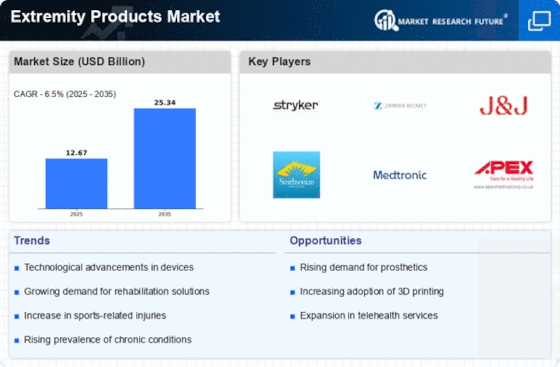
    As per MRFR analysis, the Extremity Products Market Size was estimated at 12.67 USD Billion in 2024. The Extremity Products industry is projected to grow from 13.5 in 2025 to 25.34 by 2035, exhibiting a compound annual growth rate (CAGR) of 6.5 during the forecast period 2025 - 2035.

    Key Market Trends & Highlights

    The Extremity Products Market is poised for substantial growth driven by technological advancements and increasing customization demands.

    • Technological advancements are reshaping the Extremity Products Market, enhancing product efficacy and user experience.
    • The North American region remains the largest market, while the Asia-Pacific region is emerging as the fastest-growing area for extremity products.
    • Upper extremity products dominate the market, whereas lower extremity products are witnessing the most rapid growth.
    • Rising incidence of sports injuries and an aging population are key drivers propelling market expansion.

    Market Size & Forecast

    2024 Market Size 12.67 (USD Billion)
    2035 Market Size 25.34 (USD Billion)
    CAGR (2025 - 2035) 6.5%
    Largest Regional Market Share in 2024 North America

    Major Players

    <p>Stryker Corporation (US), Zimmer Biomet Holdings Inc (US), DePuy Synthes (US), Smith & Nephew plc (GB), Medtronic plc (IE), Apex Medical Technologies (US), Conmed Corporation (US), Orthofix Medical Inc (US), NuVasive Inc (US)</p>

    Market Trends

    The Extremity Products Market is currently experiencing a dynamic evolution, driven by advancements in technology and an increasing focus on patient-centered care. Innovations in materials and design are enhancing the functionality and comfort of extremity products, which include prosthetics, orthotics, and braces. This market appears to be expanding as healthcare providers and patients alike seek solutions that improve mobility and quality of life. Furthermore, the growing prevalence of conditions requiring extremity interventions, such as diabetes and arthritis, is likely to bolster demand for these products. In addition, the rise of telehealth and remote monitoring technologies is influencing the Extremity Products Market. Patients are increasingly engaging with healthcare professionals through digital platforms, which may facilitate better management of their conditions. This trend suggests a shift towards more personalized treatment plans, potentially leading to improved outcomes. As the market continues to adapt to these changes, stakeholders must remain vigilant in understanding consumer needs and preferences to stay competitive in this evolving landscape.

    Technological Advancements

    The Extremity Products Market is witnessing a surge in technological innovations, particularly in the development of smart prosthetics and orthotic devices. These advancements enhance user experience by integrating sensors and connectivity features, allowing for real-time monitoring and adjustments. Such technologies may lead to improved functionality and user satisfaction.

    Increased Focus on Customization

    Customization is becoming a prominent trend within the Extremity Products Market. Patients are increasingly seeking tailored solutions that cater to their specific needs and preferences. This shift towards personalized products may enhance comfort and usability, thereby improving overall patient outcomes.

    Growing Awareness of Rehabilitation

    There is a rising awareness regarding the importance of rehabilitation in the Extremity Products Market. Healthcare providers are emphasizing the role of rehabilitation in recovery processes, which may lead to increased demand for supportive devices. This trend indicates a holistic approach to patient care, focusing on both recovery and long-term mobility.

    Extremity Products Market Market Drivers

    Rising Healthcare Expenditure

    The increase in healthcare expenditure across various regions is a notable driver for the Extremity Products Market. As healthcare budgets expand, there is a greater allocation of resources towards rehabilitation and recovery solutions, including extremity products. This trend is particularly evident in regions where healthcare systems are evolving to provide comprehensive care for musculoskeletal conditions. Data suggests that higher healthcare spending correlates with increased accessibility to advanced extremity products, thereby enhancing market growth. The Extremity Products Market stands to benefit from this trend, as consumers gain access to a wider range of innovative products designed to improve recovery outcomes and overall quality of life.

    Rising Incidence of Sports Injuries

    The increasing participation in sports and physical activities has led to a notable rise in sports-related injuries. This trend appears to be a significant driver for the Extremity Products Market, as athletes and active individuals seek effective solutions for injury prevention and recovery. According to recent data, sports injuries account for a substantial percentage of all injuries, necessitating the demand for specialized extremity products such as braces, supports, and rehabilitation devices. The growing awareness of the importance of injury management and the need for quick recovery solutions further fuels this market. As more individuals engage in high-impact sports, the Extremity Products Market is likely to experience sustained growth, driven by the need for innovative and effective products that cater to this demographic.

    Increased Focus on Preventive Healthcare

    The shift towards preventive healthcare is emerging as a significant driver for the Extremity Products Market. As healthcare systems worldwide emphasize the importance of prevention over treatment, there is a growing demand for products that help individuals maintain their physical health and prevent injuries. This trend is reflected in the rising popularity of fitness and wellness programs that incorporate the use of extremity products for injury prevention. Market analysis indicates that consumers are increasingly willing to invest in products that promote long-term health benefits. Consequently, the Extremity Products Market is likely to see an uptick in sales as more individuals recognize the value of preventive measures in their daily lives.

    Aging Population and Associated Health Issues

    The demographic shift towards an aging population is a critical factor influencing the Extremity Products Market. As individuals age, they often experience a range of musculoskeletal issues, including arthritis and osteoporosis, which can lead to increased demand for extremity products. Data indicates that the elderly population is more prone to injuries and chronic conditions that require supportive devices. This trend suggests a growing market for products designed to enhance mobility and provide pain relief. The Extremity Products Market is likely to benefit from the development of advanced solutions tailored to the needs of older adults, including ergonomic designs and user-friendly features that promote independence and quality of life.

    Technological Innovations in Product Development

    Technological advancements are reshaping the Extremity Products Market, leading to the introduction of innovative products that enhance functionality and user experience. The integration of smart technology, such as sensors and connectivity features, into extremity products is becoming increasingly prevalent. These innovations not only improve the effectiveness of rehabilitation devices but also provide users with real-time feedback on their progress. Market data suggests that the demand for technologically advanced products is on the rise, as consumers seek solutions that offer greater convenience and efficiency. This trend indicates a potential for growth in the Extremity Products Market, as manufacturers invest in research and development to create cutting-edge products that meet evolving consumer expectations.

    Market Segment Insights

    By Product: Upper Extremity (Largest) vs. Lower Extremity (Fastest-Growing)

    <p>The extremity products market is primarily dominated by the upper extremity segment, which holds the largest market share among all product types. This segment includes a wide range of orthopedic devices and prosthetics tailored for the shoulder, arm, and hand, capitalizing on advancements in technology and materials. In contrast, the lower extremity segment, while smaller in size, is experiencing rapid growth due to increasing incidences of lower limb injuries and an aging population that requires mobility solutions.</p>

    <p>Upper Extremity (Dominant) vs. Lower Extremity (Emerging)</p>

    <p>The upper extremity segment is characterized by its extensive array of products, including braces, prosthetics, and supportive devices designed to enhance functionality and mobility for patients. This segment benefits from established brand recognition and a diverse product offering that meets varying patient needs. Conversely, the lower extremity segment is emerging quickly, driven by a surge in demand for advanced orthopedic supports and innovative prosthetic technologies that facilitate recovery from injuries. Market players are focusing on developing lightweight, durable products that enhance user comfort and resilience, positioning the lower extremity segment for sustained growth in the coming years.</p>

    By Material: Metallic Material (Largest) vs. Polymeric Material (Fastest-Growing)

    <p>In the Extremity Products Market, the material segment showcases a diverse distribution, with Metallic Material holding the largest share. This segment has been a staple due to its durability and strength, favored in orthopedic implant applications. Conversely, Polymeric Material is carving out a significant niche, rapidly adopting due to its versatility and weight efficiency, proving to be an appealing alternative especially in prosthetics and soft tissue applications. Growth trends indicate a pronounced shift towards Polymeric Material, driven by advancements in material science that enhance performance characteristics while reducing costs. Furthermore, the increasing demand for lightweight solutions in extremity products coupled with an aging population fuels the preference for materials that offer greater flexibility and comfort, ensuring the continued ascendancy of Polymeric alternatives in the market.</p>

    <p>Metallic Material (Dominant) vs. Ceramic Material (Emerging)</p>

    <p>Metallic Material is recognized as the dominant segment within the Extremity Products Market, valued for its high tensile strength and biocompatibility, making it an ideal choice for applications such as bone fixation and joint replacement. The established trust in metallic implants ensures their widespread use, although innovations and superior characteristics of Ceramic Material make it an emerging contender. Ceramic Material offers unique advantages such as excellent wear resistance and aesthetic appeal in joint replacements. Its lightweight and bioactive properties cater to the evolving consumer expectations for quality and longevity in extremity solutions, thus marking its rise as a favored option in surgeries aiming for minimal invasiveness and improved patient outcomes.</p>

    Get more detailed insights about Extremity Products Market Research Report—Global Forecast till 2035

    Regional Insights

    North America : Market Leader in Innovation

    North America is the largest market for extremity products, holding approximately 45% of the global share. The region's growth is driven by advanced healthcare infrastructure, increasing prevalence of orthopedic conditions, and a strong focus on research and development. Regulatory support from agencies like the FDA further catalyzes innovation and market expansion, ensuring that new products meet stringent safety and efficacy standards. The United States is the primary contributor, with key players such as Stryker Corporation, Zimmer Biomet, and DePuy Synthes leading the competitive landscape. The presence of these major companies fosters a robust ecosystem for innovation and collaboration. Canada also plays a significant role, contributing to the market with its growing healthcare investments and increasing demand for advanced medical technologies.

    Europe : Emerging Market with Growth Potential

    Europe is the second-largest market for extremity products, accounting for approximately 30% of the global market share. The region's growth is fueled by an aging population, rising healthcare expenditures, and increasing awareness of advanced surgical techniques. Regulatory frameworks, such as the Medical Device Regulation (MDR), are enhancing product safety and efficacy, thereby boosting consumer confidence and market demand. Leading countries in this region include Germany, France, and the UK, where significant investments in healthcare infrastructure are evident. Major players like Smith & Nephew and Medtronic are actively expanding their product offerings. The competitive landscape is characterized by a mix of established companies and innovative startups, driving advancements in extremity product technologies.

    Asia-Pacific : Rapidly Growing Market Segment

    Asia-Pacific is witnessing rapid growth in the extremity products market, holding about 20% of the global share. This growth is driven by increasing healthcare access, rising disposable incomes, and a growing prevalence of orthopedic disorders. Countries like China and India are investing heavily in healthcare infrastructure, which is expected to further boost market demand. Regulatory bodies are also becoming more stringent, ensuring that products meet international safety standards, which enhances market credibility. China is the largest market in the region, followed by Japan and India. The competitive landscape features both local and international players, with companies like Apex Medical Technologies and Conmed Corporation making significant inroads. The region's diverse population and varying healthcare needs present unique opportunities for tailored extremity product solutions.

    Middle East and Africa : Untapped Market with Potential

    The Middle East and Africa represent an emerging market for extremity products, holding around 5% of the global share. The growth in this region is driven by increasing healthcare investments, a rising prevalence of chronic diseases, and a growing awareness of advanced medical technologies. Governments are implementing policies to improve healthcare access, which is expected to catalyze market growth in the coming years. Countries like South Africa and the UAE are leading the way in adopting advanced healthcare solutions. The competitive landscape is still developing, with both local and international players vying for market share. Companies are focusing on establishing partnerships and collaborations to enhance their presence and meet the growing demand for extremity products in this region.

    Key Players and Competitive Insights

    The Extremity Products Market is characterized by a dynamic competitive landscape, driven by innovation, technological advancements, and strategic partnerships. Key players such as Stryker Corporation (US), Zimmer Biomet Holdings Inc (US), and DePuy Synthes (US) are at the forefront, each adopting distinct strategies to enhance their market positioning. Stryker Corporation (US) focuses on innovation in surgical instruments and implants, while Zimmer Biomet Holdings Inc (US) emphasizes digital transformation and data analytics to improve patient outcomes. DePuy Synthes (US) is leveraging its extensive product portfolio to cater to diverse surgical needs, thereby shaping a competitive environment that is increasingly reliant on technological integration and customer-centric solutions.

    The business tactics employed by these companies include localizing manufacturing to reduce costs and optimize supply chains, which is particularly crucial in a moderately fragmented market. This competitive structure allows for a variety of players to coexist, yet the influence of major companies remains significant. Their ability to adapt to market demands and streamline operations positions them favorably against emerging competitors, thereby reinforcing their market share.

    In August 2025, Stryker Corporation (US) announced the launch of a new robotic-assisted surgical system designed to enhance precision in extremity surgeries. This strategic move not only underscores Stryker's commitment to innovation but also positions the company to capture a larger share of the growing demand for minimally invasive surgical solutions. The introduction of advanced robotics is likely to set a new standard in surgical procedures, further solidifying Stryker's leadership in the market.

    In September 2025, Zimmer Biomet Holdings Inc (US) entered into a partnership with a leading telehealth provider to integrate remote monitoring capabilities into its extremity products. This collaboration aims to enhance patient engagement and streamline post-operative care, reflecting a broader trend towards digital health solutions. By embracing telehealth, Zimmer Biomet is not only improving patient outcomes but also expanding its service offerings, which could lead to increased customer loyalty and market penetration.

    In October 2025, DePuy Synthes (US) unveiled a new line of biodegradable implants aimed at reducing environmental impact. This initiative aligns with the growing emphasis on sustainability within the healthcare sector. By prioritizing eco-friendly materials, DePuy Synthes is likely to appeal to environmentally conscious consumers and healthcare providers, thereby differentiating itself in a competitive market that increasingly values sustainability alongside performance.

    As of October 2025, the Extremity Products Market is witnessing trends such as digitalization, sustainability, and the integration of artificial intelligence in product development. Strategic alliances are becoming pivotal in shaping the competitive landscape, as companies seek to leverage complementary strengths to enhance their offerings. Looking ahead, competitive differentiation is expected to evolve from traditional price-based competition to a focus on innovation, technological advancements, and supply chain reliability, indicating a shift towards a more sophisticated and value-driven market environment.

    Key Companies in the Extremity Products Market market include

    Industry Developments

    June 2022 In2Bones Global Inc., a privately held company, has been acquired by CONMED Corporation, according to a statement.

    January 2022 The innovative Tornier Perform® Patient-Matched Primary Reversed Glenoid (Patient-Matched Glenoid), from one of the top manufacturers of medical equipment, was utilized in a surgical procedure for the first time, according to a statement from Stryker.

    Future Outlook

    Extremity Products Market Future Outlook

    <p>The Extremity Products Market is projected to grow at a 6.5% CAGR from 2024 to 2035, driven by technological advancements, increasing healthcare expenditure, and rising demand for orthopedic solutions.</p>

    New opportunities lie in:

    • <p>Expansion of telehealth services for remote consultations and follow-ups.</p>
    • <p>Development of biodegradable implants to meet sustainability demands.</p>
    • <p>Investment in AI-driven diagnostic tools for enhanced patient outcomes.</p>

    <p>By 2035, the Extremity Products Market is expected to be robust, driven by innovation and strategic investments.</p>

    Market Segmentation

    Extremity Products Market Product Outlook

    • Upper Extremity
    • Lower Extremity

    Extremity Products Market Material Outlook

    • Metallic Material
    • Ceramic Material
    • Polymeric Material
    • Natural Material

    Report Scope

    MARKET SIZE 202412.67(USD Billion)
    MARKET SIZE 202513.5(USD Billion)
    MARKET SIZE 203525.34(USD Billion)
    COMPOUND ANNUAL GROWTH RATE (CAGR)6.5% (2024 - 2035)
    REPORT COVERAGERevenue Forecast, Competitive Landscape, Growth Factors, and Trends
    BASE YEAR2024
    Market Forecast Period2025 - 2035
    Historical Data2019 - 2024
    Market Forecast UnitsUSD Billion
    Key Companies ProfiledMarket analysis in progress
    Segments CoveredMarket segmentation analysis in progress
    Key Market OpportunitiesIntegration of advanced materials and 3D printing technology in Extremity Products Market enhances customization and patient outcomes.
    Key Market DynamicsRising demand for advanced extremity products driven by technological innovations and evolving consumer preferences.
    Countries CoveredNorth America, Europe, APAC, South America, MEA

    FAQs

    What is the projected growth of the Extremity Products market?

    The Extremity Products market is the expected increase in total market value of 25.34 USD billion over a defined forecast period 2025–2035. It is driven by factors such as demand trends, technological advances, regulatory changes, and geographic expansion.

    What is the size of the Extremity Products market?

    Extremity Products market size was valued at approximately 12.67 billion USD in 2024. This figure will reach 25.34 billion USD covering all regions (America, Europe, Asia, MEA and ROW), focusing its segments / services / distribution channels till 2035.

    What is the CAGR of the Extremity Products market?

    Extremity Products market is expected to grow at a CAGR of 6.5% between 2025 and 2035.

    How much will the Extremity Products market be worth by 2035?

    Extremity Products market is expected to be worth of 25.34 billion USD, reflecting growth driven by usage, technology and global demands by the end of 2035.

    How will the Extremity Products market perform over the next 10 years?

    Over the next 10 years the Extremity Products market is expected to shift from usd billion 12.67 to 25.34 billion USD, led by adoption of advanced tech, demographic trends, regulatory approvals, with potential headwinds from 2025 to 2035.

    Which region held the largest market share in the Extremity Products market?

    North America had the largest share in the global market

    1. SECTION I: EXECUTIVE SUMMARY AND KEY HIGHLIGHTS
      1. | 1.1 EXECUTIVE SUMMARY
      2. | | 1.1.1 Market Overview
      3. | | 1.1.2 Key Findings
      4. | | 1.1.3 Market Segmentation
      5. | | 1.1.4 Competitive Landscape
      6. | | 1.1.5 Challenges and Opportunities
      7. | | 1.1.6 Future Outlook
    2. SECTION II: SCOPING, METHODOLOGY AND MARKET STRUCTURE
      1. | 2.1 MARKET INTRODUCTION
      2. | | 2.1.1 Definition
      3. | | 2.1.2 Scope of the study
      4. | | | 2.1.2.1 Research Objective
      5. | | | 2.1.2.2 Assumption
      6. | | | 2.1.2.3 Limitations
      7. | 2.2 RESEARCH METHODOLOGY
      8. | | 2.2.1 Overview
      9. | | 2.2.2 Data Mining
      10. | | 2.2.3 Secondary Research
      11. | | 2.2.4 Primary Research
      12. | | | 2.2.4.1 Primary Interviews and Information Gathering Process
      13. | | | 2.2.4.2 Breakdown of Primary Respondents
      14. | | 2.2.5 Forecasting Model
      15. | | 2.2.6 Market Size Estimation
      16. | | | 2.2.6.1 Bottom-Up Approach
      17. | | | 2.2.6.2 Top-Down Approach
      18. | | 2.2.7 Data Triangulation
      19. | | 2.2.8 Validation
    3. SECTION III: QUALITATIVE ANALYSIS
      1. | 3.1 MARKET DYNAMICS
      2. | | 3.1.1 Overview
      3. | | 3.1.2 Drivers
      4. | | 3.1.3 Restraints
      5. | | 3.1.4 Opportunities
      6. | 3.2 MARKET FACTOR ANALYSIS
      7. | | 3.2.1 Value chain Analysis
      8. | | 3.2.2 Porter's Five Forces Analysis
      9. | | | 3.2.2.1 Bargaining Power of Suppliers
      10. | | | 3.2.2.2 Bargaining Power of Buyers
      11. | | | 3.2.2.3 Threat of New Entrants
      12. | | | 3.2.2.4 Threat of Substitutes
      13. | | | 3.2.2.5 Intensity of Rivalry
      14. | | 3.2.3 COVID-19 Impact Analysis
      15. | | | 3.2.3.1 Market Impact Analysis
      16. | | | 3.2.3.2 Regional Impact
      17. | | | 3.2.3.3 Opportunity and Threat Analysis
    4. SECTION IV: QUANTITATIVE ANALYSIS
      1. | 4.1 Healthcare, BY Product (USD Billion)
      2. | | 4.1.1 Upper Extremity
      3. | | 4.1.2 Lower Extremity
      4. | 4.2 Healthcare, BY Material (USD Billion)
      5. | | 4.2.1 Metallic Material
      6. | | 4.2.2 Ceramic Material
      7. | | 4.2.3 Polymeric Material
      8. | | 4.2.4 Natural Material
      9. | 4.3 Healthcare, BY Region (USD Billion)
      10. | | 4.3.1 North America
      11. | | | 4.3.1.1 US
      12. | | | 4.3.1.2 Canada
      13. | | 4.3.2 Europe
      14. | | | 4.3.2.1 Germany
      15. | | | 4.3.2.2 UK
      16. | | | 4.3.2.3 France
      17. | | | 4.3.2.4 Russia
      18. | | | 4.3.2.5 Italy
      19. | | | 4.3.2.6 Spain
      20. | | | 4.3.2.7 Rest of Europe
      21. | | 4.3.3 APAC
      22. | | | 4.3.3.1 China
      23. | | | 4.3.3.2 India
      24. | | | 4.3.3.3 Japan
      25. | | | 4.3.3.4 South Korea
      26. | | | 4.3.3.5 Malaysia
      27. | | | 4.3.3.6 Thailand
      28. | | | 4.3.3.7 Indonesia
      29. | | | 4.3.3.8 Rest of APAC
      30. | | 4.3.4 South America
      31. | | | 4.3.4.1 Brazil
      32. | | | 4.3.4.2 Mexico
      33. | | | 4.3.4.3 Argentina
      34. | | | 4.3.4.4 Rest of South America
      35. | | 4.3.5 MEA
      36. | | | 4.3.5.1 GCC Countries
      37. | | | 4.3.5.2 South Africa
      38. | | | 4.3.5.3 Rest of MEA
    5. SECTION V: COMPETITIVE ANALYSIS
      1. | 5.1 Competitive Landscape
      2. | | 5.1.1 Overview
      3. | | 5.1.2 Competitive Analysis
      4. | | 5.1.3 Market share Analysis
      5. | | 5.1.4 Major Growth Strategy in the Healthcare
      6. | | 5.1.5 Competitive Benchmarking
      7. | | 5.1.6 Leading Players in Terms of Number of Developments in the Healthcare
      8. | | 5.1.7 Key developments and growth strategies
      9. | | | 5.1.7.1 New Product Launch/Service Deployment
      10. | | | 5.1.7.2 Merger & Acquisitions
      11. | | | 5.1.7.3 Joint Ventures
      12. | | 5.1.8 Major Players Financial Matrix
      13. | | | 5.1.8.1 Sales and Operating Income
      14. | | | 5.1.8.2 Major Players R&D Expenditure. 2023
      15. | 5.2 Company Profiles
      16. | | 5.2.1 Stryker Corporation (US)
      17. | | | 5.2.1.1 Financial Overview
      18. | | | 5.2.1.2 Products Offered
      19. | | | 5.2.1.3 Key Developments
      20. | | | 5.2.1.4 SWOT Analysis
      21. | | | 5.2.1.5 Key Strategies
      22. | | 5.2.2 Zimmer Biomet Holdings Inc (US)
      23. | | | 5.2.2.1 Financial Overview
      24. | | | 5.2.2.2 Products Offered
      25. | | | 5.2.2.3 Key Developments
      26. | | | 5.2.2.4 SWOT Analysis
      27. | | | 5.2.2.5 Key Strategies
      28. | | 5.2.3 DePuy Synthes (US)
      29. | | | 5.2.3.1 Financial Overview
      30. | | | 5.2.3.2 Products Offered
      31. | | | 5.2.3.3 Key Developments
      32. | | | 5.2.3.4 SWOT Analysis
      33. | | | 5.2.3.5 Key Strategies
      34. | | 5.2.4 Smith & Nephew plc (GB)
      35. | | | 5.2.4.1 Financial Overview
      36. | | | 5.2.4.2 Products Offered
      37. | | | 5.2.4.3 Key Developments
      38. | | | 5.2.4.4 SWOT Analysis
      39. | | | 5.2.4.5 Key Strategies
      40. | | 5.2.5 Medtronic plc (IE)
      41. | | | 5.2.5.1 Financial Overview
      42. | | | 5.2.5.2 Products Offered
      43. | | | 5.2.5.3 Key Developments
      44. | | | 5.2.5.4 SWOT Analysis
      45. | | | 5.2.5.5 Key Strategies
      46. | | 5.2.6 Apex Medical Technologies (US)
      47. | | | 5.2.6.1 Financial Overview
      48. | | | 5.2.6.2 Products Offered
      49. | | | 5.2.6.3 Key Developments
      50. | | | 5.2.6.4 SWOT Analysis
      51. | | | 5.2.6.5 Key Strategies
      52. | | 5.2.7 Conmed Corporation (US)
      53. | | | 5.2.7.1 Financial Overview
      54. | | | 5.2.7.2 Products Offered
      55. | | | 5.2.7.3 Key Developments
      56. | | | 5.2.7.4 SWOT Analysis
      57. | | | 5.2.7.5 Key Strategies
      58. | | 5.2.8 Orthofix Medical Inc (US)
      59. | | | 5.2.8.1 Financial Overview
      60. | | | 5.2.8.2 Products Offered
      61. | | | 5.2.8.3 Key Developments
      62. | | | 5.2.8.4 SWOT Analysis
      63. | | | 5.2.8.5 Key Strategies
      64. | | 5.2.9 NuVasive Inc (US)
      65. | | | 5.2.9.1 Financial Overview
      66. | | | 5.2.9.2 Products Offered
      67. | | | 5.2.9.3 Key Developments
      68. | | | 5.2.9.4 SWOT Analysis
      69. | | | 5.2.9.5 Key Strategies
      70. | 5.3 Appendix
      71. | | 5.3.1 References
      72. | | 5.3.2 Related Reports
    6. LIST OF FIGURES
      1. | 6.1 MARKET SYNOPSIS
      2. | 6.2 NORTH AMERICA MARKET ANALYSIS
      3. | 6.3 US MARKET ANALYSIS BY PRODUCT
      4. | 6.4 US MARKET ANALYSIS BY MATERIAL
      5. | 6.5 CANADA MARKET ANALYSIS BY PRODUCT
      6. | 6.6 CANADA MARKET ANALYSIS BY MATERIAL
      7. | 6.7 EUROPE MARKET ANALYSIS
      8. | 6.8 GERMANY MARKET ANALYSIS BY PRODUCT
      9. | 6.9 GERMANY MARKET ANALYSIS BY MATERIAL
      10. | 6.10 UK MARKET ANALYSIS BY PRODUCT
      11. | 6.11 UK MARKET ANALYSIS BY MATERIAL
      12. | 6.12 FRANCE MARKET ANALYSIS BY PRODUCT
      13. | 6.13 FRANCE MARKET ANALYSIS BY MATERIAL
      14. | 6.14 RUSSIA MARKET ANALYSIS BY PRODUCT
      15. | 6.15 RUSSIA MARKET ANALYSIS BY MATERIAL
      16. | 6.16 ITALY MARKET ANALYSIS BY PRODUCT
      17. | 6.17 ITALY MARKET ANALYSIS BY MATERIAL
      18. | 6.18 SPAIN MARKET ANALYSIS BY PRODUCT
      19. | 6.19 SPAIN MARKET ANALYSIS BY MATERIAL
      20. | 6.20 REST OF EUROPE MARKET ANALYSIS BY PRODUCT
      21. | 6.21 REST OF EUROPE MARKET ANALYSIS BY MATERIAL
      22. | 6.22 APAC MARKET ANALYSIS
      23. | 6.23 CHINA MARKET ANALYSIS BY PRODUCT
      24. | 6.24 CHINA MARKET ANALYSIS BY MATERIAL
      25. | 6.25 INDIA MARKET ANALYSIS BY PRODUCT
      26. | 6.26 INDIA MARKET ANALYSIS BY MATERIAL
      27. | 6.27 JAPAN MARKET ANALYSIS BY PRODUCT
      28. | 6.28 JAPAN MARKET ANALYSIS BY MATERIAL
      29. | 6.29 SOUTH KOREA MARKET ANALYSIS BY PRODUCT
      30. | 6.30 SOUTH KOREA MARKET ANALYSIS BY MATERIAL
      31. | 6.31 MALAYSIA MARKET ANALYSIS BY PRODUCT
      32. | 6.32 MALAYSIA MARKET ANALYSIS BY MATERIAL
      33. | 6.33 THAILAND MARKET ANALYSIS BY PRODUCT
      34. | 6.34 THAILAND MARKET ANALYSIS BY MATERIAL
      35. | 6.35 INDONESIA MARKET ANALYSIS BY PRODUCT
      36. | 6.36 INDONESIA MARKET ANALYSIS BY MATERIAL
      37. | 6.37 REST OF APAC MARKET ANALYSIS BY PRODUCT
      38. | 6.38 REST OF APAC MARKET ANALYSIS BY MATERIAL
      39. | 6.39 SOUTH AMERICA MARKET ANALYSIS
      40. | 6.40 BRAZIL MARKET ANALYSIS BY PRODUCT
      41. | 6.41 BRAZIL MARKET ANALYSIS BY MATERIAL
      42. | 6.42 MEXICO MARKET ANALYSIS BY PRODUCT
      43. | 6.43 MEXICO MARKET ANALYSIS BY MATERIAL
      44. | 6.44 ARGENTINA MARKET ANALYSIS BY PRODUCT
      45. | 6.45 ARGENTINA MARKET ANALYSIS BY MATERIAL
      46. | 6.46 REST OF SOUTH AMERICA MARKET ANALYSIS BY PRODUCT
      47. | 6.47 REST OF SOUTH AMERICA MARKET ANALYSIS BY MATERIAL
      48. | 6.48 MEA MARKET ANALYSIS
      49. | 6.49 GCC COUNTRIES MARKET ANALYSIS BY PRODUCT
      50. | 6.50 GCC COUNTRIES MARKET ANALYSIS BY MATERIAL
      51. | 6.51 SOUTH AFRICA MARKET ANALYSIS BY PRODUCT
      52. | 6.52 SOUTH AFRICA MARKET ANALYSIS BY MATERIAL
      53. | 6.53 REST OF MEA MARKET ANALYSIS BY PRODUCT
      54. | 6.54 REST OF MEA MARKET ANALYSIS BY MATERIAL
      55. | 6.55 KEY BUYING CRITERIA OF HEALTHCARE
      56. | 6.56 RESEARCH PROCESS OF MRFR
      57. | 6.57 DRO ANALYSIS OF HEALTHCARE
      58. | 6.58 DRIVERS IMPACT ANALYSIS: HEALTHCARE
      59. | 6.59 RESTRAINTS IMPACT ANALYSIS: HEALTHCARE
      60. | 6.60 SUPPLY / VALUE CHAIN: HEALTHCARE
      61. | 6.61 HEALTHCARE, BY PRODUCT, 2024 (% SHARE)
      62. | 6.62 HEALTHCARE, BY PRODUCT, 2024 TO 2035 (USD Billion)
      63. | 6.63 HEALTHCARE, BY MATERIAL, 2024 (% SHARE)
      64. | 6.64 HEALTHCARE, BY MATERIAL, 2024 TO 2035 (USD Billion)
      65. | 6.65 BENCHMARKING OF MAJOR COMPETITORS
    7. LIST OF TABLES
      1. | 7.1 LIST OF ASSUMPTIONS
      2. | | 7.1.1
      3. | 7.2 North America MARKET SIZE ESTIMATES; FORECAST
      4. | | 7.2.1 BY PRODUCT, 2025-2035 (USD Billion)
      5. | | 7.2.2 BY MATERIAL, 2025-2035 (USD Billion)
      6. | 7.3 US MARKET SIZE ESTIMATES; FORECAST
      7. | | 7.3.1 BY PRODUCT, 2025-2035 (USD Billion)
      8. | | 7.3.2 BY MATERIAL, 2025-2035 (USD Billion)
      9. | 7.4 Canada MARKET SIZE ESTIMATES; FORECAST
      10. | | 7.4.1 BY PRODUCT, 2025-2035 (USD Billion)
      11. | | 7.4.2 BY MATERIAL, 2025-2035 (USD Billion)
      12. | 7.5 Europe MARKET SIZE ESTIMATES; FORECAST
      13. | | 7.5.1 BY PRODUCT, 2025-2035 (USD Billion)
      14. | | 7.5.2 BY MATERIAL, 2025-2035 (USD Billion)
      15. | 7.6 Germany MARKET SIZE ESTIMATES; FORECAST
      16. | | 7.6.1 BY PRODUCT, 2025-2035 (USD Billion)
      17. | | 7.6.2 BY MATERIAL, 2025-2035 (USD Billion)
      18. | 7.7 UK MARKET SIZE ESTIMATES; FORECAST
      19. | | 7.7.1 BY PRODUCT, 2025-2035 (USD Billion)
      20. | | 7.7.2 BY MATERIAL, 2025-2035 (USD Billion)
      21. | 7.8 France MARKET SIZE ESTIMATES; FORECAST
      22. | | 7.8.1 BY PRODUCT, 2025-2035 (USD Billion)
      23. | | 7.8.2 BY MATERIAL, 2025-2035 (USD Billion)
      24. | 7.9 Russia MARKET SIZE ESTIMATES; FORECAST
      25. | | 7.9.1 BY PRODUCT, 2025-2035 (USD Billion)
      26. | | 7.9.2 BY MATERIAL, 2025-2035 (USD Billion)
      27. | 7.10 Italy MARKET SIZE ESTIMATES; FORECAST
      28. | | 7.10.1 BY PRODUCT, 2025-2035 (USD Billion)
      29. | | 7.10.2 BY MATERIAL, 2025-2035 (USD Billion)
      30. | 7.11 Spain MARKET SIZE ESTIMATES; FORECAST
      31. | | 7.11.1 BY PRODUCT, 2025-2035 (USD Billion)
      32. | | 7.11.2 BY MATERIAL, 2025-2035 (USD Billion)
      33. | 7.12 Rest of Europe MARKET SIZE ESTIMATES; FORECAST
      34. | | 7.12.1 BY PRODUCT, 2025-2035 (USD Billion)
      35. | | 7.12.2 BY MATERIAL, 2025-2035 (USD Billion)
      36. | 7.13 APAC MARKET SIZE ESTIMATES; FORECAST
      37. | | 7.13.1 BY PRODUCT, 2025-2035 (USD Billion)
      38. | | 7.13.2 BY MATERIAL, 2025-2035 (USD Billion)
      39. | 7.14 China MARKET SIZE ESTIMATES; FORECAST
      40. | | 7.14.1 BY PRODUCT, 2025-2035 (USD Billion)
      41. | | 7.14.2 BY MATERIAL, 2025-2035 (USD Billion)
      42. | 7.15 India MARKET SIZE ESTIMATES; FORECAST
      43. | | 7.15.1 BY PRODUCT, 2025-2035 (USD Billion)
      44. | | 7.15.2 BY MATERIAL, 2025-2035 (USD Billion)
      45. | 7.16 Japan MARKET SIZE ESTIMATES; FORECAST
      46. | | 7.16.1 BY PRODUCT, 2025-2035 (USD Billion)
      47. | | 7.16.2 BY MATERIAL, 2025-2035 (USD Billion)
      48. | 7.17 South Korea MARKET SIZE ESTIMATES; FORECAST
      49. | | 7.17.1 BY PRODUCT, 2025-2035 (USD Billion)
      50. | | 7.17.2 BY MATERIAL, 2025-2035 (USD Billion)
      51. | 7.18 Malaysia MARKET SIZE ESTIMATES; FORECAST
      52. | | 7.18.1 BY PRODUCT, 2025-2035 (USD Billion)
      53. | | 7.18.2 BY MATERIAL, 2025-2035 (USD Billion)
      54. | 7.19 Thailand MARKET SIZE ESTIMATES; FORECAST
      55. | | 7.19.1 BY PRODUCT, 2025-2035 (USD Billion)
      56. | | 7.19.2 BY MATERIAL, 2025-2035 (USD Billion)
      57. | 7.20 Indonesia MARKET SIZE ESTIMATES; FORECAST
      58. | | 7.20.1 BY PRODUCT, 2025-2035 (USD Billion)
      59. | | 7.20.2 BY MATERIAL, 2025-2035 (USD Billion)
      60. | 7.21 Rest of APAC MARKET SIZE ESTIMATES; FORECAST
      61. | | 7.21.1 BY PRODUCT, 2025-2035 (USD Billion)
      62. | | 7.21.2 BY MATERIAL, 2025-2035 (USD Billion)
      63. | 7.22 South America MARKET SIZE ESTIMATES; FORECAST
      64. | | 7.22.1 BY PRODUCT, 2025-2035 (USD Billion)
      65. | | 7.22.2 BY MATERIAL, 2025-2035 (USD Billion)
      66. | 7.23 Brazil MARKET SIZE ESTIMATES; FORECAST
      67. | | 7.23.1 BY PRODUCT, 2025-2035 (USD Billion)
      68. | | 7.23.2 BY MATERIAL, 2025-2035 (USD Billion)
      69. | 7.24 Mexico MARKET SIZE ESTIMATES; FORECAST
      70. | | 7.24.1 BY PRODUCT, 2025-2035 (USD Billion)
      71. | | 7.24.2 BY MATERIAL, 2025-2035 (USD Billion)
      72. | 7.25 Argentina MARKET SIZE ESTIMATES; FORECAST
      73. | | 7.25.1 BY PRODUCT, 2025-2035 (USD Billion)
      74. | | 7.25.2 BY MATERIAL, 2025-2035 (USD Billion)
      75. | 7.26 Rest of South America MARKET SIZE ESTIMATES; FORECAST
      76. | | 7.26.1 BY PRODUCT, 2025-2035 (USD Billion)
      77. | | 7.26.2 BY MATERIAL, 2025-2035 (USD Billion)
      78. | 7.27 MEA MARKET SIZE ESTIMATES; FORECAST
      79. | | 7.27.1 BY PRODUCT, 2025-2035 (USD Billion)
      80. | | 7.27.2 BY MATERIAL, 2025-2035 (USD Billion)
      81. | 7.28 GCC Countries MARKET SIZE ESTIMATES; FORECAST
      82. | | 7.28.1 BY PRODUCT, 2025-2035 (USD Billion)
      83. | | 7.28.2 BY MATERIAL, 2025-2035 (USD Billion)
      84. | 7.29 South Africa MARKET SIZE ESTIMATES; FORECAST
      85. | | 7.29.1 BY PRODUCT, 2025-2035 (USD Billion)
      86. | | 7.29.2 BY MATERIAL, 2025-2035 (USD Billion)
      87. | 7.30 Rest of MEA MARKET SIZE ESTIMATES; FORECAST
      88. | | 7.30.1 BY PRODUCT, 2025-2035 (USD Billion)
      89. | | 7.30.2 BY MATERIAL, 2025-2035 (USD Billion)
      90. | 7.31 PRODUCT LAUNCH/PRODUCT DEVELOPMENT/APPROVAL
      91. | | 7.31.1
      92. | 7.32 ACQUISITION/PARTNERSHIP
      93. | | 7.32.1

    Extremity Products Market Segmentation

    Extremity Products Product Outlook (USD Billion, 2018-2032)

    Upper Extremity

    Lower Extremity

    Extremity Products Material Outlook (USD Billion, 2018-2032)

    Metallic Material

    Ceramic Material

    Polymeric Material

    Natural Material

    Extremity Products Regional Outlook (USD Billion, 2018-2032)

    North America Outlook (USD Billion, 2018-2032)

    Extremity Products by Product

    Upper Extremity

    Lower Extremity

    Extremity Products by Material

    Metallic Material

    Ceramic Material

    Polymeric Material

    Natural Material

    US Outlook (USD Billion, 2018-2032)

    Extremity Products by Product

    Upper Extremity

    Lower Extremity

    Extremity Products by Material

    Metallic Material

    Ceramic Material

    Polymeric Material

    Natural Material

    Canada Outlook (USD Billion, 2018-2032)

    Extremity Products by Product

    Upper Extremity

    Lower Extremity

    Extremity Products by Material

    Metallic Material

    Ceramic Material

    Polymeric Material

    Natural Material

    Europe Outlook (USD Billion, 2018-2032)

    Extremity Products by Product

    Upper Extremity

    Lower Extremity

    Extremity Products by Material

    Metallic Material

    Ceramic Material

    Polymeric Material

    Natural Material

    Germany Outlook (USD Billion, 2018-2032)

    Extremity Products by Product

    Upper Extremity

    Lower Extremity

    Extremity Products by Material

    Metallic Material

    Ceramic Material

    Polymeric Material

    Natural Material

    France Outlook (USD Billion, 2018-2032)

    Extremity Products by Product

    Upper Extremity

    Lower Extremity

    Extremity Products by Material

    Metallic Material

    Ceramic Material

    Polymeric Material

    Natural Material

    UK Outlook (USD Billion, 2018-2032)

    Extremity Products by Product

    Upper Extremity

    Lower Extremity

    Extremity Products by Material

    Metallic Material

    Ceramic Material

    Polymeric Material

    Natural Material

    Italy Outlook (USD Billion, 2018-2032)

    Extremity Products by Product

    Upper Extremity

    Lower Extremity

    Extremity Products by Material

    Metallic Material

    Ceramic Material

    Polymeric Material

    Natural Material

    Spain Outlook (USD Billion, 2018-2032)

    Extremity Products by Product

    Upper Extremity

    Lower Extremity

    Extremity Products by Material

    Metallic Material

    Ceramic Material

    Polymeric Material

    Natural Material

    Rest Of Europe Outlook (USD Billion, 2018-2032)

    Extremity Products by Product

    Upper Extremity

    Lower Extremity

    Extremity Products by Material

    Metallic Material

    Ceramic Material

    Polymeric Material

    Natural Material

    Asia-Pacific Outlook (USD Billion, 2018-2032)

    Extremity Products by Product

    Upper Extremity

    Lower Extremity

    Extremity Products by Material

    Metallic Material

    Ceramic Material

    Polymeric Material

    Natural Material

    China Outlook (USD Billion, 2018-2032)

    Extremity Products by Product

    Upper Extremity

    Lower Extremity

    Extremity Products by Material

    Metallic Material

    Ceramic Material

    Polymeric Material

    Natural Material

    Japan Outlook (USD Billion, 2018-2032)

    Extremity Products by Product

    Upper Extremity

    Lower Extremity

    Extremity Products by Material

    Metallic Material

    Ceramic Material

    Polymeric Material

    Natural Material

    India Outlook (USD Billion, 2018-2032)

    Extremity Products by Product

    Upper Extremity

    Lower Extremity

    Extremity Products by Material

    Metallic Material

    Ceramic Material

    Polymeric Material

    Natural Material

    Australia Outlook (USD Billion, 2018-2032)

    Extremity Products by Product

    Upper Extremity

    Lower Extremity

    Extremity Products by Material

    Metallic Material

    Ceramic Material

    Polymeric Material

    Natural Material

    Rest of Asia-Pacific Outlook (USD Billion, 2018-2032)

    Extremity Products by Product

    Upper Extremity

    Lower Extremity

    Extremity Products by Material

    Metallic Material

    Ceramic Material

    Polymeric Material

    Natural Material

    Rest of the World Outlook (USD Billion, 2018-2032)

    Extremity Products by Product

    Upper Extremity

    Lower Extremity

    Extremity Products by Material

    Metallic Material

    Ceramic Material

    Polymeric Material

    Natural Material

    Middle East Outlook (USD Billion, 2018-2032)

    Extremity Products by Product

    Upper Extremity

    Lower Extremity

    Extremity Products by Material

    Metallic Material

    Ceramic Material

    Polymeric Material

    Natural Material

    Africa Outlook (USD Billion, 2018-2032)

    Extremity Products by Product

    Upper Extremity

    Lower Extremity

    Extremity Products by Material

    Metallic Material

    Ceramic Material

    Polymeric Material

    Natural Material

    Latin America Outlook (USD Billion, 2018-2032)

    Extremity Products by Product

    Upper Extremity

    Lower Extremity

    Extremity Products by Material

    Metallic Material

    Ceramic Material

    Polymeric Material

    Natural Material

    Infographic

    Free Sample Request

    Kindly complete the form below to receive a free sample of this Report

    Get Free Sample

    Customer Strories

    “I am very pleased with how market segments have been defined in a relevant way for my purposes (such as "Portable Freezers & refrigerators" and "last-mile"). In general the report is well structured. Thanks very much for your efforts.”

    Victoria Milne

    Founder
    Case Study
    Chemicals and Materials

    Compare Licence

    ×
    Features License Type
    Single User Multiuser License Enterprise User
    Price $4,950 $5,950 $7,250
    Maximum User Access Limit 1 User Upto 10 Users Unrestricted Access Throughout the Organization
    Free Customization
    Direct Access to Analyst
    Deliverable Format
    Platform Access
    Discount on Next Purchase 10% 15% 15%
    Printable Versions