×
Hero Background
English
Chinese
French
Japanese
Korean
German
Spanish

Deodorant Market Analysis

ID: MRFR/CG/10978-HCR
128 Pages
Snehal Singh
October 2025

Deodorant Market Research Report Information By End-User (Men and Women), By Packaging Material (Metal, Plastic and Others), By Product Type (Spray, Roll-On, Stick and Others), and By Region (North America, Europe, Asia-Pacific, And Rest Of The World) –Market Forecast Till 2035

Share:
Download PDF ×

We do not share your information with anyone. However, we may send you emails based on your report interest from time to time. You may contact us at any time to opt-out.

Deodorant Market Infographic
Purchase Options

Market Analysis

In-depth Analysis of Deodorant Market Industry Landscape

The global deodorant market is expected to grow to USD 46.88 BN by 2032, at a 6.50% CAGR from 2023 to 2032. The rising demand for personal grooming products and the rise in female workforce participation drive the market growth. At its core, consumer preferences are pivotal, driving demand for deodorants that offer long-lasting odor protection, skin-friendly formulations, and various fragrance options. Because health is a massive influence on market shape, in particular, as consumer awareness of possible risks from certain chemicals increases, including the presence of aluminum in traditional deodorants, this matter is significantly taken in account. This consciousness has spurred demand for alternatives natural and aluminium-free, and also part of a wider trend to formulate products around the concepts of wellness. Trends in fragrance are also important, with buyers demanding scents of different styles and characters, and with quality directly related to whether or not a product is purchased. All factors contributing to the development of the Deodorant Market Tamper with technological developments, which have stimulants, formulations, product effects, eco-friendly packaging, etc. effect on formulations, product efficacy, and packaging. In particular, innovation covers both ways of delivering products and packing materials in addition to integrating ingredients that enhance skin quality. Environmental sustainability is gaining ground, serving to add another layer of complexity to market dynamics. The whole industry is working to clarify complex issues concerning eco-conscious manufacturing. Moreover, product differentiation through unique formulations, diverse scent offerings, and specialized product lines tailored to specific consumer needs strengthens market positions. Market dynamics are also influenced by regulatory factors and global economic conditions. Stringent regulations regarding the selection of ingredients, safety standards, and product labeling impact product formulations and market entry. Economic conditions such as consumer spending power, inflation rates, and purchasing patterns also shape the market's trajectory, affecting demand for premium or budget-friendly options. Additionally, the influence of social and cultural factors cannot be understated. Shifting lifestyle preferences, cultural norms, and evolving beauty and personal care standards impact consumer choices in the Deodorant Market.
Author
Snehal Singh
Assistant Manager - Research

High acumen in analyzing complex macro & micro markets with more than 6 years of work experience in the field of market research. By implementing her analytical skills in forecasting and estimation into market research reports, she has expertise in Packaging, Construction, and Equipment domains. She handles a team size of 20-25 resources and ensures smooth running of the projects, associated marketing activities, and client servicing.

Leave a Comment

FAQs

What is the current valuation of the deodorant market as of 2024?

The deodorant market was valued at 30.16 USD Billion in 2024.

What is the projected market valuation for the deodorant industry in 2035?

The deodorant market is projected to reach 60.31 USD Billion by 2035.

What is the expected compound annual growth rate (CAGR) for the deodorant market from 2025 to 2035?

The expected CAGR for the deodorant market during the forecast period 2025 - 2035 is 6.5%.

Which companies are considered key players in the deodorant market?

Key players in the deodorant market include Procter & Gamble, Unilever, Colgate-Palmolive, Henkel, Reckitt Benckiser, Estée Lauder, Coty, Beiersdorf, and L'Oréal.

How do the deodorant market segments for men and women compare in terms of valuation?

In 2024, the deodorant market for men was valued at 12.06 USD Billion, while the women's segment was valued at 18.1 USD Billion.

What are the projected valuations for different packaging materials in the deodorant market by 2035?

By 2035, the projected valuations for packaging materials in the deodorant market are 16.0 USD Billion for metal, 30.0 USD Billion for plastic, and 14.31 USD Billion for others.

Market Summary

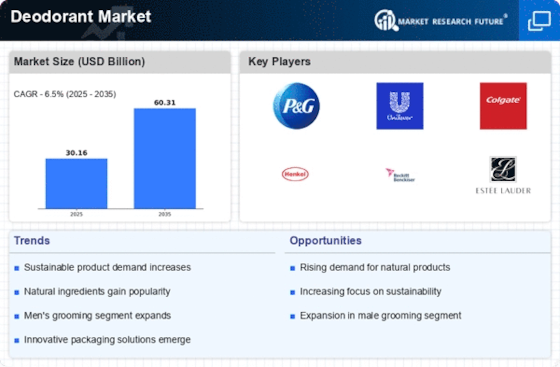
As per MRFR analysis, the Deodorant Market Size was estimated at 30.16 USD Billion in 2024. The deodorant industry is projected to grow from 32.12 USD Billion in 2025 to 60.31 USD Billion by 2035, exhibiting a compound annual growth rate (CAGR) of 6.5 during the forecast period 2025 - 2035.

Key Market Trends & Highlights

The deodorant market is experiencing a transformative shift towards natural and sustainable products.

  • The demand for natural ingredients in deodorants is rising, particularly in North America, as consumers seek healthier options. Gender-neutral deodorant products are gaining traction, reflecting changing societal norms and preferences. Technological integration in product development is becoming more prevalent, enhancing user experience and product efficacy. Increased awareness of personal hygiene and the rising influence of e-commerce are driving growth in both the men's and women's segments, with metal packaging remaining dominant while plastic options are rapidly expanding.

Market Size & Forecast

2024 Market Size 30.16 (USD Billion)
2035 Market Size 60.31 (USD Billion)
CAGR (2025 - 2035) 6.5%
Largest Regional Market Share in 2024 North America

Major Players

<p>Procter &amp; Gamble (US), Unilever (GB), <a href="https://www.colgatepalmolive.com/en-us/brands">Colgate-Palmolive (US)</a>, Henkel (DE), Reckitt Benckiser (GB), Estée Lauder (US), Coty (US), Beiersdorf (DE), L'Oréal (FR)</p>

Market Trends

The Deodorant Market is currently experiencing a dynamic evolution, driven by shifting consumer preferences and heightened awareness regarding personal care products. As individuals increasingly seek natural and organic alternatives, brands are responding by reformulating their offerings to align with these demands. This trend reflects a broader societal movement towards sustainability and health consciousness, prompting manufacturers to innovate and diversify their product lines. Furthermore, the rise of e-commerce platforms has transformed the way consumers access deodorants, allowing for greater convenience and a wider selection of products. This shift not only enhances consumer choice but also encourages brands to adopt more aggressive marketing strategies to capture online market share. In addition to the focus on natural ingredients, the Deodorant Market is witnessing a surge in gender-neutral and unisex products. This development indicates a significant cultural shift, as consumers increasingly reject traditional gender norms in personal care. Brands are now exploring inclusive marketing strategies that resonate with a diverse audience, thereby expanding their reach. Moreover, the integration of technology in product development, such as the use of smart packaging and personalized formulations, suggests a future where consumer engagement and customization play pivotal roles in shaping market dynamics. Overall, the Deodorant Market appears poised for continued growth, driven by innovation and evolving consumer expectations.

Rise of Natural Ingredients

The Deodorant Market is witnessing a notable shift towards products featuring natural and organic components. Consumers are increasingly prioritizing health-conscious choices, prompting brands to reformulate their offerings to meet these preferences. This trend reflects a broader societal movement towards sustainability and wellness.

Gender-Neutral Products

There is a growing demand for gender-neutral and unisex deodorants, indicating a cultural shift in consumer attitudes. Brands are responding by developing inclusive marketing strategies that appeal to a diverse audience, thereby expanding their market reach and challenging traditional gender norms.

Technological Integration

The incorporation of technology in the Deodorant Market is becoming more prevalent, with innovations such as smart packaging and personalized formulations. This trend suggests a future where consumer engagement and customization are central to product development, enhancing the overall shopping experience.

Deodorant Market Market Drivers

Health and Wellness Trends

The Deodorant Market is significantly impacted by the overarching health and wellness trends that are shaping consumer behavior. As individuals become more health-conscious, there is a growing demand for deodorants that are free from synthetic ingredients and harmful chemicals. This trend is particularly relevant as consumers seek products that align with their overall wellness goals. Market Research Future indicates that the demand for natural and organic deodorants has increased by approximately 15% in recent years, reflecting a shift towards safer alternatives. Brands are responding by reformulating their products to meet these health-conscious preferences, thereby enhancing their appeal to a broader audience. This alignment with health and wellness trends not only drives sales but also fosters consumer trust and loyalty.

Innovative Product Offerings

The Deodorant Market is characterized by a wave of innovative product offerings that cater to diverse consumer preferences. Brands are increasingly introducing unique formulations, such as gel, spray, and roll-on deodorants, to meet varying needs. Additionally, the rise of specialty deodorants, including those designed for sensitive skin or infused with fragrances, reflects a growing desire for personalization in personal care products. Market analysis indicates that the introduction of these innovative products has contributed to a significant increase in market share for several leading brands. As consumers seek out products that not only perform well but also provide a tailored experience, companies are compelled to invest in research and development to stay competitive in this dynamic landscape.

Rising Influence of E-Commerce

The Deodorant Market is witnessing a transformative shift due to the rising influence of e-commerce platforms. With the convenience of online shopping, consumers are increasingly turning to digital channels to purchase personal care products, including deodorants. This trend is particularly evident among younger consumers who prefer the ease of browsing and purchasing from the comfort of their homes. Data indicates that e-commerce sales in the deodorant segment have grown by approximately 20% in the past year, highlighting a significant change in consumer purchasing behavior. As a result, brands are investing in their online presence and optimizing their digital marketing strategies to capture this growing market segment. This shift not only enhances accessibility for consumers but also allows brands to reach a broader audience.

Increased Awareness of Personal Hygiene

The Deodorant Market experiences a notable surge in demand due to heightened awareness surrounding personal hygiene. Consumers are increasingly prioritizing cleanliness and body odor management, which drives the need for effective deodorant products. This trend is particularly pronounced among younger demographics, who are more inclined to invest in personal care items. According to recent data, the deodorant segment is projected to grow at a compound annual growth rate of approximately 4.5% over the next five years. This growth is indicative of a broader cultural shift towards self-care and wellness, where consumers view deodorants not merely as functional products but as essential components of their daily routines. As a result, brands are responding by innovating and expanding their product lines to cater to this evolving consumer mindset.

Sustainability and Eco-Friendly Products

The Deodorant Market is increasingly influenced by the demand for sustainable and eco-friendly products. Consumers are becoming more conscious of the environmental impact of their purchases, leading to a preference for deodorants that utilize biodegradable packaging and natural ingredients. This shift is reflected in the growing number of brands that are reformulating their products to eliminate harmful chemicals and embrace sustainable practices. Market data suggests that the eco-friendly deodorant segment is expected to witness a growth rate of around 6% annually, as consumers actively seek out products that align with their values. This trend not only enhances brand loyalty but also encourages companies to adopt more responsible manufacturing processes, thereby contributing to a more sustainable future.

Market Segment Insights

By End-User: Men (Largest) vs. Women (Fastest-Growing)

<p>The deodorant market is characterized by a significant share held by the men's segment, which continues to maintain its status as the largest consumer group. Men's deodorants are widely recognized for their diverse range of scents and formulations tailored to meet the specific preferences of male consumers. In contrast, the women's segment, while smaller in market share, is rapidly gaining traction and capturing the attention of manufacturers and retailers alike, thanks to innovative products that resonate with emerging trends such as natural and sustainable ingredients.</p>

<p>Men (Dominant) vs. Women (Emerging)</p>

<p>The male deodorant segment is well-established and consists of a robust variety of products, ranging from antiperspirants to body sprays, catering to traditional masculine preferences. Brands continually evolve their offerings with unique scents and functionality to retain their dominance in this competitive landscape. On the other hand, the women’s segment is emerging as a crucial player, driven by changing consumer behaviors that favor personalized, eco-friendly, and health-conscious deodorant options. As brands innovate to meet these demands, the women's segment is anticipated to expand, resulting in increased competition and growth opportunities.</p>

By Packaging Material: Metal (Largest) vs. Plastic (Fastest-Growing)

<p>The deodorant market exhibits a diverse array of packaging materials, with metal and plastic leading the charge. Metal packaging, which includes aluminum and tin, holds a significant share of the market, valued for its durability and locking mechanisms that preserve product integrity. Plastic packaging, on the other hand, has gained traction due to its lightweight characteristics and versatility, becoming an increasingly popular choice among consumers. This dynamic balance showcases how varying consumer preferences and product requirements shape the packaging landscape.</p>

<p>Metal (Dominant) vs. Plastic (Emerging)</p>

<p>Metal packaging for deodorants remains the dominant choice, favored for its recyclable nature, sturdiness, and strong preservation capabilities. It caters well to premium products, allowing for vivid branding while ensuring longer shelf life. Alternatively, plastic packaging is emerging as a favorite, particularly with eco-friendly adaptations like bioplastics becoming more prevalent. Its lightweight feature enhances convenience, appealing to on-the-go consumers. However, the sustainability trend is pressuring manufacturers to innovate, leading to hybrid solutions that combine both materials for enhanced performance and environmental considerations.</p>

By Product Type: Spray (Largest) vs. Roll-On (Fastest-Growing)

<p>The deodorant market showcases distinct preferences for various product types, with Spray deodorants emerging as the largest segment, driven by their ease of use, quick application, and widespread consumer acceptance. Roll-On deodorants follow closely, favored for their precision and prolonged <a href="https://www.marketresearchfuture.com/reports/fragrance-market-4689">fragrance</a> retention. Stick and other formats continue to hold a niche but less dominant market presence, demonstrating consumer diversity in deodorant usage. Understanding these segment dynamics is crucial for market stakeholders to optimize product offerings. The growth trends within this segment indicate a significant shift towards Roll-On deodorants, which are witnessing the fastest growth due to increasing consumer demand for long-lasting freshness and targeted application. Additionally, the trend towards natural and organic formulations is benefitting Roll-On formats, as brands innovate to meet consumer preferences. Spray deodorants, while dominant, are adapting to include eco-friendly packaging and formulations to retain market interest amid evolving consumer priorities.</p>

<p>Spray (Dominant) vs. Stick (Emerging)</p>

<p>Spray deodorants dominate the market due to their user-friendly nature and rapid application process, making them the preferred choice for convenience-oriented consumers. They appeal to a broad demographic, including active individuals seeking quick refreshment. In contrast, Stick deodorants are emerging within the market, offering a blend of solid structure and effective odor control. Though they account for a smaller market share, their appeal lies in comfort and targeted delivery, appealing particularly to consumers prioritizing long-lasting effect and a minimalistic approach. As the deodorant market evolves, both product types continue to compete for consumer preference, each catering to different lifestyle choices and preferences.</p>

Get more detailed insights about Deodorant Market Research Report – Forecast till 2035

Regional Insights

North America : Market Leader in Deodorants

North America is the largest market for deodorants, holding approximately 35% of the global share. The growth is driven by increasing consumer awareness regarding personal hygiene and the rising demand for natural and organic products. Regulatory support for product safety and environmental standards further catalyzes market expansion. The U.S. leads this region, followed closely by Canada, both contributing significantly to the market's robust growth trajectory. The competitive landscape in North America is characterized by the presence of major players such as Procter & Gamble, Unilever, and Colgate-Palmolive. These companies are continuously innovating to meet consumer preferences, focusing on sustainability and efficacy. The market is also witnessing a surge in niche brands that cater to specific demographics, enhancing competition and variety in product offerings. Overall, the region's dynamic market is poised for continued growth as consumer trends evolve.

Europe : Emerging Trends in Deodorants

Europe is the second-largest market for deodorants, accounting for approximately 30% of the global market share. The region is witnessing a shift towards eco-friendly and sustainable products, driven by stringent regulations and consumer demand for transparency in ingredients. The European Union's regulations on cosmetic products promote safety and environmental responsibility, further enhancing market growth. Germany and the UK are the leading countries in this region, showcasing significant market potential. The competitive landscape in Europe is marked by established brands like Henkel and Reckitt Benckiser, alongside a growing number of local and organic brands. This diversity allows consumers to choose from a wide range of products that align with their values. The market is also influenced by trends such as gender-neutral products and innovative packaging solutions. As consumers become more conscious of their choices, the demand for sustainable deodorants is expected to rise, shaping the future of the market.

Asia-Pacific : Rapid Growth in Emerging Markets

Asia-Pacific is rapidly emerging as a significant player in the deodorant market, holding approximately 25% of the global share. The region's growth is fueled by increasing urbanization, rising disposable incomes, and changing lifestyle preferences. Countries like China and India are witnessing a surge in demand for personal care products, including deodorants, driven by a growing middle class and heightened awareness of personal hygiene. Regulatory frameworks are also evolving to ensure product safety and quality. The competitive landscape in Asia-Pacific is diverse, with both international and local brands vying for market share. Key players such as Unilever and Procter & Gamble are expanding their presence, while local brands are gaining traction by catering to regional preferences. The market is characterized by innovative product launches, including natural and herbal deodorants, which resonate well with health-conscious consumers. As the region continues to develop, the deodorant market is expected to flourish, driven by evolving consumer needs.

Middle East and Africa : Untapped Potential in Deodorants

The Middle East and Africa region is witnessing a gradual increase in deodorant market penetration, currently holding about 10% of the global share. The growth is primarily driven by rising urbanization, increasing disposable incomes, and a growing awareness of personal grooming. Regulatory bodies are beginning to implement stricter guidelines for cosmetic products, which is expected to enhance consumer trust and safety in the market. Countries like South Africa and the UAE are leading this growth, showcasing significant market potential. The competitive landscape in this region is characterized by a mix of international brands and local players. Major companies such as Estée Lauder and Coty are expanding their product lines to cater to diverse consumer preferences. Additionally, the market is seeing an influx of new entrants focusing on natural and organic products, which are gaining popularity among health-conscious consumers. As the region continues to develop, the deodorant market is poised for significant growth, driven by changing consumer behaviors and preferences.

Key Players and Competitive Insights

The Deodorant Market is characterized by a dynamic competitive landscape, driven by evolving consumer preferences and a heightened focus on sustainability. Major players such as Procter & Gamble (US), Unilever (GB), and Reckitt Benckiser (GB) are at the forefront, each adopting distinct strategies to enhance their market positioning. Procter & Gamble (US) emphasizes innovation in product formulations, particularly in natural and organic deodorants, while Unilever (GB) focuses on expanding its portfolio through acquisitions and partnerships, particularly in the eco-friendly segment. Reckitt Benckiser (GB) appears to be concentrating on digital transformation and e-commerce strategies to reach a broader consumer base, thereby shaping a competitive environment that increasingly prioritizes sustainability and consumer engagement.

The deodorant market exhibits a moderately fragmented structure, with a mix of established brands and emerging players. Key business tactics include localizing manufacturing to reduce costs and optimize supply chains, which is particularly relevant in the context of rising raw material prices. The collective influence of these major players fosters a competitive atmosphere where innovation and sustainability are paramount, compelling companies to adapt swiftly to market demands.

In August 2025, Unilever (GB) announced a strategic partnership with a leading sustainable packaging firm to enhance its eco-friendly product line. This move is significant as it aligns with the growing consumer demand for sustainable products, potentially positioning Unilever as a leader in the green deodorant segment. The partnership not only reinforces Unilever's commitment to sustainability but also enhances its brand image among environmentally conscious consumers.

In September 2025, Procter & Gamble (US) launched a new line of aluminum-free deodorants, targeting health-conscious consumers who are increasingly wary of traditional formulations. This strategic introduction reflects a broader trend towards natural ingredients and could significantly impact market share, as consumers gravitate towards brands that prioritize health and wellness. The launch is indicative of Procter & Gamble's agility in responding to consumer trends, thereby solidifying its competitive edge.

In October 2025, Reckitt Benckiser (GB) unveiled a digital marketing campaign aimed at promoting its latest deodorant range, leveraging AI-driven analytics to tailor messaging to specific consumer segments. This initiative underscores the importance of digitalization in the current market landscape, as brands seek to engage consumers more effectively through personalized marketing strategies. The campaign is likely to enhance brand loyalty and drive sales, reflecting Reckitt Benckiser's commitment to innovation in consumer engagement.

As of October 2025, the deodorant market is witnessing a pronounced shift towards digitalization, sustainability, and the integration of advanced technologies such as AI. Strategic alliances are increasingly shaping the competitive landscape, enabling companies to leverage shared resources and expertise. Looking ahead, competitive differentiation is expected to evolve, with a marked transition from price-based competition to a focus on innovation, technological advancements, and supply chain reliability. This evolution suggests that companies that prioritize these aspects will likely emerge as leaders in the deodorant market.

Key Companies in the Deodorant Market market include

Industry Developments

September 2022 Schmidt's, a new certified natural aerosol deodorant brand from Unilever PLC, was introduced. The company would be able to provide a wider range of products in the beauty and personal care market thanks to the launch.

June 2022 The Weightless Dry Spray line was created under the Procter & Gamble Secret brand. It includes options for antiperspirant and aluminum-free deodorants, which help prevent sweat and odor.

May 2021 Grove Collaborative announced the extension of its personal care range with the introduction of the world's first deodorant and body care refill system made entirely without plastic. The company's goal to eliminate all plastic by 2025 will be announced by the news.

Future Outlook

Deodorant Market Future Outlook

<p>The Deodorant Market is projected to grow at a 6.5% CAGR from 2024 to 2035, driven by increasing consumer awareness and demand for natural ingredients.</p>

New opportunities lie in:

  • <p>Expansion into eco-friendly packaging solutions</p><p>Development of personalized deodorant formulations</p><p>Integration of smart technology in deodorant applications</p>

<p>By 2035, the deodorant market is expected to achieve substantial growth, reflecting evolving consumer preferences.</p>

Market Segmentation

Deodorant Market End-User Outlook

  • Men
  • Women

Deodorant Market Product Type Outlook

  • Spray
  • Roll-On
  • Stick
  • Others

Deodorant Market Packaging Material Outlook

  • Metal
  • Plastic
  • Others

Report Scope

MARKET SIZE 202430.16(USD Billion)
MARKET SIZE 202532.12(USD Billion)
MARKET SIZE 203560.31(USD Billion)
COMPOUND ANNUAL GROWTH RATE (CAGR)6.5% (2024 - 2035)
REPORT COVERAGERevenue Forecast, Competitive Landscape, Growth Factors, and Trends
BASE YEAR2024
Market Forecast Period2025 - 2035
Historical Data2019 - 2024
Market Forecast UnitsUSD Billion
Key Companies ProfiledMarket analysis in progress
Segments CoveredMarket segmentation analysis in progress
Key Market OpportunitiesGrowing demand for natural and sustainable formulations in the Deodorant Market presents significant opportunities.
Key Market DynamicsRising consumer preference for natural ingredients drives innovation and competition in the deodorant market.
Countries CoveredNorth America, Europe, APAC, South America, MEA

FAQs

What is the current valuation of the deodorant market as of 2024?

The deodorant market was valued at 30.16 USD Billion in 2024.

What is the projected market valuation for the deodorant industry in 2035?

The deodorant market is projected to reach 60.31 USD Billion by 2035.

What is the expected compound annual growth rate (CAGR) for the deodorant market from 2025 to 2035?

The expected CAGR for the deodorant market during the forecast period 2025 - 2035 is 6.5%.

Which companies are considered key players in the deodorant market?

Key players in the deodorant market include Procter &amp; Gamble, Unilever, Colgate-Palmolive, Henkel, Reckitt Benckiser, Estée Lauder, Coty, Beiersdorf, and L'Oréal.

How do the deodorant market segments for men and women compare in terms of valuation?

In 2024, the deodorant market for men was valued at 12.06 USD Billion, while the women's segment was valued at 18.1 USD Billion.

What are the projected valuations for different packaging materials in the deodorant market by 2035?

By 2035, the projected valuations for packaging materials in the deodorant market are 16.0 USD Billion for metal, 30.0 USD Billion for plastic, and 14.31 USD Billion for others.

  1. SECTION I: EXECUTIVE SUMMARY AND KEY HIGHLIGHTS
    1. EXECUTIVE SUMMARY
      1. Market Overview
      2. Key Findings
      3. Market Segmentation
      4. Competitive Landscape
      5. Challenges and Opportunities
      6. Future Outlook 2
  2. SECTION II: SCOPING, METHODOLOGY AND MARKET STRUCTURE
    1. MARKET INTRODUCTION
      1. Definition
      2. Scope of the study
    2. RESEARCH METHODOLOGY
      1. Overview
      2. Data Mining
      3. Secondary Research
      4. Primary Research
      5. Forecasting Model
      6. Market Size Estimation
      7. Data Triangulation
      8. Validation 3
  3. SECTION III: QUALITATIVE ANALYSIS
    1. MARKET DYNAMICS
      1. Overview
      2. Drivers
      3. Restraints
      4. Opportunities
    2. MARKET FACTOR ANALYSIS
      1. Value chain Analysis
      2. Porter's Five Forces Analysis
      3. COVID-19 Impact Analysis
  4. SECTION IV: QUANTITATIVE ANALYSIS
    1. Consumer and Retail, BY End-User (USD Billion)
      1. Men
      2. Women
    2. Consumer and Retail, BY Packaging Material (USD Billion)
      1. Metal
      2. Plastic
      3. Others
    3. Consumer and Retail, BY Product Type (USD Billion)
      1. Spray
      2. Roll-On
      3. Stick
      4. Others
    4. Consumer and Retail, BY Region (USD Billion)
      1. North America
      2. Europe
      3. APAC
      4. South America
      5. MEA
  5. SECTION V: COMPETITIVE ANALYSIS
    1. Competitive Landscape
      1. Overview
      2. Competitive Analysis
      3. Market share Analysis
      4. Major Growth Strategy in the Consumer and Retail
      5. Competitive Benchmarking
      6. Leading Players in Terms of Number of Developments in the Consumer and Retail
      7. Key developments and growth strategies
      8. Major Players Financial Matrix
    2. Company Profiles
      1. Procter & Gamble (US)
      2. Unilever (GB)
      3. Colgate-Palmolive (US)
      4. Henkel (DE)
      5. Reckitt Benckiser (GB)
      6. Estée Lauder (US)
      7. Coty (US)
      8. Beiersdorf (DE)
      9. L'Oréal (FR)
    3. Appendix
      1. References
      2. Related Reports 6 LIST OF FIGURES
    4. MARKET SYNOPSIS
    5. NORTH AMERICA MARKET ANALYSIS
    6. US MARKET ANALYSIS BY END-USER
    7. US MARKET ANALYSIS BY PACKAGING MATERIAL
    8. US MARKET ANALYSIS BY PRODUCT TYPE
    9. CANADA MARKET ANALYSIS BY END-USER
    10. CANADA MARKET ANALYSIS BY PACKAGING MATERIAL
    11. CANADA MARKET ANALYSIS BY PRODUCT TYPE
    12. EUROPE MARKET ANALYSIS
    13. GERMANY MARKET ANALYSIS BY END-USER
    14. GERMANY MARKET ANALYSIS BY PACKAGING MATERIAL
    15. GERMANY MARKET ANALYSIS BY PRODUCT TYPE
    16. UK MARKET ANALYSIS BY END-USER
    17. UK MARKET ANALYSIS BY PACKAGING MATERIAL
    18. UK MARKET ANALYSIS BY PRODUCT TYPE
    19. FRANCE MARKET ANALYSIS BY END-USER
    20. FRANCE MARKET ANALYSIS BY PACKAGING MATERIAL
    21. FRANCE MARKET ANALYSIS BY PRODUCT TYPE
    22. RUSSIA MARKET ANALYSIS BY END-USER
    23. RUSSIA MARKET ANALYSIS BY PACKAGING MATERIAL
    24. RUSSIA MARKET ANALYSIS BY PRODUCT TYPE
    25. ITALY MARKET ANALYSIS BY END-USER
    26. ITALY MARKET ANALYSIS BY PACKAGING MATERIAL
    27. ITALY MARKET ANALYSIS BY PRODUCT TYPE
    28. SPAIN MARKET ANALYSIS BY END-USER
    29. SPAIN MARKET ANALYSIS BY PACKAGING MATERIAL
    30. SPAIN MARKET ANALYSIS BY PRODUCT TYPE
    31. REST OF EUROPE MARKET ANALYSIS BY END-USER
    32. REST OF EUROPE MARKET ANALYSIS BY PACKAGING MATERIAL
    33. REST OF EUROPE MARKET ANALYSIS BY PRODUCT TYPE
    34. APAC MARKET ANALYSIS
    35. CHINA MARKET ANALYSIS BY END-USER
    36. CHINA MARKET ANALYSIS BY PACKAGING MATERIAL
    37. CHINA MARKET ANALYSIS BY PRODUCT TYPE
    38. INDIA MARKET ANALYSIS BY END-USER
    39. INDIA MARKET ANALYSIS BY PACKAGING MATERIAL
    40. INDIA MARKET ANALYSIS BY PRODUCT TYPE
    41. JAPAN MARKET ANALYSIS BY END-USER
    42. JAPAN MARKET ANALYSIS BY PACKAGING MATERIAL
    43. JAPAN MARKET ANALYSIS BY PRODUCT TYPE
    44. SOUTH KOREA MARKET ANALYSIS BY END-USER
    45. SOUTH KOREA MARKET ANALYSIS BY PACKAGING MATERIAL
    46. SOUTH KOREA MARKET ANALYSIS BY PRODUCT TYPE
    47. MALAYSIA MARKET ANALYSIS BY END-USER
    48. MALAYSIA MARKET ANALYSIS BY PACKAGING MATERIAL
    49. MALAYSIA MARKET ANALYSIS BY PRODUCT TYPE
    50. THAILAND MARKET ANALYSIS BY END-USER
    51. THAILAND MARKET ANALYSIS BY PACKAGING MATERIAL
    52. THAILAND MARKET ANALYSIS BY PRODUCT TYPE
    53. INDONESIA MARKET ANALYSIS BY END-USER
    54. INDONESIA MARKET ANALYSIS BY PACKAGING MATERIAL
    55. INDONESIA MARKET ANALYSIS BY PRODUCT TYPE
    56. REST OF APAC MARKET ANALYSIS BY END-USER
    57. REST OF APAC MARKET ANALYSIS BY PACKAGING MATERIAL
    58. REST OF APAC MARKET ANALYSIS BY PRODUCT TYPE
    59. SOUTH AMERICA MARKET ANALYSIS
    60. BRAZIL MARKET ANALYSIS BY END-USER
    61. BRAZIL MARKET ANALYSIS BY PACKAGING MATERIAL
    62. BRAZIL MARKET ANALYSIS BY PRODUCT TYPE
    63. MEXICO MARKET ANALYSIS BY END-USER
    64. MEXICO MARKET ANALYSIS BY PACKAGING MATERIAL
    65. MEXICO MARKET ANALYSIS BY PRODUCT TYPE
    66. ARGENTINA MARKET ANALYSIS BY END-USER
    67. ARGENTINA MARKET ANALYSIS BY PACKAGING MATERIAL
    68. ARGENTINA MARKET ANALYSIS BY PRODUCT TYPE
    69. REST OF SOUTH AMERICA MARKET ANALYSIS BY END-USER
    70. REST OF SOUTH AMERICA MARKET ANALYSIS BY PACKAGING MATERIAL
    71. REST OF SOUTH AMERICA MARKET ANALYSIS BY PRODUCT TYPE
    72. MEA MARKET ANALYSIS
    73. GCC COUNTRIES MARKET ANALYSIS BY END-USER
    74. GCC COUNTRIES MARKET ANALYSIS BY PACKAGING MATERIAL
    75. GCC COUNTRIES MARKET ANALYSIS BY PRODUCT TYPE
    76. SOUTH AFRICA MARKET ANALYSIS BY END-USER
    77. SOUTH AFRICA MARKET ANALYSIS BY PACKAGING MATERIAL
    78. SOUTH AFRICA MARKET ANALYSIS BY PRODUCT TYPE
    79. REST OF MEA MARKET ANALYSIS BY END-USER
    80. REST OF MEA MARKET ANALYSIS BY PACKAGING MATERIAL
    81. REST OF MEA MARKET ANALYSIS BY PRODUCT TYPE
    82. KEY BUYING CRITERIA OF CONSUMER AND RETAIL
    83. RESEARCH PROCESS OF MRFR
    84. DRO ANALYSIS OF CONSUMER AND RETAIL
    85. DRIVERS IMPACT ANALYSIS: CONSUMER AND RETAIL
    86. RESTRAINTS IMPACT ANALYSIS: CONSUMER AND RETAIL
    87. SUPPLY / VALUE CHAIN: CONSUMER AND RETAIL
    88. CONSUMER AND RETAIL, BY END-USER, 2024 (% SHARE)
    89. CONSUMER AND RETAIL, BY END-USER, 2024 TO 2035 (USD Billion)
    90. CONSUMER AND RETAIL, BY PACKAGING MATERIAL, 2024 (% SHARE)
    91. CONSUMER AND RETAIL, BY PACKAGING MATERIAL, 2024 TO 2035 (USD Billion)
    92. CONSUMER AND RETAIL, BY PRODUCT TYPE, 2024 (% SHARE)
    93. CONSUMER AND RETAIL, BY PRODUCT TYPE, 2024 TO 2035 (USD Billion)
    94. BENCHMARKING OF MAJOR COMPETITORS 7 LIST OF TABLES
    95. LIST OF ASSUMPTIONS
    96. North America MARKET SIZE ESTIMATES; FORECAST
      1. BY END-USER, 2025-2035 (USD Billion)
      2. BY PACKAGING MATERIAL, 2025-2035 (USD Billion)
      3. BY PRODUCT TYPE, 2025-2035 (USD Billion)
    97. US MARKET SIZE ESTIMATES; FORECAST
      1. BY END-USER, 2025-2035 (USD Billion)
      2. BY PACKAGING MATERIAL, 2025-2035 (USD Billion)
      3. BY PRODUCT TYPE, 2025-2035 (USD Billion)
    98. Canada MARKET SIZE ESTIMATES; FORECAST
      1. BY END-USER, 2025-2035 (USD Billion)
      2. BY PACKAGING MATERIAL, 2025-2035 (USD Billion)
      3. BY PRODUCT TYPE, 2025-2035 (USD Billion)
    99. Europe MARKET SIZE ESTIMATES; FORECAST
      1. BY END-USER, 2025-2035 (USD Billion)
      2. BY PACKAGING MATERIAL, 2025-2035 (USD Billion)
      3. BY PRODUCT TYPE, 2025-2035 (USD Billion)
    100. Germany MARKET SIZE ESTIMATES; FORECAST
      1. BY END-USER, 2025-2035 (USD Billion)
      2. BY PACKAGING MATERIAL, 2025-2035 (USD Billion)
      3. BY PRODUCT TYPE, 2025-2035 (USD Billion)
    101. UK MARKET SIZE ESTIMATES; FORECAST
      1. BY END-USER, 2025-2035 (USD Billion)
      2. BY PACKAGING MATERIAL, 2025-2035 (USD Billion)
      3. BY PRODUCT TYPE, 2025-2035 (USD Billion)
    102. France MARKET SIZE ESTIMATES; FORECAST
      1. BY END-USER, 2025-2035 (USD Billion)
      2. BY PACKAGING MATERIAL, 2025-2035 (USD Billion)
      3. BY PRODUCT TYPE, 2025-2035 (USD Billion)
    103. Russia MARKET SIZE ESTIMATES; FORECAST
      1. BY END-USER, 2025-2035 (USD Billion)
      2. BY PACKAGING MATERIAL, 2025-2035 (USD Billion)
      3. BY PRODUCT TYPE, 2025-2035 (USD Billion)
    104. Italy MARKET SIZE ESTIMATES; FORECAST
      1. BY END-USER, 2025-2035 (USD Billion)
      2. BY PACKAGING MATERIAL, 2025-2035 (USD Billion)
      3. BY PRODUCT TYPE, 2025-2035 (USD Billion)
    105. Spain MARKET SIZE ESTIMATES; FORECAST
      1. BY END-USER, 2025-2035 (USD Billion)
      2. BY PACKAGING MATERIAL, 2025-2035 (USD Billion)
      3. BY PRODUCT TYPE, 2025-2035 (USD Billion)
    106. Rest of Europe MARKET SIZE ESTIMATES; FORECAST
      1. BY END-USER, 2025-2035 (USD Billion)
      2. BY PACKAGING MATERIAL, 2025-2035 (USD Billion)
      3. BY PRODUCT TYPE, 2025-2035 (USD Billion)
    107. APAC MARKET SIZE ESTIMATES; FORECAST
      1. BY END-USER, 2025-2035 (USD Billion)
      2. BY PACKAGING MATERIAL, 2025-2035 (USD Billion)
      3. BY PRODUCT TYPE, 2025-2035 (USD Billion)
    108. China MARKET SIZE ESTIMATES; FORECAST
      1. BY END-USER, 2025-2035 (USD Billion)
      2. BY PACKAGING MATERIAL, 2025-2035 (USD Billion)
      3. BY PRODUCT TYPE, 2025-2035 (USD Billion)
    109. India MARKET SIZE ESTIMATES; FORECAST
      1. BY END-USER, 2025-2035 (USD Billion)
      2. BY PACKAGING MATERIAL, 2025-2035 (USD Billion)
      3. BY PRODUCT TYPE, 2025-2035 (USD Billion)
    110. Japan MARKET SIZE ESTIMATES; FORECAST
      1. BY END-USER, 2025-2035 (USD Billion)
      2. BY PACKAGING MATERIAL, 2025-2035 (USD Billion)
      3. BY PRODUCT TYPE, 2025-2035 (USD Billion)
    111. South Korea MARKET SIZE ESTIMATES; FORECAST
      1. BY END-USER, 2025-2035 (USD Billion)
      2. BY PACKAGING MATERIAL, 2025-2035 (USD Billion)
      3. BY PRODUCT TYPE, 2025-2035 (USD Billion)
    112. Malaysia MARKET SIZE ESTIMATES; FORECAST
      1. BY END-USER, 2025-2035 (USD Billion)
      2. BY PACKAGING MATERIAL, 2025-2035 (USD Billion)
      3. BY PRODUCT TYPE, 2025-2035 (USD Billion)
    113. Thailand MARKET SIZE ESTIMATES; FORECAST
      1. BY END-USER, 2025-2035 (USD Billion)
      2. BY PACKAGING MATERIAL, 2025-2035 (USD Billion)
      3. BY PRODUCT TYPE, 2025-2035 (USD Billion)
    114. Indonesia MARKET SIZE ESTIMATES; FORECAST
      1. BY END-USER, 2025-2035 (USD Billion)
      2. BY PACKAGING MATERIAL, 2025-2035 (USD Billion)
      3. BY PRODUCT TYPE, 2025-2035 (USD Billion)
    115. Rest of APAC MARKET SIZE ESTIMATES; FORECAST
      1. BY END-USER, 2025-2035 (USD Billion)
      2. BY PACKAGING MATERIAL, 2025-2035 (USD Billion)
      3. BY PRODUCT TYPE, 2025-2035 (USD Billion)
    116. South America MARKET SIZE ESTIMATES; FORECAST
      1. BY END-USER, 2025-2035 (USD Billion)
      2. BY PACKAGING MATERIAL, 2025-2035 (USD Billion)
      3. BY PRODUCT TYPE, 2025-2035 (USD Billion)
    117. Brazil MARKET SIZE ESTIMATES; FORECAST
      1. BY END-USER, 2025-2035 (USD Billion)
      2. BY PACKAGING MATERIAL, 2025-2035 (USD Billion)
      3. BY PRODUCT TYPE, 2025-2035 (USD Billion)
    118. Mexico MARKET SIZE ESTIMATES; FORECAST
      1. BY END-USER, 2025-2035 (USD Billion)
      2. BY PACKAGING MATERIAL, 2025-2035 (USD Billion)
      3. BY PRODUCT TYPE, 2025-2035 (USD Billion)
    119. Argentina MARKET SIZE ESTIMATES; FORECAST
      1. BY END-USER, 2025-2035 (USD Billion)
      2. BY PACKAGING MATERIAL, 2025-2035 (USD Billion)
      3. BY PRODUCT TYPE, 2025-2035 (USD Billion)
    120. Rest of South America MARKET SIZE ESTIMATES; FORECAST
      1. BY END-USER, 2025-2035 (USD Billion)
      2. BY PACKAGING MATERIAL, 2025-2035 (USD Billion)
      3. BY PRODUCT TYPE, 2025-2035 (USD Billion)
    121. MEA MARKET SIZE ESTIMATES; FORECAST
      1. BY END-USER, 2025-2035 (USD Billion)
      2. BY PACKAGING MATERIAL, 2025-2035 (USD Billion)
      3. BY PRODUCT TYPE, 2025-2035 (USD Billion)
    122. GCC Countries MARKET SIZE ESTIMATES; FORECAST
      1. BY END-USER, 2025-2035 (USD Billion)
      2. BY PACKAGING MATERIAL, 2025-2035 (USD Billion)
      3. BY PRODUCT TYPE, 2025-2035 (USD Billion)
    123. South Africa MARKET SIZE ESTIMATES; FORECAST
      1. BY END-USER, 2025-2035 (USD Billion)
      2. BY PACKAGING MATERIAL, 2025-2035 (USD Billion)
      3. BY PRODUCT TYPE, 2025-2035 (USD Billion)
    124. Rest of MEA MARKET SIZE ESTIMATES; FORECAST
      1. BY END-USER, 2025-2035 (USD Billion)
      2. BY PACKAGING MATERIAL, 2025-2035 (USD Billion)
      3. BY PRODUCT TYPE, 2025-2035 (USD Billion)
    125. PRODUCT LAUNCH/PRODUCT DEVELOPMENT/APPROVAL
    126. ACQUISITION/PARTNERSHIP

Market Segmentation Tab

Deodorant End-User Outlook (USD Billion, 2018-2032)

Men

Women

Deodorant Packaging Material Outlook (USD Billion, 2018-2032)

Metal

Plastic

Others

Deodorant Product Type Outlook (USD Billion, 2018-2032)

Spray

Roll-On

Stick

Others

Deodorant Regional Outlook (USD Billion, 2018-2032)

North America Outlook (USD Billion, 2018-2032)

North America Deodorant by End-User

Men

Women

North America Deodorant by Packaging Material

Metal

Plastic

Others

North America Deodorant by Product Type

Spray

Roll-On

Stick

Others

US Outlook (USD Billion, 2018-2032)

US Deodorant by End-User

Men

Women

US Deodorant by Packaging Material

Metal

Plastic

Others

US Deodorant by Product Type

Spray

Roll-On

Stick

Others

Canada Outlook (USD Billion, 2018-2032)

Canada Deodorant by End-User

Men

Women

Canada Deodorant by Packaging Material

Metal

Plastic

Others

Canada Deodorant by Product Type

Spray

Roll-On

Stick

Others

Europe Outlook (USD Billion, 2018-2032)

Europe Deodorant by End-User

Men

Women

Europe Deodorant by Packaging Material

Metal

Plastic

Others

Europe Deodorant by Product Type

Spray

Roll-On

Stick

Others

Germany Outlook (USD Billion, 2018-2032)

Germany Deodorant by End-User

Men

Women

Germany Deodorant by Packaging Material

Metal

Plastic

Others

Germany Deodorant by Product Type

Spray

Roll-On

Stick

Others

France Outlook (USD Billion, 2018-2032)

France Deodorant by End-User

Men

Women

France Deodorant by Packaging Material

Metal

Plastic

Others

France Deodorant by Product Type

Spray

Roll-On

Stick

Others

UK Outlook (USD Billion, 2018-2032)

UK Deodorant by End-User

Men

Women

UK Deodorant by Packaging Material

Metal

Plastic

Others

UK Deodorant by Product Type

Spray

Roll-On

Stick

Others

Italy Outlook (USD Billion, 2018-2032)

Italy Deodorant by End-User

Men

Women

Italy Deodorant by Packaging Material

Metal

Plastic

Others

Italy Deodorant by Product Type

Spray

Roll-On

Stick

Others

Spain Outlook (USD Billion, 2018-2032)

Spain Deodorant by End-User

Men

Women

Spain Deodorant by Packaging Material

Metal

Plastic

Others

Spain Deodorant by Product Type

Spray

Roll-On

Stick

Others

Rest Of Europe Outlook (USD Billion, 2018-2032)

Rest Of Europe Deodorant by End-User

Men

Women

Rest Of Europe Deodorant by Packaging Material

Metal

Plastic

Others

Rest Of Europe Deodorant by Product Type

Spray

Roll-On

Stick

Others

Asia-Pacific Outlook (USD Billion, 2018-2032)

Asia-Pacific Deodorant by End-User

Men

Women

Asia-Pacific Deodorant by Packaging Material

Metal

Plastic

Others

Asia-Pacific Deodorant by Product Type

Spray

Roll-On

Stick

Others

China Outlook (USD Billion, 2018-2032)

China Deodorant by End-User

Men

Women

China Deodorant by Packaging Material

Metal

Plastic

Others

China Deodorant by Product Type

Spray

Roll-On

Stick

Others

Japan Outlook (USD Billion, 2018-2032)

Japan Deodorant by End-User

Men

Women

Japan Deodorant by Packaging Material

Metal

Plastic

Others

Japan Deodorant by Product Type

Spray

Roll-On

Stick

Others

India Outlook (USD Billion, 2018-2032)

India Deodorant by End-User

Men

Women

India Deodorant by Packaging Material

Metal

Plastic

Others

India Deodorant by Product Type

Spray

Roll-On

Stick

Others

Australia Outlook (USD Billion, 2018-2032)

Australia Deodorant by End-User

Men

Women

Australia Deodorant by Packaging Material

Metal

Plastic

Others

Australia Deodorant by Product Type

Spray

Roll-On

Stick

Others

Rest of Asia-Pacific Outlook (USD Billion, 2018-2032)

Rest of Asia-Pacific Deodorant by End-User

Men

Women

Rest of Asia-Pacific Deodorant by Packaging Material

Metal

Plastic

Others

Rest of Asia-Pacific Deodorant by Product Type

Spray

Roll-On

Stick

Others

Rest of the World Outlook (USD Billion, 2018-2032)

Rest of the World Deodorant by End-User

Men

Women

Rest of the World Deodorant by Packaging Material

Metal

Plastic

Others

Rest of the World Deodorant by Product Type

Spray

Roll-On

Stick

Others

Middle East Outlook (USD Billion, 2018-2032)

Middle East Deodorant by End-User

Men

Women

Middle East Deodorant by Packaging Material

Metal

Plastic

Others

Middle East Deodorant by Product Type

Spray

Roll-On

Stick

Others

Africa Outlook (USD Billion, 2018-2032)

Africa Deodorant by End-User

Men

Women

Africa Deodorant by Packaging Material

Metal

Plastic

Others

Africa Deodorant by Product Type

Spray

Roll-On

Stick

Others

Latin America Outlook (USD Billion, 2018-2032)

Latin America Deodorant by End-User

Men

Women

Latin America Deodorant by Packaging Material

Metal

Plastic

Others

Latin America Deodorant by Product Type

Spray

Roll-On

Stick

Others

Infographic

Free Sample Request

Kindly complete the form below to receive a free sample of this Report

Get Free Sample

Customer Strories

Compare Licence

×
Features License Type
Single User Multiuser License Enterprise User
Price $4,950 $5,950 $7,250
Maximum User Access Limit 1 User Upto 10 Users Unrestricted Access Throughout the Organization
Free Customization
Direct Access to Analyst
Deliverable Format
Platform Access
Discount on Next Purchase 10% 15% 15%
Printable Versions