Request Free Sample ×

Kindly complete the form below to receive a free sample of this Report

* Please use a valid business email

Leading companies partner with us for data-driven Insights

clients tt-cursor
Hero Background
English
Chinese
French
Japanese
Korean
German
Spanish

Exhaust Sensors for Automotive Market Size

ID: MRFR/AT/1610-HCR
100 Pages
Shubham Munde
Last Updated: April 21, 2026

Exhaust Sensors for Automotive Market by Sensor Type (Exhaust Temperature & Pressure, O2, NOX, Particulate Matter, Engine Coolant Temperature, & MAP/MAF Sensor), Fuel Type (Gasoline & Diesel), Vehicle Type (Passenger, LCV, HCV), & by Region- Forecast to 2035

Share:
Download PDF ×

We do not share your information with anyone. However, we may send you emails based on your report interest from time to time. You may contact us at any time to opt-out.

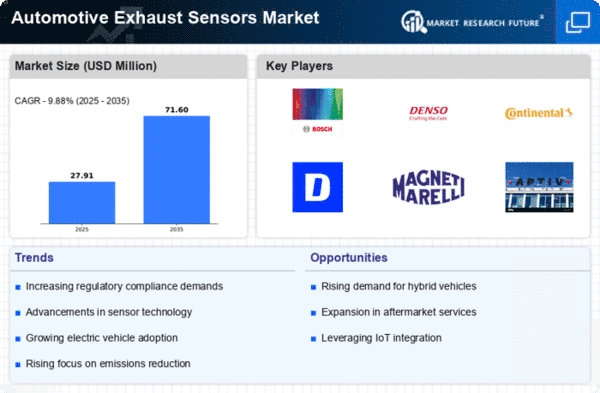
Automotive Exhaust Sensors Market Infographic
Purchase Options

Automotive Exhaust Sensors Size

Automotive Exhaust Sensors Market Growth Projections and Opportunities

The market for exhaust sensors in the automotive industry is heavily influenced by several key factors. These factors play a significant role in shaping the demand, supply, and overall dynamics of this market segment.

First and foremost, government regulations and emission standards have a profound impact on the exhaust sensor market. With an increasing focus on reducing harmful emissions from vehicles, governments around the world are implementing stringent regulations mandating the use of advanced exhaust sensing technologies. Automakers are compelled to integrate sophisticated sensors into their vehicles to ensure compliance with these standards, thereby driving the demand for exhaust sensors.

Technological advancements also play a crucial role in shaping the market for exhaust sensors. As automotive manufacturers strive to develop cleaner and more efficient vehicles, there is a continuous need for innovative sensing solutions. Advancements in sensor technology, such as the development of more accurate and durable sensors, contribute to the growth of the market by offering improved performance and reliability.

Additionally, the growing adoption of electric and hybrid vehicles is influencing the demand for exhaust sensors. While these vehicles produce fewer emissions than traditional internal combustion engine vehicles, they still require exhaust sensors to monitor and optimize their performance. As the market for electric and hybrid vehicles expands, so does the demand for exhaust sensors tailored to meet the specific requirements of these vehicles.

Moreover, economic factors such as fuel prices and consumer purchasing power also impact the market for exhaust sensors. Fluctuations in fuel prices can influence consumer preferences towards more fuel-efficient vehicles, driving the demand for exhaust sensors that help optimize fuel consumption. Similarly, changes in consumer purchasing power can affect overall vehicle sales, thereby indirectly influencing the demand for exhaust sensors.

Furthermore, the competitive landscape of the automotive industry plays a significant role in shaping the market for exhaust sensors. As automakers strive to gain a competitive edge by offering vehicles with superior performance and lower emissions, they rely on advanced sensing technologies to achieve these objectives. This creates opportunities for sensor manufacturers to innovate and differentiate their products, thereby driving competition within the market.

Supply chain factors also play a crucial role in determining the availability and pricing of exhaust sensors. The availability of raw materials, components, and manufacturing capabilities can impact the production capacity and cost structure of sensor manufacturers. Additionally, factors such as geopolitical tensions, trade policies, and logistics can affect the smooth functioning of the supply chain, leading to potential disruptions in the availability of exhaust sensors.

Lastly, consumer preferences and trends also influence the market for exhaust sensors. As consumers become more environmentally conscious, there is a growing demand for vehicles with lower emissions and higher fuel efficiency. This trend drives automakers to invest in advanced sensing technologies, including exhaust sensors, to meet the evolving needs and preferences of consumers.

In conclusion, the market for exhaust sensors in the automotive industry is shaped by a complex interplay of factors including government regulations, technological advancements, vehicle electrification, economic conditions, competitive pressures, supply chain dynamics, and consumer preferences. Understanding and effectively navigating these market factors are essential for stakeholders within the automotive ecosystem to capitalize on the opportunities and mitigate the challenges within this dynamic market segment.
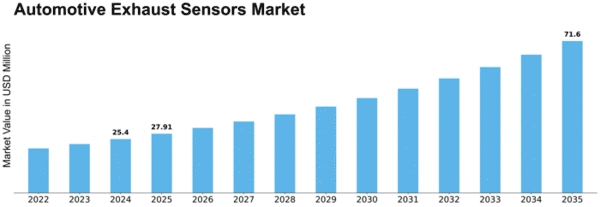

Automotive Exhaust Sensors Market Size Graph
Author
Author Profile
Shubham Munde
Team Lead - Research

Shubham brings over 7 years of expertise in Market Intelligence and Strategic Consulting, with a strong focus on the Automotive, Aerospace, and Defense sectors. Backed by a solid foundation in semiconductors, electronics, and software, he has successfully delivered high-impact syndicated and custom research on a global scale. His core strengths include market sizing, forecasting, competitive intelligence, consumer insights, and supply chain mapping. Widely recognized for developing scalable growth strategies, Shubham empowers clients to navigate complex markets and achieve a lasting competitive edge. Trusted by start-ups and Fortune 500 companies alike, he consistently converts challenges into strategic opportunities that drive sustainable growth.

Leave a Comment

FAQs

What is the projected market valuation for the Automotive Exhaust Sensors Market in 2035?

<p>The projected market valuation for the Automotive Exhaust Sensors Market in 2035 is 71.6 USD Million.</p>

What was the market valuation for the Automotive Exhaust Sensors Market in 2024?

<p>The market valuation for the Automotive Exhaust Sensors Market in 2024 was 25.4 USD Million.</p>

What is the expected CAGR for the Automotive Exhaust Sensors Market from 2025 to 2035?

<p>The expected CAGR for the Automotive Exhaust Sensors Market during the forecast period 2025 - 2035 is 9.88%.</p>

Which companies are considered key players in the Automotive Exhaust Sensors Market?

<p>Key players in the Automotive Exhaust Sensors Market include Bosch, Denso, Continental, Delphi Technologies, Magneti Marelli, Aptiv, Sensata Technologies, Honeywell, and Valeo.</p>

What are the main applications of automotive exhaust sensors?

<p>The main applications of automotive exhaust sensors include Emission Control, Performance Monitoring, Fuel Efficiency, and Diagnostics.</p>

How much was the market size for Emission Control in 2024?

The market size for Emission Control in 2024 was 10.0 USD Million, projected to reach 28.0 USD Million.

What sensor types are included in the Automotive Exhaust Sensors Market?

The sensor types in the Automotive Exhaust Sensors Market include Oxygen Sensors, Nitrogen Oxide Sensors, Particulate Matter Sensors, and Temperature Sensors.

What was the market size for Nitrogen Oxide Sensors in 2024?

The market size for Nitrogen Oxide Sensors in 2024 was 7.0 USD Million, with a projection of 20.0 USD Million.

Which end-use segments are covered in the Automotive Exhaust Sensors Market?

The end-use segments in the Automotive Exhaust Sensors Market include Passenger Vehicles, Commercial Vehicles, Heavy-Duty Vehicles, and Motorcycles.

What technology types are utilized in automotive exhaust sensors?

The technology types utilized in automotive exhaust sensors include Electrochemical, Infrared, Zirconia, and Thin Film.

Market Summary

As per MRFR analysis, the Automotive Exhaust Sensors Market Size was estimated at 25.4 USD Million in 2024. The Automotive Exhaust Sensors industry is projected to grow from 27.9 USD Million in 2025 to 71.6 USD Million by 2035, exhibiting a compound annual growth rate (CAGR) of 9.88% during the forecast period 2025 - 2035.

Key Market Trends & Highlights

The Automotive Exhaust Sensors Market is poised for growth driven by regulatory compliance and technological advancements.

  • North America remains the largest market for automotive exhaust sensors, driven by stringent emissions regulations. Asia-Pacific is emerging as the fastest-growing region, reflecting a rapid shift towards electrification and hybrid vehicles. The emission control segment dominates the market, while the performance monitoring segment is experiencing the fastest growth. Key market drivers include rising demand for fuel efficiency and increasing regulatory compliance, which are shaping industry dynamics.

Market Size & Forecast

2024 Market Size 25.4 (USD Million)
2035 Market Size 71.6 (USD Million)
CAGR (2025 - 2035) 9.88%
Largest Regional Market Share in 2024 North America

Major Players

Bosch (DE), <a href="https://www.denso-am.eu/products/engine-management-systems/exhaust-gas-temperature-sensors">Denso</a> (JP), Continental (DE), Delphi Technologies (GB), Magneti Marelli (IT), Aptiv (IE), <a href="https://www.sensata.com/industries/automotive-sensing-technology-and-switches">Sensata Technologies</a> (US), Honeywell (US)

Market Trends

The Automotive Exhaust Sensors Market is currently experiencing a transformative phase, driven by the increasing emphasis on environmental regulations and the need for enhanced vehicle performance. As governments worldwide implement stricter emissions standards, the demand for advanced exhaust sensors is likely to rise. These sensors play a crucial role in monitoring and controlling emissions, thereby ensuring compliance with regulatory frameworks. Furthermore, the growing consumer awareness regarding air quality and sustainability appears to be influencing manufacturers to innovate and integrate more sophisticated sensor technologies into their vehicles. In addition to regulatory pressures, the Automotive Exhaust Sensors Market is also shaped by advancements in technology. The integration of smart sensors and the Internet of Things (IoT) is becoming more prevalent, allowing for real-time data collection and analysis. This technological evolution not only enhances the efficiency of exhaust systems but also contributes to improved fuel economy and reduced emissions. As the automotive industry continues to evolve towards electrification and hybrid technologies, the role of exhaust sensors is expected to adapt, potentially leading to new applications and market opportunities in the future.

Regulatory Compliance and Environmental Awareness

The increasing stringency of emissions regulations is driving the demand for advanced exhaust sensors. As governments enforce stricter standards, manufacturers are compelled to adopt innovative technologies to ensure compliance, thereby propelling market growth.

Technological Advancements in Sensor Design

The Automotive Exhaust Sensors Market is witnessing a trend towards the integration of smart technologies. Enhanced sensor designs that incorporate IoT capabilities allow for real-time monitoring, improving vehicle performance and emissions control.

Shift Towards Electrification and Hybrid Vehicles

As the automotive industry transitions towards electrification, the role of exhaust sensors is evolving. This shift may lead to new applications and opportunities within the market, as manufacturers seek to optimize performance in hybrid and electric vehicles.

Automotive Exhaust Sensors Market Market Drivers

Rising Demand for Fuel-Efficient Vehicles

The rising demand for fuel-efficient vehicles is significantly influencing the Global Exhaust Sensors for Automotive Market Industry. As consumers become more environmentally conscious, there is a notable shift towards vehicles that offer better fuel economy and lower emissions. This trend is particularly evident in the growing popularity of hybrid and electric vehicles, which require advanced exhaust sensor systems to monitor and manage emissions effectively. Consequently, automotive manufacturers are investing in innovative exhaust sensor technologies to meet consumer expectations and regulatory requirements. This shift is expected to bolster the market, aligning with the projected growth trajectory towards 12.9 USD Billion by 2035.

Shift Towards Electric and Hybrid Vehicles

The shift towards electric and hybrid vehicles is reshaping the Global Exhaust Sensors for Automotive Market Industry. As manufacturers pivot to produce more environmentally friendly vehicles, the need for advanced exhaust sensors remains critical, particularly for hybrid models that still rely on internal combustion engines. These sensors play a vital role in monitoring emissions and ensuring compliance with stringent regulations. The growing acceptance of electric vehicles, while reducing the overall demand for traditional exhaust sensors, still necessitates sophisticated monitoring systems for hybrids. This evolving landscape suggests a dynamic market environment, with potential growth opportunities as the automotive sector adapts to new technologies.

Increasing Stringency of Emission Regulations

The Global Exhaust Sensors for Automotive Market Industry is experiencing a surge in demand due to the increasing stringency of emission regulations across various regions. Governments worldwide are implementing stricter standards to combat air pollution and reduce greenhouse gas emissions. For instance, the European Union has introduced the Euro 7 regulations, which necessitate advanced exhaust sensor technologies to monitor and control emissions effectively. This regulatory pressure is likely to drive the market, as manufacturers seek to comply with these standards, thereby contributing to the projected market growth from 7.36 USD Billion in 2024 to 12.9 USD Billion by 2035.

Technological Advancements in Sensor Technologies

Technological advancements in sensor technologies are propelling the Global Exhaust Sensors for Automotive Market Industry forward. Innovations such as the development of wideband lambda sensors and NOx sensors enhance the accuracy and efficiency of emissions monitoring. These advancements not only improve vehicle performance but also facilitate compliance with evolving regulatory standards. For example, the integration of smart sensors with IoT capabilities allows for real-time data transmission and analysis, enabling manufacturers to optimize engine performance. This trend is expected to contribute to a compound annual growth rate of 5.22% from 2025 to 2035, reflecting the growing reliance on sophisticated sensor technologies.

Growth of the Automotive Industry in Emerging Markets

The growth of the automotive industry in emerging markets is a crucial driver for the Global Exhaust Sensors for Automotive Market Industry. Countries such as India and Brazil are witnessing a rapid increase in vehicle production and sales, fueled by rising disposable incomes and urbanization. This expansion necessitates the adoption of advanced exhaust sensor technologies to ensure compliance with local emission standards. As these markets mature, the demand for efficient and reliable exhaust sensors is anticipated to rise, contributing to the overall market growth. The increasing vehicle population in these regions is likely to play a pivotal role in achieving the projected market size of 12.9 USD Billion by 2035.

Market Segment Insights

By Application: Emission Control (Largest) vs. Diagnostics (Fastest-Growing)

In the Automotive Exhaust Sensors Market, the segment values showcase a diverse application landscape. Emission Control leads the market, significantly influencing the broader automotive industry by ensuring compliance with stringent environmental regulations. Performance Monitoring and Fuel Efficiency also hold considerable shares, reflecting the industry focus on optimizing vehicle performance and reducing fuel consumption. Diagnostics, while smaller currently, is rapidly gaining traction, capturing attention due to the increasing emphasis on vehicle health and maintenance. As automotive manufacturers strive to meet evolving emission standards, the demand for Emission Control technologies remains robust. Simultaneously, the Diagnostics segment is witnessing accelerated growth driven by advancements in sensor technology, IoT integration, and rising consumer awareness regarding vehicle emissions and maintenance. This trend is expected to continue as the industry gears towards more sustainable practices and smarter vehicle systems.

Emission Control (Dominant) vs. Diagnostics (Emerging)

Emission Control technologies represent the backbone of automotive exhaust management, characterized by their established market presence and vital role in regulatory compliance. This segment includes components like catalytic converters and particulate filters, essential for reducing harmful emissions from vehicles. As vehicles become more complex, integrating Emission Control systems is critical. On the other hand, the Diagnostics segment is emerging rapidly, focusing on real-time monitoring and reporting of exhaust systems' health. Although currently smaller in market share, Diagnostic sensors are critical to future automotive practices, emphasizing predictive maintenance and vehicle performance optimization. The growth in this area is fueled by advancements in digital and connected technologies, making vehicle monitoring more accessible and efficient.

By Sensor Type: Oxygen Sensor (Largest) vs. Nitrogen Oxide Sensor (Fastest-Growing)

In the Automotive Exhaust Sensors Market, the oxygen sensor holds a significant market share due to its established role in improving engine performance and efficiency. This sensor type is considered essential for monitoring the air-fuel mixture in combustion engines, thus dominating a considerable portion of the market. In contrast, the nitrogen oxide sensor, while smaller in terms of current share, is rapidly gaining attention and adoption, especially in light of stricter emissions regulations. This growth trend highlights the evolving landscape of automotive technologies and the push towards cleaner emissions.

Oxygen Sensor (Dominant) vs. Nitrogen Oxide Sensor (Emerging)

The oxygen sensor is a crucial component of modern vehicular systems, responsible for measuring the amount of oxygen in the exhaust gases, thus ensuring efficient fuel combustion. This sensor type's extended presence in the market reflects its reliability and robustness, making it a dominant choice among automotive manufacturers. On the other hand, the nitrogen oxide sensor is an emerging player gaining traction, especially in diesel vehicles and those adhering to higher emission standards. As automakers pivot towards more stringent emissions compliance, the nitrogen oxide sensor is positioned to capture a growing share of the market, offering advanced detection capabilities and contributing to better environmental compliance.

By End Use: Passenger Vehicles (Largest) vs. Commercial Vehicles (Fastest-Growing)

The Automotive Exhaust Sensors Market is segmented into various end uses, with passenger vehicles holding the largest market share due to the increasing demand for fuel-efficient and eco-friendly vehicles. This segment is driven by changing consumer preferences towards electric and hybrid models. Following closely are commercial vehicles, which are witnessing a significant rise in demand driven by the expansion of global transportation networks and regulatory changes prioritizing emissions control.

Passenger Vehicles (Dominant) vs. Commercial Vehicles (Emerging)

Passenger vehicles represent the dominant segment in the Automotive Exhaust Sensors Market, characterized by a high volume of production and sales. These vehicles are increasingly equipped with advanced exhaust sensor technologies to meet stringent emissions regulations and improve fuel efficiency. In contrast, <a href="https://www.marketresearchfuture.com/reports/commercial-vehicle-market-34525">commercial vehicles</a> are emerging rapidly in the market, benefitting from trends such as the growth of e-commerce and a focus on reducing operational costs through better emission management. As regulations become stricter, both segments are innovating in sensor technology, but passenger vehicles currently lead the market.

By Technology: Zirconia (Largest) vs. Infrared (Fastest-Growing)

In the Automotive Exhaust Sensors Market, Zirconia sensors currently capture the largest market share due to their reliability and accuracy in measuring oxygen levels in exhaust systems. Additionally, Electrochemical sensors also hold a significant portion of the market, providing strong performance in specific applications. Thin Film sensors, while less dominant, are gaining traction due to their compact size and efficiency in diverse automotive applications, prompting manufacturers to expand their offerings.

Technology: Zirconia (Dominant) vs. Infrared (Emerging)

Zirconia sensors are recognized for their robustness and precision, making them the dominant technology in the automotive exhaust sensors market. They are pivotal for regulatory compliance and emissions control due to their accurate oxygen measurement capabilities. On the other hand, Infrared sensors are emerging rapidly, favored for their ability to detect a wider range of gases and provide real-time data. This growth is driven by advancements in technology that enhance their sensitivity and reduce costs, making them attractive for newer vehicle models and applications requiring more sophisticated exhaust management systems.

Get more detailed insights about Global Exhaust Sensors for Automotive Market Research Report – Forecast to 2035

Regional Insights

North America : Market Leader in Innovation

North America is poised to maintain its leadership in the automotive exhaust sensors market, holding a significant share of 12.77% in 2024. The region's growth is driven by stringent emissions regulations and a rising demand for fuel-efficient vehicles. Government initiatives aimed at reducing carbon footprints further catalyze market expansion, fostering innovation in sensor technologies. The competitive landscape is robust, with key players like Bosch, Denso, and Sensata Technologies leading the charge. The U.S. remains the largest market, supported by advanced automotive manufacturing and a strong focus on R&D. The presence of major automotive manufacturers enhances the demand for high-quality exhaust sensors, ensuring a dynamic market environment.

Europe : Regulatory-Driven Market Growth

Europe's automotive exhaust sensors market is projected to grow significantly, with a market size of €7.62 billion. The region's growth is primarily driven by stringent EU regulations on emissions and a strong push towards electric vehicles. The European Green Deal aims to make Europe climate-neutral by 2050, which is a key catalyst for the adoption of advanced exhaust sensor technologies. Leading countries such as Germany, France, and the UK are at the forefront of this market, with major players like Continental and Delphi Technologies driving innovation. The competitive landscape is characterized by a focus on sustainability and technological advancements, ensuring that Europe remains a pivotal player in the global automotive sector.

Asia-Pacific : Emerging Market Potential

The Asia-Pacific automotive exhaust sensors market is witnessing rapid growth, with a market size of $4.62 billion. This growth is fueled by increasing vehicle production and rising environmental awareness among consumers. Countries like China and India are leading the charge, driven by government initiatives promoting cleaner technologies and stricter emissions standards. China stands out as the largest market in the region, with significant investments in automotive manufacturing and a growing demand for advanced exhaust sensors. Key players such as Denso and Aptiv are expanding their presence, enhancing competition and innovation in the market. The region's potential for growth is immense, making it a focal point for automotive sensor development.

Middle East and Africa : Niche Market Opportunities

The Middle East and Africa automotive exhaust sensors market, though smaller at $0.37 billion, presents unique growth opportunities. The region is experiencing a gradual increase in vehicle ownership and a shift towards more environmentally friendly technologies. Government initiatives aimed at improving air quality are driving demand for advanced exhaust sensors, albeit at a slower pace compared to other regions. Countries like South Africa and the UAE are emerging as key players in the automotive sector, with investments in infrastructure and manufacturing. The presence of global companies is fostering competition, while local players are beginning to innovate. This evolving landscape offers potential for growth in the automotive exhaust sensors market.

Key Players and Competitive Insights

The Automotive Exhaust Sensors Market is currently characterized by a dynamic competitive landscape, driven by technological advancements and increasing regulatory pressures for emissions control. Key players such as Bosch (DE), Denso (JP), and Continental (DE) are at the forefront, leveraging innovation and strategic partnerships to enhance their market positions. Bosch (DE) focuses on developing advanced sensor technologies that improve vehicle efficiency and reduce emissions, while Denso (JP) emphasizes its commitment to sustainability through the integration of eco-friendly materials in its products. Continental (DE) is actively pursuing digital transformation initiatives, aiming to enhance its product offerings through data analytics and connectivity solutions, which collectively shape a competitive environment that prioritizes innovation and environmental responsibility.In terms of business tactics, companies are increasingly localizing manufacturing to reduce costs and improve supply chain efficiency. The market appears moderately fragmented, with several players vying for market share, yet the influence of major companies remains substantial. This competitive structure allows for a diverse range of products and innovations, fostering an environment where smaller firms can also thrive by focusing on niche markets or specialized technologies.
In November Bosch (DE) announced the launch of a new line of exhaust sensors designed to meet the latest emissions standards in Europe. This strategic move not only reinforces Bosch's commitment to sustainability but also positions the company to capture a larger share of the growing European market, where regulatory compliance is becoming increasingly stringent. The introduction of these sensors is expected to enhance vehicle performance while reducing environmental impact, aligning with global trends towards greener automotive technologies.
In October Denso (JP) entered into a partnership with a leading electric vehicle manufacturer to develop advanced exhaust sensor systems tailored for hybrid and electric vehicles. This collaboration signifies Denso's proactive approach to adapting its product portfolio in response to the shifting automotive landscape, where electrification is gaining momentum. By aligning with a key player in the EV sector, Denso is likely to enhance its competitive edge and ensure its technologies remain relevant in a rapidly evolving market.
In September Continental (DE) unveiled a new digital platform that integrates exhaust sensor data with vehicle management systems, enabling real-time monitoring and predictive maintenance. This innovation reflects Continental's strategic focus on digitalization and connectivity, which are becoming essential in modern automotive applications. By offering enhanced data analytics capabilities, Continental positions itself as a leader in the integration of smart technologies within the automotive sector, potentially transforming how exhaust systems are managed and optimized.
As of December the competitive trends in the Automotive Exhaust Sensors Market are increasingly defined by digitalization, sustainability, and the integration of artificial intelligence. Strategic alliances are playing a crucial role in shaping the current landscape, as companies seek to combine their strengths to innovate and meet evolving consumer demands. The shift from price-based competition to a focus on technological advancement and supply chain reliability is evident, suggesting that future competitive differentiation will hinge on the ability to deliver innovative solutions that align with regulatory requirements and consumer expectations.

Key Companies in the Automotive Exhaust Sensors Market include

Industry Developments

    • Infineon bought Cypress Semiconductor, a semiconductor industry leader, in April 2020. Infineon's automotive semiconductor offerings are likely to improve as a result of this purchase.

Exhaust Sensors for Auto Market Segementation

Global Automotive Exhaust Sensor Market, by Sensor Type:

    • NOx sensors
    • O2 sensors
    • MAP-MAF sensors
    • Differential pressure sensors
    • Temperature sensors
    • Particulate matter sensors

Global Automotive Exhaust Sensor Market, by Vehicle Type:

    • Passenger Cars
    • Light-weight Commercial Vehicle (LCVs)
    • Heavy-weight Commercial Vehicle (HCV)

Global Automotive Exhaust Sensor Market, by Region:

    • North-America
    • Europe
    • Latin America
    • Middle East
    • the Asia Pacific

Future Outlook

Automotive Exhaust Sensors Market Future Outlook

The Automotive Exhaust Sensors Market is projected to grow at a 9.88% CAGR from 2025 to 2035, driven by increasing emissions regulations, technological advancements, and rising demand for fuel efficiency.

New opportunities lie in:

  • <p>Development of advanced sensor technologies for electric vehicles Integration of IoT solutions for real-time monitoring Expansion into emerging markets with tailored sensor solutions</p>

By 2035, the market is expected to be robust, driven by innovation and regulatory compliance.

Market Segmentation

Automotive Exhaust Sensors Market End Use Outlook

  • Passenger Vehicles
  • Commercial Vehicles
  • Heavy-Duty Vehicles
  • Motorcycles

Automotive Exhaust Sensors Market Technology Outlook

  • Electrochemical
  • Infrared
  • Zirconia
  • Thin Film

Automotive Exhaust Sensors Market Application Outlook

  • Emission Control
  • Performance Monitoring
  • Fuel Efficiency
  • Diagnostics

Automotive Exhaust Sensors Market Sensor Type Outlook

  • Oxygen Sensor
  • Nitrogen Oxide Sensor
  • Particulate Matter Sensor
  • Temperature Sensor

Report Scope

MARKET SIZE 2024 25.4(USD Million)
MARKET SIZE 2025 27.9(USD Million)
MARKET SIZE 2035 71.6(USD Million)
COMPOUND ANNUAL GROWTH RATE (CAGR) 9.88% (2025 - 2035)
REPORT COVERAGE Revenue Forecast, Competitive Landscape, Growth Factors, and Trends
BASE YEAR 2024
Market Forecast Period 2025 - 2035
Historical Data 2019 - 2024
Market Forecast Units USD Million
Key Companies Profiled Bosch (DE), Denso (JP), Continental (DE), Delphi Technologies (GB), Magneti Marelli (IT), Aptiv (IE), Sensata Technologies (US), Honeywell (US)
Segments Covered Application, Sensor Type, End Use, Technology
Key Market Opportunities Integration of advanced sensors for enhanced emissions compliance and vehicle performance optimization.
Key Market Dynamics Rising regulatory pressures drive innovation in automotive exhaust sensors, enhancing emissions control and vehicle performance.
Countries Covered North America, Europe, APAC, South America, MEA

FAQs

What is the projected market valuation for the Automotive Exhaust Sensors Market in 2035?

<p>The projected market valuation for the Automotive Exhaust Sensors Market in 2035 is 71.6 USD Million.</p>

What was the market valuation for the Automotive Exhaust Sensors Market in 2024?

<p>The market valuation for the Automotive Exhaust Sensors Market in 2024 was 25.4 USD Million.</p>

What is the expected CAGR for the Automotive Exhaust Sensors Market from 2025 to 2035?

<p>The expected CAGR for the Automotive Exhaust Sensors Market during the forecast period 2025 - 2035 is 9.88%.</p>

Which companies are considered key players in the Automotive Exhaust Sensors Market?

<p>Key players in the Automotive Exhaust Sensors Market include Bosch, Denso, Continental, Delphi Technologies, Magneti Marelli, Aptiv, Sensata Technologies, Honeywell, and Valeo.</p>

What are the main applications of automotive exhaust sensors?

<p>The main applications of automotive exhaust sensors include Emission Control, Performance Monitoring, Fuel Efficiency, and Diagnostics.</p>

How much was the market size for Emission Control in 2024?

The market size for Emission Control in 2024 was 10.0 USD Million, projected to reach 28.0 USD Million.

What sensor types are included in the Automotive Exhaust Sensors Market?

The sensor types in the Automotive Exhaust Sensors Market include Oxygen Sensors, Nitrogen Oxide Sensors, Particulate Matter Sensors, and Temperature Sensors.

What was the market size for Nitrogen Oxide Sensors in 2024?

The market size for Nitrogen Oxide Sensors in 2024 was 7.0 USD Million, with a projection of 20.0 USD Million.

Which end-use segments are covered in the Automotive Exhaust Sensors Market?

The end-use segments in the Automotive Exhaust Sensors Market include Passenger Vehicles, Commercial Vehicles, Heavy-Duty Vehicles, and Motorcycles.

What technology types are utilized in automotive exhaust sensors?

The technology types utilized in automotive exhaust sensors include Electrochemical, Infrared, Zirconia, and Thin Film.

  1. SECTION I: EXECUTIVE SUMMARY AND KEY HIGHLIGHTS |
    1. EXECUTIVE SUMMARY | |
      1. Market Overview | |
      2. Key Findings | |
      3. Market Segmentation | |
      4. Competitive Landscape | |
      5. Challenges and Opportunities | |
      6. Future Outlook 2
  2. SECTION II: SCOPING, METHODOLOGY AND MARKET STRUCTURE |
    1. MARKET INTRODUCTION | |
      1. Definition | |
      2. Scope of the study | | |
    2. RESEARCH METHODOLOGY | |
      1. Overview | |
      2. Data Mining | |
      3. Secondary Research | |
      4. Primary Research | | |
      5. Forecasting Model | |
      6. Market Size Estimation | | |
      7. Data Triangulation | |
      8. Validation 3
  3. SECTION III: QUALITATIVE ANALYSIS |
    1. MARKET DYNAMICS | |
      1. Overview | |
      2. Drivers | |
      3. Restraints | |
      4. Opportunities |
    2. MARKET FACTOR ANALYSIS | |
      1. Value chain Analysis | |
      2. Porter's Five Forces Analysis | | |
      3. COVID-19 Impact Analysis | | |
  4. SECTION IV: QUANTITATIVE ANALYSIS |
    1. Automobile, BY Application (USD Million) | |
      1. Emission Control | |
      2. Performance Monitoring | |
      3. Fuel Efficiency | |
      4. Diagnostics |
    2. Automobile, BY Sensor Type (USD Million) | |
      1. Oxygen Sensor | |
      2. Nitrogen Oxide Sensor | |
      3. Particulate Matter Sensor | |
      4. Temperature Sensor |
    3. Automobile, BY End Use (USD Million) | |
      1. Passenger Vehicles | |
      2. Commercial Vehicles | |
      3. Heavy-Duty Vehicles | |
      4. Motorcycles |
    4. Automobile, BY Technology (USD Million) | |
      1. Electrochemical | |
      2. Infrared | |
      3. Zirconia | |
      4. Thin Film |
    5. Automobile, BY Region (USD Million) | |
      1. North America | | |
      2. Europe | | |
      3. APAC | | |
      4. South America | | |
      5. MEA | | |
  5. SECTION V: COMPETITIVE ANALYSIS |
    1. Competitive Landscape | |
      1. Overview | |
      2. Competitive Analysis | |
      3. Market share Analysis | |
      4. Major Growth Strategy in the Automobile | |
      5. Competitive Benchmarking | |
      6. Leading Players in Terms of Number of Developments in the Automobile | |
      7. Key developments and growth strategies | | |
      8. Major Players Financial Matrix | | |
    2. Company Profiles | |
      1. Bosch (DE) | | |
      2. Denso (JP) | | |
      3. Continental (DE) | | |
      4. Delphi Technologies (GB) | | |
      5. Magneti Marelli (IT) | | |
      6. Aptiv (IE) | | |
      7. Sensata Technologies (US) | | |
      8. Honeywell (US) | | |
      9. Valeo (FR) | | |
    3. Appendix | |
      1. References | |
      2. Related Reports 6 LIST OF FIGURES |
    4. MARKET SYNOPSIS |
    5. NORTH AMERICA MARKET ANALYSIS |
    6. US MARKET ANALYSIS BY APPLICATION |
    7. US MARKET ANALYSIS BY SENSOR TYPE |
    8. US MARKET ANALYSIS BY END USE |
    9. US MARKET ANALYSIS BY TECHNOLOGY |
    10. CANADA MARKET ANALYSIS BY APPLICATION |
    11. CANADA MARKET ANALYSIS BY SENSOR TYPE |
    12. CANADA MARKET ANALYSIS BY END USE |
    13. CANADA MARKET ANALYSIS BY TECHNOLOGY |
    14. EUROPE MARKET ANALYSIS |
    15. GERMANY MARKET ANALYSIS BY APPLICATION |
    16. GERMANY MARKET ANALYSIS BY SENSOR TYPE |
    17. GERMANY MARKET ANALYSIS BY END USE |
    18. GERMANY MARKET ANALYSIS BY TECHNOLOGY |
    19. UK MARKET ANALYSIS BY APPLICATION |
    20. UK MARKET ANALYSIS BY SENSOR TYPE |
    21. UK MARKET ANALYSIS BY END USE |
    22. UK MARKET ANALYSIS BY TECHNOLOGY |
    23. FRANCE MARKET ANALYSIS BY APPLICATION |
    24. FRANCE MARKET ANALYSIS BY SENSOR TYPE |
    25. FRANCE MARKET ANALYSIS BY END USE |
    26. FRANCE MARKET ANALYSIS BY TECHNOLOGY |
    27. RUSSIA MARKET ANALYSIS BY APPLICATION |
    28. RUSSIA MARKET ANALYSIS BY SENSOR TYPE |
    29. RUSSIA MARKET ANALYSIS BY END USE |
    30. RUSSIA MARKET ANALYSIS BY TECHNOLOGY |
    31. ITALY MARKET ANALYSIS BY APPLICATION |
    32. ITALY MARKET ANALYSIS BY SENSOR TYPE |
    33. ITALY MARKET ANALYSIS BY END USE |
    34. ITALY MARKET ANALYSIS BY TECHNOLOGY |
    35. SPAIN MARKET ANALYSIS BY APPLICATION |
    36. SPAIN MARKET ANALYSIS BY SENSOR TYPE |
    37. SPAIN MARKET ANALYSIS BY END USE |
    38. SPAIN MARKET ANALYSIS BY TECHNOLOGY |
    39. REST OF EUROPE MARKET ANALYSIS BY APPLICATION |
    40. REST OF EUROPE MARKET ANALYSIS BY SENSOR TYPE |
    41. REST OF EUROPE MARKET ANALYSIS BY END USE |
    42. REST OF EUROPE MARKET ANALYSIS BY TECHNOLOGY |
    43. APAC MARKET ANALYSIS |
    44. CHINA MARKET ANALYSIS BY APPLICATION |
    45. CHINA MARKET ANALYSIS BY SENSOR TYPE |
    46. CHINA MARKET ANALYSIS BY END USE |
    47. CHINA MARKET ANALYSIS BY TECHNOLOGY |
    48. INDIA MARKET ANALYSIS BY APPLICATION |
    49. INDIA MARKET ANALYSIS BY SENSOR TYPE |
    50. INDIA MARKET ANALYSIS BY END USE |
    51. INDIA MARKET ANALYSIS BY TECHNOLOGY |
    52. JAPAN MARKET ANALYSIS BY APPLICATION |
    53. JAPAN MARKET ANALYSIS BY SENSOR TYPE |
    54. JAPAN MARKET ANALYSIS BY END USE |
    55. JAPAN MARKET ANALYSIS BY TECHNOLOGY |
    56. SOUTH KOREA MARKET ANALYSIS BY APPLICATION |
    57. SOUTH KOREA MARKET ANALYSIS BY SENSOR TYPE |
    58. SOUTH KOREA MARKET ANALYSIS BY END USE |
    59. SOUTH KOREA MARKET ANALYSIS BY TECHNOLOGY |
    60. MALAYSIA MARKET ANALYSIS BY APPLICATION |
    61. MALAYSIA MARKET ANALYSIS BY SENSOR TYPE |
    62. MALAYSIA MARKET ANALYSIS BY END USE |
    63. MALAYSIA MARKET ANALYSIS BY TECHNOLOGY |
    64. THAILAND MARKET ANALYSIS BY APPLICATION |
    65. THAILAND MARKET ANALYSIS BY SENSOR TYPE |
    66. THAILAND MARKET ANALYSIS BY END USE |
    67. THAILAND MARKET ANALYSIS BY TECHNOLOGY |
    68. INDONESIA MARKET ANALYSIS BY APPLICATION |
    69. INDONESIA MARKET ANALYSIS BY SENSOR TYPE |
    70. INDONESIA MARKET ANALYSIS BY END USE |
    71. INDONESIA MARKET ANALYSIS BY TECHNOLOGY |
    72. REST OF APAC MARKET ANALYSIS BY APPLICATION |
    73. REST OF APAC MARKET ANALYSIS BY SENSOR TYPE |
    74. REST OF APAC MARKET ANALYSIS BY END USE |
    75. REST OF APAC MARKET ANALYSIS BY TECHNOLOGY |
    76. SOUTH AMERICA MARKET ANALYSIS |
    77. BRAZIL MARKET ANALYSIS BY APPLICATION |
    78. BRAZIL MARKET ANALYSIS BY SENSOR TYPE |
    79. BRAZIL MARKET ANALYSIS BY END USE |
    80. BRAZIL MARKET ANALYSIS BY TECHNOLOGY |
    81. MEXICO MARKET ANALYSIS BY APPLICATION |
    82. MEXICO MARKET ANALYSIS BY SENSOR TYPE |
    83. MEXICO MARKET ANALYSIS BY END USE |
    84. MEXICO MARKET ANALYSIS BY TECHNOLOGY |
    85. ARGENTINA MARKET ANALYSIS BY APPLICATION |
    86. ARGENTINA MARKET ANALYSIS BY SENSOR TYPE |
    87. ARGENTINA MARKET ANALYSIS BY END USE |
    88. ARGENTINA MARKET ANALYSIS BY TECHNOLOGY |
    89. REST OF SOUTH AMERICA MARKET ANALYSIS BY APPLICATION |
    90. REST OF SOUTH AMERICA MARKET ANALYSIS BY SENSOR TYPE |
    91. REST OF SOUTH AMERICA MARKET ANALYSIS BY END USE |
    92. REST OF SOUTH AMERICA MARKET ANALYSIS BY TECHNOLOGY |
    93. MEA MARKET ANALYSIS |
    94. GCC COUNTRIES MARKET ANALYSIS BY APPLICATION |
    95. GCC COUNTRIES MARKET ANALYSIS BY SENSOR TYPE |
    96. GCC COUNTRIES MARKET ANALYSIS BY END USE |
    97. GCC COUNTRIES MARKET ANALYSIS BY TECHNOLOGY |
    98. SOUTH AFRICA MARKET ANALYSIS BY APPLICATION |
    99. SOUTH AFRICA MARKET ANALYSIS BY SENSOR TYPE |
    100. SOUTH AFRICA MARKET ANALYSIS BY END USE |
    101. SOUTH AFRICA MARKET ANALYSIS BY TECHNOLOGY |
    102. REST OF MEA MARKET ANALYSIS BY APPLICATION |
    103. REST OF MEA MARKET ANALYSIS BY SENSOR TYPE |
    104. REST OF MEA MARKET ANALYSIS BY END USE |
    105. REST OF MEA MARKET ANALYSIS BY TECHNOLOGY |
    106. KEY BUYING CRITERIA OF AUTOMOBILE |
    107. RESEARCH PROCESS OF MRFR |
    108. DRO ANALYSIS OF AUTOMOBILE |
    109. DRIVERS IMPACT ANALYSIS: AUTOMOBILE |
    110. RESTRAINTS IMPACT ANALYSIS: AUTOMOBILE |
    111. SUPPLY / VALUE CHAIN: AUTOMOBILE |
    112. AUTOMOBILE, BY APPLICATION, 2024 (% SHARE) |
    113. AUTOMOBILE, BY APPLICATION, 2024 TO 2035 (USD Million) |
    114. AUTOMOBILE, BY SENSOR TYPE, 2024 (% SHARE) |
    115. AUTOMOBILE, BY SENSOR TYPE, 2024 TO 2035 (USD Million) |
    116. AUTOMOBILE, BY END USE, 2024 (% SHARE) |
    117. AUTOMOBILE, BY END USE, 2024 TO 2035 (USD Million) |
    118. AUTOMOBILE, BY TECHNOLOGY, 2024 (% SHARE) |
    119. AUTOMOBILE, BY TECHNOLOGY, 2024 TO 2035 (USD Million) |
    120. BENCHMARKING OF MAJOR COMPETITORS 7 LIST OF TABLES |
    121. LIST OF ASSUMPTIONS | |
      1. |
    122. North America MARKET SIZE ESTIMATES; FORECAST | |
      1. BY APPLICATION, 2025-2035 (USD Million) | |
      2. BY SENSOR TYPE, 2025-2035 (USD Million) | |
      3. BY END USE, 2025-2035 (USD Million) | |
      4. BY TECHNOLOGY, 2025-2035 (USD Million) |
    123. US MARKET SIZE ESTIMATES; FORECAST | |
      1. BY APPLICATION, 2025-2035 (USD Million) | |
      2. BY SENSOR TYPE, 2025-2035 (USD Million) | |
      3. BY END USE, 2025-2035 (USD Million) | |
      4. BY TECHNOLOGY, 2025-2035 (USD Million) |
    124. Canada MARKET SIZE ESTIMATES; FORECAST | |
      1. BY APPLICATION, 2025-2035 (USD Million) | |
      2. BY SENSOR TYPE, 2025-2035 (USD Million) | |
      3. BY END USE, 2025-2035 (USD Million) | |
      4. BY TECHNOLOGY, 2025-2035 (USD Million) |
    125. Europe MARKET SIZE ESTIMATES; FORECAST | |
      1. BY APPLICATION, 2025-2035 (USD Million) | |
      2. BY SENSOR TYPE, 2025-2035 (USD Million) | |
      3. BY END USE, 2025-2035 (USD Million) | |
      4. BY TECHNOLOGY, 2025-2035 (USD Million) |
    126. Germany MARKET SIZE ESTIMATES; FORECAST | |
      1. BY APPLICATION, 2025-2035 (USD Million) | |
      2. BY SENSOR TYPE, 2025-2035 (USD Million) | |
      3. BY END USE, 2025-2035 (USD Million) | |
      4. BY TECHNOLOGY, 2025-2035 (USD Million) |
    127. UK MARKET SIZE ESTIMATES; FORECAST | |
      1. BY APPLICATION, 2025-2035 (USD Million) | |
      2. BY SENSOR TYPE, 2025-2035 (USD Million) | |
      3. BY END USE, 2025-2035 (USD Million) | |
      4. BY TECHNOLOGY, 2025-2035 (USD Million) |
    128. France MARKET SIZE ESTIMATES; FORECAST | |
      1. BY APPLICATION, 2025-2035 (USD Million) | |
      2. BY SENSOR TYPE, 2025-2035 (USD Million) | |
      3. BY END USE, 2025-2035 (USD Million) | |
      4. BY TECHNOLOGY, 2025-2035 (USD Million) |
    129. Russia MARKET SIZE ESTIMATES; FORECAST | |
      1. BY APPLICATION, 2025-2035 (USD Million) | |
      2. BY SENSOR TYPE, 2025-2035 (USD Million) | |
      3. BY END USE, 2025-2035 (USD Million) | |
      4. BY TECHNOLOGY, 2025-2035 (USD Million) |
    130. Italy MARKET SIZE ESTIMATES; FORECAST | |
      1. BY APPLICATION, 2025-2035 (USD Million) | |
      2. BY SENSOR TYPE, 2025-2035 (USD Million) | |
      3. BY END USE, 2025-2035 (USD Million) | |
      4. BY TECHNOLOGY, 2025-2035 (USD Million) |
    131. Spain MARKET SIZE ESTIMATES; FORECAST | |
      1. BY APPLICATION, 2025-2035 (USD Million) | |
      2. BY SENSOR TYPE, 2025-2035 (USD Million) | |
      3. BY END USE, 2025-2035 (USD Million) | |
      4. BY TECHNOLOGY, 2025-2035 (USD Million) |
    132. Rest of Europe MARKET SIZE ESTIMATES; FORECAST | |
      1. BY APPLICATION, 2025-2035 (USD Million) | |
      2. BY SENSOR TYPE, 2025-2035 (USD Million) | |
      3. BY END USE, 2025-2035 (USD Million) | |
      4. BY TECHNOLOGY, 2025-2035 (USD Million) |
    133. APAC MARKET SIZE ESTIMATES; FORECAST | |
      1. BY APPLICATION, 2025-2035 (USD Million) | |
      2. BY SENSOR TYPE, 2025-2035 (USD Million) | |
      3. BY END USE, 2025-2035 (USD Million) | |
      4. BY TECHNOLOGY, 2025-2035 (USD Million) |
    134. China MARKET SIZE ESTIMATES; FORECAST | |
      1. BY APPLICATION, 2025-2035 (USD Million) | |
      2. BY SENSOR TYPE, 2025-2035 (USD Million) | |
      3. BY END USE, 2025-2035 (USD Million) | |
      4. BY TECHNOLOGY, 2025-2035 (USD Million) |
    135. India MARKET SIZE ESTIMATES; FORECAST | |
      1. BY APPLICATION, 2025-2035 (USD Million) | |
      2. BY SENSOR TYPE, 2025-2035 (USD Million) | |
      3. BY END USE, 2025-2035 (USD Million) | |
      4. BY TECHNOLOGY, 2025-2035 (USD Million) |
    136. Japan MARKET SIZE ESTIMATES; FORECAST | |
      1. BY APPLICATION, 2025-2035 (USD Million) | |
      2. BY SENSOR TYPE, 2025-2035 (USD Million) | |
      3. BY END USE, 2025-2035 (USD Million) | |
      4. BY TECHNOLOGY, 2025-2035 (USD Million) |
    137. South Korea MARKET SIZE ESTIMATES; FORECAST | |
      1. BY APPLICATION, 2025-2035 (USD Million) | |
      2. BY SENSOR TYPE, 2025-2035 (USD Million) | |
      3. BY END USE, 2025-2035 (USD Million) | |
      4. BY TECHNOLOGY, 2025-2035 (USD Million) |
    138. Malaysia MARKET SIZE ESTIMATES; FORECAST | |
      1. BY APPLICATION, 2025-2035 (USD Million) | |
      2. BY SENSOR TYPE, 2025-2035 (USD Million) | |
      3. BY END USE, 2025-2035 (USD Million) | |
      4. BY TECHNOLOGY, 2025-2035 (USD Million) |
    139. Thailand MARKET SIZE ESTIMATES; FORECAST | |
      1. BY APPLICATION, 2025-2035 (USD Million) | |
      2. BY SENSOR TYPE, 2025-2035 (USD Million) | |
      3. BY END USE, 2025-2035 (USD Million) | |
      4. BY TECHNOLOGY, 2025-2035 (USD Million) |
    140. Indonesia MARKET SIZE ESTIMATES; FORECAST | |
      1. BY APPLICATION, 2025-2035 (USD Million) | |
      2. BY SENSOR TYPE, 2025-2035 (USD Million) | |
      3. BY END USE, 2025-2035 (USD Million) | |
      4. BY TECHNOLOGY, 2025-2035 (USD Million) |
    141. Rest of APAC MARKET SIZE ESTIMATES; FORECAST | |
      1. BY APPLICATION, 2025-2035 (USD Million) | |
      2. BY SENSOR TYPE, 2025-2035 (USD Million) | |
      3. BY END USE, 2025-2035 (USD Million) | |
      4. BY TECHNOLOGY, 2025-2035 (USD Million) |
    142. South America MARKET SIZE ESTIMATES; FORECAST | |
      1. BY APPLICATION, 2025-2035 (USD Million) | |
      2. BY SENSOR TYPE, 2025-2035 (USD Million) | |
      3. BY END USE, 2025-2035 (USD Million) | |
      4. BY TECHNOLOGY, 2025-2035 (USD Million) |
    143. Brazil MARKET SIZE ESTIMATES; FORECAST | |
      1. BY APPLICATION, 2025-2035 (USD Million) | |
      2. BY SENSOR TYPE, 2025-2035 (USD Million) | |
      3. BY END USE, 2025-2035 (USD Million) | |
      4. BY TECHNOLOGY, 2025-2035 (USD Million) |
    144. Mexico MARKET SIZE ESTIMATES; FORECAST | |
      1. BY APPLICATION, 2025-2035 (USD Million) | |
      2. BY SENSOR TYPE, 2025-2035 (USD Million) | |
      3. BY END USE, 2025-2035 (USD Million) | |
      4. BY TECHNOLOGY, 2025-2035 (USD Million) |
    145. Argentina MARKET SIZE ESTIMATES; FORECAST | |
      1. BY APPLICATION, 2025-2035 (USD Million) | |
      2. BY SENSOR TYPE, 2025-2035 (USD Million) | |
      3. BY END USE, 2025-2035 (USD Million) | |
      4. BY TECHNOLOGY, 2025-2035 (USD Million) |
    146. Rest of South America MARKET SIZE ESTIMATES; FORECAST | |
      1. BY APPLICATION, 2025-2035 (USD Million) | |
      2. BY SENSOR TYPE, 2025-2035 (USD Million) | |
      3. BY END USE, 2025-2035 (USD Million) | |
      4. BY TECHNOLOGY, 2025-2035 (USD Million) |
    147. MEA MARKET SIZE ESTIMATES; FORECAST | |
      1. BY APPLICATION, 2025-2035 (USD Million) | |
      2. BY SENSOR TYPE, 2025-2035 (USD Million) | |
      3. BY END USE, 2025-2035 (USD Million) | |
      4. BY TECHNOLOGY, 2025-2035 (USD Million) |
    148. GCC Countries MARKET SIZE ESTIMATES; FORECAST | |
      1. BY APPLICATION, 2025-2035 (USD Million) | |
      2. BY SENSOR TYPE, 2025-2035 (USD Million) | |
      3. BY END USE, 2025-2035 (USD Million) | |
      4. BY TECHNOLOGY, 2025-2035 (USD Million) |
    149. South Africa MARKET SIZE ESTIMATES; FORECAST | |
      1. BY APPLICATION, 2025-2035 (USD Million) | |
      2. BY SENSOR TYPE, 2025-2035 (USD Million) | |
      3. BY END USE, 2025-2035 (USD Million) | |
      4. BY TECHNOLOGY, 2025-2035 (USD Million) |
    150. Rest of MEA MARKET SIZE ESTIMATES; FORECAST | |
      1. BY APPLICATION, 2025-2035 (USD Million) | |
      2. BY SENSOR TYPE, 2025-2035 (USD Million) | |
      3. BY END USE, 2025-2035 (USD Million) | |
      4. BY TECHNOLOGY, 2025-2035 (USD Million) |
    151. PRODUCT LAUNCH/PRODUCT DEVELOPMENT/APPROVAL | |
      1. |
    152. ACQUISITION/PARTNERSHIP | |

Automobile Market Segmentation

Automobile By Application (USD Million, 2025-2035)

  • Emission Control
  • Performance Monitoring
  • Fuel Efficiency
  • Diagnostics

Automobile By Sensor Type (USD Million, 2025-2035)

  • Oxygen Sensor
  • Nitrogen Oxide Sensor
  • Particulate Matter Sensor
  • Temperature Sensor

Automobile By End Use (USD Million, 2025-2035)

  • Passenger Vehicles
  • Commercial Vehicles
  • Heavy-Duty Vehicles
  • Motorcycles

Automobile By Technology (USD Million, 2025-2035)

  • Electrochemical
  • Infrared
  • Zirconia
  • Thin Film
Infographic

Free Sample Request

Kindly complete the form below to receive a free sample of this Report

Get Free Sample

Customer Strories

Compare Licence

×
Features License Type
Single User Multiuser License Enterprise User
Price $4,950 $5,950 $7,250
Maximum User Access Limit 1 User Upto 10 Users Unrestricted Access Throughout the Organization
Free Customization
Direct Access to Analyst
Deliverable Format
Platform Access
Discount on Next Purchase 10% 15% 15%
Printable Versions