×
  • Cat-intel
  • MedIntelliX
  • Resources
  • About Us
  • Hero Background
    English
    Chinese
    French
    Japanese
    Korean
    German
    Spanish

    APAC Steel Market Share

    ID: MRFR/CnM/10927-HCR
    111 Pages
    Chitranshi Jaiswal
    October 2025

    APAC Steel Market Research Report By Steel Type Outlook (Flat, Long), By Steel Product Outlook (Structural Steel, Prestressing Steel), and By Steel Application Outlook (Building Construction, Automotive, Electrical Appliance) - Forecast to 2035

    Share:
    Download PDF ×

    We do not share your information with anyone. However, we may send you emails based on your report interest from time to time. You may contact us at any time to opt-out.

    APAC Steel Market Infographic
    Purchase Options

    Market Share

    APAC Steel Market Share Analysis

    In the dynamic and rapidly increasing Asia-Pacific (APAC) Steel Market, companies use a variety of market share positioning methods to gain an edge and meet the needs of steel-dependent businesses. Production efficiency and mechanical advancement are key. To improve production efficiency, save costs, and improve steel product quality, companies invest in top-notch manufacturing techniques including electric curve warmers and high-speed movement. By staying ahead of mechanical advances, businesses become leaders in providing high-quality steel that fulfills the strict requirements of development, automobile, framework, and assembling.

    Market share in the APAC Steel Market depends on estimation methods. Some companies use an expenditure initiative strategy, positioning their steel products as realistic monetary incentives. This technique appeals to large-scale operations seeking durable steel sources. Premium estimate methods emphasize steel's quality and uniqueness. Despite the higher cost, brands that emphasize common metallurgical features, high-level coatings, and particular composites attract businesses that value steel's appearance and durability.

    Increasing circulation channels is key to market share positioning. Establishing steel administration, development, and retail organizations ensures that steel products are readily available and suitable for numerous uses. Joint efforts with planners, experts, and project engineers increase visibility and transparency, transforming brands into formidable steel industry leaders.

    Key coordinated initiatives and organizations in the APAC Steel Market help position market share. Companies can employ reciprocal skill by partnering with innovation suppliers, research foundations, and supportability groups. Collaboration may lead to new ideas, creative partnerships, and market shifts and opportunities.

    Maintainability is a key market share metric in the APAC Steel Market. With growing environmental consciousness, brands that provide realistic steel options like reused steel, energy-efficient production cycles, and eco-friendly standards gain popularity. Providing manageability drives through confirmations, eco-marking, and green structure drives attracts naturally aware customers and portrays the brand as a mindful supporter of reasonable steel industry improvement.

    Market share in the APAC Steel Market depends on buyer training. Brands invest in instructional content that informs designers, architects, producers, and chiefs about steel products' benefits and uses. By providing specialized data, contextual analysis, and real-world experiences, enterprises help partners make educated decisions, building trust and brand loyalty.

    Author
    Chitranshi Jaiswal
    Research Analyst Level I

    In her 3 years of experience in the market research field, she has handled critical cross-domain projects. She has an in-depth knowledge of market estimation & analysis, problem-solving, primary as well as secondary research, and team management.She holds an engineering degree and is an MBA professional from a well-known university, capable of evaluating the market and competitive conditions. An exceptional strategist with excellent communication skills and a passion for delivering cutting-edge & practical insights for the market. Proficient in multi-tasking, and can successfully deal with competing demands, while maintaining complete confidentiality. Generated business through active client and project development, networking, and high-quality responses. Her knowledge and skills have helped in making solid business decisions, securing funding from investors, and avoiding business failures.

    Leave a Comment

    FAQs

    What was the projected market size of the APAC Steel Market in 2024?

    The APAC Steel Market was expected to be valued at 730.64 USD Billion in 2024.

    What is the compound annual growth rate (CAGR) for the APAC Steel Market from 2025 to 2035?

    APAC Steel Market is projected to register a CAGR of 4.6% from 2025-2035

    Which segment of the APAC Steel Market is expected to dominate in terms of market value in 2024?

    The Long steel segment is expected to dominate the APAC Steel Market with a value of 410.0 USD Billion in 2024.

    What is the projected market value of the Flat steel segment in 2035?

    The Flat steel segment is projected to reach a value of 346.98 USD Billion by 2035.

    Who are the major players in the APAC Steel Market?

    Key players in the APAC Steel Market include Baowu Steel Group, ArcelorMittal, and Tata Steel, among others.

    What challenges are the APAC Steel Market currently facing?

    Challenges for the APAC Steel Market include fluctuating raw material prices and changing regulations.

    How does the APAC Steel Market growth rate vary by region?

    The growth rate of the APAC Steel Market varies widely across regions and is influenced by local demand and policy.

    What key applications drive demand in the APAC Steel Market?

    Key applications driving demand include construction, automotive, and infrastructure development.

    What are the emerging trends in the APAC Steel Market?

    Emerging trends include increased use of sustainable steel production techniques and technological advancements.

    What are the emerging trends in the APAC Steel Market?

    Emerging trends include increased use of sustainable steel production techniques and technological advancements.

    Market Summary

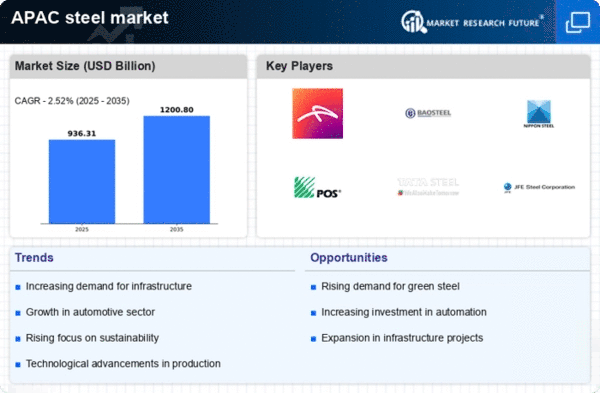
    As per MRFR analysis, the APAC steel market Size was estimated at 913.29 USD Billion in 2024. The APAC steel market is projected to grow from 936.31 USD Billion in 2025 to 1200.8 USD Billion by 2035, exhibiting a compound annual growth rate (CAGR) of 2.52% during the forecast period 2025 - 2035.

    Key Market Trends & Highlights

    The APAC steel market is experiencing robust growth driven by urbanization and infrastructure investments.

    • China remains the largest market for steel, while India is recognized as the fastest-growing region in the APAC sector.
    • Sustainability initiatives are increasingly influencing production practices across the steel industry.
    • Technological advancements are enhancing efficiency and reducing emissions in steel manufacturing processes.
    • Rising urbanization and government infrastructure investments are key drivers propelling market expansion in both China and India.

    Market Size & Forecast

    2024 Market Size 913.29 (USD Billion)
    2035 Market Size 1200.8 (USD Billion)
    CAGR (2025 - 2035) 2.52%

    Major Players

    <p>ArcelorMittal (LU), China Baowu Steel Group (CN), Nippon Steel Corporation (JP), POSCO (KR), Tata Steel (IN), JFE Steel Corporation (JP), Thyssenkrupp AG (DE), United States Steel Corporation (US), Steel Authority of India Limited (IN)</p>

    Market Trends

    The steel market in the APAC region is currently experiencing a dynamic phase characterized by evolving demand and supply dynamics. The region's rapid industrialization and urbanization are driving the need for steel in construction, automotive, and manufacturing sectors. Countries such as China and India are at the forefront, with significant investments in infrastructure projects. This trend appears to be fostering a competitive environment, where innovation and sustainability are becoming increasingly vital. Furthermore, the push towards green steel production is gaining traction, as governments and industries seek to reduce carbon emissions and enhance environmental responsibility. In addition, the steel market is witnessing fluctuations in raw material prices, which could impact production costs and pricing strategies. The ongoing geopolitical tensions and trade policies may also influence market stability. As the region navigates these complexities, stakeholders are likely to focus on strategic partnerships and technological advancements to enhance efficiency and sustainability. Overall, the APAC steel market seems poised for growth, albeit with challenges that require careful management and adaptation.

    Sustainability Initiatives

    The steel market is increasingly prioritizing sustainability, with many companies adopting eco-friendly practices. This shift is driven by regulatory pressures and consumer demand for greener products. Efforts include the use of renewable energy sources and the development of low-carbon steel production methods.

    Technological Advancements

    Innovations in production technologies are transforming the steel market. Automation and digitalization are enhancing operational efficiency, reducing waste, and improving product quality. These advancements are crucial for maintaining competitiveness in a rapidly evolving market.

    Infrastructure Development

    Ongoing infrastructure projects across the APAC region are significantly influencing the steel market. Governments are investing heavily in transportation, energy, and urban development, which is expected to sustain demand for steel in the coming years.

    APAC Steel Market Market Drivers

    Rising Urbanization

    The rapid urbanization in APAC countries is a pivotal driver for the steel market. As cities expand, the demand for residential and commercial buildings increases, leading to a surge in steel consumption. For instance, urban areas in China and India are projected to grow significantly, with urban populations expected to reach 1 billion by 2030. This urban growth necessitates substantial infrastructure development, including roads, bridges, and high-rise buildings, all of which require steel. Consequently, the steel market is likely to experience heightened demand, with estimates suggesting a growth rate of around 5-7% annually in the region. The construction sector's reliance on steel as a primary material underscores its critical role in supporting urbanization efforts.

    Trade Policies and Tariffs

    Trade policies and tariffs in APAC are influencing the dynamics of the steel market. Countries are increasingly implementing protective measures to support domestic steel producers, which can impact import levels and pricing strategies. For example, recent tariff adjustments in countries like Australia and India aim to safeguard local industries from foreign competition. These policies may lead to fluctuations in steel prices, affecting both consumers and manufacturers. The steel market must navigate these complexities, as trade regulations can create both opportunities and challenges. While protective tariffs may benefit local producers, they could also result in higher costs for consumers and manufacturers reliant on imported steel. The evolving trade landscape is likely to have lasting implications for the steel market in the region.

    Government Infrastructure Investments

    Government initiatives in APAC to bolster infrastructure are significantly influencing the steel market. Countries like India and Japan are investing heavily in infrastructure projects, including transportation networks, energy facilities, and urban development. For example, India's National Infrastructure Pipeline aims to invest over $1.4 trillion by 2025, which is expected to drive steel demand substantially. Such investments not only enhance connectivity but also stimulate economic growth, thereby increasing the need for steel in construction and manufacturing. The steel market stands to benefit from these government-led initiatives, with projections indicating a potential increase in steel consumption by 8-10% in the coming years as infrastructure projects materialize.

    Industrial Growth and Manufacturing Expansion

    The industrial growth in APAC is a crucial driver for the steel market. As manufacturing sectors expand, particularly in countries like China, Vietnam, and Thailand, the demand for steel products rises correspondingly. The manufacturing output in these nations has shown a consistent upward trend, with projections indicating a growth rate of approximately 6% annually. This expansion is largely fueled by increased production in automotive, machinery, and consumer goods sectors, all of which rely heavily on steel. Consequently, the steel market is poised to benefit from this industrial growth, as manufacturers seek reliable steel supplies to meet their production needs. The interplay between industrial growth and steel demand is likely to shape the market dynamics in the region.

    Technological Innovations in Steel Production

    Technological advancements in steel production processes are reshaping the steel market in APAC. Innovations such as electric arc furnaces and advanced metallurgy techniques are enhancing production efficiency and reducing environmental impact. For instance, the adoption of green steel technologies is gaining traction, with several APAC countries exploring methods to lower carbon emissions in steel manufacturing. This shift not only aligns with The steel market to meet evolving consumer preferences for environmentally friendly products. As these technologies become more prevalent, they may lead to cost reductions and improved product quality, potentially increasing competitiveness in the market. The ongoing evolution in production technology is likely to play a significant role in shaping the future landscape of the steel market.

    Market Segment Insights

    By End Use: Construction (Largest) vs. Automotive (Fastest-Growing)

    <p>In the APAC steel market, the construction segment holds the largest share, driven by robust infrastructure development and rising urbanization across various countries. The automotive sector, while smaller, is witnessing significant growth due to increasing vehicle production and the shift towards electric vehicles requiring advanced steel solutions. Growth trends indicate a substantial expansion in both segments, with construction propelled by governmental investments and housing projects. Meanwhile, the automotive sector is rapidly evolving with technological advancements and a growing demand for high-strength, lightweight materials. This dual growth pattern highlights the dynamic nature of the steel market, with each segment responding to unique drivers and challenges.</p>

    <p>Construction: Dominant vs. Automotive: Emerging</p>

    <p>The construction segment is characterized by its reliance on high-quality steel for infrastructure projects, including bridges, buildings, and railways, establishing itself as the dominant force in the market. Its growth is fueled by increasing investment in public works and residential construction. Conversely, the automotive segment is emerging as a key player, focusing on innovative uses of steel, particularly in electric vehicles and advanced manufacturing processes. As automakers seek to reduce vehicle weight for better fuel efficiency, the demand for specialized steel solutions is on the rise. Both segments are crucial to the overall health of the steel market, reflecting diverse applications and technological advancements that cater to evolving consumer needs.</p>

    By Product Type: Flat Steel (Largest) vs. Alloy Steel (Fastest-Growing)

    <p>In the APAC steel market, Flat Steel holds the largest share due to its widespread application across various industries, predominantly in construction and automotive. This segment's dominance is attributed to its versatility and essential role in delivering quality products. On the other hand, Alloy Steel is witnessing rapid growth, driven by the increases in demand for specialized products such as high-strength steel and enhanced performance materials across diverse sectors including manufacturing and aerospace. The growth trends within these segments reveal significant shifts influenced by technological advancements and evolving consumer preferences. The demand for Flat Steel remains strong, owing to large-scale infrastructure projects and the automotive industry's recovery. Contrastingly, Alloy Steel is emerging as the fastest-growing category, leveraging innovations in material science that enhance performance characteristics, thus attracting a broader customer base looking for superior quality and durability.</p>

    <p>Flat Steel (Dominant) vs. Alloy Steel (Emerging)</p>

    <p>Flat Steel is characterized by its smooth surface and uniform thickness, making it ideal for applications requiring precision and quality. This segment enjoys a dominant position due to its extensive usage in the construction sector, where it provides the backbone for structural frameworks and building elements. Conversely, Alloy Steel, which includes a range of metals to improve strength and resistance, is increasingly viewed as an emerging segment with high potential. Its properties make it suitable for critical applications in automotive, aerospace, and machinery sectors. As industries prioritize performance and safety, Alloy Steel's market position is strengthening, driven by innovations that meet the demanding requirements of modern engineering.</p>

    By Manufacturing Process: Basic Oxygen Steelmaking (Largest) vs. Electric Arc Furnace (Fastest-Growing)

    <p>In the manufacturing process segment, Basic Oxygen Steelmaking holds a significant market share due to its widespread adoption across the region, contributing to a large portion of steel production. On the other hand, Electric Arc Furnace is gaining traction, particularly among smaller manufacturers looking for flexible operations and shorter production cycles. Its growing acceptance indicates a shift in production technology preferences within the market. The growth trends in this segment are driven by increasing demands for sustainable production methods and improved efficiency. Factors such as the drive toward lower carbon emissions and the potential for recycling scrap steel in Electric Arc Furnaces are making this method increasingly popular. Furthermore, innovations in technology are enhancing production capabilities, thereby attracting manufacturers to transition towards more advanced processes.</p>

    <p>Basic Oxygen Steelmaking (Dominant) vs. Electric Arc Furnace (Emerging)</p>

    <p>Basic Oxygen Steelmaking remains the dominant process in steel production within the region, characterized by its efficiency and substantial output capacity. It is particularly favored among large-scale manufacturers due to its ability to produce high-quality steel at lower costs. In contrast, the Electric Arc Furnace serves as an emerging alternative, especially for those prioritizing smaller batches and recycling strategies. It uses electricity to melt steel scrap, making it a more flexible and eco-friendly option, which is appealing in a market that increasingly values sustainability. While Basic Oxygen Steelmaking leads in volume, Electric Arc Furnaces are expected to grow rapidly as they offer agility and innovation in production methods.</p>

    By Application: Infrastructure (Largest) vs. Energy (Fastest-Growing)

    <p>The application segment of the steel market showcases a diverse distribution among various sectors. Infrastructure stands as the largest share holder, driven by the continuous need for urban development and large-scale construction projects across the region. Following closely are Industrial and Transport sectors, which demonstrate significant engagement in steel utilization for machinery and vehicle manufacturing, respectively. The Packaging sector, while smaller, remains vital due to increasing consumer goods demand. In terms of growth trends, the Energy sector is noted as the fastest-growing segment within this landscape, propelled by rising investments in renewable energy infrastructure and the shift towards sustainable practices. The demand for steel in this sector is also rising considerably, with developments in energy generation technologies leading to increased consumption. As governments focus on infrastructure renewal and energy transition, these trends are expected to continue shaping the market dynamics.</p>

    <p>Infrastructure: Dominant vs. Energy: Emerging</p>

    <p>The Infrastructure sector stands out as the dominant application within the steel market, characterized by extensive requirements in construction, bridges, and public works. This sector benefits from sustained governmental and private investments aimed at improving urban infrastructure and enhancing connectivity. On the other hand, the Energy sector is emerging rapidly, fueled by the global transition to renewable energy sources. This sector's growth is marked by increased steel demand for wind and solar projects, along with other energy-related infrastructures. While Infrastructure maintains a strong foothold due to established needs, the Energy sector's dynamism presents new opportunities and challenges, indicating a shift in market influences as sustainability drives future steel applications.</p>

    Get more detailed insights about APAC Steel Market Research Report-Forecast to 2035

    Regional Insights

    China : Unmatched Production and Demand Growth

    China holds a staggering 62.5% market share in the APAC steel market, valued at $500.0 billion. Key growth drivers include rapid urbanization, infrastructure projects, and government initiatives aimed at boosting manufacturing. The demand for steel is primarily driven by construction, automotive, and machinery sectors. Regulatory policies, such as emissions control and production quotas, are shaping the industry, while significant investments in infrastructure continue to bolster industrial development.

    India : Strong Growth in Domestic Demand

    India commands a 15% market share, valued at $150.0 billion, driven by a booming construction sector and government initiatives like the National Steel Policy. The demand for steel is increasing due to urbanization and infrastructure development, with a focus on renewable energy projects. Regulatory support and foreign investments are enhancing production capabilities, while local players are expanding their market reach to meet rising consumption.

    Japan : High-Quality Production Standards

    Japan holds a 10% market share, valued at $100.0 billion, characterized by advanced technology and high-quality steel production. Key growth drivers include automotive and electronics industries, which demand specialized steel products. The government promotes innovation through R&D funding and environmental regulations, ensuring sustainable practices. The market is witnessing a shift towards high-strength steel for automotive applications, enhancing competitiveness.

    South Korea : Strong Exports and Domestic Demand

    South Korea captures an 8% market share, valued at $80.0 billion, with a focus on high-value steel products. The automotive and shipbuilding sectors are significant demand drivers, supported by government policies promoting innovation and exports. The competitive landscape features major players like POSCO and Hyundai Steel, which are investing in advanced manufacturing technologies. The market is adapting to global trends, including sustainability and digitalization.

    Malaysia : Strategic Location for Trade

    Malaysia holds a 3% market share, valued at $30.0 billion, with growth driven by infrastructure projects and regional trade agreements. The demand for steel is increasing in construction and manufacturing sectors, supported by government initiatives like the Malaysia Vision 2020. The competitive landscape includes local players and foreign investments, fostering a dynamic business environment. Key markets include Kuala Lumpur and Penang, where industrial activities are concentrated.

    Thailand : Infrastructure Development Boosts Demand

    Thailand accounts for 2.5% of the market share, valued at $25.0 billion, with growth fueled by government infrastructure projects and urbanization. The construction and automotive sectors are primary consumers of steel, supported by favorable regulatory policies. The competitive landscape features both local and international players, with Bangkok and Chonburi as key markets. The business environment is evolving, with a focus on sustainable practices and innovation.

    Indonesia : Infrastructure Needs Drive Growth

    Indonesia holds a 2% market share, valued at $20.0 billion, with growth driven by infrastructure development and urbanization. The demand for steel is increasing in construction and manufacturing sectors, supported by government initiatives like the National Medium-Term Development Plan. The competitive landscape includes local and foreign players, with Jakarta and Surabaya as key markets. The business environment is improving, with investments in production capabilities and sustainability.

    Rest of APAC : Varied Demand Across Regions

    The Rest of APAC accounts for 1% of the market share, valued at $8.29 billion, with diverse demand driven by local industries. Key growth drivers include infrastructure projects and regional trade agreements. The competitive landscape varies significantly, with local players dominating smaller markets. Countries like Vietnam and the Philippines are emerging as potential growth areas, focusing on construction and manufacturing sectors.

    Key Players and Competitive Insights

    The steel market exhibits a dynamic competitive landscape characterized by robust growth drivers such as increasing infrastructure investments, urbanization, and a shift towards sustainable practices. Major players like China Baowu Steel Group (CN), Tata Steel (IN), and Nippon Steel Corporation (JP) are strategically positioned to leverage these trends. China Baowu Steel Group, for instance, focuses on innovation and technological advancements, aiming to enhance production efficiency and reduce carbon emissions. Tata Steel emphasizes regional expansion and sustainability, aligning its operations with global environmental standards. Nippon Steel Corporation is investing heavily in digital transformation, which is likely to optimize its supply chain and production processes, thereby shaping a competitive environment that prioritizes efficiency and sustainability.

    Key business tactics within the market include localizing manufacturing and optimizing supply chains to enhance responsiveness to regional demands. The competitive structure appears moderately fragmented, with several key players exerting influence over market dynamics. This fragmentation allows for a diverse range of strategies, enabling companies to differentiate themselves through innovation and operational excellence.

    In September 2025, Tata Steel (IN) announced a strategic partnership with a leading technology firm to develop advanced steel manufacturing processes that utilize AI and machine learning. This collaboration is expected to enhance Tata Steel's production capabilities, reduce costs, and improve product quality, thereby reinforcing its competitive position in the market. The strategic importance of this partnership lies in its potential to drive innovation and operational efficiency, aligning with the broader industry trend towards digitalization.

    In October 2025, Nippon Steel Corporation (JP) unveiled a new initiative aimed at achieving carbon neutrality by 2050, which includes investments in green technologies and sustainable practices. This initiative not only positions Nippon Steel as a leader in sustainability but also responds to increasing regulatory pressures and consumer demand for environmentally friendly products. The strategic significance of this move is profound, as it may enhance the company's reputation and market share in an increasingly eco-conscious market.

    In August 2025, China Baowu Steel Group (CN) expanded its operations by acquiring a local steel manufacturer in Southeast Asia. This acquisition is likely to bolster its market presence in the region and enhance its supply chain capabilities. The strategic importance of this expansion is underscored by the growing demand for steel in emerging markets, which could provide China Baowu with a competitive edge in terms of production capacity and market reach.

    As of November 2025, current competitive trends in the steel market are increasingly defined by digitalization, sustainability, and the integration of AI technologies. Strategic alliances are becoming pivotal in shaping the landscape, as companies seek to enhance their capabilities and market positions. The evolution of competitive differentiation appears to be shifting from traditional price-based competition towards a focus on innovation, technology, and supply chain reliability. This transition suggests that companies that prioritize these aspects may be better positioned to thrive in the evolving market.

    Key Companies in the APAC Steel Market market include

    Industry Developments

    The APAC Steel Market has been experiencing notable developments, particularly with Baowu Steel Group enhancing its production capacities to meet rising demand fueled by infrastructure projects across the region. In September 2023, the Indian Ministry of Steel announced an initiative aimed at increasing the output of the Steel Authority of India Limited, which is crucial for the country's growing construction sector. Meanwhile, Hyundai Steel has been focusing on sustainable practices, announcing plans to invest in green steel technologies to comply with stringent environmental regulations.

    On mergers and acquisitions, JFE Steel acquired a 49% stake in an Australian iron ore mine in August 2023, which will strengthen its raw material sourcing. In July 2023, Tata Steel and Shandong Iron and Steel Group renewed their partnership to enhance competitive advantages in production and distribution within Asia. The market has seen strong valuation growth, with leading firms like ArcelorMittal and JSW Steel benefitting from increased global steel prices.

    The surge in construction and manufacturing activity across the Asia-Pacific region, particularly in countries like India and Vietnam, continues to significantly impact the steel market, supporting ongoing investments and strategic growth initiatives.

    Future Outlook

    APAC Steel Market Future Outlook

    <p>The steel market is projected to grow at 2.52% CAGR from 2024 to 2035, driven by infrastructure development, urbanization, and technological advancements.</p>

    New opportunities lie in:

    • <p>Investment in advanced steel recycling technologies</p>
    • <p>Development of high-strength, lightweight steel alloys</p>
    • <p>Expansion into emerging markets with tailored product offerings</p>

    <p>By 2035, the steel market is expected to achieve robust growth and enhanced competitive positioning.</p>

    Market Segmentation

    APAC Steel Market End Use Outlook

    • Construction
    • Automotive
    • Aerospace
    • Shipbuilding
    • Consumer Goods

    APAC Steel Market Application Outlook

    • Infrastructure
    • Industrial
    • Transport
    • Packaging
    • Energy

    APAC Steel Market Product Type Outlook

    • Flat Steel
    • Long Steel
    • Metallic Coated Steel
    • Pre-Engineered Steel
    • Alloy Steel

    APAC Steel Market Manufacturing Process Outlook

    • Basic Oxygen Steelmaking
    • Electric Arc Furnace
    • Open Hearth Furnace
    • Ladle Refining Furnace
    • Continuous Casting

    Report Scope

    MARKET SIZE 2024913.29(USD Billion)
    MARKET SIZE 2025936.31(USD Billion)
    MARKET SIZE 20351200.8(USD Billion)
    COMPOUND ANNUAL GROWTH RATE (CAGR)2.52% (2024 - 2035)
    REPORT COVERAGERevenue Forecast, Competitive Landscape, Growth Factors, and Trends
    BASE YEAR2024
    Market Forecast Period2025 - 2035
    Historical Data2019 - 2024
    Market Forecast UnitsUSD Billion
    Key Companies Profiled["ArcelorMittal (LU)", "China Baowu Steel Group (CN)", "Nippon Steel Corporation (JP)", "POSCO (KR)", "Tata Steel (IN)", "JFE Steel Corporation (JP)", "Thyssenkrupp AG (DE)", "United States Steel Corporation (US)", "Steel Authority of India Limited (IN)"]
    Segments CoveredEnd Use, Product Type, Manufacturing Process, Application
    Key Market OpportunitiesAdoption of advanced manufacturing technologies enhances efficiency in the steel market.
    Key Market DynamicsRising demand for sustainable steel production drives innovation and regulatory shifts in the APAC steel market.
    Countries CoveredChina, India, Japan, South Korea, Malaysia, Thailand, Indonesia, Rest of APAC

    FAQs

    What was the projected market size of the APAC Steel Market in 2024?

    The APAC Steel Market was expected to be valued at 730.64 USD Billion in 2024.

    What is the compound annual growth rate (CAGR) for the APAC Steel Market from 2025 to 2035?

    APAC Steel Market is projected to register a CAGR of 4.6% from 2025-2035

    Which segment of the APAC Steel Market is expected to dominate in terms of market value in 2024?

    The Long steel segment is expected to dominate the APAC Steel Market with a value of 410.0 USD Billion in 2024.

    What is the projected market value of the Flat steel segment in 2035?

    The Flat steel segment is projected to reach a value of 346.98 USD Billion by 2035.

    Who are the major players in the APAC Steel Market?

    Key players in the APAC Steel Market include Baowu Steel Group, ArcelorMittal, and Tata Steel, among others.

    What challenges are the APAC Steel Market currently facing?

    Challenges for the APAC Steel Market include fluctuating raw material prices and changing regulations.

    How does the APAC Steel Market growth rate vary by region?

    The growth rate of the APAC Steel Market varies widely across regions and is influenced by local demand and policy.

    What key applications drive demand in the APAC Steel Market?

    Key applications driving demand include construction, automotive, and infrastructure development.

    What are the emerging trends in the APAC Steel Market?

    Emerging trends include increased use of sustainable steel production techniques and technological advancements.

    What are the emerging trends in the APAC Steel Market?

    Emerging trends include increased use of sustainable steel production techniques and technological advancements.

    1. SECTION I: EXECUTIVE SUMMARY AND KEY HIGHLIGHTS
      1. | 1.1 EXECUTIVE SUMMARY
      2. | | 1.1.1 Market Overview
      3. | | 1.1.2 Key Findings
      4. | | 1.1.3 Market Segmentation
      5. | | 1.1.4 Competitive Landscape
      6. | | 1.1.5 Challenges and Opportunities
      7. | | 1.1.6 Future Outlook
    2. SECTION II: SCOPING, METHODOLOGY AND MARKET STRUCTURE
      1. | 2.1 MARKET INTRODUCTION
      2. | | 2.1.1 Definition
      3. | | 2.1.2 Scope of the study
      4. | | | 2.1.2.1 Research Objective
      5. | | | 2.1.2.2 Assumption
      6. | | | 2.1.2.3 Limitations
      7. | 2.2 RESEARCH METHODOLOGY
      8. | | 2.2.1 Overview
      9. | | 2.2.2 Data Mining
      10. | | 2.2.3 Secondary Research
      11. | | 2.2.4 Primary Research
      12. | | | 2.2.4.1 Primary Interviews and Information Gathering Process
      13. | | | 2.2.4.2 Breakdown of Primary Respondents
      14. | | 2.2.5 Forecasting Model
      15. | | 2.2.6 Market Size Estimation
      16. | | | 2.2.6.1 Bottom-Up Approach
      17. | | | 2.2.6.2 Top-Down Approach
      18. | | 2.2.7 Data Triangulation
      19. | | 2.2.8 Validation
    3. SECTION III: QUALITATIVE ANALYSIS
      1. | 3.1 MARKET DYNAMICS
      2. | | 3.1.1 Overview
      3. | | 3.1.2 Drivers
      4. | | 3.1.3 Restraints
      5. | | 3.1.4 Opportunities
      6. | 3.2 MARKET FACTOR ANALYSIS
      7. | | 3.2.1 Value chain Analysis
      8. | | 3.2.2 Porter's Five Forces Analysis
      9. | | | 3.2.2.1 Bargaining Power of Suppliers
      10. | | | 3.2.2.2 Bargaining Power of Buyers
      11. | | | 3.2.2.3 Threat of New Entrants
      12. | | | 3.2.2.4 Threat of Substitutes
      13. | | | 3.2.2.5 Intensity of Rivalry
      14. | | 3.2.3 COVID-19 Impact Analysis
      15. | | | 3.2.3.1 Market Impact Analysis
      16. | | | 3.2.3.2 Regional Impact
      17. | | | 3.2.3.3 Opportunity and Threat Analysis
    4. SECTION IV: QUANTITATIVE ANALYSIS
      1. | 4.1 Chemicals and Materials, BY Type (USD Billion)
      2. | | 4.1.1 Flat
      3. | | 4.1.2 Long
      4. | 4.2 Chemicals and Materials, BY Product (USD Billion)
      5. | | 4.2.1 Structural Steel
      6. | | 4.2.2 Prestressing Steel
      7. | 4.3 Chemicals and Materials, BY Application (USD Billion)
      8. | | 4.3.1 Building Construction
      9. | | 4.3.2 Automotive
      10. | | 4.3.3 Electrical Appliance
      11. | 4.4 Chemicals and Materials, BY Region (USD Billion)
      12. | | 4.4.1 North America
      13. | | | 4.4.1.1 US
      14. | | | 4.4.1.2 Canada
      15. | | 4.4.2 Europe
      16. | | | 4.4.2.1 Germany
      17. | | | 4.4.2.2 UK
      18. | | | 4.4.2.3 France
      19. | | | 4.4.2.4 Russia
      20. | | | 4.4.2.5 Italy
      21. | | | 4.4.2.6 Spain
      22. | | | 4.4.2.7 Rest of Europe
      23. | | 4.4.3 APAC
      24. | | | 4.4.3.1 China
      25. | | | 4.4.3.2 India
      26. | | | 4.4.3.3 Japan
      27. | | | 4.4.3.4 South Korea
      28. | | | 4.4.3.5 Malaysia
      29. | | | 4.4.3.6 Thailand
      30. | | | 4.4.3.7 Indonesia
      31. | | | 4.4.3.8 Rest of APAC
      32. | | 4.4.4 South America
      33. | | | 4.4.4.1 Brazil
      34. | | | 4.4.4.2 Mexico
      35. | | | 4.4.4.3 Argentina
      36. | | | 4.4.4.4 Rest of South America
      37. | | 4.4.5 MEA
      38. | | | 4.4.5.1 GCC Countries
      39. | | | 4.4.5.2 South Africa
      40. | | | 4.4.5.3 Rest of MEA
    5. SECTION V: COMPETITIVE ANALYSIS
      1. | 5.1 Competitive Landscape
      2. | | 5.1.1 Overview
      3. | | 5.1.2 Competitive Analysis
      4. | | 5.1.3 Market share Analysis
      5. | | 5.1.4 Major Growth Strategy in the Chemicals and Materials
      6. | | 5.1.5 Competitive Benchmarking
      7. | | 5.1.6 Leading Players in Terms of Number of Developments in the Chemicals and Materials
      8. | | 5.1.7 Key developments and growth strategies
      9. | | | 5.1.7.1 New Product Launch/Service Deployment
      10. | | | 5.1.7.2 Merger & Acquisitions
      11. | | | 5.1.7.3 Joint Ventures
      12. | | 5.1.8 Major Players Financial Matrix
      13. | | | 5.1.8.1 Sales and Operating Income
      14. | | | 5.1.8.2 Major Players R&D Expenditure. 2023
      15. | 5.2 Company Profiles
      16. | | 5.2.1 China Baowu Steel Group (CN)
      17. | | | 5.2.1.1 Financial Overview
      18. | | | 5.2.1.2 Products Offered
      19. | | | 5.2.1.3 Key Developments
      20. | | | 5.2.1.4 SWOT Analysis
      21. | | | 5.2.1.5 Key Strategies
      22. | | 5.2.2 ArcelorMittal Nippon Steel (IN)
      23. | | | 5.2.2.1 Financial Overview
      24. | | | 5.2.2.2 Products Offered
      25. | | | 5.2.2.3 Key Developments
      26. | | | 5.2.2.4 SWOT Analysis
      27. | | | 5.2.2.5 Key Strategies
      28. | | 5.2.3 POSCO (KR)
      29. | | | 5.2.3.1 Financial Overview
      30. | | | 5.2.3.2 Products Offered
      31. | | | 5.2.3.3 Key Developments
      32. | | | 5.2.3.4 SWOT Analysis
      33. | | | 5.2.3.5 Key Strategies
      34. | | 5.2.4 Nippon Steel Corporation (JP)
      35. | | | 5.2.4.1 Financial Overview
      36. | | | 5.2.4.2 Products Offered
      37. | | | 5.2.4.3 Key Developments
      38. | | | 5.2.4.4 SWOT Analysis
      39. | | | 5.2.4.5 Key Strategies
      40. | | 5.2.5 JFE Steel Corporation (JP)
      41. | | | 5.2.5.1 Financial Overview
      42. | | | 5.2.5.2 Products Offered
      43. | | | 5.2.5.3 Key Developments
      44. | | | 5.2.5.4 SWOT Analysis
      45. | | | 5.2.5.5 Key Strategies
      46. | | 5.2.6 Tata Steel Limited (IN)
      47. | | | 5.2.6.1 Financial Overview
      48. | | | 5.2.6.2 Products Offered
      49. | | | 5.2.6.3 Key Developments
      50. | | | 5.2.6.4 SWOT Analysis
      51. | | | 5.2.6.5 Key Strategies
      52. | | 5.2.7 Hyundai Steel Company (KR)
      53. | | | 5.2.7.1 Financial Overview
      54. | | | 5.2.7.2 Products Offered
      55. | | | 5.2.7.3 Key Developments
      56. | | | 5.2.7.4 SWOT Analysis
      57. | | | 5.2.7.5 Key Strategies
      58. | | 5.2.8 Steel Authority of India Limited (IN)
      59. | | | 5.2.8.1 Financial Overview
      60. | | | 5.2.8.2 Products Offered
      61. | | | 5.2.8.3 Key Developments
      62. | | | 5.2.8.4 SWOT Analysis
      63. | | | 5.2.8.5 Key Strategies
      64. | | 5.2.9 Shougang Group (CN)
      65. | | | 5.2.9.1 Financial Overview
      66. | | | 5.2.9.2 Products Offered
      67. | | | 5.2.9.3 Key Developments
      68. | | | 5.2.9.4 SWOT Analysis
      69. | | | 5.2.9.5 Key Strategies
      70. | 5.3 Appendix
      71. | | 5.3.1 References
      72. | | 5.3.2 Related Reports
    6. LIST OF FIGURES
      1. | 6.1 MARKET SYNOPSIS
      2. | 6.2 NORTH AMERICA MARKET ANALYSIS
      3. | 6.3 US MARKET ANALYSIS BY TYPE
      4. | 6.4 US MARKET ANALYSIS BY PRODUCT
      5. | 6.5 US MARKET ANALYSIS BY APPLICATION
      6. | 6.6 CANADA MARKET ANALYSIS BY TYPE
      7. | 6.7 CANADA MARKET ANALYSIS BY PRODUCT
      8. | 6.8 CANADA MARKET ANALYSIS BY APPLICATION
      9. | 6.9 EUROPE MARKET ANALYSIS
      10. | 6.10 GERMANY MARKET ANALYSIS BY TYPE
      11. | 6.11 GERMANY MARKET ANALYSIS BY PRODUCT
      12. | 6.12 GERMANY MARKET ANALYSIS BY APPLICATION
      13. | 6.13 UK MARKET ANALYSIS BY TYPE
      14. | 6.14 UK MARKET ANALYSIS BY PRODUCT
      15. | 6.15 UK MARKET ANALYSIS BY APPLICATION
      16. | 6.16 FRANCE MARKET ANALYSIS BY TYPE
      17. | 6.17 FRANCE MARKET ANALYSIS BY PRODUCT
      18. | 6.18 FRANCE MARKET ANALYSIS BY APPLICATION
      19. | 6.19 RUSSIA MARKET ANALYSIS BY TYPE
      20. | 6.20 RUSSIA MARKET ANALYSIS BY PRODUCT
      21. | 6.21 RUSSIA MARKET ANALYSIS BY APPLICATION
      22. | 6.22 ITALY MARKET ANALYSIS BY TYPE
      23. | 6.23 ITALY MARKET ANALYSIS BY PRODUCT
      24. | 6.24 ITALY MARKET ANALYSIS BY APPLICATION
      25. | 6.25 SPAIN MARKET ANALYSIS BY TYPE
      26. | 6.26 SPAIN MARKET ANALYSIS BY PRODUCT
      27. | 6.27 SPAIN MARKET ANALYSIS BY APPLICATION
      28. | 6.28 REST OF EUROPE MARKET ANALYSIS BY TYPE
      29. | 6.29 REST OF EUROPE MARKET ANALYSIS BY PRODUCT
      30. | 6.30 REST OF EUROPE MARKET ANALYSIS BY APPLICATION
      31. | 6.31 APAC MARKET ANALYSIS
      32. | 6.32 CHINA MARKET ANALYSIS BY TYPE
      33. | 6.33 CHINA MARKET ANALYSIS BY PRODUCT
      34. | 6.34 CHINA MARKET ANALYSIS BY APPLICATION
      35. | 6.35 INDIA MARKET ANALYSIS BY TYPE
      36. | 6.36 INDIA MARKET ANALYSIS BY PRODUCT
      37. | 6.37 INDIA MARKET ANALYSIS BY APPLICATION
      38. | 6.38 JAPAN MARKET ANALYSIS BY TYPE
      39. | 6.39 JAPAN MARKET ANALYSIS BY PRODUCT
      40. | 6.40 JAPAN MARKET ANALYSIS BY APPLICATION
      41. | 6.41 SOUTH KOREA MARKET ANALYSIS BY TYPE
      42. | 6.42 SOUTH KOREA MARKET ANALYSIS BY PRODUCT
      43. | 6.43 SOUTH KOREA MARKET ANALYSIS BY APPLICATION
      44. | 6.44 MALAYSIA MARKET ANALYSIS BY TYPE
      45. | 6.45 MALAYSIA MARKET ANALYSIS BY PRODUCT
      46. | 6.46 MALAYSIA MARKET ANALYSIS BY APPLICATION
      47. | 6.47 THAILAND MARKET ANALYSIS BY TYPE
      48. | 6.48 THAILAND MARKET ANALYSIS BY PRODUCT
      49. | 6.49 THAILAND MARKET ANALYSIS BY APPLICATION
      50. | 6.50 INDONESIA MARKET ANALYSIS BY TYPE
      51. | 6.51 INDONESIA MARKET ANALYSIS BY PRODUCT
      52. | 6.52 INDONESIA MARKET ANALYSIS BY APPLICATION
      53. | 6.53 REST OF APAC MARKET ANALYSIS BY TYPE
      54. | 6.54 REST OF APAC MARKET ANALYSIS BY PRODUCT
      55. | 6.55 REST OF APAC MARKET ANALYSIS BY APPLICATION
      56. | 6.56 SOUTH AMERICA MARKET ANALYSIS
      57. | 6.57 BRAZIL MARKET ANALYSIS BY TYPE
      58. | 6.58 BRAZIL MARKET ANALYSIS BY PRODUCT
      59. | 6.59 BRAZIL MARKET ANALYSIS BY APPLICATION
      60. | 6.60 MEXICO MARKET ANALYSIS BY TYPE
      61. | 6.61 MEXICO MARKET ANALYSIS BY PRODUCT
      62. | 6.62 MEXICO MARKET ANALYSIS BY APPLICATION
      63. | 6.63 ARGENTINA MARKET ANALYSIS BY TYPE
      64. | 6.64 ARGENTINA MARKET ANALYSIS BY PRODUCT
      65. | 6.65 ARGENTINA MARKET ANALYSIS BY APPLICATION
      66. | 6.66 REST OF SOUTH AMERICA MARKET ANALYSIS BY TYPE
      67. | 6.67 REST OF SOUTH AMERICA MARKET ANALYSIS BY PRODUCT
      68. | 6.68 REST OF SOUTH AMERICA MARKET ANALYSIS BY APPLICATION
      69. | 6.69 MEA MARKET ANALYSIS
      70. | 6.70 GCC COUNTRIES MARKET ANALYSIS BY TYPE
      71. | 6.71 GCC COUNTRIES MARKET ANALYSIS BY PRODUCT
      72. | 6.72 GCC COUNTRIES MARKET ANALYSIS BY APPLICATION
      73. | 6.73 SOUTH AFRICA MARKET ANALYSIS BY TYPE
      74. | 6.74 SOUTH AFRICA MARKET ANALYSIS BY PRODUCT
      75. | 6.75 SOUTH AFRICA MARKET ANALYSIS BY APPLICATION
      76. | 6.76 REST OF MEA MARKET ANALYSIS BY TYPE
      77. | 6.77 REST OF MEA MARKET ANALYSIS BY PRODUCT
      78. | 6.78 REST OF MEA MARKET ANALYSIS BY APPLICATION
      79. | 6.79 KEY BUYING CRITERIA OF CHEMICALS AND MATERIALS
      80. | 6.80 RESEARCH PROCESS OF MRFR
      81. | 6.81 DRO ANALYSIS OF CHEMICALS AND MATERIALS
      82. | 6.82 DRIVERS IMPACT ANALYSIS: CHEMICALS AND MATERIALS
      83. | 6.83 RESTRAINTS IMPACT ANALYSIS: CHEMICALS AND MATERIALS
      84. | 6.84 SUPPLY / VALUE CHAIN: CHEMICALS AND MATERIALS
      85. | 6.85 CHEMICALS AND MATERIALS, BY TYPE, 2024 (% SHARE)
      86. | 6.86 CHEMICALS AND MATERIALS, BY TYPE, 2024 TO 2035 (USD Billion)
      87. | 6.87 CHEMICALS AND MATERIALS, BY PRODUCT, 2024 (% SHARE)
      88. | 6.88 CHEMICALS AND MATERIALS, BY PRODUCT, 2024 TO 2035 (USD Billion)
      89. | 6.89 CHEMICALS AND MATERIALS, BY APPLICATION, 2024 (% SHARE)
      90. | 6.90 CHEMICALS AND MATERIALS, BY APPLICATION, 2024 TO 2035 (USD Billion)
      91. | 6.91 BENCHMARKING OF MAJOR COMPETITORS
    7. LIST OF TABLES
      1. | 7.1 LIST OF ASSUMPTIONS
      2. | | 7.1.1
      3. | 7.2 North America MARKET SIZE ESTIMATES; FORECAST
      4. | | 7.2.1 BY TYPE, 2025-2035 (USD Billion)
      5. | | 7.2.2 BY PRODUCT, 2025-2035 (USD Billion)
      6. | | 7.2.3 BY APPLICATION, 2025-2035 (USD Billion)
      7. | 7.3 US MARKET SIZE ESTIMATES; FORECAST
      8. | | 7.3.1 BY TYPE, 2025-2035 (USD Billion)
      9. | | 7.3.2 BY PRODUCT, 2025-2035 (USD Billion)
      10. | | 7.3.3 BY APPLICATION, 2025-2035 (USD Billion)
      11. | 7.4 Canada MARKET SIZE ESTIMATES; FORECAST
      12. | | 7.4.1 BY TYPE, 2025-2035 (USD Billion)
      13. | | 7.4.2 BY PRODUCT, 2025-2035 (USD Billion)
      14. | | 7.4.3 BY APPLICATION, 2025-2035 (USD Billion)
      15. | 7.5 Europe MARKET SIZE ESTIMATES; FORECAST
      16. | | 7.5.1 BY TYPE, 2025-2035 (USD Billion)
      17. | | 7.5.2 BY PRODUCT, 2025-2035 (USD Billion)
      18. | | 7.5.3 BY APPLICATION, 2025-2035 (USD Billion)
      19. | 7.6 Germany MARKET SIZE ESTIMATES; FORECAST
      20. | | 7.6.1 BY TYPE, 2025-2035 (USD Billion)
      21. | | 7.6.2 BY PRODUCT, 2025-2035 (USD Billion)
      22. | | 7.6.3 BY APPLICATION, 2025-2035 (USD Billion)
      23. | 7.7 UK MARKET SIZE ESTIMATES; FORECAST
      24. | | 7.7.1 BY TYPE, 2025-2035 (USD Billion)
      25. | | 7.7.2 BY PRODUCT, 2025-2035 (USD Billion)
      26. | | 7.7.3 BY APPLICATION, 2025-2035 (USD Billion)
      27. | 7.8 France MARKET SIZE ESTIMATES; FORECAST
      28. | | 7.8.1 BY TYPE, 2025-2035 (USD Billion)
      29. | | 7.8.2 BY PRODUCT, 2025-2035 (USD Billion)
      30. | | 7.8.3 BY APPLICATION, 2025-2035 (USD Billion)
      31. | 7.9 Russia MARKET SIZE ESTIMATES; FORECAST
      32. | | 7.9.1 BY TYPE, 2025-2035 (USD Billion)
      33. | | 7.9.2 BY PRODUCT, 2025-2035 (USD Billion)
      34. | | 7.9.3 BY APPLICATION, 2025-2035 (USD Billion)
      35. | 7.10 Italy MARKET SIZE ESTIMATES; FORECAST
      36. | | 7.10.1 BY TYPE, 2025-2035 (USD Billion)
      37. | | 7.10.2 BY PRODUCT, 2025-2035 (USD Billion)
      38. | | 7.10.3 BY APPLICATION, 2025-2035 (USD Billion)
      39. | 7.11 Spain MARKET SIZE ESTIMATES; FORECAST
      40. | | 7.11.1 BY TYPE, 2025-2035 (USD Billion)
      41. | | 7.11.2 BY PRODUCT, 2025-2035 (USD Billion)
      42. | | 7.11.3 BY APPLICATION, 2025-2035 (USD Billion)
      43. | 7.12 Rest of Europe MARKET SIZE ESTIMATES; FORECAST
      44. | | 7.12.1 BY TYPE, 2025-2035 (USD Billion)
      45. | | 7.12.2 BY PRODUCT, 2025-2035 (USD Billion)
      46. | | 7.12.3 BY APPLICATION, 2025-2035 (USD Billion)
      47. | 7.13 APAC MARKET SIZE ESTIMATES; FORECAST
      48. | | 7.13.1 BY TYPE, 2025-2035 (USD Billion)
      49. | | 7.13.2 BY PRODUCT, 2025-2035 (USD Billion)
      50. | | 7.13.3 BY APPLICATION, 2025-2035 (USD Billion)
      51. | 7.14 China MARKET SIZE ESTIMATES; FORECAST
      52. | | 7.14.1 BY TYPE, 2025-2035 (USD Billion)
      53. | | 7.14.2 BY PRODUCT, 2025-2035 (USD Billion)
      54. | | 7.14.3 BY APPLICATION, 2025-2035 (USD Billion)
      55. | 7.15 India MARKET SIZE ESTIMATES; FORECAST
      56. | | 7.15.1 BY TYPE, 2025-2035 (USD Billion)
      57. | | 7.15.2 BY PRODUCT, 2025-2035 (USD Billion)
      58. | | 7.15.3 BY APPLICATION, 2025-2035 (USD Billion)
      59. | 7.16 Japan MARKET SIZE ESTIMATES; FORECAST
      60. | | 7.16.1 BY TYPE, 2025-2035 (USD Billion)
      61. | | 7.16.2 BY PRODUCT, 2025-2035 (USD Billion)
      62. | | 7.16.3 BY APPLICATION, 2025-2035 (USD Billion)
      63. | 7.17 South Korea MARKET SIZE ESTIMATES; FORECAST
      64. | | 7.17.1 BY TYPE, 2025-2035 (USD Billion)
      65. | | 7.17.2 BY PRODUCT, 2025-2035 (USD Billion)
      66. | | 7.17.3 BY APPLICATION, 2025-2035 (USD Billion)
      67. | 7.18 Malaysia MARKET SIZE ESTIMATES; FORECAST
      68. | | 7.18.1 BY TYPE, 2025-2035 (USD Billion)
      69. | | 7.18.2 BY PRODUCT, 2025-2035 (USD Billion)
      70. | | 7.18.3 BY APPLICATION, 2025-2035 (USD Billion)
      71. | 7.19 Thailand MARKET SIZE ESTIMATES; FORECAST
      72. | | 7.19.1 BY TYPE, 2025-2035 (USD Billion)
      73. | | 7.19.2 BY PRODUCT, 2025-2035 (USD Billion)
      74. | | 7.19.3 BY APPLICATION, 2025-2035 (USD Billion)
      75. | 7.20 Indonesia MARKET SIZE ESTIMATES; FORECAST
      76. | | 7.20.1 BY TYPE, 2025-2035 (USD Billion)
      77. | | 7.20.2 BY PRODUCT, 2025-2035 (USD Billion)
      78. | | 7.20.3 BY APPLICATION, 2025-2035 (USD Billion)
      79. | 7.21 Rest of APAC MARKET SIZE ESTIMATES; FORECAST
      80. | | 7.21.1 BY TYPE, 2025-2035 (USD Billion)
      81. | | 7.21.2 BY PRODUCT, 2025-2035 (USD Billion)
      82. | | 7.21.3 BY APPLICATION, 2025-2035 (USD Billion)
      83. | 7.22 South America MARKET SIZE ESTIMATES; FORECAST
      84. | | 7.22.1 BY TYPE, 2025-2035 (USD Billion)
      85. | | 7.22.2 BY PRODUCT, 2025-2035 (USD Billion)
      86. | | 7.22.3 BY APPLICATION, 2025-2035 (USD Billion)
      87. | 7.23 Brazil MARKET SIZE ESTIMATES; FORECAST
      88. | | 7.23.1 BY TYPE, 2025-2035 (USD Billion)
      89. | | 7.23.2 BY PRODUCT, 2025-2035 (USD Billion)
      90. | | 7.23.3 BY APPLICATION, 2025-2035 (USD Billion)
      91. | 7.24 Mexico MARKET SIZE ESTIMATES; FORECAST
      92. | | 7.24.1 BY TYPE, 2025-2035 (USD Billion)
      93. | | 7.24.2 BY PRODUCT, 2025-2035 (USD Billion)
      94. | | 7.24.3 BY APPLICATION, 2025-2035 (USD Billion)
      95. | 7.25 Argentina MARKET SIZE ESTIMATES; FORECAST
      96. | | 7.25.1 BY TYPE, 2025-2035 (USD Billion)
      97. | | 7.25.2 BY PRODUCT, 2025-2035 (USD Billion)
      98. | | 7.25.3 BY APPLICATION, 2025-2035 (USD Billion)
      99. | 7.26 Rest of South America MARKET SIZE ESTIMATES; FORECAST
      100. | | 7.26.1 BY TYPE, 2025-2035 (USD Billion)
      101. | | 7.26.2 BY PRODUCT, 2025-2035 (USD Billion)
      102. | | 7.26.3 BY APPLICATION, 2025-2035 (USD Billion)
      103. | 7.27 MEA MARKET SIZE ESTIMATES; FORECAST
      104. | | 7.27.1 BY TYPE, 2025-2035 (USD Billion)
      105. | | 7.27.2 BY PRODUCT, 2025-2035 (USD Billion)
      106. | | 7.27.3 BY APPLICATION, 2025-2035 (USD Billion)
      107. | 7.28 GCC Countries MARKET SIZE ESTIMATES; FORECAST
      108. | | 7.28.1 BY TYPE, 2025-2035 (USD Billion)
      109. | | 7.28.2 BY PRODUCT, 2025-2035 (USD Billion)
      110. | | 7.28.3 BY APPLICATION, 2025-2035 (USD Billion)
      111. | 7.29 South Africa MARKET SIZE ESTIMATES; FORECAST
      112. | | 7.29.1 BY TYPE, 2025-2035 (USD Billion)
      113. | | 7.29.2 BY PRODUCT, 2025-2035 (USD Billion)
      114. | | 7.29.3 BY APPLICATION, 2025-2035 (USD Billion)
      115. | 7.30 Rest of MEA MARKET SIZE ESTIMATES; FORECAST
      116. | | 7.30.1 BY TYPE, 2025-2035 (USD Billion)
      117. | | 7.30.2 BY PRODUCT, 2025-2035 (USD Billion)
      118. | | 7.30.3 BY APPLICATION, 2025-2035 (USD Billion)
      119. | 7.31 PRODUCT LAUNCH/PRODUCT DEVELOPMENT/APPROVAL
      120. | | 7.31.1
      121. | 7.32 ACQUISITION/PARTNERSHIP
      122. | | 7.32.1

    APAC Steel Market Segmentation

    • Steel Market By Steel Type Outlook (USD Billion, 2019-2035)

      • Flat
      • Long
    • Steel Market By Steel Product Outlook (USD Billion, 2019-2035)

      • Structural Steel
      • Prestressing Steel
    • Steel Market By Steel Application Outlook (USD Billion, 2019-2035)

      • Building Construction
      • Automotive
      • Electrical Appliance

    Steel Market Regional Outlook (USD Billion, 2019-2035)

    • APAC Outlook (USD Billion, 2019-2035)

      • APAC Steel Market by Steel Type Outlook Type

        • Flat
        • Long
      • APAC Steel Market by Steel Product Outlook Type

        • Structural Steel
        • Prestressing Steel
      • APAC Steel Market by Steel Application Outlook Type

        • Building Construction
        • Automotive
        • Electrical Appliance
      • CHINA Outlook (USD Billion, 2019-2035)

      • CHINA Steel Market by Steel Type Outlook Type

        • Flat
        • Long
      • CHINA Steel Market by Steel Product Outlook Type

        • Structural Steel
        • Prestressing Steel
      • CHINA Steel Market by Steel Application Outlook Type

        • Building Construction
        • Automotive
        • Electrical Appliance
      • INDIA Outlook (USD Billion, 2019-2035)

      • INDIA Steel Market by Steel Type Outlook Type

        • Flat
        • Long
      • INDIA Steel Market by Steel Product Outlook Type

        • Structural Steel
        • Prestressing Steel
      • INDIA Steel Market by Steel Application Outlook Type

        • Building Construction
        • Automotive
        • Electrical Appliance
      • JAPAN Outlook (USD Billion, 2019-2035)

      • JAPAN Steel Market by Steel Type Outlook Type

        • Flat
        • Long
      • JAPAN Steel Market by Steel Product Outlook Type

        • Structural Steel
        • Prestressing Steel
      • JAPAN Steel Market by Steel Application Outlook Type

        • Building Construction
        • Automotive
        • Electrical Appliance
      • SOUTH KOREA Outlook (USD Billion, 2019-2035)

      • SOUTH KOREA Steel Market by Steel Type Outlook Type

        • Flat
        • Long
      • SOUTH KOREA Steel Market by Steel Product Outlook Type

        • Structural Steel
        • Prestressing Steel
      • SOUTH KOREA Steel Market by Steel Application Outlook Type

        • Building Construction
        • Automotive
        • Electrical Appliance
      • MALAYSIA Outlook (USD Billion, 2019-2035)

      • MALAYSIA Steel Market by Steel Type Outlook Type

        • Flat
        • Long
      • MALAYSIA Steel Market by Steel Product Outlook Type

        • Structural Steel
        • Prestressing Steel
      • MALAYSIA Steel Market by Steel Application Outlook Type

        • Building Construction
        • Automotive
        • Electrical Appliance
      • THAILAND Outlook (USD Billion, 2019-2035)

      • THAILAND Steel Market by Steel Type Outlook Type

        • Flat
        • Long
      • THAILAND Steel Market by Steel Product Outlook Type

        • Structural Steel
        • Prestressing Steel
      • THAILAND Steel Market by Steel Application Outlook Type

        • Building Construction
        • Automotive
        • Electrical Appliance
      • INDONESIA Outlook (USD Billion, 2019-2035)

      • INDONESIA Steel Market by Steel Type Outlook Type

        • Flat
        • Long
      • INDONESIA Steel Market by Steel Product Outlook Type

        • Structural Steel
        • Prestressing Steel
      • INDONESIA Steel Market by Steel Application Outlook Type

        • Building Construction
        • Automotive
        • Electrical Appliance
      • REST OF APAC Outlook (USD Billion, 2019-2035)

      • REST OF APAC Steel Market by Steel Type Outlook Type

        • Flat
        • Long
      • REST OF APAC Steel Market by Steel Product Outlook Type

        • Structural Steel
        • Prestressing Steel
      • REST OF APAC Steel Market by Steel Application Outlook Type

        • Building Construction
        • Automotive
        • Electrical Appliance
    Infographic

    Free Sample Request

    Kindly complete the form below to receive a free sample of this Report

    Get Free Sample

    Customer Strories

    “I am very pleased with how market segments have been defined in a relevant way for my purposes (such as "Portable Freezers & refrigerators" and "last-mile"). In general the report is well structured. Thanks very much for your efforts.”

    Victoria Milne

    Founder
    Case Study
    Chemicals and Materials

    Compare Licence

    ×
    Features License Type
    Single User Multiuser License Enterprise User
    Price $4,950 $5,950 $7,250
    Maximum User Access Limit 1 User Upto 10 Users Unrestricted Access Throughout the Organization
    Free Customization
    Direct Access to Analyst
    Deliverable Format
    Platform Access
    Discount on Next Purchase 10% 15% 15%
    Printable Versions