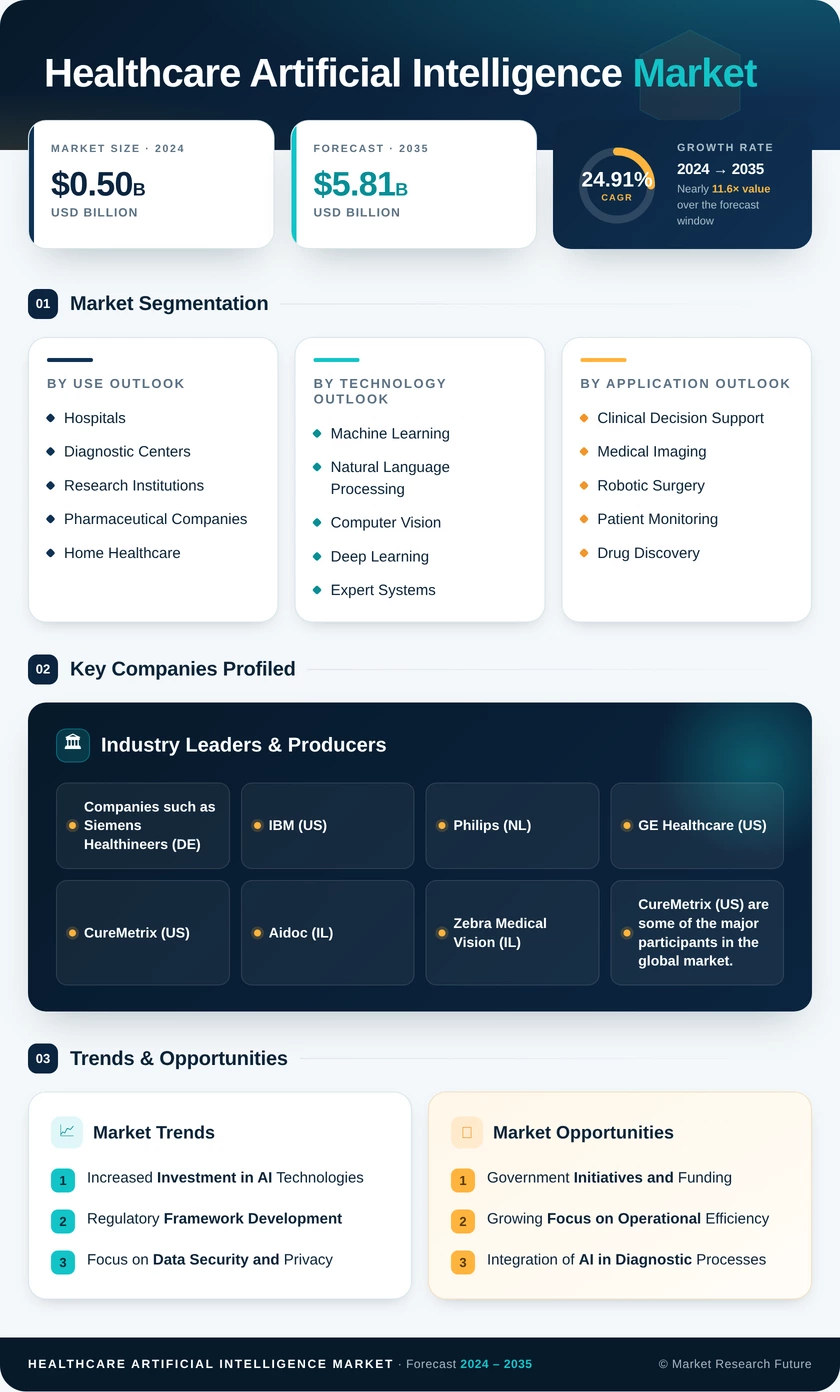
Markt für Künstliche Intelligenz im Gesundheitswesen (2026 - 2035)
- Reimbursement Finally Arrives
- Workforce Economics
- Clearance Velocity and Compute Cost
- Ambient Workflow Beyond Documentation
- Emerging-Market Diagnostic Leapfrogging
- Data Monetisation Through Federated Consortia
-
1 Market Summary |
- 1.1 Study Assumptions & Market Definition |
- 1.2 Scope of the Study |
- 1.3 Research Methodology
-
2 Key Report Takeaways |
- 2.1 By Technology |
- 2.2 By Sector |
- 2.3 By Geography
-
3 Market Size & Forecast (2021–2035) |
- 3.1 Historical Market Size (2021–2025) |
- 3.2 Current & Forecast Market Size (2026–2035) |
- 3.3 Year-over-Year Growth Analysis
-
4 Driver Impact Analysis |
- 4.1 Reimbursement Pathways for Algorithm-Assisted Diagnostics |
- 4.2 Clinician Shortage & Documentation Burden |
- 4.3 Clearance Velocity & Falling Compute Cost |
- 4.4 Pharmaceutical R&D Productivity Pressure
-
5 Restraints Impact Analysis |
- 5.1 Privacy Architecture & Cross-Border Data Limits |
- 5.2 Algorithmic Bias & Post-Market Validation Gaps |
- 5.3 Legacy Record Interoperability Friction
-
6 Opportunity Analysis |
- 6.1 Ambient Workflow Expansion |
- 6.2 Emerging-Market Diagnostic Leapfrogging |
- 6.3 Federated Data Consortia & Monetisation |
- 6.4 Payer-Side Claims Automation |
- 6.5 Regulated Procedural Autonomy |
- 6.6 Industry Value Chain Analysis |
- 6.7 Porter's Five Forces Analysis
-
7 Regional Market Share & Country-Level Analysis |
-
7.1 North America | |
- 7.1.1 US | |
- 7.1.2 Canada | |
- 7.1.3 Mexico |
-
7.2 Europe | |
- 7.2.1 Germany | |
- 7.2.2 UK | |
- 7.2.3 France | |
- 7.2.4 Italy | |
- 7.2.5 Spain | |
- 7.2.6 Nordic Countries | |
- 7.2.7 Russia | |
- 7.2.8 Rest of Europe |
-
7.3 Asia-Pacific | |
- 7.3.1 China | |
- 7.3.2 India | |
- 7.3.3 Japan | |
- 7.3.4 South Korea | |
- 7.3.5 ASEAN | |
- 7.3.6 Rest of Asia-Pacific |
-
7.4 South America | |
- 7.4.1 Brazil | |
- 7.4.2 Argentina | |
- 7.4.3 Rest of South America |
-
7.5 Middle East & Africa | |
- 7.5.1 Saudi Arabia | |
- 7.5.2 UAE | |
- 7.5.3 South Africa | |
- 7.5.4 Egypt | |
- 7.5.5 Rest of Middle East & Africa
-
7.1 North America | |
-
8 Future Outlook (2026–2035) |
- 8.1 Supervised Autonomy in Procedural Care |
- 8.2 Platform Economics & Pricing Compression |
- 8.3 Sovereign Health Compute |
- 8.4 Outcome-Linked Contracting
-
9 Market Segmentation Analysis |
-
9.1 By Component | |
- 9.1.1 Software Solutions | |
- 9.1.2 Hardware | |
- 9.1.3 Services |
-
9.2 By Technology | |
- 9.2.1 Machine Learning | |
- 9.2.2 Deep Learning | |
- 9.2.3 Natural Language Processing | |
- 9.2.4 Computer Vision & Context-Aware Computing |
-
9.3 By Application | |
- 9.3.1 Robot-Assisted Surgery | |
- 9.3.2 Automated Image Diagnosis | |
- 9.3.3 Clinical Trial Optimisation | |
- 9.3.4 Preliminary Diagnosis | |
- 9.3.5 Administrative Workflow Assistance | |
- 9.3.6 Virtual Nursing Assistants | |
- 9.3.7 Dosage Error Reduction | |
- 9.3.8 Fraud Detection & Cybersecurity |
-
9.4 By End User | |
- 9.4.1 Healthcare Providers | |
- 9.4.2 Pharmaceutical & Biotechnology Companies | |
- 9.4.3 Healthcare Payers | |
- 9.4.4 Patient & Consumer Platforms | |
- 9.4.5 Others
-
9.1 By Component | |
-
10 Competitive Landscape |
- 10.1 Market Share Analysis (2026) |
- 10.2 Competitive Benchmarking Matrix |
-
10.3 Company Profiles | |
- 10.3.1 NVIDIA Corporation | |
- 10.3.2 Microsoft Corporation | |
- 10.3.3 Alphabet Inc. (Google Health) | |
- 10.3.4 Siemens Healthineers AG | |
- 10.3.5 GE HealthCare Technologies | |
- 10.3.6 Koninklijke Philips N.V. | |
- 10.3.7 Medtronic plc | |
- 10.3.8 Oracle Corporation (Oracle Health) | |
- 10.3.9 International Business Machines | |
- 10.3.10 Intuitive Surgical Inc. | |
- 10.3.11 Tempus AI Inc. | |
- 10.3.12 Aidoc Medical
- 11 Recent News & Developments
-
12 Report Scope & Methodology |
- 12.1 Study Period & Base Year |
- 12.2 Data Sources & Citations |
- 12.3 Abbreviations
- 13 Detailed Sources & Citations
- 14 Frequently Asked Questions
- 15 LIST OF TABLES
- 16 LIST OF FIGURES
Verwandte Berichte

Customer Stories

“This is really good guys. Excellent work on a tight deadline. I will continue to use you going forward and recommend you to others. Nice job”
 Noah Malgeri
Co-Founder

“Thanks for sending the report it gives us a good global view of the Betaïne market.”
 Peter Groot koerkamp
Account and Business Manager

“We found the report very insightful! we found your research firm very helpful. I'm sending this email to secure our future business.”
 Younghwan Choi
Senior Retail Manager

“I am very pleased with how market segments have been defined in a relevant way for my purposes (such as "Portable Freezers & refrigerators" and "last-mile"). In general the report is well structured. Thanks very much for your efforts.”
 Mark Irwin
Management Consultant

“We got the report in time, we really thank you for your support in this process. I also thank to all of your team as they did a great job.”
 Akif Moroglu
Strategy & Business Development Director

“The Automotive 48V ECU Components Procurement Intelligence Study” was a complex project, but the Market Research Future (MRFR) team handled it with quality, agility, and customer-centricity. They delivered all requested data on time and within the agreed scope. The team, including Shubhendra Anand and Rahul Gotadki, was always readily available to clarify questions and swiftly implement necessary adjustments, driving the project to a successful conclusion within a very demanding timeframe.
I would also like to specifically commend Akshay Agarwal for his responsiveness and support at every stage—from our initial inquiry on May 6th through to final delivery on June 18th. His dedication made the entire process seamless.”
 Guilherme Gomes Martins
Product Management Director

“Thanks. It’s been a pleasure working with you, please use me as reference with any other Intel employees.”
 Joseph Aguayo
Sales Operations & Pricing Manager

“Thank you, this will be very helpful for OQS.”
 La Terria Dodd
Program Support Specialist

“I have been reading the first document or the study, ,the Global HVAC and FP market report 2021 till 2026. Must say, good info! I have not gone in depth at all parts, but got a good indication of the data inside!”
 Rob Kooiker
Group Product Manager HVAC & Fire Protection GMA