Gige Camera Market Summary
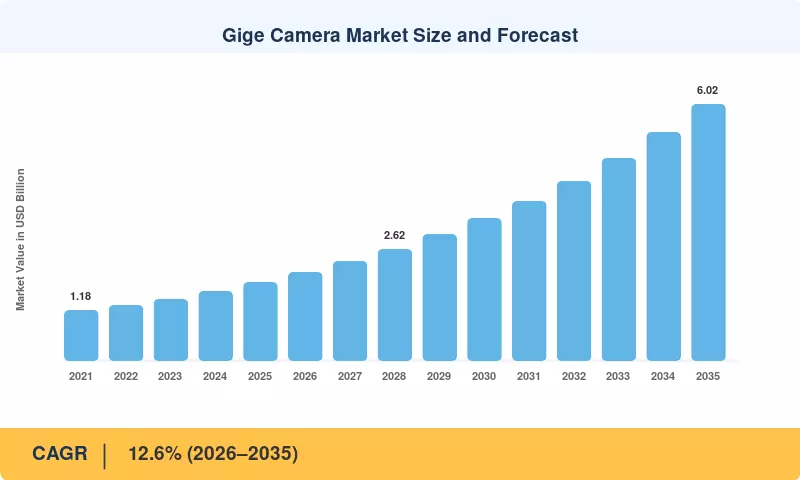
The GigE Camera Market was valued at USD 1.84 billion in 2025 and is projected to reach USD 2.07 billion in 2026, rising to USD 6.02 billion by 2035 at a CAGR of 12.6% over 2026–2035. Two catalysts anchor this outlook. The U.S. CHIPS and Science Act set aside USD 39 billion in manufacturing incentives that are now pulling new wafer fabs and packaging lines into service [4]. Global robot installations reached 541,302 units in 2023 [3], and most of those cells ship with at least one networked camera for guidance or inspection.
Technology substitution is reshaping the installed base. Analog cameras and Camera Link setups that depended on dedicated frame grabbers are giving way to Ethernet-connected units that stream uncompressed images over standard network cards and cables up to 100 metres long [1]. Buyers replacing legacy machine vision cameras now standardise on GenICam-compliant interfaces [2] and global-shutter CMOS sensors such as Sony's Pregius S family [19]. Europe's Chips Act, which targets more than €43 billion in public and private investment [5], adds a second large funding pool behind this refresh.
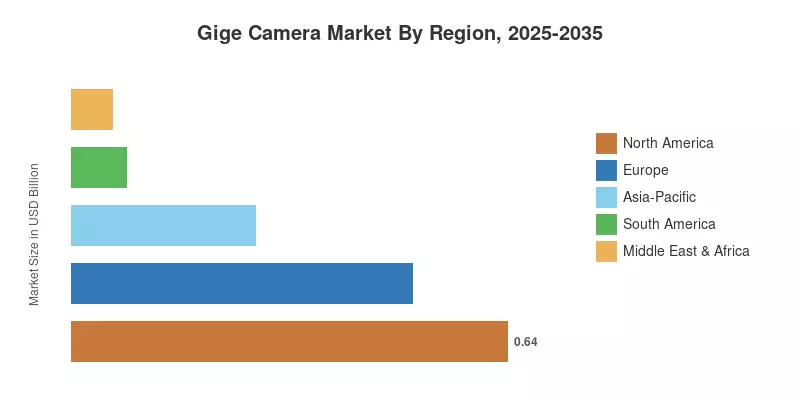
Regionally, North America leads with a 34.8% share in 2025, supported by fab construction and automotive retooling. Asia-Pacific is the fastest-growing region at a 14.9% CAGR and already ranks second in size, driven by China's 276,288 robot installations in 2023 [3] and India's semiconductor programme [12]. Europe follows with USD 0.50 billion in 2025, anchored by German machine builders. Over the next decade, the GigE Camera Market will be shaped less by raw sensor resolution and more by how efficiently cameras feed AI models at the network edge.
Key Report Takeaways
• By Technology
- Complementary Metal- Oxide - Semiconductor (CMOS) sensors hold a 79.4% share (2025) of the GigE Camera Market, helped by global-shutter designs that match CCD image quality at lower power.
- Charge Coupled Device (CCD) units generated USD 0.38 B in 2025, sustained mainly by scientific users and like-for-like replacements.
• By Type
- Area Scan cameras account for a 68.5% share (2025), reflecting their role in robot guidance and assembly verification.
- Line Scan cameras are set to grow at a 14.1% CAGR (2026–2035) as battery electrode and web inspection lines multiply.
• By Colour Sensor Type
- Monochrome sensors lead with a 57.2% share (2025), preferred for gauging and code reading where contrast matters more than hue.
- Colour sensors are forecast to expand at a 14.4% CAGR (2026–2035), led by food sorting and medical imaging.
• By End-user Vertical
- Industrial users represent a 52.6% share (2025) of the GigE Camera Market, spanning automotive, electronics, and logistics.
- Medical / Life Sciences is the fastest-growing vertical at a 15.3% CAGR (2026–2035).
- Traffic, Security & Surveillance contributed USD 0.24 B in 2025.
• By Region
- North America holds a 34.8% share (2025), the largest of any region.
- Asia-Pacific leads growth at a 14.9% CAGR (2026–2035).
- Europe generated USD 0.50 B in 2025.
Market Size and Forecast (2021–2035)
Estimates for the GigE Camera Market combine vendor revenue mapping across more than 40 camera manufacturers, shipment data from industry associations, and primary interviews with system integrators, distributors, and end users. Historical values were reconciled against company filings [16][17][18] and robot installation data [3], then projected using bottom-up demand modelling by vertical and region.
Driver Impact Analysis
| Driver |
~% Impact on CAGR |
Geographic Relevance |
Impact Timeline |
Ref |
| Factory Automation and Robot Density |
~+2.4% |
Global; strongest in Asia-Pacific |
Medium-term (2–4 yr) |
[3] |
| Semiconductor and Electronics Fab Buildout |
~+2.1% |
North America, Asia-Pacific, Europe |
Long-term (≥4 yr) |
[4][5][7] |
| EV Battery Gigafactory Inspection |
~+1.8% |
Asia-Pacific, Europe, North America |
Medium-term (2–4 yr) |
[6] |
|
Edge AI Inspection |
~+1.6% |
Global |
Long-term (≥4 yr) |
|
| Multi-Gigabit Ethernet and PoE Adoption |
~+1.5% |
Global |
Short-term (≤2 yr) |
[1][14] |
| Pharmaceutical Serialization Mandates |
~+1.2% |
North America, Europe |
Short-term (≤2 yr) |
[8] |
Factory Automation and Robot Density
Robot installations remain the most direct pull on camera volumes. The International Federation of Robotics counted 541,302 new industrial robots in 2023, lifting the operational stock above 4.2 million units [3]. Vision-guided picking, bin picking, and weld-seam tracking each add at least one networked camera per cell. GigE fits these layouts well because a single managed switch can aggregate dozens of devices spread across a production hall, with automotive, electronics, and metal fabrication generating most of the demand.
Semiconductor and Electronics Fab Buildout
SEMI reports that global semiconductor equipment sales reached USD 117.1 billion in 2024 [7], while U.S. CHIPS awards now back projects from Intel, TSMC, Samsung, and Micron [4]. Wafer handling, die bonding, and PCB assembly lines use area scan cameras for alignment and line scan units for substrate inspection. Europe's €43 billion Chips Act [5] extends the same pull to German and Italian fab and packaging projects, keeping orders elevated well beyond the current construction wave.
EV Battery Gigafactory Inspection
Electric car sales approached 14 million in 2023, around 18% of all new cars sold, according to the IEA [6]. Each gigafactory requires electrode coating inspection, separator defect detection, and cell stacking verification. Those tasks favour high-line-rate cameras connected over 5GigE or 10GigE links. Chinese, Korean, and European cell makers now specify hundreds of cameras per production line, making battery manufacturing one of the fastest-scaling application clusters in the forecast.
Edge AI Inspection
Deep-learning defect classifiers increasingly run on industrial PCs and embedded GPUs placed beside the line. These models need clean, uncompressed image streams for both training and inference, which plays directly to GigE's raw-data transport. Market Research Future estimates that AI-based inspection stations specify about 1.4 times more cameras than rule-based systems, because multiple viewing angles improve classification accuracy. Vendors including Basler and Teledyne have bundled AI-ready software with their camera lines [17][18].
Multi-Gigabit Ethernet and PoE Adoption
Revisions to the GigE Vision standard support 2.5, 5, and 10 Gb/s links while preserving the 100-metre cable reach that differentiates the interface [1]. IEEE 802.3bt extends Power over Ethernet to as much as 90 W at the source [14], enough to drive cameras with integrated lighting or enclosure heaters. Single-cable installation lowers wiring cost per node by an estimated 20–30% compared with separate power and trigger runs.
Pharmaceutical Serialization Mandates
The U.S. Drug Supply Chain Security Act moved into enhanced electronic traceability in November 2024, with phased exemptions for smaller trading partners extending into 2025 and 2026 [8]. Every packaging line needs cameras to verify 2D DataMatrix codes, lot numbers, and expiry dates at speeds above 400 units per minute. Europe's Falsified Medicines Directive already requires unique identifiers on prescription packs, so upgrade and replacement cycles keep pharmaceutical demand steady.
Restraints Impact Analysis
The restraint impacts below are directional estimates of downward pressure on the GigE Camera Market CAGR. Like the drivers, they interact and are not designed to be added together.
| Restraint |
~% Impact on CAGR |
Geographic Relevance |
Impact Timeline |
Ref |
| Host CPU Load and Latency |
~−0.9% |
Global |
Short-term (≤2 yr) |
[1] |
| Competition from CoaXPress and USB3 Vision |
~−0.8% |
Global |
Medium-term (2–4 yr) |
[15] |
| Price Erosion from Low-Cost Vendors |
~−0.7% |
Global |
Medium-term (2–4 yr) |
[13] |
| Cybersecurity Compliance Costs |
~−0.6% |
Europe, North America |
Medium-term (2–4 yr) |
[10][11] |
| Semiconductor Supply and Export Controls |
~−0.5% |
Asia-Pacific, North America |
Short-term (≤2 yr) |
[23] |
Host CPU Load and Latency
Uncompressed streams at 10 Gb/s can consume a full processor core just to handle packet interrupts, and every dropped packet triggers resend requests that add latency [1]. Users often need performance-tuned network cards or filter drivers, adding an estimated USD 300–800 per inspection station. These overheads push some ultra-fast applications toward frame-grabber interfaces instead.
Competition from CoaXPress and USB3 Vision
CoaXPress 2.0 delivers 12.5 Gb/s per coaxial lane and scales to 50 Gb/s across four lanes [15], outclassing most GigE links for the fastest work. USB3 Vision offers a cheaper plug-and-play route for single-camera benchtop systems. GigE vendors therefore face pressure at both ends of the performance range, particularly in semiconductor metrology and laboratory automation.
Price Erosion from Low-Cost Vendors
Chinese suppliers’ entry-level 1GigE area scan machines are up to 25-40% cheaper than major European manufacturers. This trend is reinforced domestically by sourcing preferences under China’s robot industry development plan [13] and spills over to overseas markets. The outcome is consistent compression of average selling prices and margins across the mid-range.
Cybersecurity Compliance Costs
Regulation (EU) 2024/2847, the Cyber Resilience Act, requires vulnerability handling and security updates for networked products, with fines of up to €15 million or 2.5% of global turnover [10]. Combined with IEC 62443 expectations from plant operators [11], this adds firmware signing, penetration testing, and documentation costs that weigh hardest on smaller camera makers.
Semiconductor Supply and Export Controls
During the 2021–2022 chip shortage, lead times for image sensors and FPGAs stretched past 40 weeks for some models. U.S. export rules updated in October 2023 for advanced computing and semiconductor tools [23] add licensing uncertainty for vendors serving Chinese fabs. That uncertainty can delay shipments tied to restricted end users.
Gige Camera Market Opportunities
Emerging-Market Manufacturing Hubs
India's ₹76,000 crore Semicon India programme [12], Mexico's nearshoring wave, and Saudi Arabia's plan to reach 36,000 factories by 2035 [22] are creating greenfield plants with no legacy interface lock-in. New sites can standardise on multi-gigabit Ethernet from day one, giving GigE suppliers with local distribution a clear opening.
RDMA-Enabled High-Throughput Systems
Remote direct memory access lets camera data land in host memory without CPU involvement, directly addressing the processing bottleneck described in Section 5 [1]. Vendors that ship RDMA-capable 10GigE and 25GigE models can win sockets previously lost to CoaXPress in display panel and wafer inspection.
Inspection-as-a-Service and Data Monetization
Integrators are packaging cameras, lighting, AI software, and analytics dashboards into monthly subscriptions priced per inspection line. This model converts one-off hardware sales into recurring revenue and gives vendors defect data that improves model training across customers. Firms with strong software stacks are best placed to capture it.
Medical and Life-Science Imaging
Digital pathology scanners, ophthalmic devices, and laboratory automation increasingly use colour GigE cameras because long cables let imaging heads sit away from sterile zones. This application cluster underpins the fastest vertical growth rate in the forecast.
Intelligent Transportation and Smart Cities
Tolling, licence-plate recognition, and rail track inspection need ruggedised cameras spread over long distances, a natural fit for PoE-powered Ethernet devices. Public infrastructure budgets in the Gulf and Asia-Pacific provide multi-year procurement pipelines.
Gige Camera Market Future Outlook
Edge AI Becomes the Default Inspection Architecture
According to World Bank data [21], the value generated by global manufacturing is over USD 16 trillion per year, with an increasing share of that production likely to pass AI-based quality checks by 2035. Spending on computer vision hardware is changing from smart cameras with set rules to networked sensors feeding shared GPU servers on the shop floor. That architecture favors interfaces that cheaply move raw images over long distances, which favors Ethernet over point-to-point connectivity.
Multi-Gigabit Ethernet and RDMA Convergence
RDMA-enabled 10GigE and 25GigE lines are likely to cover most new high-throughput installations by the early 2030s [1]. With the decreasing price of network cards with hardware offload, the CPU-load constraint described in Section 5 should disappear. By adopting the latest improvements to GigE Vision, camera producers will take business away from frame-grabber interfaces in mid-speed applications.
Semiconductor and Battery Capacity Supercycle
The IEA forecasts that given specified policies, electric vehicles might make up around half of new car sales by 2035 [6], which would suggest ongoing gigafactory building. Semiconductor equipment investment, currently exceeding USD 117 billion in 2024 [7], is expected to stay high as the US, Europe, Japan and India subsidize local capacity. Both sectors are camera-intensive and inspection-crucial.
Cybersecurity and Product Lifecycle Accountability
The reporting responsibilities under the Cyber Resilience Act will be effective from September 2026, with full requirements applicable from December 2027 [10]. Vendors will have to provide secure boot, signed firmware and commitments to multi-year patching, making cybersecurity a procurement requirement and not an afterthought. Early certification to IEC 62443 component standards [11] will be a great advantage to suppliers in regulated plants.
Regional Market Share Analysis
| Region |
Key Metric |
Primary Investment Themes |
| North America |
34.8% share (2025) |
CHIPS-funded fabs, automotive retooling, pharma traceability |
| Europe |
USD 0.50 B (2025) |
Machine building, Machinery Regulation compliance, Chips Act |
| Asia-Pacific |
14.9% CAGR (2026–2035) |
Robot density, battery gigafactories, electronics assembly |
| South America |
4.6% share (2025) |
Nearshoring, food and agri sorting, automotive plants |
| Middle East & Africa |
USD 0.06 B (2025) |
Industrial diversification, smart city and tolling projects |
| Total |
USD 1.84 B (2025) |
— |
Regional demand in the GigE Camera Market tracks where fabs, gigafactories, and automated plants are being built. North America leads on value, while Asia-Pacific leads on growth.
North America
| Country |
Key Metric |
Key Driver |
| US |
81.0% share of region (2025) |
Fab construction and pharmaceutical serialization |
| Canada |
11.2% CAGR (2026–2035) |
Automotive and food processing automation |
| Mexico |
USD 0.05 B (2025) |
Nearshored electronics and auto parts plants |
America's fab pipeline is the region's core engine. Finalised CHIPS awards include up to USD 6.6 billion for TSMC Arizona and USD 7.86 billion for Intel [4], each requiring thousands of cameras for wafer handling and back-end inspection. DSCSA traceability rules [8] keep pharmaceutical packaging lines upgrading, while Mexico's maquiladora sector is adding camera-dense electronics and EV component capacity under USMCA sourcing rules.
Europe
| Country |
Key Metric |
Key Driver |
| Germany |
31.0% share of region (2025) |
Machine builders and automotive OEMs |
| UK |
USD 0.06 B (2025) |
Food, pharma, and logistics automation |
| France |
11.4% CAGR (2026–2035) |
France 2030 industrial investment plan |
| Italy |
9.0% share of region (2025) |
Packaging machinery exports |
| Spain |
USD 0.03 B (2025) |
Automotive assembly and agri-food sorting |
| Nordic Countries |
10.9% CAGR (2026–2035) |
Battery and forestry product inspection |
| Russia |
3.0% share of region (2025) |
Domestic substitution under trade restrictions |
| Rest of Europe |
USD 0.08 B (2025) |
Central European auto supply chains |
Germany anchors European demand through its machine-building base, which the VDMA identifies as the world's largest exporter of vision-equipped production systems [20]. The Machinery Regulation, applicable from January 2027 [9], tightens safety requirements for autonomous and AI-enabled machinery and is prompting OEMs to redesign vision subsystems. TSMC's ESMC fab in Dresden and France's €54 billion France 2030 programme add semiconductor and industrial pull.
Asia-Pacific
| Country |
Key Metric |
Key Driver |
| China |
46.0% share of region (2025) |
Robot installations and battery gigafactories |
| India |
17.8% CAGR (2026–2035) |
Semicon India programme and electronics assembly |
| Japan |
USD 0.11 B (2025) |
Fab subsidies and precision manufacturing |
| South Korea |
14.2% CAGR (2026–2035) |
Memory fabs and battery cell production |
| ASEAN |
USD 0.04 B (2025) |
Electronics relocation to Vietnam, Malaysia, Thailand |
| Rest of Asia-Pacific |
5.0% share of region (2025) |
Australian mining and food processing |
China installed 276,288 industrial robots in 2023, more than half the global total [3], and its robot industry plan targets doubling manufacturing robot density [13]. India approved the Tata Electronics–PSMC fab at Dholera in February 2024 with an outlay of ₹91,000 crore [12]. Japan's subsidy of up to ¥476 billion for TSMC's Kumamoto JASM fab and Korea's semiconductor cluster investments sustain demand for high-resolution inspection.
South America
| Country |
Key Metric |
Key Driver |
| Brazil |
52.0% share of region (2025) |
Nova Indústria Brasil industrial policy |
| Argentina |
USD 0.01 B (2025) |
Agricultural grading and food export lines |
| Rest of South America |
11.8% CAGR (2026–2035) |
Chilean mining and Colombian packaging |
Brazil's Nova Indústria Brasil policy, launched in January 2024, earmarks about R$300 billion in financing for industrial modernisation through 2026, with automation and digitalisation among its priority missions [21]. Automotive plants in São Paulo and Minas Gerais are upgrading weld and paint inspection, while Argentine grain and fruit exporters adopt colour sorting cameras to meet export grading standards.
Middle East & Africa
| Country |
Key Metric |
Key Driver |
| Saudi Arabia |
13.2% CAGR (2026–2035) |
National Industrial Strategy factory targets |
| UAE |
USD 12 M (2025) |
Operation 300bn and smart mobility projects |
| South Africa |
21.0% share of region (2025) |
Automotive export plants |
| Egypt |
12.4% CAGR (2026–2035) |
Pharmaceutical and food manufacturing growth |
| Rest of MEA |
USD 18 M (2025) |
Mining and port automation |
Saudi Arabia's National Industrial Strategy aims to raise the number of factories to about 36,000 by 2035 [22], creating greenfield demand for inspection systems. The UAE's Operation 300bn targets AED 300 billion in industrial GDP by 2031, and smart tolling and rail projects across the Gulf favour PoE-powered roadside cameras. South Africa's vehicle export plants remain the largest installed base in sub-Saharan Africa.
Gige Camera Market Segmentation
By Technology
| Segment |
Key Metric |
Primary Demand Driver |
| Charge Coupled Device (CCD) |
USD 0.38 B (2025) |
Scientific imaging and legacy line replacements |
| Complementary Metal- Oxide - Semiconductor (CMOS) |
79.4% share (2025) |
Global-shutter performance at lower cost and power |
Within the GigE Camera Market, Complementary Metal- Oxide - Semiconductor (CMOS) technology dominates with a 79.4% share and is also the only expanding technology, as global-shutter designs now match CCD sensitivity at higher frame rates [19]. Charge-Coupled Device (CCD) revenue of USD 0.38 billion comes largely from scientific users and plants maintaining validated legacy lines. Several sensor makers have ended CCD production, so this segment will keep shrinking as remaining stock is replaced.
By Type
| Segment |
Key Metric |
Primary Demand Driver |
| Area Scan |
68.5% share (2025) |
Robot guidance, assembly verification, code reading |
| Line Scan |
14.1% CAGR (2026–2035) |
Battery electrode, web, and wafer inspection |
Area Scan cameras lead the GigE Camera Market by type with a 68.5% share, because nearly every robot cell and packaging line needs a two-dimensional snapshot for positioning or verification. Line Scan is the fastest-growing type at a 14.1% CAGR. Continuous materials such as battery electrodes, films, glass, and printed substrates require uninterrupted imaging at high line rates, and gigafactory buildout is multiplying these installations across Asia-Pacific and Europe [6].
By Colour Sensor Type
| Segment |
Key Metric |
Primary Demand Driver |
| Monochrome |
57.2% share (2025) |
Gauging, OCR, and high-contrast defect detection |
| Colour |
14.4% CAGR (2026–2035) |
Food sorting, medical imaging, AI classification |
Monochrome sensors account for a 57.2% share of the GigE Camera Market by colour sensor type, since they capture more light per pixel and deliver sharper edges for measurement and code reading. Colour sensors grow faster at a 14.4% CAGR. Food graders, pharmaceutical tablet inspectors, and digital pathology systems need accurate hue data, and deep-learning classifiers often perform better with colour input when distinguishing subtle surface defects.
By End-user Vertical
| Segment |
Key Metric |
Primary Demand Driver |
| Industrial |
52.6% share (2025) |
Automotive, electronics, battery, and logistics automation |
| Medical / Life Sciences |
15.3% CAGR (2026–2035) |
Digital pathology, ophthalmology, lab automation |
| Traffic, Security & Surveillance |
USD 0.24 B (2025) |
Tolling, licence-plate recognition, rail inspection |
| Pharmaceutical |
8.1% share (2025) |
Serialization and packaging verification |
| Military and Defense |
11.7% CAGR (2026–2035) |
Targeting, surveillance, and test-range imaging |
| Other End-user Verticals |
USD 0.12 B (2025) |
Agriculture, recycling, scientific research |
Industrial users dominate the GigE Camera Market by vertical with a 52.6% share, driven by robot cells, fab tooling, and battery lines. Medical / Life Sciences is the fastest-growing vertical at a 15.3% CAGR, as hospitals digitise pathology and labs automate sample handling. Traffic, Security & Surveillance contributed USD 0.24 billion, while Pharmaceutical holds an 8.1% share tied to DSCSA compliance [8], and Military and Defense grows at an 11.7% CAGR.
Competitive Benchmarking
The GigE Camera Market remains fragmented, with an estimated Herfindahl-Hirschman Index of roughly 450–600 and a top-five combined share of about 38–45%. European and Japanese brands lead in premium segments, while Chinese manufacturers compete aggressively on price in entry-level area scan models. Competition increasingly centres on software ecosystems, multi-gigabit portfolios, and cybersecurity readiness rather than sensor specifications alone.
| Company |
Est. Revenue Share Range |
Key Offerings for Gige Camera Market |
Strategic Positioning |
| Basler AG |
~10–13% |
ace 2, boost, and racer 2 GigE/5GigE/10GigE families |
Volume leader in mid-range industrial cameras with pylon software [17] |
| Teledyne Technologies (Teledyne DALSA, Teledyne FLIR) |
~9–12% |
Genie Nano, Linea GigE line scan, Blackfly S |
Broadest portfolio spanning area scan, line scan, and thermal [18] |
| Cognex Corporation |
~6–9% |
In-Sight smart cameras, deep-learning vision software |
Software-led integration; expanded optics via Moritex [16] |
| Sony Corporation |
~5–8% |
XCG-series GigE modules, Pregius S sensors |
Vertical integration from sensor to camera [19] |
| Hikrobot Co., Ltd. |
~5–8% |
MV-CA and MV-CH GigE series |
Price-competitive scale leader in China |
| Allied Vision Technologies (TKH Group) |
~4–7% |
Alvium G1/G5, Mako, Prosilica GT |
Rugged and embedded designs for OEM integration |
| Baumer Group |
~3–5% |
CX and LX series GigE cameras |
Precision and harsh-environment models |
| JAI A/S |
~2–4% |
Go-X, Spark, Fusion prism cameras |
Multi-spectral and prism-based colour imaging |
| IDS Imaging Development Systems |
~2–4% |
uEye+ GigE, uEye Warp10 |
AI-ready IDS NXT platform and 10GigE speed |
| Omron Corporation |
~2–4% |
Sentech STC-series GigE cameras |
Bundling cameras with Omron automation controllers |
Recent News & Developments
- European Union (June 2023): Published the Machinery Regulation (EU) 2023/1230, applicable from January 2027, which sets new safety rules for AI-enabled machinery and pushes OEMs to redesign vision subsystems. [9]
- U.S. FDA (August 2023): Announced a one-year stabilization period for DSCSA enhanced traceability, giving packaging lines until November 2024 to finalise serialization inspection upgrades. [8]
- Government of India (February 2024): Approved the Tata Electronics–PSMC fab at Dholera with an outlay of ₹91,000 crore, opening a large new domestic inspection market. [12]
- International Federation of Robotics (September 2024): Reported 541,302 industrial robot installations for 2023, confirming sustained demand for vision-guided automation. [3]
- U.S. Department of Commerce (November 2024): Finalised CHIPS awards of up to USD 6.6 billion for TSMC Arizona and USD 7.86 billion for Intel, locking in multi-year fab tooling demand. [4]
- European Union (November 2024): Published the Cyber Resilience Act as Regulation (EU) 2024/2847, setting security obligations for networked cameras sold in the EU. [10]




 Noah Malgeri
Co-Founder

 Peter Groot koerkamp
Account and Business Manager

 Younghwan Choi
Senior Retail Manager

 Mark Irwin
Management Consultant

 Akif Moroglu
Strategy & Business Development Director

 Guilherme Gomes Martins
Product Management Director

 Joseph Aguayo
Sales Operations & Pricing Manager

 La Terria Dodd
Program Support Specialist

 Rob Kooiker
Group Product Manager HVAC & Fire Protection GMA


