Increased Demand for Personalization to Augment the Global Furniture Market
Evolution of Technology Fuels Innovation in the Furniture Industry
With the rising demand for personalized and customizable interiors of houses, the scope of the global furniture market is likely to increase. The sector promises growth from USD 540.17 billion to USD 700 billion from 2024 to 2035. This advancement, however, is likely to occur at an extremely sluggish CAGR of 2.39% through the forecast period.
Furniture is an essential part of any place, whether it is office furniture, home furniture, or outdoor furniture. But the most important thing is the production of the furniture used in different places. The quality of the wood used plays a vital role in enhancing the superiority and quality of furniture.
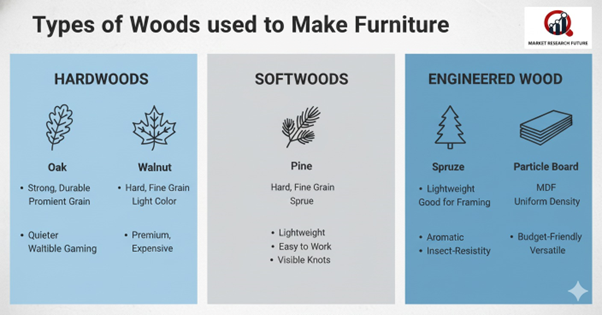
Hence, here is a list of woods that are used to make furniture. Do check it out to know about these types before purchasing any furniture product:-
- Basswood: Frequently used in combination with rare woods such as walnut, maple, or mahogany, basswood is a common hardwood. It has colour variants that range from creamy-white to creamy brownish or reddish. The texture of this wood has broad rays and sometimes slightly darker streaks, too. Being light and soft, it becomes easy to carve mouldings and appliques. Lines that naturally appear on the wood are straight and even. Basswood is close-grained, with very small pores. It is not very expensive.
- Sycamore: Used extensively for making affordable furniture and veneers, this hardwood is split-resistant. Hence, it is considered to be the favorite wood for butcher blocks. This wood is available in various shades ranging from pinkish to reddish-brown in colour. With remarkably closely spaced rays, the pattern of grains is highly defined. It is moderately easy to work with hand tools and is available at a reasonable price.
- Cedar (Eastern red cedar): Cedar is a softwood that is primarily used to make chests and closets. It has a unique scent and is effective as a bug repellent. The wood comes in a light red shade with light streaks and knots. Its grain is quite remarkable. It is close-grained and does not need to be bleached or stained. It is naturally weather-resistant and is an ideal option for making outdoor furniture. It can also be used for fencing or an exterior sound barrier. Having top qualities makes it an expensive wood.
- Oak (red oak, white oak): With its attractive grain structure, this abundant hardwood has always been valued for its quality and strength. It is widely used for making solid furniture, and, in modern furniture, it is mainly used for veneers. Its colour shade of white oak is counted among the rich greyish brown colour. Besides, the red oak is also considered similar, but with a prominent reddish cast. Both types of oak are finely grained, with definite rays or streaks. Further, the wood is open-grained and is moderately higher in price. But as compared to the white oak, the red oak is less expensive.
- Butternut: Often called white walnut, this hardwood is similar to walnuts in many ways. The light brown shade of the wood, along with occasional dark or reddish streaks, makes it look very eye-catching. The grain is distinct and leafy. Butternut has a coarse texture with visibly open pores that are usually filled. Further, the Butternut has a well-staining feature and is often stained to look like dark walnut. The wood is light and is easy to work with hand tools. On average, it is higher in price.
Do consider this list of types of wood when you are all set to buy any furniture. This will help you get the knowledge of the features some wood has.
Regional Analysis
The growing construction industry in the Asia-Pacific region is responsible for the rising demand for furniture in the region. Leading players of the furniture market, therefore, get better prospects in the region.
Technological advancements in North America yield better prospects for firms active in the furniture industry to innovate and cater to the rising demand for personalization and customization, driving the growth of the ecosystem.
Related Report


Leave a Comment