Top Uses of Doppler Radar
Doppler Radar Market Overview
Doppler radar, a sophisticated type of radar technology, is widely used to determine the speed, movement, and direction of objects. It works on the principle of the Doppler Effect, which measures the frequency change of radio waves as they bounce off moving targets. This technology provides precise, real-time data on an object’s velocity and position, making it indispensable across multiple domains such as meteorology, navigation, healthcare, Défense, and astronomy.
From tracking weather patterns and predicting storms to diagnosing vascular diseases and improving navigation systems, Doppler radar has transformed modern monitoring and detection capabilities. Its ability to provide accurate velocity measurements and dynamic situational awareness has positioned it as a critical innovation in both civil and military applications.
Understanding Doppler Radar
Doppler radar operates by transmitting a microwave or radio wave toward a target and then measuring the change in frequency of the reflected signal. The frequency shift, known as the Doppler shift, helps determine whether the object is moving toward or away from the radar and at what speed.
The technology’s ability to distinguish between stationary and moving targets makes it invaluable for a range of industries—from aviation safety and weather prediction to medical diagnostics and space observation.
Key Applications of Doppler Radar
1. Navigation and Transportation
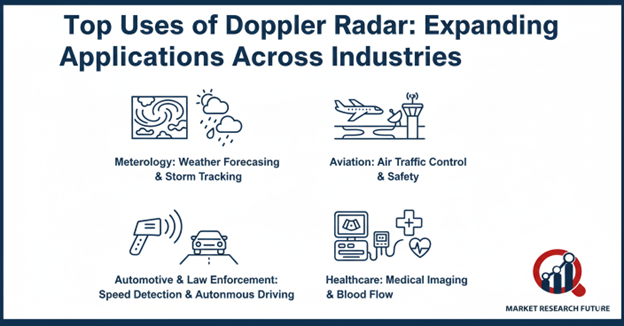
Doppler radar plays a pivotal role in modern navigation systems, especially in aviation, marine, and automotive sectors.
- It helps calculate the speed and movement of vehicles using frequency shifts in reflected signals.
- In marine navigation, Doppler radar assists in determining the position and velocity of ships relative to the sea surface, enhancing navigational accuracy.
- Aviation systems rely on it for airspeed measurement, terrain mapping, and collision avoidance.
- In traffic management, Doppler radar is used in speed guns and surveillance systems to monitor vehicle speeds and ensure road safety.
2. Healthcare and Medical Diagnostics
The Doppler Effect has revolutionized medical imaging and diagnostics, offering a non-invasive way to evaluate blood flow and cardiac activity.
- Doppler ultrasound is widely used to measure blood velocity in arteries and veins.
- In echocardiography, it helps assess heart valve function and detect blockages or abnormalities.
- The technology provides valuable insights into vascular disorders, helping doctors detect conditions such as deep vein thrombosis, arterial stenosis, or poor circulation.
- Doppler-based imaging enables real-time analysis of cardiovascular health, improving diagnostic accuracy and patient outcomes.
3. Meteorology and Weather Forecasting
One of the most prominent uses of Doppler radar lies in meteorology.
- It detects precipitation intensity, wind velocity, and storm movement by analysing frequency shifts in radio waves reflected off raindrops and snowflakes.
- Doppler radar helps meteorologists track severe weather events such as tornadoes, hurricanes, and thunderstorms with remarkable precision.
- It plays a crucial role in early warning systems, enabling timely alerts to minimize the impact of natural disasters.
- Modern dual-polarization Doppler radars further enhance accuracy by differentiating between types of precipitation, such as rain, hail, and snow.
4. Military and Défense Applications
In Défense and security operations, Doppler radar serves as a strategic detection and surveillance tool.
- It is used to detect moving targets such as aircraft, drones, and submarines by analysing reflected frequency shifts.
- Sonar Doppler systems in naval operations identify underwater objects and estimate their speed and direction.
- Doppler radar also assists in missile guidance, battlefield surveillance, and air Défense systems, ensuring tactical advantage and precision.
- The technology’s reliability in adverse conditions makes it a cornerstone of modern military radar systems.
5. Radiology and Imaging
In radiology, Doppler radar principles are applied to produce velocity and motion data about internal body structures.
- It enhances medical imaging by providing insights into tissue movement and fluid dynamics.
- This technology supports diagnostic applications that rely on motion-based imaging, complementing X-ray and MRI technologies for comprehensive assessments.
6. Astronomy and Space Exploration
In the field of astronomy, Doppler radar is an essential tool for understanding celestial motion.
- Pulse-Doppler radar systems help astronomers map the surfaces of planets, asteroids, and moons.
- It aids in radar astronomy, where scientists study celestial bodies by observing radar wave reflections.
- Doppler measurements are also used to determine the speed and rotation of stars, galaxies, and binary systems.
- Additionally, air traffic control and space monitoring systems use Doppler radar to track satellites and spacecraft for safety and positioning accuracy.
Market Outlook and Growth Drivers
The global Doppler radar market is witnessing steady growth due to increasing demand in weather monitoring, Défense systems, and healthcare diagnostics. Key growth drivers include:
- Technological advancements in radar sensors and signal processing.
- Rising need for real-time monitoring in meteorology and disaster management.
- Expansion of smart transportation systems and air traffic control solutions.
- Increased healthcare applications for non-invasive vascular diagnostics.
Emerging trends such as compact radar modules, AI-driven data analytics, and integrated sensor technologies are expected to drive innovation and adoption across new domains.
Conclusion
Doppler radar stands as one of the most versatile and impactful innovations in modern technology. Its wide-ranging applications—from predicting weather patterns and improving navigation accuracy to advancing medical imaging and enhancing Défense capabilities—underscore its indispensable role in multiple industries. As advancements in radar technology continue to accelerate, the scope and precision of Doppler radar will expand, contributing to greater safety, operational efficiency, and scientific discovery worldwide.
Related Report


Leave a Comment