Specialty Chemicals – Wide Application Performance Chemicals
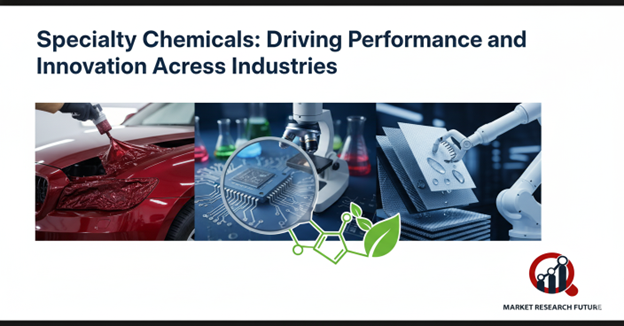
Specialty Chemicals Market Overview
Specialty chemicals—often termed performance or formulation chemicals—are a cornerstone of modern industrial innovation. Unlike commodity chemicals, which are produced in large volumes for general use, specialty chemicals are formulated for specific functions and end-use applications. These products form the foundation of multiple industries, including automotive, aerospace, agriculture, construction, cosmetics, food processing, and textiles, where they enhance product performance, quality, and efficiency.
As industries worldwide strive for higher performance standards, environmental sustainability, and product differentiation, the role of specialty chemicals has become increasingly vital. They are no longer viewed as simple inputs but as enablers of technological progress—delivering targeted properties such as adhesion, elasticity, lubrication, conductivity, and resistance to wear or corrosion.
What Are Specialty Chemicals?
Specialty chemicals are high-value, low-volume chemical products designed to provide specific effects or performance characteristics. These may be unique molecules or carefully engineered formulations. Their value lies not in the quantity produced but in the function they deliver.
Some of the key categories of specialty chemicals include:
- Agricultural chemicals (fertilizers, crop protection)
- Adhesives and sealants
- Surfactants and cleaning agents
- Polymers and elastomers
- Cosmetic and food additives
- Industrial gases and lubricants
- Paints, coatings, and construction chemicals
- Fragrances and flavors
The chemical composition and molecular structure of these products determine how they perform in their intended application—whether it’s improving crop yield, extending product life, or enhancing consumer experience.
Shifting Industry Dynamics
The specialty chemicals industry has evolved from being product-centric to service- and solution-oriented. Many leading manufacturers are strengthening their competitive edge by providing customized technical support, application guidance, and after-sales services alongside chemical products.
For example, in segments like pharmaceutical ingredients, water treatment, and automotive coatings, companies are focusing on integrated solutions rather than just chemical supply. This service-driven model creates customer loyalty and erects barriers for new entrants, ensuring sustained market leadership.
Moreover, digital transformation and data analytics are reshaping the landscape, enabling real-time monitoring of chemical performance, predictive maintenance, and efficient process optimization.
Market Insights
The global specialty chemicals market is projected to expand at a healthy rate from 2020 to 2028. The growing demand for high-performance, function-specific chemicals in industries such as oil & gas, pulp & paper, construction, personal care, and automotive is a key growth driver.
As consumer preferences shift toward eco-friendly and high-quality products, R&D innovation and formulation customization have become critical. Manufacturers are investing heavily in sustainable chemistry, renewable raw materials, and bio-based ingredients to meet both regulatory standards and customer expectations.
Key Market Growth Drivers
- Performance-Based Demand:
Specialty chemicals are tailored to enhance the efficiency, durability, and appearance of end-use products, fuelling their demand across high-performance industries.
- Innovation and R&D Investment:
Continuous research into molecular design, process optimization, and green chemistry drives product differentiation and market expansion.
- Sustainability and Environmental Concerns:
The global shift toward safer, environmentally friendly formulations is transforming the market. Companies are focusing on low-VOC coatings, biodegradable surfactants, and bio-based polymers.
- Customization and Client Collaboration:
Manufacturers increasingly co-develop solutions with end users to deliver tailored performance chemicals for specific applications.
- Emerging Market Growth:
Rapid industrialization in Asia-Pacific, the Middle East, and Latin America is fueling demand for specialty chemicals across construction, manufacturing, and consumer goods sectors.
Challenges
Despite its strong growth trajectory, the specialty chemicals market faces notable challenges:
- High Production Costs: Premium raw materials and advanced manufacturing processes increase production expenses.
- Commoditization Pressure: Overlapping formulations and market saturation can blur product differentiation.
- Regulatory Complexity: Environmental and safety regulations differ across regions, affecting production and export strategies.
- Supply Chain Vulnerability: Global disruptions impact availability and consistency of specialty chemical inputs.
Overcoming these challenges will require a focus on innovation, digital integration, and strategic partnerships to maintain competitiveness and ensure sustainable growth.
Regional Insights
- North America: The U.S. remains a key consumer, particularly in biocides, lubricants, surfactants, and specialty coatings, supported by advanced manufacturing and stringent quality standards.
- Europe: The region’s mature market benefits from strong regulatory frameworks, green chemistry initiatives, and innovation in flavors, fragrances, and cleaning agents.
- Asia-Pacific: China leads in construction, electronics, and textile chemicals, while India and Japan show strong demand for pharma ingredients, agrochemicals, and polymers.
- Latin America: Countries like Brazil and Mexico are witnessing steady growth driven by agricultural and industrial expansion.
- Middle East & Africa: Emerging opportunities in construction, water management, and oilfield chemicals are driving regional market development.
Future Outlook
The specialty chemicals market is entering a new era defined by innovation, sustainability, and digital transformation. As industries pivot toward eco-efficient production and smart manufacturing, demand for customized performance chemicals will continue to rise.
Future growth will be shaped by:
- Expansion of bio-based and recyclable materials
- Integration of AI and predictive analytics in formulation design
- Greater focus on circular economy principles
- Collaboration between chemical manufacturers and end-use industries to co-create value
With continuous R&D investment and a commitment to responsible chemistry, specialty chemicals will remain the backbone of industrial progress and sustainable innovation.
Conclusion
The specialty chemicals sector is not just an industrial segment—it is an engine of progress for multiple global industries. As the demand for high-performance, eco-friendly, and function-specific materials continues to rise, the market will see a transformation driven by innovation, collaboration, and sustainability.
Through continued research and technological evolution, specialty chemicals will redefine how industries approach efficiency, safety, and environmental responsibility, paving the way for a smarter, greener, and more resilient global economy.
Related Report


Leave a Comment