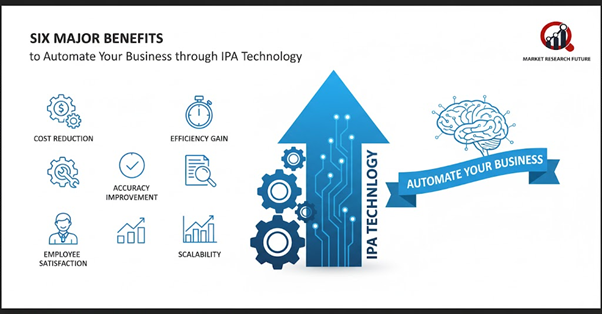
Six Major Benefits to Automate Your Business through IPA Technology
Overview of the Intelligent Process Automation Market
Catering to the elevated demand for personalization through services, the demand for intelligent process automation is rising. The intelligent process automation market is set to rise from USD 8.99 billion in 2024 to USD 30 billion by 2035. The progress of the competitive landscape is projected to occur at a CAGR of 11.58% through 2035.
Time flies so fast these days that it’s hard to keep track of everything. The rate of progress is rapid, and humans have limitations in certain tasks. Machines work at a much faster pace than humans, but the authority to operate them remains in human hands.
A combination of both can intelligently ease workloads. Intelligent Process Automation (IPA) is a technology designed to automate processes. It leverages artificial intelligence, machine learning, robotic processes, and computer vision technology to drive the intelligent process automation industry.
How Does Intelligent Process Automation Function?
Intelligent Process Automation combines Digital Process Automation (DPA), Artificial Intelligence (AI), and Robotic Process Automation (RPA) to manage work efficiently. It uses these technologies to read, inspect, manage, and execute various aspects of business process automation.
Unlike other software tools that rely heavily on human intervention, IPA improves over time, expanding its scope within organizations. Machine learning algorithms provide predictive capabilities and can make small decisions autonomously as a situational awareness feature.
The main idea behind IPA is to allow organizations to make optimal use of their employees’ knowledge and intelligence, while automation handles clerical and manual tasks.
Why Is Intelligent Process Automation Required?
Companies face constant pressure to meet deadlines, maintain strong profit margins, and increase sales. This has led to a surge in digitalization and automation of business processes. Intelligent process automation is necessary for businesses for several reasons:
- Less Workforce Needed: Automation reduces the need for manual labor. Skilled labor is costly, but IPA allows work to be carried out systematically, enabling companies to operate with a smaller workforce and save significantly on salaries and other benefits.
- A Complex Process Made Simple: Machine learning analyzes trends using statistical data to identify results. AI structures unstructured data, including images, documents, and text. IPA converts this data into a usable format, enabling even complex tasks to be accomplished efficiently.
- Higher Productivity: Robotic technology optimizes resource use. Repetitive and monotonous tasks are automated, human errors are minimized, and workforce efficiency increases. This leads to higher productivity and improved profit margins.
- Cost Efficacy: Organizations implementing IPA have observed substantial reductions in operational costs. Automation handles a portion of skilled work, easing the burden on staff and achieving approximately 20% cost savings.
- Improved Customer Satisfaction: IPA mimics human learning and improves over time. With routine tasks delegated to automation, employees can focus on customer service, resulting in higher customer satisfaction and better business outcomes.
- Quick Action in Less Time: In large organizations, identifying clients and planning visits manually can be time-consuming. IPA enables smarter scanning, real-time tracking, and faster execution, ensuring tasks are completed more efficiently.
The Future of Intelligent Process Automation
Automation is transforming the way the world works. The future of business will combine human workforce and robotic resources to drive growth. Intelligent systems are reducing manual effort in everything from autonomous vehicles to drone technology.
Businesses seeking growth will increasingly rely on IPA, and the intelligent process automation industry is expected to flourish in the coming years.
Regional Analysis
The adoption of IPA technology is advancing rapidly across North America, driven by a strong presence of IT and business process outsourcing companies and high demand for efficiency in large enterprises.
Europe is witnessing steady growth due to regulatory compliance requirements and the need for process optimization in manufacturing and finance sectors. In the Asia-Pacific region, IPA adoption is accelerating, particularly in India, China, and Japan, fueled by digital transformation initiatives and cost optimization strategies.
Meanwhile, Latin America and the Middle East are emerging markets for IPA, where businesses are gradually embracing automation to remain competitive and meet increasing customer expectations.
Related Report


Leave a Comment