Propelling Urbanization: A Key Influencer, Upholding the Global Crane Market
Inclination Toward Green Buildings is Set to Augment the Construction Sector
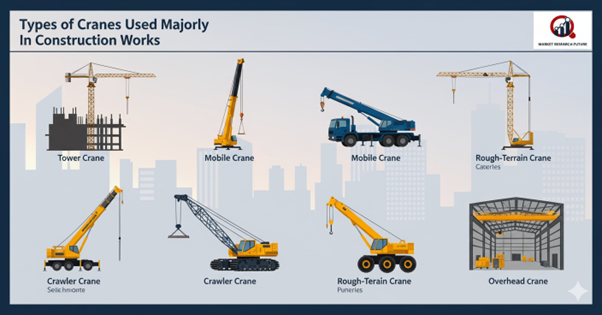
With the rising demand for the construction sector, owing to the rapidly increasing need for urbanization, the valuation of the global crane market is likely to increase from USD 30.07 billion, measured in 2022, to USD 41.73 billion by 2030. The progress of the sector is projected to occur at a sluggish CAGR of 4.18% during this period.
Every construction site needs cranes for various tasks, and they come in a wide variety of sizes, shapes, and configurations. For example, a tower crane’s long boom can reach heights of 500 feet or more, while a crawler crane can carry loads up to 640 tons over land.
A mobile crane is placed on wheels or tracks and can travel along one level if the load weighs less than 10 tons or climb an incline if it weighs less than 30 tons. There are two types of cranes used in construction work, namely the tower crane and the mobile crane.
The tower crane is fixed. This means that it does not move easily from one place to another. It is also known as a fixed crane or a gin pole.
The boom of a tower crane can extend up to 350 feet in the air, depending on its size. Tower cranes are used for lifting heavy loads in construction sites, and they can also be utilized in cargo loading and unloading operations at ports or harbors.
Mobile cranes are more versatile than tower cranes because they have wheels or tracks so that they can be moved easily from one place to another. Also, their mobile structure allows them to be used in different positions. They can easily be used for lifting and placing a load. They are also known as moving cranes.
A tower crane is a fixed-base, self-propelled lifting machine which can carry loads up to 5700 kg (10,350 lb), supported by a single mast, or sometimes by two pylons and a vertical arm.
Its lengthwise load capacity is about 300 m (984 ft). To achieve a greater height, a tower crane is equipped with a boom with an extension of 12 to 100 m (39 to 328 ft). The boom is usually combined with a jib for additional height.
A tower crane may also have a mobile stage, and sometimes a lattice-like metalworking platform called a "boom-jib". This combination is known as a "tower truck", or "tower crane mounted on an EOT Crane Carrier".
More About Mobile Cranes
It is used in limited work areas where there is either no room for movement or access via truck-mounted equipment, or where it would be too dangerous to operate these machines due to confined spaces, live wires, etc. The mobile crane is used to raise heavy loads and lower them when needed.
It comes in various sizes depending on the lifting capacity. The mobile cranes can be operated manually or with electric controls. The design of the crane varies greatly from one manufacturer to another, but usually they consist of a base frame with uprights and a boom.
A pivot point about which the boom swings, and wheels or tracks for smooth movement. The wheeled cranes can be moved either by hand or via wheel cart on the ground.
Truck Mounted Crane
The truck-mounted crane is similar to the mobile crane, except that it is not designed to move freely but is mounted on a truck. It may be placed anywhere convenient and used to lift loads of any width, but it is mostly used for smaller ones.
The crane remains stationary, and some movement in the lifting takes place by using hydraulic cylinders instead of a wheeled vehicle to which the cab and boom are attached. It can be driven manually or powered by electricity.
Tower Crane
Tower cranes are heavy-duty machines, which are mainly used in construction projects, where a payload of around 6000 kg or more needs to be lifted. These powerful cranes are usually used at construction sites or in heavy industrial plants where moving oversized loads may not be an option.
These cranes are mainly operated by a crane driver who sits inside the cabin with controls, while a load handler waits on the ground to receive items to be lifted and carry them to their destination using hand trucks.
Crawler Crane
It is similar to a tower crane, but it is designed for temporary use only and is used when moving through narrow or confined areas with limited clearance.
It consists of a cab, which contains the operator's seat, engine, and controls, as well as a lifting mechanism, which is similar to that of the tower crane, except that it does not have any sort of lifting capacity.
Regional Analysis
With the rising rate of urbanization in Asia-Pacific countries, the region is likely to create the highest prospects for leading players in the crane market. The growth of the industry, therefore, is expected to occur at the highest pace.
Technological advancements in North America have been the highest, thanks to constant innovation and commercialization by leading firms in the crane industry. This creates a strong driving force for the ecosystem.
The rising focus on sustainable construction practices in Europe has augmented the landscape of the construction market. With innovations in the industry, the demand for cranes in Europe is likely to increase through the forecast period.
Related Report


Leave a Comment