非烯四聚体市场 摘要
主要市场趋势和亮点
市场规模与预测
| CAGR (2025 - 2035) | 4.56% |
| CAGR (2025 - 2035) | 4.56% |
The Nonene and Tetramer Market is currently experiencing a dynamic phase characterized by evolving consumer preferences and technological advancements. The demand for nonene, a crucial intermediate in the production of various chemicals, is on the rise due to its applications in the manufacturing of surfactants, lubricants, and polymers. Concurrently, tetramer, which serves as a key component in the synthesis of high-performance materials, is gaining traction in industries such as automotive and construction. This growth trajectory appears to be driven by an increasing emphasis on sustainability and the development of eco-friendly products, which may influence production processes and material selection. Moreover, the Nonene and Tetramer Market is likely to witness shifts in supply chain dynamics as manufacturers adapt to changing regulations and market demands. The integration of innovative technologies, such as advanced catalysts and process optimization techniques, could enhance production efficiency and reduce environmental impact. As stakeholders navigate these complexities, collaboration across sectors may emerge as a vital strategy to address challenges and capitalize on emerging opportunities. Overall, the Nonene and Tetramer Market seems poised for continued evolution, reflecting broader trends in sustainability and technological innovation.
The Nonene and Tetramer Market is increasingly influenced by sustainability initiatives. Manufacturers are exploring eco-friendly alternatives and processes to meet regulatory requirements and consumer expectations. This trend may lead to the development of greener production methods and the use of renewable resources.
Technological advancements are reshaping the Nonene and Tetramer Market. Innovations in production techniques and catalyst development are enhancing efficiency and reducing costs. These advancements could potentially improve product quality and expand application areas.
Shifting consumer preferences are impacting the Nonene and Tetramer Market. There is a growing demand for high-performance materials that align with environmental considerations. This trend may drive manufacturers to adapt their offerings to meet the evolving needs of end-users.
新兴市场在非烯烃和四聚体市场的增长中发挥着至关重要的作用。亚太地区和拉丁美洲等地区的快速工业化和城市化正在推动对基于非烯烃产品的需求。这些地区人口的增加和可支配收入的上升正在促进石化产品的消费。预计到2025年,亚太地区将占全球非烯烃消费的40%以上,突显其作为关键市场的重要性。这一趋势表明,随着制造商寻求利用这些新兴经济体中不断扩大的消费群体,非烯烃和四聚体市场可能会经历强劲的增长机会。
化学加工技术的创新正在显著影响非烯和四聚体市场。先进的催化工艺和改进的分离技术正在提高非烯生产的效率,从而提高产量并降低运营成本。例如,更高效催化剂的引入有可能将生产率提高多达30%,从而使非烯对制造商更具可及性。这一技术演变不仅支持了非烯生产的经济可行性,还与行业的可持续发展目标相一致。随着公司在研发方面的投资,非烯和四聚体市场可能会见证一波新产品和应用的涌现,进一步丰富其市场产品并增强竞争力。
非烯和四聚体市场正在消费者品类中扩展应用。非烯衍生物越来越多地被用于个人护理产品、清洁剂和包装材料的配方中。非烯的多功能性使得能够开发出满足消费者对质量和可持续性需求的高性能产品。到2025年,个人护理领域预计将占据非烯市场的显著份额,这一趋势是由消费者对高端产品的偏好上升所推动的。这一趋势表明,非烯和四聚体市场将继续多样化其应用基础,从而增强其市场潜力并吸引新的投资。
非烯和四聚体市场受益于日益增加的监管支持,旨在促进可持续实践。各国政府正在实施更严格的环境法规,鼓励使用环保材料和工艺。这种监管环境促使制造商采用可持续实践,例如利用可再生原料生产非烯。预计到2025年,包括非烯在内的生物基化学品市场将以8%的复合年增长率增长,反映出向可持续性转变的趋势。这一趋势表明,非烯和四聚体市场可能会在监管压力的影响下发展,促进创新和更环保替代品的开发。
非烯和四聚体市场正经历着对石化产品显著增加的需求,这一需求受到其在各个行业广泛应用的推动。汽车和建筑行业的增长导致对高性能材料的需求激增,这些材料利用了非烯及其衍生物。到2025年,石化产品的需求预计将达到约15亿公吨,表明市场环境强劲。这一趋势表明,非烯和四聚体市场可能会从不断扩大的石化行业中受益,因为制造商寻求提升产品性能和可持续性。此外,汽车制造中对轻量化材料的日益关注预计将进一步推动对基于非烯产品的需求,从而巩固市场的增长轨迹。
The Nonene and Tetramer market shows a distinct distribution in market share, with Nonene dominating due to its widespread application in producing surfactants, plastics, and various chemical intermediates. The established nature of Nonene supports its strong presence in different industries, making it a preferred choice for manufacturers seeking reliability and versatility in chemical solutions. Conversely, Tetramer is emerging as a significant player, characterized by its specialized applications in high-performance materials and fuels, gradually gaining traction in the market.
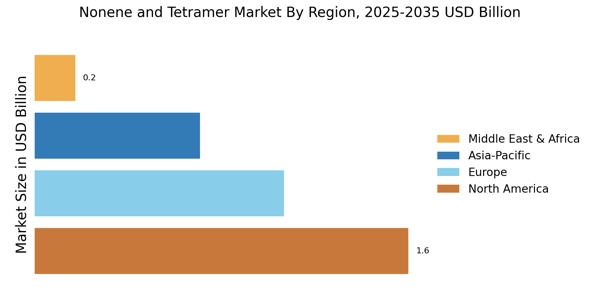
North America is witnessing robust growth in the Nonene and Tetramer market, driven by increasing demand in the automotive and chemical sectors. The region holds approximately 45% of the global market share, making it the largest market. Regulatory support for sustainable practices and advancements in production technologies are further propelling growth. The U.S. is the primary contributor, followed by Canada, which is also expanding its production capabilities. The competitive landscape is dominated by key players such as ExxonMobil, Chevron, and LyondellBasell, who are investing heavily in R&D to enhance product offerings. The presence of these major companies ensures a stable supply chain and innovation in production processes. Additionally, the region's focus on eco-friendly solutions is shaping market dynamics, with companies adapting to meet regulatory standards and consumer preferences.
Europe is emerging as a significant player in the Nonene and Tetramer market, holding around 30% of the global market share, making it the second-largest region. The growth is fueled by stringent environmental regulations and a strong push towards sustainable chemical production. Countries like Germany and France are leading the charge, with policies that encourage innovation and investment in green technologies, thus enhancing market dynamics. The competitive landscape features major players such as BASF, INEOS, and TotalEnergies, who are actively involved in developing sustainable solutions. The European market is characterized by a collaborative approach among companies, governments, and research institutions, fostering innovation. This synergy is crucial for meeting the increasing demand for eco-friendly products and complying with regulatory frameworks, ensuring a resilient market environment.
Asia-Pacific is rapidly becoming a key player in the Nonene and Tetramer market, driven by industrialization and urbanization. The region holds approximately 20% of the global market share, with countries like China and Japan leading the demand. The growth is supported by increasing investments in manufacturing and infrastructure, alongside favorable government policies aimed at boosting the chemical sector. The region's market is expected to grow significantly as demand for petrochemicals rises. China is the largest market in the region, with significant contributions from Japan and South Korea. The competitive landscape is marked by the presence of major companies such as Mitsubishi Chemical and SABIC, who are expanding their operations to meet the growing demand. The focus on innovation and technology adoption is crucial for maintaining competitiveness in this dynamic market, as companies strive to enhance production efficiency and sustainability.
The Middle East and Africa region is witnessing a growing demand for Nonene and Tetramer, primarily driven by its rich natural resources and increasing industrial activities. The region holds about 5% of the global market share, with countries like Saudi Arabia and the UAE leading the market. The growth is supported by government initiatives aimed at diversifying economies and enhancing the petrochemical sector, which is crucial for regional development. Saudi Arabia is the dominant player in the region, with significant investments in petrochemical projects. The competitive landscape includes key players such as SABIC, who are leveraging local resources to expand their market presence. The region's strategic location also facilitates trade, making it an attractive hub for chemical production and export, further enhancing its market potential.
The Nonene and Tetramer Market is currently characterized by a dynamic competitive landscape, driven by increasing demand for high-performance chemicals across various industries, including automotive, construction, and consumer goods. Key players such as ExxonMobil (US), SABIC (SA), and LyondellBasell (US) are strategically positioned to leverage their extensive production capabilities and technological advancements. ExxonMobil (US) focuses on innovation in refining processes, while SABIC (SA) emphasizes sustainability in its operations, aiming to reduce carbon emissions. LyondellBasell (US) is actively pursuing digital transformation initiatives to enhance operational efficiency, which collectively shapes a competitive environment that is increasingly focused on sustainability and technological integration.In terms of business tactics, companies are localizing manufacturing to reduce transportation costs and enhance supply chain resilience. The market structure appears moderately fragmented, with several key players holding substantial market shares. This fragmentation allows for competitive pricing strategies, yet the influence of major companies is significant, as they set industry standards and drive innovation.
In August SABIC (SA) announced a partnership with a leading technology firm to develop advanced recycling technologies aimed at producing high-quality nonene from recycled materials. This strategic move not only aligns with global sustainability goals but also positions SABIC as a leader in the circular economy, potentially enhancing its market share in the nonene segment.
In September LyondellBasell (US) unveiled a new production facility in Texas, designed to increase its tetramer output significantly. This expansion is crucial as it allows the company to meet the growing demand for high-performance chemicals in North America, thereby strengthening its competitive position in the region. The facility is expected to incorporate state-of-the-art technology, further enhancing LyondellBasell's operational efficiency.
In July ExxonMobil (US) launched a new initiative focused on digitalizing its supply chain processes, utilizing AI and machine learning to optimize logistics and inventory management. This initiative is likely to improve operational efficiency and reduce costs, allowing ExxonMobil to maintain a competitive edge in a market that increasingly values technological integration.
As of October the Nonene and Tetramer Market is witnessing trends that emphasize digitalization, sustainability, and the integration of artificial intelligence. Strategic alliances are becoming more prevalent, as companies recognize the need to collaborate to enhance innovation and operational capabilities. Looking ahead, competitive differentiation is expected to evolve, with a shift from traditional price-based competition towards a focus on innovation, technological advancements, and supply chain reliability, which will be critical for long-term success in this sector.



August 2026: Chevron Phillips Chemical published a U.S. patent application covering tetramers of 1-octene and polyalphaolefin compositions produced from them. The application describes processes for oligomerizing 1-octene to produce C32 olefins, addressing the dependence of some PAO production routes on 1-decene feedstock. The development is relevant to tetramer-based synthetic hydrocarbon applications and PAO formulations.
August 2025: Chevron Phillips Chemical completed the expansion of its low-viscosity polyalphaolefin (PAO) production unit in Beringen, Belgium, doubling site capacity to 120,000 metric tons per year. The company said the expansion makes Beringen the largest decene-based low-viscosity PAO facility in Europe by volume. PAOs are produced through oligomerization of alpha olefins, making the capacity addition relevant to downstream tetramer and related oligomer markets.
September 2025: ExxonMobil started a new technology at its Singapore manufacturing site to convert lower-value molecules into higher-value products, including lubricant base stocks and fuel. The company introduced its EHC 340 MAX base stock as part of the project, targeting higher-value lubricant applications.
August 2025: ExxonMobil announced a final investment decision for additional Group III base-stock production at its Baytown, Texas complex. The project is planned to produce around 8,000 barrels per day of Group III base stocks, with a further expansion targeted for startup in 2028. The investment expands ExxonMobil's broader synthetic and high-performance base-stock portfolio relevant to specialty hydrocarbon and lubricant applications.
May 2026: TotalEnergies Lubrifiants updated its Nevastane food-grade lubricant range with new MOSH/MOAH pictograms on technical data sheets. The company notes that some synthetic polyalphaolefins (PAOs) can appear as MOSH analogues in conventional analytical testing, while advanced GC×GC-ToF-MS can distinguish PAOs from MOSH. The update supports product identification and analytical control for PAO-based lubricant applications
非烯烃和四聚体市场预计将在2024年至2035年间以4.56%的复合年增长率增长,主要受汽车和工业应用需求增加的推动。
新机遇在于:
到2035年,市场预计将实现强劲增长,确立其在特种化学应用中的领导地位。
| MARKET SIZE 2024 | 3.658(USD Billion) |
| MARKET SIZE 2025 | 3.825(USD Billion) |
| MARKET SIZE 2035 | 5.976(USD Billion) |
| COMPOUND ANNUAL GROWTH RATE (CAGR) | 4.56% (2025 - 2035) |
| REPORT COVERAGE | Revenue Forecast, Competitive Landscape, Growth Factors, and Trends |
| BASE YEAR | 2024 |
| Market Forecast Period | 2025 - 2035 |
| Historical Data | 2019 - 2024 |
| Market Forecast Units | USD Billion |
| Key Companies Profiled | ExxonMobil (US), Chevron (US), SABIC (SA), LyondellBasell (US), INEOS (GB), Mitsubishi Chemical (JP), BASF (DE), Shell (NL), TotalEnergies (FR) |
| Segments Covered | Product Type, Application, Purity Grade, End User Industry, Regional |
| Key Market Opportunities | Growing demand for sustainable materials drives innovation in the Nonene and Tetramer Market. |
| Key Market Dynamics | Rising demand for sustainable chemicals drives innovation and competition in the Nonene and Tetramer Market. |
| Countries Covered | North America, Europe, APAC, South America, MEA |
 Chitranshi Jaiswal

请填写以下表格以获取本报告的免费样本

“This is really good guys. Excellent work on a tight deadline. I will continue to use you going forward and recommend you to others. Nice job”
 Noah Malgeri
Co-Founder

“Thanks for sending the report it gives us a good global view of the Betaïne market.”
 Peter Groot koerkamp
Account and Business Manager

“We found the report very insightful! we found your research firm very helpful. I'm sending this email to secure our future business.”
 Younghwan Choi
Senior Retail Manager

“I am very pleased with how market segments have been defined in a relevant way for my purposes (such as "Portable Freezers & refrigerators" and "last-mile"). In general the report is well structured. Thanks very much for your efforts.”
 Mark Irwin
Management Consultant

“We got the report in time, we really thank you for your support in this process. I also thank to all of your team as they did a great job.”
 Akif Moroglu
Strategy & Business Development Director

“The Automotive 48V ECU Components Procurement Intelligence Study” was a complex project, but the Market Research Future (MRFR) team handled it with quality, agility, and customer-centricity. They delivered all requested data on time and within the agreed scope. The team, including Shubhendra Anand and Rahul Gotadki, was always readily available to clarify questions and swiftly implement necessary adjustments, driving the project to a successful conclusion within a very demanding timeframe.
I would also like to specifically commend Akshay Agarwal for his responsiveness and support at every stage—from our initial inquiry on May 6th through to final delivery on June 18th. His dedication made the entire process seamless.”
 Guilherme Gomes Martins
Product Management Director

“Thanks. It’s been a pleasure working with you, please use me as reference with any other Intel employees.”
 Joseph Aguayo
Sales Operations & Pricing Manager

“Thank you, this will be very helpful for OQS.”
 La Terria Dodd
Program Support Specialist

“I have been reading the first document or the study, ,the Global HVAC and FP market report 2021 till 2026. Must say, good info! I have not gone in depth at all parts, but got a good indication of the data inside!”
 Rob Kooiker
Group Product Manager HVAC & Fire Protection GMA


