Request Free Sample ×

Kindly complete the form below to receive a free sample of this Report

* Please use a valid business email

Leading companies partner with us for data-driven Insights

clients tt-cursor
Hero Background
English
Chinese
French
Japanese
Korean
German
Spanish

Wheelchair Market Analysis

ID: MRFR/HC/6933-CR
158 Pages
Nidhi Mandole
February 2020

Wheelchair Market Research Report Information By Product (Manual Wheelchair, Electric Wheelchair, Accessories), By Category (Adults and Pediatric), By End-Use (Home Care Settings, Hospitals & Clinics), and By Region (North America, Europe, Asia-Pacific, And Rest Of The World) –Industry Forecast Till 2035

Share:
Download PDF ×

We do not share your information with anyone. However, we may send you emails based on your report interest from time to time. You may contact us at any time to opt-out.

Wheelchair Market Infographic
Purchase Options

Market Analysis

In-depth Analysis of Wheelchair Market Industry Landscape

As per the World Health Organization (WHO), road accidents contribute significantly to global mortality, ranking as the eighth-leading cause of death across all age groups worldwide. Disturbingly, the fatality rates resulting from crashes are notably higher in low and middle-income nations in comparison to their high-income counterparts. This disparity in road safety stems from various factors, including unsafe road infrastructure, the prevalence of unsafe vehicles, insufficient post-crash care, lax enforcement of traffic laws, and the peril of driving under the influence of alcohol and other psychoactive substances. The ramifications of these accidents often result in injury-related impairments, thereby elevating the demand for electric wheelchairs.

The consequences of road accidents are not only limited to fatalities but also include a substantial number of disabilities caused by injuries sustained during these incidents. The surge in accident-related impairments significantly contributes to an increased requirement for electric wheelchairs. The elevated demand for these mobility aids can be attributed to the long-term disabilities or mobility limitations endured by survivors, necessitating assistance in movement and locomotion.

Moreover, various neurological conditions and ailments play a pivotal role in the prevalence of wheelchair usage. Among these conditions, cerebrovascular disease stands out as the most common neurological ailment leading to the adoption of wheelchairs. Additionally, individuals diagnosed with neurological disorders such as multiple sclerosis, polio, and muscular dystrophy might rely on wheelchairs to enhance their mobility and ensure better quality of life. The increasing incidence of these neurological conditions among populations is expected to contribute to the upward trajectory of the global electric wheelchair market in the forecast period.

Neurological disorders and injuries resulting from road accidents often lead to long-term or permanent disabilities, significantly affecting an individual's mobility. Consequently, the heightened demand for electric wheelchairs arises as a crucial need for individuals grappling with the aftermath of such conditions. These electric wheelchairs provide enhanced mobility and independence, offering support to individuals facing mobility challenges caused by neurological disorders or injury-related impairments.

The rising occurrence of road accidents globally and the associated disabilities resulting from these incidents contribute substantially to the amplified demand for electric wheelchairs. Furthermore, neurological conditions and ailments that impede mobility also play a pivotal role in the increased adoption of these mobility aids. As a result, the projected surge in the incidence of such conditions is anticipated to drive the growth of the global electric wheelchair market in the foreseeable future.


Author
Author Profile
Nidhi Mandole
Senior Research Analyst

She is an extremely curious individual currently working in Healthcare and Medical Devices Domain. Nidhi is comfortably versed in data centric research backed by healthcare educational background. She leverages extensive data mining and analytics tools such as Primary and Secondary Research, Statistical Analysis, Machine Learning, Data Modelling. Her key role also involves Technical Sales Support, Client Interaction and Project management within the Healthcare team. Lastly, she showcases extensive affinity towards learning new skills and remain fascinated in implementing them.

Leave a Comment

FAQs

What is the current valuation of the Wheelchair Market as of 2024?

<p>The Wheelchair Market was valued at 5.78 USD Billion in 2024.</p>

What is the projected market size for the Wheelchair Market in 2035?

<p>The market is projected to reach 12.32 USD Billion by 2035.</p>

What is the expected CAGR for the Wheelchair Market during the forecast period 2025 - 2035?

<p>The expected CAGR for the Wheelchair Market during 2025 - 2035 is 7.12%.</p>

Which product segment had the highest valuation in 2024?

<p>In 2024, the Electric Wheelchairs segment had a valuation of 2.5 USD Billion.</p>

What is the projected valuation for Manual Wheelchairs by 2035?

<p>The Manual Wheelchairs segment is projected to reach 5.2 USD Billion by 2035.</p>

How does the market for pediatric wheelchairs compare to adult wheelchairs in 2024?

<p>In 2024, the market for pediatric wheelchairs was valued at 2.3 USD Billion, compared to 3.48 USD Billion for adults.</p>

What end-user segment is expected to dominate the Wheelchair Market by 2035?

The Home Care Settings segment is expected to dominate, projected to reach 7.12 USD Billion by 2035.

Which companies are considered key players in the Wheelchair Market?

Key players include Invacare Corporation, Permobil, Sunrise Medical, and Drive Medical.

What was the valuation of accessories in the Wheelchair Market in 2024?

The Accessories segment was valued at 0.78 USD Billion in 2024.

What trends are anticipated in the Wheelchair Market over the next decade?

The market is likely to experience growth driven by advancements in technology and increasing demand for mobility solutions.

Market Summary

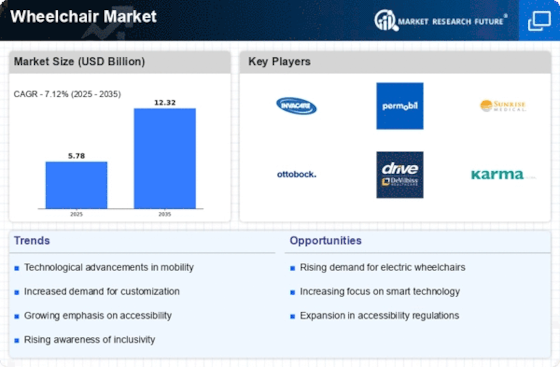
According to MRFR analysis, the Wheelchair Market Size was valued at USD 5.78 Billion in 2024. The market is projected to grow from USD 6.192 Billion in 2025 to USD 12.32 Billion by 2035, registering a CAGR of 7.12% during the forecast period (2025–2035). North America dominated the market with the largest revenue share of 39.79% in 2024.
 
The Wheelchair Market is growing steadily due to the rising geriatric population, increasing prevalence of mobility disabilities, and growing demand for advanced mobility solutions. Key trends include the adoption of electric and smart wheelchairs, technological innovations in lightweight materials, and expanding healthcare infrastructure improving accessibility to mobility assistance devices globally.

Key Market Trends & Highlights

The wheelchair market is experiencing a dynamic evolution driven by technological advancements and changing consumer needs.

  • Technological advancements are enhancing the functionality and user experience of wheelchairs, particularly in North America. Customization and personalization are becoming increasingly important, allowing users to tailor wheelchairs to their specific needs, especially in the adult segment. Sustainability initiatives are gaining traction, with manufacturers focusing on eco-friendly materials and production processes, particularly in the Asia-Pacific region. The aging population and rising disability rates are significant market drivers, influencing demand across both manual and electric wheelchair segments.

Market Size & Forecast

2024 Market Size 5.78 (USD Billion)
2035 Market Size 12.32 (USD Billion)
CAGR (2025 - 2035) 7.12%
Largest Regional Market Share in 2024 North America

Major Players

Invacare Corporation (US), Permobil (SE), Sunrise Medical (US), <a href="https://www.ottobock.com/en-ex/category/32514">Ottobock</a> (DE), Drive Medical (US), Karma Medical Products (TW), Pride Mobility Products (US), Medline Industries (US), GF Health Products (US)

Market Trends

The Wheelchair Market is currently experiencing a dynamic evolution, driven by advancements in technology and a growing awareness of the needs of individuals with mobility challenges. Manufacturers are increasingly focusing on creating innovative designs that enhance user comfort and accessibility.

This shift appears to be influenced by a broader societal recognition of the importance of inclusivity and the need for adaptive solutions. As a result, the market is witnessing a surge in demand for customized wheelchairs that cater to specific user requirements, thereby promoting independence and improving quality of life. Moreover, the integration of smart technology into wheelchair designs is becoming more prevalent.

Features such as automated adjustments, connectivity with mobile applications, and enhanced safety mechanisms are gaining traction. This trend suggests a potential shift towards more personalized and user-friendly mobility solutions. Additionally, the growing emphasis on sustainability is prompting manufacturers to explore eco-friendly materials and production methods. Overall, the Wheelchair Market is poised for continued growth, reflecting a commitment to innovation and user-centric design.

Technological Advancements

The Wheelchair Market is witnessing a notable trend towards the incorporation of advanced technologies. Innovations such as smart wheelchairs equipped with sensors and connectivity features are becoming increasingly common. These enhancements aim to improve user experience and safety, allowing for greater independence.

Customization and Personalization

There is a growing demand for customized wheelchairs tailored to individual needs. This trend reflects an understanding of the diverse requirements of users, leading to designs that prioritize comfort, functionality, and aesthetic preferences. Such personalization fosters a sense of ownership and satisfaction among users.

Sustainability Initiatives

The Wheelchair Market is also seeing a shift towards sustainable practices. Manufacturers are exploring eco-friendly materials and production techniques to reduce environmental impact. This trend indicates a broader commitment to sustainability within the industry, appealing to environmentally conscious consumers.

Wheelchair Market Market Drivers

Aging Population

The increasing number of elderly individuals worldwide is a primary driver of the Wheelchair Market. As people age, mobility issues become more prevalent, leading to a higher demand for wheelchairs. According to recent statistics, the population aged 65 and older is projected to reach 1.5 billion by 2050, which suggests a substantial market opportunity for wheelchair manufacturers.
 
This demographic shift necessitates the development of innovative and comfortable mobility solutions tailored to the needs of older adults. Furthermore, the aging population often requires additional support services, which may further stimulate growth in the Wheelchair Market as families seek comprehensive mobility solutions for their loved ones.

Rising Disability Rates

The prevalence of disabilities is on the rise, which significantly impacts the Wheelchair Market. Factors such as increased awareness, better diagnostic tools, and improved healthcare access contribute to this trend. Recent data indicates that approximately 15% of the world's population lives with some form of disability, which translates to a substantial market for mobility aids.
 
This growing demographic is likely to drive demand for various types of wheelchairs, including manual, powered, and specialized models. As the need for mobility solutions expands, manufacturers in the Wheelchair Market are expected to innovate and diversify their product offerings to cater to a wider range of disabilities.

Technological Innovations

Technological advancements are reshaping the Wheelchair Market, leading to the development of smarter and more efficient mobility solutions. Innovations such as electric wheelchairs, smart controls, and advanced materials are enhancing user experience and accessibility.
 
For instance, the integration of IoT technology allows for real-time monitoring of wheelchair performance and user health metrics. This trend is likely to attract a tech-savvy consumer base, particularly among younger individuals with disabilities. Moreover, the increasing focus on user-friendly designs and enhanced functionality may drive competition among manufacturers, ultimately benefiting consumers in the Wheelchair Market.

Increased Awareness and Advocacy

There is a growing awareness and advocacy for the rights of individuals with disabilities, which is positively influencing the Wheelchair Market. Non-profit organizations and community groups are actively promoting the importance of mobility aids, leading to a cultural shift in how society views disability. This heightened awareness is likely to encourage more individuals to seek out wheelchairs, thereby expanding the market.
 
Furthermore, campaigns aimed at reducing stigma and promoting inclusivity may lead to increased demand for stylish and functional wheelchair designs. As societal attitudes continue to evolve, the Wheelchair Market is expected to benefit from a broader acceptance and understanding of the needs of individuals with mobility challenges.

Government Initiatives and Funding

Government policies and funding initiatives play a crucial role in shaping the Wheelchair Market. Many countries are implementing programs aimed at improving accessibility for individuals with disabilities, which often includes financial support for mobility aids. For example, various healthcare systems provide subsidies or reimbursements for wheelchair purchases, making them more affordable for consumers.
 
This financial assistance is likely to increase the adoption of wheelchairs, particularly among low-income populations. Additionally, advocacy for disability rights and accessibility legislation may further bolster the Wheelchair Market by promoting awareness and encouraging manufacturers to develop compliant products.

Market Segment Insights

By Product: Manual Wheelchairs (Largest) vs. Electric Wheelchairs (Fastest-Growing)

The wheelchair market is characterized by a diverse range of products, prominently featuring manual wheelchairs, electric wheelchairs, and various accessories. Manual wheelchairs hold the largest market share, attributed to their affordability and ease of use. They are traditionally preferred by users who require basic mobility support without the complexities of powered systems. On the other hand, electric wheelchairs, though currently smaller in market share, are rapidly gaining traction among consumers seeking advanced features and enhanced comfort, propelling their demand in recent years. Growth trends within the wheelchair market are significantly influenced by technological advancements and changing consumer preferences. The electric wheelchair segment is experiencing a surge as innovations in design and battery technology improve usability and reduce costs. Additionally, an aging global population and an increase in mobility-related health conditions are driving the demand for all types of wheelchairs. Accessibility regulations and a greater focus on inclusive mobility solutions further augment the market growth, especially for electric variants as they cater to a wider range of user needs.

Manual Wheelchairs (Dominant) vs. Electric Wheelchairs (Emerging)

Manual wheelchairs represent the dominant segment of the wheelchair market share, appealing for their lightweight design, simplicity, and affordability. They come in various types, from basic models to specialized designs for sports or specific medical needs. These wheelchairs are often favored in environments where users require physical activity or have limited accessibility to charging facilities. In contrast, <a href="https://www.marketresearchfuture.com/reports/electric-wheelchair-market-6618">electric wheelchairs</a> are positioned as an emerging trend, incorporating advanced technologies to enhance user independence and mobility. They offer features such as joystick control and customizable seating options, which significantly improve the user experience. While manual wheelchairs remain prevalent, the electric segment is gradually capturing market attention due to its technological innovations and increasing consumer demand for comfort and convenience.

By Category: Adults (Largest) vs. Pediatrics (Fastest-Growing)

In the Wheelchair Market, the distribution among categories reveals Adults as the largest user base, commanding a significant majority due to demographic trends. Aging populations and increasing disabilities associated with aging contribute to a steady demand for adult wheelchairs, making it a well-established segment. On the other hand, the Pediatrics category has emerged with rapid growth due to rising awareness about childhood disabilities and improved healthcare access, making this segment increasingly relevant.

Category: Adults (Dominant) vs. Pediatrics (Emerging)

The Adults segment in the wheelchair market stands out as the dominant category, primarily focusing on individuals with age-related mobility challenges and disabilities. This segment benefits from extensive product offerings designed for comfort and functionality, catering to the varying needs of adult users. Conversely, the Pediatrics segment is marked as an emerging force in the industry, with innovative designs and features that align with the requirements of younger users. Enhanced accessibility and supportive environments in healthcare have significantly spurred growth in the Pediatrics segment, reflecting a shift towards more inclusive mobility solutions for children.

By End-User: Home Care Settings (Largest) vs. Hospitals & Clinics (Fastest-Growing)

In the wheelchair market, the end-user segment is predominantly divided between home care settings and hospitals &amp; clinics. Home care settings hold the largest market share due to the rising number of elderly individuals and the increasing preference for aging in place. Meanwhile, hospitals and clinics are witnessing substantial demand driven by the need for mobility solutions in medical settings. As healthcare facilities adapt to patient-centered care, the importance of wheelchairs in these environments continues to grow.

Home Care Settings (Dominant) vs. Hospitals &amp; Clinics (Emerging)

Home care settings remain the dominant force within the wheelchair market share due to the persistent demand for personalized mobility solutions at home. This segment is characterized by a growing population of senior individuals seeking independence and comfortable mobility aids. In contrast, hospitals and clinics represent an emerging market, with rapid growth attributed to advancements in medical technology and improved patient care standards. This segment necessitates specialized wheelchairs designed for the efficiency and safety of patient transport, indicating a shift towards more innovative and user-focused solutions in medical environments.

Get more detailed insights about Wheelchair Market Research Report— Forecast till 2035

Regional Insights

North America : Market Leader in Innovation

North America accounted for the largest share of the global Wheelchair Market size, reaching USD 2.3 billion in 2024. The region's growth is driven by increasing demand for advanced mobility solutions, an aging population, and supportive government regulations.

The U.S. and Canada are the primary contributors, with a strong focus on technological advancements and accessibility initiatives that enhance user experience and safety. The competitive landscape is characterized by key players such as Invacare Corporation, Sunrise Medical, and Drive Medical, which dominate the market with innovative products.

The presence of established healthcare infrastructure and a growing emphasis on rehabilitation services further bolster market growth. Additionally, the region benefits from significant investments in R&D, leading to the introduction of smart wheelchairs and other assistive technologies.

Europe : Emerging Market with Growth Potential

Europe is the second-largest market for wheelchairs, accounting for approximately 30% of the global market share. The region's growth is propelled by an increasing elderly population, rising awareness of disability rights, and favorable regulations promoting accessibility. Countries like Germany and the UK are at the forefront, implementing policies that enhance mobility solutions for individuals with disabilities.

The competitive landscape in Europe features prominent players such as Ottobock and Permobil, which are known for their high-quality products and innovative designs. The market is also witnessing a surge in local manufacturers focusing on customized solutions. Regulatory bodies are actively promoting initiatives to improve wheelchair accessibility, which is expected to further stimulate market growth. The European Commission emphasizes the importance of inclusive mobility solutions for all citizens.

Asia-Pacific : Rapidly Growing Market Segment

Asia-Pacific is an emerging powerhouse in the wheelchair market, holding approximately 25% of the global share. The region's growth is driven by rising healthcare expenditures, increasing awareness of disability rights, and a growing elderly population. Countries like China and India are leading the charge, with significant investments in healthcare infrastructure and mobility solutions to cater to their vast populations.

The competitive landscape is evolving, with local manufacturers like Karma Medical Products gaining traction alongside established global players. The market is characterized by a diverse range of products catering to various needs, from manual to powered wheelchairs. Government initiatives aimed at improving healthcare access and mobility for disabled individuals are expected to further boost market growth in the coming years.

Middle East and Africa : Untapped Market with Potential

The Middle East and Africa represent a resource-rich frontier for the wheelchair market, holding approximately 5% of the global share. The region's growth is driven by increasing awareness of disability rights, government initiatives aimed at improving healthcare access, and a rising demand for mobility solutions.

Countries like South Africa and the UAE are making strides in enhancing accessibility for individuals with disabilities, supported by various regulatory frameworks. The competitive landscape is still developing, with a mix of local and international players. Key manufacturers are beginning to establish a presence in the region, focusing on affordable and durable wheelchair options.

The market is expected to grow as governments prioritize inclusivity and accessibility, leading to increased investments in healthcare infrastructure and mobility solutions.

Key Players and Competitive Insights

The Wheelchair Market is currently characterized by a dynamic competitive landscape, driven by a confluence of innovation, technological advancements, and an increasing emphasis on user-centric designs. Major players such as Invacare Corporation (US), Permobil (SE), and Sunrise Medical (US) are at the forefront, each adopting distinct strategies to enhance their market positioning. Invacare Corporation (US) focuses on expanding its product portfolio through innovative designs that cater to diverse user needs, while Permobil (SE) emphasizes the integration of advanced technology into its wheelchairs, enhancing user experience and mobility.
 
Sunrise Medical (US) is strategically positioned through its commitment to sustainability and eco-friendly manufacturing processes, which resonates with a growing consumer preference for environmentally responsible products. Collectively, these strategies not only bolster individual company profiles but also intensify competition within the market, as firms strive to differentiate themselves through unique value propositions. In terms of business tactics, companies are increasingly localizing manufacturing to reduce lead times and enhance supply chain efficiency. This approach appears to be a response to the complexities of The Wheelchair Market responsiveness.
 
The Wheelchair Market is moderately fragmented, with several key players exerting influence over various segments. The collective actions of these companies suggest a trend towards consolidation, as firms seek to leverage synergies through partnerships and acquisitions, thereby enhancing their competitive edge.
 
In August 2025, Invacare Corporation (US) announced a strategic partnership with a leading technology firm to develop smart wheelchair solutions that incorporate AI-driven features. This move is significant as it positions Invacare at the cutting edge of technological innovation, potentially transforming user experience and mobility solutions. The integration of AI into wheelchairs could lead to enhanced safety features and personalized user interfaces, thereby attracting a broader customer base.
 
In September 2025, Permobil (SE) launched a new line of electric wheelchairs equipped with advanced navigation systems. This initiative underscores Permobil's commitment to innovation and user-centric design, as it aims to provide users with greater independence and mobility. The introduction of such technology not only enhances the functionality of their products but also reinforces Permobil's reputation as a leader in the market.
 
In July 2025, Sunrise Medical (US) unveiled its latest eco-friendly wheelchair model, which utilizes sustainable materials and manufacturing processes. This strategic move aligns with the growing consumer demand for environmentally responsible products and positions Sunrise Medical as a pioneer in sustainable practices within the industry. By prioritizing sustainability, the company not only meets regulatory expectations but also appeals to a conscientious consumer base, thereby enhancing its market share.
 
As of October 2025, the Wheelchair Market is witnessing a pronounced shift towards digitalization, sustainability, and the integration of artificial intelligence. These trends are reshaping competitive dynamics, as companies increasingly form strategic alliances to enhance their technological capabilities and market reach.
 
The focus appears to be shifting from traditional price-based competition to a more nuanced approach that emphasizes innovation, technological advancement, and supply chain reliability. This evolution suggests that future competitive differentiation will hinge on the ability to deliver cutting-edge solutions that meet the diverse needs of users, thereby fostering a more inclusive and accessible market.

Key Companies in the Wheelchair Market include

Industry Developments

  • Q2 2024: Invacare Launches AVIVA STORM RX Power Wheelchair Market in North America Invacare Corporation announced the launch of its new AVIVA STORM RX power wheelchair in North America, featuring advanced battery technology and customizable seating to enhance user mobility and comfort.
  • Q2 2024: Permobil Acquires Progeo Wheelchairs to Expand European Presence Permobil, a global leader in advanced mobility solutions, completed the acquisition of Italian wheelchair manufacturer Progeo, strengthening its product portfolio and distribution network across Europe.
  • Q2 2024: Sunrise Medical Announces Opening of New Manufacturing Facility in Mexico Sunrise Medical opened a new state-of-the-art manufacturing facility in Monterrey, Mexico, to increase production capacity for manual and powered wheelchairs and improve supply chain efficiency.
  • Q3 2024: Ottobock Receives FDA Clearance for Juvo B6 Power Wheelchair Market Ottobock announced that its Juvo B6 power wheelchair received FDA clearance, allowing the company to market and sell the device in the United States.
  • Q3 2024: Quantum Rehab Launches Edge 4 HD Power Wheelchair Market Quantum Rehab introduced the Edge 4 HD, a heavy-duty power wheelchair designed for bariatric users, featuring enhanced weight capacity and advanced drive technology.
  • Q3 2024: WHILL Secures $45 Million in Series D Funding to Accelerate Global Expansion Personal mobility device maker WHILL raised $45 million in Series D funding to support international growth and the development of next-generation electric wheelchairs.
  • Q4 2024: Pride Mobility Products Appoints New CEO to Drive Innovation Pride Mobility Products announced the appointment of a new Chief Executive Officer, aiming to accelerate product innovation and expand its global market share in the wheelchair sector.
  • Q4 2024: Invacare Wins Major Supply Contract with UK National Health Service Invacare secured a multi-year contract to supply powered and manual wheelchairs to the UK National Health Service, reinforcing its position as a leading provider in the region.
  • Q1 2025: Permobil Launches M Corpus VS Standing Power Wheelchair Market in North America Permobil introduced the M Corpus VS, a standing power wheelchair, to the North American market, offering users improved mobility and health benefits through advanced standing technology.
  • Q1 2025: Sunrise Medical Acquires Magic Mobility to Expand All-Terrain Wheelchair Market Portfolio Sunrise Medical completed the acquisition of Magic Mobility, an Australian manufacturer of all-terrain wheelchairs, broadening its product offerings for users with active lifestyles.
  • Q2 2025: Ottobock Opens Innovation Center for Mobility Solutions in Germany Ottobock inaugurated a new innovation center in Duderstadt, Germany, dedicated to research and development of advanced wheelchair technologies and mobility solutions.
  • Q2 2025: WHILL Partners with United Airlines to Provide Personal EV Wheelchairs at Major Airports WHILL announced a partnership with United Airlines to deploy its personal electric wheelchairs at select major U.S. airports, enhancing accessibility and travel experience for passengers with mobility needs.

Future Outlook

Wheelchair Market Future Outlook

The Wheelchair Market is projected to grow at a 7.12% CAGR from 2025 to 2035, driven by technological advancements, increasing demand for mobility solutions, and an aging population.

New opportunities lie in:

  • <p>Development of smart wheelchairs with <a href="https://www.marketresearchfuture.com/reports/internet-of-things-market-1176">IoT  </a>integration Expansion of wheelchair rental services in urban areas Partnerships with healthcare providers for customized mobility solutions</p>

By 2035, the Wheelchair Market is expected to be robust, reflecting significant growth and innovation.

Market Segmentation

Wheelchair Market Product Outlook

  • Manual Wheelchairs
  • Electric Wheelchairs
  • Accessories

Wheelchair Market Category Outlook

  • Adults
  • Pediatrics

Wheelchair Market End-User Outlook

  • Home Care Settings
  • Hospitals & Clinics

Report Scope

MARKET SIZE 2024 5.78(USD Billion)
MARKET SIZE 2025 6.192(USD Billion)
MARKET SIZE 2035 12.32(USD Billion)
COMPOUND ANNUAL GROWTH RATE (CAGR) 7.12% (2025 - 2035)
REPORT COVERAGE Revenue Forecast, Competitive Landscape, Growth Factors, and Trends
BASE YEAR 2024
Market Forecast Period 2025 - 2035
Historical Data 2019 - 2024
Market Forecast Units USD Billion
Key Companies Profiled Invacare Corporation (US), Permobil (SE), Sunrise Medical (US), Ottobock (DE), Drive Medical (US), Karma Medical Products (TW), Pride Mobility Products (US), Medline Industries (US), GF Health Products (US)
Segments Covered Product, Category, End-Use, Region
Key Market Opportunities Integration of smart technology and customization options in the Wheelchair Market enhances user experience and accessibility.
Key Market Dynamics Technological advancements and shifting consumer preferences drive innovation and competition in the wheelchair market.
Countries Covered North America, Europe, APAC, South America, MEA

FAQs

What is the current valuation of the Wheelchair Market as of 2024?

<p>The Wheelchair Market was valued at 5.78 USD Billion in 2024.</p>

What is the projected market size for the Wheelchair Market in 2035?

<p>The market is projected to reach 12.32 USD Billion by 2035.</p>

What is the expected CAGR for the Wheelchair Market during the forecast period 2025 - 2035?

<p>The expected CAGR for the Wheelchair Market during 2025 - 2035 is 7.12%.</p>

Which product segment had the highest valuation in 2024?

<p>In 2024, the Electric Wheelchairs segment had a valuation of 2.5 USD Billion.</p>

What is the projected valuation for Manual Wheelchairs by 2035?

<p>The Manual Wheelchairs segment is projected to reach 5.2 USD Billion by 2035.</p>

How does the market for pediatric wheelchairs compare to adult wheelchairs in 2024?

<p>In 2024, the market for pediatric wheelchairs was valued at 2.3 USD Billion, compared to 3.48 USD Billion for adults.</p>

What end-user segment is expected to dominate the Wheelchair Market by 2035?

The Home Care Settings segment is expected to dominate, projected to reach 7.12 USD Billion by 2035.

Which companies are considered key players in the Wheelchair Market?

Key players include Invacare Corporation, Permobil, Sunrise Medical, and Drive Medical.

What was the valuation of accessories in the Wheelchair Market in 2024?

The Accessories segment was valued at 0.78 USD Billion in 2024.

What trends are anticipated in the Wheelchair Market over the next decade?

The market is likely to experience growth driven by advancements in technology and increasing demand for mobility solutions.

  1. SECTION I: EXECUTIVE SUMMARY AND KEY HIGHLIGHTS
    1. | 1.1 EXECUTIVE SUMMARY
    2. | | 1.1.1 Market Overview
    3. | | 1.1.2 Key Findings
    4. | | 1.1.3 Market Segmentation
    5. | | 1.1.4 Competitive Landscape
    6. | | 1.1.5 Challenges and Opportunities
    7. | | 1.1.6 Future Outlook
  2. SECTION II: SCOPING, METHODOLOGY AND MARKET STRUCTURE
    1. | 2.1 MARKET INTRODUCTION
    2. | | 2.1.1 Definition
    3. | | 2.1.2 Scope of the study
    4. | | | 2.1.2.1 Research Objective
    5. | | | 2.1.2.2 Assumption
    6. | | | 2.1.2.3 Limitations
    7. | 2.2 RESEARCH METHODOLOGY
    8. | | 2.2.1 Overview
    9. | | 2.2.2 Data Mining
    10. | | 2.2.3 Secondary Research
    11. | | 2.2.4 Primary Research
    12. | | | 2.2.4.1 Primary Interviews and Information Gathering Process
    13. | | | 2.2.4.2 Breakdown of Primary Respondents
    14. | | 2.2.5 Forecasting Model
    15. | | 2.2.6 Market Size Estimation
    16. | | | 2.2.6.1 Bottom-Up Approach
    17. | | | 2.2.6.2 Top-Down Approach
    18. | | 2.2.7 Data Triangulation
    19. | | 2.2.8 Validation
  3. SECTION III: QUALITATIVE ANALYSIS
    1. | 3.1 MARKET DYNAMICS
    2. | | 3.1.1 Overview
    3. | | 3.1.2 Drivers
    4. | | 3.1.3 Restraints
    5. | | 3.1.4 Opportunities
    6. | 3.2 MARKET FACTOR ANALYSIS
    7. | | 3.2.1 Value chain Analysis
    8. | | 3.2.2 Porter's Five Forces Analysis
    9. | | | 3.2.2.1 Bargaining Power of Suppliers
    10. | | | 3.2.2.2 Bargaining Power of Buyers
    11. | | | 3.2.2.3 Threat of New Entrants
    12. | | | 3.2.2.4 Threat of Substitutes
    13. | | | 3.2.2.5 Intensity of Rivalry
    14. | | 3.2.3 COVID-19 Impact Analysis
    15. | | | 3.2.3.1 Market Impact Analysis
    16. | | | 3.2.3.2 Regional Impact
    17. | | | 3.2.3.3 Opportunity and Threat Analysis
  4. SECTION IV: QUANTITATIVE ANALYSIS
    1. | 4.1 Healthcare, BY Product (USD Billion)
    2. | | 4.1.1 Manual Wheelchairs
    3. | | 4.1.2 Electric Wheelchairs
    4. | | 4.1.3 Accessories
    5. | 4.2 Healthcare, BY Category (USD Billion)
    6. | | 4.2.1 Adults
    7. | | 4.2.2 Pediatrics
    8. | 4.3 Healthcare, BY End-User (USD Billion)
    9. | | 4.3.1 Home Care Settings
    10. | | 4.3.2 Hospitals & Clinics
    11. | 4.4 Healthcare, BY Region (USD Billion)
    12. | | 4.4.1 North America
    13. | | | 4.4.1.1 US
    14. | | | 4.4.1.2 Canada
    15. | | 4.4.2 Europe
    16. | | | 4.4.2.1 Germany
    17. | | | 4.4.2.2 UK
    18. | | | 4.4.2.3 France
    19. | | | 4.4.2.4 Russia
    20. | | | 4.4.2.5 Italy
    21. | | | 4.4.2.6 Spain
    22. | | | 4.4.2.7 Rest of Europe
    23. | | 4.4.3 APAC
    24. | | | 4.4.3.1 China
    25. | | | 4.4.3.2 India
    26. | | | 4.4.3.3 Japan
    27. | | | 4.4.3.4 South Korea
    28. | | | 4.4.3.5 Malaysia
    29. | | | 4.4.3.6 Thailand
    30. | | | 4.4.3.7 Indonesia
    31. | | | 4.4.3.8 Rest of APAC
    32. | | 4.4.4 South America
    33. | | | 4.4.4.1 Brazil
    34. | | | 4.4.4.2 Mexico
    35. | | | 4.4.4.3 Argentina
    36. | | | 4.4.4.4 Rest of South America
    37. | | 4.4.5 MEA
    38. | | | 4.4.5.1 GCC Countries
    39. | | | 4.4.5.2 South Africa
    40. | | | 4.4.5.3 Rest of MEA
  5. SECTION V: COMPETITIVE ANALYSIS
    1. | 5.1 Competitive Landscape
    2. | | 5.1.1 Overview
    3. | | 5.1.2 Competitive Analysis
    4. | | 5.1.3 Market share Analysis
    5. | | 5.1.4 Major Growth Strategy in the Healthcare
    6. | | 5.1.5 Competitive Benchmarking
    7. | | 5.1.6 Leading Players in Terms of Number of Developments in the Healthcare
    8. | | 5.1.7 Key developments and growth strategies
    9. | | | 5.1.7.1 New Product Launch/Service Deployment
    10. | | | 5.1.7.2 Merger & Acquisitions
    11. | | | 5.1.7.3 Joint Ventures
    12. | | 5.1.8 Major Players Financial Matrix
    13. | | | 5.1.8.1 Sales and Operating Income
    14. | | | 5.1.8.2 Major Players R&D Expenditure. 2023
    15. | 5.2 Company Profiles
    16. | | 5.2.1 Invacare Corporation (US)
    17. | | | 5.2.1.1 Financial Overview
    18. | | | 5.2.1.2 Products Offered
    19. | | | 5.2.1.3 Key Developments
    20. | | | 5.2.1.4 SWOT Analysis
    21. | | | 5.2.1.5 Key Strategies
    22. | | 5.2.2 Permobil (SE)
    23. | | | 5.2.2.1 Financial Overview
    24. | | | 5.2.2.2 Products Offered
    25. | | | 5.2.2.3 Key Developments
    26. | | | 5.2.2.4 SWOT Analysis
    27. | | | 5.2.2.5 Key Strategies
    28. | | 5.2.3 Sunrise Medical (US)
    29. | | | 5.2.3.1 Financial Overview
    30. | | | 5.2.3.2 Products Offered
    31. | | | 5.2.3.3 Key Developments
    32. | | | 5.2.3.4 SWOT Analysis
    33. | | | 5.2.3.5 Key Strategies
    34. | | 5.2.4 Ottobock (DE)
    35. | | | 5.2.4.1 Financial Overview
    36. | | | 5.2.4.2 Products Offered
    37. | | | 5.2.4.3 Key Developments
    38. | | | 5.2.4.4 SWOT Analysis
    39. | | | 5.2.4.5 Key Strategies
    40. | | 5.2.5 Drive Medical (US)
    41. | | | 5.2.5.1 Financial Overview
    42. | | | 5.2.5.2 Products Offered
    43. | | | 5.2.5.3 Key Developments
    44. | | | 5.2.5.4 SWOT Analysis
    45. | | | 5.2.5.5 Key Strategies
    46. | | 5.2.6 Karma Medical Products (TW)
    47. | | | 5.2.6.1 Financial Overview
    48. | | | 5.2.6.2 Products Offered
    49. | | | 5.2.6.3 Key Developments
    50. | | | 5.2.6.4 SWOT Analysis
    51. | | | 5.2.6.5 Key Strategies
    52. | | 5.2.7 Pride Mobility Products (US)
    53. | | | 5.2.7.1 Financial Overview
    54. | | | 5.2.7.2 Products Offered
    55. | | | 5.2.7.3 Key Developments
    56. | | | 5.2.7.4 SWOT Analysis
    57. | | | 5.2.7.5 Key Strategies
    58. | | 5.2.8 Medline Industries (US)
    59. | | | 5.2.8.1 Financial Overview
    60. | | | 5.2.8.2 Products Offered
    61. | | | 5.2.8.3 Key Developments
    62. | | | 5.2.8.4 SWOT Analysis
    63. | | | 5.2.8.5 Key Strategies
    64. | | 5.2.9 GF Health Products (US)
    65. | | | 5.2.9.1 Financial Overview
    66. | | | 5.2.9.2 Products Offered
    67. | | | 5.2.9.3 Key Developments
    68. | | | 5.2.9.4 SWOT Analysis
    69. | | | 5.2.9.5 Key Strategies
    70. | 5.3 Appendix
    71. | | 5.3.1 References
    72. | | 5.3.2 Related Reports
  6. LIST OF FIGURES
    1. | 6.1 MARKET SYNOPSIS
    2. | 6.2 NORTH AMERICA MARKET ANALYSIS
    3. | 6.3 US MARKET ANALYSIS BY PRODUCT
    4. | 6.4 US MARKET ANALYSIS BY CATEGORY
    5. | 6.5 US MARKET ANALYSIS BY END-USER
    6. | 6.6 CANADA MARKET ANALYSIS BY PRODUCT
    7. | 6.7 CANADA MARKET ANALYSIS BY CATEGORY
    8. | 6.8 CANADA MARKET ANALYSIS BY END-USER
    9. | 6.9 EUROPE MARKET ANALYSIS
    10. | 6.10 GERMANY MARKET ANALYSIS BY PRODUCT
    11. | 6.11 GERMANY MARKET ANALYSIS BY CATEGORY
    12. | 6.12 GERMANY MARKET ANALYSIS BY END-USER
    13. | 6.13 UK MARKET ANALYSIS BY PRODUCT
    14. | 6.14 UK MARKET ANALYSIS BY CATEGORY
    15. | 6.15 UK MARKET ANALYSIS BY END-USER
    16. | 6.16 FRANCE MARKET ANALYSIS BY PRODUCT
    17. | 6.17 FRANCE MARKET ANALYSIS BY CATEGORY
    18. | 6.18 FRANCE MARKET ANALYSIS BY END-USER
    19. | 6.19 RUSSIA MARKET ANALYSIS BY PRODUCT
    20. | 6.20 RUSSIA MARKET ANALYSIS BY CATEGORY
    21. | 6.21 RUSSIA MARKET ANALYSIS BY END-USER
    22. | 6.22 ITALY MARKET ANALYSIS BY PRODUCT
    23. | 6.23 ITALY MARKET ANALYSIS BY CATEGORY
    24. | 6.24 ITALY MARKET ANALYSIS BY END-USER
    25. | 6.25 SPAIN MARKET ANALYSIS BY PRODUCT
    26. | 6.26 SPAIN MARKET ANALYSIS BY CATEGORY
    27. | 6.27 SPAIN MARKET ANALYSIS BY END-USER
    28. | 6.28 REST OF EUROPE MARKET ANALYSIS BY PRODUCT
    29. | 6.29 REST OF EUROPE MARKET ANALYSIS BY CATEGORY
    30. | 6.30 REST OF EUROPE MARKET ANALYSIS BY END-USER
    31. | 6.31 APAC MARKET ANALYSIS
    32. | 6.32 CHINA MARKET ANALYSIS BY PRODUCT
    33. | 6.33 CHINA MARKET ANALYSIS BY CATEGORY
    34. | 6.34 CHINA MARKET ANALYSIS BY END-USER
    35. | 6.35 INDIA MARKET ANALYSIS BY PRODUCT
    36. | 6.36 INDIA MARKET ANALYSIS BY CATEGORY
    37. | 6.37 INDIA MARKET ANALYSIS BY END-USER
    38. | 6.38 JAPAN MARKET ANALYSIS BY PRODUCT
    39. | 6.39 JAPAN MARKET ANALYSIS BY CATEGORY
    40. | 6.40 JAPAN MARKET ANALYSIS BY END-USER
    41. | 6.41 SOUTH KOREA MARKET ANALYSIS BY PRODUCT
    42. | 6.42 SOUTH KOREA MARKET ANALYSIS BY CATEGORY
    43. | 6.43 SOUTH KOREA MARKET ANALYSIS BY END-USER
    44. | 6.44 MALAYSIA MARKET ANALYSIS BY PRODUCT
    45. | 6.45 MALAYSIA MARKET ANALYSIS BY CATEGORY
    46. | 6.46 MALAYSIA MARKET ANALYSIS BY END-USER
    47. | 6.47 THAILAND MARKET ANALYSIS BY PRODUCT
    48. | 6.48 THAILAND MARKET ANALYSIS BY CATEGORY
    49. | 6.49 THAILAND MARKET ANALYSIS BY END-USER
    50. | 6.50 INDONESIA MARKET ANALYSIS BY PRODUCT
    51. | 6.51 INDONESIA MARKET ANALYSIS BY CATEGORY
    52. | 6.52 INDONESIA MARKET ANALYSIS BY END-USER
    53. | 6.53 REST OF APAC MARKET ANALYSIS BY PRODUCT
    54. | 6.54 REST OF APAC MARKET ANALYSIS BY CATEGORY
    55. | 6.55 REST OF APAC MARKET ANALYSIS BY END-USER
    56. | 6.56 SOUTH AMERICA MARKET ANALYSIS
    57. | 6.57 BRAZIL MARKET ANALYSIS BY PRODUCT
    58. | 6.58 BRAZIL MARKET ANALYSIS BY CATEGORY
    59. | 6.59 BRAZIL MARKET ANALYSIS BY END-USER
    60. | 6.60 MEXICO MARKET ANALYSIS BY PRODUCT
    61. | 6.61 MEXICO MARKET ANALYSIS BY CATEGORY
    62. | 6.62 MEXICO MARKET ANALYSIS BY END-USER
    63. | 6.63 ARGENTINA MARKET ANALYSIS BY PRODUCT
    64. | 6.64 ARGENTINA MARKET ANALYSIS BY CATEGORY
    65. | 6.65 ARGENTINA MARKET ANALYSIS BY END-USER
    66. | 6.66 REST OF SOUTH AMERICA MARKET ANALYSIS BY PRODUCT
    67. | 6.67 REST OF SOUTH AMERICA MARKET ANALYSIS BY CATEGORY
    68. | 6.68 REST OF SOUTH AMERICA MARKET ANALYSIS BY END-USER
    69. | 6.69 MEA MARKET ANALYSIS
    70. | 6.70 GCC COUNTRIES MARKET ANALYSIS BY PRODUCT
    71. | 6.71 GCC COUNTRIES MARKET ANALYSIS BY CATEGORY
    72. | 6.72 GCC COUNTRIES MARKET ANALYSIS BY END-USER
    73. | 6.73 SOUTH AFRICA MARKET ANALYSIS BY PRODUCT
    74. | 6.74 SOUTH AFRICA MARKET ANALYSIS BY CATEGORY
    75. | 6.75 SOUTH AFRICA MARKET ANALYSIS BY END-USER
    76. | 6.76 REST OF MEA MARKET ANALYSIS BY PRODUCT
    77. | 6.77 REST OF MEA MARKET ANALYSIS BY CATEGORY
    78. | 6.78 REST OF MEA MARKET ANALYSIS BY END-USER
    79. | 6.79 KEY BUYING CRITERIA OF HEALTHCARE
    80. | 6.80 RESEARCH PROCESS OF MRFR
    81. | 6.81 DRO ANALYSIS OF HEALTHCARE
    82. | 6.82 DRIVERS IMPACT ANALYSIS: HEALTHCARE
    83. | 6.83 RESTRAINTS IMPACT ANALYSIS: HEALTHCARE
    84. | 6.84 SUPPLY / VALUE CHAIN: HEALTHCARE
    85. | 6.85 HEALTHCARE, BY PRODUCT, 2024 (% SHARE)
    86. | 6.86 HEALTHCARE, BY PRODUCT, 2024 TO 2035 (USD Billion)
    87. | 6.87 HEALTHCARE, BY CATEGORY, 2024 (% SHARE)
    88. | 6.88 HEALTHCARE, BY CATEGORY, 2024 TO 2035 (USD Billion)
    89. | 6.89 HEALTHCARE, BY END-USER, 2024 (% SHARE)
    90. | 6.90 HEALTHCARE, BY END-USER, 2024 TO 2035 (USD Billion)
    91. | 6.91 BENCHMARKING OF MAJOR COMPETITORS
  7. LIST OF TABLES
    1. | 7.1 LIST OF ASSUMPTIONS
    2. | | 7.1.1
    3. | 7.2 North America MARKET SIZE ESTIMATES; FORECAST
    4. | | 7.2.1 BY PRODUCT, 2025-2035 (USD Billion)
    5. | | 7.2.2 BY CATEGORY, 2025-2035 (USD Billion)
    6. | | 7.2.3 BY END-USER, 2025-2035 (USD Billion)
    7. | 7.3 US MARKET SIZE ESTIMATES; FORECAST
    8. | | 7.3.1 BY PRODUCT, 2025-2035 (USD Billion)
    9. | | 7.3.2 BY CATEGORY, 2025-2035 (USD Billion)
    10. | | 7.3.3 BY END-USER, 2025-2035 (USD Billion)
    11. | 7.4 Canada MARKET SIZE ESTIMATES; FORECAST
    12. | | 7.4.1 BY PRODUCT, 2025-2035 (USD Billion)
    13. | | 7.4.2 BY CATEGORY, 2025-2035 (USD Billion)
    14. | | 7.4.3 BY END-USER, 2025-2035 (USD Billion)
    15. | 7.5 Europe MARKET SIZE ESTIMATES; FORECAST
    16. | | 7.5.1 BY PRODUCT, 2025-2035 (USD Billion)
    17. | | 7.5.2 BY CATEGORY, 2025-2035 (USD Billion)
    18. | | 7.5.3 BY END-USER, 2025-2035 (USD Billion)
    19. | 7.6 Germany MARKET SIZE ESTIMATES; FORECAST
    20. | | 7.6.1 BY PRODUCT, 2025-2035 (USD Billion)
    21. | | 7.6.2 BY CATEGORY, 2025-2035 (USD Billion)
    22. | | 7.6.3 BY END-USER, 2025-2035 (USD Billion)
    23. | 7.7 UK MARKET SIZE ESTIMATES; FORECAST
    24. | | 7.7.1 BY PRODUCT, 2025-2035 (USD Billion)
    25. | | 7.7.2 BY CATEGORY, 2025-2035 (USD Billion)
    26. | | 7.7.3 BY END-USER, 2025-2035 (USD Billion)
    27. | 7.8 France MARKET SIZE ESTIMATES; FORECAST
    28. | | 7.8.1 BY PRODUCT, 2025-2035 (USD Billion)
    29. | | 7.8.2 BY CATEGORY, 2025-2035 (USD Billion)
    30. | | 7.8.3 BY END-USER, 2025-2035 (USD Billion)
    31. | 7.9 Russia MARKET SIZE ESTIMATES; FORECAST
    32. | | 7.9.1 BY PRODUCT, 2025-2035 (USD Billion)
    33. | | 7.9.2 BY CATEGORY, 2025-2035 (USD Billion)
    34. | | 7.9.3 BY END-USER, 2025-2035 (USD Billion)
    35. | 7.10 Italy MARKET SIZE ESTIMATES; FORECAST
    36. | | 7.10.1 BY PRODUCT, 2025-2035 (USD Billion)
    37. | | 7.10.2 BY CATEGORY, 2025-2035 (USD Billion)
    38. | | 7.10.3 BY END-USER, 2025-2035 (USD Billion)
    39. | 7.11 Spain MARKET SIZE ESTIMATES; FORECAST
    40. | | 7.11.1 BY PRODUCT, 2025-2035 (USD Billion)
    41. | | 7.11.2 BY CATEGORY, 2025-2035 (USD Billion)
    42. | | 7.11.3 BY END-USER, 2025-2035 (USD Billion)
    43. | 7.12 Rest of Europe MARKET SIZE ESTIMATES; FORECAST
    44. | | 7.12.1 BY PRODUCT, 2025-2035 (USD Billion)
    45. | | 7.12.2 BY CATEGORY, 2025-2035 (USD Billion)
    46. | | 7.12.3 BY END-USER, 2025-2035 (USD Billion)
    47. | 7.13 APAC MARKET SIZE ESTIMATES; FORECAST
    48. | | 7.13.1 BY PRODUCT, 2025-2035 (USD Billion)
    49. | | 7.13.2 BY CATEGORY, 2025-2035 (USD Billion)
    50. | | 7.13.3 BY END-USER, 2025-2035 (USD Billion)
    51. | 7.14 China MARKET SIZE ESTIMATES; FORECAST
    52. | | 7.14.1 BY PRODUCT, 2025-2035 (USD Billion)
    53. | | 7.14.2 BY CATEGORY, 2025-2035 (USD Billion)
    54. | | 7.14.3 BY END-USER, 2025-2035 (USD Billion)
    55. | 7.15 India MARKET SIZE ESTIMATES; FORECAST
    56. | | 7.15.1 BY PRODUCT, 2025-2035 (USD Billion)
    57. | | 7.15.2 BY CATEGORY, 2025-2035 (USD Billion)
    58. | | 7.15.3 BY END-USER, 2025-2035 (USD Billion)
    59. | 7.16 Japan MARKET SIZE ESTIMATES; FORECAST
    60. | | 7.16.1 BY PRODUCT, 2025-2035 (USD Billion)
    61. | | 7.16.2 BY CATEGORY, 2025-2035 (USD Billion)
    62. | | 7.16.3 BY END-USER, 2025-2035 (USD Billion)
    63. | 7.17 South Korea MARKET SIZE ESTIMATES; FORECAST
    64. | | 7.17.1 BY PRODUCT, 2025-2035 (USD Billion)
    65. | | 7.17.2 BY CATEGORY, 2025-2035 (USD Billion)
    66. | | 7.17.3 BY END-USER, 2025-2035 (USD Billion)
    67. | 7.18 Malaysia MARKET SIZE ESTIMATES; FORECAST
    68. | | 7.18.1 BY PRODUCT, 2025-2035 (USD Billion)
    69. | | 7.18.2 BY CATEGORY, 2025-2035 (USD Billion)
    70. | | 7.18.3 BY END-USER, 2025-2035 (USD Billion)
    71. | 7.19 Thailand MARKET SIZE ESTIMATES; FORECAST
    72. | | 7.19.1 BY PRODUCT, 2025-2035 (USD Billion)
    73. | | 7.19.2 BY CATEGORY, 2025-2035 (USD Billion)
    74. | | 7.19.3 BY END-USER, 2025-2035 (USD Billion)
    75. | 7.20 Indonesia MARKET SIZE ESTIMATES; FORECAST
    76. | | 7.20.1 BY PRODUCT, 2025-2035 (USD Billion)
    77. | | 7.20.2 BY CATEGORY, 2025-2035 (USD Billion)
    78. | | 7.20.3 BY END-USER, 2025-2035 (USD Billion)
    79. | 7.21 Rest of APAC MARKET SIZE ESTIMATES; FORECAST
    80. | | 7.21.1 BY PRODUCT, 2025-2035 (USD Billion)
    81. | | 7.21.2 BY CATEGORY, 2025-2035 (USD Billion)
    82. | | 7.21.3 BY END-USER, 2025-2035 (USD Billion)
    83. | 7.22 South America MARKET SIZE ESTIMATES; FORECAST
    84. | | 7.22.1 BY PRODUCT, 2025-2035 (USD Billion)
    85. | | 7.22.2 BY CATEGORY, 2025-2035 (USD Billion)
    86. | | 7.22.3 BY END-USER, 2025-2035 (USD Billion)
    87. | 7.23 Brazil MARKET SIZE ESTIMATES; FORECAST
    88. | | 7.23.1 BY PRODUCT, 2025-2035 (USD Billion)
    89. | | 7.23.2 BY CATEGORY, 2025-2035 (USD Billion)
    90. | | 7.23.3 BY END-USER, 2025-2035 (USD Billion)
    91. | 7.24 Mexico MARKET SIZE ESTIMATES; FORECAST
    92. | | 7.24.1 BY PRODUCT, 2025-2035 (USD Billion)
    93. | | 7.24.2 BY CATEGORY, 2025-2035 (USD Billion)
    94. | | 7.24.3 BY END-USER, 2025-2035 (USD Billion)
    95. | 7.25 Argentina MARKET SIZE ESTIMATES; FORECAST
    96. | | 7.25.1 BY PRODUCT, 2025-2035 (USD Billion)
    97. | | 7.25.2 BY CATEGORY, 2025-2035 (USD Billion)
    98. | | 7.25.3 BY END-USER, 2025-2035 (USD Billion)
    99. | 7.26 Rest of South America MARKET SIZE ESTIMATES; FORECAST
    100. | | 7.26.1 BY PRODUCT, 2025-2035 (USD Billion)
    101. | | 7.26.2 BY CATEGORY, 2025-2035 (USD Billion)
    102. | | 7.26.3 BY END-USER, 2025-2035 (USD Billion)
    103. | 7.27 MEA MARKET SIZE ESTIMATES; FORECAST
    104. | | 7.27.1 BY PRODUCT, 2025-2035 (USD Billion)
    105. | | 7.27.2 BY CATEGORY, 2025-2035 (USD Billion)
    106. | | 7.27.3 BY END-USER, 2025-2035 (USD Billion)
    107. | 7.28 GCC Countries MARKET SIZE ESTIMATES; FORECAST
    108. | | 7.28.1 BY PRODUCT, 2025-2035 (USD Billion)
    109. | | 7.28.2 BY CATEGORY, 2025-2035 (USD Billion)
    110. | | 7.28.3 BY END-USER, 2025-2035 (USD Billion)
    111. | 7.29 South Africa MARKET SIZE ESTIMATES; FORECAST
    112. | | 7.29.1 BY PRODUCT, 2025-2035 (USD Billion)
    113. | | 7.29.2 BY CATEGORY, 2025-2035 (USD Billion)
    114. | | 7.29.3 BY END-USER, 2025-2035 (USD Billion)
    115. | 7.30 Rest of MEA MARKET SIZE ESTIMATES; FORECAST
    116. | | 7.30.1 BY PRODUCT, 2025-2035 (USD Billion)
    117. | | 7.30.2 BY CATEGORY, 2025-2035 (USD Billion)
    118. | | 7.30.3 BY END-USER, 2025-2035 (USD Billion)
    119. | 7.31 PRODUCT LAUNCH/PRODUCT DEVELOPMENT/APPROVAL
    120. | | 7.31.1
    121. | 7.32 ACQUISITION/PARTNERSHIP
    122. | | 7.32.1

Healthcare Market Segmentation

Healthcare By Product (USD Billion, 2025-2035)

  • Manual Wheelchairs
  • Electric Wheelchairs
  • Accessories

Healthcare By Category (USD Billion, 2025-2035)

  • Adults
  • Pediatrics

Healthcare By End-User (USD Billion, 2025-2035)

  • Home Care Settings
  • Hospitals & Clinics
Infographic

Free Sample Request

Kindly complete the form below to receive a free sample of this Report

Get Free Sample

Customer Strories

Compare Licence

×
Features License Type
Single User Multiuser License Enterprise User
Price $4,950 $5,950 $7,250
Maximum User Access Limit 1 User Upto 10 Users Unrestricted Access Throughout the Organization
Free Customization
Direct Access to Analyst
Deliverable Format
Platform Access
Discount on Next Purchase 10% 15% 15%
Printable Versions