

Request Free Sample ×

Kindly complete the form below to receive a free sample of this Report

* Please use a valid business email

Leading companies partner with us for data-driven Insights

clients tt-cursor
Hero Background
English
Chinese
French
Japanese
Korean
German
Spanish

Web Scrapper Software Market Trends

ID: MRFR/ICT/9312-CR
90 Pages
Aarti Dhapte
March 2022

Web Scraper Software Market Research Report By Application (Data Extraction, Price Monitoring, Market Research, Content Scraping), By Deployment Mode (Cloud-Based, On-Premises), By End User (Small and Medium Enterprises, Large Enterprises, Individual Users), By Type (Open Source, Commercial, Enterprise) and By Regional (North America, Europe, South America, Asia Pacific, Middle East and Africa) - Forecast to 2035

Share:
Download PDF ×

We do not share your information with anyone. However, we may send you emails based on your report interest from time to time. You may contact us at any time to opt-out.

Web Scrapper Software Market Infographic
Purchase Options

Market Trends

Key Emerging Trends in the Web Scrapper Software Market

One of the noticeable market patterns in the web scraper software market is the attention on cutting edge information extraction capacities. As associations try to remove and dissect a great many information types, including organized, unstructured, and semi-organized information, web scraper software suppliers are developing to offer high level extraction strategies that can deal with different information organizations, dialects, and sources. This pattern is driving the improvement of more modern and adaptable web scratching apparatuses equipped for separating and changing information from complex web pages and dynamic substance.

One more key pattern in the web scraper software market is the accentuation on information protection and consistence. With the rising spotlight on information insurance guidelines and client protection concerns, web scraper software suppliers are upgrading their answers for guarantee consistence with information security regulations, moral information utilization, and regard for website terms of administration. This pattern mirrors the developing significance of moral web scratching rehearses and the requirement for straightforward and dependable information extraction techniques in the computerized scene.

Besides, the interest for constant and close continuous information extraction arrangements is impacting the advancement of web scraper software. Associations require convenient admittance to exceptional data for market insight, cost checking, serious examination, and other time-delicate applications. Subsequently, web scraper software suppliers are creating arrangements that can productively and consistently remove information continuously from dynamic websites, APIs, and streaming sources, in this manner empowering clients to settle on informed choices in view of the most recent information experiences.

Also, the reception of cloud-based web scraper stages is reshaping the market elements. Cloud-based web scraper arrangements offer versatility, adaptability, and openness, empowering clients to send and oversee web scratching work processes in a conveyed and practical way. This pattern is driving the movement towards cloud-based web scraper software that gives the framework and instruments to smooth out information extraction, storing, and examination, subsequently upgrading the agility and versatility of web scratching activities.

Author
Author Profile
Aarti Dhapte
AVP - Research

A consulting professional focused on helping businesses navigate complex markets through structured research and strategic insights. I partner with clients to solve high-impact business problems across market entry strategy, competitive intelligence, and opportunity assessment. Over the course of my experience, I have led and contributed to 100+ market research and consulting engagements, delivering insights across multiple industries and geographies, and supporting strategic decisions linked to $500M+ market opportunities. My core expertise lies in building robust market sizing, forecasting, and commercial models (top-down and bottom-up), alongside deep-dive competitive and industry analysis. I have played a key role in shaping go-to-market strategies, investment cases, and growth roadmaps, enabling clients to make confident, data-backed decisions in dynamic markets.

Leave a Comment

FAQs

What is the projected market valuation for the Web Scraper Software Market in 2035?

<p>The projected market valuation for the Web Scraper Software Market in 2035 is 6.848 USD Billion.</p>

What was the overall market valuation for the Web Scraper Software Market in 2024?

<p>The overall market valuation for the Web Scraper Software Market in 2024 was 1.131 USD Billion.</p>

What is the expected CAGR for the Web Scraper Software Market during the forecast period 2025 - 2035?

<p>The expected CAGR for the Web Scraper Software Market during the forecast period 2025 - 2035 is 17.79%.</p>

Which deployment mode segment is projected to have the highest valuation by 2035?

<p>The Cloud-Based deployment mode segment is projected to reach 3.424 USD Billion by 2035.</p>

How do the valuations of small and medium enterprises compare to large enterprises in the Web Scraper Software Market?

<p>Both small and medium enterprises and large enterprises are projected to have equal valuations of 2.592 USD Billion by 2035.</p>

What are the key applications driving growth in the Web Scraper Software Market?

<p>Key applications driving growth include Data Extraction, Price Monitoring, Market Research Future, and Content Scraping, with Data Extraction projected to reach 2.739 USD Billion by 2035.</p>

Which type segment is expected to dominate the market by 2035?

<p>The Enterprise type segment is expected to dominate the market, projected to reach 2.756 USD Billion by 2035.</p>

Who are the leading players in the Web Scraper Software Market?

<p>Leading players in the Web Scraper Software Market include Octoparse, ParseHub, Scrapy, and Diffbot.</p>

What is the projected valuation for the Open Source segment by 2035?

<p>The Open Source segment is projected to reach 1.364 USD Billion by 2035.</p>

How does the market for individual users compare to other end-user segments?

<p>The market for individual users is projected to reach 1.664 USD Billion by 2035, which is lower than both small and medium enterprises and large enterprises.</p>

Market Summary

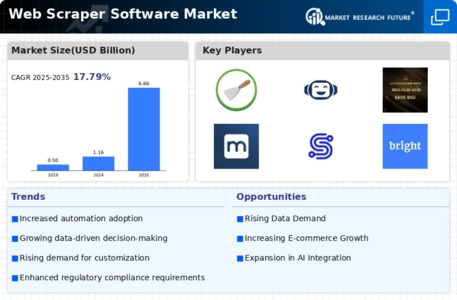
The Global Web Scraper Software Market is projected to grow from 1.16 USD Billion in 2024 to 6.86 USD Billion by 2035.

Key Market Trends & Highlights

Web Scraper Software Key Trends and Highlights

  • The market is expected to experience a compound annual growth rate (CAGR) of 17.54% from 2025 to 2035. By 2035, the market valuation is anticipated to reach 6.86 USD Billion, indicating robust growth potential. In 2024, the market is valued at 1.16 USD Billion, reflecting the increasing demand for data extraction solutions. Growing adoption of web scraping technology due to the need for competitive intelligence is a major market driver.

Market Size & Forecast

2024 Market Size 1.16 (USD Billion)
2035 Market Size 6.86 (USD Billion)
CAGR (2025-2035) 17.54%
Largest Regional Market Share in 2024 latin_america)

Major Players

Scrapy, Diffbot, Fminer, Data Collector, Octoparse, Mozenda, ScraperAPI, Bright Data, WebHarvy, Content Grabber, Import.io, ParseHub, DataMiner, Apify, Web Scraper IO

Market Trends

The Web Scraper Software Market is experiencing a surge driven by the increasing need for data analysis across various sectors such as e-commerce, finance, and digital marketing. Businesses are heavily relying on data-driven insights to stay competitive, and web scraping provides a cost-effective way to gather crucial information from websites. The rise in digital content and the expansion of online businesses further fuel this demand. Additionally, the growing awareness of the importance of big data analytics is pushing companies to adopt web scraping tools to streamline their operations and enhance decision-making processes.

There are numerous opportunities to be explored in this market, particularly with advancements in artificial intelligence and machine learning. All these technologies enable more advanced scraping methods and improved data processing capabilities. Businesses intend to devise tools that not only fetch data but also sort and interpret it efficiently. In the ever-increasing risk of data usage ethics, there is a strong market advantage for software that is able to gather data whilst managing to follow the rules.

Moreover, the emergence of the need for diversity in scraping tools has given developers a chance to tailor their products for certain industries or customers. More recent news shows that there is a transition to solutions that are easy to operate and automated in processes. Customers want web scrapers that do not need many skills and can perform all the complex activities with just a click on the interface.

Tools that can handle dynamic websites and adapt to changing structures of web pages are gaining traction. Another notable trend is the focus on integration capabilities, allowing web scrapers to work seamlessly with other data processing tools. In this context, cloud-based solutions are becoming more popular, providing accessibility and scalability for businesses of all sizes.


Source: Primary Research, Secondary Research, Market Research Future Database and Analyst Review

Web Scrapper Software Market Market Drivers

Emergence of Big Data Analytics

The emergence of big data analytics significantly influences the Global Web Scraper Software Market Industry. As organizations accumulate vast amounts of data from various sources, the need for effective data extraction and analysis becomes paramount. Web scraping tools enable businesses to harness this data, transforming it into actionable insights that drive decision-making. The increasing reliance on big data analytics across sectors such as healthcare, finance, and marketing is likely to propel the demand for web scraping solutions. This trend suggests a promising future for the market, as companies seek to leverage data for competitive advantage.

Rising Demand for Data-Driven Insights

The Global Web Scraper Software Market Industry experiences a surge in demand for data-driven insights across various sectors. Organizations increasingly rely on data analytics to inform strategic decisions, enhance customer experiences, and optimize operations. This trend is particularly evident in industries such as e-commerce, finance, and marketing, where timely access to competitive intelligence is crucial. As businesses seek to harness vast amounts of online data, the market is projected to reach 1.16 USD Billion in 2024, indicating a robust growth trajectory. The need for efficient data extraction tools is likely to drive innovation and adoption of web scraping solutions.

Advancements in Technology and Automation

Technological advancements and automation play a pivotal role in shaping the Global Web Scraper Software Market Industry. Innovations in artificial intelligence, machine learning, and natural language processing enhance the capabilities of web scraping tools, allowing for more sophisticated data extraction and analysis. These advancements enable users to automate repetitive tasks, thereby increasing efficiency and accuracy in data collection. As organizations seek to leverage these technologies, the demand for advanced web scraping solutions is likely to rise. This trend may contribute to the market's growth, as businesses increasingly recognize the value of integrating automated data extraction into their operations.

Growth of E-Commerce and Online Businesses

The expansion of e-commerce and online businesses significantly propels the Global Web Scraper Software Market Industry. With the increasing number of online retailers and service providers, there is a heightened necessity for businesses to monitor competitors, track pricing strategies, and analyze consumer behavior. This competitive landscape fosters the adoption of web scraping tools that enable companies to gather and analyze data effectively. As the market evolves, it is anticipated to grow to 6.86 USD Billion by 2035, reflecting a compound annual growth rate of 17.54% from 2025 to 2035. This growth underscores the vital role of web scraping in the digital economy.

Regulatory Compliance and Data Privacy Concerns

The Global Web Scraper Software Market Industry faces challenges related to regulatory compliance and data privacy concerns. As governments worldwide implement stricter data protection regulations, organizations must navigate these complexities while utilizing web scraping tools. Compliance with laws such as the General Data Protection Regulation (GDPR) and the California Consumer Privacy Act (CCPA) necessitates that businesses adopt ethical scraping practices. This evolving regulatory landscape may drive demand for web scraping solutions that prioritize compliance and data security. Consequently, companies that offer compliant web scraping tools could gain a competitive advantage in the market.

Market Segment Insights

By Application: Data Extraction (Largest) vs. Price Monitoring (Fastest-Growing)

<p>In the Web Scraper Software Market, Data Extraction holds the largest market share, driven by its critical role in enabling businesses to gather essential information from diverse online sources. This capability is increasingly vital as organizations seek to leverage data for strategic decision-making. Following closely, Price Monitoring is emerging as the fastest-growing segment, reflecting the rising necessity of competitive pricing strategies in e-commerce and retail sectors where real-time data is crucial.</p>

<p>Market Research Future: Data Extraction (Dominant) vs. Content Scraping (Emerging)</p>

<p>Data Extraction remains the dominant application within the Web Scraper Software Market, catering to enterprises that require comprehensive data aggregation from websites, ensuring they can draw actionable insights swiftly. Its adaptability across industries makes it indispensable. In contrast, Content Scraping is an emerging application, gaining traction due to the growing need for businesses to assemble rich content for marketing and SEO purposes. As digital content evolves, Content Scraping tools are increasingly designed to navigate complex web architectures, presenting new opportunities for market players.</p>

By Deployment Mode: Cloud-Based (Largest) vs. On-Premises (Fastest-Growing)

<p>In the Web Scraper Software Market, the distribution of deployment modes reveals a significant preference for Cloud-Based solutions, which currently lead the market in share. This segment appeals to a wide range of users due to its scalability, accessibility, and cost-effectiveness. On-Premises solutions, while smaller in market share, are gaining traction, especially in industries with stringent data security requirements and compliance standards. As businesses transition towards digitalization, cloud offerings are experiencing consistent growth fueled by remote work trends and the need for agile operational models. However, the On-Premises segment is emerging as the fastest-growing due to a renewed focus on data privacy and security. Organizations that prioritize control over their infrastructure are increasingly investing in on-prem solutions, allowing for a dual-track market strategy that accommodates diverse customer needs.</p>

<p>Deployment Mode: Cloud-Based (Dominant) vs. On-Premises (Emerging)</p>

<p>Cloud-Based deployment in the Web Scraper Software Market offers unmatched flexibility and ease of access, making it the dominant choice for many organizations. It allows users to leverage cloud infrastructure for enhanced scalability and collaboration. This deployment mode supports rapid deployment and lower initial investment, making it appealing for startups and SMEs. Conversely, On-Premises solutions are positioned as an emerging choice for organizations with strict control over their data environment. This segment values security and compliance, catering to businesses in regulated industries. The increasing emphasis on data integrity and privacy is driving growth in the On-Premises segment, as companies seek reliable and secure options for their web scraping initiatives.</p>

By End User: Small and Medium Enterprises (Largest) vs. Large Enterprises (Fastest-Growing)

<p>The Web Scraper Software Market is significantly influenced by the end-user segment, with Small and Medium Enterprises (SMEs) leading the market. SMEs leverage web scraping tools to gain insights and optimize their operations in a competitive landscape. On the other hand, Large Enterprises are also making substantial contributions but are seen as emerging players due to their increasing adoption of advanced web scraping solutions to enhance their data-driven decision-making capabilities. Growth trends indicate a marked shift towards digital transformation across all sectors. SMEs benefit from affordable and user-friendly scraping tools, enabling them to harness data for marketing and analysis. In contrast, Large Enterprises are increasingly investing in robust software solutions for extensive data extraction, prompting rapid growth in this segment. Factors like the need for agile data acquisition and competitive intelligence drive this trend.</p>

<p>SMEs (Dominant) vs. Individual Users (Emerging)</p>

<p>SMEs stand out as the dominant force in the Web Scraper Software Market, primarily due to their growing need for data insights to remain competitive. These enterprises utilize scraping tools effectively to monitor market trends, gather competitive data, and improve their operational efficiencies. Their robust adoption rates indicate a clear reliance on web scraping for marketing analytics, customer insights, and business intelligence. Conversely, Individual Users represent an emerging segment within the market. They utilize web scraper software predominantly for personal projects, research, and small-scale data analysis. While their adoption is lower than that of SMEs, the increase in tech-savvy individuals and freelance professionals pursuing data extraction tasks suggests a growing interest in web scraping tools. The market dynamics are likely to evolve as both segments continue to adapt to the changing digital landscape.</p>

By Type: Commercial (Largest) vs. Open Source (Fastest-Growing)

<p>In the Web Scraper Software Market, the segment distribution reveals that Commercial solutions are currently the largest players, boasting a significant share of the market. This dominance stems from their robust features, dedicated customer support, and comprehensive pricing models that cater to a wide range of users, including businesses of varying sizes. Open Source scrapers, on the other hand, are gaining traction due to their flexibility, cost-effectiveness, and the growing community support that enhances their appeal, particularly among startups and tech enthusiasts who prefer customizable solutions. Growth trends in this segment indicate a dynamic shift, with Open Source software emerging as the fastest-growing category. Factors contributing to this growth include increased demand for personalized solutions, rising cybersecurity awareness, and an upsurge in data-driven decision-making across various industries. As organizations look to leverage data scraping tools to gain competitive advantages, the demand for customized, open-source solutions is likely to continue its upward trajectory, further challenging the established Commercial segment.</p>

<p>Commercial (Dominant) vs. Open Source (Emerging)</p>

<p>The Commercial segment of the Web Scraper Software Market represents the dominant force, characterized by advanced features, extensive support, and sustained innovation. These solutions often come with licenses that include guarantees for ongoing updates and security, making them a preferred choice for enterprise-level clients who require reliability and performance. Conversely, the Open Source segment is rapidly becoming an emerging alternative, appealing to developers and businesses that prioritize customization, scalability, and cost-saving benefits. The community-driven aspect of Open Source allows for a continuous evolution of tools based on user feedback, fostering creativity and collaboration that can lead to breakthrough innovations. This duality in market characteristics sets the stage for a competitive and evolving landscape.</p>

Web Scraper Software Market End User Insights

The Web Scraper Software Market is experiencing substantial growth, particularly driven by various end users. In 2023, the market was valued at 0.96 billion USD, reflecting rising demand for efficient <a href="data%20extraction%20-%20https://www.marketresearchfuture.com/reports/data-extraction-market-29944">data extraction </a>tools across different sectors. Among the end users, Small and Medium Enterprises (SMEs) play a vital role due to their need for cost-effective solutions to harness market intelligence and competitive data. Large Enterprises dominate the web scraping scene, utilizing sophisticated software to gain insights from vast data pools, which aids in strategic decision-making.

Get more detailed insights about Web Scrapper Software Market Research Report—Global Forecast till 2035

Regional Insights

The Web Scraper Software Market is showcasing robust growth across various regions, with overall market revenue expected to reach 0.96 USD Billion in 2023 and projected to grow significantly by 2032. In North America, the market is valued at 0.42 USD Billion in 2023, holding a majority share, and is projected to expand to 1.84 USD Billion by 2032, reflecting its strong dominance due to high digital adoption and data-driven decision-making. Europe follows with a valuation of 0.25 USD Billion in 2023 and an expected rise to 1.1 USD Billion in 2032, driven by increasing demand for data analytics.

The Asia Pacific (APAC) region stands at 0.22 USD Billion in 2023, growing to 1.11 USD Billion by 2032, marking it as a significant market due to rapid technological advancements and rising investment in web scraping technologies. South America, while smaller at 0.05 USD Billion in 2023, is gradually gaining traction and is anticipated to reach 0.25 USD Billion by 2032, driven by an increase in internet penetration.

Lastly, the Middle East and Africa (MEA) starts from a modest 0.02 USD Billion in 2023 but holds potential for growth, expected to reach 0.1 USD Billion by 2032, reflecting emerging trends in digital transformation. Overall, the Web Scraper Software Market segmentation illustrates strong variations in growth potential and market dynamics across these regions.

Key Players and Competitive Insights

The Web Scraper Software Market is characterized by a rapidly evolving landscape driven by the increasing demand for data extraction and analysis across various industries. As businesses aim to harness the power of big data, web scraper software has become vital in enabling them to collect valuable information from websites efficiently. The competitive insights within this market reveal a focus on innovation, user-friendliness, and scalability as companies strive to differentiate themselves. With advancements in technology and growing data-driven decision-making, the market is witnessing a surge in various web scraping solutions tailored to meet diverse customer needs. As a result, companies must continuously adapt and enhance their offerings to maintain a competitive edge in this dynamic environment. Scrapy has established itself as a formidable player in the Web Scraper Software Market, renowned for its robust framework that allows developers to construct powerful web scraping applications. Known for its flexibility and efficiency, Scrapy fosters an active community that contributes to its continuous improvement and support. The platform's strengths lie in its ability to handle large-scale web scraping projects with ease, offering features such as built-in support for handling requests, data processing, and exporting scraped data in various formats. Additionally, Scrapy's high-performance capabilities enable users to efficiently scrape websites without the common issues related to rate limiting or temporary IP bans. This strong performance, coupled with a rich set of libraries and tools, solidifies Scrapy's position in the market as a leading web scraping solution, catering to the needs of developers and businesses alike. Diffbot, another notable entity within the Web Scraper Software Market, is distinguished by its advanced artificial intelligence-driven approach to web scraping. By utilizing machine learning algorithms to analyze web pages, Diffbot automates the extraction of structured data, transforming unstructured content from websites into usable data sets. This capability provides organizations access to large volumes of relevant information without the technical complexities associated with traditional scraping methods. The strength of Diffbot lies in its ability to deliver accurate and up-to-date data, enhancing the decision-making processes for clients across various sectors. Additionally, Diffbot offers an intuitive API that integrates seamlessly into existing systems, further facilitating the extraction of data from complex websites. As businesses navigate the wealth of information available online, Diffbot's innovative solutions are becoming an indispensable resource for organizations looking to gain a competitive advantage in their respective markets.

Key Companies in the Web Scrapper Software Market include

Industry Developments

Recent developments in the Web Scraper Software Market have been notable, particularly with heightened competition and innovation among key players such as Scrapy, Diffbot, and Octoparse. Companies like Mozenda and DataMiner are also expanding their offerings, integrating advanced machine-learning features to enhance data extraction capabilities. There has been a noticeable shift towards automating scraping processes, which is driving demand from smaller businesses looking to leverage data for competitive advantage. Moreover, recent valuation increases among firms in this sector signal robust growth potential, with organizations like Bright Data and ScraperAPI leading the charge.

In terms of mergers and acquisitions, there have been strategic moves within the market, aiming to consolidate resources and broaden service portfolios, although no recent mergers involving the companies of interest have been widely reported.

Current market dynamics are characterized by increased investments in research and development, ensuring that solutions remain responsive to evolving customer needs and compliance regulations. The impact of these developments is visible in the improved feature sets and usability of products offered by providers like ParseHub and WebHarvy, positioning them favorably within a growing market landscape.

Future Outlook

Web Scrapper Software Market Future Outlook

The Global <a href="web%20scraper%20software%20-%20https://www.marketresearchfuture.com/reports/web-scraper-software-market-10347">Web Scraper Software </a>Market is projected to grow at a 17.54% CAGR from 2025 to 2035, driven by increasing data-driven decision-making and the demand for competitive intelligence.

New opportunities lie in:

  • <p>Develop AI-driven scraping tools to enhance data extraction efficiency. Expand services to include real-time data monitoring for businesses. Create customizable scraping solutions tailored for niche industries.</p>

By 2035, the market is expected to be robust, reflecting substantial growth and innovation.

Market Segmentation

Web Scraper Software Market Type Outlook

  • {""=>["North America"
  • "Europe"
  • "South America"
  • "Asia Pacific"
  • "Middle East and Africa"]}

Web Scraper Software Market End User Outlook

  • {""=>["Open Source"
  • "Commercial"
  • "Enterprise"]}

Web Scraper Software Market Application Outlook

  • {""=>["Cloud-Based"
  • "On-Premises"]}

Web Scraper Software Market Deployment Mode Outlook

  • {""=>["Small and Medium Enterprises"
  • "Large Enterprises"
  • "Individual Users"]}

Report Scope

Report Attribute/Metric Details
Market Size 2022 0.82 (USD Billion)
Market Size 2023 0.96 (USD Billion)
Market Size 2032 4.2 (USD Billion)
Compound Annual Growth Rate (CAGR) 17.79% (2024 - 2032)
Report Coverage Revenue Forecast, Competitive Landscape, Growth Factors, and Trends
Base Year 2023
Market Forecast Period 2024 - 2032
Historical Data 2019 - 2023
Market Forecast Units USD Billion
Key Companies Profiled Scrapy, Diffbot, Fminer, Data Collector, Octoparse, Mozenda, ScraperAPI, Bright Data, WebHarvy, Content Grabber, Import.io, ParseHub, DataMiner, Apify, Web Scraper IO
Segments Covered Application, Deployment Mode, End User, Type, Regional
Key Market Opportunities Increased demand for data analytics, Growth of e-commerce platforms, Expansion of AI and machine learning, Rising need for competitive intelligence, Integration with cloud services
Key Market Dynamics Rising data-driven decision-making, Increasing regulatory scrutiny, Growing e-commerce adoption, Advancements in AI technologies, Demand for competitive intelligence tools
Countries Covered North America, Europe, APAC, South America, MEA

FAQs

What is the projected market valuation for the Web Scraper Software Market in 2035?

<p>The projected market valuation for the Web Scraper Software Market in 2035 is 6.848 USD Billion.</p>

What was the overall market valuation for the Web Scraper Software Market in 2024?

<p>The overall market valuation for the Web Scraper Software Market in 2024 was 1.131 USD Billion.</p>

What is the expected CAGR for the Web Scraper Software Market during the forecast period 2025 - 2035?

<p>The expected CAGR for the Web Scraper Software Market during the forecast period 2025 - 2035 is 17.79%.</p>

Which deployment mode segment is projected to have the highest valuation by 2035?

<p>The Cloud-Based deployment mode segment is projected to reach 3.424 USD Billion by 2035.</p>

How do the valuations of small and medium enterprises compare to large enterprises in the Web Scraper Software Market?

<p>Both small and medium enterprises and large enterprises are projected to have equal valuations of 2.592 USD Billion by 2035.</p>

What are the key applications driving growth in the Web Scraper Software Market?

<p>Key applications driving growth include Data Extraction, Price Monitoring, Market Research Future, and Content Scraping, with Data Extraction projected to reach 2.739 USD Billion by 2035.</p>

Which type segment is expected to dominate the market by 2035?

<p>The Enterprise type segment is expected to dominate the market, projected to reach 2.756 USD Billion by 2035.</p>

Who are the leading players in the Web Scraper Software Market?

<p>Leading players in the Web Scraper Software Market include Octoparse, ParseHub, Scrapy, and Diffbot.</p>

What is the projected valuation for the Open Source segment by 2035?

<p>The Open Source segment is projected to reach 1.364 USD Billion by 2035.</p>

How does the market for individual users compare to other end-user segments?

<p>The market for individual users is projected to reach 1.664 USD Billion by 2035, which is lower than both small and medium enterprises and large enterprises.</p>

  1. SECTION I: EXECUTIVE SUMMARY AND KEY HIGHLIGHTS
    1. | 1.1 EXECUTIVE SUMMARY
    2. | | 1.1.1 Market Overview
    3. | | 1.1.2 Key Findings
    4. | | 1.1.3 Market Segmentation
    5. | | 1.1.4 Competitive Landscape
    6. | | 1.1.5 Challenges and Opportunities
    7. | | 1.1.6 Future Outlook
  2. SECTION II: SCOPING, METHODOLOGY AND MARKET STRUCTURE
    1. | 2.1 MARKET INTRODUCTION
    2. | | 2.1.1 Definition
    3. | | 2.1.2 Scope of the study
    4. | | | 2.1.2.1 Research Objective
    5. | | | 2.1.2.2 Assumption
    6. | | | 2.1.2.3 Limitations
    7. | 2.2 RESEARCH METHODOLOGY
    8. | | 2.2.1 Overview
    9. | | 2.2.2 Data Mining
    10. | | 2.2.3 Secondary Research
    11. | | 2.2.4 Primary Research
    12. | | | 2.2.4.1 Primary Interviews and Information Gathering Process
    13. | | | 2.2.4.2 Breakdown of Primary Respondents
    14. | | 2.2.5 Forecasting Model
    15. | | 2.2.6 Market Size Estimation
    16. | | | 2.2.6.1 Bottom-Up Approach
    17. | | | 2.2.6.2 Top-Down Approach
    18. | | 2.2.7 Data Triangulation
    19. | | 2.2.8 Validation
  3. SECTION III: QUALITATIVE ANALYSIS
    1. | 3.1 MARKET DYNAMICS
    2. | | 3.1.1 Overview
    3. | | 3.1.2 Drivers
    4. | | 3.1.3 Restraints
    5. | | 3.1.4 Opportunities
    6. | 3.2 MARKET FACTOR ANALYSIS
    7. | | 3.2.1 Value chain Analysis
    8. | | 3.2.2 Porter's Five Forces Analysis
    9. | | | 3.2.2.1 Bargaining Power of Suppliers
    10. | | | 3.2.2.2 Bargaining Power of Buyers
    11. | | | 3.2.2.3 Threat of New Entrants
    12. | | | 3.2.2.4 Threat of Substitutes
    13. | | | 3.2.2.5 Intensity of Rivalry
    14. | | 3.2.3 COVID-19 Impact Analysis
    15. | | | 3.2.3.1 Market Impact Analysis
    16. | | | 3.2.3.2 Regional Impact
    17. | | | 3.2.3.3 Opportunity and Threat Analysis
  4. SECTION IV: QUANTITATIVE ANALYSIS
    1. | 4.1 Information and Communications Technology, BY Application (USD Billion)
    2. | | 4.1.1 Data Extraction
    3. | | 4.1.2 Price Monitoring
    4. | | 4.1.3 Market Research Future
    5. | | 4.1.4 Content Scraping
    6. | 4.2 Information and Communications Technology, BY Deployment Mode (USD Billion)
    7. | | 4.2.1 Cloud-Based
    8. | | 4.2.2 On-Premises
    9. | 4.3 Information and Communications Technology, BY End User (USD Billion)
    10. | | 4.3.1 Small and Medium Enterprises
    11. | | 4.3.2 Large Enterprises
    12. | | 4.3.3 Individual Users
    13. | 4.4 Information and Communications Technology, BY Type (USD Billion)
    14. | | 4.4.1 Open Source
    15. | | 4.4.2 Commercial
    16. | | 4.4.3 Enterprise
    17. | 4.5 Information and Communications Technology, BY Region (USD Billion)
    18. | | 4.5.1 North America
    19. | | | 4.5.1.1 US
    20. | | | 4.5.1.2 Canada
    21. | | 4.5.2 Europe
    22. | | | 4.5.2.1 Germany
    23. | | | 4.5.2.2 UK
    24. | | | 4.5.2.3 France
    25. | | | 4.5.2.4 Russia
    26. | | | 4.5.2.5 Italy
    27. | | | 4.5.2.6 Spain
    28. | | | 4.5.2.7 Rest of Europe
    29. | | 4.5.3 APAC
    30. | | | 4.5.3.1 China
    31. | | | 4.5.3.2 India
    32. | | | 4.5.3.3 Japan
    33. | | | 4.5.3.4 South Korea
    34. | | | 4.5.3.5 Malaysia
    35. | | | 4.5.3.6 Thailand
    36. | | | 4.5.3.7 Indonesia
    37. | | | 4.5.3.8 Rest of APAC
    38. | | 4.5.4 South America
    39. | | | 4.5.4.1 Brazil
    40. | | | 4.5.4.2 Mexico
    41. | | | 4.5.4.3 Argentina
    42. | | | 4.5.4.4 Rest of South America
    43. | | 4.5.5 MEA
    44. | | | 4.5.5.1 GCC Countries
    45. | | | 4.5.5.2 South Africa
    46. | | | 4.5.5.3 Rest of MEA
  5. SECTION V: COMPETITIVE ANALYSIS
    1. | 5.1 Competitive Landscape
    2. | | 5.1.1 Overview
    3. | | 5.1.2 Competitive Analysis
    4. | | 5.1.3 Market share Analysis
    5. | | 5.1.4 Major Growth Strategy in the Information and Communications Technology
    6. | | 5.1.5 Competitive Benchmarking
    7. | | 5.1.6 Leading Players in Terms of Number of Developments in the Information and Communications Technology
    8. | | 5.1.7 Key developments and growth strategies
    9. | | | 5.1.7.1 New Product Launch/Service Deployment
    10. | | | 5.1.7.2 Merger & Acquisitions
    11. | | | 5.1.7.3 Joint Ventures
    12. | | 5.1.8 Major Players Financial Matrix
    13. | | | 5.1.8.1 Sales and Operating Income
    14. | | | 5.1.8.2 Major Players R&D Expenditure. 2023
    15. | 5.2 Company Profiles
    16. | | 5.2.1 Octoparse (CN)
    17. | | | 5.2.1.1 Financial Overview
    18. | | | 5.2.1.2 Products Offered
    19. | | | 5.2.1.3 Key Developments
    20. | | | 5.2.1.4 SWOT Analysis
    21. | | | 5.2.1.5 Key Strategies
    22. | | 5.2.2 ParseHub (US)
    23. | | | 5.2.2.1 Financial Overview
    24. | | | 5.2.2.2 Products Offered
    25. | | | 5.2.2.3 Key Developments
    26. | | | 5.2.2.4 SWOT Analysis
    27. | | | 5.2.2.5 Key Strategies
    28. | | 5.2.3 Scrapy (US)
    29. | | | 5.2.3.1 Financial Overview
    30. | | | 5.2.3.2 Products Offered
    31. | | | 5.2.3.3 Key Developments
    32. | | | 5.2.3.4 SWOT Analysis
    33. | | | 5.2.3.5 Key Strategies
    34. | | 5.2.4 WebHarvy (IN)
    35. | | | 5.2.4.1 Financial Overview
    36. | | | 5.2.4.2 Products Offered
    37. | | | 5.2.4.3 Key Developments
    38. | | | 5.2.4.4 SWOT Analysis
    39. | | | 5.2.4.5 Key Strategies
    40. | | 5.2.5 Diffbot (US)
    41. | | | 5.2.5.1 Financial Overview
    42. | | | 5.2.5.2 Products Offered
    43. | | | 5.2.5.3 Key Developments
    44. | | | 5.2.5.4 SWOT Analysis
    45. | | | 5.2.5.5 Key Strategies
    46. | | 5.2.6 DataMiner (US)
    47. | | | 5.2.6.1 Financial Overview
    48. | | | 5.2.6.2 Products Offered
    49. | | | 5.2.6.3 Key Developments
    50. | | | 5.2.6.4 SWOT Analysis
    51. | | | 5.2.6.5 Key Strategies
    52. | | 5.2.7 Import.io (US)
    53. | | | 5.2.7.1 Financial Overview
    54. | | | 5.2.7.2 Products Offered
    55. | | | 5.2.7.3 Key Developments
    56. | | | 5.2.7.4 SWOT Analysis
    57. | | | 5.2.7.5 Key Strategies
    58. | | 5.2.8 Apify (CZ)
    59. | | | 5.2.8.1 Financial Overview
    60. | | | 5.2.8.2 Products Offered
    61. | | | 5.2.8.3 Key Developments
    62. | | | 5.2.8.4 SWOT Analysis
    63. | | | 5.2.8.5 Key Strategies
    64. | | 5.2.9 Content Grabber (AU)
    65. | | | 5.2.9.1 Financial Overview
    66. | | | 5.2.9.2 Products Offered
    67. | | | 5.2.9.3 Key Developments
    68. | | | 5.2.9.4 SWOT Analysis
    69. | | | 5.2.9.5 Key Strategies
    70. | 5.3 Appendix
    71. | | 5.3.1 References
    72. | | 5.3.2 Related Reports
  6. LIST OF FIGURES
    1. | 6.1 MARKET SYNOPSIS
    2. | 6.2 NORTH AMERICA MARKET ANALYSIS
    3. | 6.3 US MARKET ANALYSIS BY APPLICATION
    4. | 6.4 US MARKET ANALYSIS BY DEPLOYMENT MODE
    5. | 6.5 US MARKET ANALYSIS BY END USER
    6. | 6.6 US MARKET ANALYSIS BY TYPE
    7. | 6.7 CANADA MARKET ANALYSIS BY APPLICATION
    8. | 6.8 CANADA MARKET ANALYSIS BY DEPLOYMENT MODE
    9. | 6.9 CANADA MARKET ANALYSIS BY END USER
    10. | 6.10 CANADA MARKET ANALYSIS BY TYPE
    11. | 6.11 EUROPE MARKET ANALYSIS
    12. | 6.12 GERMANY MARKET ANALYSIS BY APPLICATION
    13. | 6.13 GERMANY MARKET ANALYSIS BY DEPLOYMENT MODE
    14. | 6.14 GERMANY MARKET ANALYSIS BY END USER
    15. | 6.15 GERMANY MARKET ANALYSIS BY TYPE
    16. | 6.16 UK MARKET ANALYSIS BY APPLICATION
    17. | 6.17 UK MARKET ANALYSIS BY DEPLOYMENT MODE
    18. | 6.18 UK MARKET ANALYSIS BY END USER
    19. | 6.19 UK MARKET ANALYSIS BY TYPE
    20. | 6.20 FRANCE MARKET ANALYSIS BY APPLICATION
    21. | 6.21 FRANCE MARKET ANALYSIS BY DEPLOYMENT MODE
    22. | 6.22 FRANCE MARKET ANALYSIS BY END USER
    23. | 6.23 FRANCE MARKET ANALYSIS BY TYPE
    24. | 6.24 RUSSIA MARKET ANALYSIS BY APPLICATION
    25. | 6.25 RUSSIA MARKET ANALYSIS BY DEPLOYMENT MODE
    26. | 6.26 RUSSIA MARKET ANALYSIS BY END USER
    27. | 6.27 RUSSIA MARKET ANALYSIS BY TYPE
    28. | 6.28 ITALY MARKET ANALYSIS BY APPLICATION
    29. | 6.29 ITALY MARKET ANALYSIS BY DEPLOYMENT MODE
    30. | 6.30 ITALY MARKET ANALYSIS BY END USER
    31. | 6.31 ITALY MARKET ANALYSIS BY TYPE
    32. | 6.32 SPAIN MARKET ANALYSIS BY APPLICATION
    33. | 6.33 SPAIN MARKET ANALYSIS BY DEPLOYMENT MODE
    34. | 6.34 SPAIN MARKET ANALYSIS BY END USER
    35. | 6.35 SPAIN MARKET ANALYSIS BY TYPE
    36. | 6.36 REST OF EUROPE MARKET ANALYSIS BY APPLICATION
    37. | 6.37 REST OF EUROPE MARKET ANALYSIS BY DEPLOYMENT MODE
    38. | 6.38 REST OF EUROPE MARKET ANALYSIS BY END USER
    39. | 6.39 REST OF EUROPE MARKET ANALYSIS BY TYPE
    40. | 6.40 APAC MARKET ANALYSIS
    41. | 6.41 CHINA MARKET ANALYSIS BY APPLICATION
    42. | 6.42 CHINA MARKET ANALYSIS BY DEPLOYMENT MODE
    43. | 6.43 CHINA MARKET ANALYSIS BY END USER
    44. | 6.44 CHINA MARKET ANALYSIS BY TYPE
    45. | 6.45 INDIA MARKET ANALYSIS BY APPLICATION
    46. | 6.46 INDIA MARKET ANALYSIS BY DEPLOYMENT MODE
    47. | 6.47 INDIA MARKET ANALYSIS BY END USER
    48. | 6.48 INDIA MARKET ANALYSIS BY TYPE
    49. | 6.49 JAPAN MARKET ANALYSIS BY APPLICATION
    50. | 6.50 JAPAN MARKET ANALYSIS BY DEPLOYMENT MODE
    51. | 6.51 JAPAN MARKET ANALYSIS BY END USER
    52. | 6.52 JAPAN MARKET ANALYSIS BY TYPE
    53. | 6.53 SOUTH KOREA MARKET ANALYSIS BY APPLICATION
    54. | 6.54 SOUTH KOREA MARKET ANALYSIS BY DEPLOYMENT MODE
    55. | 6.55 SOUTH KOREA MARKET ANALYSIS BY END USER
    56. | 6.56 SOUTH KOREA MARKET ANALYSIS BY TYPE
    57. | 6.57 MALAYSIA MARKET ANALYSIS BY APPLICATION
    58. | 6.58 MALAYSIA MARKET ANALYSIS BY DEPLOYMENT MODE
    59. | 6.59 MALAYSIA MARKET ANALYSIS BY END USER
    60. | 6.60 MALAYSIA MARKET ANALYSIS BY TYPE
    61. | 6.61 THAILAND MARKET ANALYSIS BY APPLICATION
    62. | 6.62 THAILAND MARKET ANALYSIS BY DEPLOYMENT MODE
    63. | 6.63 THAILAND MARKET ANALYSIS BY END USER
    64. | 6.64 THAILAND MARKET ANALYSIS BY TYPE
    65. | 6.65 INDONESIA MARKET ANALYSIS BY APPLICATION
    66. | 6.66 INDONESIA MARKET ANALYSIS BY DEPLOYMENT MODE
    67. | 6.67 INDONESIA MARKET ANALYSIS BY END USER
    68. | 6.68 INDONESIA MARKET ANALYSIS BY TYPE
    69. | 6.69 REST OF APAC MARKET ANALYSIS BY APPLICATION
    70. | 6.70 REST OF APAC MARKET ANALYSIS BY DEPLOYMENT MODE
    71. | 6.71 REST OF APAC MARKET ANALYSIS BY END USER
    72. | 6.72 REST OF APAC MARKET ANALYSIS BY TYPE
    73. | 6.73 SOUTH AMERICA MARKET ANALYSIS
    74. | 6.74 BRAZIL MARKET ANALYSIS BY APPLICATION
    75. | 6.75 BRAZIL MARKET ANALYSIS BY DEPLOYMENT MODE
    76. | 6.76 BRAZIL MARKET ANALYSIS BY END USER
    77. | 6.77 BRAZIL MARKET ANALYSIS BY TYPE
    78. | 6.78 MEXICO MARKET ANALYSIS BY APPLICATION
    79. | 6.79 MEXICO MARKET ANALYSIS BY DEPLOYMENT MODE
    80. | 6.80 MEXICO MARKET ANALYSIS BY END USER
    81. | 6.81 MEXICO MARKET ANALYSIS BY TYPE
    82. | 6.82 ARGENTINA MARKET ANALYSIS BY APPLICATION
    83. | 6.83 ARGENTINA MARKET ANALYSIS BY DEPLOYMENT MODE
    84. | 6.84 ARGENTINA MARKET ANALYSIS BY END USER
    85. | 6.85 ARGENTINA MARKET ANALYSIS BY TYPE
    86. | 6.86 REST OF SOUTH AMERICA MARKET ANALYSIS BY APPLICATION
    87. | 6.87 REST OF SOUTH AMERICA MARKET ANALYSIS BY DEPLOYMENT MODE
    88. | 6.88 REST OF SOUTH AMERICA MARKET ANALYSIS BY END USER
    89. | 6.89 REST OF SOUTH AMERICA MARKET ANALYSIS BY TYPE
    90. | 6.90 MEA MARKET ANALYSIS
    91. | 6.91 GCC COUNTRIES MARKET ANALYSIS BY APPLICATION
    92. | 6.92 GCC COUNTRIES MARKET ANALYSIS BY DEPLOYMENT MODE
    93. | 6.93 GCC COUNTRIES MARKET ANALYSIS BY END USER
    94. | 6.94 GCC COUNTRIES MARKET ANALYSIS BY TYPE
    95. | 6.95 SOUTH AFRICA MARKET ANALYSIS BY APPLICATION
    96. | 6.96 SOUTH AFRICA MARKET ANALYSIS BY DEPLOYMENT MODE
    97. | 6.97 SOUTH AFRICA MARKET ANALYSIS BY END USER
    98. | 6.98 SOUTH AFRICA MARKET ANALYSIS BY TYPE
    99. | 6.99 REST OF MEA MARKET ANALYSIS BY APPLICATION
    100. | 6.100 REST OF MEA MARKET ANALYSIS BY DEPLOYMENT MODE
    101. | 6.101 REST OF MEA MARKET ANALYSIS BY END USER
    102. | 6.102 REST OF MEA MARKET ANALYSIS BY TYPE
    103. | 6.103 KEY BUYING CRITERIA OF INFORMATION AND COMMUNICATIONS TECHNOLOGY
    104. | 6.104 RESEARCH PROCESS OF MRFR
    105. | 6.105 DRO ANALYSIS OF INFORMATION AND COMMUNICATIONS TECHNOLOGY
    106. | 6.106 DRIVERS IMPACT ANALYSIS: INFORMATION AND COMMUNICATIONS TECHNOLOGY
    107. | 6.107 RESTRAINTS IMPACT ANALYSIS: INFORMATION AND COMMUNICATIONS TECHNOLOGY
    108. | 6.108 SUPPLY / VALUE CHAIN: INFORMATION AND COMMUNICATIONS TECHNOLOGY
    109. | 6.109 INFORMATION AND COMMUNICATIONS TECHNOLOGY, BY APPLICATION, 2024 (% SHARE)
    110. | 6.110 INFORMATION AND COMMUNICATIONS TECHNOLOGY, BY APPLICATION, 2024 TO 2035 (USD Billion)
    111. | 6.111 INFORMATION AND COMMUNICATIONS TECHNOLOGY, BY DEPLOYMENT MODE, 2024 (% SHARE)
    112. | 6.112 INFORMATION AND COMMUNICATIONS TECHNOLOGY, BY DEPLOYMENT MODE, 2024 TO 2035 (USD Billion)
    113. | 6.113 INFORMATION AND COMMUNICATIONS TECHNOLOGY, BY END USER, 2024 (% SHARE)
    114. | 6.114 INFORMATION AND COMMUNICATIONS TECHNOLOGY, BY END USER, 2024 TO 2035 (USD Billion)
    115. | 6.115 INFORMATION AND COMMUNICATIONS TECHNOLOGY, BY TYPE, 2024 (% SHARE)
    116. | 6.116 INFORMATION AND COMMUNICATIONS TECHNOLOGY, BY TYPE, 2024 TO 2035 (USD Billion)
    117. | 6.117 BENCHMARKING OF MAJOR COMPETITORS
  7. LIST OF TABLES
    1. | 7.1 LIST OF ASSUMPTIONS
    2. | | 7.1.1
    3. | 7.2 North America MARKET SIZE ESTIMATES; FORECAST
    4. | | 7.2.1 BY APPLICATION, 2025-2035 (USD Billion)
    5. | | 7.2.2 BY DEPLOYMENT MODE, 2025-2035 (USD Billion)
    6. | | 7.2.3 BY END USER, 2025-2035 (USD Billion)
    7. | | 7.2.4 BY TYPE, 2025-2035 (USD Billion)
    8. | 7.3 US MARKET SIZE ESTIMATES; FORECAST
    9. | | 7.3.1 BY APPLICATION, 2025-2035 (USD Billion)
    10. | | 7.3.2 BY DEPLOYMENT MODE, 2025-2035 (USD Billion)
    11. | | 7.3.3 BY END USER, 2025-2035 (USD Billion)
    12. | | 7.3.4 BY TYPE, 2025-2035 (USD Billion)
    13. | 7.4 Canada MARKET SIZE ESTIMATES; FORECAST
    14. | | 7.4.1 BY APPLICATION, 2025-2035 (USD Billion)
    15. | | 7.4.2 BY DEPLOYMENT MODE, 2025-2035 (USD Billion)
    16. | | 7.4.3 BY END USER, 2025-2035 (USD Billion)
    17. | | 7.4.4 BY TYPE, 2025-2035 (USD Billion)
    18. | 7.5 Europe MARKET SIZE ESTIMATES; FORECAST
    19. | | 7.5.1 BY APPLICATION, 2025-2035 (USD Billion)
    20. | | 7.5.2 BY DEPLOYMENT MODE, 2025-2035 (USD Billion)
    21. | | 7.5.3 BY END USER, 2025-2035 (USD Billion)
    22. | | 7.5.4 BY TYPE, 2025-2035 (USD Billion)
    23. | 7.6 Germany MARKET SIZE ESTIMATES; FORECAST
    24. | | 7.6.1 BY APPLICATION, 2025-2035 (USD Billion)
    25. | | 7.6.2 BY DEPLOYMENT MODE, 2025-2035 (USD Billion)
    26. | | 7.6.3 BY END USER, 2025-2035 (USD Billion)
    27. | | 7.6.4 BY TYPE, 2025-2035 (USD Billion)
    28. | 7.7 UK MARKET SIZE ESTIMATES; FORECAST
    29. | | 7.7.1 BY APPLICATION, 2025-2035 (USD Billion)
    30. | | 7.7.2 BY DEPLOYMENT MODE, 2025-2035 (USD Billion)
    31. | | 7.7.3 BY END USER, 2025-2035 (USD Billion)
    32. | | 7.7.4 BY TYPE, 2025-2035 (USD Billion)
    33. | 7.8 France MARKET SIZE ESTIMATES; FORECAST
    34. | | 7.8.1 BY APPLICATION, 2025-2035 (USD Billion)
    35. | | 7.8.2 BY DEPLOYMENT MODE, 2025-2035 (USD Billion)
    36. | | 7.8.3 BY END USER, 2025-2035 (USD Billion)
    37. | | 7.8.4 BY TYPE, 2025-2035 (USD Billion)
    38. | 7.9 Russia MARKET SIZE ESTIMATES; FORECAST
    39. | | 7.9.1 BY APPLICATION, 2025-2035 (USD Billion)
    40. | | 7.9.2 BY DEPLOYMENT MODE, 2025-2035 (USD Billion)
    41. | | 7.9.3 BY END USER, 2025-2035 (USD Billion)
    42. | | 7.9.4 BY TYPE, 2025-2035 (USD Billion)
    43. | 7.10 Italy MARKET SIZE ESTIMATES; FORECAST
    44. | | 7.10.1 BY APPLICATION, 2025-2035 (USD Billion)
    45. | | 7.10.2 BY DEPLOYMENT MODE, 2025-2035 (USD Billion)
    46. | | 7.10.3 BY END USER, 2025-2035 (USD Billion)
    47. | | 7.10.4 BY TYPE, 2025-2035 (USD Billion)
    48. | 7.11 Spain MARKET SIZE ESTIMATES; FORECAST
    49. | | 7.11.1 BY APPLICATION, 2025-2035 (USD Billion)
    50. | | 7.11.2 BY DEPLOYMENT MODE, 2025-2035 (USD Billion)
    51. | | 7.11.3 BY END USER, 2025-2035 (USD Billion)
    52. | | 7.11.4 BY TYPE, 2025-2035 (USD Billion)
    53. | 7.12 Rest of Europe MARKET SIZE ESTIMATES; FORECAST
    54. | | 7.12.1 BY APPLICATION, 2025-2035 (USD Billion)
    55. | | 7.12.2 BY DEPLOYMENT MODE, 2025-2035 (USD Billion)
    56. | | 7.12.3 BY END USER, 2025-2035 (USD Billion)
    57. | | 7.12.4 BY TYPE, 2025-2035 (USD Billion)
    58. | 7.13 APAC MARKET SIZE ESTIMATES; FORECAST
    59. | | 7.13.1 BY APPLICATION, 2025-2035 (USD Billion)
    60. | | 7.13.2 BY DEPLOYMENT MODE, 2025-2035 (USD Billion)
    61. | | 7.13.3 BY END USER, 2025-2035 (USD Billion)
    62. | | 7.13.4 BY TYPE, 2025-2035 (USD Billion)
    63. | 7.14 China MARKET SIZE ESTIMATES; FORECAST
    64. | | 7.14.1 BY APPLICATION, 2025-2035 (USD Billion)
    65. | | 7.14.2 BY DEPLOYMENT MODE, 2025-2035 (USD Billion)
    66. | | 7.14.3 BY END USER, 2025-2035 (USD Billion)
    67. | | 7.14.4 BY TYPE, 2025-2035 (USD Billion)
    68. | 7.15 India MARKET SIZE ESTIMATES; FORECAST
    69. | | 7.15.1 BY APPLICATION, 2025-2035 (USD Billion)
    70. | | 7.15.2 BY DEPLOYMENT MODE, 2025-2035 (USD Billion)
    71. | | 7.15.3 BY END USER, 2025-2035 (USD Billion)
    72. | | 7.15.4 BY TYPE, 2025-2035 (USD Billion)
    73. | 7.16 Japan MARKET SIZE ESTIMATES; FORECAST
    74. | | 7.16.1 BY APPLICATION, 2025-2035 (USD Billion)
    75. | | 7.16.2 BY DEPLOYMENT MODE, 2025-2035 (USD Billion)
    76. | | 7.16.3 BY END USER, 2025-2035 (USD Billion)
    77. | | 7.16.4 BY TYPE, 2025-2035 (USD Billion)
    78. | 7.17 South Korea MARKET SIZE ESTIMATES; FORECAST
    79. | | 7.17.1 BY APPLICATION, 2025-2035 (USD Billion)
    80. | | 7.17.2 BY DEPLOYMENT MODE, 2025-2035 (USD Billion)
    81. | | 7.17.3 BY END USER, 2025-2035 (USD Billion)
    82. | | 7.17.4 BY TYPE, 2025-2035 (USD Billion)
    83. | 7.18 Malaysia MARKET SIZE ESTIMATES; FORECAST
    84. | | 7.18.1 BY APPLICATION, 2025-2035 (USD Billion)
    85. | | 7.18.2 BY DEPLOYMENT MODE, 2025-2035 (USD Billion)
    86. | | 7.18.3 BY END USER, 2025-2035 (USD Billion)
    87. | | 7.18.4 BY TYPE, 2025-2035 (USD Billion)
    88. | 7.19 Thailand MARKET SIZE ESTIMATES; FORECAST
    89. | | 7.19.1 BY APPLICATION, 2025-2035 (USD Billion)
    90. | | 7.19.2 BY DEPLOYMENT MODE, 2025-2035 (USD Billion)
    91. | | 7.19.3 BY END USER, 2025-2035 (USD Billion)
    92. | | 7.19.4 BY TYPE, 2025-2035 (USD Billion)
    93. | 7.20 Indonesia MARKET SIZE ESTIMATES; FORECAST
    94. | | 7.20.1 BY APPLICATION, 2025-2035 (USD Billion)
    95. | | 7.20.2 BY DEPLOYMENT MODE, 2025-2035 (USD Billion)
    96. | | 7.20.3 BY END USER, 2025-2035 (USD Billion)
    97. | | 7.20.4 BY TYPE, 2025-2035 (USD Billion)
    98. | 7.21 Rest of APAC MARKET SIZE ESTIMATES; FORECAST
    99. | | 7.21.1 BY APPLICATION, 2025-2035 (USD Billion)
    100. | | 7.21.2 BY DEPLOYMENT MODE, 2025-2035 (USD Billion)
    101. | | 7.21.3 BY END USER, 2025-2035 (USD Billion)
    102. | | 7.21.4 BY TYPE, 2025-2035 (USD Billion)
    103. | 7.22 South America MARKET SIZE ESTIMATES; FORECAST
    104. | | 7.22.1 BY APPLICATION, 2025-2035 (USD Billion)
    105. | | 7.22.2 BY DEPLOYMENT MODE, 2025-2035 (USD Billion)
    106. | | 7.22.3 BY END USER, 2025-2035 (USD Billion)
    107. | | 7.22.4 BY TYPE, 2025-2035 (USD Billion)
    108. | 7.23 Brazil MARKET SIZE ESTIMATES; FORECAST
    109. | | 7.23.1 BY APPLICATION, 2025-2035 (USD Billion)
    110. | | 7.23.2 BY DEPLOYMENT MODE, 2025-2035 (USD Billion)
    111. | | 7.23.3 BY END USER, 2025-2035 (USD Billion)
    112. | | 7.23.4 BY TYPE, 2025-2035 (USD Billion)
    113. | 7.24 Mexico MARKET SIZE ESTIMATES; FORECAST
    114. | | 7.24.1 BY APPLICATION, 2025-2035 (USD Billion)
    115. | | 7.24.2 BY DEPLOYMENT MODE, 2025-2035 (USD Billion)
    116. | | 7.24.3 BY END USER, 2025-2035 (USD Billion)
    117. | | 7.24.4 BY TYPE, 2025-2035 (USD Billion)
    118. | 7.25 Argentina MARKET SIZE ESTIMATES; FORECAST
    119. | | 7.25.1 BY APPLICATION, 2025-2035 (USD Billion)
    120. | | 7.25.2 BY DEPLOYMENT MODE, 2025-2035 (USD Billion)
    121. | | 7.25.3 BY END USER, 2025-2035 (USD Billion)
    122. | | 7.25.4 BY TYPE, 2025-2035 (USD Billion)
    123. | 7.26 Rest of South America MARKET SIZE ESTIMATES; FORECAST
    124. | | 7.26.1 BY APPLICATION, 2025-2035 (USD Billion)
    125. | | 7.26.2 BY DEPLOYMENT MODE, 2025-2035 (USD Billion)
    126. | | 7.26.3 BY END USER, 2025-2035 (USD Billion)
    127. | | 7.26.4 BY TYPE, 2025-2035 (USD Billion)
    128. | 7.27 MEA MARKET SIZE ESTIMATES; FORECAST
    129. | | 7.27.1 BY APPLICATION, 2025-2035 (USD Billion)
    130. | | 7.27.2 BY DEPLOYMENT MODE, 2025-2035 (USD Billion)
    131. | | 7.27.3 BY END USER, 2025-2035 (USD Billion)
    132. | | 7.27.4 BY TYPE, 2025-2035 (USD Billion)
    133. | 7.28 GCC Countries MARKET SIZE ESTIMATES; FORECAST
    134. | | 7.28.1 BY APPLICATION, 2025-2035 (USD Billion)
    135. | | 7.28.2 BY DEPLOYMENT MODE, 2025-2035 (USD Billion)
    136. | | 7.28.3 BY END USER, 2025-2035 (USD Billion)
    137. | | 7.28.4 BY TYPE, 2025-2035 (USD Billion)
    138. | 7.29 South Africa MARKET SIZE ESTIMATES; FORECAST
    139. | | 7.29.1 BY APPLICATION, 2025-2035 (USD Billion)
    140. | | 7.29.2 BY DEPLOYMENT MODE, 2025-2035 (USD Billion)
    141. | | 7.29.3 BY END USER, 2025-2035 (USD Billion)
    142. | | 7.29.4 BY TYPE, 2025-2035 (USD Billion)
    143. | 7.30 Rest of MEA MARKET SIZE ESTIMATES; FORECAST
    144. | | 7.30.1 BY APPLICATION, 2025-2035 (USD Billion)
    145. | | 7.30.2 BY DEPLOYMENT MODE, 2025-2035 (USD Billion)
    146. | | 7.30.3 BY END USER, 2025-2035 (USD Billion)
    147. | | 7.30.4 BY TYPE, 2025-2035 (USD Billion)
    148. | 7.31 PRODUCT LAUNCH/PRODUCT DEVELOPMENT/APPROVAL
    149. | | 7.31.1
    150. | 7.32 ACQUISITION/PARTNERSHIP
    151. | | 7.32.1

Information and Communications Technology Market Segmentation

Information and Communications Technology By Application (USD Billion, 2025-2035)

  • Data Extraction
  • Price Monitoring
  • Market Research Future
  • Content Scraping

Information and Communications Technology By Deployment Mode (USD Billion, 2025-2035)

  • Cloud-Based
  • On-Premises

Information and Communications Technology By End User (USD Billion, 2025-2035)

  • Small and Medium Enterprises
  • Large Enterprises
  • Individual Users

Information and Communications Technology By Type (USD Billion, 2025-2035)

  • Open Source
  • Commercial
  • Enterprise
Infographic

Free Sample Request

Kindly complete the form below to receive a free sample of this Report

Get Free Sample

Customer Strories

Compare Licence

×
Features License Type
Single User Multiuser License Enterprise User
Price $4,950 $5,950 $7,250
Maximum User Access Limit 1 User Upto 10 Users Unrestricted Access Throughout the Organization
Free Customization
Direct Access to Analyst
Deliverable Format
Platform Access
Discount on Next Purchase 10% 15% 15%
Printable Versions















