Request Free Sample ×

Kindly complete the form below to receive a free sample of this Report

* Please use a valid business email

Leading companies partner with us for data-driven Insights

clients tt-cursor
Hero Background
English
Chinese
French
Japanese
Korean
German
Spanish

Wearable Injectors Market Analysis

ID: MRFR/HC/5029-HCR
200 Pages
Rahul Gotadki
March 2026

Wearable Injectors Market Research Report By Application (Diabetes Management, Multiple Sclerosis Treatment, Rheumatoid Arthritis Treatment, Cardiovascular Disease Treatment), By Product Type (Patch Injectors, Wearable Infusion Pumps, Micro-needles, Smart Insulin Patches), By End User (Hospitals, Home Care Settings, Ambulatory Surgical Centers, Long-term Care Facilities), By Technology (Continuous Glucose Monitoring, Intravenous Therapy, Drug Delivery Systems) and By Region (North America, Europe, South America, Asia Pacific, Middle East and Africa) - Growth & Industry Forecast 2025 To 2035

Share:
Download PDF ×

We do not share your information with anyone. However, we may send you emails based on your report interest from time to time. You may contact us at any time to opt-out.

Wearable Injectors Market Infographic
Purchase Options

Market Analysis

In-depth Analysis of Wearable Injectors Market Industry Landscape

The market for wearble injectors is evolving rapidly and in a way that transforms the healthcare industry. A variety of factors shape the market dynamics of the industry, like technological breakthroughs, growing base of chronic conditions, patient engagement in self-administration, and trend of patient-centered medicine care.

Technological breakthroughs are the key factors that boost the evolution of the wearable injectors market. These gadgets that are able to adjust dose on its own and make to use them user-friendly are quite important instruments that patients can apply to themselves. Incorporation of these cutting-edge technologies, including connectivity, sensors, and dose tracking capabilities, facilitates better patient experience via continuous data provision to both patients and medical staff.

The rising incidences of chronic diseases including diabetes, cardiovascular disorders, and autoimmune disease represents a central determinant factor for the expansion and dynamics of the wearable injectors market. Since the world's demand for chronic disease management increases, a pressing issue arises in the quest for efficient and user-friendly drug delivery techniques. The wearable injectors are developed to apply the long-acting therapies in a way which is convenient and reliable. This facilitates medication compliance and ensures better management of disease.

Another influencing factor of market dynamics is the increasing power of patients in managing their health and the shift toward patient-centered care. However, wearable injectors do not go against a general trend of patient engagement and self-management, where patients can take part in the treatment on their own. The numerous advantages of wearable injectors such as, ease of use and portability, further enhance the patient-centric drug administration procedure.

Regulations remain the most important regulatory factors in defining the development of the wearable injectors market. Tough rules and standards makes sure that devices are safe, effective and of high quality by design. Compliance with these requirements on to the getting of market approval is necessary and the building of trust between healthcare professionals and patients. The regulatory issues are in the way too of the introduction of additional features and technologies aimed to improve the functionalities of injectors.

The wearable injectors market is also impacted by a number of economic parameters and health care remuneration policies. The economic viability of the injectors and the reimbursement systems influence the adoption process of the wearable injectors by healthcare systems and providers. The cost and availability of these entities in healthcare systems are the factors that determine their popularity and usage in various hospitals.


Author
Author Profile
Rahul Gotadki
Research Manager

He holds an experience of about 9+ years in Market Research and Business Consulting, working under the spectrum of Life Sciences and Healthcare domains. Rahul conceptualizes and implements a scalable business strategy and provides strategic leadership to the clients. His expertise lies in market estimation, competitive intelligence, pipeline analysis, customer assessment, etc.

Leave a Comment

FAQs

What is the projected market valuation of the Wearable Injectors Market by 2035?

<p>The Wearable Injectors Market is projected to reach approximately 4.999 USD Billion by 2035.</p>

What was the market valuation of the Wearable Injectors Market in 2024?

<p>In 2024, the Wearable Injectors Market was valued at 2.48 USD Billion.</p>

What is the expected CAGR for the Wearable Injectors Market during the forecast period 2025 - 2035?

<p>The expected CAGR for the Wearable Injectors Market during the forecast period 2025 - 2035 is 6.58%.</p>

Which application segment is expected to show significant growth in the Wearable Injectors Market?

<p>The Diabetes Management segment is anticipated to grow from 0.75 USD Billion in 2024 to 1.5 USD Billion by 2035.</p>

What are the key product types in the Wearable Injectors Market?

<p>Key product types include Patch Injectors, Wearable Infusion Pumps, Micro-needles, and Smart Insulin Patches.</p>

How does the market for Wearable Infusion Pumps compare to other product types?

<p>The market for Wearable Infusion Pumps is expected to grow from 0.99 USD Billion in 2024 to 2.0 USD Billion by 2035, indicating robust demand.</p>

Which end-user segment is projected to dominate the Wearable Injectors Market?

<p>The Hospitals segment is projected to dominate, growing from 0.99 USD Billion in 2024 to 1.99 USD Billion by 2035.</p>

What role do key players like Medtronic and Roche play in the Wearable Injectors Market?

<p>Key players such as Medtronic and Roche are likely to drive innovation and market growth through advanced product offerings.</p>

What technological advancements are influencing the Wearable Injectors Market?

<p>Technologies such as Continuous Glucose Monitoring and Drug Delivery Systems are expected to significantly influence market dynamics.</p>

How does the market for Smart Insulin Patches compare to other product types?

<p>The Smart Insulin Patches segment is relatively smaller, with a projected growth from 0.13 USD Billion in 2024 to 0.25 USD Billion by 2035.</p>

Market Summary

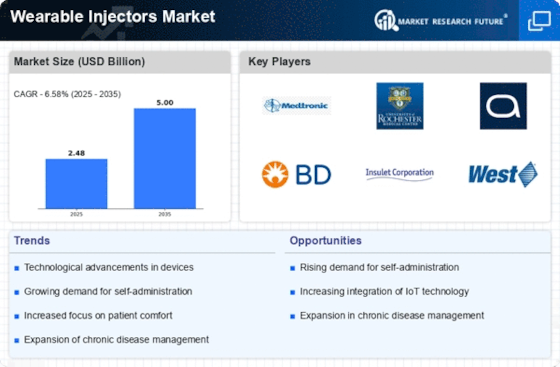
As per Market Research Future analysis, the Wearable Injectors Market was estimated at 2.48 USD Billion in 2024. The Wearable Injectors industry is projected to grow from 2.643 USD Billion in 2025 to 4.999 USD Billion by 2035, exhibiting a compound annual growth rate (CAGR) of 6.58% during the forecast period 2025 - 2035

Key Market Trends & Highlights

The Wearable Injectors Market is poised for substantial growth driven by technological advancements and increasing patient-centric solutions.

  • North America remains the largest market for wearable injectors, driven by high healthcare expenditure and advanced medical infrastructure. The Asia-Pacific region is emerging as the fastest-growing market, fueled by rising healthcare investments and a growing population. Diabetes management continues to dominate the market, while wearable infusion pumps are rapidly gaining traction as the fastest-growing segment. Key market drivers include the rising prevalence of chronic diseases and a supportive regulatory environment that fosters innovation in drug delivery.

Market Size & Forecast

2024 Market Size 2.48 (USD Billion)
2035 Market Size 4.999 (USD Billion)
CAGR (2025 - 2035) 6.58%
Largest Regional Market Share in 2024 North America

Major Players

Medtronic (US), Roche (CH), AbbVie (US), Becton Dickinson (US), Insulet Corporation (US), West Pharmaceutical Services (US), Ypsomed (CH), Zynex (US), Terumo Corporation (JP). These companies play a significant role in shaping the competitive structure of the wearable injectors ecosystem.

Market Trends

The Wearable Injectors Market is currently experiencing a notable transformation, driven by advancements in technology and increasing demand for patient-centric healthcare solutions. The evolving wearable injectors market trends indicate strong adoption across chronic disease management applications. These devices, designed to deliver medication subcutaneously, offer a convenient alternative to traditional injection methods. As healthcare systems evolve, the emphasis on chronic disease management and the need for improved patient compliance are propelling the adoption of wearable injectors. Furthermore, the integration of smart technology into these devices enhances their functionality, allowing for real-time monitoring and data collection, which could potentially lead to better health outcomes.

In addition to technological innovations, the Wearable Injectors Market is influenced by changing patient preferences and the growing trend towards personalized medicine. Patients increasingly seek solutions that provide comfort and flexibility, which wearable injectors can offer. The market appears to be expanding as manufacturers focus on developing user-friendly designs and customizable features. Growth in biologics is also contributing to expansion in the large volume wearable injectors market, including developments in the ultra-large volume wearable injectors market, the ultra large volume wearable injectors market, and the ultralarge volume wearable injectors market, reflecting increasing demand for high-capacity drug delivery solutions. Moreover, the ultra large volume wearable injectors market size is expected to expand steadily alongside biologic drug adoption.

Regional demand continues to strengthen in the united states wearable injectors market, the europe wearable injectors market, and emerging economies such as the mexico wearable injectors market, contributing to overall global expansion. As highlighted in industry discussions such as the medgadget global wearable injectors market analysis and commentary referencing the medgadget global wearable injectors market expanding at a healthy cagr, the sector is positioned for consistent long-term growth.

Technological Advancements

The Wearable Injectors Market is witnessing rapid technological progress, with innovations enhancing device functionality and user experience. Smart features, such as connectivity and real-time monitoring, are becoming increasingly prevalent, allowing for better patient engagement and adherence to treatment regimens. These advancements are particularly influencing the medical wearable injector market and accelerating innovation within the large volume wearable injectors market.

Patient-Centric Solutions

There is a growing emphasis on patient-centric healthcare, which is influencing the design and functionality of wearable injectors. These devices are being developed to cater to individual needs, providing comfort and convenience, thereby improving overall patient satisfaction within the wearable injectors market.

Regulatory Support and Market Growth

Regulatory bodies are increasingly recognizing the potential of wearable injectors in enhancing treatment adherence. This support is likely to encourage manufacturers to invest in research and development, further driving expansion in the wearable injectors market size and improving overall wearable injectors market share globally.

Wearable Injectors Market Market Drivers

Supportive Regulatory Environment

A supportive regulatory environment is fostering growth in the Wearable Injectors Market. Regulatory bodies are increasingly recognizing the potential of wearable injectors to improve patient care and are streamlining approval processes for these devices. This regulatory support not only accelerates the introduction of innovative products to the market but also instills confidence among manufacturers and investors. As a result, the Wearable Injectors Market is likely to see an influx of new entrants and products, enhancing competition and driving further advancements in technology and design. The favorable regulatory landscape is thus a key driver of market expansion.

Increased Focus on Patient Compliance

The emphasis on patient compliance in treatment regimens is a significant factor influencing the Wearable Injectors Market. Healthcare providers are increasingly recognizing that adherence to prescribed therapies is crucial for achieving optimal health outcomes. Wearable injectors offer a user-friendly solution that simplifies the administration of medications, thereby enhancing compliance rates. Studies indicate that patients using wearable injectors are more likely to adhere to their treatment plans compared to traditional methods. This trend is expected to drive the growth of the Wearable Injectors Market as more healthcare systems adopt these devices to improve patient outcomes and reduce healthcare costs.

Rising Prevalence of Chronic Diseases

The increasing prevalence of chronic diseases such as diabetes and rheumatoid arthritis is a primary driver for the Wearable Injectors Market. As these conditions require regular medication administration, the demand for convenient and efficient drug delivery systems rises. According to recent data, the number of individuals diagnosed with diabetes is projected to reach 700 million by 2045, which underscores the necessity for innovative solutions like wearable injectors. These devices not only enhance patient compliance but also improve the overall quality of life for patients managing chronic conditions. The Wearable Injectors Market is thus positioned to expand significantly as healthcare providers seek to offer more effective treatment options.

Technological Innovations in Drug Delivery

Technological advancements in drug delivery systems are propelling the Wearable Injectors Market forward. Innovations such as miniaturization, smart technology integration, and enhanced biocompatibility are making wearable injectors more appealing to both patients and healthcare providers. For instance, the incorporation of sensors and connectivity features allows for real-time monitoring and data collection, which can lead to personalized treatment plans. The market for wearable injectors is expected to grow at a compound annual growth rate (CAGR) of approximately 15% over the next five years, driven by these technological innovations. As a result, the Wearable Injectors Market is likely to witness a surge in product development and adoption.

Growing Demand for Home Healthcare Solutions

The rising demand for home healthcare solutions is significantly impacting the Wearable Injectors Market. As patients increasingly prefer to manage their health from the comfort of their homes, the need for convenient and effective drug delivery systems becomes paramount. Wearable injectors provide a practical solution for self-administration of medications, particularly for chronic disease management. Market analysis suggests that the home healthcare market is expected to grow substantially, with wearable injectors playing a crucial role in this transformation. This shift towards home-based care is likely to drive the Wearable Injectors Market, as more patients seek autonomy in their treatment.

Market Segment Insights

By Application: Diabetes Management (Largest) vs. Cardiovascular Disease Treatment (Fastest-Growing)

In the wearable injectors market, the application segment is characterized by various therapeutic areas, with Diabetes Management holding the largest market share. Due to the increasing prevalence of diabetes worldwide, wearable injectors designed for insulin delivery have gained significant traction. Meanwhile, Multiple Sclerosis Treatment and Rheumatoid Arthritis Treatment also play critical roles but command smaller, yet substantial portions of the market. As healthcare evolves, the demand for patient-centric treatment solutions propels innovative applications in this segment. Growth trends in the wearable injectors market are prominently driven by advancements in technology, increasing disease prevalence, and growing awareness regarding self-administration of medications. Diabetes Management continues to dominate, but Cardiovascular Disease Treatment is emerging as the fastest-growing segment, reflecting a shift in focus to chronic conditions and holistic health management. Patient convenience and adherence are pivotal in shaping these trends, encouraging innovation in wearable devices that enhance the overall treatment experience.

Diabetes Management (Dominant) vs. Cardiovascular Disease Treatment (Emerging)

Diabetes Management stands out as the dominant application in the wearable injectors market, attributed to a robust demand for insulin delivery systems. Patients benefit from the convenience and consistency offered by these devices, allowing for better glycemic control. Continuous innovation in this segment, including smart injectors that integrate with mobile applications, enhances usability and patient engagement. On the other hand, Cardiovascular Disease Treatment is highlighted as an emerging application area, driven by a growing awareness of cardiovascular conditions and the need for better management solutions. This segment is increasingly focused on preventive care, with wearable injectors being developed for medications that support heart health, further expanding the scope and adaptability of these technologies in providing comprehensive care.

By Product Type: Patch Injectors (Largest) vs. Wearable Infusion Pumps (Fastest-Growing)

In the Wearable Injectors Market, Patch Injectors hold the largest share, dominating the competitive landscape due to their user-friendly design and ease of application. On the other hand, Wearable Infusion Pumps are quickly gaining traction, attracting attention for their innovative delivery methods and increased functionality. Together, these segments illustrate the diverse preferences of the market, where convenience and technology play pivotal roles in consumer choice.

Patch Injectors (Dominant) vs. Smart Insulin Patches (Emerging)

Patch Injectors represent the dominant force in the wearable injectors market, appreciated for their seamless integration into daily routines and non-invasive application. They provide a reliable method of drug delivery and cater to a broad range of therapeutic areas, resulting in widespread adoption among patients and healthcare providers. Conversely, Smart Insulin Patches are emerging as a significant innovation, particularly in diabetes management, by offering real-time monitoring and automated insulin delivery. Their advanced technology is attracting both users and stakeholders, indicating a shift towards more efficient and personalized healthcare solutions.

By End User: Hospitals (Largest) vs. Home Care Settings (Fastest-Growing)

The wearable injectors market is primarily dominated by hospitals, which account for a significant share of the total market due to the increasing prevalence of chronic diseases, necessitating frequent medication administration. This segment benefits from the increasing integration of wearable technology into conventional healthcare practices, enhancing patient monitoring and compliance through innovative delivery systems. Home care settings are the fastest-growing segment as patients increasingly prefer receiving treatments in the comfort of their homes, fostering autonomy. This trend is significantly driven by the aging population and advancements in technology that make wearable injectors more accessible and user-friendly, thus reshaping how medical treatments are administered outside traditional healthcare facilities.

Home Care Settings (Dominant) vs. Long-term Care Facilities (Emerging)

Home care settings are becoming a dominant force in the wearable injectors market due to their convenience and effectiveness in patient-centered care. With a strong preference for treatments that can be administered at home, healthcare providers are increasingly adopting wearable injectors to enhance patient adherence and satisfaction. In contrast, long-term care facilities represent an emerging segment, bridging the gap between hospital care and home-based treatment, necessitating tailored innovations to accommodate a diverse patient demographic. As these facilities seek to improve care efficiency and reduce emergency admissions, the integration of wearable injectors will play a crucial role in facilitating continuous management of patients with chronic conditions.

By Technology: Continuous Glucose Monitoring (Largest) vs. Intravenous Therapy (Fastest-Growing)

The Wearable Injectors Market is structured around three main technology categories: Continuous Glucose Monitoring (CGM), Intravenous Therapy, and Drug Delivery Systems. <a href="https://www.marketresearchfuture.com/reports/continuous-glucose-monitoring-system-market-20310">Continuous Glucose Monitoring</a> holds the largest market share due to the increasing prevalence of diabetes and the growing demand for real-time glucose monitoring solutions. Intravenous Therapy, while smaller in share, is rapidly gaining traction as more patients seek at-home therapy options, making it a significant player in the market. Meanwhile, Drug Delivery Systems are also present, focusing on specialized drug administration for chronic conditions.

Technology: Continuous Glucose Monitoring (Dominant) vs. Intravenous Therapy (Emerging)

Continuous Glucose Monitoring systems are pivotal in the Wearable Injectors Market, providing innovative solutions for managing diabetes by allowing users to monitor glucose levels effortlessly and continuously. Its dominance is driven by technological advancements, high adoption rates among patients, and the chronic nature of diabetes, which necessitates regular monitoring. In contrast, Intravenous Therapy is emerging as a valuable segment, primarily due to the growth of telehealth and the demand for less invasive healthcare solutions. This segment is witnessing innovations aimed at simplifying the drug delivery process for patients at home, thus making it a competitive force alongside CGM.

Get more detailed insights about Wearable Injectors Market Research Report-Forecast to 2035

Regional Insights

The Wearable Injectors Market is witnessing notable growth across various regions, with North America leading the way, boasting a market value of 1.2 USD Billion in 2024, projected to reach 2.4 USD billion by 2035. This region is crucial due to its advanced healthcare infrastructure and increasing chronic diseases, significantly driving demand. Europe follows with a valuation of 0.8 USD Billion in 2024, expected to double to 1.6 USD billion by 2035, as European nations continue to focus on innovative healthcare solutions. 

South America and Asia Pacific account for smaller market shares, valued at 0.15 USD billion and 0.25 USD billion, respectively, in 2024, showing the potential for growth as healthcare technology advances in these regions.

The Middle East and Africa represent a growing market as well, starting at 0.08 USD billion in 2024 and anticipated to reach 0.2 USD billion by 2035, highlighting an increasing focus on improving healthcare delivery. Overall, the Wearable Injectors Market segmentation reflects diverse opportunities and challenges, influenced by factors such as regional healthcare expenditures, technological advancements, and evolving patient management strategies.

Key Players and Competitive Insights

The Wearable Injectors Market is characterized by a dynamic landscape where companies are consistently innovating to meet the growing demand for medication delivery systems that prioritize patient comfort and adherence. With an increasing prevalence of chronic diseases requiring regular medication, wearable injectors have become essential for both patients and healthcare providers.  The competition in this market is driven by advancements in technology, cost-effectiveness, and the ability to offer personalized solutions. Companies are exploring strategic partnerships, mergers, and collaborations to enhance their product offerings and expand their market reach. The ability to leverage data analytics and real-world evidence has become critical in understanding patient needs and improving the design and functionality of wearable injectors.Novartis has established a strong presence in the Wearable Injectors Market through continuous investment in research and development, enabling the company to deliver innovative solutions that cater to the specific needs of patients. The strengths of Novartis lie in its extensive portfolio of medications that require sustained delivery methods, allowing for improved patient compliance.  The company also benefits from a solid reputation in the pharmaceutical industry, backed by a commitment to quality and safety. As Novartis strives to enhance its market presence in wearable injectors, its focus on patient-centric solutions positions it favorably within the competitive landscape, making it a notable player that is well-regarded for bringing effective therapies to market.Teva Pharmaceutical Industries is another significant competitor in the Wearable Injectors Market, recognized for its commitment to making medications accessible and affordable. The company’s strengths include an extensive range of generic and specialty medications, complemented by its quality delivery systems, such as wearable injectors that provide patients with convenient administration options.  Teva invests heavily in developing innovative technologies and has engaged in strategic mergers and acquisitions to bolster its market position and expand its portfolio. The company's focus on enhancing patient outcomes through innovative delivery methods contributes to its competitive edge. By maintaining strong relationships with healthcare providers and stakeholders globally,  Teva Pharmaceutical Industries successfully navigates the complexities of the market while keeping patient needs at the forefront of its product development strategy.

Key Companies in the Wearable Injectors Market include

Industry Developments

  • Q2 2024: Enable Injections Announces FDA Clearance of enFuse® On-Body Infusor for Subcutaneous Delivery of Empaveli® (pegcetacoplan) Enable Injections received FDA clearance for its enFuse wearable injector to deliver Empaveli, marking a significant regulatory milestone for wearable drug delivery devices in the U.S.
  • Q2 2024: Ypsomed and Novo Nordisk enter into partnership for large-volume patch injectors Ypsomed announced a partnership with Novo Nordisk to develop and supply large-volume patch injectors for the subcutaneous self-administration of drugs, expanding wearable injector options for biologics.
  • Q2 2024: Gerresheimer opens new manufacturing facility for wearable drug delivery devices in North Carolina Gerresheimer inaugurated a new production site in North Carolina dedicated to manufacturing wearable drug delivery devices, aiming to meet growing demand in the U.S. market.
  • Q2 2024: BD launches next-generation BD Libertas™ Wearable Injector in Europe BD announced the commercial launch of its next-generation BD Libertas wearable injector in select European markets, expanding its portfolio for self-administered biologic therapies.
  • Q3 2024: West Announces FDA Clearance of SmartDose® Gen. III Wearable Injector West Pharmaceutical Services received FDA clearance for its SmartDose Gen. III wearable injector, enabling new options for subcutaneous delivery of high-volume biologics.
  • Q3 2024: Amgen receives expanded FDA approval for Neulasta® Onpro® wearable injector for additional indications Amgen announced that the FDA has expanded the approved indications for its Neulasta Onpro wearable injector, allowing use in a broader range of cancer patients undergoing chemotherapy.
  • Q3 2024: Insulet Announces FDA Clearance of Omnipod 5 for Type 2 Diabetes Insulet received FDA clearance for its Omnipod 5 wearable insulin delivery system for use in adults with type 2 diabetes, expanding its wearable injector platform beyond type 1 diabetes.
  • Q3 2024: Enable Injections Raises $215 Million in Series C Financing to Accelerate Commercialization of enFuse® Enable Injections closed a $215 million Series C funding round to support the commercialization and scale-up of its enFuse wearable injector platform.
  • Q4 2024: Ypsomed secures contract with major U.S. pharma for supply of wearable injectors Ypsomed announced a multi-year contract to supply wearable injectors to a leading U.S. pharmaceutical company for use in biologic drug delivery.
  • Q4 2024: Gerresheimer acquires Sensile Medical to expand wearable injector technology portfolio Gerresheimer completed the acquisition of Sensile Medical, strengthening its capabilities in wearable injector technology and expanding its product offerings.
  • Q1 2025: BD announces partnership with AstraZeneca for development of next-generation wearable injectors BD entered into a partnership with AstraZeneca to co-develop next-generation wearable injectors for the delivery of biologic medicines.
  • Q1 2025: MedTech startup Subcuject raises $40 million Series B to advance wearable injector platform Subcuject, a medtech startup focused on wearable injectors, raised $40 million in Series B funding to accelerate product development and regulatory submissions.

Future Outlook

Wearable Injectors Market Future Outlook

The Wearable Injectors Market is projected to grow at a 6.58% CAGR from 2025 to 2035, driven by technological advancements, increasing chronic diseases, and patient preference for self-administration.

New opportunities lie in:

  • <p>Integration of AI for personalized medication delivery systems. Expansion into emerging markets with tailored pricing strategies. Development of multi-drug delivery systems for chronic disease management.</p>

By 2035, the Wearable Injectors Market is expected to achieve substantial growth, reflecting evolving healthcare needs.

Market Segmentation

Wearable Injectors Market End User Outlook

  • Hospitals
  • Home Care Settings
  • Ambulatory Surgical Centers
  • Long-term Care Facilities

Wearable Injectors Market Technology Outlook

  • Continuous Glucose Monitoring
  • Intravenous Therapy
  • Drug Delivery Systems

Wearable Injectors Market Application Outlook

  • Diabetes Management
  • Multiple Sclerosis Treatment
  • Rheumatoid Arthritis Treatment
  • Cardiovascular Disease Treatment

Wearable Injectors Market Product Type Outlook

  • Patch Injectors
  • Wearable Infusion Pumps
  • Micro-needles
  • Smart Insulin Patches

Report Scope

MARKET SIZE 2024 2.48(USD Billion)
MARKET SIZE 2025 2.643(USD Billion)
MARKET SIZE 2035 4.999(USD Billion)
COMPOUND ANNUAL GROWTH RATE (CAGR) 6.58% (2025 - 2035)
REPORT COVERAGE Revenue Forecast, Competitive Landscape, Growth Factors, and Trends
BASE YEAR 2024
Market Forecast Period 2025 - 2035
Historical Data 2019 - 2024
Market Forecast Units USD Billion
Key Companies Profiled Medtronic (US), Roche (CH), AbbVie (US), Becton Dickinson (US), Insulet Corporation (US), West Pharmaceutical Services (US), Ypsomed (CH), Zynex (US), Terumo Corporation (JP)
Segments Covered Application, Product Type, End User, Technology, Regional
Key Market Opportunities Integration of advanced drug delivery systems enhances patient compliance in the Wearable Injectors Market.
Key Market Dynamics Technological advancements and regulatory changes drive innovation and competition in the wearable injectors market.
Countries Covered North America, Europe, APAC, South America, MEA

FAQs

What is the projected market valuation of the Wearable Injectors Market by 2035?

<p>The Wearable Injectors Market is projected to reach approximately 4.999 USD Billion by 2035.</p>

What was the market valuation of the Wearable Injectors Market in 2024?

<p>In 2024, the Wearable Injectors Market was valued at 2.48 USD Billion.</p>

What is the expected CAGR for the Wearable Injectors Market during the forecast period 2025 - 2035?

<p>The expected CAGR for the Wearable Injectors Market during the forecast period 2025 - 2035 is 6.58%.</p>

Which application segment is expected to show significant growth in the Wearable Injectors Market?

<p>The Diabetes Management segment is anticipated to grow from 0.75 USD Billion in 2024 to 1.5 USD Billion by 2035.</p>

What are the key product types in the Wearable Injectors Market?

<p>Key product types include Patch Injectors, Wearable Infusion Pumps, Micro-needles, and Smart Insulin Patches.</p>

How does the market for Wearable Infusion Pumps compare to other product types?

<p>The market for Wearable Infusion Pumps is expected to grow from 0.99 USD Billion in 2024 to 2.0 USD Billion by 2035, indicating robust demand.</p>

Which end-user segment is projected to dominate the Wearable Injectors Market?

<p>The Hospitals segment is projected to dominate, growing from 0.99 USD Billion in 2024 to 1.99 USD Billion by 2035.</p>

What role do key players like Medtronic and Roche play in the Wearable Injectors Market?

<p>Key players such as Medtronic and Roche are likely to drive innovation and market growth through advanced product offerings.</p>

What technological advancements are influencing the Wearable Injectors Market?

<p>Technologies such as Continuous Glucose Monitoring and Drug Delivery Systems are expected to significantly influence market dynamics.</p>

How does the market for Smart Insulin Patches compare to other product types?

<p>The Smart Insulin Patches segment is relatively smaller, with a projected growth from 0.13 USD Billion in 2024 to 0.25 USD Billion by 2035.</p>

  1. SECTION I: EXECUTIVE SUMMARY AND KEY HIGHLIGHTS
    1. | 1.1 EXECUTIVE SUMMARY
    2. | | 1.1.1 Market Overview
    3. | | 1.1.2 Key Findings
    4. | | 1.1.3 Market Segmentation
    5. | | 1.1.4 Competitive Landscape
    6. | | 1.1.5 Challenges and Opportunities
    7. | | 1.1.6 Future Outlook
  2. SECTION II: SCOPING, METHODOLOGY AND MARKET STRUCTURE
    1. | 2.1 MARKET INTRODUCTION
    2. | | 2.1.1 Definition
    3. | | 2.1.2 Scope of the study
    4. | | | 2.1.2.1 Research Objective
    5. | | | 2.1.2.2 Assumption
    6. | | | 2.1.2.3 Limitations
    7. | 2.2 RESEARCH METHODOLOGY
    8. | | 2.2.1 Overview
    9. | | 2.2.2 Data Mining
    10. | | 2.2.3 Secondary Research
    11. | | 2.2.4 Primary Research
    12. | | | 2.2.4.1 Primary Interviews and Information Gathering Process
    13. | | | 2.2.4.2 Breakdown of Primary Respondents
    14. | | 2.2.5 Forecasting Model
    15. | | 2.2.6 Market Size Estimation
    16. | | | 2.2.6.1 Bottom-Up Approach
    17. | | | 2.2.6.2 Top-Down Approach
    18. | | 2.2.7 Data Triangulation
    19. | | 2.2.8 Validation
  3. SECTION III: QUALITATIVE ANALYSIS
    1. | 3.1 MARKET DYNAMICS
    2. | | 3.1.1 Overview
    3. | | 3.1.2 Drivers
    4. | | 3.1.3 Restraints
    5. | | 3.1.4 Opportunities
    6. | 3.2 MARKET FACTOR ANALYSIS
    7. | | 3.2.1 Value chain Analysis
    8. | | 3.2.2 Porter's Five Forces Analysis
    9. | | | 3.2.2.1 Bargaining Power of Suppliers
    10. | | | 3.2.2.2 Bargaining Power of Buyers
    11. | | | 3.2.2.3 Threat of New Entrants
    12. | | | 3.2.2.4 Threat of Substitutes
    13. | | | 3.2.2.5 Intensity of Rivalry
    14. | | 3.2.3 COVID-19 Impact Analysis
    15. | | | 3.2.3.1 Market Impact Analysis
    16. | | | 3.2.3.2 Regional Impact
    17. | | | 3.2.3.3 Opportunity and Threat Analysis
  4. SECTION IV: QUANTITATIVE ANALYSIS
    1. | 4.1 Healthcare, BY Application (USD Billion)
    2. | | 4.1.1 Diabetes Management
    3. | | 4.1.2 Multiple Sclerosis Treatment
    4. | | 4.1.3 Rheumatoid Arthritis Treatment
    5. | | 4.1.4 Cardiovascular Disease Treatment
    6. | 4.2 Healthcare, BY Product Type (USD Billion)
    7. | | 4.2.1 Patch Injectors
    8. | | 4.2.2 Wearable Infusion Pumps
    9. | | 4.2.3 Micro-needles
    10. | | 4.2.4 Smart Insulin Patches
    11. | 4.3 Healthcare, BY End User (USD Billion)
    12. | | 4.3.1 Hospitals
    13. | | 4.3.2 Home Care Settings
    14. | | 4.3.3 Ambulatory Surgical Centers
    15. | | 4.3.4 Long-term Care Facilities
    16. | 4.4 Healthcare, BY Technology (USD Billion)
    17. | | 4.4.1 Continuous Glucose Monitoring
    18. | | 4.4.2 Intravenous Therapy
    19. | | 4.4.3 Drug Delivery Systems
    20. | 4.5 Healthcare, BY Region (USD Billion)
    21. | | 4.5.1 North America
    22. | | | 4.5.1.1 US
    23. | | | 4.5.1.2 Canada
    24. | | 4.5.2 Europe
    25. | | | 4.5.2.1 Germany
    26. | | | 4.5.2.2 UK
    27. | | | 4.5.2.3 France
    28. | | | 4.5.2.4 Russia
    29. | | | 4.5.2.5 Italy
    30. | | | 4.5.2.6 Spain
    31. | | | 4.5.2.7 Rest of Europe
    32. | | 4.5.3 APAC
    33. | | | 4.5.3.1 China
    34. | | | 4.5.3.2 India
    35. | | | 4.5.3.3 Japan
    36. | | | 4.5.3.4 South Korea
    37. | | | 4.5.3.5 Malaysia
    38. | | | 4.5.3.6 Thailand
    39. | | | 4.5.3.7 Indonesia
    40. | | | 4.5.3.8 Rest of APAC
    41. | | 4.5.4 South America
    42. | | | 4.5.4.1 Brazil
    43. | | | 4.5.4.2 Mexico
    44. | | | 4.5.4.3 Argentina
    45. | | | 4.5.4.4 Rest of South America
    46. | | 4.5.5 MEA
    47. | | | 4.5.5.1 GCC Countries
    48. | | | 4.5.5.2 South Africa
    49. | | | 4.5.5.3 Rest of MEA
  5. SECTION V: COMPETITIVE ANALYSIS
    1. | 5.1 Competitive Landscape
    2. | | 5.1.1 Overview
    3. | | 5.1.2 Competitive Analysis
    4. | | 5.1.3 Market share Analysis
    5. | | 5.1.4 Major Growth Strategy in the Healthcare
    6. | | 5.1.5 Competitive Benchmarking
    7. | | 5.1.6 Leading Players in Terms of Number of Developments in the Healthcare
    8. | | 5.1.7 Key developments and growth strategies
    9. | | | 5.1.7.1 New Product Launch/Service Deployment
    10. | | | 5.1.7.2 Merger & Acquisitions
    11. | | | 5.1.7.3 Joint Ventures
    12. | | 5.1.8 Major Players Financial Matrix
    13. | | | 5.1.8.1 Sales and Operating Income
    14. | | | 5.1.8.2 Major Players R&D Expenditure. 2023
    15. | 5.2 Company Profiles
    16. | | 5.2.1 Medtronic (US)
    17. | | | 5.2.1.1 Financial Overview
    18. | | | 5.2.1.2 Products Offered
    19. | | | 5.2.1.3 Key Developments
    20. | | | 5.2.1.4 SWOT Analysis
    21. | | | 5.2.1.5 Key Strategies
    22. | | 5.2.2 Roche (CH)
    23. | | | 5.2.2.1 Financial Overview
    24. | | | 5.2.2.2 Products Offered
    25. | | | 5.2.2.3 Key Developments
    26. | | | 5.2.2.4 SWOT Analysis
    27. | | | 5.2.2.5 Key Strategies
    28. | | 5.2.3 AbbVie (US)
    29. | | | 5.2.3.1 Financial Overview
    30. | | | 5.2.3.2 Products Offered
    31. | | | 5.2.3.3 Key Developments
    32. | | | 5.2.3.4 SWOT Analysis
    33. | | | 5.2.3.5 Key Strategies
    34. | | 5.2.4 Becton Dickinson (US)
    35. | | | 5.2.4.1 Financial Overview
    36. | | | 5.2.4.2 Products Offered
    37. | | | 5.2.4.3 Key Developments
    38. | | | 5.2.4.4 SWOT Analysis
    39. | | | 5.2.4.5 Key Strategies
    40. | | 5.2.5 Insulet Corporation (US)
    41. | | | 5.2.5.1 Financial Overview
    42. | | | 5.2.5.2 Products Offered
    43. | | | 5.2.5.3 Key Developments
    44. | | | 5.2.5.4 SWOT Analysis
    45. | | | 5.2.5.5 Key Strategies
    46. | | 5.2.6 West Pharmaceutical Services (US)
    47. | | | 5.2.6.1 Financial Overview
    48. | | | 5.2.6.2 Products Offered
    49. | | | 5.2.6.3 Key Developments
    50. | | | 5.2.6.4 SWOT Analysis
    51. | | | 5.2.6.5 Key Strategies
    52. | | 5.2.7 Ypsomed (CH)
    53. | | | 5.2.7.1 Financial Overview
    54. | | | 5.2.7.2 Products Offered
    55. | | | 5.2.7.3 Key Developments
    56. | | | 5.2.7.4 SWOT Analysis
    57. | | | 5.2.7.5 Key Strategies
    58. | | 5.2.8 Zynex (US)
    59. | | | 5.2.8.1 Financial Overview
    60. | | | 5.2.8.2 Products Offered
    61. | | | 5.2.8.3 Key Developments
    62. | | | 5.2.8.4 SWOT Analysis
    63. | | | 5.2.8.5 Key Strategies
    64. | | 5.2.9 Terumo Corporation (JP)
    65. | | | 5.2.9.1 Financial Overview
    66. | | | 5.2.9.2 Products Offered
    67. | | | 5.2.9.3 Key Developments
    68. | | | 5.2.9.4 SWOT Analysis
    69. | | | 5.2.9.5 Key Strategies
    70. | 5.3 Appendix
    71. | | 5.3.1 References
    72. | | 5.3.2 Related Reports
  6. LIST OF FIGURES
    1. | 6.1 MARKET SYNOPSIS
    2. | 6.2 NORTH AMERICA MARKET ANALYSIS
    3. | 6.3 US MARKET ANALYSIS BY APPLICATION
    4. | 6.4 US MARKET ANALYSIS BY PRODUCT TYPE
    5. | 6.5 US MARKET ANALYSIS BY END USER
    6. | 6.6 US MARKET ANALYSIS BY TECHNOLOGY
    7. | 6.7 CANADA MARKET ANALYSIS BY APPLICATION
    8. | 6.8 CANADA MARKET ANALYSIS BY PRODUCT TYPE
    9. | 6.9 CANADA MARKET ANALYSIS BY END USER
    10. | 6.10 CANADA MARKET ANALYSIS BY TECHNOLOGY
    11. | 6.11 EUROPE MARKET ANALYSIS
    12. | 6.12 GERMANY MARKET ANALYSIS BY APPLICATION
    13. | 6.13 GERMANY MARKET ANALYSIS BY PRODUCT TYPE
    14. | 6.14 GERMANY MARKET ANALYSIS BY END USER
    15. | 6.15 GERMANY MARKET ANALYSIS BY TECHNOLOGY
    16. | 6.16 UK MARKET ANALYSIS BY APPLICATION
    17. | 6.17 UK MARKET ANALYSIS BY PRODUCT TYPE
    18. | 6.18 UK MARKET ANALYSIS BY END USER
    19. | 6.19 UK MARKET ANALYSIS BY TECHNOLOGY
    20. | 6.20 FRANCE MARKET ANALYSIS BY APPLICATION
    21. | 6.21 FRANCE MARKET ANALYSIS BY PRODUCT TYPE
    22. | 6.22 FRANCE MARKET ANALYSIS BY END USER
    23. | 6.23 FRANCE MARKET ANALYSIS BY TECHNOLOGY
    24. | 6.24 RUSSIA MARKET ANALYSIS BY APPLICATION
    25. | 6.25 RUSSIA MARKET ANALYSIS BY PRODUCT TYPE
    26. | 6.26 RUSSIA MARKET ANALYSIS BY END USER
    27. | 6.27 RUSSIA MARKET ANALYSIS BY TECHNOLOGY
    28. | 6.28 ITALY MARKET ANALYSIS BY APPLICATION
    29. | 6.29 ITALY MARKET ANALYSIS BY PRODUCT TYPE
    30. | 6.30 ITALY MARKET ANALYSIS BY END USER
    31. | 6.31 ITALY MARKET ANALYSIS BY TECHNOLOGY
    32. | 6.32 SPAIN MARKET ANALYSIS BY APPLICATION
    33. | 6.33 SPAIN MARKET ANALYSIS BY PRODUCT TYPE
    34. | 6.34 SPAIN MARKET ANALYSIS BY END USER
    35. | 6.35 SPAIN MARKET ANALYSIS BY TECHNOLOGY
    36. | 6.36 REST OF EUROPE MARKET ANALYSIS BY APPLICATION
    37. | 6.37 REST OF EUROPE MARKET ANALYSIS BY PRODUCT TYPE
    38. | 6.38 REST OF EUROPE MARKET ANALYSIS BY END USER
    39. | 6.39 REST OF EUROPE MARKET ANALYSIS BY TECHNOLOGY
    40. | 6.40 APAC MARKET ANALYSIS
    41. | 6.41 CHINA MARKET ANALYSIS BY APPLICATION
    42. | 6.42 CHINA MARKET ANALYSIS BY PRODUCT TYPE
    43. | 6.43 CHINA MARKET ANALYSIS BY END USER
    44. | 6.44 CHINA MARKET ANALYSIS BY TECHNOLOGY
    45. | 6.45 INDIA MARKET ANALYSIS BY APPLICATION
    46. | 6.46 INDIA MARKET ANALYSIS BY PRODUCT TYPE
    47. | 6.47 INDIA MARKET ANALYSIS BY END USER
    48. | 6.48 INDIA MARKET ANALYSIS BY TECHNOLOGY
    49. | 6.49 JAPAN MARKET ANALYSIS BY APPLICATION
    50. | 6.50 JAPAN MARKET ANALYSIS BY PRODUCT TYPE
    51. | 6.51 JAPAN MARKET ANALYSIS BY END USER
    52. | 6.52 JAPAN MARKET ANALYSIS BY TECHNOLOGY
    53. | 6.53 SOUTH KOREA MARKET ANALYSIS BY APPLICATION
    54. | 6.54 SOUTH KOREA MARKET ANALYSIS BY PRODUCT TYPE
    55. | 6.55 SOUTH KOREA MARKET ANALYSIS BY END USER
    56. | 6.56 SOUTH KOREA MARKET ANALYSIS BY TECHNOLOGY
    57. | 6.57 MALAYSIA MARKET ANALYSIS BY APPLICATION
    58. | 6.58 MALAYSIA MARKET ANALYSIS BY PRODUCT TYPE
    59. | 6.59 MALAYSIA MARKET ANALYSIS BY END USER
    60. | 6.60 MALAYSIA MARKET ANALYSIS BY TECHNOLOGY
    61. | 6.61 THAILAND MARKET ANALYSIS BY APPLICATION
    62. | 6.62 THAILAND MARKET ANALYSIS BY PRODUCT TYPE
    63. | 6.63 THAILAND MARKET ANALYSIS BY END USER
    64. | 6.64 THAILAND MARKET ANALYSIS BY TECHNOLOGY
    65. | 6.65 INDONESIA MARKET ANALYSIS BY APPLICATION
    66. | 6.66 INDONESIA MARKET ANALYSIS BY PRODUCT TYPE
    67. | 6.67 INDONESIA MARKET ANALYSIS BY END USER
    68. | 6.68 INDONESIA MARKET ANALYSIS BY TECHNOLOGY
    69. | 6.69 REST OF APAC MARKET ANALYSIS BY APPLICATION
    70. | 6.70 REST OF APAC MARKET ANALYSIS BY PRODUCT TYPE
    71. | 6.71 REST OF APAC MARKET ANALYSIS BY END USER
    72. | 6.72 REST OF APAC MARKET ANALYSIS BY TECHNOLOGY
    73. | 6.73 SOUTH AMERICA MARKET ANALYSIS
    74. | 6.74 BRAZIL MARKET ANALYSIS BY APPLICATION
    75. | 6.75 BRAZIL MARKET ANALYSIS BY PRODUCT TYPE
    76. | 6.76 BRAZIL MARKET ANALYSIS BY END USER
    77. | 6.77 BRAZIL MARKET ANALYSIS BY TECHNOLOGY
    78. | 6.78 MEXICO MARKET ANALYSIS BY APPLICATION
    79. | 6.79 MEXICO MARKET ANALYSIS BY PRODUCT TYPE
    80. | 6.80 MEXICO MARKET ANALYSIS BY END USER
    81. | 6.81 MEXICO MARKET ANALYSIS BY TECHNOLOGY
    82. | 6.82 ARGENTINA MARKET ANALYSIS BY APPLICATION
    83. | 6.83 ARGENTINA MARKET ANALYSIS BY PRODUCT TYPE
    84. | 6.84 ARGENTINA MARKET ANALYSIS BY END USER
    85. | 6.85 ARGENTINA MARKET ANALYSIS BY TECHNOLOGY
    86. | 6.86 REST OF SOUTH AMERICA MARKET ANALYSIS BY APPLICATION
    87. | 6.87 REST OF SOUTH AMERICA MARKET ANALYSIS BY PRODUCT TYPE
    88. | 6.88 REST OF SOUTH AMERICA MARKET ANALYSIS BY END USER
    89. | 6.89 REST OF SOUTH AMERICA MARKET ANALYSIS BY TECHNOLOGY
    90. | 6.90 MEA MARKET ANALYSIS
    91. | 6.91 GCC COUNTRIES MARKET ANALYSIS BY APPLICATION
    92. | 6.92 GCC COUNTRIES MARKET ANALYSIS BY PRODUCT TYPE
    93. | 6.93 GCC COUNTRIES MARKET ANALYSIS BY END USER
    94. | 6.94 GCC COUNTRIES MARKET ANALYSIS BY TECHNOLOGY
    95. | 6.95 SOUTH AFRICA MARKET ANALYSIS BY APPLICATION
    96. | 6.96 SOUTH AFRICA MARKET ANALYSIS BY PRODUCT TYPE
    97. | 6.97 SOUTH AFRICA MARKET ANALYSIS BY END USER
    98. | 6.98 SOUTH AFRICA MARKET ANALYSIS BY TECHNOLOGY
    99. | 6.99 REST OF MEA MARKET ANALYSIS BY APPLICATION
    100. | 6.100 REST OF MEA MARKET ANALYSIS BY PRODUCT TYPE
    101. | 6.101 REST OF MEA MARKET ANALYSIS BY END USER
    102. | 6.102 REST OF MEA MARKET ANALYSIS BY TECHNOLOGY
    103. | 6.103 KEY BUYING CRITERIA OF HEALTHCARE
    104. | 6.104 RESEARCH PROCESS OF MRFR
    105. | 6.105 DRO ANALYSIS OF HEALTHCARE
    106. | 6.106 DRIVERS IMPACT ANALYSIS: HEALTHCARE
    107. | 6.107 RESTRAINTS IMPACT ANALYSIS: HEALTHCARE
    108. | 6.108 SUPPLY / VALUE CHAIN: HEALTHCARE
    109. | 6.109 HEALTHCARE, BY APPLICATION, 2024 (% SHARE)
    110. | 6.110 HEALTHCARE, BY APPLICATION, 2024 TO 2035 (USD Billion)
    111. | 6.111 HEALTHCARE, BY PRODUCT TYPE, 2024 (% SHARE)
    112. | 6.112 HEALTHCARE, BY PRODUCT TYPE, 2024 TO 2035 (USD Billion)
    113. | 6.113 HEALTHCARE, BY END USER, 2024 (% SHARE)
    114. | 6.114 HEALTHCARE, BY END USER, 2024 TO 2035 (USD Billion)
    115. | 6.115 HEALTHCARE, BY TECHNOLOGY, 2024 (% SHARE)
    116. | 6.116 HEALTHCARE, BY TECHNOLOGY, 2024 TO 2035 (USD Billion)
    117. | 6.117 BENCHMARKING OF MAJOR COMPETITORS
  7. LIST OF TABLES
    1. | 7.1 LIST OF ASSUMPTIONS
    2. | | 7.1.1
    3. | 7.2 North America MARKET SIZE ESTIMATES; FORECAST
    4. | | 7.2.1 BY APPLICATION, 2025-2035 (USD Billion)
    5. | | 7.2.2 BY PRODUCT TYPE, 2025-2035 (USD Billion)
    6. | | 7.2.3 BY END USER, 2025-2035 (USD Billion)
    7. | | 7.2.4 BY TECHNOLOGY, 2025-2035 (USD Billion)
    8. | 7.3 US MARKET SIZE ESTIMATES; FORECAST
    9. | | 7.3.1 BY APPLICATION, 2025-2035 (USD Billion)
    10. | | 7.3.2 BY PRODUCT TYPE, 2025-2035 (USD Billion)
    11. | | 7.3.3 BY END USER, 2025-2035 (USD Billion)
    12. | | 7.3.4 BY TECHNOLOGY, 2025-2035 (USD Billion)
    13. | 7.4 Canada MARKET SIZE ESTIMATES; FORECAST
    14. | | 7.4.1 BY APPLICATION, 2025-2035 (USD Billion)
    15. | | 7.4.2 BY PRODUCT TYPE, 2025-2035 (USD Billion)
    16. | | 7.4.3 BY END USER, 2025-2035 (USD Billion)
    17. | | 7.4.4 BY TECHNOLOGY, 2025-2035 (USD Billion)
    18. | 7.5 Europe MARKET SIZE ESTIMATES; FORECAST
    19. | | 7.5.1 BY APPLICATION, 2025-2035 (USD Billion)
    20. | | 7.5.2 BY PRODUCT TYPE, 2025-2035 (USD Billion)
    21. | | 7.5.3 BY END USER, 2025-2035 (USD Billion)
    22. | | 7.5.4 BY TECHNOLOGY, 2025-2035 (USD Billion)
    23. | 7.6 Germany MARKET SIZE ESTIMATES; FORECAST
    24. | | 7.6.1 BY APPLICATION, 2025-2035 (USD Billion)
    25. | | 7.6.2 BY PRODUCT TYPE, 2025-2035 (USD Billion)
    26. | | 7.6.3 BY END USER, 2025-2035 (USD Billion)
    27. | | 7.6.4 BY TECHNOLOGY, 2025-2035 (USD Billion)
    28. | 7.7 UK MARKET SIZE ESTIMATES; FORECAST
    29. | | 7.7.1 BY APPLICATION, 2025-2035 (USD Billion)
    30. | | 7.7.2 BY PRODUCT TYPE, 2025-2035 (USD Billion)
    31. | | 7.7.3 BY END USER, 2025-2035 (USD Billion)
    32. | | 7.7.4 BY TECHNOLOGY, 2025-2035 (USD Billion)
    33. | 7.8 France MARKET SIZE ESTIMATES; FORECAST
    34. | | 7.8.1 BY APPLICATION, 2025-2035 (USD Billion)
    35. | | 7.8.2 BY PRODUCT TYPE, 2025-2035 (USD Billion)
    36. | | 7.8.3 BY END USER, 2025-2035 (USD Billion)
    37. | | 7.8.4 BY TECHNOLOGY, 2025-2035 (USD Billion)
    38. | 7.9 Russia MARKET SIZE ESTIMATES; FORECAST
    39. | | 7.9.1 BY APPLICATION, 2025-2035 (USD Billion)
    40. | | 7.9.2 BY PRODUCT TYPE, 2025-2035 (USD Billion)
    41. | | 7.9.3 BY END USER, 2025-2035 (USD Billion)
    42. | | 7.9.4 BY TECHNOLOGY, 2025-2035 (USD Billion)
    43. | 7.10 Italy MARKET SIZE ESTIMATES; FORECAST
    44. | | 7.10.1 BY APPLICATION, 2025-2035 (USD Billion)
    45. | | 7.10.2 BY PRODUCT TYPE, 2025-2035 (USD Billion)
    46. | | 7.10.3 BY END USER, 2025-2035 (USD Billion)
    47. | | 7.10.4 BY TECHNOLOGY, 2025-2035 (USD Billion)
    48. | 7.11 Spain MARKET SIZE ESTIMATES; FORECAST
    49. | | 7.11.1 BY APPLICATION, 2025-2035 (USD Billion)
    50. | | 7.11.2 BY PRODUCT TYPE, 2025-2035 (USD Billion)
    51. | | 7.11.3 BY END USER, 2025-2035 (USD Billion)
    52. | | 7.11.4 BY TECHNOLOGY, 2025-2035 (USD Billion)
    53. | 7.12 Rest of Europe MARKET SIZE ESTIMATES; FORECAST
    54. | | 7.12.1 BY APPLICATION, 2025-2035 (USD Billion)
    55. | | 7.12.2 BY PRODUCT TYPE, 2025-2035 (USD Billion)
    56. | | 7.12.3 BY END USER, 2025-2035 (USD Billion)
    57. | | 7.12.4 BY TECHNOLOGY, 2025-2035 (USD Billion)
    58. | 7.13 APAC MARKET SIZE ESTIMATES; FORECAST
    59. | | 7.13.1 BY APPLICATION, 2025-2035 (USD Billion)
    60. | | 7.13.2 BY PRODUCT TYPE, 2025-2035 (USD Billion)
    61. | | 7.13.3 BY END USER, 2025-2035 (USD Billion)
    62. | | 7.13.4 BY TECHNOLOGY, 2025-2035 (USD Billion)
    63. | 7.14 China MARKET SIZE ESTIMATES; FORECAST
    64. | | 7.14.1 BY APPLICATION, 2025-2035 (USD Billion)
    65. | | 7.14.2 BY PRODUCT TYPE, 2025-2035 (USD Billion)
    66. | | 7.14.3 BY END USER, 2025-2035 (USD Billion)
    67. | | 7.14.4 BY TECHNOLOGY, 2025-2035 (USD Billion)
    68. | 7.15 India MARKET SIZE ESTIMATES; FORECAST
    69. | | 7.15.1 BY APPLICATION, 2025-2035 (USD Billion)
    70. | | 7.15.2 BY PRODUCT TYPE, 2025-2035 (USD Billion)
    71. | | 7.15.3 BY END USER, 2025-2035 (USD Billion)
    72. | | 7.15.4 BY TECHNOLOGY, 2025-2035 (USD Billion)
    73. | 7.16 Japan MARKET SIZE ESTIMATES; FORECAST
    74. | | 7.16.1 BY APPLICATION, 2025-2035 (USD Billion)
    75. | | 7.16.2 BY PRODUCT TYPE, 2025-2035 (USD Billion)
    76. | | 7.16.3 BY END USER, 2025-2035 (USD Billion)
    77. | | 7.16.4 BY TECHNOLOGY, 2025-2035 (USD Billion)
    78. | 7.17 South Korea MARKET SIZE ESTIMATES; FORECAST
    79. | | 7.17.1 BY APPLICATION, 2025-2035 (USD Billion)
    80. | | 7.17.2 BY PRODUCT TYPE, 2025-2035 (USD Billion)
    81. | | 7.17.3 BY END USER, 2025-2035 (USD Billion)
    82. | | 7.17.4 BY TECHNOLOGY, 2025-2035 (USD Billion)
    83. | 7.18 Malaysia MARKET SIZE ESTIMATES; FORECAST
    84. | | 7.18.1 BY APPLICATION, 2025-2035 (USD Billion)
    85. | | 7.18.2 BY PRODUCT TYPE, 2025-2035 (USD Billion)
    86. | | 7.18.3 BY END USER, 2025-2035 (USD Billion)
    87. | | 7.18.4 BY TECHNOLOGY, 2025-2035 (USD Billion)
    88. | 7.19 Thailand MARKET SIZE ESTIMATES; FORECAST
    89. | | 7.19.1 BY APPLICATION, 2025-2035 (USD Billion)
    90. | | 7.19.2 BY PRODUCT TYPE, 2025-2035 (USD Billion)
    91. | | 7.19.3 BY END USER, 2025-2035 (USD Billion)
    92. | | 7.19.4 BY TECHNOLOGY, 2025-2035 (USD Billion)
    93. | 7.20 Indonesia MARKET SIZE ESTIMATES; FORECAST
    94. | | 7.20.1 BY APPLICATION, 2025-2035 (USD Billion)
    95. | | 7.20.2 BY PRODUCT TYPE, 2025-2035 (USD Billion)
    96. | | 7.20.3 BY END USER, 2025-2035 (USD Billion)
    97. | | 7.20.4 BY TECHNOLOGY, 2025-2035 (USD Billion)
    98. | 7.21 Rest of APAC MARKET SIZE ESTIMATES; FORECAST
    99. | | 7.21.1 BY APPLICATION, 2025-2035 (USD Billion)
    100. | | 7.21.2 BY PRODUCT TYPE, 2025-2035 (USD Billion)
    101. | | 7.21.3 BY END USER, 2025-2035 (USD Billion)
    102. | | 7.21.4 BY TECHNOLOGY, 2025-2035 (USD Billion)
    103. | 7.22 South America MARKET SIZE ESTIMATES; FORECAST
    104. | | 7.22.1 BY APPLICATION, 2025-2035 (USD Billion)
    105. | | 7.22.2 BY PRODUCT TYPE, 2025-2035 (USD Billion)
    106. | | 7.22.3 BY END USER, 2025-2035 (USD Billion)
    107. | | 7.22.4 BY TECHNOLOGY, 2025-2035 (USD Billion)
    108. | 7.23 Brazil MARKET SIZE ESTIMATES; FORECAST
    109. | | 7.23.1 BY APPLICATION, 2025-2035 (USD Billion)
    110. | | 7.23.2 BY PRODUCT TYPE, 2025-2035 (USD Billion)
    111. | | 7.23.3 BY END USER, 2025-2035 (USD Billion)
    112. | | 7.23.4 BY TECHNOLOGY, 2025-2035 (USD Billion)
    113. | 7.24 Mexico MARKET SIZE ESTIMATES; FORECAST
    114. | | 7.24.1 BY APPLICATION, 2025-2035 (USD Billion)
    115. | | 7.24.2 BY PRODUCT TYPE, 2025-2035 (USD Billion)
    116. | | 7.24.3 BY END USER, 2025-2035 (USD Billion)
    117. | | 7.24.4 BY TECHNOLOGY, 2025-2035 (USD Billion)
    118. | 7.25 Argentina MARKET SIZE ESTIMATES; FORECAST
    119. | | 7.25.1 BY APPLICATION, 2025-2035 (USD Billion)
    120. | | 7.25.2 BY PRODUCT TYPE, 2025-2035 (USD Billion)
    121. | | 7.25.3 BY END USER, 2025-2035 (USD Billion)
    122. | | 7.25.4 BY TECHNOLOGY, 2025-2035 (USD Billion)
    123. | 7.26 Rest of South America MARKET SIZE ESTIMATES; FORECAST
    124. | | 7.26.1 BY APPLICATION, 2025-2035 (USD Billion)
    125. | | 7.26.2 BY PRODUCT TYPE, 2025-2035 (USD Billion)
    126. | | 7.26.3 BY END USER, 2025-2035 (USD Billion)
    127. | | 7.26.4 BY TECHNOLOGY, 2025-2035 (USD Billion)
    128. | 7.27 MEA MARKET SIZE ESTIMATES; FORECAST
    129. | | 7.27.1 BY APPLICATION, 2025-2035 (USD Billion)
    130. | | 7.27.2 BY PRODUCT TYPE, 2025-2035 (USD Billion)
    131. | | 7.27.3 BY END USER, 2025-2035 (USD Billion)
    132. | | 7.27.4 BY TECHNOLOGY, 2025-2035 (USD Billion)
    133. | 7.28 GCC Countries MARKET SIZE ESTIMATES; FORECAST
    134. | | 7.28.1 BY APPLICATION, 2025-2035 (USD Billion)
    135. | | 7.28.2 BY PRODUCT TYPE, 2025-2035 (USD Billion)
    136. | | 7.28.3 BY END USER, 2025-2035 (USD Billion)
    137. | | 7.28.4 BY TECHNOLOGY, 2025-2035 (USD Billion)
    138. | 7.29 South Africa MARKET SIZE ESTIMATES; FORECAST
    139. | | 7.29.1 BY APPLICATION, 2025-2035 (USD Billion)
    140. | | 7.29.2 BY PRODUCT TYPE, 2025-2035 (USD Billion)
    141. | | 7.29.3 BY END USER, 2025-2035 (USD Billion)
    142. | | 7.29.4 BY TECHNOLOGY, 2025-2035 (USD Billion)
    143. | 7.30 Rest of MEA MARKET SIZE ESTIMATES; FORECAST
    144. | | 7.30.1 BY APPLICATION, 2025-2035 (USD Billion)
    145. | | 7.30.2 BY PRODUCT TYPE, 2025-2035 (USD Billion)
    146. | | 7.30.3 BY END USER, 2025-2035 (USD Billion)
    147. | | 7.30.4 BY TECHNOLOGY, 2025-2035 (USD Billion)
    148. | 7.31 PRODUCT LAUNCH/PRODUCT DEVELOPMENT/APPROVAL
    149. | | 7.31.1
    150. | 7.32 ACQUISITION/PARTNERSHIP
    151. | | 7.32.1

Healthcare Market Segmentation

Healthcare By Application (USD Billion, 2025-2035)

  • Diabetes Management
  • Multiple Sclerosis Treatment
  • Rheumatoid Arthritis Treatment
  • Cardiovascular Disease Treatment

Healthcare By Product Type (USD Billion, 2025-2035)

  • Patch Injectors
  • Wearable Infusion Pumps
  • Micro-needles
  • Smart Insulin Patches

Healthcare By End User (USD Billion, 2025-2035)

  • Hospitals
  • Home Care Settings
  • Ambulatory Surgical Centers
  • Long-term Care Facilities

Healthcare By Technology (USD Billion, 2025-2035)

  • Continuous Glucose Monitoring
  • Intravenous Therapy
  • Drug Delivery Systems
Infographic

Free Sample Request

Kindly complete the form below to receive a free sample of this Report

Get Free Sample

Customer Strories

Compare Licence

×
Features License Type
Single User Multiuser License Enterprise User
Price $4,950 $5,950 $7,250
Maximum User Access Limit 1 User Upto 10 Users Unrestricted Access Throughout the Organization
Free Customization
Direct Access to Analyst
Deliverable Format
Platform Access
Discount on Next Purchase 10% 15% 15%
Printable Versions