Request Free Sample ×

Kindly complete the form below to receive a free sample of this Report

* Please use a valid business email

Leading companies partner with us for data-driven Insights

clients tt-cursor
Hero Background
English
Chinese
French
Japanese
Korean
German
Spanish

Water Desalination Pumps Market Share

ID: MRFR/EnP/10090-HCR
128 Pages
Snehal Singh
Last Updated: April 06, 2026

Water Desalination Pumps Market Research Report Information By Type (Centrifugal Pumps, Positive Displacement Pumps, and Others), By Application (Water and wastewater Treatment, Oil & Gas, Power, and Others), And By Region (North America, Europe, Asia-Pacific, And Rest of The World) –Market Forecast Till 2035

Share:
Download PDF ×

We do not share your information with anyone. However, we may send you emails based on your report interest from time to time. You may contact us at any time to opt-out.

Water Desalination Pumps Market Infographic
Purchase Options

Market Share

Water Desalination Pumps Market Share Analysis

The water desalination pumps market has been experiencing significant trends in recent years, driven by the increasing global demand for fresh water in the face of growing population and water scarcity challenges. One prominent trend is the adoption of advanced technologies in desalination processes, leading to the development and utilization of more efficient and cost-effective pumps. With a surge in research and development activities, manufacturers are constantly innovating to enhance pump performance, reduce energy consumption, and optimize overall desalination plant efficiency.

Another notable trend in the water desalination pumps market is the rising focus on sustainable solutions. As environmental concerns become more prominent, there is a growing emphasis on developing desalination systems that minimize their ecological footprint. This trend has led to the integration of renewable energy sources, such as solar and wind power, into desalination plants. Pumps designed to operate seamlessly with these sustainable energy sources are gaining traction, aligning with global efforts to promote environmentally friendly practices in water treatment.

The market is also witnessing a shift towards modular and decentralized desalination systems. Traditional large-scale desalination plants are being complemented by smaller, more flexible units that can be deployed closer to the point of need. This decentralization trend allows for more efficient water distribution and reduces transmission losses. Pumps designed for modular desalination systems are characterized by their compact size, scalability, and adaptability, catering to diverse geographical and demographic requirements.

Furthermore, the integration of smart technologies and automation is playing a pivotal role in the evolution of the water desalination pumps market. Advanced monitoring and control systems are being incorporated to optimize pump performance, detect anomalies, and enhance overall operational efficiency. Real-time data analytics and remote monitoring capabilities are empowering plant operators to make informed decisions, reducing downtime and ensuring the longevity of pump systems.

In terms of geographical trends, regions facing acute water scarcity, such as the Middle East and parts of Asia, are witnessing a surge in desalination projects, driving the demand for water desalination pumps. Additionally, coastal areas around the world are increasingly turning to desalination as a reliable source of freshwater, contributing to the growth of the global desalination industry.

Despite these positive trends, challenges persist in the water desalination pumps market. High initial capital costs and energy consumption associated with desalination processes remain key concerns. However, ongoing research and development efforts are focused on addressing these challenges, with a goal to make desalination more economically viable and energy-efficient in the long run.

In conclusion, the water desalination pumps market is undergoing transformative changes driven by technological advancements, sustainability initiatives, decentralization trends, and the integration of smart technologies. As the world grapples with water scarcity challenges, the role of desalination in providing a sustainable and reliable source of freshwater is expected to grow, further fueling innovation and growth in the water desalination pumps market.


Author
Author Profile
Snehal Singh
Manager - Research

High acumen in analyzing complex macro & micro markets with more than 6 years of work experience in the field of market research. By implementing her analytical skills in forecasting and estimation into market research reports, she has expertise in Packaging, Construction, and Equipment domains. She handles a team size of 20-25 resources and ensures smooth running of the projects, associated marketing activities, and client servicing.

Leave a Comment

FAQs

What is the current valuation of the Water Desalination Pumps Market as of 2024?

<p>The market valuation was 0.5757 USD Billion in 2024.</p>

What is the projected market size for the Water Desalination Pumps Market in 2035?

<p>The projected valuation for 2035 is 1.163 USD Billion.</p>

What is the expected CAGR for the Water Desalination Pumps Market during the forecast period 2025 - 2035?

<p>The expected CAGR during this period is 6.6%.</p>

Which types of pumps dominate the Water Desalination Pumps Market?

<p>Centrifugal pumps and positive displacement pumps are the primary types, with valuations of 0.5751 USD Billion and 0.3462 USD Billion respectively.</p>

What applications are driving the demand for Water Desalination Pumps?

<p>Key applications include water and wastewater treatment, oil and gas, and power, with water treatment valued at 0.46 USD Billion.</p>

Who are the leading players in the Water Desalination Pumps Market?

<p>Key players include Xylem Inc, Veolia Environnement, SUEZ, and Pentair plc.</p>

How does the market for positive displacement pumps compare to centrifugal pumps?

Positive displacement pumps are valued at 0.3462 USD Billion, while centrifugal pumps are valued at 0.5751 USD Billion.

What is the significance of the 'Others' category in the Water Desalination Pumps Market?

The 'Others' category includes various pump types, with a valuation of 0.2417 USD Billion.

What trends are influencing the growth of the Water Desalination Pumps Market?

The market growth appears driven by increasing demand for clean water and advancements in desalination technology.

How does the market's growth potential impact investment opportunities?

The projected growth to 1.163 USD Billion by 2035 suggests substantial investment opportunities in the Water Desalination Pumps Market.

Market Summary

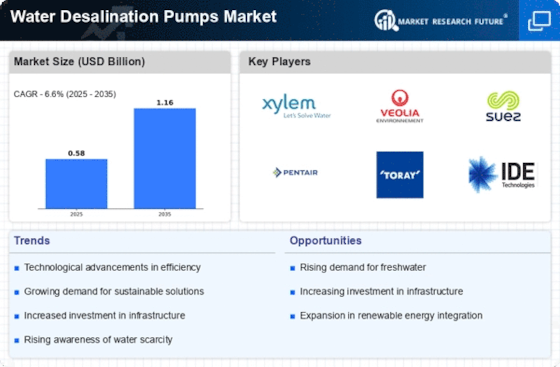
As per Market Research Future analysis, the Water Desalination Pumps Market Size was estimated at 0.5757 USD Billion in 2024. The Water Desalination Pumps industry is projected to grow from USD 0.6137 Billion in 2025 to USD 1.163 Billion by 2035, exhibiting a compound annual growth rate (CAGR) of 6% during the forecast period 2025 - 2035

Key Market Trends & Highlights

The Water Desalination Pumps Market is poised for substantial growth driven by technological advancements and increasing demand for sustainable solutions.

  • North America remains the largest market for water desalination pumps, driven by advanced infrastructure and regulatory support. The Asia-Pacific region is emerging as the fastest-growing market, fueled by rising water scarcity and industrial demand. Centrifugal pumps dominate the market due to their efficiency in large-scale applications, while positive displacement pumps are experiencing rapid growth in niche segments. Key market drivers include increasing water scarcity and government initiatives aimed at promoting sustainable water management practices.

Market Size & Forecast

2024 Market Size 0.5757 (USD Billion)
2035 Market Size 1.163 (USD Billion)
CAGR (2025 - 2035) 6.6%
Largest Regional Market Share in 2024 Europe

Major Players

<a href="https://www.xylem.com/en-in/products--services/pumps-packaged-pump-systems/pumps">Xylem Inc </a>(US), Veolia Environnement (FR), SUEZ (FR), Pentair plc (US), Toray Industries, Inc. (JP), IDE Technologies (IL), <a href="https://www.acciona.com/solutions/water/activity-areas/desalination">Acciona Agua</a> (ES), Doosan Heavy Industries &amp; Construction (KR), Hyflux Ltd (SG)

Market Trends

The Water Desalination Pumps Market is currently experiencing a notable transformation driven by increasing global water scarcity and the rising demand for fresh water. This market is characterized by a diverse range of technologies and applications, catering to various sectors such as municipal, industrial, and agricultural. As nations grapple with the challenges posed by climate change and population growth, the need for efficient desalination solutions becomes more pressing. Consequently, advancements in pump technology, including energy efficiency and automation, are likely to play a pivotal role in shaping the future landscape of this market. Moreover, the Water Desalination Pumps Market appears to be influenced by regulatory frameworks and government initiatives aimed at promoting sustainable water management practices. Investments in infrastructure and research and development are expected to enhance the performance and reliability of desalination systems. As stakeholders seek to optimize operational costs and minimize environmental impacts, the integration of renewable energy sources into desalination processes may emerge as a key trend. Overall, the market is poised for growth, driven by innovation and a collective commitment to addressing water scarcity challenges.

Technological Advancements

The Water Desalination Pumps Market is witnessing a surge in technological innovations aimed at enhancing efficiency and reducing operational costs. New pump designs and materials are being developed to withstand harsh marine environments, thereby improving durability and performance. Additionally, automation and smart technologies are being integrated into desalination systems, allowing for real-time monitoring and optimization of processes.

Sustainability Focus

There is a growing emphasis on sustainability within the Water Desalination Pumps Market, as stakeholders increasingly prioritize environmentally friendly practices. This trend includes the adoption of energy-efficient pumps and the exploration of renewable energy sources to power desalination plants. Such initiatives not only reduce carbon footprints but also align with global efforts to combat climate change.

Regulatory Support

Government policies and regulations are playing a crucial role in shaping the Water Desalination Pumps Market. Many countries are implementing frameworks that encourage investment in desalination technologies and infrastructure. This regulatory support is likely to foster innovation and facilitate the deployment of advanced desalination solutions, ultimately contributing to improved water security.

Water Desalination Pumps Market Market Drivers

Rising Industrial Demand

The industrial sector's growing demand for water is a significant driver of the Water Desalination Pumps Market. Industries such as agriculture, energy, and manufacturing require substantial water resources for their operations. As freshwater sources become increasingly scarce, many industries are turning to desalination as a reliable alternative. Recent market analyses suggest that the industrial segment could account for a considerable share of the desalination market, with projections indicating a potential increase in demand for desalination pumps by over 15% in the coming years. This trend underscores the necessity for efficient and reliable pumping solutions to meet the rising water needs of various industries.

Increasing Water Scarcity

The escalating issue of water scarcity is a primary driver for the Water Desalination Pumps Market. As populations grow and industrial demands rise, the availability of fresh water diminishes. This trend is particularly evident in arid regions where natural water sources are limited. According to recent data, the demand for desalinated water is projected to increase significantly, with estimates suggesting a growth rate of over 10% annually in certain areas. Consequently, the need for efficient desalination pumps becomes paramount, as they play a crucial role in converting seawater into potable water. This growing urgency for sustainable water solutions is likely to propel investments in desalination technologies, thereby enhancing the market for water desalination pumps.

Technological Innovations

Technological advancements in desalination processes are transforming the Water Desalination Pumps Market. Innovations such as reverse osmosis and advanced filtration techniques have improved the efficiency and cost-effectiveness of desalination. Recent studies indicate that the integration of smart technologies, including IoT and AI, into desalination systems can optimize pump performance and reduce energy consumption. This shift towards more sophisticated technologies is expected to attract significant investments, as stakeholders seek to enhance operational efficiency and reduce environmental impacts. Furthermore, the development of energy-efficient pumps is likely to address the rising operational costs associated with desalination, making it a more viable option for water-scarce regions.

Government Initiatives and Funding

Government initiatives aimed at addressing water shortages are significantly influencing the Water Desalination Pumps Market. Many countries are implementing policies that promote the development of desalination projects, often accompanied by financial incentives and funding opportunities. For instance, recent government reports indicate that public funding for desalination infrastructure has increased, with several nations allocating substantial budgets to enhance water supply systems. This support not only facilitates the construction of new desalination plants but also encourages the adoption of advanced pumping technologies. As a result, the market for water desalination pumps is likely to experience robust growth, driven by favorable regulatory environments and increased public investment.

Environmental Concerns and Sustainability

Environmental concerns regarding water usage and sustainability are driving the Water Desalination Pumps Market. As awareness of water conservation grows, there is a shift towards sustainable practices in water management. Desalination is increasingly viewed as a viable solution to mitigate water scarcity while minimizing environmental impacts. Recent studies highlight that modern desalination technologies are designed to reduce energy consumption and lower carbon footprints. This focus on sustainability is likely to attract investments in desalination infrastructure, thereby boosting the demand for advanced desalination pumps. As stakeholders prioritize eco-friendly solutions, the market for water desalination pumps is expected to expand, reflecting a broader commitment to sustainable water resource management.

Market Segment Insights

By Type: Centrifugal Pumps (Largest) vs. Positive Displacement Pumps (Fastest-Growing)

<p>In the Water Desalination Pumps Market, centrifugal pumps hold the largest market share, primarily due to their widespread application and efficiency in high-capacity desalination systems. They are favored for their ability to handle large volumes of water, which is essential in large-scale desalination plants. Positive displacement pumps, while currently a smaller segment, are rapidly gaining traction for their effectiveness in applications requiring high pressure and precise flow control. Their increasing deployment in niche applications is driving their market share up significantly. The growth trends for this segment are fueled by rising global water scarcity and the increasing demand for desalinated water. Enhanced technological advancements are leading to innovations in both centrifugal and positive displacement pumps, improving their efficiency and resilience. Additionally, stringent regulatory requirements for water quality and technological shifts towards more energy-efficient solutions are propelling the adoption of these pumps in the desalination sector.</p>

<p>Centrifugal Pumps (Dominant) vs. Positive Displacement Pumps (Emerging)</p>

<p>Centrifugal pumps dominate the Water Desalination Pumps Market due to their reliability and efficiency in continuous flow applications. They are designed to handle large volumes and can operate at various pressures, making them suitable for extensive desalination operations. On the other hand, positive displacement pumps are emerging as a significant alternative in the market. These pumps excel in applications that require consistent flow rates, even against varying pressures. Their ability to deliver high pressure makes them ideal for reverse osmosis systems. As innovation continues, both pump types will likely adapt and further enhance their position in the desalination sector, responding to the growing needs for sustainable and efficient water management solutions.</p>

By Application: Water and Wastewater Treatment (Largest) vs. Oil and Gas (Fastest-Growing)

<p>The Water Desalination Pumps Market is segmented primarily into Water and Wastewater Treatment, Oil and Gas, Power, and Others. Water and Wastewater Treatment dominates the market, accounting for the largest share due to increasing demands for fresh water and stringent regulations regarding water quality. This segment significantly influences the overall market dynamics by fostering technological advancements and driving investments toward sustainable solutions. On the other hand, the Oil and Gas segment is emerging as a swiftly growing area, driven by the industry's need for reliable and efficient water management solutions amid the increasing focus on desalination processes within extraction activities.</p>

<p>Water and Wastewater Treatment (Dominant) vs. Oil and Gas (Emerging)</p>

<p>The Water and Wastewater Treatment segment is characterized by its robust demand for desalination pumps to meet rising global water scarcity challenges. This segment benefits from extensive investments in infrastructure development and increasing government support for water management solutions. In contrast, the Oil and Gas segment is gaining prominence as operators seek efficient water handling systems, particularly in offshore operations where desalination plays a key role in maintaining production levels. Companies are innovating to improve pump efficiencies, which further supports the segment's growth. Both segments reflect significant trends in sustainable resource management, though they cater to different applications and market requirements.</p>

Get more detailed insights about Water Desalination Pumps Market Research Report - Global Forecast 2035

Regional Insights

North America : Innovation and Sustainability Focus

North America is a leader in the water desalination pumps market, driven by increasing water scarcity and a strong emphasis on sustainable practices. The region holds approximately 35% of the global market share, with the United States being the largest contributor, followed by Canada. Regulatory support for innovative technologies and investments in infrastructure are key growth drivers, enhancing the demand for efficient desalination solutions. The competitive landscape is characterized by major players such as Xylem Inc and Pentair plc, which are at the forefront of technological advancements. The presence of established companies fosters a robust market environment, encouraging innovation and collaboration. Additionally, government initiatives aimed at improving water quality and availability further bolster market growth, ensuring a steady demand for desalination pumps.

Europe : Regulatory Support and Innovation

Europe is witnessing a significant rise in the water desalination pumps market, driven by stringent regulations on water quality and increasing demand for fresh water. The region accounts for approximately 25% of the global market share, with countries like France and Spain leading the charge. The European Union's commitment to sustainable water management and investment in desalination technologies are pivotal in shaping market dynamics. Key players such as Veolia Environnement and SUEZ are actively involved in developing innovative solutions to meet the growing demand. The competitive landscape is marked by collaborations between public and private sectors, enhancing the efficiency of desalination processes. Furthermore, the presence of advanced research institutions supports the development of cutting-edge technologies, ensuring Europe remains a key player in the global market.

Asia-Pacific : Emerging Market with High Potential

Asia-Pacific is emerging as a powerhouse in the water desalination pumps market, driven by rapid urbanization and increasing water scarcity. The region holds approximately 30% of the global market share, with countries like China and India leading in demand. Government initiatives aimed at enhancing water supply and quality are significant growth catalysts, fostering investments in desalination technologies and infrastructure. The competitive landscape is characterized by the presence of key players such as Toray Industries and IDE Technologies, which are focusing on innovative solutions tailored to regional needs. The market is also witnessing collaborations between local and international firms, enhancing technological advancements. As the region continues to prioritize water security, the demand for efficient desalination pumps is expected to rise significantly, positioning Asia-Pacific as a critical market.

Middle East and Africa : Resource-Rich Yet Water-Scarce

The Middle East and Africa region is a critical market for water desalination pumps, driven by extreme water scarcity and a growing population. This region holds approximately 10% of the global market share, with countries like Saudi Arabia and the UAE leading in desalination initiatives. The reliance on desalination as a primary water source is a significant growth driver, supported by government investments in infrastructure and technology. The competitive landscape features key players such as Acciona Agua and Doosan Heavy Industries, which are actively involved in large-scale desalination projects. The presence of these companies fosters innovation and efficiency in desalination processes. Additionally, regional collaborations and partnerships are enhancing the market's growth potential, ensuring that the Middle East and Africa remain pivotal in the global water desalination landscape.

Key Players and Competitive Insights

Leading market players are investing heavily in research and development to expand their product lines, which will help the Water Desalination Pumps Market, grow even more. Market participants are also undertaking a variety of strategic activities to expand their global footprint, with important market developments including new product launches, contractual agreements, mergers and acquisitions, higher investments, and collaboration with other organizations. To expand and survive in a more competitive and rising market climate, the Water Desalination Pumps industry must offer cost-effective items.
Manufacturing locally to minimize operational costs is one of the key business tactics used by manufacturers in the global Water Desalination Pumps industry to benefit clients and increase the market sector. In recent years, the Water Desalination Pumps industry has offered some of the most significant advantages to the global water infrastructure and sustainability landscape.
Major players in the Water Desalination Pumps Market, including Ebara, Flowserve, GRUNDFOS Holding, Henan Province Xixia Automobile Water Pump, ITT, IWAKI, Idex, KSB, Kirloskar Brothers, PROCON s, PSG Dover, Pentair, SPX, Shanghai Kai Quan Pump, Sulzer Ltd., Torishima Pump, Watson-Marlow, Wilo, Xylem are attempting to increase market demand by investing in research and development operations.
Ebara Corp (Ebara) is a prominent manufacturer and distributor of industrial and environmental machinery, along with associated equipment. The company offers comprehensive services encompassing engineering, construction, operations, and maintenance, particularly specializing in hydroelectric and nuclear power-related facilities. Ebara's product portfolio includes a diverse range of offerings such as pumps, turbines, compressors, refrigeration equipment, heating systems, blowers, fans, plating equipment, dry vacuum pumps, chemical mechanical polishing (CMP) equipment, and exhaust gas treatment tools.
Furthermore, Ebara is actively engaged in the construction and upkeep of industrial waste incineration plants, municipal waste incineration plants, and water treatment facilities. The company is at the forefront of renewable energy technologies, including the development of wind power generators, fuel cell cogeneration systems, and photovoltaic power generators. Operating through subsidiaries in Asia, North America, and various other countries, Ebara maintains its headquarters in Ohta-ku, Tokyo, Japan.
Flowserve Corp (Flowserve) stands as a comprehensive provider of precision-engineered flow control systems catering to critical service applications. The company specializes in the development and manufacturing of a diverse range of flow control equipment, including bearings, pumps, positive displacement pumps, overhung pumps, valves, and seals. With a global presence, Flowserve extends its services to various industries, offering aftermarket support to global infrastructure sectors.
Flowserve's clientele spans across a wide spectrum of industries, including oil and gas, power, chemical, water, mining, ore processing, pharmaceuticals, food, pulp and paper, and beverage. The company not only provides cutting-edge products but also ensures the seamless operation of these systems through comprehensive aftermarket services. Operating across key regions such as North America, Europe, Asia-Pacific, Latin America, the Middle East, and Africa, Flowserve is headquartered in Irving, Texas, USA.

Key Companies in the Water Desalination Pumps Market include

Industry Developments

July 2021:In July 2021, IDE Water Technologies chose DuPont to supply SWRO membrane elements, including dry SWRO membranes, for the Sorek B desalination plant in Israel. DuPont's membranes were selected for their versatility and ease of installation.

July 2021:In July 2021, Veolia Water Technologies entered into a partnership agreement with 24 new collaborators to market, sell, and distribute specific Veolia Water Technologies products across the APAC region. Leveraging their local distribution expertise, these partners will contribute to the global expansion of the company's product portfolio. The covered countries encompass China, Indonesia, Malaysia, Thailand, Vietnam, Bangladesh, Sri Lanka, and New Zealand.

Future Outlook

Water Desalination Pumps Market Future Outlook

The Water Desalination Pumps Market is projected to grow at a 6.6% CAGR from 2025 to 2035, driven by increasing water scarcity, technological advancements, and rising demand for sustainable solutions.

New opportunities lie in:

  • Development of energy-efficient pump technologies for reduced operational costs.
  • Expansion into emerging markets with tailored desalination solutions.
  • Integration of IoT for real-time monitoring and predictive maintenance services.

By 2035, the market is expected to be robust, driven by innovation and strategic investments.

Market Segmentation

Water Desalination Pumps Market Type Outlook

  • Centrifugal Pumps
  • Positive Displacement Pumps
  • Others

Water Desalination Pumps Market Application Outlook

  • Water and Wastewater Treatment
  • Oil and Gas
  • Power
  • Others

Report Scope

MARKET SIZE 2024 0.5757(USD Billion)
MARKET SIZE 2025 0.6137(USD Billion)
MARKET SIZE 2035 1.163(USD Billion)
COMPOUND ANNUAL GROWTH RATE (CAGR) 6.6% (2025 - 2035)
REPORT COVERAGE Revenue Forecast, Competitive Landscape, Growth Factors, and Trends
BASE YEAR 2024
Market Forecast Period 2025 - 2035
Historical Data 2019 - 2024
Market Forecast Units USD Billion
Key Companies Profiled Xylem Inc (US), Veolia Environnement (FR), SUEZ (FR), Pentair plc (US), Toray Industries, Inc. (JP), IDE Technologies (IL), Acciona Agua (ES), Doosan Heavy Industries & Construction (KR), Hyflux Ltd (SG)
Segments Covered Type, Application, Region
Key Market Opportunities Advancements in energy-efficient technologies enhance growth potential in the Water Desalination Pumps Market.
Key Market Dynamics Rising demand for sustainable water solutions drives innovation and competition in the water desalination pumps market.

Countries Covered North America, Europe, APAC, South America, MEA

FAQs

What is the current valuation of the Water Desalination Pumps Market as of 2024?

<p>The market valuation was 0.5757 USD Billion in 2024.</p>

What is the projected market size for the Water Desalination Pumps Market in 2035?

<p>The projected valuation for 2035 is 1.163 USD Billion.</p>

What is the expected CAGR for the Water Desalination Pumps Market during the forecast period 2025 - 2035?

<p>The expected CAGR during this period is 6.6%.</p>

Which types of pumps dominate the Water Desalination Pumps Market?

<p>Centrifugal pumps and positive displacement pumps are the primary types, with valuations of 0.5751 USD Billion and 0.3462 USD Billion respectively.</p>

What applications are driving the demand for Water Desalination Pumps?

<p>Key applications include water and wastewater treatment, oil and gas, and power, with water treatment valued at 0.46 USD Billion.</p>

Who are the leading players in the Water Desalination Pumps Market?

<p>Key players include Xylem Inc, Veolia Environnement, SUEZ, and Pentair plc.</p>

How does the market for positive displacement pumps compare to centrifugal pumps?

Positive displacement pumps are valued at 0.3462 USD Billion, while centrifugal pumps are valued at 0.5751 USD Billion.

What is the significance of the 'Others' category in the Water Desalination Pumps Market?

The 'Others' category includes various pump types, with a valuation of 0.2417 USD Billion.

What trends are influencing the growth of the Water Desalination Pumps Market?

The market growth appears driven by increasing demand for clean water and advancements in desalination technology.

How does the market's growth potential impact investment opportunities?

The projected growth to 1.163 USD Billion by 2035 suggests substantial investment opportunities in the Water Desalination Pumps Market.

  1. SECTION I: EXECUTIVE SUMMARY AND KEY HIGHLIGHTS
    1. | 1.1 EXECUTIVE SUMMARY
    2. | | 1.1.1 Market Overview
    3. | | 1.1.2 Key Findings
    4. | | 1.1.3 Market Segmentation
    5. | | 1.1.4 Competitive Landscape
    6. | | 1.1.5 Challenges and Opportunities
    7. | | 1.1.6 Future Outlook
  2. SECTION II: SCOPING, METHODOLOGY AND MARKET STRUCTURE
    1. | 2.1 MARKET INTRODUCTION
    2. | | 2.1.1 Definition
    3. | | 2.1.2 Scope of the study
    4. | | | 2.1.2.1 Research Objective
    5. | | | 2.1.2.2 Assumption
    6. | | | 2.1.2.3 Limitations
    7. | 2.2 RESEARCH METHODOLOGY
    8. | | 2.2.1 Overview
    9. | | 2.2.2 Data Mining
    10. | | 2.2.3 Secondary Research
    11. | | 2.2.4 Primary Research
    12. | | | 2.2.4.1 Primary Interviews and Information Gathering Process
    13. | | | 2.2.4.2 Breakdown of Primary Respondents
    14. | | 2.2.5 Forecasting Model
    15. | | 2.2.6 Market Size Estimation
    16. | | | 2.2.6.1 Bottom-Up Approach
    17. | | | 2.2.6.2 Top-Down Approach
    18. | | 2.2.7 Data Triangulation
    19. | | 2.2.8 Validation
  3. SECTION III: QUALITATIVE ANALYSIS
    1. | 3.1 MARKET DYNAMICS
    2. | | 3.1.1 Overview
    3. | | 3.1.2 Drivers
    4. | | 3.1.3 Restraints
    5. | | 3.1.4 Opportunities
    6. | 3.2 MARKET FACTOR ANALYSIS
    7. | | 3.2.1 Value chain Analysis
    8. | | 3.2.2 Porter's Five Forces Analysis
    9. | | | 3.2.2.1 Bargaining Power of Suppliers
    10. | | | 3.2.2.2 Bargaining Power of Buyers
    11. | | | 3.2.2.3 Threat of New Entrants
    12. | | | 3.2.2.4 Threat of Substitutes
    13. | | | 3.2.2.5 Intensity of Rivalry
    14. | | 3.2.3 COVID-19 Impact Analysis
    15. | | | 3.2.3.1 Market Impact Analysis
    16. | | | 3.2.3.2 Regional Impact
    17. | | | 3.2.3.3 Opportunity and Threat Analysis
  4. SECTION IV: QUANTITATIVE ANALYSIS
    1. | 4.1 Energy & Power, BY Type (USD Billion)
    2. | | 4.1.1 Centrifugal Pumps
    3. | | 4.1.2 Positive Displacement Pumps
    4. | | 4.1.3 Others
    5. | 4.2 Energy & Power, BY Application (USD Billion)
    6. | | 4.2.1 Water and Wastewater Treatment
    7. | | 4.2.2 Oil and Gas
    8. | | 4.2.3 Power
    9. | | 4.2.4 Others
    10. | 4.3 Energy & Power, BY Region (USD Billion)
    11. | | 4.3.1 North America
    12. | | | 4.3.1.1 US
    13. | | | 4.3.1.2 Canada
    14. | | 4.3.2 Europe
    15. | | | 4.3.2.1 Germany
    16. | | | 4.3.2.2 UK
    17. | | | 4.3.2.3 France
    18. | | | 4.3.2.4 Russia
    19. | | | 4.3.2.5 Italy
    20. | | | 4.3.2.6 Spain
    21. | | | 4.3.2.7 Rest of Europe
    22. | | 4.3.3 APAC
    23. | | | 4.3.3.1 China
    24. | | | 4.3.3.2 India
    25. | | | 4.3.3.3 Japan
    26. | | | 4.3.3.4 South Korea
    27. | | | 4.3.3.5 Malaysia
    28. | | | 4.3.3.6 Thailand
    29. | | | 4.3.3.7 Indonesia
    30. | | | 4.3.3.8 Rest of APAC
    31. | | 4.3.4 South America
    32. | | | 4.3.4.1 Brazil
    33. | | | 4.3.4.2 Mexico
    34. | | | 4.3.4.3 Argentina
    35. | | | 4.3.4.4 Rest of South America
    36. | | 4.3.5 MEA
    37. | | | 4.3.5.1 GCC Countries
    38. | | | 4.3.5.2 South Africa
    39. | | | 4.3.5.3 Rest of MEA
  5. SECTION V: COMPETITIVE ANALYSIS
    1. | 5.1 Competitive Landscape
    2. | | 5.1.1 Overview
    3. | | 5.1.2 Competitive Analysis
    4. | | 5.1.3 Market share Analysis
    5. | | 5.1.4 Major Growth Strategy in the Energy & Power
    6. | | 5.1.5 Competitive Benchmarking
    7. | | 5.1.6 Leading Players in Terms of Number of Developments in the Energy & Power
    8. | | 5.1.7 Key developments and growth strategies
    9. | | | 5.1.7.1 New Product Launch/Service Deployment
    10. | | | 5.1.7.2 Merger & Acquisitions
    11. | | | 5.1.7.3 Joint Ventures
    12. | | 5.1.8 Major Players Financial Matrix
    13. | | | 5.1.8.1 Sales and Operating Income
    14. | | | 5.1.8.2 Major Players R&D Expenditure. 2023
    15. | 5.2 Company Profiles
    16. | | 5.2.1 Xylem Inc (US)
    17. | | | 5.2.1.1 Financial Overview
    18. | | | 5.2.1.2 Products Offered
    19. | | | 5.2.1.3 Key Developments
    20. | | | 5.2.1.4 SWOT Analysis
    21. | | | 5.2.1.5 Key Strategies
    22. | | 5.2.2 Veolia Environnement (FR)
    23. | | | 5.2.2.1 Financial Overview
    24. | | | 5.2.2.2 Products Offered
    25. | | | 5.2.2.3 Key Developments
    26. | | | 5.2.2.4 SWOT Analysis
    27. | | | 5.2.2.5 Key Strategies
    28. | | 5.2.3 SUEZ (FR)
    29. | | | 5.2.3.1 Financial Overview
    30. | | | 5.2.3.2 Products Offered
    31. | | | 5.2.3.3 Key Developments
    32. | | | 5.2.3.4 SWOT Analysis
    33. | | | 5.2.3.5 Key Strategies
    34. | | 5.2.4 Pentair plc (US)
    35. | | | 5.2.4.1 Financial Overview
    36. | | | 5.2.4.2 Products Offered
    37. | | | 5.2.4.3 Key Developments
    38. | | | 5.2.4.4 SWOT Analysis
    39. | | | 5.2.4.5 Key Strategies
    40. | | 5.2.5 Toray Industries, Inc. (JP)
    41. | | | 5.2.5.1 Financial Overview
    42. | | | 5.2.5.2 Products Offered
    43. | | | 5.2.5.3 Key Developments
    44. | | | 5.2.5.4 SWOT Analysis
    45. | | | 5.2.5.5 Key Strategies
    46. | | 5.2.6 IDE Technologies (IL)
    47. | | | 5.2.6.1 Financial Overview
    48. | | | 5.2.6.2 Products Offered
    49. | | | 5.2.6.3 Key Developments
    50. | | | 5.2.6.4 SWOT Analysis
    51. | | | 5.2.6.5 Key Strategies
    52. | | 5.2.7 Acciona Agua (ES)
    53. | | | 5.2.7.1 Financial Overview
    54. | | | 5.2.7.2 Products Offered
    55. | | | 5.2.7.3 Key Developments
    56. | | | 5.2.7.4 SWOT Analysis
    57. | | | 5.2.7.5 Key Strategies
    58. | | 5.2.8 Doosan Heavy Industries & Construction (KR)
    59. | | | 5.2.8.1 Financial Overview
    60. | | | 5.2.8.2 Products Offered
    61. | | | 5.2.8.3 Key Developments
    62. | | | 5.2.8.4 SWOT Analysis
    63. | | | 5.2.8.5 Key Strategies
    64. | | 5.2.9 Hyflux Ltd (SG)
    65. | | | 5.2.9.1 Financial Overview
    66. | | | 5.2.9.2 Products Offered
    67. | | | 5.2.9.3 Key Developments
    68. | | | 5.2.9.4 SWOT Analysis
    69. | | | 5.2.9.5 Key Strategies
    70. | 5.3 Appendix
    71. | | 5.3.1 References
    72. | | 5.3.2 Related Reports
  6. LIST OF FIGURES
    1. | 6.1 MARKET SYNOPSIS
    2. | 6.2 NORTH AMERICA MARKET ANALYSIS
    3. | 6.3 US MARKET ANALYSIS BY TYPE
    4. | 6.4 US MARKET ANALYSIS BY APPLICATION
    5. | 6.5 CANADA MARKET ANALYSIS BY TYPE
    6. | 6.6 CANADA MARKET ANALYSIS BY APPLICATION
    7. | 6.7 EUROPE MARKET ANALYSIS
    8. | 6.8 GERMANY MARKET ANALYSIS BY TYPE
    9. | 6.9 GERMANY MARKET ANALYSIS BY APPLICATION
    10. | 6.10 UK MARKET ANALYSIS BY TYPE
    11. | 6.11 UK MARKET ANALYSIS BY APPLICATION
    12. | 6.12 FRANCE MARKET ANALYSIS BY TYPE
    13. | 6.13 FRANCE MARKET ANALYSIS BY APPLICATION
    14. | 6.14 RUSSIA MARKET ANALYSIS BY TYPE
    15. | 6.15 RUSSIA MARKET ANALYSIS BY APPLICATION
    16. | 6.16 ITALY MARKET ANALYSIS BY TYPE
    17. | 6.17 ITALY MARKET ANALYSIS BY APPLICATION
    18. | 6.18 SPAIN MARKET ANALYSIS BY TYPE
    19. | 6.19 SPAIN MARKET ANALYSIS BY APPLICATION
    20. | 6.20 REST OF EUROPE MARKET ANALYSIS BY TYPE
    21. | 6.21 REST OF EUROPE MARKET ANALYSIS BY APPLICATION
    22. | 6.22 APAC MARKET ANALYSIS
    23. | 6.23 CHINA MARKET ANALYSIS BY TYPE
    24. | 6.24 CHINA MARKET ANALYSIS BY APPLICATION
    25. | 6.25 INDIA MARKET ANALYSIS BY TYPE
    26. | 6.26 INDIA MARKET ANALYSIS BY APPLICATION
    27. | 6.27 JAPAN MARKET ANALYSIS BY TYPE
    28. | 6.28 JAPAN MARKET ANALYSIS BY APPLICATION
    29. | 6.29 SOUTH KOREA MARKET ANALYSIS BY TYPE
    30. | 6.30 SOUTH KOREA MARKET ANALYSIS BY APPLICATION
    31. | 6.31 MALAYSIA MARKET ANALYSIS BY TYPE
    32. | 6.32 MALAYSIA MARKET ANALYSIS BY APPLICATION
    33. | 6.33 THAILAND MARKET ANALYSIS BY TYPE
    34. | 6.34 THAILAND MARKET ANALYSIS BY APPLICATION
    35. | 6.35 INDONESIA MARKET ANALYSIS BY TYPE
    36. | 6.36 INDONESIA MARKET ANALYSIS BY APPLICATION
    37. | 6.37 REST OF APAC MARKET ANALYSIS BY TYPE
    38. | 6.38 REST OF APAC MARKET ANALYSIS BY APPLICATION
    39. | 6.39 SOUTH AMERICA MARKET ANALYSIS
    40. | 6.40 BRAZIL MARKET ANALYSIS BY TYPE
    41. | 6.41 BRAZIL MARKET ANALYSIS BY APPLICATION
    42. | 6.42 MEXICO MARKET ANALYSIS BY TYPE
    43. | 6.43 MEXICO MARKET ANALYSIS BY APPLICATION
    44. | 6.44 ARGENTINA MARKET ANALYSIS BY TYPE
    45. | 6.45 ARGENTINA MARKET ANALYSIS BY APPLICATION
    46. | 6.46 REST OF SOUTH AMERICA MARKET ANALYSIS BY TYPE
    47. | 6.47 REST OF SOUTH AMERICA MARKET ANALYSIS BY APPLICATION
    48. | 6.48 MEA MARKET ANALYSIS
    49. | 6.49 GCC COUNTRIES MARKET ANALYSIS BY TYPE
    50. | 6.50 GCC COUNTRIES MARKET ANALYSIS BY APPLICATION
    51. | 6.51 SOUTH AFRICA MARKET ANALYSIS BY TYPE
    52. | 6.52 SOUTH AFRICA MARKET ANALYSIS BY APPLICATION
    53. | 6.53 REST OF MEA MARKET ANALYSIS BY TYPE
    54. | 6.54 REST OF MEA MARKET ANALYSIS BY APPLICATION
    55. | 6.55 KEY BUYING CRITERIA OF ENERGY & POWER
    56. | 6.56 RESEARCH PROCESS OF MRFR
    57. | 6.57 DRO ANALYSIS OF ENERGY & POWER
    58. | 6.58 DRIVERS IMPACT ANALYSIS: ENERGY & POWER
    59. | 6.59 RESTRAINTS IMPACT ANALYSIS: ENERGY & POWER
    60. | 6.60 SUPPLY / VALUE CHAIN: ENERGY & POWER
    61. | 6.61 ENERGY & POWER, BY TYPE, 2024 (% SHARE)
    62. | 6.62 ENERGY & POWER, BY TYPE, 2024 TO 2035 (USD Billion)
    63. | 6.63 ENERGY & POWER, BY APPLICATION, 2024 (% SHARE)
    64. | 6.64 ENERGY & POWER, BY APPLICATION, 2024 TO 2035 (USD Billion)
    65. | 6.65 BENCHMARKING OF MAJOR COMPETITORS
  7. LIST OF TABLES
    1. | 7.1 LIST OF ASSUMPTIONS
    2. | | 7.1.1
    3. | 7.2 North America MARKET SIZE ESTIMATES; FORECAST
    4. | | 7.2.1 BY TYPE, 2025-2035 (USD Billion)
    5. | | 7.2.2 BY APPLICATION, 2025-2035 (USD Billion)
    6. | 7.3 US MARKET SIZE ESTIMATES; FORECAST
    7. | | 7.3.1 BY TYPE, 2025-2035 (USD Billion)
    8. | | 7.3.2 BY APPLICATION, 2025-2035 (USD Billion)
    9. | 7.4 Canada MARKET SIZE ESTIMATES; FORECAST
    10. | | 7.4.1 BY TYPE, 2025-2035 (USD Billion)
    11. | | 7.4.2 BY APPLICATION, 2025-2035 (USD Billion)
    12. | 7.5 Europe MARKET SIZE ESTIMATES; FORECAST
    13. | | 7.5.1 BY TYPE, 2025-2035 (USD Billion)
    14. | | 7.5.2 BY APPLICATION, 2025-2035 (USD Billion)
    15. | 7.6 Germany MARKET SIZE ESTIMATES; FORECAST
    16. | | 7.6.1 BY TYPE, 2025-2035 (USD Billion)
    17. | | 7.6.2 BY APPLICATION, 2025-2035 (USD Billion)
    18. | 7.7 UK MARKET SIZE ESTIMATES; FORECAST
    19. | | 7.7.1 BY TYPE, 2025-2035 (USD Billion)
    20. | | 7.7.2 BY APPLICATION, 2025-2035 (USD Billion)
    21. | 7.8 France MARKET SIZE ESTIMATES; FORECAST
    22. | | 7.8.1 BY TYPE, 2025-2035 (USD Billion)
    23. | | 7.8.2 BY APPLICATION, 2025-2035 (USD Billion)
    24. | 7.9 Russia MARKET SIZE ESTIMATES; FORECAST
    25. | | 7.9.1 BY TYPE, 2025-2035 (USD Billion)
    26. | | 7.9.2 BY APPLICATION, 2025-2035 (USD Billion)
    27. | 7.10 Italy MARKET SIZE ESTIMATES; FORECAST
    28. | | 7.10.1 BY TYPE, 2025-2035 (USD Billion)
    29. | | 7.10.2 BY APPLICATION, 2025-2035 (USD Billion)
    30. | 7.11 Spain MARKET SIZE ESTIMATES; FORECAST
    31. | | 7.11.1 BY TYPE, 2025-2035 (USD Billion)
    32. | | 7.11.2 BY APPLICATION, 2025-2035 (USD Billion)
    33. | 7.12 Rest of Europe MARKET SIZE ESTIMATES; FORECAST
    34. | | 7.12.1 BY TYPE, 2025-2035 (USD Billion)
    35. | | 7.12.2 BY APPLICATION, 2025-2035 (USD Billion)
    36. | 7.13 APAC MARKET SIZE ESTIMATES; FORECAST
    37. | | 7.13.1 BY TYPE, 2025-2035 (USD Billion)
    38. | | 7.13.2 BY APPLICATION, 2025-2035 (USD Billion)
    39. | 7.14 China MARKET SIZE ESTIMATES; FORECAST
    40. | | 7.14.1 BY TYPE, 2025-2035 (USD Billion)
    41. | | 7.14.2 BY APPLICATION, 2025-2035 (USD Billion)
    42. | 7.15 India MARKET SIZE ESTIMATES; FORECAST
    43. | | 7.15.1 BY TYPE, 2025-2035 (USD Billion)
    44. | | 7.15.2 BY APPLICATION, 2025-2035 (USD Billion)
    45. | 7.16 Japan MARKET SIZE ESTIMATES; FORECAST
    46. | | 7.16.1 BY TYPE, 2025-2035 (USD Billion)
    47. | | 7.16.2 BY APPLICATION, 2025-2035 (USD Billion)
    48. | 7.17 South Korea MARKET SIZE ESTIMATES; FORECAST
    49. | | 7.17.1 BY TYPE, 2025-2035 (USD Billion)
    50. | | 7.17.2 BY APPLICATION, 2025-2035 (USD Billion)
    51. | 7.18 Malaysia MARKET SIZE ESTIMATES; FORECAST
    52. | | 7.18.1 BY TYPE, 2025-2035 (USD Billion)
    53. | | 7.18.2 BY APPLICATION, 2025-2035 (USD Billion)
    54. | 7.19 Thailand MARKET SIZE ESTIMATES; FORECAST
    55. | | 7.19.1 BY TYPE, 2025-2035 (USD Billion)
    56. | | 7.19.2 BY APPLICATION, 2025-2035 (USD Billion)
    57. | 7.20 Indonesia MARKET SIZE ESTIMATES; FORECAST
    58. | | 7.20.1 BY TYPE, 2025-2035 (USD Billion)
    59. | | 7.20.2 BY APPLICATION, 2025-2035 (USD Billion)
    60. | 7.21 Rest of APAC MARKET SIZE ESTIMATES; FORECAST
    61. | | 7.21.1 BY TYPE, 2025-2035 (USD Billion)
    62. | | 7.21.2 BY APPLICATION, 2025-2035 (USD Billion)
    63. | 7.22 South America MARKET SIZE ESTIMATES; FORECAST
    64. | | 7.22.1 BY TYPE, 2025-2035 (USD Billion)
    65. | | 7.22.2 BY APPLICATION, 2025-2035 (USD Billion)
    66. | 7.23 Brazil MARKET SIZE ESTIMATES; FORECAST
    67. | | 7.23.1 BY TYPE, 2025-2035 (USD Billion)
    68. | | 7.23.2 BY APPLICATION, 2025-2035 (USD Billion)
    69. | 7.24 Mexico MARKET SIZE ESTIMATES; FORECAST
    70. | | 7.24.1 BY TYPE, 2025-2035 (USD Billion)
    71. | | 7.24.2 BY APPLICATION, 2025-2035 (USD Billion)
    72. | 7.25 Argentina MARKET SIZE ESTIMATES; FORECAST
    73. | | 7.25.1 BY TYPE, 2025-2035 (USD Billion)
    74. | | 7.25.2 BY APPLICATION, 2025-2035 (USD Billion)
    75. | 7.26 Rest of South America MARKET SIZE ESTIMATES; FORECAST
    76. | | 7.26.1 BY TYPE, 2025-2035 (USD Billion)
    77. | | 7.26.2 BY APPLICATION, 2025-2035 (USD Billion)
    78. | 7.27 MEA MARKET SIZE ESTIMATES; FORECAST
    79. | | 7.27.1 BY TYPE, 2025-2035 (USD Billion)
    80. | | 7.27.2 BY APPLICATION, 2025-2035 (USD Billion)
    81. | 7.28 GCC Countries MARKET SIZE ESTIMATES; FORECAST
    82. | | 7.28.1 BY TYPE, 2025-2035 (USD Billion)
    83. | | 7.28.2 BY APPLICATION, 2025-2035 (USD Billion)
    84. | 7.29 South Africa MARKET SIZE ESTIMATES; FORECAST
    85. | | 7.29.1 BY TYPE, 2025-2035 (USD Billion)
    86. | | 7.29.2 BY APPLICATION, 2025-2035 (USD Billion)
    87. | 7.30 Rest of MEA MARKET SIZE ESTIMATES; FORECAST
    88. | | 7.30.1 BY TYPE, 2025-2035 (USD Billion)
    89. | | 7.30.2 BY APPLICATION, 2025-2035 (USD Billion)
    90. | 7.31 PRODUCT LAUNCH/PRODUCT DEVELOPMENT/APPROVAL
    91. | | 7.31.1
    92. | 7.32 ACQUISITION/PARTNERSHIP
    93. | | 7.32.1

Energy & Power Market Segmentation

Energy & Power By Type (USD Billion, 2025-2035)

  • Centrifugal Pumps
  • Positive Displacement Pumps
  • Others

Energy & Power By Application (USD Billion, 2025-2035)

  • Water and Wastewater Treatment
  • Oil and Gas
  • Power
  • Others
Infographic

Free Sample Request

Kindly complete the form below to receive a free sample of this Report

Get Free Sample

Customer Strories

Compare Licence

×
Features License Type
Single User Multiuser License Enterprise User
Price $4,950 $5,950 $7,250
Maximum User Access Limit 1 User Upto 10 Users Unrestricted Access Throughout the Organization
Free Customization
Direct Access to Analyst
Deliverable Format
Platform Access
Discount on Next Purchase 10% 15% 15%
Printable Versions