×
Request Free Sample ×

Kindly complete the form below to receive a free sample of this Report

* Please use a valid business email

Leading companies partner with us for data-driven Insights

clients tt-cursor
Hero Background
English
Chinese
French
Japanese
Korean
German
Spanish

Wastewater Treatment Services Market Analysis

ID: MRFR/Equip/10522-HCR
111 Pages
Snehal Singh
February 2026

Wastewater Treatment Services Market Research Report Information By Segment (Chemicals, Equipment and Services), By Application (Municipal and Industrial) and By Region (North America, Europe, Asia-Pacific, and Rest of the World) –Market Forecast Till 2035

Share:
Download PDF ×

We do not share your information with anyone. However, we may send you emails based on your report interest from time to time. You may contact us at any time to opt-out.

Wastewater Treatment Services Market Infographic
Purchase Options

Market Analysis

In-depth Analysis of Wastewater Treatment Services Market Industry Landscape

The wastewater treatment services market is influenced by various market dynamics that shape its growth and development. One key factor driving this market is increasing concerns about water pollution and the need for effective wastewater management solutions. With rapid urbanization, industrialization, and population growth, the volume of wastewater generated has been on the rise, necessitating the implementation of advanced treatment technologies and services.

Government regulations and policies play a significant role in driving the demand for wastewater treatment services. Stringent environmental regulations aimed at protecting water bodies from contamination have compelled industries and municipalities to invest in wastewater treatment infrastructure. Compliance with these regulations often requires upgrading existing treatment facilities or implementing new ones, thereby driving the demand for wastewater treatment services.

Technological advancements also drive market dynamics in the wastewater treatment services sector. Innovations in treatment technologies, such as membrane filtration, biological treatment processes, and advanced oxidation processes, have improved the efficiency and effectiveness of wastewater treatment. As a result, there is a growing demand for services related to the installation, operation, and maintenance of these advanced treatment systems.

Furthermore, increasing awareness about the importance of water conservation and sustainability has led to the adoption of more eco-friendly and energy-efficient wastewater treatment solutions. Companies offering wastewater treatment services are increasingly focusing on developing sustainable practices and solutions that minimize energy consumption, reduce chemical usage, and maximize water recovery.

Market competition is another key dynamic shaping the wastewater treatment services market. With the growing demand for these services, numerous companies are entering the market, leading to increased competition. This competition drives innovation and pushes companies to offer better services, technologies, and pricing options to attract customers.

Moreover, market consolidation is a significant trend observed in the wastewater treatment services sector. Larger companies are acquiring smaller firms to expand their service offerings, geographic presence, and customer base. This consolidation allows companies to achieve economies of scale, improve operational efficiency, and strengthen their market position.

The COVID-19 pandemic has also impacted the wastewater treatment services market dynamics. While the pandemic initially led to disruptions in supply chains and project delays, it also highlighted the importance of resilient and reliable wastewater infrastructure. As a result, there has been increased investment in upgrading and expanding wastewater treatment facilities to enhance resilience against future crises.

Global economic factors also influence market dynamics in the wastewater treatment services sector. Economic growth, industrial output, and infrastructure development directly impact the demand for wastewater treatment services. As economies grow and industries expand, the volume of wastewater generated increases, driving the need for wastewater treatment solutions.


Author
Snehal Singh
Assistant Manager - Research

High acumen in analyzing complex macro & micro markets with more than 6 years of work experience in the field of market research. By implementing her analytical skills in forecasting and estimation into market research reports, she has expertise in Packaging, Construction, and Equipment domains. She handles a team size of 20-25 resources and ensures smooth running of the projects, associated marketing activities, and client servicing.

Leave a Comment

FAQs

What is the current valuation of the Wastewater Treatment Services Market?

<p>As of 2024, the Wastewater Treatment Services Market was valued at 61.84 USD Billion.</p>

What is the projected market size for the Wastewater Treatment Services Market by 2035?

<p>The market is projected to reach 127.54 USD Billion by 2035.</p>

What is the expected CAGR for the Wastewater Treatment Services Market during the forecast period?

<p>The expected CAGR for the Wastewater Treatment Services Market from 2025 to 2035 is 6.8%.</p>

Which segments are included in the Wastewater Treatment Services Market?

<p>The market segments include Chemicals, Equipment, and Services, with valuations ranging from 15.0 to 57.54 USD Billion.</p>

What are the key applications of the Wastewater Treatment Services Market?

<p>The key applications are Municipal and Industrial, each projected to grow from 30.92 to 63.77 USD Billion.</p>

Who are the leading players in the Wastewater Treatment Services Market?

<p>Key players include Veolia Environnement, Suez, Xylem, and Evoqua Water Technologies, among others.</p>

How do the Chemicals and Equipment segments compare in terms of market valuation?

The Equipment segment is expected to grow from 20.0 to 40.0 USD Billion, while Chemicals range from 15.0 to 30.0 USD Billion.

What is the significance of the Services segment in the Wastewater Treatment Services Market?

The Services segment is projected to expand from 26.84 to 57.54 USD Billion, indicating robust growth potential.

How does the market's growth trajectory appear for the next decade?

The market's growth trajectory appears promising, with a projected increase in valuation and a steady CAGR of 6.8%.

What factors might influence the growth of the Wastewater Treatment Services Market?

Factors such as regulatory changes, technological advancements, and increasing demand for sustainable solutions may influence market growth.

Market Summary

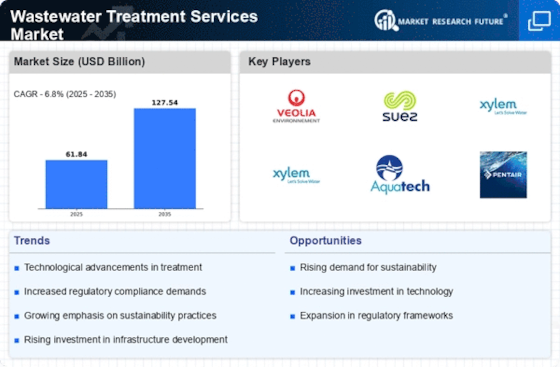
As per Market Research Future analysis, the Wastewater Treatment Services Market was estimated at 61.84 USD Billion in 2024. The wastewater treatment industry is projected to grow from 66.04 USD Billion in 2025 to 127.54 USD Billion by 2035, exhibiting a compound annual growth rate (CAGR) of 6.8% during the forecast period 2025 - 2035

Key Market Trends & Highlights

The Wastewater Treatment Services Market is experiencing a transformative shift towards sustainability and technological innovation.

  • Technological advancements are reshaping wastewater treatment processes, enhancing efficiency and effectiveness. Decentralized treatment solutions are gaining traction, particularly in urban areas facing space constraints. The focus on sustainability is driving investments in resource recovery and eco-friendly practices. Regulatory compliance and population growth are major drivers propelling the market in North America and Asia-Pacific, particularly in the municipal and industrial segments.

Market Size & Forecast

2024 Market Size 61.84 (USD Billion)
2035 Market Size 127.54 (USD Billion)
CAGR (2025 - 2035) 6.8%
Largest Regional Market Share in 2024 North America

Major Players

Veolia Environnement (FR), <a href="https://www.suez.com/en/water/water-conservation/wastewater">Suez </a>(FR), Xylem (US), Evoqua Water Technologies (US), Aquatech International (US), <a href="https://www.pentair.com/en-us/solutions/industrial-solutions/industrial-wastewater.html">Pentair</a> (US), Aqua America (US), Kurita Water Industries (JP), MWH Global (US)

Market Trends

The Wastewater Treatment Services Market is currently experiencing a transformative phase, driven by increasing environmental regulations and a growing awareness of sustainable practices. As urbanization accelerates, the demand for efficient wastewater management solutions intensifies. This market appears to be evolving, with a notable shift towards advanced technologies that enhance treatment processes and reduce operational costs. Stakeholders are increasingly investing in innovative systems that not only comply with regulatory standards but also promote resource recovery and energy efficiency. Furthermore, the integration of smart technologies, such as IoT and AI, is likely to revolutionize monitoring and management practices, leading to improved service delivery and operational effectiveness. In addition, the Wastewater Treatment Services Market is witnessing a trend towards decentralized treatment systems. This approach seems to offer flexibility and resilience, particularly in rural and underserved areas. By enabling localized treatment solutions, communities can better manage their wastewater while minimizing transportation costs and environmental impacts. The emphasis on circular economy principles is also gaining traction, as industries seek to recycle and reuse water, thereby reducing their overall water footprint. Overall, the Wastewater Treatment Services Market is poised for growth, driven by technological advancements and a commitment to sustainable practices that align with global environmental goals.

Technological Advancements

The Wastewater Treatment Services Market is increasingly influenced by the adoption of cutting-edge technologies. Innovations such as membrane bioreactors and advanced oxidation processes are enhancing treatment efficiency and effectiveness. These technologies not only improve the quality of treated water but also facilitate the recovery of valuable resources, such as nutrients and energy, from wastewater.

Decentralized Treatment Solutions

There is a noticeable shift towards decentralized wastewater treatment systems within the Wastewater Treatment Services Market and Water and Wastewater Treatment Equipment sector. This trend appears to be driven by the need for localized solutions that can address specific community needs. Decentralized systems offer flexibility, reduce transportation costs, and minimize environmental impacts, making them an attractive option for many regions.

Focus on Sustainability

Sustainability is becoming a central theme in the Wastewater Treatment Services Market. Companies are increasingly prioritizing practices that align with circular economy principles. This includes efforts to recycle and reuse water, thereby reducing overall consumption and environmental impact. The commitment to sustainable practices is likely to shape future investments and innovations in the sector.

Wastewater Treatment Services Market Market Drivers

Technological Innovations

Technological advancements are reshaping the Wastewater Treatment Services Market, driving efficiency and effectiveness in treatment processes. Innovations such as membrane bioreactors, advanced oxidation processes, and real-time monitoring systems are enhancing the ability to treat wastewater to higher standards. These technologies not only improve the quality of treated water but also reduce operational costs and energy consumption. The market for advanced wastewater treatment technologies is projected to witness substantial growth, with estimates suggesting a potential increase of over 8% annually. As industries and municipalities adopt these cutting-edge solutions, the Wastewater Treatment Services Market is poised for transformation, reflecting a shift towards more sustainable and efficient practices.

Focus on Resource Recovery

The growing emphasis on resource recovery from wastewater is emerging as a pivotal driver in the Wastewater Treatment Services Market. Stakeholders are increasingly recognizing the potential of wastewater as a source of valuable resources, such as nutrients, energy, and water. Technologies that facilitate the recovery of these resources not only contribute to sustainability but also offer economic benefits. For instance, the recovery of biogas from anaerobic digestion processes can be utilized for energy production, reducing reliance on fossil fuels. This trend is likely to propel the Industrial Wastewater Treatment Service forward, as more facilities integrate resource recovery into their operations, aligning with circular economy principles and enhancing overall efficiency.

Population Growth and Urbanization

Rapid population growth and urbanization are significantly influencing the Wastewater Treatment Services Market. As urban areas expand, the volume of wastewater generated increases, necessitating the development of efficient treatment solutions. According to recent estimates, urban populations are expected to rise by over 2 billion by 2050, leading to heightened demand for wastewater management services. This surge in population density places immense pressure on existing infrastructure, prompting investments in new treatment facilities and upgrades to current systems. Consequently, the Wastewater Treatment Services Market is likely to experience robust growth as municipalities and private sectors seek to address the challenges posed by urbanization and ensure sustainable water management practices.

Regulatory Compliance and Standards

The increasing stringency of environmental regulations is a primary driver for the Wastewater Treatment Services Market. Governments worldwide are implementing stricter guidelines to ensure that wastewater is treated effectively before being discharged into natural water bodies. This regulatory landscape compels industries and municipalities to invest in advanced wastewater treatment technologies. For instance, the implementation of the Clean Water Act in various regions mandates that wastewater treatment facilities meet specific effluent quality standards. As a result, the demand for compliant wastewater treatment services is expected to rise, with the market projected to grow at a compound annual growth rate of approximately 6% over the next few years. This trend underscores the critical role of regulatory frameworks in shaping the Wastewater Treatment Services Market.

Investment in Infrastructure Development

Investment in infrastructure development is a crucial driver for the Wastewater Treatment Services Market. Many regions are facing aging wastewater treatment facilities that require upgrades or complete overhauls to meet modern standards. Governments and private entities are increasingly allocating funds to enhance wastewater infrastructure, recognizing its importance for public health and environmental protection. Recent reports indicate that infrastructure spending in the wastewater sector could exceed several billion dollars in the coming years. This influx of capital is expected to stimulate growth in the Wastewater Treatment Services Market, as new projects and renovations create opportunities for service providers to deliver innovative and effective treatment solutions.

Market Segment Insights

By Segment: Chemicals (Largest) vs. Equipment (Fastest-Growing)

<p>In the Wastewater Treatment Services Market, the segment distribution reveals that Chemicals hold the largest share followed by Equipment and Services. Chemicals play a crucial role in the treatment process, providing essential elements for purifying wastewater. Equipment, while currently smaller in market share compared to Chemicals, is witnessing significant growth due to technological advancements and increasing regulatory demands for efficient wastewater management. The Services segment, though essential, has a more stable growth trajectory as it is heavily intertwined with the other two segments.</p>

<p>Chemicals (Dominant) vs. Equipment (Emerging)</p>

<p>Chemicals represent the dominant segment in the Wastewater Treatment Services Market, essential for a variety of treatment processes such as disinfection, coagulation, and flocculation. Their key role in ensuring compliance with environmental regulations drives consistent demand. Conversely, the Equipment segment is emerging rapidly, fueled by the need for innovative technologies such as advanced filtration systems and biosolid processing units. The growth of Equipment is propelled by the increasing investment in infrastructure to meet water quality targets and a rising focus on sustainable solutions. This dynamic interplay highlights the evolving landscape of wastewater treatment, where both segments are critical for achieving comprehensive treatment objectives.</p>

By Application: Municipal (Largest) vs. Industrial (Fastest-Growing)

<p>In the Wastewater Treatment Services Market, the Municipal segment accounts for the largest share, driven by the increasing population and the consequent rise in urbanization. Municipal facilities have become essential for managing wastewater efficiently, ensuring environmental protection and public health. On the other hand, the Industrial segment, though smaller, is the fastest-growing segment due to the stringent regulations imposed on industrial discharges and the rising focus on sustainability through the adoption of advanced treatment technologies.</p>

<p>Wastewater Treatment: Municipal (Dominant) vs. Industrial (Emerging)</p>

<p>The Municipal wastewater treatment segment remains dominant in the Wastewater Treatment Services Market, characterized by its established infrastructure and robust regulatory support. It caters to large urban populations, focusing on compliance with environmental standards. Conversely, the Industrial segment is emerging rapidly, driven by various industries' need to treat wastewater efficiently and sustainably. This segment is witnessing innovation with technologies such as membrane bioreactors and advanced oxidation processes. As industries face increasing regulations and sustainability goals, the demand for specialized wastewater treatment services is anticipated to grow, creating a dynamic shift within the market.</p>

By End Use: Wastewater Treatment (Largest) vs. Water Reclamation (Fastest-Growing)

<p>In the On-site Wastewater Treatment and Reclamation Services Market, the distribution of market share among segment values highlights wastewater treatment as the largest contributor, driven by the increasing demand for efficient management of wastewater in various industries. Water reclamation follows closely, gaining traction as municipalities and industries seek sustainable practices for repurposing treated water, reflecting a growing awareness of environmental issues and regulatory pressures. Growth trends indicate that while wastewater treatment remains fundamental, water reclamation is emerging as the fastest-growing segment, fueled by advancements in technology and innovative treatment methods. Factors such as population growth, urbanization, and stringent regulations are propelling the need for effective sludge management and effluent treatment solutions, ensuring safe disposal and compliance with environmental standards.</p>

<p>Wastewater Treatment (Dominant) vs. Sludge Management (Emerging)</p>

<p>Wastewater treatment holds a dominant position in the On-site Wastewater Treatment and Reclamation Services Market, characterized by established technologies and widespread implementation across industrial and municipal sectors. It focuses on processes designed to remove contaminants from wastewater, thereby protecting public health and the environment. Sludge management, while emerging, plays a critical complementary role, addressing the challenges of managing by-products from wastewater treatment processes. With increasing global emphasis on resource recovery and sustainable practices, sludge management technologies are evolving to enhance efficiency and reduce environmental impact, making them integral to comprehensive wastewater strategies.</p>

Get more detailed insights about Wastewater Treatment Services Market Research Report—Global Forecast till 2035

Regional Insights

North America : Innovation and Sustainability Focus

North America is the largest market for wastewater treatment services, holding approximately 40% of the global market share. The region's growth is driven by stringent environmental regulations, increasing urbanization, and the need for sustainable water management solutions. The U.S. and Canada are the primary contributors, with significant investments in infrastructure and technology to enhance treatment processes and reduce environmental impact. The competitive landscape is dominated by key players such as Veolia Environnement, Suez, and Xylem, which are leveraging advanced technologies to improve efficiency and reduce costs. The presence of these companies fosters innovation, while government initiatives support the adoption of new technologies. The focus on sustainability and resource recovery is shaping the future of wastewater treatment in this region.

Europe : Regulatory-Driven Market Growth

Europe is the second-largest market for wastewater treatment services, accounting for approximately 30% of the global market share. The region's growth is propelled by stringent EU regulations aimed at improving water quality and promoting sustainable practices. The European Green Deal and the Water Framework Directive are key regulatory catalysts driving investments in advanced treatment technologies and infrastructure upgrades across member states. Leading countries in this market include Germany, France, and the UK, where companies like Suez and Veolia are prominent. The competitive landscape is characterized by a mix of large multinational corporations and innovative local firms. The emphasis on circular economy principles and resource recovery is reshaping wastewater treatment practices, ensuring compliance with environmental standards and enhancing service delivery.

Asia-Pacific : Emerging Market Potential

Asia-Pacific is witnessing rapid growth in the wastewater treatment services market, holding approximately 25% of the global market share. The region's expansion is driven by rapid urbanization, industrialization, and increasing awareness of water scarcity issues. Countries like China and India are leading this growth, with substantial investments in wastewater infrastructure and technology to meet rising demand and regulatory requirements. The competitive landscape features both local and international players, including Kurita Water Industries and Xylem. Governments are increasingly prioritizing water management, leading to partnerships with private firms to enhance service delivery. The focus on sustainable practices and innovative technologies is expected to drive further growth in the region, addressing both environmental and public health concerns.

Middle East and Africa : Resource Management Challenges

The Middle East and Africa region is emerging as a significant market for wastewater treatment services, accounting for approximately 5% of the global market share. The growth is primarily driven by acute water scarcity issues, rapid population growth, and the need for sustainable water management solutions. Countries like South Africa and the UAE are investing heavily in wastewater treatment technologies to address these challenges and improve water security. The competitive landscape includes both local firms and international players, with a focus on innovative solutions to enhance efficiency. Key players such as Aqua America and Evoqua Water Technologies are actively involved in projects aimed at improving water quality and resource recovery. The region's unique challenges necessitate tailored solutions that align with local needs and regulatory frameworks.

Key Players and Competitive Insights

Leading market players are investing heavily in research and development in order to expand their product lines, which will help the Wastewater Treatment Services Market, grow even more. Market participants are also undertaking a variety of strategic activities to expand their global footprint, with important market developments including new product launches, contractual agreements, mergers and acquisitions, higher investments, and collaboration with other organizations. To expand and survive in a more competitive and rising market climate, Wastewater Treatment Services industry must offer cost-effective items. Manufacturing locally to minimize operational costs is one of the key business tactics used by manufacturers in the global Wastewater Treatment Services industry to benefit clients and increase the market sector. In recent years, the Wastewater Treatment Services industry has offered some of the most significant advantages to medicine. Major players in the Wastewater Treatment Services Market, including Veolia (France), SUEZ Worldwide (France), DuPont (U.S.), 3M (U.S.), Xylem (U.S.), Kemira (Finland), Evoqua Water Technologies LLC (U.S.), Pentair PLC (U.K.), Ecolab (U.S.), American Water (U.S.), Acciona (Spain), Hydro International (U.K.), Aquatech International LLC (U.S.), Trojan Technologies (Canada), BioMicrobics Inc. (U.S.), Kurita Water Industries Ltd. (Japan), ASIO (Czech Republic) and others, are attempting to increase market demand by investing in research and development operations. Environmental management services are offered by Veolia Environnement SA (Veolia). The business provides services for the treatment and distribution of drinking water, wastewater treatment options, waste collection, waste-to-energy processing, dismantling, and the processing of hazardous material. It provides energy solutions across the whole conversion cycle, from acquiring energy sources into an industrial site to constructing new facilities or updating older ones to reselling the electricity generated on the open market. In Europe, Asia, North America, Latin America, Africa, the Middle East, and Oceania, the corporation provides services to public agencies, local authorities, industrial and commercial service clients, and private persons. The head office of Veolia is located in Paris, Ile-de-France, France. Manufacturer and distributor of industrial goods and services is 3M Co. The company's product line also includes advanced materials, display materials and systems, stationery and office supplies, home care, home renovation, roofing granules, closure and masking systems, and other items. Additionally, 3M provides a range of services, including medical, dental, consumer health, food safety, and health information systems. Customers from a variety of industries, including automotive, electronics, health care, safety, energy, and consumer, are served by it. Asia Pacific, Europe, the Middle East, Africa, and the Americas are all regions where the corporation has manufacturing and converting operations. The US city of St. Paul, Minnesota, is home to 3M.

Key Companies in the Wastewater Treatment Services Market include

Industry Developments

March 2023 – Aquatech International officially signed a partnership with Fluid Technology Solutions, Inc., a manufacturer specializing in advanced membranes and separation technologies. The objective is to work together in order to improve their brine concentration, separation and water re-use technologies. January 2023 – Xylem Inc. agreed to purchase Evoqua for about USD 7.5 billion plus stock in an all-stock transaction. This enlarging business would be able to combine Xylem’s elite global position in water solutions with Evoqua’s focus on advanced treatment systems and services to build and deliver an extensive range of advanced solutions.

April 2022 – Xylem Ventures Spread Its Wings And Took A Leap Investment – Investments – To Launch Xylem Supply Chain: Future Water Supplies with the objective of developing new and advanced water and industrial technology, Xylem invested in the venture capital funds Burnt Island Ventures and The Wastly Group’s Funds. These sources of funding were to enhance the open innovation structure of Xylem Innovation Labs and its ability to go global and fast with the best transformative technologies in the water sector.

January 2022 – Evoqua Water Technologies LLC also confirmed that it has purchased Renal Business from Mar Cor Purification and Cantel Medical, subsidiaries of the STERIS Group. The acquisition boosted the company’s ability to sell water solutions to the healthcare market in North America as it expanded the company’s footprint in North America. November 2021 – Kemira has increased the production capacity of water treatment chemicals in Britain. Now, more than 100 kilotons of ferric-based water treatment chemicals manufactured in Goole would be produced on an annual basis.

The volume of aluminum-based water treatment chemicals produced in Ellesmere Port was raised by the company in January 2021 by 30,000 tons. In September 2023, Cambi signed a contract with Woodman Point Water Resource Recovery Facility. The facility is owned by Water, which plans to build additional digesters and employ thermal hydrolysis process THP technology to be able to increase its sludge treatment capacity. July 2023 – A ceremony was held to mark the end of the construction of the Bangladeshi Dasherkandi Sewage Treatment Plant.

The construction of this project, which was carried out by Chinese enterprises, is expected to serve five million people in Bangladesh.

Future Outlook

Wastewater Treatment Services Market Future Outlook

The Wastewater Treatment Services Market is projected to grow at a 6.8% CAGR from 2025 to 2035, driven by increasing regulatory pressures, technological advancements, and rising environmental concerns.

New opportunities lie in:

  • <p>Investment in advanced membrane filtration technologies Development of decentralized wastewater treatment systems Integration of IoT for real-time monitoring and management</p>

By 2035, the market is expected to be robust, driven by innovation and sustainability initiatives.

Market Segmentation

Wastewater Treatment Services Market Segment Outlook

  • Chemicals
  • Equipment
  • Services

Wastewater Treatment Services Market Application Outlook

  • Municipal
  • Industrial

Report Scope

MARKET SIZE 2024 61.84(USD Billion)
MARKET SIZE 2025 66.04(USD Billion)
MARKET SIZE 2035 127.54(USD Billion)
COMPOUND ANNUAL GROWTH RATE (CAGR) 6.8% (2025 - 2035)
REPORT COVERAGE Revenue Forecast, Competitive Landscape, Growth Factors, and Trends
BASE YEAR 2024
Market Forecast Period 2025 - 2035
Historical Data 2019 - 2024
Market Forecast Units USD Billion
Key Companies Profiled Veolia Environnement (FR), Suez (FR), Xylem (US), Evoqua Water Technologies (US), Aquatech International (US), Pentair (US), Aqua America (US), Kurita Water Industries (JP), MWH Global (US)
Segments Covered Segment, Application, Region
Key Market Opportunities Integration of advanced treatment technologies to enhance efficiency and sustainability in the Wastewater Treatment Services Market.
Key Market Dynamics Rising regulatory pressures drive innovation and investment in advanced wastewater treatment technologies and sustainable practices.
Countries Covered North America, Europe, APAC, South America, MEA

FAQs

What is the current valuation of the Wastewater Treatment Services Market?

<p>As of 2024, the Wastewater Treatment Services Market was valued at 61.84 USD Billion.</p>

What is the projected market size for the Wastewater Treatment Services Market by 2035?

<p>The market is projected to reach 127.54 USD Billion by 2035.</p>

What is the expected CAGR for the Wastewater Treatment Services Market during the forecast period?

<p>The expected CAGR for the Wastewater Treatment Services Market from 2025 to 2035 is 6.8%.</p>

Which segments are included in the Wastewater Treatment Services Market?

<p>The market segments include Chemicals, Equipment, and Services, with valuations ranging from 15.0 to 57.54 USD Billion.</p>

What are the key applications of the Wastewater Treatment Services Market?

<p>The key applications are Municipal and Industrial, each projected to grow from 30.92 to 63.77 USD Billion.</p>

Who are the leading players in the Wastewater Treatment Services Market?

<p>Key players include Veolia Environnement, Suez, Xylem, and Evoqua Water Technologies, among others.</p>

How do the Chemicals and Equipment segments compare in terms of market valuation?

The Equipment segment is expected to grow from 20.0 to 40.0 USD Billion, while Chemicals range from 15.0 to 30.0 USD Billion.

What is the significance of the Services segment in the Wastewater Treatment Services Market?

The Services segment is projected to expand from 26.84 to 57.54 USD Billion, indicating robust growth potential.

How does the market's growth trajectory appear for the next decade?

The market's growth trajectory appears promising, with a projected increase in valuation and a steady CAGR of 6.8%.

What factors might influence the growth of the Wastewater Treatment Services Market?

Factors such as regulatory changes, technological advancements, and increasing demand for sustainable solutions may influence market growth.

  1. SECTION I: EXECUTIVE SUMMARY AND KEY HIGHLIGHTS
    1. | 1.1 EXECUTIVE SUMMARY
    2. | | 1.1.1 Market Overview
    3. | | 1.1.2 Key Findings
    4. | | 1.1.3 Market Segmentation
    5. | | 1.1.4 Competitive Landscape
    6. | | 1.1.5 Challenges and Opportunities
    7. | | 1.1.6 Future Outlook
  2. SECTION II: SCOPING, METHODOLOGY AND MARKET STRUCTURE
    1. | 2.1 MARKET INTRODUCTION
    2. | | 2.1.1 Definition
    3. | | 2.1.2 Scope of the study
    4. | | | 2.1.2.1 Research Objective
    5. | | | 2.1.2.2 Assumption
    6. | | | 2.1.2.3 Limitations
    7. | 2.2 RESEARCH METHODOLOGY
    8. | | 2.2.1 Overview
    9. | | 2.2.2 Data Mining
    10. | | 2.2.3 Secondary Research
    11. | | 2.2.4 Primary Research
    12. | | | 2.2.4.1 Primary Interviews and Information Gathering Process
    13. | | | 2.2.4.2 Breakdown of Primary Respondents
    14. | | 2.2.5 Forecasting Model
    15. | | 2.2.6 Market Size Estimation
    16. | | | 2.2.6.1 Bottom-Up Approach
    17. | | | 2.2.6.2 Top-Down Approach
    18. | | 2.2.7 Data Triangulation
    19. | | 2.2.8 Validation
  3. SECTION III: QUALITATIVE ANALYSIS
    1. | 3.1 MARKET DYNAMICS
    2. | | 3.1.1 Overview
    3. | | 3.1.2 Drivers
    4. | | 3.1.3 Restraints
    5. | | 3.1.4 Opportunities
    6. | 3.2 MARKET FACTOR ANALYSIS
    7. | | 3.2.1 Value chain Analysis
    8. | | 3.2.2 Porter's Five Forces Analysis
    9. | | | 3.2.2.1 Bargaining Power of Suppliers
    10. | | | 3.2.2.2 Bargaining Power of Buyers
    11. | | | 3.2.2.3 Threat of New Entrants
    12. | | | 3.2.2.4 Threat of Substitutes
    13. | | | 3.2.2.5 Intensity of Rivalry
    14. | | 3.2.3 COVID-19 Impact Analysis
    15. | | | 3.2.3.1 Market Impact Analysis
    16. | | | 3.2.3.2 Regional Impact
    17. | | | 3.2.3.3 Opportunity and Threat Analysis
  4. SECTION IV: QUANTITATIVE ANALYSIS
    1. | 4.1 Pharmaceutical, BY Application (USD Billion)
    2. | | 4.1.1 Residential
    3. | | 4.1.2 Commercial
    4. | | 4.1.3 Industrial
    5. | | 4.1.4 Agricultural
    6. | 4.2 Pharmaceutical, BY Technology (USD Billion)
    7. | | 4.2.1 Aerobic Treatment
    8. | | 4.2.2 Anaerobic Treatment
    9. | | 4.2.3 Membrane Bioreactor
    10. | | 4.2.4 Constructed Wetlands
    11. | 4.3 Pharmaceutical, BY End Use (USD Billion)
    12. | | 4.3.1 Wastewater Treatment
    13. | | 4.3.2 Water Reclamation
    14. | | 4.3.3 Sludge Management
    15. | | 4.3.4 Effluent Treatment
    16. | 4.4 Pharmaceutical, BY Region (USD Billion)
    17. | | 4.4.1 North America
    18. | | | 4.4.1.1 US
    19. | | | 4.4.1.2 Canada
    20. | | 4.4.2 Europe
    21. | | | 4.4.2.1 Germany
    22. | | | 4.4.2.2 UK
    23. | | | 4.4.2.3 France
    24. | | | 4.4.2.4 Russia
    25. | | | 4.4.2.5 Italy
    26. | | | 4.4.2.6 Spain
    27. | | | 4.4.2.7 Rest of Europe
    28. | | 4.4.3 APAC
    29. | | | 4.4.3.1 China
    30. | | | 4.4.3.2 India
    31. | | | 4.4.3.3 Japan
    32. | | | 4.4.3.4 South Korea
    33. | | | 4.4.3.5 Malaysia
    34. | | | 4.4.3.6 Thailand
    35. | | | 4.4.3.7 Indonesia
    36. | | | 4.4.3.8 Rest of APAC
    37. | | 4.4.4 South America
    38. | | | 4.4.4.1 Brazil
    39. | | | 4.4.4.2 Mexico
    40. | | | 4.4.4.3 Argentina
    41. | | | 4.4.4.4 Rest of South America
    42. | | 4.4.5 MEA
    43. | | | 4.4.5.1 GCC Countries
    44. | | | 4.4.5.2 South Africa
    45. | | | 4.4.5.3 Rest of MEA
  5. SECTION V: COMPETITIVE ANALYSIS
    1. | 5.1 Competitive Landscape
    2. | | 5.1.1 Overview
    3. | | 5.1.2 Competitive Analysis
    4. | | 5.1.3 Market share Analysis
    5. | | 5.1.4 Major Growth Strategy in the Pharmaceutical
    6. | | 5.1.5 Competitive Benchmarking
    7. | | 5.1.6 Leading Players in Terms of Number of Developments in the Pharmaceutical
    8. | | 5.1.7 Key developments and growth strategies
    9. | | | 5.1.7.1 New Product Launch/Service Deployment
    10. | | | 5.1.7.2 Merger & Acquisitions
    11. | | | 5.1.7.3 Joint Ventures
    12. | | 5.1.8 Major Players Financial Matrix
    13. | | | 5.1.8.1 Sales and Operating Income
    14. | | | 5.1.8.2 Major Players R&D Expenditure. 2023
    15. | 5.2 Company Profiles
    16. | | 5.2.1 Veolia (FR)
    17. | | | 5.2.1.1 Financial Overview
    18. | | | 5.2.1.2 Products Offered
    19. | | | 5.2.1.3 Key Developments
    20. | | | 5.2.1.4 SWOT Analysis
    21. | | | 5.2.1.5 Key Strategies
    22. | | 5.2.2 SUEZ (FR)
    23. | | | 5.2.2.1 Financial Overview
    24. | | | 5.2.2.2 Products Offered
    25. | | | 5.2.2.3 Key Developments
    26. | | | 5.2.2.4 SWOT Analysis
    27. | | | 5.2.2.5 Key Strategies
    28. | | 5.2.3 Xylem (US)
    29. | | | 5.2.3.1 Financial Overview
    30. | | | 5.2.3.2 Products Offered
    31. | | | 5.2.3.3 Key Developments
    32. | | | 5.2.3.4 SWOT Analysis
    33. | | | 5.2.3.5 Key Strategies
    34. | | 5.2.4 Ecolab (US)
    35. | | | 5.2.4.1 Financial Overview
    36. | | | 5.2.4.2 Products Offered
    37. | | | 5.2.4.3 Key Developments
    38. | | | 5.2.4.4 SWOT Analysis
    39. | | | 5.2.4.5 Key Strategies
    40. | | 5.2.5 Pentair (US)
    41. | | | 5.2.5.1 Financial Overview
    42. | | | 5.2.5.2 Products Offered
    43. | | | 5.2.5.3 Key Developments
    44. | | | 5.2.5.4 SWOT Analysis
    45. | | | 5.2.5.5 Key Strategies
    46. | | 5.2.6 Aquatech International (US)
    47. | | | 5.2.6.1 Financial Overview
    48. | | | 5.2.6.2 Products Offered
    49. | | | 5.2.6.3 Key Developments
    50. | | | 5.2.6.4 SWOT Analysis
    51. | | | 5.2.6.5 Key Strategies
    52. | | 5.2.7 Infiltrator Water Technologies (US)
    53. | | | 5.2.7.1 Financial Overview
    54. | | | 5.2.7.2 Products Offered
    55. | | | 5.2.7.3 Key Developments
    56. | | | 5.2.7.4 SWOT Analysis
    57. | | | 5.2.7.5 Key Strategies
    58. | | 5.2.8 BioMicrobics (US)
    59. | | | 5.2.8.1 Financial Overview
    60. | | | 5.2.8.2 Products Offered
    61. | | | 5.2.8.3 Key Developments
    62. | | | 5.2.8.4 SWOT Analysis
    63. | | | 5.2.8.5 Key Strategies
    64. | | 5.2.9 Westech Engineering (US)
    65. | | | 5.2.9.1 Financial Overview
    66. | | | 5.2.9.2 Products Offered
    67. | | | 5.2.9.3 Key Developments
    68. | | | 5.2.9.4 SWOT Analysis
    69. | | | 5.2.9.5 Key Strategies
    70. | | 5.2.10 Aqua-Aerobic Systems (US)
    71. | | | 5.2.10.1 Financial Overview
    72. | | | 5.2.10.2 Products Offered
    73. | | | 5.2.10.3 Key Developments
    74. | | | 5.2.10.4 SWOT Analysis
    75. | | | 5.2.10.5 Key Strategies
    76. | 5.3 Appendix
    77. | | 5.3.1 References
    78. | | 5.3.2 Related Reports
  6. LIST OF FIGURES
    1. | 6.1 MARKET SYNOPSIS
    2. | 6.2 NORTH AMERICA MARKET ANALYSIS
    3. | 6.3 US MARKET ANALYSIS BY APPLICATION
    4. | 6.4 US MARKET ANALYSIS BY TECHNOLOGY
    5. | 6.5 US MARKET ANALYSIS BY END USE
    6. | 6.6 CANADA MARKET ANALYSIS BY APPLICATION
    7. | 6.7 CANADA MARKET ANALYSIS BY TECHNOLOGY
    8. | 6.8 CANADA MARKET ANALYSIS BY END USE
    9. | 6.9 EUROPE MARKET ANALYSIS
    10. | 6.10 GERMANY MARKET ANALYSIS BY APPLICATION
    11. | 6.11 GERMANY MARKET ANALYSIS BY TECHNOLOGY
    12. | 6.12 GERMANY MARKET ANALYSIS BY END USE
    13. | 6.13 UK MARKET ANALYSIS BY APPLICATION
    14. | 6.14 UK MARKET ANALYSIS BY TECHNOLOGY
    15. | 6.15 UK MARKET ANALYSIS BY END USE
    16. | 6.16 FRANCE MARKET ANALYSIS BY APPLICATION
    17. | 6.17 FRANCE MARKET ANALYSIS BY TECHNOLOGY
    18. | 6.18 FRANCE MARKET ANALYSIS BY END USE
    19. | 6.19 RUSSIA MARKET ANALYSIS BY APPLICATION
    20. | 6.20 RUSSIA MARKET ANALYSIS BY TECHNOLOGY
    21. | 6.21 RUSSIA MARKET ANALYSIS BY END USE
    22. | 6.22 ITALY MARKET ANALYSIS BY APPLICATION
    23. | 6.23 ITALY MARKET ANALYSIS BY TECHNOLOGY
    24. | 6.24 ITALY MARKET ANALYSIS BY END USE
    25. | 6.25 SPAIN MARKET ANALYSIS BY APPLICATION
    26. | 6.26 SPAIN MARKET ANALYSIS BY TECHNOLOGY
    27. | 6.27 SPAIN MARKET ANALYSIS BY END USE
    28. | 6.28 REST OF EUROPE MARKET ANALYSIS BY APPLICATION
    29. | 6.29 REST OF EUROPE MARKET ANALYSIS BY TECHNOLOGY
    30. | 6.30 REST OF EUROPE MARKET ANALYSIS BY END USE
    31. | 6.31 APAC MARKET ANALYSIS
    32. | 6.32 CHINA MARKET ANALYSIS BY APPLICATION
    33. | 6.33 CHINA MARKET ANALYSIS BY TECHNOLOGY
    34. | 6.34 CHINA MARKET ANALYSIS BY END USE
    35. | 6.35 INDIA MARKET ANALYSIS BY APPLICATION
    36. | 6.36 INDIA MARKET ANALYSIS BY TECHNOLOGY
    37. | 6.37 INDIA MARKET ANALYSIS BY END USE
    38. | 6.38 JAPAN MARKET ANALYSIS BY APPLICATION
    39. | 6.39 JAPAN MARKET ANALYSIS BY TECHNOLOGY
    40. | 6.40 JAPAN MARKET ANALYSIS BY END USE
    41. | 6.41 SOUTH KOREA MARKET ANALYSIS BY APPLICATION
    42. | 6.42 SOUTH KOREA MARKET ANALYSIS BY TECHNOLOGY
    43. | 6.43 SOUTH KOREA MARKET ANALYSIS BY END USE
    44. | 6.44 MALAYSIA MARKET ANALYSIS BY APPLICATION
    45. | 6.45 MALAYSIA MARKET ANALYSIS BY TECHNOLOGY
    46. | 6.46 MALAYSIA MARKET ANALYSIS BY END USE
    47. | 6.47 THAILAND MARKET ANALYSIS BY APPLICATION
    48. | 6.48 THAILAND MARKET ANALYSIS BY TECHNOLOGY
    49. | 6.49 THAILAND MARKET ANALYSIS BY END USE
    50. | 6.50 INDONESIA MARKET ANALYSIS BY APPLICATION
    51. | 6.51 INDONESIA MARKET ANALYSIS BY TECHNOLOGY
    52. | 6.52 INDONESIA MARKET ANALYSIS BY END USE
    53. | 6.53 REST OF APAC MARKET ANALYSIS BY APPLICATION
    54. | 6.54 REST OF APAC MARKET ANALYSIS BY TECHNOLOGY
    55. | 6.55 REST OF APAC MARKET ANALYSIS BY END USE
    56. | 6.56 SOUTH AMERICA MARKET ANALYSIS
    57. | 6.57 BRAZIL MARKET ANALYSIS BY APPLICATION
    58. | 6.58 BRAZIL MARKET ANALYSIS BY TECHNOLOGY
    59. | 6.59 BRAZIL MARKET ANALYSIS BY END USE
    60. | 6.60 MEXICO MARKET ANALYSIS BY APPLICATION
    61. | 6.61 MEXICO MARKET ANALYSIS BY TECHNOLOGY
    62. | 6.62 MEXICO MARKET ANALYSIS BY END USE
    63. | 6.63 ARGENTINA MARKET ANALYSIS BY APPLICATION
    64. | 6.64 ARGENTINA MARKET ANALYSIS BY TECHNOLOGY
    65. | 6.65 ARGENTINA MARKET ANALYSIS BY END USE
    66. | 6.66 REST OF SOUTH AMERICA MARKET ANALYSIS BY APPLICATION
    67. | 6.67 REST OF SOUTH AMERICA MARKET ANALYSIS BY TECHNOLOGY
    68. | 6.68 REST OF SOUTH AMERICA MARKET ANALYSIS BY END USE
    69. | 6.69 MEA MARKET ANALYSIS
    70. | 6.70 GCC COUNTRIES MARKET ANALYSIS BY APPLICATION
    71. | 6.71 GCC COUNTRIES MARKET ANALYSIS BY TECHNOLOGY
    72. | 6.72 GCC COUNTRIES MARKET ANALYSIS BY END USE
    73. | 6.73 SOUTH AFRICA MARKET ANALYSIS BY APPLICATION
    74. | 6.74 SOUTH AFRICA MARKET ANALYSIS BY TECHNOLOGY
    75. | 6.75 SOUTH AFRICA MARKET ANALYSIS BY END USE
    76. | 6.76 REST OF MEA MARKET ANALYSIS BY APPLICATION
    77. | 6.77 REST OF MEA MARKET ANALYSIS BY TECHNOLOGY
    78. | 6.78 REST OF MEA MARKET ANALYSIS BY END USE
    79. | 6.79 KEY BUYING CRITERIA OF PHARMACEUTICAL
    80. | 6.80 RESEARCH PROCESS OF MRFR
    81. | 6.81 DRO ANALYSIS OF PHARMACEUTICAL
    82. | 6.82 DRIVERS IMPACT ANALYSIS: PHARMACEUTICAL
    83. | 6.83 RESTRAINTS IMPACT ANALYSIS: PHARMACEUTICAL
    84. | 6.84 SUPPLY / VALUE CHAIN: PHARMACEUTICAL
    85. | 6.85 PHARMACEUTICAL, BY APPLICATION, 2024 (% SHARE)
    86. | 6.86 PHARMACEUTICAL, BY APPLICATION, 2024 TO 2035 (USD Billion)
    87. | 6.87 PHARMACEUTICAL, BY TECHNOLOGY, 2024 (% SHARE)
    88. | 6.88 PHARMACEUTICAL, BY TECHNOLOGY, 2024 TO 2035 (USD Billion)
    89. | 6.89 PHARMACEUTICAL, BY END USE, 2024 (% SHARE)
    90. | 6.90 PHARMACEUTICAL, BY END USE, 2024 TO 2035 (USD Billion)
    91. | 6.91 BENCHMARKING OF MAJOR COMPETITORS
  7. LIST OF TABLES
    1. | 7.1 LIST OF ASSUMPTIONS
    2. | | 7.1.1
    3. | 7.2 North America MARKET SIZE ESTIMATES; FORECAST
    4. | | 7.2.1 BY APPLICATION, 2025-2035 (USD Billion)
    5. | | 7.2.2 BY TECHNOLOGY, 2025-2035 (USD Billion)
    6. | | 7.2.3 BY END USE, 2025-2035 (USD Billion)
    7. | 7.3 US MARKET SIZE ESTIMATES; FORECAST
    8. | | 7.3.1 BY APPLICATION, 2025-2035 (USD Billion)
    9. | | 7.3.2 BY TECHNOLOGY, 2025-2035 (USD Billion)
    10. | | 7.3.3 BY END USE, 2025-2035 (USD Billion)
    11. | 7.4 Canada MARKET SIZE ESTIMATES; FORECAST
    12. | | 7.4.1 BY APPLICATION, 2025-2035 (USD Billion)
    13. | | 7.4.2 BY TECHNOLOGY, 2025-2035 (USD Billion)
    14. | | 7.4.3 BY END USE, 2025-2035 (USD Billion)
    15. | 7.5 Europe MARKET SIZE ESTIMATES; FORECAST
    16. | | 7.5.1 BY APPLICATION, 2025-2035 (USD Billion)
    17. | | 7.5.2 BY TECHNOLOGY, 2025-2035 (USD Billion)
    18. | | 7.5.3 BY END USE, 2025-2035 (USD Billion)
    19. | 7.6 Germany MARKET SIZE ESTIMATES; FORECAST
    20. | | 7.6.1 BY APPLICATION, 2025-2035 (USD Billion)
    21. | | 7.6.2 BY TECHNOLOGY, 2025-2035 (USD Billion)
    22. | | 7.6.3 BY END USE, 2025-2035 (USD Billion)
    23. | 7.7 UK MARKET SIZE ESTIMATES; FORECAST
    24. | | 7.7.1 BY APPLICATION, 2025-2035 (USD Billion)
    25. | | 7.7.2 BY TECHNOLOGY, 2025-2035 (USD Billion)
    26. | | 7.7.3 BY END USE, 2025-2035 (USD Billion)
    27. | 7.8 France MARKET SIZE ESTIMATES; FORECAST
    28. | | 7.8.1 BY APPLICATION, 2025-2035 (USD Billion)
    29. | | 7.8.2 BY TECHNOLOGY, 2025-2035 (USD Billion)
    30. | | 7.8.3 BY END USE, 2025-2035 (USD Billion)
    31. | 7.9 Russia MARKET SIZE ESTIMATES; FORECAST
    32. | | 7.9.1 BY APPLICATION, 2025-2035 (USD Billion)
    33. | | 7.9.2 BY TECHNOLOGY, 2025-2035 (USD Billion)
    34. | | 7.9.3 BY END USE, 2025-2035 (USD Billion)
    35. | 7.10 Italy MARKET SIZE ESTIMATES; FORECAST
    36. | | 7.10.1 BY APPLICATION, 2025-2035 (USD Billion)
    37. | | 7.10.2 BY TECHNOLOGY, 2025-2035 (USD Billion)
    38. | | 7.10.3 BY END USE, 2025-2035 (USD Billion)
    39. | 7.11 Spain MARKET SIZE ESTIMATES; FORECAST
    40. | | 7.11.1 BY APPLICATION, 2025-2035 (USD Billion)
    41. | | 7.11.2 BY TECHNOLOGY, 2025-2035 (USD Billion)
    42. | | 7.11.3 BY END USE, 2025-2035 (USD Billion)
    43. | 7.12 Rest of Europe MARKET SIZE ESTIMATES; FORECAST
    44. | | 7.12.1 BY APPLICATION, 2025-2035 (USD Billion)
    45. | | 7.12.2 BY TECHNOLOGY, 2025-2035 (USD Billion)
    46. | | 7.12.3 BY END USE, 2025-2035 (USD Billion)
    47. | 7.13 APAC MARKET SIZE ESTIMATES; FORECAST
    48. | | 7.13.1 BY APPLICATION, 2025-2035 (USD Billion)
    49. | | 7.13.2 BY TECHNOLOGY, 2025-2035 (USD Billion)
    50. | | 7.13.3 BY END USE, 2025-2035 (USD Billion)
    51. | 7.14 China MARKET SIZE ESTIMATES; FORECAST
    52. | | 7.14.1 BY APPLICATION, 2025-2035 (USD Billion)
    53. | | 7.14.2 BY TECHNOLOGY, 2025-2035 (USD Billion)
    54. | | 7.14.3 BY END USE, 2025-2035 (USD Billion)
    55. | 7.15 India MARKET SIZE ESTIMATES; FORECAST
    56. | | 7.15.1 BY APPLICATION, 2025-2035 (USD Billion)
    57. | | 7.15.2 BY TECHNOLOGY, 2025-2035 (USD Billion)
    58. | | 7.15.3 BY END USE, 2025-2035 (USD Billion)
    59. | 7.16 Japan MARKET SIZE ESTIMATES; FORECAST
    60. | | 7.16.1 BY APPLICATION, 2025-2035 (USD Billion)
    61. | | 7.16.2 BY TECHNOLOGY, 2025-2035 (USD Billion)
    62. | | 7.16.3 BY END USE, 2025-2035 (USD Billion)
    63. | 7.17 South Korea MARKET SIZE ESTIMATES; FORECAST
    64. | | 7.17.1 BY APPLICATION, 2025-2035 (USD Billion)
    65. | | 7.17.2 BY TECHNOLOGY, 2025-2035 (USD Billion)
    66. | | 7.17.3 BY END USE, 2025-2035 (USD Billion)
    67. | 7.18 Malaysia MARKET SIZE ESTIMATES; FORECAST
    68. | | 7.18.1 BY APPLICATION, 2025-2035 (USD Billion)
    69. | | 7.18.2 BY TECHNOLOGY, 2025-2035 (USD Billion)
    70. | | 7.18.3 BY END USE, 2025-2035 (USD Billion)
    71. | 7.19 Thailand MARKET SIZE ESTIMATES; FORECAST
    72. | | 7.19.1 BY APPLICATION, 2025-2035 (USD Billion)
    73. | | 7.19.2 BY TECHNOLOGY, 2025-2035 (USD Billion)
    74. | | 7.19.3 BY END USE, 2025-2035 (USD Billion)
    75. | 7.20 Indonesia MARKET SIZE ESTIMATES; FORECAST
    76. | | 7.20.1 BY APPLICATION, 2025-2035 (USD Billion)
    77. | | 7.20.2 BY TECHNOLOGY, 2025-2035 (USD Billion)
    78. | | 7.20.3 BY END USE, 2025-2035 (USD Billion)
    79. | 7.21 Rest of APAC MARKET SIZE ESTIMATES; FORECAST
    80. | | 7.21.1 BY APPLICATION, 2025-2035 (USD Billion)
    81. | | 7.21.2 BY TECHNOLOGY, 2025-2035 (USD Billion)
    82. | | 7.21.3 BY END USE, 2025-2035 (USD Billion)
    83. | 7.22 South America MARKET SIZE ESTIMATES; FORECAST
    84. | | 7.22.1 BY APPLICATION, 2025-2035 (USD Billion)
    85. | | 7.22.2 BY TECHNOLOGY, 2025-2035 (USD Billion)
    86. | | 7.22.3 BY END USE, 2025-2035 (USD Billion)
    87. | 7.23 Brazil MARKET SIZE ESTIMATES; FORECAST
    88. | | 7.23.1 BY APPLICATION, 2025-2035 (USD Billion)
    89. | | 7.23.2 BY TECHNOLOGY, 2025-2035 (USD Billion)
    90. | | 7.23.3 BY END USE, 2025-2035 (USD Billion)
    91. | 7.24 Mexico MARKET SIZE ESTIMATES; FORECAST
    92. | | 7.24.1 BY APPLICATION, 2025-2035 (USD Billion)
    93. | | 7.24.2 BY TECHNOLOGY, 2025-2035 (USD Billion)
    94. | | 7.24.3 BY END USE, 2025-2035 (USD Billion)
    95. | 7.25 Argentina MARKET SIZE ESTIMATES; FORECAST
    96. | | 7.25.1 BY APPLICATION, 2025-2035 (USD Billion)
    97. | | 7.25.2 BY TECHNOLOGY, 2025-2035 (USD Billion)
    98. | | 7.25.3 BY END USE, 2025-2035 (USD Billion)
    99. | 7.26 Rest of South America MARKET SIZE ESTIMATES; FORECAST
    100. | | 7.26.1 BY APPLICATION, 2025-2035 (USD Billion)
    101. | | 7.26.2 BY TECHNOLOGY, 2025-2035 (USD Billion)
    102. | | 7.26.3 BY END USE, 2025-2035 (USD Billion)
    103. | 7.27 MEA MARKET SIZE ESTIMATES; FORECAST
    104. | | 7.27.1 BY APPLICATION, 2025-2035 (USD Billion)
    105. | | 7.27.2 BY TECHNOLOGY, 2025-2035 (USD Billion)
    106. | | 7.27.3 BY END USE, 2025-2035 (USD Billion)
    107. | 7.28 GCC Countries MARKET SIZE ESTIMATES; FORECAST
    108. | | 7.28.1 BY APPLICATION, 2025-2035 (USD Billion)
    109. | | 7.28.2 BY TECHNOLOGY, 2025-2035 (USD Billion)
    110. | | 7.28.3 BY END USE, 2025-2035 (USD Billion)
    111. | 7.29 South Africa MARKET SIZE ESTIMATES; FORECAST
    112. | | 7.29.1 BY APPLICATION, 2025-2035 (USD Billion)
    113. | | 7.29.2 BY TECHNOLOGY, 2025-2035 (USD Billion)
    114. | | 7.29.3 BY END USE, 2025-2035 (USD Billion)
    115. | 7.30 Rest of MEA MARKET SIZE ESTIMATES; FORECAST
    116. | | 7.30.1 BY APPLICATION, 2025-2035 (USD Billion)
    117. | | 7.30.2 BY TECHNOLOGY, 2025-2035 (USD Billion)
    118. | | 7.30.3 BY END USE, 2025-2035 (USD Billion)
    119. | 7.31 PRODUCT LAUNCH/PRODUCT DEVELOPMENT/APPROVAL
    120. | | 7.31.1
    121. | 7.32 ACQUISITION/PARTNERSHIP
    122. | | 7.32.1

Pharmaceutical Market Segmentation

Pharmaceutical By Application (USD Billion, 2025-2035)

  • Residential
  • Commercial
  • Industrial
  • Agricultural

Pharmaceutical By Technology (USD Billion, 2025-2035)

  • Aerobic Treatment
  • Anaerobic Treatment
  • Membrane Bioreactor
  • Constructed Wetlands

Pharmaceutical By End Use (USD Billion, 2025-2035)

  • Wastewater Treatment
  • Water Reclamation
  • Sludge Management
  • Effluent Treatment
Infographic

Free Sample Request

Kindly complete the form below to receive a free sample of this Report

Get Free Sample

Customer Strories

Compare Licence

×
Features License Type
Single User Multiuser License Enterprise User
Price $4,950 $5,950 $7,250
Maximum User Access Limit 1 User Upto 10 Users Unrestricted Access Throughout the Organization
Free Customization
Direct Access to Analyst
Deliverable Format
Platform Access
Discount on Next Purchase 10% 15% 15%
Printable Versions