
Request Free Sample ×

Kindly complete the form below to receive a free sample of this Report

* Please use a valid business email

Leading companies partner with us for data-driven Insights

clients tt-cursor
Hero Background
English
Chinese
French
Japanese
Korean
German
Spanish

Vacuum Skin Packaging Market Trends

ID: MRFR/PCM/1993-CR
111 Pages
Snehal Singh
June 2019

Vacuum Skin Packaging Market Research Report Information By Material (Polyethylene (PE), Polypropylene (PP), Polyvinyl Chloride (PVC), and Others), By Application (Meat, Poultry, Cheese, and Others) And By Region (North America, Europe, Asia-Pacific, And Rest Of The World) –Market Forecast Till 2035

Share:
Download PDF ×

We do not share your information with anyone. However, we may send you emails based on your report interest from time to time. You may contact us at any time to opt-out.

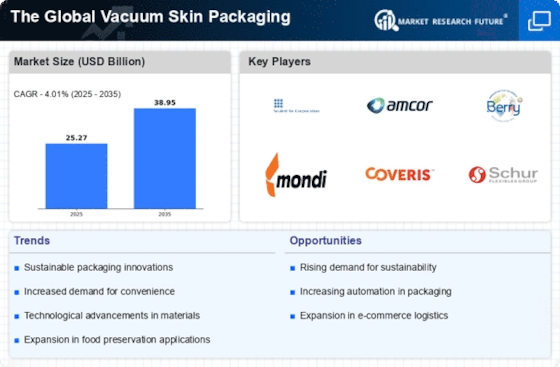
Vacuum Skin Packaging Market Infographic
Purchase Options

Market Trends

Key Emerging Trends in the Vacuum Skin Packaging Market

Vacuum skin packing (VSP) has become a major participant in the packaging industry due to its ability to improve usability, preserve product freshness, and highlight buyer products. Given current business sector trends, the vacuum skin packaging market is growing rapidly due to a few major factors.

The desire for longer realistic usage and better item display is driving vacuum skin packaging's popularity. Growing consumer awareness of food handling and quality has led companies to use innovative packaging methods including vacuum skin packing. This packaging method seals the object, preventing air and other impurities from deteriorating it and keeping it fresh.

Additionally, retail's growing preference for vacuum skin packaging is boosting its market energy. Retailers realize the importance of appealing packaging in attracting customers and influencing purchases. A simple and smooth vacuum skin packaging allows purchasers to examine the item before buying. This honesty builds trust and improves shopping.

In the food industry, vacuum skin packaging has exploded. To extend product life and ensure product integrity, VSP is used to bundle meat, fish, and poultry. Vacuum-fixed packaging reduces additives, meeting consumer demand for clean, natural food.

Maintainability has become an important factor in market dynamics across industries, including packaging. Offering eco-friendly alternatives, vacuum skin packaging has met this demand. Along with the global push for eco-friendly designs, vacuum skin packaging manufacturers are studying recyclable and biodegradable materials. As consumers become more aware of packaging's environmental impact, supportability should boost market growth.

Geologically, the vacuum skin packaging industry is growing in developed and developing countries. Vacuum skin packaging is growing in created economies because to their strong retail foundation and buyer awareness. Meanwhile, creating districts are seeing more demand for packaged products, driving market growth.

Mechanical advances are also shaping market trends. Continuous improvements in vacuum skin packing hardware and materials improve system efficiency and viability. This is attracting more manufacturers to vacuum skin packaging, creating a serious and dynamic market.

Collaboration and organization among key players are more common as the business grows. Companies are collaborating to use each other's assets, expand their product ranges, and handle additional projects. The vacuum skin packaging market is growing due to this cooperative approach.


Author
Author Profile
Snehal Singh
Manager - Research

High acumen in analyzing complex macro & micro markets with more than 6 years of work experience in the field of market research. By implementing her analytical skills in forecasting and estimation into market research reports, she has expertise in Packaging, Construction, and Equipment domains. She handles a team size of 20-25 resources and ensures smooth running of the projects, associated marketing activities, and client servicing.

Leave a Comment

FAQs

What is the projected market valuation for The Global Vacuum Skin Packaging in 2035?

<p>The projected market valuation for The Global Vacuum Skin Packaging in 2035 is 38.95 USD Billion.</p>

What was the market valuation for The Global Vacuum Skin Packaging in 2024?

<p>The market valuation for The Global Vacuum Skin Packaging in 2024 was 25.27 USD Billion.</p>

What is the expected CAGR for The Global Vacuum Skin Packaging during the forecast period 2025 - 2035?

<p>The expected CAGR for The Global Vacuum Skin Packaging during the forecast period 2025 - 2035 is 4.01%.</p>

Which materials are primarily used in The Global Vacuum Skin Packaging?

<p>The primary materials used in The Global Vacuum Skin Packaging include Polyethylene (PE), Polypropylene (PP), and Polyvinyl Chloride (PVC), with respective valuations of 12.0, 9.0, and 7.0 USD Billion projected.</p>

What are the key applications of vacuum skin packaging?

<p>Key applications of vacuum skin packaging include Meat, Poultry, and Cheese, with projected valuations of 15.0, 10.0, and 8.0 USD Billion respectively.</p>

Who are the leading companies in The Global Vacuum Skin Packaging?

<p>Leading companies in The Global Vacuum Skin Packaging include Sealed Air Corporation, Amcor plc, and Berry Global Inc.</p>

What is the market valuation for Polyethylene (PE) in The Global Vacuum Skin Packaging?

The market valuation for Polyethylene (PE) in The Global Vacuum Skin Packaging is projected to reach 12.0 USD Billion.

How does the market for Poultry compare to other applications in vacuum skin packaging?

The market for Poultry is projected at 10.0 USD Billion, making it one of the larger segments alongside Meat, which is valued at 15.0 USD Billion.

What is the projected growth for the 'Others' segment in the material category?

The projected growth for the 'Others' segment in the material category is expected to reach 10.95 USD Billion.

What trends are influencing the growth of The Global Vacuum Skin Packaging?

Trends influencing the growth of The Global Vacuum Skin Packaging include increasing demand for food preservation and the adoption of sustainable packaging solutions.

Market Summary

As per Market Research Future analysis, The Global Vacuum Skin Packaging Market Size was estimated at 25.27 USD Billion in 2024. The vacuum skin packaging industry is projected to grow from 26.28 USD Billion in 2025 to 38.95 USD Billion by 2035, exhibiting a compound annual growth rate (CAGR) of 4.01% during the forecast period 2025 - 2035

Key Market Trends & Highlights

The Global Vacuum Skin Packaging Market is poised for substantial growth driven by sustainability and technological advancements.

  • North America remains the largest market for vacuum skin packaging, driven by increasing consumer demand for fresh food products. The Asia-Pacific region is emerging as the fastest-growing market, fueled by rapid urbanization and changing consumer preferences. Polyethylene continues to dominate the market as the largest segment, while polyvinyl chloride is recognized as the fastest-growing segment. Key market drivers include the rising demand for fresh food products and the increased focus on food safety regulations.

Market Size & Forecast

2024 Market Size 25.27 (USD Billion)
2035 Market Size 38.95 (USD Billion)
CAGR (2025 - 2035) 4.01%
Largest Regional Market Share in 2024 North America

Major Players

Sealed Air Corporation (US), <a href="https://www.amcor.com/product-listing/vsp-packaging-fna052">Amcor plc</a> (GB), Berry Global Inc. (US), Mondi Group plc (GB), Coveris Holdings S.A. (LU), Schur Flexibles Group (AT), Winpak Ltd. (CA), Clondalkin Group Holdings B.V. (NL), Ulma Packaging S Coop (ES)

Market Trends

The Global Vacuum Skin Packaging is currently experiencing a notable transformation, driven by evolving consumer preferences and advancements in packaging technology. This market appears to be increasingly focused on sustainability, as manufacturers seek to reduce environmental impact while maintaining product integrity. The demand for vacuum skin packaging is likely to rise, particularly in the food sector, where freshness and shelf life are paramount. Additionally, the growing trend towards convenience in food consumption suggests that vacuum skin packaging could play a pivotal role in meeting consumer needs for ready-to-eat meals and snacks. Moreover, The Global Vacuum Skin Packaging Market seems to be influenced by the rising awareness of food safety and hygiene standards. As consumers become more health-conscious, the packaging solutions that ensure product safety and extend shelf life are gaining traction. This trend is further supported by regulatory frameworks that emphasize safe packaging practices. Consequently, the market is poised for growth, with innovations in materials and processes likely to enhance the efficiency and effectiveness of vacuum skin packaging solutions. Overall, the landscape of this market appears dynamic, with various factors converging to shape its future trajectory.

Sustainability Initiatives

The focus on sustainable practices is becoming increasingly prominent within The Global Vacuum Skin Packaging Market. Manufacturers are exploring eco-friendly materials and processes to minimize waste and reduce carbon footprints. This trend reflects a broader societal shift towards environmental responsibility, influencing consumer choices and brand loyalty.

Technological Advancements

Innovations in packaging technology are significantly impacting The Global Vacuum Skin Packaging Market. Enhanced barrier properties and improved sealing techniques are being developed, which not only extend product shelf life but also enhance visual appeal. These advancements are likely to attract a wider range of industries seeking efficient packaging solutions.

Health and Safety Standards

The emphasis on health and safety is shaping The Global Vacuum Skin Packaging Market. As consumers prioritize food safety, packaging solutions that ensure hygiene and prevent contamination are increasingly sought after. This trend is further reinforced by regulatory requirements that mandate stringent safety measures in food packaging.

Vacuum Skin Packaging Market Market Drivers

Rising Demand for Fresh Food Products

The increasing consumer preference for fresh and minimally processed food products is a key driver in the vacuum skin packaging market. As consumers become more health-conscious, they seek packaging solutions that preserve the freshness and quality of food items. Vacuum skin packaging effectively extends the shelf life of perishable goods, such as meats and seafood, by minimizing oxygen exposure. This trend is reflected in market data, which indicates that the demand for vacuum skin packaging in the food sector is projected to grow at a compound annual growth rate of approximately 5.5% over the next five years. Consequently, manufacturers are investing in innovative packaging solutions to cater to this rising demand, thereby enhancing their market presence.

Increased Focus on Food Safety Regulations

The heightened emphasis on food safety regulations is a significant driver for the vacuum skin packaging market. Governments and regulatory bodies worldwide are implementing stringent guidelines to ensure the safety and quality of food products. Vacuum skin packaging plays a crucial role in meeting these regulations by providing a barrier against contaminants and extending shelf life. As a result, food manufacturers are increasingly adopting vacuum skin packaging to comply with safety standards and enhance consumer trust. Market analysis indicates that the food safety packaging segment is expected to witness a growth rate of around 6% annually, reflecting the industry's commitment to maintaining high safety standards.

Growth in E-commerce and Online Food Delivery

The expansion of e-commerce and online food delivery services has significantly influenced the vacuum skin packaging market. As more consumers opt for online grocery shopping and meal delivery services, the need for effective packaging solutions that ensure product integrity during transit becomes paramount. Vacuum skin packaging offers a reliable method to protect food items from damage and spoilage, thus appealing to e-commerce businesses. Recent statistics suggest that the online food delivery market is expected to reach a valuation of over 200 billion dollars by 2026, further driving the demand for efficient packaging solutions. This trend presents opportunities for packaging manufacturers to innovate and develop tailored solutions for the e-commerce sector.

Technological Innovations in Packaging Solutions

Technological advancements in packaging solutions are transforming the vacuum skin packaging market. Innovations such as improved barrier materials, advanced sealing technologies, and automation in packaging processes are enhancing the efficiency and effectiveness of vacuum skin packaging. These advancements not only improve the preservation of food products but also reduce production costs for manufacturers. Recent developments in smart packaging technologies, which provide real-time monitoring of food conditions, are also gaining traction. The market for smart packaging is projected to grow significantly, indicating a shift towards more sophisticated packaging solutions. This trend suggests that companies investing in technology-driven packaging solutions are likely to gain a competitive edge.

Sustainability and Eco-friendly Packaging Solutions

The growing consumer awareness regarding environmental sustainability is driving the demand for eco-friendly packaging solutions within the vacuum skin packaging market. As consumers increasingly prefer products with minimal environmental impact, manufacturers are exploring sustainable materials and practices. Vacuum skin packaging can be designed using recyclable and biodegradable materials, aligning with the sustainability goals of many companies. Industry expert's indicates that the eco-friendly packaging segment is expected to grow at a rate of 7% annually, reflecting the shift towards sustainable practices in the packaging industry. This trend encourages manufacturers to innovate and adopt greener packaging solutions, thereby enhancing their market appeal.

Market Segment Insights

By Material: Polyethylene (Largest) vs. Polyvinyl Chloride (Fastest-Growing)

In The Global Vacuum Skin Packaging Market, <a href="https://www.marketresearchfuture.com/reports/polyethylene-market-1056">Polyethylene </a>(PE) holds a dominant position, significantly contributing to the overall market share. The versatility of PE in various applications, coupled with its cost-effectiveness, has solidified its status as the preferred material among manufacturers. Following PE, Polyvinyl Chloride (PVC) is emerging as a key player, gaining traction due to its unique properties such as clarity and barrier performance that cater to specific packaging needs.

Polyethylene (Dominant) vs. Polyvinyl Chloride (Emerging)

Polyethylene (PE) is recognized for its flexibility, durability, and excellent sealability, making it the most commonly used material in vacuum skin packaging. Its ability to maintain product freshness and extend shelf life is crucial, particularly in the food sector. Conversely, Polyvinyl Chloride (PVC) is rapidly gaining attention for its exceptional visual appeal and barrier properties, making it suitable for packaging products requiring high visibility and protection. As consumer preferences shift towards sustainable alternatives, the development of eco-friendly PVC formulations could further enhance its market position.

By Application: Meat (Largest) vs. Poultry (Fastest-Growing)

In The Global Vacuum Skin Packaging Market, the application segment is predominantly led by meat packaging, which commands the largest share due to the high demand for fresh and preserved meat products. The meat segment benefits from vacuum skin packaging’s ability to extend shelf life and maintain product quality, making it a preferred choice among manufacturers. Following meat, the poultry segment is emerging rapidly, driven by increasing consumption rates and shifting consumer preferences towards convenient packaging solutions that enhance product freshness.

Meat (Dominant) vs. Poultry (Emerging)

The meat application segment is well-established and recognized for its dominance in the vacuum skin packaging market, primarily because it meets rigorous safety and quality standards required for perishable products. This segment emphasizes maintaining freshness and flavor, appealing to consumers seeking high-quality meat. Conversely, the poultry segment is on the rise due to changing dietary trends and growing health consciousness, presenting innovative packaging solutions that cater to convenience and sustainability. While meat remains the industry leader, poultry is rapidly gaining traction and is set to become a significant player in the coming years.

Get more detailed insights about Vacuum Skin Packaging Market Research Report - Global Forecast till 2035

Regional Insights

By region, the study provides market insights into North America, Europe, Asia-Pacific and the Rest of the World. The North American vacuum skin packaging market will dominate, owing to high household income, which has triggered customers to buy advanced quality products, including meat, seafood, and poultry. In addition, the growing consumer demand for high protein intake will boost market growth in this region. Further, the US vacuum skin packaging market held the largest market share, and the Canada vacuum skin packaging market was the fastest-growing market in the North American region.

Further, the major countries studied in the market report are The US, Canada, German, France, the UK, Italy, Spain, China, Japan, India, Australia, South Korea, and Brazil.

Europe's vacuum skin packaging market accounts for the second-largest market share due to consumers' growing demand for convenient packing solutions. Further, the German vacuum skin packaging market held the largest market share, and the UK vacuum skin packaging market was the fastest-growing market in the European region.

The Asia-Pacific vacuum skin packaging market is expected to grow at the fastest CAGR from 2023 to 2032. This is due to the rising population, growing packaged food demand, and growth in the pharmaceutical industry drives the market growth in this region. Moreover, China’s vacuum skin packaging market held the largest market share, and the Indian vacuum skin packaging market was the fastest-growing market in the Asia-Pacific region.

Key Players and Competitive Insights

Leading market players are investing heavily in research and development in order to expand their product lines, which will help the vacuum skin packaging market grow even more. Market participants are also undertaking multiple strategic activities to expand their footprint, with important market developments including contractual agreements, new product launches, mergers and acquisitions, higher investments, and collaboration with other organizations. To expand and survive in a more competitive and rising market climate, the vacuum skin packaging industry must offer cost-effective items.Manufacturing locally to minimize operational costs is one of the key business tactics manufacturers use in the vacuum skin packaging industry to benefit clients and increase the market sector. Major market players in the vacuum skin packaging market, including DuPont (US), Amcor Limited (Australia), Sealed Air (US), Berry Inc. (US), LINPAC Packaging Limited (UK), Bemis Company Inc. (US), and others, are attempting to increase market demand by investing in research and development operations.Amcor Plc is a provider of packaging solutions. It offers plastic, fiber, metal, and glass packaging products such as pet bottles, plastic bottles and jars, capsules and closures, specialty folding cartons, free films, bags and pouches, wrappers, rigid containers, laminates, and flow packs. The company's products find applications in various industries, such as beverages, food, pharmaceutical, medical device, homecare personal care, pet care, specialty cartons, and other technical applications. It also serves medical-device, healthcare, pharmaceutical, personal care and home product markets.
In May Amcor Plc developed the latest technology, PowerPostTMthat delivers a bottle that is up to 30% more lightweight and can be created from 100% recycled material. The technology is designed for hot fill beverages and avoids spills from overflow. Furthermore, the product is built on vacuum-absorbing technology PowerStrap.SEE, formerly known as Sealed Air Corp, provides packaging solutions. The company offers films, trays, packaging equipment systems and easy-open packaging solutions. The company also offers designing and graphic services, fulfillment design and engineering services, shrink machinery upgrades and enhancements and ship-from-anywhere services. The company serves cold chain, construction, consumer packaged goods, e-commerce, electronics, food retail, general manufacturing, medical andmanufacturing, third-party logistics and transportation industries. It operates manufacturing facilities, packaging equipment and design centers, laboratories and customer learning centers. The company markets its products under OptiDure, Bubble Wrap, Autobag, Sealed Air, TempGuard and others.
In April Sealed Air announced a partnership on an advanced recycling program that will concentrate on recycling flexible plastics from the food supply chain and recreating them into new certified circular food-grade packaging.

Key Companies in the Vacuum Skin Packaging Market include

Industry Developments

  • Q2 2024: Sealed Air Launches New CRYOVAC Brand Vacuum Skin Packaging Market Solution for Seafood Sealed Air introduced a new CRYOVAC brand vacuum skin packaging solution specifically designed for seafood applications, aiming to enhance shelf life and product presentation. The launch targets both retail and foodservice sectors.
  • Q1 2024: Winpak Announces Expansion of Manufacturing Facility in North America to Meet Growing Demand for Vacuum Skin Packaging Market Winpak Ltd. announced the expansion of its North American manufacturing facility to increase production capacity for vacuum skin packaging products, citing rising demand from the food industry.
  • Q2 2024: Bemis Company Unveils Eco-Friendly Vacuum Skin Packaging Market Film Bemis Company launched a new eco-friendly vacuum skin packaging film made from recyclable materials, targeting sustainability-conscious food producers and retailers.
  • Q2 2024: Amcor Acquires Minority Stake in European Vacuum Skin Packaging Market Startup Amcor announced the acquisition of a minority stake in a European startup specializing in innovative vacuum skin packaging technologies, aiming to accelerate product development and market reach.
  • Q3 2024: Sealed Air Partners with Major Meat Processor to Supply Advanced Vacuum Skin Packaging Market Solutions Sealed Air entered into a partnership with a leading meat processor to supply advanced vacuum skin packaging solutions for their new product lines, enhancing shelf life and visual appeal.
  • Q2 2024: Winpak Appoints New Chief Technology Officer to Lead Vacuum Skin Packaging Market Innovation Winpak Ltd. appointed a new Chief Technology Officer to spearhead innovation in vacuum skin packaging, focusing on material science and process optimization.
  • Q1 2025: Bemis Company Secures Major Contract to Supply Vacuum Skin Packaging Market for National Supermarket Chain Bemis Company won a significant contract to supply vacuum skin packaging solutions for a national supermarket chain, supporting their fresh meat and seafood offerings.
  • Q2 2025: Amcor Launches New High-Barrier Vacuum Skin Packaging Market Film for Cheese Market Amcor launched a new high-barrier vacuum skin packaging film designed for the cheese market, offering improved shelf life and product protection.
  • Q2 2024: European Regulator Approves New Biodegradable Vacuum Skin Packaging Market Material A new biodegradable vacuum skin packaging material received regulatory approval from European authorities, paving the way for commercial rollout by several packaging firms.
  • Q3 2024: Winpak Announces Strategic Partnership with Asian Seafood Producer for Vacuum Skin Packaging Market Winpak Ltd. formed a strategic partnership with a major Asian seafood producer to supply vacuum skin packaging solutions for export markets.
  • Q1 2025: Sealed Air Opens New R&D Center Focused on Vacuum Skin Packaging Market Innovation Sealed Air opened a new research and development center dedicated to vacuum skin packaging innovation, aiming to accelerate the development of sustainable and high-performance packaging solutions.
  • Q2 2025: Private Equity Firm Invests $100 Million in Vacuum Skin Packaging Market Manufacturer A leading private equity firm invested $100 million in a vacuum skin packaging manufacturer to support expansion and technology upgrades.

Future Outlook

Vacuum Skin Packaging Market Future Outlook

The Global Vacuum Skin Packaging Market is projected to grow at a 4.01% CAGR from 2025 to 2035, driven by increasing demand for food preservation and sustainability initiatives.

New opportunities lie in:

  • <p>Expansion into emerging markets with tailored packaging solutions.</p>
  • <p> </p>
  • <p>Development of biodegradable vacuum skin packaging materials.</p>
  • <p>Integration of smart technology for real-time freshness monitoring.</p>

By 2035, the market is expected to solidify its position as a leader in sustainable packaging solutions.

Market Segmentation

Vacuum Skin Packaging Market Material Outlook

  • Polyethylene (PE)
  • Polypropylene (PP)
  • Polyvinyl Chloride (PVC)
  • Others

Vacuum Skin Packaging Market Application Outlook

  • Meat
  • Poultry
  • Cheese
  • Others

Report Scope

MARKET SIZE 2024 25.27(USD Billion)
MARKET SIZE 2025 26.28(USD Billion)
MARKET SIZE 2035 38.95(USD Billion)
COMPOUND ANNUAL GROWTH RATE (CAGR) 4.01% (2025 - 2035)
REPORT COVERAGE Revenue Forecast, Competitive Landscape, Growth Factors, and Trends
BASE YEAR 2024
Market Forecast Period 2025 - 2035
Historical Data 2019 - 2024
Market Forecast Units USD Billion
Key Companies Profiled Sealed Air Corporation (US), Amcor plc (GB), Berry Global Inc. (US), Mondi Group plc (GB), Coveris Holdings S.A. (LU), Schur Flexibles Group (AT), Winpak Ltd. (CA), Clondalkin Group Holdings B.V. (NL), Ulma Packaging S Coop (ES)
Segments Covered Material, Application, Region
Key Market Opportunities Growing demand for sustainable packaging solutions drives innovation in The Global Vacuum Skin Packaging.
Key Market Dynamics Rising demand for sustainable packaging solutions drives innovation in vacuum skin packaging technologies and materials.
Countries Covered North America, Europe, APAC, South America, MEA

FAQs

What is the projected market valuation for The Global Vacuum Skin Packaging in 2035?

<p>The projected market valuation for The Global Vacuum Skin Packaging in 2035 is 38.95 USD Billion.</p>

What was the market valuation for The Global Vacuum Skin Packaging in 2024?

<p>The market valuation for The Global Vacuum Skin Packaging in 2024 was 25.27 USD Billion.</p>

What is the expected CAGR for The Global Vacuum Skin Packaging during the forecast period 2025 - 2035?

<p>The expected CAGR for The Global Vacuum Skin Packaging during the forecast period 2025 - 2035 is 4.01%.</p>

Which materials are primarily used in The Global Vacuum Skin Packaging?

<p>The primary materials used in The Global Vacuum Skin Packaging include Polyethylene (PE), Polypropylene (PP), and Polyvinyl Chloride (PVC), with respective valuations of 12.0, 9.0, and 7.0 USD Billion projected.</p>

What are the key applications of vacuum skin packaging?

<p>Key applications of vacuum skin packaging include Meat, Poultry, and Cheese, with projected valuations of 15.0, 10.0, and 8.0 USD Billion respectively.</p>

Who are the leading companies in The Global Vacuum Skin Packaging?

<p>Leading companies in The Global Vacuum Skin Packaging include Sealed Air Corporation, Amcor plc, and Berry Global Inc.</p>

What is the market valuation for Polyethylene (PE) in The Global Vacuum Skin Packaging?

The market valuation for Polyethylene (PE) in The Global Vacuum Skin Packaging is projected to reach 12.0 USD Billion.

How does the market for Poultry compare to other applications in vacuum skin packaging?

The market for Poultry is projected at 10.0 USD Billion, making it one of the larger segments alongside Meat, which is valued at 15.0 USD Billion.

What is the projected growth for the 'Others' segment in the material category?

The projected growth for the 'Others' segment in the material category is expected to reach 10.95 USD Billion.

What trends are influencing the growth of The Global Vacuum Skin Packaging?

Trends influencing the growth of The Global Vacuum Skin Packaging include increasing demand for food preservation and the adoption of sustainable packaging solutions.

  1. SECTION I: EXECUTIVE SUMMARY AND KEY HIGHLIGHTS
    1. | 1.1 EXECUTIVE SUMMARY
    2. | | 1.1.1 Market Overview
    3. | | 1.1.2 Key Findings
    4. | | 1.1.3 Market Segmentation
    5. | | 1.1.4 Competitive Landscape
    6. | | 1.1.5 Challenges and Opportunities
    7. | | 1.1.6 Future Outlook
  2. SECTION II: SCOPING, METHODOLOGY AND MARKET STRUCTURE
    1. | 2.1 MARKET INTRODUCTION
    2. | | 2.1.1 Definition
    3. | | 2.1.2 Scope of the study
    4. | | | 2.1.2.1 Research Objective
    5. | | | 2.1.2.2 Assumption
    6. | | | 2.1.2.3 Limitations
    7. | 2.2 RESEARCH METHODOLOGY
    8. | | 2.2.1 Overview
    9. | | 2.2.2 Data Mining
    10. | | 2.2.3 Secondary Research
    11. | | 2.2.4 Primary Research
    12. | | | 2.2.4.1 Primary Interviews and Information Gathering Process
    13. | | | 2.2.4.2 Breakdown of Primary Respondents
    14. | | 2.2.5 Forecasting Model
    15. | | 2.2.6 Market Size Estimation
    16. | | | 2.2.6.1 Bottom-Up Approach
    17. | | | 2.2.6.2 Top-Down Approach
    18. | | 2.2.7 Data Triangulation
    19. | | 2.2.8 Validation
  3. SECTION III: QUALITATIVE ANALYSIS
    1. | 3.1 MARKET DYNAMICS
    2. | | 3.1.1 Overview
    3. | | 3.1.2 Drivers
    4. | | 3.1.3 Restraints
    5. | | 3.1.4 Opportunities
    6. | 3.2 MARKET FACTOR ANALYSIS
    7. | | 3.2.1 Value chain Analysis
    8. | | 3.2.2 Porter's Five Forces Analysis
    9. | | | 3.2.2.1 Bargaining Power of Suppliers
    10. | | | 3.2.2.2 Bargaining Power of Buyers
    11. | | | 3.2.2.3 Threat of New Entrants
    12. | | | 3.2.2.4 Threat of Substitutes
    13. | | | 3.2.2.5 Intensity of Rivalry
    14. | | 3.2.3 COVID-19 Impact Analysis
    15. | | | 3.2.3.1 Market Impact Analysis
    16. | | | 3.2.3.2 Regional Impact
    17. | | | 3.2.3.3 Opportunity and Threat Analysis
  4. SECTION IV: QUANTITATIVE ANALYSIS
    1. | 4.1 Packaging & Transport, BY Material (USD Billion)
    2. | | 4.1.1 Polyethylene (PE)
    3. | | 4.1.2 Polypropylene (PP)
    4. | | 4.1.3 Polyvinyl Chloride (PVC)
    5. | | 4.1.4 Others
    6. | 4.2 Packaging & Transport, BY Application (USD Billion)
    7. | | 4.2.1 Meat
    8. | | 4.2.2 Poultry
    9. | | 4.2.3 Cheese
    10. | | 4.2.4 Others
    11. | 4.3 Packaging & Transport, BY Region (USD Billion)
    12. | | 4.3.1 North America
    13. | | | 4.3.1.1 US
    14. | | | 4.3.1.2 Canada
    15. | | 4.3.2 Europe
    16. | | | 4.3.2.1 Germany
    17. | | | 4.3.2.2 UK
    18. | | | 4.3.2.3 France
    19. | | | 4.3.2.4 Russia
    20. | | | 4.3.2.5 Italy
    21. | | | 4.3.2.6 Spain
    22. | | | 4.3.2.7 Rest of Europe
    23. | | 4.3.3 APAC
    24. | | | 4.3.3.1 China
    25. | | | 4.3.3.2 India
    26. | | | 4.3.3.3 Japan
    27. | | | 4.3.3.4 South Korea
    28. | | | 4.3.3.5 Malaysia
    29. | | | 4.3.3.6 Thailand
    30. | | | 4.3.3.7 Indonesia
    31. | | | 4.3.3.8 Rest of APAC
    32. | | 4.3.4 South America
    33. | | | 4.3.4.1 Brazil
    34. | | | 4.3.4.2 Mexico
    35. | | | 4.3.4.3 Argentina
    36. | | | 4.3.4.4 Rest of South America
    37. | | 4.3.5 MEA
    38. | | | 4.3.5.1 GCC Countries
    39. | | | 4.3.5.2 South Africa
    40. | | | 4.3.5.3 Rest of MEA
  5. SECTION V: COMPETITIVE ANALYSIS
    1. | 5.1 Competitive Landscape
    2. | | 5.1.1 Overview
    3. | | 5.1.2 Competitive Analysis
    4. | | 5.1.3 Market share Analysis
    5. | | 5.1.4 Major Growth Strategy in the Packaging & Transport
    6. | | 5.1.5 Competitive Benchmarking
    7. | | 5.1.6 Leading Players in Terms of Number of Developments in the Packaging & Transport
    8. | | 5.1.7 Key developments and growth strategies
    9. | | | 5.1.7.1 New Product Launch/Service Deployment
    10. | | | 5.1.7.2 Merger & Acquisitions
    11. | | | 5.1.7.3 Joint Ventures
    12. | | 5.1.8 Major Players Financial Matrix
    13. | | | 5.1.8.1 Sales and Operating Income
    14. | | | 5.1.8.2 Major Players R&D Expenditure. 2023
    15. | 5.2 Company Profiles
    16. | | 5.2.1 Sealed Air Corporation (US)
    17. | | | 5.2.1.1 Financial Overview
    18. | | | 5.2.1.2 Products Offered
    19. | | | 5.2.1.3 Key Developments
    20. | | | 5.2.1.4 SWOT Analysis
    21. | | | 5.2.1.5 Key Strategies
    22. | | 5.2.2 Amcor plc (GB)
    23. | | | 5.2.2.1 Financial Overview
    24. | | | 5.2.2.2 Products Offered
    25. | | | 5.2.2.3 Key Developments
    26. | | | 5.2.2.4 SWOT Analysis
    27. | | | 5.2.2.5 Key Strategies
    28. | | 5.2.3 Berry Global Inc. (US)
    29. | | | 5.2.3.1 Financial Overview
    30. | | | 5.2.3.2 Products Offered
    31. | | | 5.2.3.3 Key Developments
    32. | | | 5.2.3.4 SWOT Analysis
    33. | | | 5.2.3.5 Key Strategies
    34. | | 5.2.4 Mondi Group plc (GB)
    35. | | | 5.2.4.1 Financial Overview
    36. | | | 5.2.4.2 Products Offered
    37. | | | 5.2.4.3 Key Developments
    38. | | | 5.2.4.4 SWOT Analysis
    39. | | | 5.2.4.5 Key Strategies
    40. | | 5.2.5 Coveris Holdings S.A. (LU)
    41. | | | 5.2.5.1 Financial Overview
    42. | | | 5.2.5.2 Products Offered
    43. | | | 5.2.5.3 Key Developments
    44. | | | 5.2.5.4 SWOT Analysis
    45. | | | 5.2.5.5 Key Strategies
    46. | | 5.2.6 Schur Flexibles Group (AT)
    47. | | | 5.2.6.1 Financial Overview
    48. | | | 5.2.6.2 Products Offered
    49. | | | 5.2.6.3 Key Developments
    50. | | | 5.2.6.4 SWOT Analysis
    51. | | | 5.2.6.5 Key Strategies
    52. | | 5.2.7 Winpak Ltd. (CA)
    53. | | | 5.2.7.1 Financial Overview
    54. | | | 5.2.7.2 Products Offered
    55. | | | 5.2.7.3 Key Developments
    56. | | | 5.2.7.4 SWOT Analysis
    57. | | | 5.2.7.5 Key Strategies
    58. | | 5.2.8 Clondalkin Group Holdings B.V. (NL)
    59. | | | 5.2.8.1 Financial Overview
    60. | | | 5.2.8.2 Products Offered
    61. | | | 5.2.8.3 Key Developments
    62. | | | 5.2.8.4 SWOT Analysis
    63. | | | 5.2.8.5 Key Strategies
    64. | | 5.2.9 Ulma Packaging S Coop (ES)
    65. | | | 5.2.9.1 Financial Overview
    66. | | | 5.2.9.2 Products Offered
    67. | | | 5.2.9.3 Key Developments
    68. | | | 5.2.9.4 SWOT Analysis
    69. | | | 5.2.9.5 Key Strategies
    70. | 5.3 Appendix
    71. | | 5.3.1 References
    72. | | 5.3.2 Related Reports
  6. LIST OF FIGURES
    1. | 6.1 MARKET SYNOPSIS
    2. | 6.2 NORTH AMERICA MARKET ANALYSIS
    3. | 6.3 US MARKET ANALYSIS BY MATERIAL
    4. | 6.4 US MARKET ANALYSIS BY APPLICATION
    5. | 6.5 CANADA MARKET ANALYSIS BY MATERIAL
    6. | 6.6 CANADA MARKET ANALYSIS BY APPLICATION
    7. | 6.7 EUROPE MARKET ANALYSIS
    8. | 6.8 GERMANY MARKET ANALYSIS BY MATERIAL
    9. | 6.9 GERMANY MARKET ANALYSIS BY APPLICATION
    10. | 6.10 UK MARKET ANALYSIS BY MATERIAL
    11. | 6.11 UK MARKET ANALYSIS BY APPLICATION
    12. | 6.12 FRANCE MARKET ANALYSIS BY MATERIAL
    13. | 6.13 FRANCE MARKET ANALYSIS BY APPLICATION
    14. | 6.14 RUSSIA MARKET ANALYSIS BY MATERIAL
    15. | 6.15 RUSSIA MARKET ANALYSIS BY APPLICATION
    16. | 6.16 ITALY MARKET ANALYSIS BY MATERIAL
    17. | 6.17 ITALY MARKET ANALYSIS BY APPLICATION
    18. | 6.18 SPAIN MARKET ANALYSIS BY MATERIAL
    19. | 6.19 SPAIN MARKET ANALYSIS BY APPLICATION
    20. | 6.20 REST OF EUROPE MARKET ANALYSIS BY MATERIAL
    21. | 6.21 REST OF EUROPE MARKET ANALYSIS BY APPLICATION
    22. | 6.22 APAC MARKET ANALYSIS
    23. | 6.23 CHINA MARKET ANALYSIS BY MATERIAL
    24. | 6.24 CHINA MARKET ANALYSIS BY APPLICATION
    25. | 6.25 INDIA MARKET ANALYSIS BY MATERIAL
    26. | 6.26 INDIA MARKET ANALYSIS BY APPLICATION
    27. | 6.27 JAPAN MARKET ANALYSIS BY MATERIAL
    28. | 6.28 JAPAN MARKET ANALYSIS BY APPLICATION
    29. | 6.29 SOUTH KOREA MARKET ANALYSIS BY MATERIAL
    30. | 6.30 SOUTH KOREA MARKET ANALYSIS BY APPLICATION
    31. | 6.31 MALAYSIA MARKET ANALYSIS BY MATERIAL
    32. | 6.32 MALAYSIA MARKET ANALYSIS BY APPLICATION
    33. | 6.33 THAILAND MARKET ANALYSIS BY MATERIAL
    34. | 6.34 THAILAND MARKET ANALYSIS BY APPLICATION
    35. | 6.35 INDONESIA MARKET ANALYSIS BY MATERIAL
    36. | 6.36 INDONESIA MARKET ANALYSIS BY APPLICATION
    37. | 6.37 REST OF APAC MARKET ANALYSIS BY MATERIAL
    38. | 6.38 REST OF APAC MARKET ANALYSIS BY APPLICATION
    39. | 6.39 SOUTH AMERICA MARKET ANALYSIS
    40. | 6.40 BRAZIL MARKET ANALYSIS BY MATERIAL
    41. | 6.41 BRAZIL MARKET ANALYSIS BY APPLICATION
    42. | 6.42 MEXICO MARKET ANALYSIS BY MATERIAL
    43. | 6.43 MEXICO MARKET ANALYSIS BY APPLICATION
    44. | 6.44 ARGENTINA MARKET ANALYSIS BY MATERIAL
    45. | 6.45 ARGENTINA MARKET ANALYSIS BY APPLICATION
    46. | 6.46 REST OF SOUTH AMERICA MARKET ANALYSIS BY MATERIAL
    47. | 6.47 REST OF SOUTH AMERICA MARKET ANALYSIS BY APPLICATION
    48. | 6.48 MEA MARKET ANALYSIS
    49. | 6.49 GCC COUNTRIES MARKET ANALYSIS BY MATERIAL
    50. | 6.50 GCC COUNTRIES MARKET ANALYSIS BY APPLICATION
    51. | 6.51 SOUTH AFRICA MARKET ANALYSIS BY MATERIAL
    52. | 6.52 SOUTH AFRICA MARKET ANALYSIS BY APPLICATION
    53. | 6.53 REST OF MEA MARKET ANALYSIS BY MATERIAL
    54. | 6.54 REST OF MEA MARKET ANALYSIS BY APPLICATION
    55. | 6.55 KEY BUYING CRITERIA OF PACKAGING & TRANSPORT
    56. | 6.56 RESEARCH PROCESS OF MRFR
    57. | 6.57 DRO ANALYSIS OF PACKAGING & TRANSPORT
    58. | 6.58 DRIVERS IMPACT ANALYSIS: PACKAGING & TRANSPORT
    59. | 6.59 RESTRAINTS IMPACT ANALYSIS: PACKAGING & TRANSPORT
    60. | 6.60 SUPPLY / VALUE CHAIN: PACKAGING & TRANSPORT
    61. | 6.61 PACKAGING & TRANSPORT, BY MATERIAL, 2024 (% SHARE)
    62. | 6.62 PACKAGING & TRANSPORT, BY MATERIAL, 2024 TO 2035 (USD Billion)
    63. | 6.63 PACKAGING & TRANSPORT, BY APPLICATION, 2024 (% SHARE)
    64. | 6.64 PACKAGING & TRANSPORT, BY APPLICATION, 2024 TO 2035 (USD Billion)
    65. | 6.65 BENCHMARKING OF MAJOR COMPETITORS
  7. LIST OF TABLES
    1. | 7.1 LIST OF ASSUMPTIONS
    2. | | 7.1.1
    3. | 7.2 North America MARKET SIZE ESTIMATES; FORECAST
    4. | | 7.2.1 BY MATERIAL, 2025-2035 (USD Billion)
    5. | | 7.2.2 BY APPLICATION, 2025-2035 (USD Billion)
    6. | 7.3 US MARKET SIZE ESTIMATES; FORECAST
    7. | | 7.3.1 BY MATERIAL, 2025-2035 (USD Billion)
    8. | | 7.3.2 BY APPLICATION, 2025-2035 (USD Billion)
    9. | 7.4 Canada MARKET SIZE ESTIMATES; FORECAST
    10. | | 7.4.1 BY MATERIAL, 2025-2035 (USD Billion)
    11. | | 7.4.2 BY APPLICATION, 2025-2035 (USD Billion)
    12. | 7.5 Europe MARKET SIZE ESTIMATES; FORECAST
    13. | | 7.5.1 BY MATERIAL, 2025-2035 (USD Billion)
    14. | | 7.5.2 BY APPLICATION, 2025-2035 (USD Billion)
    15. | 7.6 Germany MARKET SIZE ESTIMATES; FORECAST
    16. | | 7.6.1 BY MATERIAL, 2025-2035 (USD Billion)
    17. | | 7.6.2 BY APPLICATION, 2025-2035 (USD Billion)
    18. | 7.7 UK MARKET SIZE ESTIMATES; FORECAST
    19. | | 7.7.1 BY MATERIAL, 2025-2035 (USD Billion)
    20. | | 7.7.2 BY APPLICATION, 2025-2035 (USD Billion)
    21. | 7.8 France MARKET SIZE ESTIMATES; FORECAST
    22. | | 7.8.1 BY MATERIAL, 2025-2035 (USD Billion)
    23. | | 7.8.2 BY APPLICATION, 2025-2035 (USD Billion)
    24. | 7.9 Russia MARKET SIZE ESTIMATES; FORECAST
    25. | | 7.9.1 BY MATERIAL, 2025-2035 (USD Billion)
    26. | | 7.9.2 BY APPLICATION, 2025-2035 (USD Billion)
    27. | 7.10 Italy MARKET SIZE ESTIMATES; FORECAST
    28. | | 7.10.1 BY MATERIAL, 2025-2035 (USD Billion)
    29. | | 7.10.2 BY APPLICATION, 2025-2035 (USD Billion)
    30. | 7.11 Spain MARKET SIZE ESTIMATES; FORECAST
    31. | | 7.11.1 BY MATERIAL, 2025-2035 (USD Billion)
    32. | | 7.11.2 BY APPLICATION, 2025-2035 (USD Billion)
    33. | 7.12 Rest of Europe MARKET SIZE ESTIMATES; FORECAST
    34. | | 7.12.1 BY MATERIAL, 2025-2035 (USD Billion)
    35. | | 7.12.2 BY APPLICATION, 2025-2035 (USD Billion)
    36. | 7.13 APAC MARKET SIZE ESTIMATES; FORECAST
    37. | | 7.13.1 BY MATERIAL, 2025-2035 (USD Billion)
    38. | | 7.13.2 BY APPLICATION, 2025-2035 (USD Billion)
    39. | 7.14 China MARKET SIZE ESTIMATES; FORECAST
    40. | | 7.14.1 BY MATERIAL, 2025-2035 (USD Billion)
    41. | | 7.14.2 BY APPLICATION, 2025-2035 (USD Billion)
    42. | 7.15 India MARKET SIZE ESTIMATES; FORECAST
    43. | | 7.15.1 BY MATERIAL, 2025-2035 (USD Billion)
    44. | | 7.15.2 BY APPLICATION, 2025-2035 (USD Billion)
    45. | 7.16 Japan MARKET SIZE ESTIMATES; FORECAST
    46. | | 7.16.1 BY MATERIAL, 2025-2035 (USD Billion)
    47. | | 7.16.2 BY APPLICATION, 2025-2035 (USD Billion)
    48. | 7.17 South Korea MARKET SIZE ESTIMATES; FORECAST
    49. | | 7.17.1 BY MATERIAL, 2025-2035 (USD Billion)
    50. | | 7.17.2 BY APPLICATION, 2025-2035 (USD Billion)
    51. | 7.18 Malaysia MARKET SIZE ESTIMATES; FORECAST
    52. | | 7.18.1 BY MATERIAL, 2025-2035 (USD Billion)
    53. | | 7.18.2 BY APPLICATION, 2025-2035 (USD Billion)
    54. | 7.19 Thailand MARKET SIZE ESTIMATES; FORECAST
    55. | | 7.19.1 BY MATERIAL, 2025-2035 (USD Billion)
    56. | | 7.19.2 BY APPLICATION, 2025-2035 (USD Billion)
    57. | 7.20 Indonesia MARKET SIZE ESTIMATES; FORECAST
    58. | | 7.20.1 BY MATERIAL, 2025-2035 (USD Billion)
    59. | | 7.20.2 BY APPLICATION, 2025-2035 (USD Billion)
    60. | 7.21 Rest of APAC MARKET SIZE ESTIMATES; FORECAST
    61. | | 7.21.1 BY MATERIAL, 2025-2035 (USD Billion)
    62. | | 7.21.2 BY APPLICATION, 2025-2035 (USD Billion)
    63. | 7.22 South America MARKET SIZE ESTIMATES; FORECAST
    64. | | 7.22.1 BY MATERIAL, 2025-2035 (USD Billion)
    65. | | 7.22.2 BY APPLICATION, 2025-2035 (USD Billion)
    66. | 7.23 Brazil MARKET SIZE ESTIMATES; FORECAST
    67. | | 7.23.1 BY MATERIAL, 2025-2035 (USD Billion)
    68. | | 7.23.2 BY APPLICATION, 2025-2035 (USD Billion)
    69. | 7.24 Mexico MARKET SIZE ESTIMATES; FORECAST
    70. | | 7.24.1 BY MATERIAL, 2025-2035 (USD Billion)
    71. | | 7.24.2 BY APPLICATION, 2025-2035 (USD Billion)
    72. | 7.25 Argentina MARKET SIZE ESTIMATES; FORECAST
    73. | | 7.25.1 BY MATERIAL, 2025-2035 (USD Billion)
    74. | | 7.25.2 BY APPLICATION, 2025-2035 (USD Billion)
    75. | 7.26 Rest of South America MARKET SIZE ESTIMATES; FORECAST
    76. | | 7.26.1 BY MATERIAL, 2025-2035 (USD Billion)
    77. | | 7.26.2 BY APPLICATION, 2025-2035 (USD Billion)
    78. | 7.27 MEA MARKET SIZE ESTIMATES; FORECAST
    79. | | 7.27.1 BY MATERIAL, 2025-2035 (USD Billion)
    80. | | 7.27.2 BY APPLICATION, 2025-2035 (USD Billion)
    81. | 7.28 GCC Countries MARKET SIZE ESTIMATES; FORECAST
    82. | | 7.28.1 BY MATERIAL, 2025-2035 (USD Billion)
    83. | | 7.28.2 BY APPLICATION, 2025-2035 (USD Billion)
    84. | 7.29 South Africa MARKET SIZE ESTIMATES; FORECAST
    85. | | 7.29.1 BY MATERIAL, 2025-2035 (USD Billion)
    86. | | 7.29.2 BY APPLICATION, 2025-2035 (USD Billion)
    87. | 7.30 Rest of MEA MARKET SIZE ESTIMATES; FORECAST
    88. | | 7.30.1 BY MATERIAL, 2025-2035 (USD Billion)
    89. | | 7.30.2 BY APPLICATION, 2025-2035 (USD Billion)
    90. | 7.31 PRODUCT LAUNCH/PRODUCT DEVELOPMENT/APPROVAL
    91. | | 7.31.1
    92. | 7.32 ACQUISITION/PARTNERSHIP
    93. | | 7.32.1

Packaging & Transport Market Segmentation

Packaging & Transport By Material (USD Billion, 2025-2035)

  • Polyethylene (PE)
  • Polypropylene (PP)
  • Polyvinyl Chloride (PVC)
  • Others

Packaging & Transport By Application (USD Billion, 2025-2035)

  • Meat
  • Poultry
  • Cheese
  • Others
Infographic

Free Sample Request

Kindly complete the form below to receive a free sample of this Report

Get Free Sample

Customer Strories

Compare Licence

×
Features License Type
Single User Multiuser License Enterprise User
Price $4,950 $5,950 $7,250
Maximum User Access Limit 1 User Upto 10 Users Unrestricted Access Throughout the Organization
Free Customization
Direct Access to Analyst
Deliverable Format
Platform Access
Discount on Next Purchase 10% 15% 15%
Printable Versions
%>