Request Free Sample ×

Kindly complete the form below to receive a free sample of this Report

* Please use a valid business email

Leading companies partner with us for data-driven Insights

clients tt-cursor
Hero Background
English
Chinese
French
Japanese
Korean
German
Spanish

US Regenerative Medicine Market Share

ID: MRFR/HC/13161-HCR
128 Pages
Satyendra Maurya
April 2026

US Regenerative Medicine Market Research Report Information By Product (Gene Therapy, Cell Therapy, Stem Cell Therapy (Autologous Therapy, Allogenic Therapy), Cord Blood/Progenitor Cell Therapies, Cell-Based Immunotherapy Products, Tissue Engineering, Scaffolds, Hydrogels, Collagen, and Others), By Application (Musculoskeletal, Oncology, Wound Care, Dental Indications, Retinal Indications, and Other Applications), - Market Forecast Till 2035

Share:
Download PDF ×

We do not share your information with anyone. However, we may send you emails based on your report interest from time to time. You may contact us at any time to opt-out.

US Regenerative Medicine Market Infographic
Purchase Options

Market Share

US Regenerative Medicine Market Share Analysis

Another successful system is cost authority, where organizations focus on turning into the minimal expense supplier in the regenerative medicine area. This includes improving functional effectiveness, smoothing out creation processes, and arranging good provider arrangements to diminish overall expenses. By offering cutthroat evaluating, an organization can draw in a bigger customer base and possibly catch a critical portion of the market. It essential to adjust cost-cutting measures with maintaining great standards to guarantee sustainable achievement. Moreover, a focus on specialty markets can be an effective market share situating system. Rather than taking care of the whole regenerative medicine market, organizations might target explicit therapeutic regions or patient socioeconomics. This designated approach considers a more profound understanding of the novel necessities of a specific fragment and empowers the improvement of arrangements. For instance, an organization could focus on regenerative therapies for muscular circumstances or focus on medicines for pediatric patients, cutting out a particular specialty in the market. Customer-driven systems assume an essential part in gaining market share in the regenerative medicine area. Understanding and tending to the requirements of healthcare suppliers, patients, and other partners are fundamental. This might include putting resources into extensive customer support administrations, giving instructive assets, or carrying out understanding assistance programs. By laying areas of strength for out with end-users and showing a pledge to working on persistent results, organizations can create brand dependability and secure a bigger market share.

Author
Author Profile
Satyendra Maurya
Research Analyst

An accomplished research analyst with high proficiency in market forecasting, data visualization, competitive benchmarking, and others. He holds a pronounced track record in research and consulting projects for sectors such as life sciences, medical devices, and healthcare IT. His capabilities in qualitative and quantitative analysis have resulted in positive client outcomes. Working on niche market trends, opportunities, sales, and forecasted value is part of his skill set.

Leave a Comment

FAQs

What is the current valuation of the US regenerative medicine market?

<p>The market valuation was $8.85 Billion in 2024.</p>

What is the projected market size for the US regenerative medicine market by 2035?

<p>The market is projected to reach $21.31 Billion by 2035.</p>

What is the expected CAGR for the US regenerative medicine market during the forecast period 2025 - 2035?

<p>The expected CAGR is 8.32% from 2025 to 2035.</p>

Which therapeutic area is expected to have the highest market valuation in 2035?

<p>Oncology is projected to reach $9.19 Billion by 2035.</p>

What are the key product types in the US regenerative medicine market?

<p>Key product types include Cell Therapy, Gene Therapy, Tissue Engineering, and Stem Cell Therapy.</p>

Which end user segment is anticipated to dominate the market by 2035?

<p>Hospitals are expected to dominate with a valuation of $8.25 Billion by 2035.</p>

Who are the leading companies in the US regenerative medicine market?

<p>Key players include Acelity, Organogenesis, Mesoblast, and Vericel.</p>

What is the market valuation for orthopedic applications in 2035?

<p>Orthopedic applications are projected to reach $4.12 Billion by 2035.</p>

How does the market for chronic wounds compare to other therapeutic areas by 2035?

<p>Chronic wounds are expected to reach $7.66 Billion, indicating strong growth.</p>

What was the market size for gene therapy in 2024?

<p>The market size for gene therapy was $1.77 Billion in 2024.</p>

Market Summary

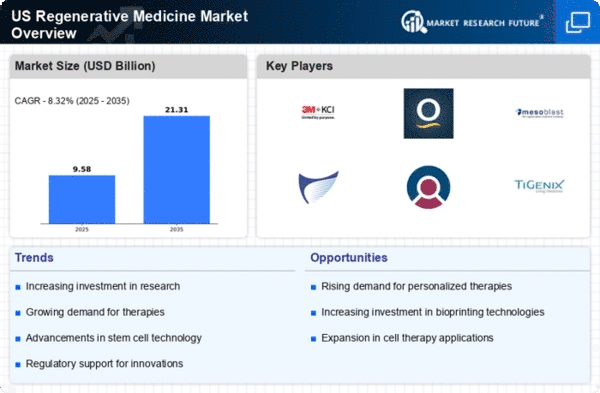
As per analysis, the US regenerative medicine market size was estimated at 8.85 USD Billion in 2024. The US regenerative medicine market is projected to grow from 9.58 USD Billion in 2025 to 21.31 USD Billion by 2035, exhibiting a compound annual growth rate (CAGR) of 8.3% during the forecast period 2025 - 2035

Key Market Trends & Highlights

The US regenerative medicine market is poised for substantial growth driven by innovation and increasing healthcare demands.

  • Investment in research and development is witnessing a notable surge, indicating a robust commitment to advancing regenerative therapies. Regulatory frameworks are evolving, facilitating faster approvals and enhancing market accessibility for innovative treatments. Collaboration between academic institutions and industry players is becoming more prevalent, fostering innovation and accelerating product development. Technological advancements and the growing prevalence of chronic diseases are key drivers propelling the regenerative medicine market forward.

Market Size & Forecast

2024 Market Size 8.85 (USD Billion)
2035 Market Size 21.31 (USD Billion)
CAGR (2025 - 2035) 8.32%

Major Players

Acelity (US), <a href="https://www.organogenesis.com/">Organogenesis </a>(US), Mesoblast (AU), Vericel (US), Sangamo Therapeutics (US), Tigenix (BE), Regenative Labs (US), Cytori Therapeutics (US), Tissue Regenix (GB)

Market Trends

The regenerative medicine market is currently experiencing a transformative phase characterized by rapid advancements in technology and increasing investment. This sector encompasses a variety of innovative therapies aimed at repairing or replacing damaged tissues and organs. The ongoing research and development efforts are likely to enhance treatment options for various conditions, including degenerative diseases and injuries. Regulatory bodies are also adapting to these changes, which may facilitate faster approvals for new therapies, thereby potentially increasing patient access to cutting-edge treatments. Moreover, the growing awareness of regenerative medicine's potential benefits is driving interest among healthcare providers and patients alike. Collaborations between academic institutions and industry players appear to be fostering a conducive environment for innovation. As the landscape evolves, it seems that the regenerative medicine market will continue to expand, offering new opportunities for stakeholders involved in research, development, and commercialization of these therapies. The future may hold promising advancements that could redefine treatment paradigms across multiple medical fields.

Increased Investment in Research and Development

There is a noticeable trend of heightened investment in research and development within the regenerative medicine market. This influx of funding is likely to accelerate the discovery of novel therapies and technologies, enhancing the overall landscape of treatment options available. As public and private sectors recognize the potential of regenerative medicine, financial support is expected to grow, fostering innovation.

Regulatory Evolution

Regulatory frameworks governing the regenerative medicine market are evolving to keep pace with rapid advancements. Authorities are likely to implement more streamlined processes for the approval of new therapies, which may facilitate quicker access for patients. This evolution suggests a proactive approach to ensuring safety while promoting innovation.

Collaboration Between Sectors

There appears to be an increasing trend of collaboration between academic institutions, industry players, and healthcare providers. These partnerships are likely to enhance knowledge sharing and resource allocation, driving advancements in regenerative medicine. Such collaborations may lead to the development of more effective therapies and improved patient outcomes.

US Regenerative Medicine Market Market Drivers

Increased Funding and Investment

The regenerative medicine market is witnessing a notable increase in funding and investment from both public and private sectors. Government initiatives, such as the National Institutes of Health (NIH) and the Food and Drug Administration (FDA), are allocating substantial resources to support research and development in this field. In 2025, funding for regenerative medicine research is projected to exceed $10 billion, highlighting the commitment to advancing this innovative sector. Additionally, venture capital investments are flowing into startups focused on regenerative therapies, further stimulating market growth. This influx of capital is likely to accelerate the development of new treatments and technologies, positioning the regenerative medicine market as a key player in the future of healthcare.

Growing Prevalence of Chronic Diseases

The increasing prevalence of chronic diseases in the US is a critical driver for the regenerative medicine market. Conditions such as diabetes, cardiovascular diseases, and neurodegenerative disorders are on the rise, necessitating innovative treatment solutions. According to the Centers for Disease Control and Prevention (CDC), chronic diseases account for 7 of the 10 leading causes of death in the US. This alarming statistic underscores the urgent need for effective therapies that regenerative medicine can provide. As healthcare providers seek to address these challenges, the market is expected to expand significantly, with estimates suggesting a compound annual growth rate (CAGR) of over 20% in the coming years. This growth reflects the potential of regenerative therapies to transform patient care and improve quality of life.

Rising Demand for Personalized Medicine

The shift towards personalized medicine is significantly influencing the regenerative medicine market. Patients increasingly seek tailored treatment options that cater to their unique genetic and biological profiles. This trend is prompting researchers and clinicians to develop therapies that are not only effective but also customized to individual needs. The market for personalized medicine is expected to grow substantially, with estimates suggesting it could reach $2 trillion by 2030. As regenerative medicine aligns with this demand, it is likely to see enhanced adoption and integration into clinical practice. This alignment may lead to improved patient outcomes and satisfaction, further driving the growth of the regenerative medicine market.

Expanding Applications in Various Medical Fields

The regenerative medicine market is expanding its applications across various medical fields, including orthopedics, cardiology, and dermatology. This diversification is driven by the increasing recognition of regenerative therapies' potential to address a wide range of conditions. For instance, stem cell therapies are being explored for their efficacy in treating orthopedic injuries and degenerative diseases. The market is projected to grow at a CAGR of approximately 25% as more healthcare providers adopt these innovative solutions. Additionally, advancements in tissue engineering and biomaterials are enabling the development of novel treatments that could revolutionize patient care. As these applications continue to evolve, they are likely to contribute significantly to the overall growth of the regenerative medicine market.

Technological Advancements in Regenerative Medicine

The regenerative medicine market is experiencing a surge in technological advancements that enhance treatment efficacy and patient outcomes. Innovations in gene editing, such as CRISPR, and stem cell therapies are at the forefront of this evolution. These technologies enable precise modifications at the cellular level, potentially leading to breakthroughs in treating previously incurable diseases. The market is projected to reach approximately $50 billion by 2026, driven by these advancements. Furthermore, the integration of artificial intelligence in research and clinical applications is streamlining processes, reducing costs, and improving patient care. As these technologies continue to develop, they are likely to attract significant investment, further propelling the regenerative medicine market forward.


Market Segment Insights

By Product: Gene Therapy (Largest) vs. Cell Therapy (Fastest-Growing)

<p>In the US Regenerative Medicine Market, 'Gene Therapy' holds the largest market share, driven by its revolutionary capabilities in treating genetic disorders. This segment has garnered significant attention, mainly due to the advancement of viral vectors and CRISPR technologies, allowing for precise modifications of genetic material. Conversely, 'Cell Therapy' is rapidly emerging, showcasing the fastest growth as novel treatments for a variety of diseases are introduced, especially in oncology and autoimmune disorders. The growth trends within these segments are propelled by increasing investments in R&D and advancements in biomanufacturing. Enhanced regulatory pathways and successful clinical trials are facilitating the introduction of innovative therapies. Furthermore, rising prevalence of chronic diseases and genetic disorders among the population fuels demand, as patients increasingly seek advanced solutions, making both segments pivotal in reshaping treatment paradigms in the healthcare landscape.</p>

<p>Gene Therapy (Dominant) vs. Cell-Based Immunotherapy Products (Emerging)</p>

<p>Gene Therapy has emerged as a dominant force in the US Regenerative Medicine Market, recognized for its potential to address the root causes of genetic diseases through targeted correction of genetic defects. This segment boasts impressive technological advancements, enabling treatments that were once considered unattainable. In contrast, Cell-Based Immunotherapy Products are carving a niche as an emerging player, leveraging the immune system to fight diseases like cancer. With innovative developments in CAR-T therapies and checkpoint inhibitors, this segment is gaining traction among healthcare providers and patients. The differentiation lies in gene therapy's singular focus on genetic alteration versus cell-based therapies' broader application of immune modulation, marking both as essential components of the regenerative medicine ecosystem.</p>

By Application: Musculoskeletal (Largest) vs. Oncology (Fastest-Growing)

<p>In the US Regenerative Medicine Market, the application segment is primarily driven by musculoskeletal applications, which hold the largest market share. This segment is well-established with a broad range of therapeutic options for conditions like osteoarthritis and degenerative disc disease. In contrast, oncology applications are emerging quickly, leveraging advancements in cell and gene therapy, thus capturing a growing portion of market attention and investment. The growth trends within these applications reveal a dynamic landscape. Musculoskeletal therapies are benefiting from an aging population and a rise in sports-related injuries, ensuring consistent demand. Meanwhile, oncology is experiencing rapid development due to a surge in research funding and clinical trials aimed at addressing previously challenging malignancies, positioning it as a critical area for innovation and expansion.</p>

<p>Musculoskeletal (Dominant) vs. Oncology (Emerging)</p>

<p>The musculoskeletal application segment is characterized by its prevalence and stability in the regenerative medicine landscape, primarily focusing on tissue regeneration and repair techniques. Its dominance stems from well-established technologies and a wide array of treatment options that cater to common orthopedic conditions. Conversely, the oncology segment is rapidly emerging, driven by innovative research and advancements in therapeutic approaches such as CAR T-cell therapy. This emerging segment focuses on harnessing the body's immune response to target cancer cells, showing promise in treating various forms of malignancies. The growing adoption of personalized medicine and increasing support from regulatory bodies further bolster the potential of the oncology segment to reshape cancer treatment paradigms.</p>

By End User: Hospitals (Largest) vs. Research Laboratories (Fastest-Growing)

The distribution of the US regenerative medicine market among end users shows that hospitals dominate the landscape, holding the largest market share. In contrast, research laboratories are witnessing rapid growth, fueled by increasing investments in innovative therapies and advanced research methodologies. This dynamic interaction between established players and emerging entities is shaping the competitive landscape significantly. Growth trends indicate that hospitals are increasingly integrating regenerative medicine into their <a href="https://www.marketresearchfuture.com/reports/achalasia-treatment-market-34316">treatment </a>protocols, driven by the rising incidence of chronic diseases and the need for advanced surgical solutions. Conversely, the expansion of research laboratories is supported by collaborations with pharmaceutical companies and academic institutions, enhancing their capability to innovate. This collaborative approach is expected to drive further advancements, creating a positive feedback loop for market growth.

Hospitals (Dominant) vs. Research Laboratories (Emerging)

Hospitals represent a dominant force in the US regenerative medicine market, primarily due to their expansive infrastructure and ability to implement new therapies swiftly. Their foundational role in patient care makes them essential players in the adoption of regenerative therapies, benefiting from strong demand for advanced treatment options. In contrast, research laboratories are emerging as critical innovators within the market. They focus on experimental therapies and play a pivotal role in the development of new products and solutions. The collaboration between hospitals and research laboratories fosters a conducive environment for breakthroughs, ensuring that both segments can thrive as the market evolves toward more regenerative techniques in healthcare.

By Therapeutic Area: Musculoskeletal Disorders (Largest) vs. Chronic Wounds (Fastest-Growing)

In the US regenerative medicine market, the distribution of market share among therapeutic areas is notably diverse. Musculoskeletal disorders represent the largest segment, significantly leading other areas due to the high prevalence of conditions such as osteoarthritis and sports injuries. These factors contribute to a robust demand for advanced treatments that promote healing and recovery. Meanwhile, chronic wounds are emerging as a fast-growing segment, driven by an aging population and increasing incidence of diabetes, which complicates wound healing processes. The growth trends in the therapeutic area are heavily influenced by advancements in biotechnologies and an increasing focus on personalized medicine. Musculoskeletal disorders continue to benefit from innovative therapies that address both recovery times and efficacy. Conversely, the chronic wounds segment is experiencing rapid development as healthcare providers seek more effective solutions, preferring regenerative approaches that not only heal but also minimize treatment costs over time. Such trends position both segments favorably for continued growth in the evolving market landscape.

Musculoskeletal Disorders (Dominant) vs. Chronic Wounds (Emerging)

Musculoskeletal disorders are a dominant therapeutic area in the US regenerative medicine market, primarily due to the high incidence and impact of related conditions. The treatments aim to restore function and reduce pain, playing a crucial role in patients' quality of life. Innovations in tissue engineering, stem cell applications, and gene therapy have bolstered this segment, pushing it to the forefront. Conversely, chronic wounds are classified as an emerging area, with growth driven by an increasing volume of patients suffering from conditions that impede conventional healing. These wounds require specialized management and are increasingly addressing the need for biological solutions that enhance healing, reduce scarring, and improve overall patient outcomes.

Get more detailed insights about US Regenerative Medicine Market Research Report - Forecast Till 2035

Regional Insights

North America : Leading Global Innovator

The North American regenerative medicine market is the largest globally, accounting for approximately 60% of the total market share. Key growth drivers include advanced research and development, a robust healthcare infrastructure, and increasing investments in biotechnology. Regulatory support from agencies like the FDA has catalyzed innovation, facilitating faster approvals for regenerative therapies. The demand for personalized medicine and cell-based therapies is also on the rise, further propelling market growth. The United States stands as the leading country in this sector, hosting major players such as Amgen, Gilead Sciences, and Regeneron Pharmaceuticals. The competitive landscape is characterized by significant investments in R&D and strategic partnerships among companies. The presence of top-tier research institutions and universities enhances innovation, while a favorable regulatory environment encourages the development of cutting-edge therapies. This dynamic ecosystem positions North America as a powerhouse in regenerative medicine.

Europe : Emerging Market Potential

Europe is witnessing a significant transformation in the regenerative medicine market, holding approximately 25% of the global share. The region benefits from strong governmental support and funding initiatives aimed at advancing research in cell and gene therapies. Regulatory frameworks, such as the European Medicines Agency's guidelines, are evolving to accommodate innovative treatments, thus fostering a conducive environment for market growth. The increasing prevalence of chronic diseases is also driving demand for regenerative solutions across Europe. Leading countries in this region include Germany, the UK, and France, which are at the forefront of research and development. The competitive landscape features key players like Novartis and Roche, alongside emerging biotech firms. Collaborative efforts between academia and industry are prevalent, enhancing innovation and accelerating the commercialization of new therapies. The European market is poised for growth, driven by advancements in technology and a focus on patient-centric solutions.

Asia-Pacific : Rapidly Growing Market

The Asia-Pacific region is rapidly emerging as a significant player in the regenerative medicine market, accounting for about 10% of the global share. Key growth drivers include increasing healthcare expenditure, a rising aging population, and advancements in biotechnology. Countries like Japan and China are leading the charge, supported by favorable government policies and investments in research and development. The region is also witnessing a surge in clinical trials, which is expected to accelerate market growth in the coming years. Japan is particularly notable for its advanced regenerative medicine initiatives, with a strong focus on stem cell research and tissue engineering. China is also making strides, with numerous biotech firms entering the market. The competitive landscape is characterized by a mix of established companies and startups, fostering innovation. As the region continues to develop its regulatory framework, the potential for growth in regenerative therapies remains substantial, attracting global attention.

Middle East and Africa : Emerging Opportunities

The Middle East and Africa region is gradually emerging in the regenerative medicine market, currently holding about 5% of the global share. The growth is driven by increasing investments in healthcare infrastructure and a rising awareness of advanced medical technologies. Governments are beginning to recognize the potential of regenerative medicine, leading to supportive policies and funding initiatives. The demand for innovative treatments is growing, particularly in countries like South Africa and the UAE, where healthcare systems are evolving. South Africa is leading the way in research and development, with several institutions focusing on regenerative therapies. The competitive landscape is still developing, with a mix of local and international players entering the market. Collaborations between governments and private sectors are becoming more common, aiming to enhance the capabilities of the healthcare system. As the region continues to invest in healthcare, the potential for regenerative medicine is expected to expand significantly.

Key Players and Competitive Insights

The regenerative medicine market is currently characterized by a dynamic competitive landscape, driven by advancements in technology, increasing investment in research and development, and a growing demand for innovative therapies. Key players such as Acelity (US), Organogenesis (US), and Vericel (US) are strategically positioning themselves through a combination of innovation and partnerships. Acelity (US) focuses on developing advanced wound care solutions, leveraging its expertise in regenerative medicine to enhance patient outcomes. Organogenesis (US) emphasizes its commitment to developing allogeneic and autologous products, which are crucial for addressing a variety of tissue repair needs. Vericel (US) is concentrating on expanding its product portfolio in cell therapy, particularly in the treatment of sports medicine and orthopedic conditions, thereby enhancing its competitive edge in the market. The business tactics employed by these companies include localizing manufacturing and optimizing supply chains to improve efficiency and reduce costs. The market structure appears moderately fragmented, with several players competing for market share. However, the collective influence of these key players is significant, as they drive innovation and set industry standards, thereby shaping the overall competitive environment. In September 2025, Acelity (US) announced a strategic partnership with a leading biotechnology firm to co-develop a novel regenerative therapy aimed at chronic wound healing. This collaboration is expected to enhance Acelity's product offerings and accelerate the development timeline, positioning the company favorably in a competitive market. The partnership underscores the importance of collaboration in driving innovation and meeting the evolving needs of healthcare providers. In August 2025, Organogenesis (US) launched a new allogeneic product line designed to address the growing demand for off-the-shelf regenerative solutions. This launch is strategically significant as it allows the company to tap into a broader market segment, potentially increasing its market share. The introduction of this product line reflects Organogenesis's commitment to innovation and its responsiveness to market trends. In October 2025, Vericel (US) expanded its manufacturing capabilities by investing in a new facility dedicated to cell therapy production. This investment is likely to enhance Vericel's operational efficiency and scalability, enabling the company to meet increasing demand for its products. The expansion signifies a proactive approach to strengthening its market position and ensuring supply chain reliability. As of November 2025, current trends in the regenerative medicine market include a strong emphasis on digitalization, sustainability, and the integration of artificial intelligence in product development. Strategic alliances are increasingly shaping the competitive landscape, as companies recognize the value of collaboration in fostering innovation. Looking ahead, competitive differentiation is expected to evolve, with a shift from price-based competition to a focus on technological advancements, innovative solutions, and reliable supply chains. This transition may redefine how companies position themselves in the market, emphasizing the importance of adaptability and forward-thinking strategies.

Key Companies in the US Regenerative Medicine Market include

Industry Developments

April 2022:The U.S. Food and Drug Administration (FDA) has designated Autolus Therapeutics plc's lead gene therapy, obecabatagene autoleucel, a CD19-directed autologous chimeric antigen receptor T therapy being studied in the ongoing FELIX Phase 2 study of leukemia, as Regenerative Medicine Advanced Therapy. This announcement was made by the company.

May 2021:The FDA in the United States approved Breyanzi for Bristol Myers Squibb. Adults with large B-cell lymphoma (LBCL) that has relapsed or is refractory (R/R) are eligible to use the medicine. The launch of the new product expanded the company's clientele and range of offerings.

Future Outlook

US Regenerative Medicine Market Future Outlook

The regenerative medicine market is projected to grow at an 8.32% CAGR from 2025 to 2035, driven by technological advancements, increasing investments, and rising demand for innovative therapies.

New opportunities lie in:

  • <p>Development of personalized cell therapies for chronic diseases. Expansion of telehealth platforms for remote patient monitoring. Investment in bioprinting technologies for tissue engineering.</p>

By 2035, the regenerative medicine market is expected to achieve substantial growth and innovation.

Market Segmentation

US Regenerative Medicine Market Product Outlook

  • Gene Therapy
  • Cell Therapy
  • Stem Cell Therapy
  • Autologous Therapy
  • Allogenic Therapy
  • Cell-Based Immunotherapy Products
  • Cord Blood/Progenitor Cell Therapies
  • Tissue Engineering
  • Scaffolds
  • Hydrogels
  • Collagen
  • Others

US Regenerative Medicine Market Application Outlook

  • Musculoskeletal
  • Oncology
  • Wound Care
  • Dental Indications
  • Retinal Indications
  • Other Applications

Report Scope

MARKET SIZE 2024 8.85(USD Billion)
MARKET SIZE 2025 9.58(USD Billion)
MARKET SIZE 2035 21.31(USD Billion)
COMPOUND ANNUAL GROWTH RATE (CAGR) 8.32% (2025 - 2035)
REPORT COVERAGE Revenue Forecast, Competitive Landscape, Growth Factors, and Trends
BASE YEAR 2024
Market Forecast Period 2025 - 2035
Historical Data 2019 - 2024
Market Forecast Units USD Billion
Key Companies Profiled Acelity (US), Organogenesis (US), Mesoblast (AU), Vericel (US), Sangamo Therapeutics (US), Tigenix (BE), Regenative Labs (US), Cytori Therapeutics (US), Tissue Regenix (GB)
Segments Covered Application, Product Type, End User, Therapeutic Area
Key Market Opportunities Advancements in cell therapy and gene editing technologies drive growth in the regenerative medicine market.
Key Market Dynamics Regulatory advancements and technological innovations drive growth in the regenerative medicine market, enhancing treatment options and accessibility.
Countries Covered US

FAQs

What is the current valuation of the US regenerative medicine market?

<p>The market valuation was $8.85 Billion in 2024.</p>

What is the projected market size for the US regenerative medicine market by 2035?

<p>The market is projected to reach $21.31 Billion by 2035.</p>

What is the expected CAGR for the US regenerative medicine market during the forecast period 2025 - 2035?

<p>The expected CAGR is 8.32% from 2025 to 2035.</p>

Which therapeutic area is expected to have the highest market valuation in 2035?

<p>Oncology is projected to reach $9.19 Billion by 2035.</p>

What are the key product types in the US regenerative medicine market?

<p>Key product types include Cell Therapy, Gene Therapy, Tissue Engineering, and Stem Cell Therapy.</p>

Which end user segment is anticipated to dominate the market by 2035?

<p>Hospitals are expected to dominate with a valuation of $8.25 Billion by 2035.</p>

Who are the leading companies in the US regenerative medicine market?

<p>Key players include Acelity, Organogenesis, Mesoblast, and Vericel.</p>

What is the market valuation for orthopedic applications in 2035?

<p>Orthopedic applications are projected to reach $4.12 Billion by 2035.</p>

How does the market for chronic wounds compare to other therapeutic areas by 2035?

<p>Chronic wounds are expected to reach $7.66 Billion, indicating strong growth.</p>

What was the market size for gene therapy in 2024?

<p>The market size for gene therapy was $1.77 Billion in 2024.</p>

  1. SECTION I: EXECUTIVE SUMMARY AND KEY HIGHLIGHTS
    1. | 1.1 EXECUTIVE SUMMARY
    2. | | 1.1.1 Market Overview
    3. | | 1.1.2 Key Findings
    4. | | 1.1.3 Market Segmentation
    5. | | 1.1.4 Competitive Landscape
    6. | | 1.1.5 Challenges and Opportunities
    7. | | 1.1.6 Future Outlook
  2. SECTION II: SCOPING, METHODOLOGY AND MARKET STRUCTURE
    1. | 2.1 MARKET INTRODUCTION
    2. | | 2.1.1 Definition
    3. | | 2.1.2 Scope of the study
    4. | | | 2.1.2.1 Research Objective
    5. | | | 2.1.2.2 Assumption
    6. | | | 2.1.2.3 Limitations
    7. | 2.2 RESEARCH METHODOLOGY
    8. | | 2.2.1 Overview
    9. | | 2.2.2 Data Mining
    10. | | 2.2.3 Secondary Research
    11. | | 2.2.4 Primary Research
    12. | | | 2.2.4.1 Primary Interviews and Information Gathering Process
    13. | | | 2.2.4.2 Breakdown of Primary Respondents
    14. | | 2.2.5 Forecasting Model
    15. | | 2.2.6 Market Size Estimation
    16. | | | 2.2.6.1 Bottom-Up Approach
    17. | | | 2.2.6.2 Top-Down Approach
    18. | | 2.2.7 Data Triangulation
    19. | | 2.2.8 Validation
  3. SECTION III: QUALITATIVE ANALYSIS
    1. | 3.1 MARKET DYNAMICS
    2. | | 3.1.1 Overview
    3. | | 3.1.2 Drivers
    4. | | 3.1.3 Restraints
    5. | | 3.1.4 Opportunities
    6. | 3.2 MARKET FACTOR ANALYSIS
    7. | | 3.2.1 Value chain Analysis
    8. | | 3.2.2 Porter's Five Forces Analysis
    9. | | | 3.2.2.1 Bargaining Power of Suppliers
    10. | | | 3.2.2.2 Bargaining Power of Buyers
    11. | | | 3.2.2.3 Threat of New Entrants
    12. | | | 3.2.2.4 Threat of Substitutes
    13. | | | 3.2.2.5 Intensity of Rivalry
    14. | | 3.2.3 COVID-19 Impact Analysis
    15. | | | 3.2.3.1 Market Impact Analysis
    16. | | | 3.2.3.2 Regional Impact
    17. | | | 3.2.3.3 Opportunity and Threat Analysis
  4. SECTION IV: QUANTITATIVE ANALYSIS
    1. | 4.1 Life Sciences, BY Application (USD Billion)
    2. | | 4.1.1 Orthopedics
    3. | | 4.1.2 Neurology
    4. | | 4.1.3 Cardiology
    5. | | 4.1.4 Dermatology
    6. | | 4.1.5 Oncology
    7. | 4.2 Life Sciences, BY Product Type (USD Billion)
    8. | | 4.2.1 Cell Therapy
    9. | | 4.2.2 Gene Therapy
    10. | | 4.2.3 Tissue Engineering
    11. | | 4.2.4 Stem Cell Therapy
    12. | 4.3 Life Sciences, BY End User (USD Billion)
    13. | | 4.3.1 Hospitals
    14. | | 4.3.2 Research Laboratories
    15. | | 4.3.3 Pharmaceutical Companies
    16. | | 4.3.4 Academic Institutions
    17. | 4.4 Life Sciences, BY Therapeutic Area (USD Billion)
    18. | | 4.4.1 Musculoskeletal Disorders
    19. | | 4.4.2 Cognitive Disorders
    20. | | 4.4.3 Cardiovascular Diseases
    21. | | 4.4.4 Chronic Wounds
  5. SECTION V: COMPETITIVE ANALYSIS
    1. | 5.1 Competitive Landscape
    2. | | 5.1.1 Overview
    3. | | 5.1.2 Competitive Analysis
    4. | | 5.1.3 Market share Analysis
    5. | | 5.1.4 Major Growth Strategy in the Life Sciences
    6. | | 5.1.5 Competitive Benchmarking
    7. | | 5.1.6 Leading Players in Terms of Number of Developments in the Life Sciences
    8. | | 5.1.7 Key developments and growth strategies
    9. | | | 5.1.7.1 New Product Launch/Service Deployment
    10. | | | 5.1.7.2 Merger & Acquisitions
    11. | | | 5.1.7.3 Joint Ventures
    12. | | 5.1.8 Major Players Financial Matrix
    13. | | | 5.1.8.1 Sales and Operating Income
    14. | | | 5.1.8.2 Major Players R&D Expenditure. 2023
    15. | 5.2 Company Profiles
    16. | | 5.2.1 Acelity (US)
    17. | | | 5.2.1.1 Financial Overview
    18. | | | 5.2.1.2 Products Offered
    19. | | | 5.2.1.3 Key Developments
    20. | | | 5.2.1.4 SWOT Analysis
    21. | | | 5.2.1.5 Key Strategies
    22. | | 5.2.2 Organogenesis (US)
    23. | | | 5.2.2.1 Financial Overview
    24. | | | 5.2.2.2 Products Offered
    25. | | | 5.2.2.3 Key Developments
    26. | | | 5.2.2.4 SWOT Analysis
    27. | | | 5.2.2.5 Key Strategies
    28. | | 5.2.3 Mesoblast (AU)
    29. | | | 5.2.3.1 Financial Overview
    30. | | | 5.2.3.2 Products Offered
    31. | | | 5.2.3.3 Key Developments
    32. | | | 5.2.3.4 SWOT Analysis
    33. | | | 5.2.3.5 Key Strategies
    34. | | 5.2.4 Vericel (US)
    35. | | | 5.2.4.1 Financial Overview
    36. | | | 5.2.4.2 Products Offered
    37. | | | 5.2.4.3 Key Developments
    38. | | | 5.2.4.4 SWOT Analysis
    39. | | | 5.2.4.5 Key Strategies
    40. | | 5.2.5 Sangamo Therapeutics (US)
    41. | | | 5.2.5.1 Financial Overview
    42. | | | 5.2.5.2 Products Offered
    43. | | | 5.2.5.3 Key Developments
    44. | | | 5.2.5.4 SWOT Analysis
    45. | | | 5.2.5.5 Key Strategies
    46. | | 5.2.6 Tigenix (BE)
    47. | | | 5.2.6.1 Financial Overview
    48. | | | 5.2.6.2 Products Offered
    49. | | | 5.2.6.3 Key Developments
    50. | | | 5.2.6.4 SWOT Analysis
    51. | | | 5.2.6.5 Key Strategies
    52. | | 5.2.7 Regenative Labs (US)
    53. | | | 5.2.7.1 Financial Overview
    54. | | | 5.2.7.2 Products Offered
    55. | | | 5.2.7.3 Key Developments
    56. | | | 5.2.7.4 SWOT Analysis
    57. | | | 5.2.7.5 Key Strategies
    58. | | 5.2.8 Cytori Therapeutics (US)
    59. | | | 5.2.8.1 Financial Overview
    60. | | | 5.2.8.2 Products Offered
    61. | | | 5.2.8.3 Key Developments
    62. | | | 5.2.8.4 SWOT Analysis
    63. | | | 5.2.8.5 Key Strategies
    64. | | 5.2.9 Tissue Regenix (GB)
    65. | | | 5.2.9.1 Financial Overview
    66. | | | 5.2.9.2 Products Offered
    67. | | | 5.2.9.3 Key Developments
    68. | | | 5.2.9.4 SWOT Analysis
    69. | | | 5.2.9.5 Key Strategies
    70. | 5.3 Appendix
    71. | | 5.3.1 References
    72. | | 5.3.2 Related Reports
  6. LIST OF FIGURES
    1. | 6.1 MARKET SYNOPSIS
    2. | 6.2 US MARKET ANALYSIS BY APPLICATION
    3. | 6.3 US MARKET ANALYSIS BY PRODUCT TYPE
    4. | 6.4 US MARKET ANALYSIS BY END USER
    5. | 6.5 US MARKET ANALYSIS BY THERAPEUTIC AREA
    6. | 6.6 KEY BUYING CRITERIA OF LIFE SCIENCES
    7. | 6.7 RESEARCH PROCESS OF MRFR
    8. | 6.8 DRO ANALYSIS OF LIFE SCIENCES
    9. | 6.9 DRIVERS IMPACT ANALYSIS: LIFE SCIENCES
    10. | 6.10 RESTRAINTS IMPACT ANALYSIS: LIFE SCIENCES
    11. | 6.11 SUPPLY / VALUE CHAIN: LIFE SCIENCES
    12. | 6.12 LIFE SCIENCES, BY APPLICATION, 2024 (% SHARE)
    13. | 6.13 LIFE SCIENCES, BY APPLICATION, 2024 TO 2035 (USD Billion)
    14. | 6.14 LIFE SCIENCES, BY PRODUCT TYPE, 2024 (% SHARE)
    15. | 6.15 LIFE SCIENCES, BY PRODUCT TYPE, 2024 TO 2035 (USD Billion)
    16. | 6.16 LIFE SCIENCES, BY END USER, 2024 (% SHARE)
    17. | 6.17 LIFE SCIENCES, BY END USER, 2024 TO 2035 (USD Billion)
    18. | 6.18 LIFE SCIENCES, BY THERAPEUTIC AREA, 2024 (% SHARE)
    19. | 6.19 LIFE SCIENCES, BY THERAPEUTIC AREA, 2024 TO 2035 (USD Billion)
    20. | 6.20 BENCHMARKING OF MAJOR COMPETITORS
  7. LIST OF TABLES
    1. | 7.1 LIST OF ASSUMPTIONS
    2. | | 7.1.1
    3. | 7.2 US MARKET SIZE ESTIMATES; FORECAST
    4. | | 7.2.1 BY APPLICATION, 2025-2035 (USD Billion)
    5. | | 7.2.2 BY PRODUCT TYPE, 2025-2035 (USD Billion)
    6. | | 7.2.3 BY END USER, 2025-2035 (USD Billion)
    7. | | 7.2.4 BY THERAPEUTIC AREA, 2025-2035 (USD Billion)
    8. | 7.3 PRODUCT LAUNCH/PRODUCT DEVELOPMENT/APPROVAL
    9. | | 7.3.1
    10. | 7.4 ACQUISITION/PARTNERSHIP
    11. | | 7.4.1

US Life Sciences Market Segmentation

Life Sciences By Application (USD Billion, 2025-2035)

  • Orthopedics
  • Neurology
  • Cardiology
  • Dermatology
  • Oncology

Life Sciences By Product Type (USD Billion, 2025-2035)

  • Cell Therapy
  • Gene Therapy
  • Tissue Engineering
  • Stem Cell Therapy

Life Sciences By End User (USD Billion, 2025-2035)

  • Hospitals
  • Research Laboratories
  • Pharmaceutical Companies
  • Academic Institutions

Life Sciences By Therapeutic Area (USD Billion, 2025-2035)

  • Musculoskeletal Disorders
  • Cognitive Disorders
  • Cardiovascular Diseases
  • Chronic Wounds
Infographic

Free Sample Request

Kindly complete the form below to receive a free sample of this Report

Get Free Sample

Customer Strories

Compare Licence

×
Features License Type
Single User Multiuser License Enterprise User
Price $4,950 $5,950 $7,250
Maximum User Access Limit 1 User Upto 10 Users Unrestricted Access Throughout the Organization
Free Customization
Direct Access to Analyst
Deliverable Format
Platform Access
Discount on Next Purchase 10% 15% 15%
Printable Versions
%>