Request Free Sample ×

Kindly complete the form below to receive a free sample of this Report

* Please use a valid business email

Leading companies partner with us for data-driven Insights

clients tt-cursor
Hero Background
English
Chinese
French
Japanese
Korean
German
Spanish

Ultra High Definition Endoscopy Market Share

ID: MRFR/HC/9959-HCR
141 Pages
Rahul Gotadki
Last Updated: April 06, 2026

Ultra-High-Definition Endoscopy Market Research Report Information By Device type (4K ultra-high definition (UHD), 8K ultra-high definition (UHD), By Application (Arthroscopy, Laparoscopy, GI Endoscopy, Obstetrics/Gynecology, ENT Endoscopy, Pulmonary Endoscopy, Others), By End Users (Hospitals, Ambulatory Surgical Centers, Others), and By Region (North America, Europe, Asia-Pacific, And Rest Of The World) - Forecast Till 2035

Share:
Download PDF ×

We do not share your information with anyone. However, we may send you emails based on your report interest from time to time. You may contact us at any time to opt-out.

Ultra High Definition Endoscopy Market Infographic
Purchase Options

Market Share

Ultra High Definition Endoscopy Market Share Analysis

The Ultra High Definition Endoscopy (UHD) market has witnessed significant growth due to advancements in medical imaging technology. UHD endoscopes provide superior image quality, allowing for enhanced visualization during medical procedures. Though market share is one of the key positioning strategies for companies producing UHD endoscopes, market existence might not simply be achieved when other competitors already occupy the space. It implies the use of tactics that will help to secure a sustained market share and making the products unique from the competition. Failure to employ a proper marketing strategy can result in decreased sales and a struggle to gain traction in a crowded market. Increasingly, business operators compete in UHD endoscope market through the innovation of the technology, thus securing a powerful market share. Technologies like enhanced resolution and advanced color rendering give an edge to companies that seek to earn respect from healthcare professionals for employing modern high-quality devices. Making UHD gastroscopy suitable for different medical sub-specialties will also be a vital strategy. The organizations have their labs to develop the Questgura , the specialized endoscopes , that are later on used for field of gastroenterology , urology , gynecology and others . It helps them to have a widespread audience . Fostering of healthcare institutions is also one of the best approach. Through the interaction with hospitals and clinics, UHD endoscopes producers can capture their initial customers by volume selection and exclusive arrangements making them consistent and stable. Finding the right equilibrium between low prices and delivering better values is one of the vital points. This approach intends to bring cost-mindful future clients of healthcare industry without making compromises on quality and features of their endoscopes of UHD quality. Adhering to stringent regulatory standards and ensuring quality assurance are non-negotiable aspects of market share positioning. Companies invest in obtaining necessary certifications, demonstrating their commitment to delivering safe and effective UHD endoscopes. Keeping a vigilant eye on competitors' activities and market trends is an integral part of the strategy. Swift responses to changing market dynamics, technological advancements, and pricing strategies help UHD endoscope manufacturers stay ahead in the competition. Exploring opportunities in emerging markets is a forward-looking approach. UHD endoscope companies may strategically expand their presence in regions with growing healthcare needs, thereby tapping into new customer bases and diversifying their market share.


Author
Author Profile
Rahul Gotadki
Research Manager

He holds an experience of about 9+ years in Market Research and Business Consulting, working under the spectrum of Life Sciences and Healthcare domains. Rahul conceptualizes and implements a scalable business strategy and provides strategic leadership to the clients. His expertise lies in market estimation, competitive intelligence, pipeline analysis, customer assessment, etc.

Leave a Comment

FAQs

What is the projected market valuation of the Ultra-High-Definition Endoscopy Market by 2035?

<p>The Ultra-High-Definition Endoscopy Market is projected to reach a valuation of 15.13 USD Billion by 2035.</p>

What was the market valuation of the Ultra-High-Definition Endoscopy Market in 2024?

<p>In 2024, the market valuation of the Ultra-High-Definition Endoscopy Market was 4.233 USD Billion.</p>

What is the expected CAGR for the Ultra-High-Definition Endoscopy Market during the forecast period 2025 - 2035?

<p>The expected CAGR for the Ultra-High-Definition Endoscopy Market during the forecast period 2025 - 2035 is 12.28%.</p>

Which device type segment is anticipated to have the highest growth in the Ultra-High-Definition Endoscopy Market?

<p>The 4K ultra-high definition (UHD) segment is anticipated to grow from 2.5 USD Billion to 9.0 USD Billion by 2035.</p>

What are the key applications driving the Ultra-High-Definition Endoscopy Market?

<p>Key applications include GI Endoscopy, Laparoscopy, and Arthroscopy, with GI Endoscopy projected to grow from 1.25 USD Billion to 4.5 USD Billion by 2035.</p>

Which end user segment is expected to dominate the Ultra-High-Definition Endoscopy Market?

<p>The Hospitals segment is expected to dominate, growing from 2.1 USD Billion in 2024 to 7.5 USD Billion by 2035.</p>

Who are the leading players in the Ultra-High-Definition Endoscopy Market?

<p>Leading players include Olympus Corporation, Fujifilm Holdings Corporation, and Karl Storz SE & Co. KG.</p>

What is the growth potential for the Ambulatory Surgical Centers segment in the Ultra-High-Definition Endoscopy Market?

<p>The Ambulatory Surgical Centers segment is projected to grow from 1.5 USD Billion to 5.5 USD Billion by 2035.</p>

How does the 8K ultra-high definition (UHD) segment compare to the 4K segment in terms of market growth?

<p>The 8K ultra-high definition (UHD) segment is expected to grow from 1.733 USD Billion to 6.13 USD Billion, indicating substantial growth potential.</p>

What is the significance of the Others segment in the Ultra-High-Definition Endoscopy Market?

<p>The Others segment is projected to grow from 0.6 USD Billion to 1.8 USD Billion, reflecting its increasing relevance in the market.</p>

Market Summary

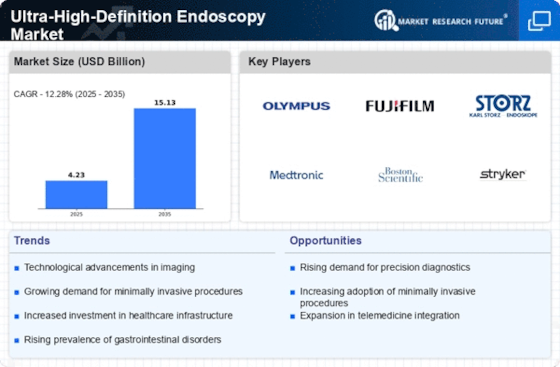
As per Market Research Future analysis, the Ultra-High-Definition Endoscopy Market Size was estimated at 4.233 USD Billion in 2024. The Ultra-High-Definition Endoscopy industry is projected to grow from 4.753 USD Billion in 2025 to 15.13 USD Billion by 2035, exhibiting a compound annual growth rate (CAGR) of 12.28% during the forecast period 2025 - 2035

Key Market Trends & Highlights

The Ultra-High-Definition Endoscopy Market is poised for substantial growth driven by technological innovations and increasing healthcare demands.

  • North America remains the largest market for Ultra-High-Definition Endoscopy, reflecting a strong healthcare infrastructure and advanced medical technologies. The Asia-Pacific region is emerging as the fastest-growing market, driven by rising healthcare investments and a burgeoning patient population. The 4K UHD segment dominates the market, while the 8K UHD segment is rapidly gaining traction due to its superior imaging capabilities. Technological advancements in imaging and the rising demand for minimally invasive procedures are key drivers propelling market growth.

Market Size & Forecast

2024 Market Size 4.233 (USD Billion)
2035 Market Size 15.13 (USD Billion)
CAGR (2025 - 2035) 12.28%
Largest Regional Market Share in 2024 North America

Major Players

Olympus Corporation (JP), Fujifilm Holdings Corporation (JP), Karl Storz SE &amp; Co. KG (DE), Medtronic plc (IE), Boston Scientific Corporation (US), Stryker Corporation (US), Conmed Corporation (US), Hoya Corporation (JP), Richard Wolf GmbH (DE)

Market Trends

The Ultra-High-Definition Endoscopy Market is currently experiencing a transformative phase, characterized by advancements in imaging technology and increasing demand for minimally invasive procedures. This market appears to be driven by a growing emphasis on precision in diagnostics and treatment, as healthcare providers seek to enhance patient outcomes. The integration of ultra-high-definition imaging systems into surgical practices seems to facilitate improved visualization, thereby allowing for more accurate assessments and interventions. Furthermore, the rising prevalence of chronic diseases necessitates the adoption of advanced endoscopic techniques, which could potentially lead to a broader acceptance of these technologies across various medical specialties.

In addition, the Ultra-High-Definition Endoscopy Market is likely influenced by ongoing innovations in device design and functionality. Manufacturers are focusing on developing user-friendly systems that incorporate advanced features such as real-time imaging and enhanced connectivity options. This trend suggests a shift towards more integrated solutions that not only improve the efficiency of procedures but also enhance the overall experience for both healthcare professionals and patients. As the market evolves, it may witness increased collaboration between technology firms and healthcare providers, fostering an environment conducive to further advancements in endoscopic practices.

Technological Advancements

The Ultra-High-Definition Endoscopy Market is witnessing rapid technological advancements that enhance imaging quality and procedural efficiency. Innovations in camera systems and optics are likely to improve visualization, enabling healthcare professionals to perform more precise interventions.

Rising Demand for Minimally Invasive Procedures

There appears to be a growing preference for minimally invasive procedures within the Ultra-High-Definition Endoscopy Market. This trend is driven by patient demand for reduced recovery times and lower risk of complications, prompting healthcare providers to adopt advanced endoscopic techniques.

Integration of Artificial Intelligence

The integration of artificial intelligence into endoscopic systems is emerging as a notable trend. AI technologies may assist in image analysis and decision-making, potentially improving diagnostic accuracy and streamlining workflows in the Ultra-High-Definition Endoscopy Market.

Ultra High Definition Endoscopy Market Market Drivers

Growing Geriatric Population

The Ultra-High-Definition Endoscopy Market is significantly influenced by the growing geriatric population, which is more susceptible to various health conditions requiring endoscopic evaluation. As the global population ages, the demand for diagnostic and therapeutic endoscopic procedures is expected to rise. This demographic shift is prompting healthcare providers to invest in advanced endoscopic technologies that cater to the needs of older patients. The market is projected to witness a growth rate of approximately 9% annually, driven by the increasing prevalence of age-related diseases such as gastrointestinal disorders. Consequently, ultra-high-definition endoscopy systems are becoming vital tools in managing the health of the elderly, ensuring that they receive timely and effective medical interventions.

Increased Healthcare Expenditure

The Ultra-High-Definition Endoscopy Market is benefiting from increased healthcare expenditure across various regions. Governments and private sectors are allocating more resources towards advanced medical technologies, recognizing the importance of high-quality diagnostic tools in improving patient care. This trend is particularly evident in emerging economies, where investments in healthcare infrastructure are on the rise. As healthcare budgets expand, the demand for ultra-high-definition endoscopy systems is likely to grow, with market analysts estimating a potential increase of 12% in sales over the next few years. Enhanced funding allows healthcare facilities to upgrade their equipment, thereby improving the overall quality of care and patient outcomes in endoscopic procedures.

Technological Advancements in Imaging

The Ultra-High-Definition Endoscopy Market is experiencing a surge in technological advancements that enhance imaging capabilities. Innovations such as 4K and 8K resolution systems provide unparalleled clarity, allowing for more accurate diagnoses and improved surgical outcomes. These advancements are not merely incremental; they represent a paradigm shift in how endoscopic procedures are performed. The integration of high-definition cameras with advanced light sources significantly improves visualization of anatomical structures. As a result, healthcare providers are increasingly adopting these technologies, leading to a projected market growth rate of approximately 10% annually over the next five years. This trend indicates a robust demand for high-definition endoscopic systems, which are becoming essential tools in modern medical practice.

Integration of Artificial Intelligence

The Ultra-High-Definition Endoscopy Market is increasingly incorporating artificial intelligence (AI) technologies to enhance diagnostic accuracy and procedural efficiency. AI algorithms can analyze endoscopic images in real-time, assisting clinicians in identifying abnormalities that may be missed by the human eye. This integration not only improves patient outcomes but also streamlines workflow in clinical settings. The market for AI-enhanced endoscopic systems is expected to grow substantially, with projections indicating a potential increase of 15% in adoption rates over the next few years. As healthcare systems continue to seek innovative solutions to improve patient care, the role of AI in ultra-high-definition endoscopy is likely to become more pronounced, driving further advancements in the field.

Rising Demand for Minimally Invasive Procedures

The Ultra-High-Definition Endoscopy Market is witnessing a notable increase in the demand for minimally invasive procedures. Patients and healthcare providers alike are gravitating towards techniques that reduce recovery times and minimize surgical trauma. This shift is driven by a growing awareness of the benefits associated with minimally invasive surgeries, including reduced postoperative pain and shorter hospital stays. As a result, the market for ultra-high-definition endoscopy systems is projected to expand significantly, with estimates suggesting a compound annual growth rate of around 8% over the next several years. The ability of ultra-high-definition endoscopy to provide detailed visualization during these procedures is a key factor in its rising adoption, as it enhances the precision and effectiveness of surgical interventions.

Market Segment Insights

By Device Type: 4K UHD (Largest) vs. 8K UHD (Fastest-Growing)

In the Ultra-High-Definition Endoscopy Market, the device type segment is primarily dominated by 4K ultra-high definition (UHD) technology. This segment holds a substantial market share due to its established presence and proven technological benefits. 4K UHD systems have become the standard choice for many healthcare facilities, offering enhanced image clarity and detail that significantly aids in diagnostic processes. In contrast, the 8K UHD technology is emerging rapidly, capturing a smaller but increasing share of the market as healthcare providers seek even greater resolution for complex surgical procedures. The growth trends within this segment are driven by the increasing adoption of advanced endoscopic procedures, medical professionals' demand for higher precision imaging, and ongoing technological advancements. The transition from 4K UHD to 8K UHD is facilitated by the declining costs of production and improvements in image processing technologies. As patients demand better outcomes and physicians leverage more sophisticated imaging solutions, 8K UHD is expected to witness accelerated growth, marking a significant shift in the market.

Device Type: 4K UHD (Dominant) vs. 8K UHD (Emerging)

The 4K ultra-high definition (UHD) segment is recognized as the dominant player in the Ultra-High-Definition Endoscopy Market, characterized by its established technology and widespread adoption across various medical facilities. 4K UHD provides remarkable clarity and details essential for accurate diagnoses and surgical procedures. Conversely, the 8K UHD segment is categorized as an emerging technology, gaining traction for its superior resolution capabilities, which are particularly advantageous for intricate surgical tasks. The transition toward 8K UHD is further facilitated by advancements in display technology and image processing. Thus, while 4K UHD remains the preferred choice for many, 8K UHD represents the future of endoscopic imaging with its potential to enhance visual acuity and patient outcomes.

By Application: GI Endoscopy (Largest) vs. Laparoscopy (Fastest-Growing)

In the Ultra-High-Definition Endoscopy Market, GI Endoscopy holds the largest market share, driven by its widespread adoption for diagnostic and therapeutic procedures. Following closely is Laparoscopy, which has gained significant prominence due to technological advancements improving its applications in various surgical settings. Other segments, including Arthroscopy and ENT Endoscopy, contribute substantially to the market, but they do not match the scale of the leading applications. Growth trends reveal that the Laparoscopy segment is emerging as the fastest-growing entity, attributed to increasing demand for minimally invasive techniques. Factors fueling this trend include technological innovations, enhanced surgical outcomes, and patient preferences for procedures with shorter recovery times, shaping the future landscape of Ultra-High-Definition Endoscopy.

GI Endoscopy (Dominant) vs. Laparoscopy (Emerging)

GI Endoscopy is the dominant segment within the Ultra-High-Definition Endoscopy Market, primarily utilized for evaluating and treating gastrointestinal disorders. Its extensive use in routine diagnostics and procedures has solidified its market position, aided by advancements in imaging technology that enhance visualization and accuracy. On the other hand, Laparoscopy, classified as an emerging segment, showcases rapid growth potential. This minimally invasive approach enables complex surgeries through small incisions, reducing recovery time and minimizing complications. As healthcare providers increasingly adopt laparoscopic techniques, the segment is expected to evolve significantly, driven by ongoing innovations in instruments and enhanced surgical protocols, thereby reshaping patient care in the surgical arena.

By End User: Hospitals (Largest) vs. Ambulatory Surgical Centers (Fastest-Growing)

In the Ultra-High-Definition Endoscopy Market, hospitals remain the largest end-user segment, accounting for a significant portion of the total market share. This dominance is attributed to the extensive infrastructure and the high volume of surgical procedures performed in these facilities. They invest in advanced technologies to improve patient outcomes and optimize operational efficiency, thereby reinforcing their leadership in the market. On the other hand, ambulatory surgical centers are emerging as the fastest-growing segment within the Ultra-High-Definition Endoscopy Market. The shift towards outpatient services has propelled the demand for minimally invasive procedures. This trend is driven by factors such as patient preference for less invasive treatments, cost-effectiveness, and shorter recovery times, allowing these centers to capture a larger market share rapidly.

Hospitals (Dominant) vs. Ambulatory Surgical Centers (Emerging)

Hospitals are the dominant end-users in the Ultra-High-Definition Endoscopy Market, benefiting from their established infrastructure and investment capabilities. These facilities are equipped with advanced technology and a skilled workforce, enabling them to perform complex and varied procedures. The demand for high-resolution imaging and superior diagnostic capabilities continues to drive their extensive use of ultra-high-definition endoscopy systems. Conversely, ambulatory surgical centers are positioned as an emerging segment that offers a more flexible and cost-efficient alternative to traditional hospital settings. Their growth is fueled by the increasing trend of outpatient surgeries, patient-driven initiatives for quicker recoveries, and a rising emphasis on minimally invasive techniques, making them a pivotal part of the evolving healthcare landscape.

Get more detailed insights about Ultra-High-Definition Endoscopy Market Research Report—Global Forecast till 2035

Regional Insights

North America : Leading Innovation and Adoption

North America is the largest market for Ultra-High-Definition Endoscopy, holding approximately 40% of the global market share. The region's growth is driven by advanced healthcare infrastructure, increasing prevalence of chronic diseases, and a strong emphasis on minimally invasive surgical procedures. Regulatory support from agencies like the FDA further catalyzes innovation and adoption of cutting-edge technologies in endoscopy. The United States dominates this market, with significant contributions from Canada. Key players such as Boston Scientific Corporation, Medtronic plc, and Stryker Corporation are actively enhancing their product offerings. The competitive landscape is characterized by continuous technological advancements and strategic partnerships, ensuring that North America remains at the forefront of endoscopic innovation.

Europe : Regulatory Support and Growth

Europe is the second-largest market for Ultra-High-Definition Endoscopy, accounting for approximately 30% of the global market share. The region benefits from stringent regulatory frameworks that promote high-quality healthcare standards. Increasing investments in healthcare infrastructure and a growing elderly population are key drivers of demand. The European Union's Medical Device Regulation (MDR) also plays a crucial role in ensuring safety and efficacy in medical devices. Germany and the United Kingdom are leading countries in this market, with significant contributions from France and Italy. Major players like Karl Storz SE & Co. KG and Olympus Corporation are well-established in the region. The competitive landscape is marked by innovation and collaboration among companies, enhancing the overall quality and accessibility of endoscopic procedures.

Asia-Pacific : Rapid Growth and Expansion

Asia-Pacific is witnessing rapid growth in the Ultra-High-Definition Endoscopy market, holding approximately 25% of the global market share. The region's expansion is fueled by increasing healthcare expenditure, rising awareness of advanced medical technologies, and a growing patient population. Countries like China and India are investing heavily in healthcare infrastructure, which is expected to further drive demand for advanced endoscopic solutions. China is the largest market in this region, followed by Japan and India. The competitive landscape features key players such as Fujifilm Holdings Corporation and Hoya Corporation, who are focusing on innovation and localization strategies. The presence of a large number of hospitals and clinics adopting advanced technologies is also contributing to the market's growth in Asia-Pacific.

Middle East and Africa : Emerging Markets and Opportunities

The Middle East and Africa region is gradually emerging in the Ultra-High-Definition Endoscopy market, holding about 5% of the global market share. The growth is driven by increasing investments in healthcare infrastructure, rising awareness of advanced medical technologies, and government initiatives aimed at improving healthcare services. Countries like the UAE and South Africa are leading this growth, supported by favorable regulatory environments. The competitive landscape is evolving, with both local and international players entering the market. Companies are focusing on partnerships and collaborations to enhance their product offerings. The presence of key players like Medtronic plc and Boston Scientific Corporation is also notable, as they aim to tap into the growing demand for advanced endoscopic solutions in the region.

Key Players and Competitive Insights

Major market players are spending a lot of capital on R&D to increase their product lines, which will help the market of ultra-high-definition endoscopy grow even more. Market participants are also taking a range of strategic initiatives to grow their worldwide footprint, including new product launches, contractual agreements, mergers and acquisitions, increased investments, and collaboration with other organizations. Competitors in the ultra-high-definition endoscopy industry must offer cost-effective items to expand and survive in an increasingly competitive and rising market environment.
One of the primary business strategies adopted by manufacturers in the global ultra-high-definition endoscopy industry is to manufacture locally to reduce operating costs.
Fujifilm Holdings Corporation (Japan) is one of the key players operating in the market. It develops, manufactures, sells, and services imaging, healthcare, materials, and business innovation solutions worldwide. The company's Healthcare segment provides products and services, such as medical devices, biomedical contract development and manufacturing, pharmaceutical, regenerative medicine, and cosmetics and supplements in the areas of prevention, diagnosis, and treatment. 
The company's business innovation segment provides devices and services used in offices, including multi-function devices and printers; and provides problem-solving document services tailored to diverse business formats and roles, including system integration, cloud service, business process outsourcing, and others.
In August Fujifilm Holdings Corporation announced the launch of the 4k UHD ELUXEO 7000X System, a novel video imaging technology. This advanced imaging system is beneficial in enabling real-time visualization of the hemoglobin-oxygen saturation levels in the tissues during endoluminal imaging and laparoscopic procedures.

Key Companies in the Ultra High Definition Endoscopy Market include

Industry Developments

In October 2022: Carl Zeiss Ag (Germany) received FDA approval for 4k UHD MTLawton, disposable bipolar forceps made from copper-base alloy that potentially reduces tissue adhesion and subsequent charring during dissection of tissue

June 2021: Smith & Nephew Plc (UK) launched a 8k UHD robot-assisted endoscope, a Real Intelligence Suite of enabling technology solutions, which includes the next-generation robotics platform and the CORI Surgical System

May 2021: EndoFresh (China) received FDA clearance for the 8k UHD Disposable Digestive Endoscopy System to diagnose and treat gastrointestinal disorders

Future Outlook

Ultra High Definition Endoscopy Market Future Outlook

The Ultra-High-Definition Endoscopy Market is projected to grow at a 12.28% CAGR from 2025 to 2035, driven by technological advancements, increasing demand for minimally invasive procedures, and rising healthcare expenditure.

New opportunities lie in:

  • <p>Development of AI-driven diagnostic tools for enhanced imaging accuracy. Expansion of telemedicine platforms integrating UHD endoscopy solutions. Partnerships with surgical centers for exclusive UHD equipment leasing agreements.</p>

By 2035, the Ultra-High-Definition Endoscopy Market is expected to be robust, reflecting substantial growth and innovation.

Market Segmentation

Ultra High Definition Endoscopy Market End User Outlook

  • Hospitals
  • Ambulatory Surgical Centers
  • Others

Ultra High Definition Endoscopy Market Application Outlook

  • Arthroscopy
  • Laparoscopy
  • GI Endoscopy
  • Obstetrics/Gynecology
  • ENT Endoscopy
  • Pulmonary Endoscopy
  • Others

Ultra High Definition Endoscopy Market Device Type Outlook

  • 4K ultra-high definition (UHD)
  • 8K ultra-high definition (UHD)

Report Scope

MARKET SIZE 2024 4.233(USD Billion)
MARKET SIZE 2025 4.753(USD Billion)
MARKET SIZE 2035 15.13(USD Billion)
COMPOUND ANNUAL GROWTH RATE (CAGR) 12.28% (2025 - 2035)
REPORT COVERAGE Revenue Forecast, Competitive Landscape, Growth Factors, and Trends
BASE YEAR 2024
Market Forecast Period 2025 - 2035
Historical Data 2019 - 2024
Market Forecast Units USD Billion
Key Companies Profiled Olympus Corporation (JP), Fujifilm Holdings Corporation (JP), Karl Storz SE & Co. KG (DE), Medtronic plc (IE), Boston Scientific Corporation (US), Stryker Corporation (US), Conmed Corporation (US), Hoya Corporation (JP), Richard Wolf GmbH (DE)
Segments Covered Device type, Application, End Users, Region
Key Market Opportunities Integration of artificial intelligence in Ultra-High-Definition Endoscopy Market enhances diagnostic accuracy and operational efficiency.
Key Market Dynamics Technological advancements drive demand for Ultra-High-Definition Endoscopy, enhancing diagnostic accuracy and procedural efficiency.
Countries Covered North America, Europe, APAC, South America, MEA

FAQs

What is the projected market valuation of the Ultra-High-Definition Endoscopy Market by 2035?

<p>The Ultra-High-Definition Endoscopy Market is projected to reach a valuation of 15.13 USD Billion by 2035.</p>

What was the market valuation of the Ultra-High-Definition Endoscopy Market in 2024?

<p>In 2024, the market valuation of the Ultra-High-Definition Endoscopy Market was 4.233 USD Billion.</p>

What is the expected CAGR for the Ultra-High-Definition Endoscopy Market during the forecast period 2025 - 2035?

<p>The expected CAGR for the Ultra-High-Definition Endoscopy Market during the forecast period 2025 - 2035 is 12.28%.</p>

Which device type segment is anticipated to have the highest growth in the Ultra-High-Definition Endoscopy Market?

<p>The 4K ultra-high definition (UHD) segment is anticipated to grow from 2.5 USD Billion to 9.0 USD Billion by 2035.</p>

What are the key applications driving the Ultra-High-Definition Endoscopy Market?

<p>Key applications include GI Endoscopy, Laparoscopy, and Arthroscopy, with GI Endoscopy projected to grow from 1.25 USD Billion to 4.5 USD Billion by 2035.</p>

Which end user segment is expected to dominate the Ultra-High-Definition Endoscopy Market?

<p>The Hospitals segment is expected to dominate, growing from 2.1 USD Billion in 2024 to 7.5 USD Billion by 2035.</p>

Who are the leading players in the Ultra-High-Definition Endoscopy Market?

<p>Leading players include Olympus Corporation, Fujifilm Holdings Corporation, and Karl Storz SE & Co. KG.</p>

What is the growth potential for the Ambulatory Surgical Centers segment in the Ultra-High-Definition Endoscopy Market?

<p>The Ambulatory Surgical Centers segment is projected to grow from 1.5 USD Billion to 5.5 USD Billion by 2035.</p>

How does the 8K ultra-high definition (UHD) segment compare to the 4K segment in terms of market growth?

<p>The 8K ultra-high definition (UHD) segment is expected to grow from 1.733 USD Billion to 6.13 USD Billion, indicating substantial growth potential.</p>

What is the significance of the Others segment in the Ultra-High-Definition Endoscopy Market?

<p>The Others segment is projected to grow from 0.6 USD Billion to 1.8 USD Billion, reflecting its increasing relevance in the market.</p>

  1. SECTION I: EXECUTIVE SUMMARY AND KEY HIGHLIGHTS
    1. | 1.1 EXECUTIVE SUMMARY
    2. | | 1.1.1 Market Overview
    3. | | 1.1.2 Key Findings
    4. | | 1.1.3 Market Segmentation
    5. | | 1.1.4 Competitive Landscape
    6. | | 1.1.5 Challenges and Opportunities
    7. | | 1.1.6 Future Outlook
  2. SECTION II: SCOPING, METHODOLOGY AND MARKET STRUCTURE
    1. | 2.1 MARKET INTRODUCTION
    2. | | 2.1.1 Definition
    3. | | 2.1.2 Scope of the study
    4. | | | 2.1.2.1 Research Objective
    5. | | | 2.1.2.2 Assumption
    6. | | | 2.1.2.3 Limitations
    7. | 2.2 RESEARCH METHODOLOGY
    8. | | 2.2.1 Overview
    9. | | 2.2.2 Data Mining
    10. | | 2.2.3 Secondary Research
    11. | | 2.2.4 Primary Research
    12. | | | 2.2.4.1 Primary Interviews and Information Gathering Process
    13. | | | 2.2.4.2 Breakdown of Primary Respondents
    14. | | 2.2.5 Forecasting Model
    15. | | 2.2.6 Market Size Estimation
    16. | | | 2.2.6.1 Bottom-Up Approach
    17. | | | 2.2.6.2 Top-Down Approach
    18. | | 2.2.7 Data Triangulation
    19. | | 2.2.8 Validation
  3. SECTION III: QUALITATIVE ANALYSIS
    1. | 3.1 MARKET DYNAMICS
    2. | | 3.1.1 Overview
    3. | | 3.1.2 Drivers
    4. | | 3.1.3 Restraints
    5. | | 3.1.4 Opportunities
    6. | 3.2 MARKET FACTOR ANALYSIS
    7. | | 3.2.1 Value chain Analysis
    8. | | 3.2.2 Porter's Five Forces Analysis
    9. | | | 3.2.2.1 Bargaining Power of Suppliers
    10. | | | 3.2.2.2 Bargaining Power of Buyers
    11. | | | 3.2.2.3 Threat of New Entrants
    12. | | | 3.2.2.4 Threat of Substitutes
    13. | | | 3.2.2.5 Intensity of Rivalry
    14. | | 3.2.3 COVID-19 Impact Analysis
    15. | | | 3.2.3.1 Market Impact Analysis
    16. | | | 3.2.3.2 Regional Impact
    17. | | | 3.2.3.3 Opportunity and Threat Analysis
  4. SECTION IV: QUANTITATIVE ANALYSIS
    1. | 4.1 Healthcare, BY Device Type (USD Billion)
    2. | | 4.1.1 4K ultra-high definition (UHD)
    3. | | 4.1.2 8K ultra-high definition (UHD)
    4. | 4.2 Healthcare, BY Application (USD Billion)
    5. | | 4.2.1 Arthroscopy
    6. | | 4.2.2 Laparoscopy
    7. | | 4.2.3 GI Endoscopy
    8. | | 4.2.4 Obstetrics/Gynecology
    9. | | 4.2.5 ENT Endoscopy
    10. | | 4.2.6 Pulmonary Endoscopy
    11. | | 4.2.7 Others
    12. | 4.3 Healthcare, BY End User (USD Billion)
    13. | | 4.3.1 Hospitals
    14. | | 4.3.2 Ambulatory Surgical Centers
    15. | | 4.3.3 Others
    16. | 4.4 Healthcare, BY Region (USD Billion)
    17. | | 4.4.1 North America
    18. | | | 4.4.1.1 US
    19. | | | 4.4.1.2 Canada
    20. | | 4.4.2 Europe
    21. | | | 4.4.2.1 Germany
    22. | | | 4.4.2.2 UK
    23. | | | 4.4.2.3 France
    24. | | | 4.4.2.4 Russia
    25. | | | 4.4.2.5 Italy
    26. | | | 4.4.2.6 Spain
    27. | | | 4.4.2.7 Rest of Europe
    28. | | 4.4.3 APAC
    29. | | | 4.4.3.1 China
    30. | | | 4.4.3.2 India
    31. | | | 4.4.3.3 Japan
    32. | | | 4.4.3.4 South Korea
    33. | | | 4.4.3.5 Malaysia
    34. | | | 4.4.3.6 Thailand
    35. | | | 4.4.3.7 Indonesia
    36. | | | 4.4.3.8 Rest of APAC
    37. | | 4.4.4 South America
    38. | | | 4.4.4.1 Brazil
    39. | | | 4.4.4.2 Mexico
    40. | | | 4.4.4.3 Argentina
    41. | | | 4.4.4.4 Rest of South America
    42. | | 4.4.5 MEA
    43. | | | 4.4.5.1 GCC Countries
    44. | | | 4.4.5.2 South Africa
    45. | | | 4.4.5.3 Rest of MEA
  5. SECTION V: COMPETITIVE ANALYSIS
    1. | 5.1 Competitive Landscape
    2. | | 5.1.1 Overview
    3. | | 5.1.2 Competitive Analysis
    4. | | 5.1.3 Market share Analysis
    5. | | 5.1.4 Major Growth Strategy in the Healthcare
    6. | | 5.1.5 Competitive Benchmarking
    7. | | 5.1.6 Leading Players in Terms of Number of Developments in the Healthcare
    8. | | 5.1.7 Key developments and growth strategies
    9. | | | 5.1.7.1 New Product Launch/Service Deployment
    10. | | | 5.1.7.2 Merger & Acquisitions
    11. | | | 5.1.7.3 Joint Ventures
    12. | | 5.1.8 Major Players Financial Matrix
    13. | | | 5.1.8.1 Sales and Operating Income
    14. | | | 5.1.8.2 Major Players R&D Expenditure. 2023
    15. | 5.2 Company Profiles
    16. | | 5.2.1 Olympus Corporation (JP)
    17. | | | 5.2.1.1 Financial Overview
    18. | | | 5.2.1.2 Products Offered
    19. | | | 5.2.1.3 Key Developments
    20. | | | 5.2.1.4 SWOT Analysis
    21. | | | 5.2.1.5 Key Strategies
    22. | | 5.2.2 Fujifilm Holdings Corporation (JP)
    23. | | | 5.2.2.1 Financial Overview
    24. | | | 5.2.2.2 Products Offered
    25. | | | 5.2.2.3 Key Developments
    26. | | | 5.2.2.4 SWOT Analysis
    27. | | | 5.2.2.5 Key Strategies
    28. | | 5.2.3 Karl Storz SE & Co. KG (DE)
    29. | | | 5.2.3.1 Financial Overview
    30. | | | 5.2.3.2 Products Offered
    31. | | | 5.2.3.3 Key Developments
    32. | | | 5.2.3.4 SWOT Analysis
    33. | | | 5.2.3.5 Key Strategies
    34. | | 5.2.4 Medtronic plc (IE)
    35. | | | 5.2.4.1 Financial Overview
    36. | | | 5.2.4.2 Products Offered
    37. | | | 5.2.4.3 Key Developments
    38. | | | 5.2.4.4 SWOT Analysis
    39. | | | 5.2.4.5 Key Strategies
    40. | | 5.2.5 Boston Scientific Corporation (US)
    41. | | | 5.2.5.1 Financial Overview
    42. | | | 5.2.5.2 Products Offered
    43. | | | 5.2.5.3 Key Developments
    44. | | | 5.2.5.4 SWOT Analysis
    45. | | | 5.2.5.5 Key Strategies
    46. | | 5.2.6 Stryker Corporation (US)
    47. | | | 5.2.6.1 Financial Overview
    48. | | | 5.2.6.2 Products Offered
    49. | | | 5.2.6.3 Key Developments
    50. | | | 5.2.6.4 SWOT Analysis
    51. | | | 5.2.6.5 Key Strategies
    52. | | 5.2.7 Conmed Corporation (US)
    53. | | | 5.2.7.1 Financial Overview
    54. | | | 5.2.7.2 Products Offered
    55. | | | 5.2.7.3 Key Developments
    56. | | | 5.2.7.4 SWOT Analysis
    57. | | | 5.2.7.5 Key Strategies
    58. | | 5.2.8 Hoya Corporation (JP)
    59. | | | 5.2.8.1 Financial Overview
    60. | | | 5.2.8.2 Products Offered
    61. | | | 5.2.8.3 Key Developments
    62. | | | 5.2.8.4 SWOT Analysis
    63. | | | 5.2.8.5 Key Strategies
    64. | | 5.2.9 Richard Wolf GmbH (DE)
    65. | | | 5.2.9.1 Financial Overview
    66. | | | 5.2.9.2 Products Offered
    67. | | | 5.2.9.3 Key Developments
    68. | | | 5.2.9.4 SWOT Analysis
    69. | | | 5.2.9.5 Key Strategies
    70. | 5.3 Appendix
    71. | | 5.3.1 References
    72. | | 5.3.2 Related Reports
  6. LIST OF FIGURES
    1. | 6.1 MARKET SYNOPSIS
    2. | 6.2 NORTH AMERICA MARKET ANALYSIS
    3. | 6.3 US MARKET ANALYSIS BY DEVICE TYPE
    4. | 6.4 US MARKET ANALYSIS BY APPLICATION
    5. | 6.5 US MARKET ANALYSIS BY END USER
    6. | 6.6 CANADA MARKET ANALYSIS BY DEVICE TYPE
    7. | 6.7 CANADA MARKET ANALYSIS BY APPLICATION
    8. | 6.8 CANADA MARKET ANALYSIS BY END USER
    9. | 6.9 EUROPE MARKET ANALYSIS
    10. | 6.10 GERMANY MARKET ANALYSIS BY DEVICE TYPE
    11. | 6.11 GERMANY MARKET ANALYSIS BY APPLICATION
    12. | 6.12 GERMANY MARKET ANALYSIS BY END USER
    13. | 6.13 UK MARKET ANALYSIS BY DEVICE TYPE
    14. | 6.14 UK MARKET ANALYSIS BY APPLICATION
    15. | 6.15 UK MARKET ANALYSIS BY END USER
    16. | 6.16 FRANCE MARKET ANALYSIS BY DEVICE TYPE
    17. | 6.17 FRANCE MARKET ANALYSIS BY APPLICATION
    18. | 6.18 FRANCE MARKET ANALYSIS BY END USER
    19. | 6.19 RUSSIA MARKET ANALYSIS BY DEVICE TYPE
    20. | 6.20 RUSSIA MARKET ANALYSIS BY APPLICATION
    21. | 6.21 RUSSIA MARKET ANALYSIS BY END USER
    22. | 6.22 ITALY MARKET ANALYSIS BY DEVICE TYPE
    23. | 6.23 ITALY MARKET ANALYSIS BY APPLICATION
    24. | 6.24 ITALY MARKET ANALYSIS BY END USER
    25. | 6.25 SPAIN MARKET ANALYSIS BY DEVICE TYPE
    26. | 6.26 SPAIN MARKET ANALYSIS BY APPLICATION
    27. | 6.27 SPAIN MARKET ANALYSIS BY END USER
    28. | 6.28 REST OF EUROPE MARKET ANALYSIS BY DEVICE TYPE
    29. | 6.29 REST OF EUROPE MARKET ANALYSIS BY APPLICATION
    30. | 6.30 REST OF EUROPE MARKET ANALYSIS BY END USER
    31. | 6.31 APAC MARKET ANALYSIS
    32. | 6.32 CHINA MARKET ANALYSIS BY DEVICE TYPE
    33. | 6.33 CHINA MARKET ANALYSIS BY APPLICATION
    34. | 6.34 CHINA MARKET ANALYSIS BY END USER
    35. | 6.35 INDIA MARKET ANALYSIS BY DEVICE TYPE
    36. | 6.36 INDIA MARKET ANALYSIS BY APPLICATION
    37. | 6.37 INDIA MARKET ANALYSIS BY END USER
    38. | 6.38 JAPAN MARKET ANALYSIS BY DEVICE TYPE
    39. | 6.39 JAPAN MARKET ANALYSIS BY APPLICATION
    40. | 6.40 JAPAN MARKET ANALYSIS BY END USER
    41. | 6.41 SOUTH KOREA MARKET ANALYSIS BY DEVICE TYPE
    42. | 6.42 SOUTH KOREA MARKET ANALYSIS BY APPLICATION
    43. | 6.43 SOUTH KOREA MARKET ANALYSIS BY END USER
    44. | 6.44 MALAYSIA MARKET ANALYSIS BY DEVICE TYPE
    45. | 6.45 MALAYSIA MARKET ANALYSIS BY APPLICATION
    46. | 6.46 MALAYSIA MARKET ANALYSIS BY END USER
    47. | 6.47 THAILAND MARKET ANALYSIS BY DEVICE TYPE
    48. | 6.48 THAILAND MARKET ANALYSIS BY APPLICATION
    49. | 6.49 THAILAND MARKET ANALYSIS BY END USER
    50. | 6.50 INDONESIA MARKET ANALYSIS BY DEVICE TYPE
    51. | 6.51 INDONESIA MARKET ANALYSIS BY APPLICATION
    52. | 6.52 INDONESIA MARKET ANALYSIS BY END USER
    53. | 6.53 REST OF APAC MARKET ANALYSIS BY DEVICE TYPE
    54. | 6.54 REST OF APAC MARKET ANALYSIS BY APPLICATION
    55. | 6.55 REST OF APAC MARKET ANALYSIS BY END USER
    56. | 6.56 SOUTH AMERICA MARKET ANALYSIS
    57. | 6.57 BRAZIL MARKET ANALYSIS BY DEVICE TYPE
    58. | 6.58 BRAZIL MARKET ANALYSIS BY APPLICATION
    59. | 6.59 BRAZIL MARKET ANALYSIS BY END USER
    60. | 6.60 MEXICO MARKET ANALYSIS BY DEVICE TYPE
    61. | 6.61 MEXICO MARKET ANALYSIS BY APPLICATION
    62. | 6.62 MEXICO MARKET ANALYSIS BY END USER
    63. | 6.63 ARGENTINA MARKET ANALYSIS BY DEVICE TYPE
    64. | 6.64 ARGENTINA MARKET ANALYSIS BY APPLICATION
    65. | 6.65 ARGENTINA MARKET ANALYSIS BY END USER
    66. | 6.66 REST OF SOUTH AMERICA MARKET ANALYSIS BY DEVICE TYPE
    67. | 6.67 REST OF SOUTH AMERICA MARKET ANALYSIS BY APPLICATION
    68. | 6.68 REST OF SOUTH AMERICA MARKET ANALYSIS BY END USER
    69. | 6.69 MEA MARKET ANALYSIS
    70. | 6.70 GCC COUNTRIES MARKET ANALYSIS BY DEVICE TYPE
    71. | 6.71 GCC COUNTRIES MARKET ANALYSIS BY APPLICATION
    72. | 6.72 GCC COUNTRIES MARKET ANALYSIS BY END USER
    73. | 6.73 SOUTH AFRICA MARKET ANALYSIS BY DEVICE TYPE
    74. | 6.74 SOUTH AFRICA MARKET ANALYSIS BY APPLICATION
    75. | 6.75 SOUTH AFRICA MARKET ANALYSIS BY END USER
    76. | 6.76 REST OF MEA MARKET ANALYSIS BY DEVICE TYPE
    77. | 6.77 REST OF MEA MARKET ANALYSIS BY APPLICATION
    78. | 6.78 REST OF MEA MARKET ANALYSIS BY END USER
    79. | 6.79 KEY BUYING CRITERIA OF HEALTHCARE
    80. | 6.80 RESEARCH PROCESS OF MRFR
    81. | 6.81 DRO ANALYSIS OF HEALTHCARE
    82. | 6.82 DRIVERS IMPACT ANALYSIS: HEALTHCARE
    83. | 6.83 RESTRAINTS IMPACT ANALYSIS: HEALTHCARE
    84. | 6.84 SUPPLY / VALUE CHAIN: HEALTHCARE
    85. | 6.85 HEALTHCARE, BY DEVICE TYPE, 2024 (% SHARE)
    86. | 6.86 HEALTHCARE, BY DEVICE TYPE, 2024 TO 2035 (USD Billion)
    87. | 6.87 HEALTHCARE, BY APPLICATION, 2024 (% SHARE)
    88. | 6.88 HEALTHCARE, BY APPLICATION, 2024 TO 2035 (USD Billion)
    89. | 6.89 HEALTHCARE, BY END USER, 2024 (% SHARE)
    90. | 6.90 HEALTHCARE, BY END USER, 2024 TO 2035 (USD Billion)
    91. | 6.91 BENCHMARKING OF MAJOR COMPETITORS
  7. LIST OF TABLES
    1. | 7.1 LIST OF ASSUMPTIONS
    2. | | 7.1.1
    3. | 7.2 North America MARKET SIZE ESTIMATES; FORECAST
    4. | | 7.2.1 BY DEVICE TYPE, 2025-2035 (USD Billion)
    5. | | 7.2.2 BY APPLICATION, 2025-2035 (USD Billion)
    6. | | 7.2.3 BY END USER, 2025-2035 (USD Billion)
    7. | 7.3 US MARKET SIZE ESTIMATES; FORECAST
    8. | | 7.3.1 BY DEVICE TYPE, 2025-2035 (USD Billion)
    9. | | 7.3.2 BY APPLICATION, 2025-2035 (USD Billion)
    10. | | 7.3.3 BY END USER, 2025-2035 (USD Billion)
    11. | 7.4 Canada MARKET SIZE ESTIMATES; FORECAST
    12. | | 7.4.1 BY DEVICE TYPE, 2025-2035 (USD Billion)
    13. | | 7.4.2 BY APPLICATION, 2025-2035 (USD Billion)
    14. | | 7.4.3 BY END USER, 2025-2035 (USD Billion)
    15. | 7.5 Europe MARKET SIZE ESTIMATES; FORECAST
    16. | | 7.5.1 BY DEVICE TYPE, 2025-2035 (USD Billion)
    17. | | 7.5.2 BY APPLICATION, 2025-2035 (USD Billion)
    18. | | 7.5.3 BY END USER, 2025-2035 (USD Billion)
    19. | 7.6 Germany MARKET SIZE ESTIMATES; FORECAST
    20. | | 7.6.1 BY DEVICE TYPE, 2025-2035 (USD Billion)
    21. | | 7.6.2 BY APPLICATION, 2025-2035 (USD Billion)
    22. | | 7.6.3 BY END USER, 2025-2035 (USD Billion)
    23. | 7.7 UK MARKET SIZE ESTIMATES; FORECAST
    24. | | 7.7.1 BY DEVICE TYPE, 2025-2035 (USD Billion)
    25. | | 7.7.2 BY APPLICATION, 2025-2035 (USD Billion)
    26. | | 7.7.3 BY END USER, 2025-2035 (USD Billion)
    27. | 7.8 France MARKET SIZE ESTIMATES; FORECAST
    28. | | 7.8.1 BY DEVICE TYPE, 2025-2035 (USD Billion)
    29. | | 7.8.2 BY APPLICATION, 2025-2035 (USD Billion)
    30. | | 7.8.3 BY END USER, 2025-2035 (USD Billion)
    31. | 7.9 Russia MARKET SIZE ESTIMATES; FORECAST
    32. | | 7.9.1 BY DEVICE TYPE, 2025-2035 (USD Billion)
    33. | | 7.9.2 BY APPLICATION, 2025-2035 (USD Billion)
    34. | | 7.9.3 BY END USER, 2025-2035 (USD Billion)
    35. | 7.10 Italy MARKET SIZE ESTIMATES; FORECAST
    36. | | 7.10.1 BY DEVICE TYPE, 2025-2035 (USD Billion)
    37. | | 7.10.2 BY APPLICATION, 2025-2035 (USD Billion)
    38. | | 7.10.3 BY END USER, 2025-2035 (USD Billion)
    39. | 7.11 Spain MARKET SIZE ESTIMATES; FORECAST
    40. | | 7.11.1 BY DEVICE TYPE, 2025-2035 (USD Billion)
    41. | | 7.11.2 BY APPLICATION, 2025-2035 (USD Billion)
    42. | | 7.11.3 BY END USER, 2025-2035 (USD Billion)
    43. | 7.12 Rest of Europe MARKET SIZE ESTIMATES; FORECAST
    44. | | 7.12.1 BY DEVICE TYPE, 2025-2035 (USD Billion)
    45. | | 7.12.2 BY APPLICATION, 2025-2035 (USD Billion)
    46. | | 7.12.3 BY END USER, 2025-2035 (USD Billion)
    47. | 7.13 APAC MARKET SIZE ESTIMATES; FORECAST
    48. | | 7.13.1 BY DEVICE TYPE, 2025-2035 (USD Billion)
    49. | | 7.13.2 BY APPLICATION, 2025-2035 (USD Billion)
    50. | | 7.13.3 BY END USER, 2025-2035 (USD Billion)
    51. | 7.14 China MARKET SIZE ESTIMATES; FORECAST
    52. | | 7.14.1 BY DEVICE TYPE, 2025-2035 (USD Billion)
    53. | | 7.14.2 BY APPLICATION, 2025-2035 (USD Billion)
    54. | | 7.14.3 BY END USER, 2025-2035 (USD Billion)
    55. | 7.15 India MARKET SIZE ESTIMATES; FORECAST
    56. | | 7.15.1 BY DEVICE TYPE, 2025-2035 (USD Billion)
    57. | | 7.15.2 BY APPLICATION, 2025-2035 (USD Billion)
    58. | | 7.15.3 BY END USER, 2025-2035 (USD Billion)
    59. | 7.16 Japan MARKET SIZE ESTIMATES; FORECAST
    60. | | 7.16.1 BY DEVICE TYPE, 2025-2035 (USD Billion)
    61. | | 7.16.2 BY APPLICATION, 2025-2035 (USD Billion)
    62. | | 7.16.3 BY END USER, 2025-2035 (USD Billion)
    63. | 7.17 South Korea MARKET SIZE ESTIMATES; FORECAST
    64. | | 7.17.1 BY DEVICE TYPE, 2025-2035 (USD Billion)
    65. | | 7.17.2 BY APPLICATION, 2025-2035 (USD Billion)
    66. | | 7.17.3 BY END USER, 2025-2035 (USD Billion)
    67. | 7.18 Malaysia MARKET SIZE ESTIMATES; FORECAST
    68. | | 7.18.1 BY DEVICE TYPE, 2025-2035 (USD Billion)
    69. | | 7.18.2 BY APPLICATION, 2025-2035 (USD Billion)
    70. | | 7.18.3 BY END USER, 2025-2035 (USD Billion)
    71. | 7.19 Thailand MARKET SIZE ESTIMATES; FORECAST
    72. | | 7.19.1 BY DEVICE TYPE, 2025-2035 (USD Billion)
    73. | | 7.19.2 BY APPLICATION, 2025-2035 (USD Billion)
    74. | | 7.19.3 BY END USER, 2025-2035 (USD Billion)
    75. | 7.20 Indonesia MARKET SIZE ESTIMATES; FORECAST
    76. | | 7.20.1 BY DEVICE TYPE, 2025-2035 (USD Billion)
    77. | | 7.20.2 BY APPLICATION, 2025-2035 (USD Billion)
    78. | | 7.20.3 BY END USER, 2025-2035 (USD Billion)
    79. | 7.21 Rest of APAC MARKET SIZE ESTIMATES; FORECAST
    80. | | 7.21.1 BY DEVICE TYPE, 2025-2035 (USD Billion)
    81. | | 7.21.2 BY APPLICATION, 2025-2035 (USD Billion)
    82. | | 7.21.3 BY END USER, 2025-2035 (USD Billion)
    83. | 7.22 South America MARKET SIZE ESTIMATES; FORECAST
    84. | | 7.22.1 BY DEVICE TYPE, 2025-2035 (USD Billion)
    85. | | 7.22.2 BY APPLICATION, 2025-2035 (USD Billion)
    86. | | 7.22.3 BY END USER, 2025-2035 (USD Billion)
    87. | 7.23 Brazil MARKET SIZE ESTIMATES; FORECAST
    88. | | 7.23.1 BY DEVICE TYPE, 2025-2035 (USD Billion)
    89. | | 7.23.2 BY APPLICATION, 2025-2035 (USD Billion)
    90. | | 7.23.3 BY END USER, 2025-2035 (USD Billion)
    91. | 7.24 Mexico MARKET SIZE ESTIMATES; FORECAST
    92. | | 7.24.1 BY DEVICE TYPE, 2025-2035 (USD Billion)
    93. | | 7.24.2 BY APPLICATION, 2025-2035 (USD Billion)
    94. | | 7.24.3 BY END USER, 2025-2035 (USD Billion)
    95. | 7.25 Argentina MARKET SIZE ESTIMATES; FORECAST
    96. | | 7.25.1 BY DEVICE TYPE, 2025-2035 (USD Billion)
    97. | | 7.25.2 BY APPLICATION, 2025-2035 (USD Billion)
    98. | | 7.25.3 BY END USER, 2025-2035 (USD Billion)
    99. | 7.26 Rest of South America MARKET SIZE ESTIMATES; FORECAST
    100. | | 7.26.1 BY DEVICE TYPE, 2025-2035 (USD Billion)
    101. | | 7.26.2 BY APPLICATION, 2025-2035 (USD Billion)
    102. | | 7.26.3 BY END USER, 2025-2035 (USD Billion)
    103. | 7.27 MEA MARKET SIZE ESTIMATES; FORECAST
    104. | | 7.27.1 BY DEVICE TYPE, 2025-2035 (USD Billion)
    105. | | 7.27.2 BY APPLICATION, 2025-2035 (USD Billion)
    106. | | 7.27.3 BY END USER, 2025-2035 (USD Billion)
    107. | 7.28 GCC Countries MARKET SIZE ESTIMATES; FORECAST
    108. | | 7.28.1 BY DEVICE TYPE, 2025-2035 (USD Billion)
    109. | | 7.28.2 BY APPLICATION, 2025-2035 (USD Billion)
    110. | | 7.28.3 BY END USER, 2025-2035 (USD Billion)
    111. | 7.29 South Africa MARKET SIZE ESTIMATES; FORECAST
    112. | | 7.29.1 BY DEVICE TYPE, 2025-2035 (USD Billion)
    113. | | 7.29.2 BY APPLICATION, 2025-2035 (USD Billion)
    114. | | 7.29.3 BY END USER, 2025-2035 (USD Billion)
    115. | 7.30 Rest of MEA MARKET SIZE ESTIMATES; FORECAST
    116. | | 7.30.1 BY DEVICE TYPE, 2025-2035 (USD Billion)
    117. | | 7.30.2 BY APPLICATION, 2025-2035 (USD Billion)
    118. | | 7.30.3 BY END USER, 2025-2035 (USD Billion)
    119. | 7.31 PRODUCT LAUNCH/PRODUCT DEVELOPMENT/APPROVAL
    120. | | 7.31.1
    121. | 7.32 ACQUISITION/PARTNERSHIP
    122. | | 7.32.1

Healthcare Market Segmentation

Healthcare By Device Type (USD Billion, 2025-2035)

  • 4K ultra-high definition (UHD)
  • 8K ultra-high definition (UHD)

Healthcare By Application (USD Billion, 2025-2035)

  • Arthroscopy
  • Laparoscopy
  • GI Endoscopy
  • Obstetrics/Gynecology
  • ENT Endoscopy
  • Pulmonary Endoscopy
  • Others

Healthcare By End User (USD Billion, 2025-2035)

  • Hospitals
  • Ambulatory Surgical Centers
  • Others
Infographic

Free Sample Request

Kindly complete the form below to receive a free sample of this Report

Get Free Sample

Customer Strories

Compare Licence

×
Features License Type
Single User Multiuser License Enterprise User
Price $4,950 $5,950 $7,250
Maximum User Access Limit 1 User Upto 10 Users Unrestricted Access Throughout the Organization
Free Customization
Direct Access to Analyst
Deliverable Format
Platform Access
Discount on Next Purchase 10% 15% 15%
Printable Versions