Request Free Sample ×

Kindly complete the form below to receive a free sample of this Report

* Please use a valid business email

Leading companies partner with us for data-driven Insights

clients tt-cursor
Hero Background
English
Chinese
French
Japanese
Korean
German
Spanish

UK Sustainable Chemicals Market Trends

ID: MRFR/CnM/12353-HCR
128 Pages
Anshula Mandaokar
March 2026

UK Sustainable Chemicals Market Research Report Information Product (Bio-Alcohols, Bio-Organic Acids, Bio-Ketones, Bio-Polymers, and Others), By Application (Industrial & Chemicals, Pharmaceuticals, Construction, Packaging, Automotive, and Others) –Market Forecast Till 2035

Share:
Download PDF ×

We do not share your information with anyone. However, we may send you emails based on your report interest from time to time. You may contact us at any time to opt-out.

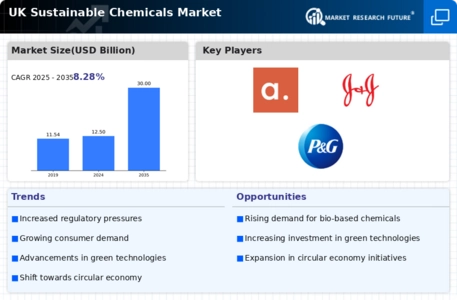
UK Sustainable Chemicals Market Infographic
Purchase Options

Market Trends

Key Emerging Trends in the UK Sustainable Chemicals Market

In recent years, the UK Sustainable Chemicals Market has shown significant changes that demonstrate a commitment towards environmentally friendly and socially responsible behavior among chemical companies. In response to global attention on sustainability as a priority area in businesses today, the UK market has been working out ways to include eco-friendly solutions into its products. The rising demand for bio-based chemicals produced from biomass, agriculture, or residues is one example of such a trend. Similarly, tough ecological laws and higher concentration on climate change have led to the adoption of sustainable methods by chemical industry players in the UK. Companies such as Clariant conduct their research on innovative low-impact processes and products that will be less harmful to both the environment and people while complying with environmental regulations. The concept behind circularity is minimizing waste generation, maximizing recycling, and reusing resources, among others. Manufacturing companies are increasingly focusing on product designs that enhance recyclability so that there is little environmental effect during the production stage. Production chains within this industry are being established between partners who share common goals regarding sustainability in order to facilitate sharing knowledge like best practices. This collaboration will also ensure that the value chains are comprehensive enough to include all sectors of the industry, from procurement, production, and even waste management, in order to make it more sustainable. Thus, through mobilizing collective efforts, a much better ecosystem can be created within this particular sector. The shift towards green chemistry is happening in the UK Sustainable Chemicals market. Green chemistry focuses on products and processes that avoid harmful substances, reduce energy consumption, and minimize waste generation. This method is fully aligned with environmental and economic goals since it allows for increasing effectiveness while reducing the ecological footprint of chemical manufacturing. Finally, changing consumer preferences coupled with market dynamics have influenced product innovation in the UK Sustainable Chemicals Market. As people become more careful about their choices, which affect the environment today, they tend to prefer products that are eco-friendly or have been developed using sustainable methods. A change in the way customers behave prompts companies to invest considerable amounts of money into developing greener alternatives, thereby enabling them to communicate their achievements clearly regarding sustainability, which should ultimately boost their business performance and profile.

Author
Author Profile
Anshula Mandaokar
Team Lead - Research

Anshula Mandaokar holds an academic degree in Chemical Engineering and has been contributing to the field for more than 5 years. She has expertise in Market Research and Business Consulting and serves as a Team Lead for a reputed Market Research firm under the Chemicals and Materials domain spectrum. She has worked on multiple projects, generating explicit results in a quick turnaround time. Her understanding of data interpretation justifies her role as a leader.

Leave a Comment

FAQs

What is the projected market valuation of the UK Sustainable Chemicals Market by 2035?

<p>The projected market valuation for the UK Sustainable Chemicals Market is 33.31 USD Million by 2035.</p>

What was the market valuation of the UK Sustainable Chemicals Market in 2024?

<p>The overall market valuation of the UK Sustainable Chemicals Market was 19.23 USD Million in 2024.</p>

What is the expected CAGR for the UK Sustainable Chemicals Market during the forecast period 2025 - 2035?

<p>The expected CAGR for the UK Sustainable Chemicals Market during the forecast period 2025 - 2035 is 5.12%.</p>

Which companies are considered key players in the UK Sustainable Chemicals Market?

<p>Key players in the UK Sustainable Chemicals Market include BASF SE, Dow Chemical Company, SABIC, and others.</p>

What are the main product segments in the UK Sustainable Chemicals Market?

<p>The main product segments include Bio-Alcohols, Bio-Organic Acids, Bio-Ketones, and Biopolymers.</p>

What is the projected valuation for Bio-Alcohols in the UK Sustainable Chemicals Market by 2035?

The projected valuation for Bio-Alcohols in the UK Sustainable Chemicals Market is expected to reach 6.5 USD Million by 2035.

How does the Pharmaceuticals application segment perform in the UK Sustainable Chemicals Market?

The Pharmaceuticals application segment was valued at 3.0 USD Million in 2024 and is projected to reach 5.0 USD Million by 2035.

What is the expected growth for the Biopolymers segment in the UK Sustainable Chemicals Market?

The Biopolymers segment is anticipated to grow from 5.0 USD Million in 2024 to 9.0 USD Million by 2035.

What application segment had the highest valuation in 2024 within the UK Sustainable Chemicals Market?

The Packaging application segment had the highest valuation at 4.0 USD Million in 2024.

What is the projected growth for the Automotive application segment by 2035?

The Automotive application segment is expected to grow from 3.0 USD Million in 2024 to 5.0 USD Million by 2035.

Market Summary

As per Market Research Future analysis, the UK Sustainable Chemicals Market was estimated at 19.23 USD Million in 2024. The sustainable chemicals industry is projected to grow from 20.21 USD Million in 2025 to 33.31 USD Million by 2035, exhibiting a compound annual growth rate (CAGR) of 5.12% during the forecast period 2025 - 2035

Key Market Trends & Highlights

The UK Sustainable Chemicals Market is experiencing a transformative shift towards eco-friendly solutions driven by regulatory support and consumer demand.

  • The rise of bio-based chemicals is reshaping the landscape of the UK Sustainable Chemicals Market.
  • Regulatory support for sustainability is fostering innovation and investment in the sector, particularly in the North American market.
  • Consumer demand for eco-friendly products is propelling growth in the bio-alcohols segment, which remains the largest in the market.
  • Technological advancements in chemical production and government initiatives are key drivers behind the rapid expansion of biopolymers and pharmaceuticals segments.

Market Size & Forecast

2024 Market Size 19.23 (USD Million)
2035 Market Size 33.31 (USD Million)
CAGR (2025 - 2035) 5.12%
Largest Regional Market Share in 2024 Europe

Major Players

BASF SE (DE), Dow Chemical Company (US), SABIC (SA), Evonik Industries AG (DE), AkzoNobel N.V. (NL), Clariant AG (CH), Croda International Plc (GB), Elementis Plc (GB), Johnson Matthey Plc (GB), Solvay S.A. (BE)

Market Trends

The UK Sustainable Chemicals Market is currently experiencing a transformative phase, driven by increasing awareness of environmental issues and the need for sustainable practices across various industries. Companies are actively seeking alternatives to traditional chemicals, which often have detrimental effects on ecosystems and human health. This shift is not merely a trend but appears to be a fundamental change in how chemicals are produced and utilized. The emphasis on sustainability is prompting innovation in the development of bio-based and biodegradable chemicals, which could potentially reduce reliance on fossil fuels and minimize waste. Moreover, regulatory frameworks are evolving to support the transition towards sustainable practices. The UK government is likely to implement stricter regulations that encourage the adoption of greener alternatives. This regulatory push, combined with consumer demand for environmentally friendly products, suggests that the market will continue to expand. As businesses adapt to these changes, collaboration between stakeholders, including manufacturers, researchers, and policymakers, seems essential for fostering a robust sustainable chemicals ecosystem. The future of the UK Sustainable Chemicals Market appears promising, with opportunities for growth and innovation on the horizon.

Rise of Bio-based Chemicals

The UK Sustainable Chemicals Market is witnessing a notable increase in the production and use of bio-based chemicals. These alternatives, derived from renewable resources, are gaining traction as industries seek to reduce their carbon footprint. The shift towards bio-based solutions indicates a broader commitment to sustainability and environmental stewardship.

Regulatory Support for Sustainability

Government policies are increasingly favoring sustainable practices within the chemical sector. The UK government appears poised to introduce regulations that promote the use of environmentally friendly chemicals. This regulatory environment may encourage companies to innovate and invest in sustainable technologies.

Consumer Demand for Eco-friendly Products

There is a growing consumer preference for products that are environmentally responsible. This trend is influencing manufacturers to prioritize sustainability in their offerings. As consumers become more aware of the impact of their choices, the demand for eco-friendly chemicals is likely to rise, shaping the future of the UK Sustainable Chemicals Market.

UK Sustainable Chemicals Market Market Drivers

Shifts in Consumer Preferences

Consumer preferences are evolving, and this shift is profoundly impacting the UK Sustainable Chemicals Market. There is a growing demand for eco-friendly products, with consumers increasingly seeking out brands that demonstrate a commitment to sustainability. Surveys indicate that over 70% of consumers are willing to pay a premium for products made from sustainable materials. This trend is prompting manufacturers to reformulate their products and adopt sustainable practices in order to meet consumer expectations. As a result, companies within the UK Sustainable Chemicals Market are likely to innovate and diversify their offerings to cater to this demand. This consumer-driven change not only enhances brand loyalty but also drives the overall growth of the sustainable chemicals sector.

Collaboration Across Industries

Collaboration across various industries is emerging as a pivotal driver for the UK Sustainable Chemicals Market. Partnerships between chemical manufacturers, technology providers, and research institutions are fostering innovation and accelerating the development of sustainable solutions. For instance, collaborations aimed at creating bio-based alternatives to traditional chemicals are gaining traction, as they leverage the expertise of multiple stakeholders. These partnerships not only enhance research capabilities but also facilitate the sharing of resources and knowledge, which can lead to more efficient production processes. Moreover, such collaborations can help in addressing regulatory challenges and aligning with sustainability goals. Therefore, the UK Sustainable Chemicals Market is likely to see an increase in collaborative efforts, which could significantly enhance its growth trajectory.

Government Initiatives and Policies

The UK Sustainable Chemicals Market is significantly influenced by government initiatives aimed at promoting sustainability. The UK government has implemented various policies that encourage the development and adoption of sustainable chemical practices. For example, the UK has set ambitious targets to reduce greenhouse gas emissions by 68% by 2030, which necessitates a transition towards sustainable chemical production. Additionally, funding programs and grants are available to support research and development in this sector. These initiatives not only provide financial backing but also create a regulatory framework that incentivizes companies to innovate and adopt sustainable practices. Consequently, the UK Sustainable Chemicals Market is poised for growth as businesses align their strategies with governmental sustainability objectives.

Increasing Investment in Sustainable Solutions

Investment in sustainable solutions is a driving force within the UK Sustainable Chemicals Market. As awareness of environmental issues grows, investors are increasingly channeling funds into companies that prioritize sustainability. Reports indicate that investments in sustainable chemicals have surged, with projections suggesting a compound annual growth rate of over 10% in the coming years. This influx of capital is enabling companies to expand their research and development efforts, leading to the creation of innovative, eco-friendly products. Furthermore, the financial community is recognizing the long-term viability of sustainable practices, which may lead to a more resilient market. Thus, the UK Sustainable Chemicals Market stands to benefit from this trend, as it attracts more investment aimed at fostering sustainable development.

Technological Advancements in Chemical Production

The UK Sustainable Chemicals Market is experiencing a notable transformation due to advancements in production technologies. Innovations such as green chemistry and bioprocessing are enabling manufacturers to create sustainable chemicals with reduced environmental impact. For instance, the adoption of enzymatic processes has been shown to lower energy consumption by up to 30%, thereby enhancing efficiency. Furthermore, the integration of digital technologies, such as artificial intelligence and machine learning, is streamlining operations and optimizing resource use. This shift not only aligns with sustainability goals but also positions companies competitively in a market that increasingly values eco-friendly practices. As a result, the UK Sustainable Chemicals Market is likely to witness a surge in investment towards these technologies, fostering a more sustainable future.

Market Segment Insights

By Product: Bio-Alcohols (Largest) vs. Biopolymers (Fastest-Growing)

<p>In the UK Sustainable Chemicals Market, the product segment is diverse, encompassing Bio-Alcohols, Bio-Organic Acids, Bio-Ketones, Biopolymers, and Others. Bio-Alcohols hold substantial market share due to their widespread applications in industry and consumer markets. This segment's accessibility and versatility contribute to its dominance within the broader sustainable chemicals landscape. Following behind, Biopolymers are emerging swiftly, showcasing a strong market presence as they gain acceptance in various applications such as packaging and automotive industries.</p>

<p>Bio-Alcohols (Dominant) vs. Biopolymers (Emerging)</p>

<p>Bio-Alcohols are a cornerstone of the UK Sustainable Chemicals Market, recognized for their renewable nature and utility in producing fuels, solvents, and other chemical intermediates. Their established infrastructure and production processes make them popular across various sectors. In contrast, Biopolymers, though still developing, are attracting considerable attention for their eco-friendly attributes and potential to replace conventional plastics. Their rapid adoption is driven by changing consumer preferences toward sustainability and strict regulatory measures against petroleum-based products. This dynamic environment positions Bio-Alcohols as a dominant force while Biopolymers represent the next wave of innovation in sustainable materials.</p>

By Application: Packaging (Largest) vs. Pharmaceuticals (Fastest-Growing)

<p>In the UK Sustainable Chemicals Market, Packaging stands out as the largest segment, dominating market presence with its extensive applications across various end-user industries. This segment is characterized by a significant demand for eco-friendly materials, driven by the increasing consumer focus on sustainability and regulatory initiatives promoting greener alternatives. In contrast, the Pharmaceuticals segment, while smaller, is recognized as the fastest-growing area due to the rising demand for biocompatible and sustainable chemical solutions in drug formulation and production, reflecting a broader trend towards environmentally conscious healthcare.</p>

<p>Packaging (Dominant) vs. Pharmaceuticals (Emerging)</p>

<p>The Packaging segment is undeniably dominant in the UK Sustainable Chemicals Market, driven by an ongoing transition towards sustainable materials amidst rising awareness of environmental issues among consumers and businesses alike. Companies in this segment are increasingly adopting bio-based and recyclable materials to meet regulatory requirements and consumer preferences. On the other hand, the Pharmaceuticals segment is emerging rapidly, propelled by innovation in green chemistry and increasing investments in sustainable alternatives for medicinal products. This segment is becoming increasingly relevant as pharmaceutical companies seek to enhance the environmental profile of their drugs through sustainable manufacturing practices and the use of renewable resources, highlighting a dynamic shift in the sector.</p>

Sustainable Chemicals Country Insights

The sustainable chemicals market is witnessing growth driven by increasing environmental awareness and regulatory initiatives promoting eco-friendly practices. Growing demand for bio-based and <a href="https://www.marketresearchfuture.com/reports/renewable-chemicals-market-1047" target="_blank" title="renewable chemicals">renewable chemicals</a> and a shift toward circular economy principles propel market expansion. Companies embracing sustainable production methods and governmental support for green innovations contribute to a robust and evolving sector. The UK's commitment to decreasing carbon emissions and fostering sustainable development further accelerates the growth of the sustainable chemicals market.

Get more detailed insights about UK Sustainable Chemicals Market Research Report - Forecast by 2035

Regional Insights

North America : Innovation and Sustainability Leader

North America is a significant player in the sustainable chemicals market, driven by stringent environmental regulations and a growing demand for eco-friendly products. The U.S. holds the largest market share at approximately 60%, followed by Canada at around 25%. Regulatory frameworks like the Clean Air Act and various state-level initiatives are catalyzing growth in this sector, pushing companies to innovate and adopt sustainable practices. The competitive landscape is characterized by major players such as Dow Chemical Company and BASF SE, which are investing heavily in sustainable technologies. The presence of research institutions and universities further enhances innovation in the region. Additionally, the market is witnessing a shift towards biobased chemicals, with companies like Johnson Matthey and Croda International Plc leading the charge in developing sustainable alternatives to traditional chemicals.

Europe : Regulatory Framework and Innovation

Europe is a frontrunner in the sustainable chemicals market, driven by robust regulatory frameworks such as REACH and the European Green Deal. The region holds a market share of approximately 25%, with Germany and the UK being the largest contributors. The EU's commitment to sustainability and circular economy principles is fostering innovation and increasing demand for sustainable chemical solutions across various industries. Leading countries like Germany, the UK, and France are home to key players such as BASF SE and Evonik Industries AG, which are at the forefront of sustainable chemical production. The competitive landscape is marked by a strong emphasis on research and development, with companies investing in green technologies and bioplastics. The presence of numerous startups focused on sustainability further enriches the market, making Europe a dynamic hub for sustainable chemical innovations.

Asia-Pacific : Emerging Market with Growth Potential

Asia-Pacific is rapidly emerging as a significant market for sustainable chemicals, driven by increasing industrialization and environmental awareness. The region holds a market share of approximately 10%, with China and India leading the charge. Government initiatives aimed at reducing carbon emissions and promoting sustainable practices are catalyzing growth in this sector, making it a focal point for investment and innovation. China is the largest market in the region, with a growing number of companies adopting sustainable practices. Key players like SABIC and Clariant AG are expanding their operations in Asia-Pacific, focusing on biobased and recycled materials. The competitive landscape is evolving, with local startups and established companies collaborating to develop innovative solutions. As consumer demand for sustainable products rises, the region is poised for significant growth in the sustainable chemicals market.

Middle East and Africa : Resource-Rich with Emerging Opportunities

The Middle East and Africa region is gradually developing its sustainable chemicals market, driven by a need for diversification from traditional oil-based products. The market share is currently around 5%, with countries like South Africa and the UAE showing potential for growth. Government initiatives aimed at sustainability and economic diversification are encouraging investments in green technologies and sustainable practices. In South Africa, companies are beginning to explore biobased chemicals, while the UAE is focusing on sustainable petrochemicals. The competitive landscape is still in its infancy, with a few key players like SABIC and local firms leading the way. As awareness of sustainability increases, the region is expected to attract more investments and partnerships, paving the way for a more robust sustainable chemicals market in the coming years.

Key Players and Competitive Insights

Leading market participants are investing heavily in research and development to enhance their product lines, which will help the sustainable chemicals market expand even more. Market participants are also undertaking different strategic activities to extend their footprint, with significant market developments including new product establishment, mergers and acquisitions, contractual agreements, and collaboration with other organizations. The sustainable chemicals industry must deliver cost-effective items to extend and stay in a more competitive and growing market climate.
Major players in the sustainable chemicals market are attempting to expand market demand by investing in research and development operations, including Mitsubishi Chemical UK Limited, Cargill PLC, BASF SE, Arkema UK Limited, Toray International UK Ltd. (TIUK), Evonik Industries AG, DSM United Kingdom Limited, Aemetis, Inc., and Albemarle Corporation.

Key Companies in the UK Sustainable Chemicals Market include

Industry Developments

March 2023: The University of York, along with renewable chemicals firm Circa Group, will establish the Circa Renewable Chemistry Institute (CRCI). The recent Institute aims to create and enable bio-based products that are safer and more tolerable for the chemical industry.

Future Outlook

UK Sustainable Chemicals Market Future Outlook

The UK Sustainable Chemicals Market is projected to grow at a 5.12% CAGR from 2025 to 2035, driven by regulatory support, technological advancements, and increasing consumer demand for eco-friendly products.

New opportunities lie in:

  • Development of <a href="https://www.marketresearchfuture.com/reports/biodegradable-packaging-market-11643" target="_blank" title="biodegradable packaging">biodegradable packaging</a> solutions for consumer goods.
  • Investment in carbon capture technologies for chemical production.
  • Expansion of bio-based feedstock sourcing partnerships with local suppliers.

By 2035, the market is expected to be robust, driven by innovation and sustainability initiatives.

Market Segmentation

UK Sustainable Chemicals Market Product Outlook

  • Bio-Alcohols
  • Bio-Organic Acids
  • Bio-Ketones
  • Biopolymers
  • Others

UK Sustainable Chemicals Market Application Outlook

  • Industrial & Chemicals
  • Pharmaceuticals
  • Construction
  • Packaging
  • Automotive
  • Others

Report Scope

MARKET SIZE 2024 19.23(USD Million)
MARKET SIZE 2025 20.21(USD Million)
MARKET SIZE 2035 33.31(USD Million)
COMPOUND ANNUAL GROWTH RATE (CAGR) 5.12% (2025 - 2035)
REPORT COVERAGE Revenue Forecast, Competitive Landscape, Growth Factors, and Trends
BASE YEAR 2024
Market Forecast Period 2025 - 2035
Historical Data 2019 - 2024
Market Forecast Units USD Million
Key Companies Profiled BASF SE (DE), Dow Chemical Company (US), SABIC (SA), Evonik Industries AG (DE), AkzoNobel N.V. (NL), Clariant AG (CH), Croda International Plc (GB), Elementis Plc (GB), Johnson Matthey Plc (GB), Solvay S.A. (BE)
Segments Covered Application
Key Market Opportunities Growing demand for biodegradable materials drives innovation in the UK Sustainable Chemicals Market.
Key Market Dynamics Rising regulatory pressures drive innovation and investment in sustainable chemical solutions across the UK market.
Countries Covered North America, Europe, APAC, South America, MEA

FAQs

What is the projected market valuation of the UK Sustainable Chemicals Market by 2035?

<p>The projected market valuation for the UK Sustainable Chemicals Market is 33.31 USD Million by 2035.</p>

What was the market valuation of the UK Sustainable Chemicals Market in 2024?

<p>The overall market valuation of the UK Sustainable Chemicals Market was 19.23 USD Million in 2024.</p>

What is the expected CAGR for the UK Sustainable Chemicals Market during the forecast period 2025 - 2035?

<p>The expected CAGR for the UK Sustainable Chemicals Market during the forecast period 2025 - 2035 is 5.12%.</p>

Which companies are considered key players in the UK Sustainable Chemicals Market?

<p>Key players in the UK Sustainable Chemicals Market include BASF SE, Dow Chemical Company, SABIC, and others.</p>

What are the main product segments in the UK Sustainable Chemicals Market?

<p>The main product segments include Bio-Alcohols, Bio-Organic Acids, Bio-Ketones, and Biopolymers.</p>

What is the projected valuation for Bio-Alcohols in the UK Sustainable Chemicals Market by 2035?

The projected valuation for Bio-Alcohols in the UK Sustainable Chemicals Market is expected to reach 6.5 USD Million by 2035.

How does the Pharmaceuticals application segment perform in the UK Sustainable Chemicals Market?

The Pharmaceuticals application segment was valued at 3.0 USD Million in 2024 and is projected to reach 5.0 USD Million by 2035.

What is the expected growth for the Biopolymers segment in the UK Sustainable Chemicals Market?

The Biopolymers segment is anticipated to grow from 5.0 USD Million in 2024 to 9.0 USD Million by 2035.

What application segment had the highest valuation in 2024 within the UK Sustainable Chemicals Market?

The Packaging application segment had the highest valuation at 4.0 USD Million in 2024.

What is the projected growth for the Automotive application segment by 2035?

The Automotive application segment is expected to grow from 3.0 USD Million in 2024 to 5.0 USD Million by 2035.

  1. SECTION I: EXECUTIVE SUMMARY AND KEY HIGHLIGHTS
    1. | 1.1 EXECUTIVE SUMMARY
    2. | | 1.1.1 Market Overview
    3. | | 1.1.2 Key Findings
    4. | | 1.1.3 Market Segmentation
    5. | | 1.1.4 Competitive Landscape
    6. | | 1.1.5 Challenges and Opportunities
    7. | | 1.1.6 Future Outlook
  2. SECTION II: SCOPING, METHODOLOGY AND MARKET STRUCTURE
    1. | 2.1 MARKET INTRODUCTION
    2. | | 2.1.1 Definition
    3. | | 2.1.2 Scope of the study
    4. | | | 2.1.2.1 Research Objective
    5. | | | 2.1.2.2 Assumption
    6. | | | 2.1.2.3 Limitations
    7. | 2.2 RESEARCH METHODOLOGY
    8. | | 2.2.1 Overview
    9. | | 2.2.2 Data Mining
    10. | | 2.2.3 Secondary Research
    11. | | 2.2.4 Primary Research
    12. | | | 2.2.4.1 Primary Interviews and Information Gathering Process
    13. | | | 2.2.4.2 Breakdown of Primary Respondents
    14. | | 2.2.5 Forecasting Model
    15. | | 2.2.6 Market Size Estimation
    16. | | | 2.2.6.1 Bottom-Up Approach
    17. | | | 2.2.6.2 Top-Down Approach
    18. | | 2.2.7 Data Triangulation
    19. | | 2.2.8 Validation
  3. SECTION III: QUALITATIVE ANALYSIS
    1. | 3.1 MARKET DYNAMICS
    2. | | 3.1.1 Overview
    3. | | 3.1.2 Drivers
    4. | | 3.1.3 Restraints
    5. | | 3.1.4 Opportunities
    6. | 3.2 MARKET FACTOR ANALYSIS
    7. | | 3.2.1 Value chain Analysis
    8. | | 3.2.2 Porter's Five Forces Analysis
    9. | | | 3.2.2.1 Bargaining Power of Suppliers
    10. | | | 3.2.2.2 Bargaining Power of Buyers
    11. | | | 3.2.2.3 Threat of New Entrants
    12. | | | 3.2.2.4 Threat of Substitutes
    13. | | | 3.2.2.5 Intensity of Rivalry
    14. | | 3.2.3 COVID-19 Impact Analysis
    15. | | | 3.2.3.1 Market Impact Analysis
    16. | | | 3.2.3.2 Regional Impact
    17. | | | 3.2.3.3 Opportunity and Threat Analysis
  4. SECTION IV: QUANTITATIVE ANALYSIS
    1. | 4.1 Chemicals and Materials, BY Product (USD Million)
    2. | | 4.1.1 Bio-Alcohols
    3. | | 4.1.2 Bio-Organic Acids
    4. | | 4.1.3 Bio-Ketones
    5. | | 4.1.4 Biopolymers
    6. | | 4.1.5 Others
    7. | 4.2 Chemicals and Materials, BY Application (USD Million)
    8. | | 4.2.1 Industrial & Chemicals
    9. | | 4.2.2 Pharmaceuticals
    10. | | 4.2.3 Construction
    11. | | 4.2.4 Packaging
    12. | | 4.2.5 Automotive
    13. | | 4.2.6 Others
    14. | 4.3 Chemicals and Materials, BY Region (USD Million)
    15. | | 4.3.1 North America
    16. | | | 4.3.1.1 US
    17. | | | 4.3.1.2 Canada
    18. | | 4.3.2 Europe
    19. | | | 4.3.2.1 Germany
    20. | | | 4.3.2.2 UK
    21. | | | 4.3.2.3 France
    22. | | | 4.3.2.4 Russia
    23. | | | 4.3.2.5 Italy
    24. | | | 4.3.2.6 Spain
    25. | | | 4.3.2.7 Rest of Europe
    26. | | 4.3.3 APAC
    27. | | | 4.3.3.1 China
    28. | | | 4.3.3.2 India
    29. | | | 4.3.3.3 Japan
    30. | | | 4.3.3.4 South Korea
    31. | | | 4.3.3.5 Malaysia
    32. | | | 4.3.3.6 Thailand
    33. | | | 4.3.3.7 Indonesia
    34. | | | 4.3.3.8 Rest of APAC
    35. | | 4.3.4 South America
    36. | | | 4.3.4.1 Brazil
    37. | | | 4.3.4.2 Mexico
    38. | | | 4.3.4.3 Argentina
    39. | | | 4.3.4.4 Rest of South America
    40. | | 4.3.5 MEA
    41. | | | 4.3.5.1 GCC Countries
    42. | | | 4.3.5.2 South Africa
    43. | | | 4.3.5.3 Rest of MEA
  5. SECTION V: COMPETITIVE ANALYSIS
    1. | 5.1 Competitive Landscape
    2. | | 5.1.1 Overview
    3. | | 5.1.2 Competitive Analysis
    4. | | 5.1.3 Market share Analysis
    5. | | 5.1.4 Major Growth Strategy in the Chemicals and Materials
    6. | | 5.1.5 Competitive Benchmarking
    7. | | 5.1.6 Leading Players in Terms of Number of Developments in the Chemicals and Materials
    8. | | 5.1.7 Key developments and growth strategies
    9. | | | 5.1.7.1 New Product Launch/Service Deployment
    10. | | | 5.1.7.2 Merger & Acquisitions
    11. | | | 5.1.7.3 Joint Ventures
    12. | | 5.1.8 Major Players Financial Matrix
    13. | | | 5.1.8.1 Sales and Operating Income
    14. | | | 5.1.8.2 Major Players R&D Expenditure. 2023
    15. | 5.2 Company Profiles
    16. | | 5.2.1 BASF SE (DE)
    17. | | | 5.2.1.1 Financial Overview
    18. | | | 5.2.1.2 Products Offered
    19. | | | 5.2.1.3 Key Developments
    20. | | | 5.2.1.4 SWOT Analysis
    21. | | | 5.2.1.5 Key Strategies
    22. | | 5.2.2 Dow Chemical Company (US)
    23. | | | 5.2.2.1 Financial Overview
    24. | | | 5.2.2.2 Products Offered
    25. | | | 5.2.2.3 Key Developments
    26. | | | 5.2.2.4 SWOT Analysis
    27. | | | 5.2.2.5 Key Strategies
    28. | | 5.2.3 SABIC (SA)
    29. | | | 5.2.3.1 Financial Overview
    30. | | | 5.2.3.2 Products Offered
    31. | | | 5.2.3.3 Key Developments
    32. | | | 5.2.3.4 SWOT Analysis
    33. | | | 5.2.3.5 Key Strategies
    34. | | 5.2.4 Evonik Industries AG (DE)
    35. | | | 5.2.4.1 Financial Overview
    36. | | | 5.2.4.2 Products Offered
    37. | | | 5.2.4.3 Key Developments
    38. | | | 5.2.4.4 SWOT Analysis
    39. | | | 5.2.4.5 Key Strategies
    40. | | 5.2.5 AkzoNobel N.V. (NL)
    41. | | | 5.2.5.1 Financial Overview
    42. | | | 5.2.5.2 Products Offered
    43. | | | 5.2.5.3 Key Developments
    44. | | | 5.2.5.4 SWOT Analysis
    45. | | | 5.2.5.5 Key Strategies
    46. | | 5.2.6 Clariant AG (CH)
    47. | | | 5.2.6.1 Financial Overview
    48. | | | 5.2.6.2 Products Offered
    49. | | | 5.2.6.3 Key Developments
    50. | | | 5.2.6.4 SWOT Analysis
    51. | | | 5.2.6.5 Key Strategies
    52. | | 5.2.7 Croda International Plc (GB)
    53. | | | 5.2.7.1 Financial Overview
    54. | | | 5.2.7.2 Products Offered
    55. | | | 5.2.7.3 Key Developments
    56. | | | 5.2.7.4 SWOT Analysis
    57. | | | 5.2.7.5 Key Strategies
    58. | | 5.2.8 Elementis Plc (GB)
    59. | | | 5.2.8.1 Financial Overview
    60. | | | 5.2.8.2 Products Offered
    61. | | | 5.2.8.3 Key Developments
    62. | | | 5.2.8.4 SWOT Analysis
    63. | | | 5.2.8.5 Key Strategies
    64. | | 5.2.9 Johnson Matthey Plc (GB)
    65. | | | 5.2.9.1 Financial Overview
    66. | | | 5.2.9.2 Products Offered
    67. | | | 5.2.9.3 Key Developments
    68. | | | 5.2.9.4 SWOT Analysis
    69. | | | 5.2.9.5 Key Strategies
    70. | | 5.2.10 Solvay S.A. (BE)
    71. | | | 5.2.10.1 Financial Overview
    72. | | | 5.2.10.2 Products Offered
    73. | | | 5.2.10.3 Key Developments
    74. | | | 5.2.10.4 SWOT Analysis
    75. | | | 5.2.10.5 Key Strategies
    76. | 5.3 Appendix
    77. | | 5.3.1 References
    78. | | 5.3.2 Related Reports
  6. LIST OF FIGURES
    1. | 6.1 MARKET SYNOPSIS
    2. | 6.2 NORTH AMERICA MARKET ANALYSIS
    3. | 6.3 US MARKET ANALYSIS BY PRODUCT
    4. | 6.4 US MARKET ANALYSIS BY APPLICATION
    5. | 6.5 CANADA MARKET ANALYSIS BY PRODUCT
    6. | 6.6 CANADA MARKET ANALYSIS BY APPLICATION
    7. | 6.7 EUROPE MARKET ANALYSIS
    8. | 6.8 GERMANY MARKET ANALYSIS BY PRODUCT
    9. | 6.9 GERMANY MARKET ANALYSIS BY APPLICATION
    10. | 6.10 UK MARKET ANALYSIS BY PRODUCT
    11. | 6.11 UK MARKET ANALYSIS BY APPLICATION
    12. | 6.12 FRANCE MARKET ANALYSIS BY PRODUCT
    13. | 6.13 FRANCE MARKET ANALYSIS BY APPLICATION
    14. | 6.14 RUSSIA MARKET ANALYSIS BY PRODUCT
    15. | 6.15 RUSSIA MARKET ANALYSIS BY APPLICATION
    16. | 6.16 ITALY MARKET ANALYSIS BY PRODUCT
    17. | 6.17 ITALY MARKET ANALYSIS BY APPLICATION
    18. | 6.18 SPAIN MARKET ANALYSIS BY PRODUCT
    19. | 6.19 SPAIN MARKET ANALYSIS BY APPLICATION
    20. | 6.20 REST OF EUROPE MARKET ANALYSIS BY PRODUCT
    21. | 6.21 REST OF EUROPE MARKET ANALYSIS BY APPLICATION
    22. | 6.22 APAC MARKET ANALYSIS
    23. | 6.23 CHINA MARKET ANALYSIS BY PRODUCT
    24. | 6.24 CHINA MARKET ANALYSIS BY APPLICATION
    25. | 6.25 INDIA MARKET ANALYSIS BY PRODUCT
    26. | 6.26 INDIA MARKET ANALYSIS BY APPLICATION
    27. | 6.27 JAPAN MARKET ANALYSIS BY PRODUCT
    28. | 6.28 JAPAN MARKET ANALYSIS BY APPLICATION
    29. | 6.29 SOUTH KOREA MARKET ANALYSIS BY PRODUCT
    30. | 6.30 SOUTH KOREA MARKET ANALYSIS BY APPLICATION
    31. | 6.31 MALAYSIA MARKET ANALYSIS BY PRODUCT
    32. | 6.32 MALAYSIA MARKET ANALYSIS BY APPLICATION
    33. | 6.33 THAILAND MARKET ANALYSIS BY PRODUCT
    34. | 6.34 THAILAND MARKET ANALYSIS BY APPLICATION
    35. | 6.35 INDONESIA MARKET ANALYSIS BY PRODUCT
    36. | 6.36 INDONESIA MARKET ANALYSIS BY APPLICATION
    37. | 6.37 REST OF APAC MARKET ANALYSIS BY PRODUCT
    38. | 6.38 REST OF APAC MARKET ANALYSIS BY APPLICATION
    39. | 6.39 SOUTH AMERICA MARKET ANALYSIS
    40. | 6.40 BRAZIL MARKET ANALYSIS BY PRODUCT
    41. | 6.41 BRAZIL MARKET ANALYSIS BY APPLICATION
    42. | 6.42 MEXICO MARKET ANALYSIS BY PRODUCT
    43. | 6.43 MEXICO MARKET ANALYSIS BY APPLICATION
    44. | 6.44 ARGENTINA MARKET ANALYSIS BY PRODUCT
    45. | 6.45 ARGENTINA MARKET ANALYSIS BY APPLICATION
    46. | 6.46 REST OF SOUTH AMERICA MARKET ANALYSIS BY PRODUCT
    47. | 6.47 REST OF SOUTH AMERICA MARKET ANALYSIS BY APPLICATION
    48. | 6.48 MEA MARKET ANALYSIS
    49. | 6.49 GCC COUNTRIES MARKET ANALYSIS BY PRODUCT
    50. | 6.50 GCC COUNTRIES MARKET ANALYSIS BY APPLICATION
    51. | 6.51 SOUTH AFRICA MARKET ANALYSIS BY PRODUCT
    52. | 6.52 SOUTH AFRICA MARKET ANALYSIS BY APPLICATION
    53. | 6.53 REST OF MEA MARKET ANALYSIS BY PRODUCT
    54. | 6.54 REST OF MEA MARKET ANALYSIS BY APPLICATION
    55. | 6.55 KEY BUYING CRITERIA OF CHEMICALS AND MATERIALS
    56. | 6.56 RESEARCH PROCESS OF MRFR
    57. | 6.57 DRO ANALYSIS OF CHEMICALS AND MATERIALS
    58. | 6.58 DRIVERS IMPACT ANALYSIS: CHEMICALS AND MATERIALS
    59. | 6.59 RESTRAINTS IMPACT ANALYSIS: CHEMICALS AND MATERIALS
    60. | 6.60 SUPPLY / VALUE CHAIN: CHEMICALS AND MATERIALS
    61. | 6.61 CHEMICALS AND MATERIALS, BY PRODUCT, 2024 (% SHARE)
    62. | 6.62 CHEMICALS AND MATERIALS, BY PRODUCT, 2024 TO 2035 (USD Million)
    63. | 6.63 CHEMICALS AND MATERIALS, BY APPLICATION, 2024 (% SHARE)
    64. | 6.64 CHEMICALS AND MATERIALS, BY APPLICATION, 2024 TO 2035 (USD Million)
    65. | 6.65 BENCHMARKING OF MAJOR COMPETITORS
  7. LIST OF TABLES
    1. | 7.1 LIST OF ASSUMPTIONS
    2. | | 7.1.1
    3. | 7.2 North America MARKET SIZE ESTIMATES; FORECAST
    4. | | 7.2.1 BY PRODUCT, 2025-2035 (USD Million)
    5. | | 7.2.2 BY APPLICATION, 2025-2035 (USD Million)
    6. | 7.3 US MARKET SIZE ESTIMATES; FORECAST
    7. | | 7.3.1 BY PRODUCT, 2025-2035 (USD Million)
    8. | | 7.3.2 BY APPLICATION, 2025-2035 (USD Million)
    9. | 7.4 Canada MARKET SIZE ESTIMATES; FORECAST
    10. | | 7.4.1 BY PRODUCT, 2025-2035 (USD Million)
    11. | | 7.4.2 BY APPLICATION, 2025-2035 (USD Million)
    12. | 7.5 Europe MARKET SIZE ESTIMATES; FORECAST
    13. | | 7.5.1 BY PRODUCT, 2025-2035 (USD Million)
    14. | | 7.5.2 BY APPLICATION, 2025-2035 (USD Million)
    15. | 7.6 Germany MARKET SIZE ESTIMATES; FORECAST
    16. | | 7.6.1 BY PRODUCT, 2025-2035 (USD Million)
    17. | | 7.6.2 BY APPLICATION, 2025-2035 (USD Million)
    18. | 7.7 UK MARKET SIZE ESTIMATES; FORECAST
    19. | | 7.7.1 BY PRODUCT, 2025-2035 (USD Million)
    20. | | 7.7.2 BY APPLICATION, 2025-2035 (USD Million)
    21. | 7.8 France MARKET SIZE ESTIMATES; FORECAST
    22. | | 7.8.1 BY PRODUCT, 2025-2035 (USD Million)
    23. | | 7.8.2 BY APPLICATION, 2025-2035 (USD Million)
    24. | 7.9 Russia MARKET SIZE ESTIMATES; FORECAST
    25. | | 7.9.1 BY PRODUCT, 2025-2035 (USD Million)
    26. | | 7.9.2 BY APPLICATION, 2025-2035 (USD Million)
    27. | 7.10 Italy MARKET SIZE ESTIMATES; FORECAST
    28. | | 7.10.1 BY PRODUCT, 2025-2035 (USD Million)
    29. | | 7.10.2 BY APPLICATION, 2025-2035 (USD Million)
    30. | 7.11 Spain MARKET SIZE ESTIMATES; FORECAST
    31. | | 7.11.1 BY PRODUCT, 2025-2035 (USD Million)
    32. | | 7.11.2 BY APPLICATION, 2025-2035 (USD Million)
    33. | 7.12 Rest of Europe MARKET SIZE ESTIMATES; FORECAST
    34. | | 7.12.1 BY PRODUCT, 2025-2035 (USD Million)
    35. | | 7.12.2 BY APPLICATION, 2025-2035 (USD Million)
    36. | 7.13 APAC MARKET SIZE ESTIMATES; FORECAST
    37. | | 7.13.1 BY PRODUCT, 2025-2035 (USD Million)
    38. | | 7.13.2 BY APPLICATION, 2025-2035 (USD Million)
    39. | 7.14 China MARKET SIZE ESTIMATES; FORECAST
    40. | | 7.14.1 BY PRODUCT, 2025-2035 (USD Million)
    41. | | 7.14.2 BY APPLICATION, 2025-2035 (USD Million)
    42. | 7.15 India MARKET SIZE ESTIMATES; FORECAST
    43. | | 7.15.1 BY PRODUCT, 2025-2035 (USD Million)
    44. | | 7.15.2 BY APPLICATION, 2025-2035 (USD Million)
    45. | 7.16 Japan MARKET SIZE ESTIMATES; FORECAST
    46. | | 7.16.1 BY PRODUCT, 2025-2035 (USD Million)
    47. | | 7.16.2 BY APPLICATION, 2025-2035 (USD Million)
    48. | 7.17 South Korea MARKET SIZE ESTIMATES; FORECAST
    49. | | 7.17.1 BY PRODUCT, 2025-2035 (USD Million)
    50. | | 7.17.2 BY APPLICATION, 2025-2035 (USD Million)
    51. | 7.18 Malaysia MARKET SIZE ESTIMATES; FORECAST
    52. | | 7.18.1 BY PRODUCT, 2025-2035 (USD Million)
    53. | | 7.18.2 BY APPLICATION, 2025-2035 (USD Million)
    54. | 7.19 Thailand MARKET SIZE ESTIMATES; FORECAST
    55. | | 7.19.1 BY PRODUCT, 2025-2035 (USD Million)
    56. | | 7.19.2 BY APPLICATION, 2025-2035 (USD Million)
    57. | 7.20 Indonesia MARKET SIZE ESTIMATES; FORECAST
    58. | | 7.20.1 BY PRODUCT, 2025-2035 (USD Million)
    59. | | 7.20.2 BY APPLICATION, 2025-2035 (USD Million)
    60. | 7.21 Rest of APAC MARKET SIZE ESTIMATES; FORECAST
    61. | | 7.21.1 BY PRODUCT, 2025-2035 (USD Million)
    62. | | 7.21.2 BY APPLICATION, 2025-2035 (USD Million)
    63. | 7.22 South America MARKET SIZE ESTIMATES; FORECAST
    64. | | 7.22.1 BY PRODUCT, 2025-2035 (USD Million)
    65. | | 7.22.2 BY APPLICATION, 2025-2035 (USD Million)
    66. | 7.23 Brazil MARKET SIZE ESTIMATES; FORECAST
    67. | | 7.23.1 BY PRODUCT, 2025-2035 (USD Million)
    68. | | 7.23.2 BY APPLICATION, 2025-2035 (USD Million)
    69. | 7.24 Mexico MARKET SIZE ESTIMATES; FORECAST
    70. | | 7.24.1 BY PRODUCT, 2025-2035 (USD Million)
    71. | | 7.24.2 BY APPLICATION, 2025-2035 (USD Million)
    72. | 7.25 Argentina MARKET SIZE ESTIMATES; FORECAST
    73. | | 7.25.1 BY PRODUCT, 2025-2035 (USD Million)
    74. | | 7.25.2 BY APPLICATION, 2025-2035 (USD Million)
    75. | 7.26 Rest of South America MARKET SIZE ESTIMATES; FORECAST
    76. | | 7.26.1 BY PRODUCT, 2025-2035 (USD Million)
    77. | | 7.26.2 BY APPLICATION, 2025-2035 (USD Million)
    78. | 7.27 MEA MARKET SIZE ESTIMATES; FORECAST
    79. | | 7.27.1 BY PRODUCT, 2025-2035 (USD Million)
    80. | | 7.27.2 BY APPLICATION, 2025-2035 (USD Million)
    81. | 7.28 GCC Countries MARKET SIZE ESTIMATES; FORECAST
    82. | | 7.28.1 BY PRODUCT, 2025-2035 (USD Million)
    83. | | 7.28.2 BY APPLICATION, 2025-2035 (USD Million)
    84. | 7.29 South Africa MARKET SIZE ESTIMATES; FORECAST
    85. | | 7.29.1 BY PRODUCT, 2025-2035 (USD Million)
    86. | | 7.29.2 BY APPLICATION, 2025-2035 (USD Million)
    87. | 7.30 Rest of MEA MARKET SIZE ESTIMATES; FORECAST
    88. | | 7.30.1 BY PRODUCT, 2025-2035 (USD Million)
    89. | | 7.30.2 BY APPLICATION, 2025-2035 (USD Million)
    90. | 7.31 PRODUCT LAUNCH/PRODUCT DEVELOPMENT/APPROVAL
    91. | | 7.31.1
    92. | 7.32 ACQUISITION/PARTNERSHIP
    93. | | 7.32.1

Chemicals and Materials Market Segmentation

Chemicals and Materials By Product (USD Million, 2025-2035)

  • Bio-Alcohols
  • Bio-Organic Acids
  • Bio-Ketones
  • Biopolymers
  • Others

Chemicals and Materials By Application (USD Million, 2025-2035)

  • Industrial & Chemicals
  • Pharmaceuticals
  • Construction
  • Packaging
  • Automotive
  • Others
Infographic

Free Sample Request

Kindly complete the form below to receive a free sample of this Report

Get Free Sample

Customer Strories

Compare Licence

×
Features License Type
Single User Multiuser License Enterprise User
Price $4,950 $5,950 $7,250
Maximum User Access Limit 1 User Upto 10 Users Unrestricted Access Throughout the Organization
Free Customization
Direct Access to Analyst
Deliverable Format
Platform Access
Discount on Next Purchase 10% 15% 15%
Printable Versions