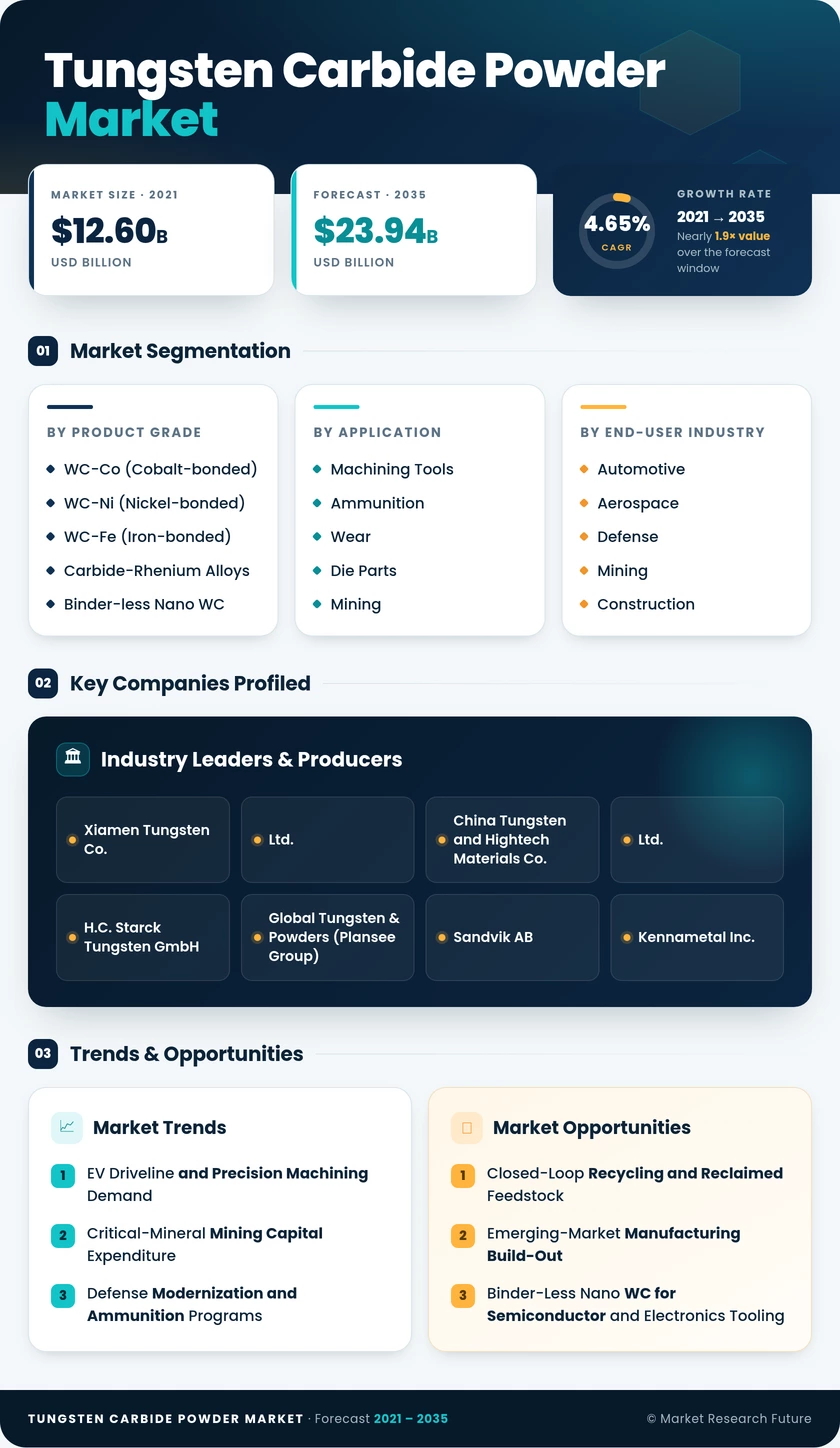
Segmentation Quick Reference
| Dimension | Sub-Segments | Dominant Segment | Fastest Growing Segment |
|---|---|---|---|
| By Product Grade | WC-Co (Cobalt-bonded); WC-Ni (Nickel-bonded); WC-Fe (Iron-bonded); Carbide-Rhenium Alloys; Binder-less Nano WC; Recycled / Reclaimed WC Powders | WC-Co (Cobalt-bonded) (63.9% share) | Carbide-Rhenium Alloys (5.6% CAGR) |
| By Application | Machining Tools; Ammunition; Wear and Die Parts; Mining and Drilling Tools; Other Applications (Additive Manufacturing, Thermal Spray Coatings, etc.) | Machining Tools (33.2% share) | Other Applications (Additive Manufacturing, Thermal Spray Coatings, etc.) (5.5% CAGR) |
| By End-User Industry | Automotive; Aerospace and Defense; Mining and Construction; Oil and Gas; Healthcare; Other End-User Industries (Electronics and Semiconductors, Industrial Manufacturing, etc.) | Mining and Construction (41.2% share) | Healthcare (5.7% CAGR) |
| By Region | Asia-Pacific; North America; Europe; South America; Middle-East and Africa | Asia-Pacific (47.5% share) | Asia-Pacific (fastest-growing region) |
Market Segmentation Overview
By Product Grade
| Sub-Segment | Key Trend |
|---|---|
| WC-Co (Cobalt-bonded) | Retains leadership on toughness and installed sintering base |
| WC-Ni (Nickel-bonded) | Gains in corrosive oil, gas and chemical service |
| WC-Fe (Iron-bonded) | Lower-cost binder option for wear components |
| Carbide-Rhenium Alloys | Fastest growth in aerospace and hypersonic hot-section demand |
| Binder-less Nano WC | Ultra-high hardness for micro-tools and semiconductor tooling |
| Recycled / Reclaimed WC Powders | Expanding with recycling mandates and feedstock security needs |
WC-Co (Cobalt-bonded) leads this dimension with a 63.9% share because tool makers' furnaces and process recipes are built around cobalt binders. Carbide-Rhenium Alloys grow fastest at 5.6% CAGR as hypersonic and turbine programs need hardness retention at extreme temperatures. Cobalt supply shocks are steadily pushing development of WC-Ni (Nickel-bonded) and WC-Fe (Iron-bonded) alternatives.
By Application
| Sub-Segment | Key Trend |
|---|---|
| Machining Tools | Largest share, tied to CNC automation and EV component machining |
| Ammunition | Stable demand for high-density penetrators |
| Wear and Die Parts | Steady replacement cycles in forming and fluid handling |
| Mining and Drilling Tools | High-value consumables for critical-mineral extraction |
| Other Applications (Additive Manufacturing, Thermal Spray Coatings, etc.) | Fastest growth in hard-chrome replacement and binder-jet printing |
Machining Tools hold the top position at 33.2% share, as automated production cells rely on predictable insert wear to sustain output. Other Applications (Additive Manufacturing, Thermal Spray Coatings, etc.) expand fastest at 5.5% CAGR because hexavalent chromium restrictions are moving coating buyers to HVOF carbide layers. Mining and Drilling Tools remain a large value pool driven by consumable replacement rather than new equipment sales.
By End-User Industry
| Sub-Segment | Key Trend |
|---|---|
| Automotive | Shift from engine machining to electric-motor and e-axle parts |
| Aerospace and Defense | Superalloy machining and penetrator demand |
| Mining and Construction | Largest consumer through abrasion-intensive rock removal |
| Oil and Gas | PDC bit bodies and downhole wear components |
| Healthcare | Fastest growth in surgical blades and dental burs |
| Other End-User Industries (Electronics and Semiconductors, Industrial Manufacturing, etc.) | PCB micro-drills and general manufacturing tooling |
Mining and Construction dominates with a 41.2% share, since drill bits and crusher wear parts are replaced continuously regardless of metal price cycles. Healthcare is the fastest-growing end user at 5.7% CAGR, driven by procedure volumes that consume single-use surgical blades and fine dental burs. Automotive keeps steady volume as machining shifts from internal-combustion engines to electric-motor housings and gears.


 Noah Malgeri
Co-Founder

 Peter Groot koerkamp
Account and Business Manager

 Younghwan Choi
Senior Retail Manager

 Mark Irwin
Management Consultant

 Akif Moroglu
Strategy & Business Development Director

 Guilherme Gomes Martins
Product Management Director

 Joseph Aguayo
Sales Operations & Pricing Manager

 La Terria Dodd
Program Support Specialist

 Rob Kooiker
Group Product Manager HVAC & Fire Protection GMA