Request Free Sample ×

Kindly complete the form below to receive a free sample of this Report

* Please use a valid business email

Leading companies partner with us for data-driven Insights

clients tt-cursor
Hero Background
English
Chinese
French
Japanese
Korean
German
Spanish

Triathlon Clothing Market Share

ID: MRFR/CG/6523-CR
128 Pages
Snehal Singh
February 2021

Triathlon Clothing Market Size, Share, Industry Trend & Analysis Research Report Information By Type (Tri Tops, Tri Shorts, Tri Suits), By Application (MenWomen) and Region (Europe, North America, Asia-Pacific, South America and the Middle East and Africa) - Forecast till 2035

Share:
Download PDF ×

We do not share your information with anyone. However, we may send you emails based on your report interest from time to time. You may contact us at any time to opt-out.

Triathlon Clothing Market Infographic
Purchase Options

Market Share

Triathlon Clothing Market Share Analysis

Triathlon clothing has become popular in major economies due to its widespread appeal and growing government initiatives. The demand for triathlon clothing is on the rise across all age groups. While it is already well-established in North America and Europe, there is substantial growth potential in emerging markets, including Africa and many other developing countries. However, the growth in these markets is currently limited due to factors like low awareness, limited government support, and a slow adoption rate. The triathlon clothing market has the opportunity to expand its reach by tapping into these emerging markets, offering a diverse product range.

Product innovation plays a crucial role in attracting consumers and increasing market share. Manufacturers are focusing on research and development (R&D) to introduce new and improved products. For example, the development of triathlon clothing with moisture-absorbing capabilities has boosted sales, appealing to consumers looking for performance-enhancing features. The introduction of a diverse color range in product lines has also attracted a wide consumer base, catering to those who value unique and trendy fashion fabrics.

Key players in the industry are making significant investments in R&D to adapt to social dynamics and stay ahead of the competition. These investments aim to create new and sustainable products, enhancing the quality and functionality of existing items. Improvements in fabric quality and other properties are a focus, ensuring that consumers receive high-quality and functional triathlon clothing. Additionally, attention is given to providing convenient and attractive packaging, aiming to capture the attention of consumers.

As the triathlon clothing market expands its presence in both established and emerging markets, ongoing innovations and investments in R&D will play a crucial role in shaping the industry's future. The focus on meeting consumer needs, improving product functionality, and exploring untapped markets reflects a positive outlook for the continued growth and development of the triathlon clothing industry.


Author
Author Profile
Snehal Singh
Manager - Research

High acumen in analyzing complex macro & micro markets with more than 6 years of work experience in the field of market research. By implementing her analytical skills in forecasting and estimation into market research reports, she has expertise in Packaging, Construction, and Equipment domains. She handles a team size of 20-25 resources and ensures smooth running of the projects, associated marketing activities, and client servicing.

Leave a Comment

FAQs

What is the current valuation of the Triathlon Clothing Market?

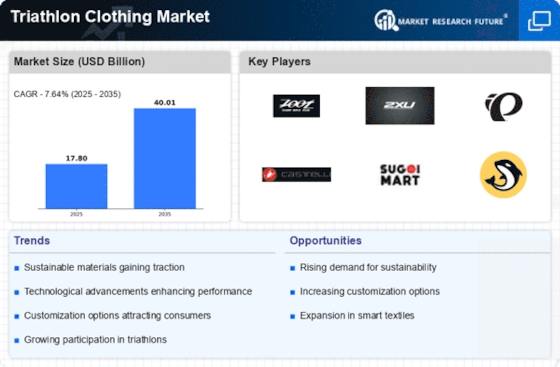
<p>The Triathlon Clothing Market was valued at 17.8 USD Billion in 2024.</p>

What is the projected market size for the Triathlon Clothing Market by 2035?

<p>The market is expected to reach 40.01 USD Billion by 2035.</p>

What is the expected CAGR for the Triathlon Clothing Market during the forecast period?

<p>The expected CAGR for the Triathlon Clothing Market from 2025 to 2035 is 7.64%.</p>

Which segments are included in the Triathlon Clothing Market?

<p>The market segments include Tri shorts, Tri suits, and Tri tops.</p>

What were the valuations for Tri suits in 2024 and what is the projected value for 2035?

<p>Tri suits were valued at 7.0 USD Billion in 2024 and are projected to reach 15.0 USD Billion by 2035.</p>

How do the valuations for men's and women's triathlon clothing compare?

<p>In 2024, both men's and women's segments were valued at 8.9 USD Billion, with women's projected to grow to 21.0 USD Billion by 2035.</p>

What distribution channels are utilized in the Triathlon Clothing Market?

<p>The market utilizes both online and offline distribution channels.</p>

What were the online and offline distribution channel valuations in 2024?

<p>In 2024, online distribution was valued at 8.9 USD Billion, while offline distribution was also at 8.9 USD Billion.</p>

Who are the key players in the Triathlon Clothing Market?

<p>Key players include Zoot Sports, 2XU, Pearl Izumi, Castelli, SUGOI, Orca, Triathlete, Hoka One, and Nike.</p>

What is the projected growth for Tri tops from 2024 to 2035?

<p>Tri tops were valued at 7.3 USD Billion in 2024 and are expected to reach 17.0 USD Billion by 2035.</p>

Market Summary

As per Market Research Future analysis, the Triathlon Clothing Market Size was estimated at 2.1 USD Billion in 2024. The Triathlon Clothing industry is projected to grow from 2.3 USD Billion in 2025 to 4.9 USD Billion by 2035, exhibiting a compound annual growth rate (CAGR) of 8 % during the forecast period 2025 - 2035

Key Market Trends & Highlights

The Triathlon Clothing Market is experiencing a dynamic shift towards sustainability and technological innovation.

  • North America remains the largest market for triathlon clothing, driven by a robust participation rate in triathlons. The Asia-Pacific region is emerging as the fastest-growing market, reflecting a rising interest in health and fitness among consumers. Tri suits dominate the market as the largest segment, while tri shorts are gaining traction as the fastest-growing category. Key market drivers include the increasing awareness of health and fitness and the trend towards sustainable materials in sports apparel.

Market Size & Forecast

2024 Market Size 2.1 (USD Billion)
2035 Market Size 4.9 (USD Billion)
CAGR (2025 - 2035) 8 %
Largest Regional Market Share in 2024 Europe

Major Players

<a href="https://zootsports.com/">Zoot Sports (US)</a>, 2XU (AU), Pearl Izumi (US), Castelli (IT), SUGOI (CA), Orca (NZ), Triathlete (US), Hoka One (US), Nike (US)

Market Trends

The Triathlon Clothing Market is currently experiencing a dynamic evolution, driven by a growing interest in triathlon events and an increasing awareness of the importance of specialized apparel. Athletes are seeking garments that not only enhance performance but also provide comfort and durability during rigorous activities. This shift in consumer preferences is prompting manufacturers to innovate, focusing on advanced materials and designs that cater to the unique demands of triathletes. As sustainability becomes a focal point in various industries, the Triathlon Clothing Market is also witnessing a rise in eco-friendly options, appealing to environmentally conscious consumers. Moreover, the market landscape is characterized by a diverse range of products, including wetsuits, cycling jerseys, and running shorts, each designed to meet specific needs. The integration of technology into clothing, such as moisture-wicking fabrics and temperature regulation features, is becoming increasingly prevalent. This trend suggests that the Triathlon Clothing Market is not only adapting to current consumer demands but is also poised for future growth as it embraces innovation and sustainability. As the market continues to evolve, it appears that the focus will remain on enhancing athlete performance while addressing environmental concerns, creating a multifaceted approach to product development.

Sustainable Materials

The Triathlon Clothing Market is witnessing a notable shift towards the use of sustainable materials. Manufacturers are increasingly incorporating recycled fabrics and eco-friendly production processes, appealing to a growing segment of environmentally conscious consumers. This trend not only addresses ecological concerns but also enhances brand loyalty among athletes who prioritize sustainability.

Technological Integration

There is a marked emphasis on the integration of technology within triathlon apparel. Innovations such as moisture-wicking fabrics, temperature control systems, and enhanced breathability are becoming standard features. This trend indicates a commitment to improving athlete performance and comfort, suggesting that future developments will likely focus on further technological advancements.

Customization and Personalization

The demand for customized and personalized triathlon clothing is on the rise. Athletes are increasingly seeking apparel that reflects their individual style and preferences, leading to a surge in brands offering bespoke options. This trend highlights a shift towards consumer-centric approaches, where personal expression and unique designs play a crucial role in purchasing decisions.

Triathlon Clothing Market Market Drivers

Rise of E-commerce Platforms

The expansion of e-commerce platforms is transforming the retail landscape for the Triathlon Clothing Market. Online shopping offers consumers a convenient way to access a wide range of triathlon apparel, often at competitive prices. This shift towards digital retailing is particularly appealing to tech-savvy athletes who prefer the ease of purchasing gear from home. Data suggests that online sales of sports apparel, including triathlon clothing, have seen substantial growth in recent years. As more consumers turn to online platforms for their shopping needs, the Triathlon Clothing Market is likely to experience increased sales and market penetration.

Rising Participation in Triathlons

The increasing number of individuals participating in triathlons appears to be a primary driver for the Triathlon Clothing Market. As more people engage in this multi-sport event, the demand for specialized clothing designed for swimming, cycling, and running is likely to rise. Recent statistics indicate that participation rates in triathlons have surged, with millions of athletes competing annually. This trend suggests a growing awareness of health and fitness, which may further fuel the market for triathlon apparel. The Triathlon Clothing Market is thus positioned to benefit from this influx of new athletes seeking high-performance gear tailored to their needs.

Technological Advancements in Fabric

Innovations in fabric technology are significantly influencing the Triathlon Clothing Market. The development of moisture-wicking, breathable, and lightweight materials enhances the performance of athletes during competitions. For instance, fabrics that offer UV protection and anti-chafing properties are becoming increasingly popular among triathletes. Market data indicates that the demand for such technologically advanced clothing is on the rise, as athletes seek to improve their performance and comfort. This trend suggests that manufacturers who invest in research and development of new materials may gain a competitive edge in the Triathlon Clothing Market.

Growing Awareness of Health and Fitness

The heightened awareness of health and fitness among the population is driving growth in the Triathlon Clothing Market. As individuals prioritize physical well-being, participation in triathlons and similar events is likely to increase. This trend is supported by various health campaigns promoting active lifestyles, which may lead to a surge in demand for specialized triathlon apparel. Market analysis shows that consumers are increasingly willing to invest in high-quality clothing that enhances their athletic performance. Consequently, the Triathlon Clothing Market stands to benefit from this shift in consumer behavior towards fitness-oriented products.

Sustainability Trends in Sports Apparel

The growing emphasis on sustainability is becoming a crucial driver for the Triathlon Clothing Market. Consumers are increasingly seeking eco-friendly products, prompting manufacturers to adopt sustainable practices in their production processes. This includes the use of recycled materials and environmentally friendly manufacturing techniques. Industry expert's indicates that a significant portion of consumers is willing to pay a premium for sustainable apparel, which may lead to a shift in purchasing behavior. As sustainability becomes a priority for athletes, the Triathlon Clothing Market must adapt to meet these evolving consumer preferences.

Market Segment Insights

By Type: Tri suits (Largest) vs. Tri shorts (Fastest-Growing)

<p>In the Triathlon Clothing Market, the distribution of market share among the various types of clothing reflects the diverse preferences of triathletes. Tri suits have emerged as the largest segment due to their all-in-one design, which offers convenience and functionality during races. They are favored for their aerodynamic fit and quick-drying materials, catering to the performance needs of both amateur and professional athletes. Meanwhile, tri shorts hold a significant share as well, providing a comfortable option for those who prefer more flexibility in their clothing choices. The growth trends within this segment indicate a rise in the popularity of tri shorts, which are currently the fastest-growing item. Many athletes appreciate their versatility for training and competitive events. Factors driving this growth include innovations in fabric technology that enhance comfort and performance while keeping the style trendy. Furthermore, increasing participation in triathlon events globally contributes to a heightened demand for various types of triathlon clothing, with brand offerings expanding to meet evolving athlete needs.</p>

<p>Tri suits (Dominant) vs. Tri tops (Emerging)</p>

<p>Tri suits are recognized as the dominant segment in triathlon clothing due to their comprehensive utility. These suits are engineered with materials that optimize aerodynamics and moisture management, allowing athletes to perform at their best across different segments of a race. Additionally, they typically feature practical designs such as pockets for nutrition and hydration, becoming essential gear for both serious competitors and casual participants. On the other hand, tri tops are an emerging player in this market, gaining traction among athletes who prefer layering and personalized attire options. These tops, often lightweight and breathable, cater to individual preferences while offering flexibility for transitions during races. As brands introduce innovative designs and technologies, tri tops are set to carve out a more substantial market share.</p>

By Application: Men (Largest) vs. Women (Fastest-Growing)

<p>In the triathlon clothing market, the application segment reveals a clear distinction in market share, with men's triathlon clothing dominating the segment. This dominance is attributed to the long-standing tradition of male participation in triathlons and the tailored designs that cater specifically to male athletes. Women's triathlon clothing, while initially lagging, is rapidly gaining momentum, driven by the rising female participation in triathlons and a growing focus on female-centric product development.</p>

<p>Application Segment: Men (Dominant) vs. Women (Emerging)</p>

<p>Men's triathlon clothing remains the dominant force in the market, characterized by diverse product offerings that range from swimsuits to performance-enhancing gear. These products emphasize durability, comfort, and aerodynamic designs that cater to male athletes' specific needs. In contrast, the women’s segment is emerging as a significant player, with brands increasingly recognizing the importance of female consumers. This segment sees innovative designs that address fit, style, and functionality, leading to an influx of new products tailored for women. As awareness and participation of women in triathlons rise, this segment is expected to witness substantial growth in the coming years, making it a key area of focus for market players.</p>

By Distribution Channel: Online (Largest) vs. Offline (Fastest-Growing)

<p>The Triathlon Clothing Market has seen a strong shift towards online distribution channels, which currently dominate market share due to the increasing preference for e-commerce. Consumers are gravitating towards the convenience of online shopping, where they can easily compare products and prices from various brands, making it the largest segment within this market. In contrast, offline channels still hold a significant share, particularly among consumers who prefer to try on products before purchase, but they have not kept pace with the rapid expansion of online options.</p>

<p>Online (Dominant) vs. Offline (Emerging)</p>

<p>Online distribution channels in the Triathlon Clothing Market have emerged as the dominant force, offering unmatched convenience and accessibility to customers. This segment capitalizes on extensive product offerings, ease of comparison shopping, and often better pricing due to lower overhead costs. Meanwhile, offline channels, while considered emerging, are experiencing a resurgence as specialty stores and local retailers enhance their customer service and experiential shopping experience. The blend of in-store expertise and the tactile experience appeals to traditional buyers, but it remains challenged by the rapid advancements and consumer shifts towards online shopping.</p>

Get more detailed insights about Triathlon Clothing Market Research Report - Forecast till 2035

Regional Insights

North America : Leading Market for Triathlon Gear

North America is the largest market for triathlon clothing, accounting for approximately 45% of the global market share. The region's growth is driven by increasing participation in triathlons and a rising trend towards fitness and wellness. Regulatory support for sports events and health initiatives further catalyzes demand. The U.S. and Canada are the primary contributors, with a growing number of events and participants fueling market expansion. The competitive landscape in North America is robust, featuring key players such as Zoot Sports, Pearl Izumi, and Nike. The presence of established brands and innovative product offerings enhances market dynamics. The U.S. leads in terms of sales and brand recognition, while Canada shows promising growth potential. The focus on high-performance materials and sustainability is shaping product development, catering to the evolving preferences of athletes.

Europe : Emerging Market with Potential

Europe is the second-largest market for triathlon clothing, holding around 30% of the global market share. The region's growth is fueled by a strong culture of sports and fitness, with countries like the UK, Germany, and France leading in participation rates. Regulatory frameworks promoting health and fitness initiatives are also significant drivers. The increasing number of triathlon events and community engagement in sports are key factors contributing to market expansion. Leading countries in Europe include the UK, Germany, and France, with a competitive landscape featuring brands like Castelli and Orca. The market is characterized by a mix of established players and emerging brands, focusing on innovation and performance. The presence of various local and international events enhances brand visibility and consumer engagement. The emphasis on eco-friendly materials and sustainable practices is becoming increasingly important in product offerings.

Asia-Pacific : Rapidly Growing Market Segment

Asia-Pacific is witnessing rapid growth in the triathlon clothing market, accounting for approximately 15% of the global share. The increasing popularity of triathlons and fitness activities, particularly in countries like Australia, Japan, and China, is driving demand. Government initiatives promoting sports and health are also contributing to market growth. The region is characterized by a young population increasingly engaged in fitness and outdoor activities, enhancing market potential. Australia leads the region in terms of market size and participation rates, with brands like 2XU and Orca gaining traction. Japan and China are emerging markets with growing interest in triathlons, supported by local events and community initiatives. The competitive landscape is evolving, with both local and international brands vying for market share. The focus on performance-enhancing materials and technology is shaping product development, catering to the needs of athletes.

Middle East and Africa : Niche Market with Growth Potential

The Middle East and Africa represent a niche market for triathlon clothing, holding about 10% of the global market share. The growth in this region is driven by increasing awareness of health and fitness, alongside a rise in sporting events. Countries like South Africa and the UAE are leading the way, with government support for sports initiatives and events. The region's unique climate and terrain also influence the demand for specialized clothing, catering to local athletes. South Africa is the largest market in the region, with a growing number of triathlon events and a supportive community. The competitive landscape is still developing, with both local and international brands entering the market. The presence of key players is limited, but there is potential for growth as more athletes engage in triathlons. The focus on performance and comfort in clothing design is becoming increasingly important as the market matures.

Key Players and Competitive Insights

The Triathlon Clothing Market is currently characterized by a dynamic competitive landscape, driven by innovation, sustainability, and a growing emphasis on performance-enhancing technologies. Key players such as Zoot Sports (US), 2XU (AU), and Pearl Izumi (US) are strategically positioning themselves to capture market share through a combination of product differentiation and targeted marketing efforts. Zoot Sports (US) has focused on enhancing its product line with advanced moisture-wicking fabrics and aerodynamic designs, appealing to both amateur and professional triathletes. Meanwhile, 2XU (AU) emphasizes its commitment to sustainability, integrating recycled materials into its apparel, which resonates with environmentally conscious consumers. Pearl Izumi (US) has adopted a strategy of regional expansion, particularly in Asia, where the triathlon community is rapidly growing, thereby enhancing its global footprint.

The business tactics employed by these companies reflect a moderately fragmented market structure, where localized manufacturing and supply chain optimization play crucial roles. Companies are increasingly localizing production to reduce lead times and enhance responsiveness to market demands. This approach not only mitigates risks associated with global supply chains but also allows for greater customization of products to meet regional preferences. The collective influence of these key players fosters a competitive environment where innovation and operational efficiency are paramount.

In August 2025, Zoot Sports (US) launched a new line of triathlon suits featuring cutting-edge thermal regulation technology. This strategic move is significant as it addresses the growing demand for performance apparel that can adapt to varying weather conditions, thereby enhancing athlete comfort and performance. The introduction of this technology positions Zoot Sports (US) as a leader in performance innovation, potentially attracting a broader customer base.

In September 2025, 2XU (AU) announced a partnership with a leading environmental organization to promote sustainable practices within the sports apparel industry. This collaboration is pivotal as it not only reinforces 2XU's commitment to sustainability but also enhances its brand image among eco-conscious consumers. By aligning with a reputable organization, 2XU (AU) is likely to strengthen its market position and appeal to a demographic increasingly concerned with environmental impact.

In October 2025, Pearl Izumi (US) unveiled a new digital platform aimed at enhancing customer engagement through personalized shopping experiences. This initiative is crucial as it reflects the growing trend towards digitalization in retail, allowing Pearl Izumi (US) to leverage data analytics for targeted marketing and product recommendations. By investing in technology that enhances customer interaction, Pearl Izumi (US) is likely to improve customer loyalty and drive sales growth.

As of October 2025, the Triathlon Clothing Market is witnessing trends that emphasize digitalization, sustainability, and the integration of advanced technologies such as AI. Strategic alliances are increasingly shaping the competitive landscape, enabling companies to pool resources and expertise to innovate more effectively. Looking ahead, competitive differentiation is expected to evolve from traditional price-based competition towards a focus on innovation, technological advancements, and supply chain reliability. Companies that can successfully navigate these trends will likely secure a competitive edge in this rapidly evolving market.

Key Companies in the Triathlon Clothing Market include

Industry Developments

December 2022 - 

In December 2022, Le Col, a leading apparel brand, signed a partnership deal with Zwift to be a clothing partner for triathlon tournaments and produce limited-edition cycling and running kit with gears.

September 2022 - 

In September 2022, VARLO signed an acquisition deal with NCAA Sports to launch a global premier sports brand to produce high-performance technical clothing for triathlon sports events. 

Future Outlook

Triathlon Clothing Market Future Outlook

The Triathlon Clothing Market is projected to grow at a 7.64% CAGR from 2024 to 2035, driven by increasing participation in triathlons, technological advancements, and rising consumer awareness.

New opportunities lie in:

  • Expansion of eco-friendly fabric lines to attract environmentally conscious consumers.
  • Development of smart clothing integrated with performance tracking technology.
  • Partnerships with fitness apps for personalized clothing recommendations and promotions.

By 2035, the Triathlon Clothing Market is expected to achieve robust growth, solidifying its competitive landscape.

Market Segmentation

Triathlon Clothing Market Type Outlook

  • Tri shorts
  • Tri suits
  • Tri tops

Triathlon Clothing Market Application Outlook

  • Men
  • Women

Triathlon Clothing Market Distribution Channel Outlook

  • Online
  • Offline

Report Scope

MARKET SIZE 202417.8(USD Billion)
MARKET SIZE 202519.16(USD Billion)
MARKET SIZE 203540.01(USD Billion)
COMPOUND ANNUAL GROWTH RATE (CAGR)7.64% (2024 - 2035)
REPORT COVERAGERevenue Forecast, Competitive Landscape, Growth Factors, and Trends
BASE YEAR2024
Market Forecast Period2025 - 2035
Historical Data2019 - 2024
Market Forecast UnitsUSD Billion
Key Companies ProfiledMarket analysis in progress
Segments CoveredMarket segmentation analysis in progress
Key Market OpportunitiesIntegration of sustainable materials and smart textiles in the Triathlon Clothing Market presents a unique growth opportunity.
Key Market DynamicsRising consumer demand for sustainable materials drives innovation and competition in the triathlon clothing sector.
Countries CoveredNorth America, Europe, APAC, South America, MEA

FAQs

What is the current valuation of the Triathlon Clothing Market?

<p>The Triathlon Clothing Market was valued at 17.8 USD Billion in 2024.</p>

What is the projected market size for the Triathlon Clothing Market by 2035?

<p>The market is expected to reach 40.01 USD Billion by 2035.</p>

What is the expected CAGR for the Triathlon Clothing Market during the forecast period?

<p>The expected CAGR for the Triathlon Clothing Market from 2025 to 2035 is 7.64%.</p>

Which segments are included in the Triathlon Clothing Market?

<p>The market segments include Tri shorts, Tri suits, and Tri tops.</p>

What were the valuations for Tri suits in 2024 and what is the projected value for 2035?

<p>Tri suits were valued at 7.0 USD Billion in 2024 and are projected to reach 15.0 USD Billion by 2035.</p>

How do the valuations for men's and women's triathlon clothing compare?

<p>In 2024, both men's and women's segments were valued at 8.9 USD Billion, with women's projected to grow to 21.0 USD Billion by 2035.</p>

What distribution channels are utilized in the Triathlon Clothing Market?

<p>The market utilizes both online and offline distribution channels.</p>

What were the online and offline distribution channel valuations in 2024?

<p>In 2024, online distribution was valued at 8.9 USD Billion, while offline distribution was also at 8.9 USD Billion.</p>

Who are the key players in the Triathlon Clothing Market?

<p>Key players include Zoot Sports, 2XU, Pearl Izumi, Castelli, SUGOI, Orca, Triathlete, Hoka One, and Nike.</p>

What is the projected growth for Tri tops from 2024 to 2035?

<p>Tri tops were valued at 7.3 USD Billion in 2024 and are expected to reach 17.0 USD Billion by 2035.</p>

  1. SECTION I: EXECUTIVE SUMMARY AND KEY HIGHLIGHTS
    1. | 1.1 EXECUTIVE SUMMARY
    2. | | 1.1.1 Market Overview
    3. | | 1.1.2 Key Findings
    4. | | 1.1.3 Market Segmentation
    5. | | 1.1.4 Competitive Landscape
    6. | | 1.1.5 Challenges and Opportunities
    7. | | 1.1.6 Future Outlook
  2. SECTION II: SCOPING, METHODOLOGY AND MARKET STRUCTURE
    1. | 2.1 MARKET INTRODUCTION
    2. | | 2.1.1 Definition
    3. | | 2.1.2 Scope of the study
    4. | | | 2.1.2.1 Research Objective
    5. | | | 2.1.2.2 Assumption
    6. | | | 2.1.2.3 Limitations
    7. | 2.2 RESEARCH METHODOLOGY
    8. | | 2.2.1 Overview
    9. | | 2.2.2 Data Mining
    10. | | 2.2.3 Secondary Research
    11. | | 2.2.4 Primary Research
    12. | | | 2.2.4.1 Primary Interviews and Information Gathering Process
    13. | | | 2.2.4.2 Breakdown of Primary Respondents
    14. | | 2.2.5 Forecasting Model
    15. | | 2.2.6 Market Size Estimation
    16. | | | 2.2.6.1 Bottom-Up Approach
    17. | | | 2.2.6.2 Top-Down Approach
    18. | | 2.2.7 Data Triangulation
    19. | | 2.2.8 Validation
  3. SECTION III: QUALITATIVE ANALYSIS
    1. | 3.1 MARKET DYNAMICS
    2. | | 3.1.1 Overview
    3. | | 3.1.2 Drivers
    4. | | 3.1.3 Restraints
    5. | | 3.1.4 Opportunities
    6. | 3.2 MARKET FACTOR ANALYSIS
    7. | | 3.2.1 Value chain Analysis
    8. | | 3.2.2 Porter's Five Forces Analysis
    9. | | | 3.2.2.1 Bargaining Power of Suppliers
    10. | | | 3.2.2.2 Bargaining Power of Buyers
    11. | | | 3.2.2.3 Threat of New Entrants
    12. | | | 3.2.2.4 Threat of Substitutes
    13. | | | 3.2.2.5 Intensity of Rivalry
    14. | | 3.2.3 COVID-19 Impact Analysis
    15. | | | 3.2.3.1 Market Impact Analysis
    16. | | | 3.2.3.2 Regional Impact
    17. | | | 3.2.3.3 Opportunity and Threat Analysis
  4. SECTION IV: QUANTITATIVE ANALYSIS
    1. | 4.1 Consumer and Retail, BY Type (USD Billion)
    2. | | 4.1.1 Tri shorts
    3. | | 4.1.2 Tri suits
    4. | | 4.1.3 Tri tops
    5. | 4.2 Consumer and Retail, BY Application (USD Billion)
    6. | | 4.2.1 Men
    7. | | 4.2.2 Women
    8. | 4.3 Consumer and Retail, BY Distribution Channel (USD Billion)
    9. | | 4.3.1 Online
    10. | | 4.3.2 Offline
    11. | 4.4 Consumer and Retail, BY Region (USD Billion)
    12. | | 4.4.1 North America
    13. | | | 4.4.1.1 US
    14. | | | 4.4.1.2 Canada
    15. | | 4.4.2 Europe
    16. | | | 4.4.2.1 Germany
    17. | | | 4.4.2.2 UK
    18. | | | 4.4.2.3 France
    19. | | | 4.4.2.4 Russia
    20. | | | 4.4.2.5 Italy
    21. | | | 4.4.2.6 Spain
    22. | | | 4.4.2.7 Rest of Europe
    23. | | 4.4.3 APAC
    24. | | | 4.4.3.1 China
    25. | | | 4.4.3.2 India
    26. | | | 4.4.3.3 Japan
    27. | | | 4.4.3.4 South Korea
    28. | | | 4.4.3.5 Malaysia
    29. | | | 4.4.3.6 Thailand
    30. | | | 4.4.3.7 Indonesia
    31. | | | 4.4.3.8 Rest of APAC
    32. | | 4.4.4 South America
    33. | | | 4.4.4.1 Brazil
    34. | | | 4.4.4.2 Mexico
    35. | | | 4.4.4.3 Argentina
    36. | | | 4.4.4.4 Rest of South America
    37. | | 4.4.5 MEA
    38. | | | 4.4.5.1 GCC Countries
    39. | | | 4.4.5.2 South Africa
    40. | | | 4.4.5.3 Rest of MEA
  5. SECTION V: COMPETITIVE ANALYSIS
    1. | 5.1 Competitive Landscape
    2. | | 5.1.1 Overview
    3. | | 5.1.2 Competitive Analysis
    4. | | 5.1.3 Market share Analysis
    5. | | 5.1.4 Major Growth Strategy in the Consumer and Retail
    6. | | 5.1.5 Competitive Benchmarking
    7. | | 5.1.6 Leading Players in Terms of Number of Developments in the Consumer and Retail
    8. | | 5.1.7 Key developments and growth strategies
    9. | | | 5.1.7.1 New Product Launch/Service Deployment
    10. | | | 5.1.7.2 Merger & Acquisitions
    11. | | | 5.1.7.3 Joint Ventures
    12. | | 5.1.8 Major Players Financial Matrix
    13. | | | 5.1.8.1 Sales and Operating Income
    14. | | | 5.1.8.2 Major Players R&D Expenditure. 2023
    15. | 5.2 Company Profiles
    16. | | 5.2.1 Zoot Sports (US)
    17. | | | 5.2.1.1 Financial Overview
    18. | | | 5.2.1.2 Products Offered
    19. | | | 5.2.1.3 Key Developments
    20. | | | 5.2.1.4 SWOT Analysis
    21. | | | 5.2.1.5 Key Strategies
    22. | | 5.2.2 2XU (AU)
    23. | | | 5.2.2.1 Financial Overview
    24. | | | 5.2.2.2 Products Offered
    25. | | | 5.2.2.3 Key Developments
    26. | | | 5.2.2.4 SWOT Analysis
    27. | | | 5.2.2.5 Key Strategies
    28. | | 5.2.3 Pearl Izumi (US)
    29. | | | 5.2.3.1 Financial Overview
    30. | | | 5.2.3.2 Products Offered
    31. | | | 5.2.3.3 Key Developments
    32. | | | 5.2.3.4 SWOT Analysis
    33. | | | 5.2.3.5 Key Strategies
    34. | | 5.2.4 Castelli (IT)
    35. | | | 5.2.4.1 Financial Overview
    36. | | | 5.2.4.2 Products Offered
    37. | | | 5.2.4.3 Key Developments
    38. | | | 5.2.4.4 SWOT Analysis
    39. | | | 5.2.4.5 Key Strategies
    40. | | 5.2.5 SUGOI (CA)
    41. | | | 5.2.5.1 Financial Overview
    42. | | | 5.2.5.2 Products Offered
    43. | | | 5.2.5.3 Key Developments
    44. | | | 5.2.5.4 SWOT Analysis
    45. | | | 5.2.5.5 Key Strategies
    46. | | 5.2.6 Orca (NZ)
    47. | | | 5.2.6.1 Financial Overview
    48. | | | 5.2.6.2 Products Offered
    49. | | | 5.2.6.3 Key Developments
    50. | | | 5.2.6.4 SWOT Analysis
    51. | | | 5.2.6.5 Key Strategies
    52. | | 5.2.7 Triathlete (US)
    53. | | | 5.2.7.1 Financial Overview
    54. | | | 5.2.7.2 Products Offered
    55. | | | 5.2.7.3 Key Developments
    56. | | | 5.2.7.4 SWOT Analysis
    57. | | | 5.2.7.5 Key Strategies
    58. | | 5.2.8 Hoka One (US)
    59. | | | 5.2.8.1 Financial Overview
    60. | | | 5.2.8.2 Products Offered
    61. | | | 5.2.8.3 Key Developments
    62. | | | 5.2.8.4 SWOT Analysis
    63. | | | 5.2.8.5 Key Strategies
    64. | | 5.2.9 Nike (US)
    65. | | | 5.2.9.1 Financial Overview
    66. | | | 5.2.9.2 Products Offered
    67. | | | 5.2.9.3 Key Developments
    68. | | | 5.2.9.4 SWOT Analysis
    69. | | | 5.2.9.5 Key Strategies
    70. | 5.3 Appendix
    71. | | 5.3.1 References
    72. | | 5.3.2 Related Reports
  6. LIST OF FIGURES
    1. | 6.1 MARKET SYNOPSIS
    2. | 6.2 NORTH AMERICA MARKET ANALYSIS
    3. | 6.3 US MARKET ANALYSIS BY TYPE
    4. | 6.4 US MARKET ANALYSIS BY APPLICATION
    5. | 6.5 US MARKET ANALYSIS BY DISTRIBUTION CHANNEL
    6. | 6.6 CANADA MARKET ANALYSIS BY TYPE
    7. | 6.7 CANADA MARKET ANALYSIS BY APPLICATION
    8. | 6.8 CANADA MARKET ANALYSIS BY DISTRIBUTION CHANNEL
    9. | 6.9 EUROPE MARKET ANALYSIS
    10. | 6.10 GERMANY MARKET ANALYSIS BY TYPE
    11. | 6.11 GERMANY MARKET ANALYSIS BY APPLICATION
    12. | 6.12 GERMANY MARKET ANALYSIS BY DISTRIBUTION CHANNEL
    13. | 6.13 UK MARKET ANALYSIS BY TYPE
    14. | 6.14 UK MARKET ANALYSIS BY APPLICATION
    15. | 6.15 UK MARKET ANALYSIS BY DISTRIBUTION CHANNEL
    16. | 6.16 FRANCE MARKET ANALYSIS BY TYPE
    17. | 6.17 FRANCE MARKET ANALYSIS BY APPLICATION
    18. | 6.18 FRANCE MARKET ANALYSIS BY DISTRIBUTION CHANNEL
    19. | 6.19 RUSSIA MARKET ANALYSIS BY TYPE
    20. | 6.20 RUSSIA MARKET ANALYSIS BY APPLICATION
    21. | 6.21 RUSSIA MARKET ANALYSIS BY DISTRIBUTION CHANNEL
    22. | 6.22 ITALY MARKET ANALYSIS BY TYPE
    23. | 6.23 ITALY MARKET ANALYSIS BY APPLICATION
    24. | 6.24 ITALY MARKET ANALYSIS BY DISTRIBUTION CHANNEL
    25. | 6.25 SPAIN MARKET ANALYSIS BY TYPE
    26. | 6.26 SPAIN MARKET ANALYSIS BY APPLICATION
    27. | 6.27 SPAIN MARKET ANALYSIS BY DISTRIBUTION CHANNEL
    28. | 6.28 REST OF EUROPE MARKET ANALYSIS BY TYPE
    29. | 6.29 REST OF EUROPE MARKET ANALYSIS BY APPLICATION
    30. | 6.30 REST OF EUROPE MARKET ANALYSIS BY DISTRIBUTION CHANNEL
    31. | 6.31 APAC MARKET ANALYSIS
    32. | 6.32 CHINA MARKET ANALYSIS BY TYPE
    33. | 6.33 CHINA MARKET ANALYSIS BY APPLICATION
    34. | 6.34 CHINA MARKET ANALYSIS BY DISTRIBUTION CHANNEL
    35. | 6.35 INDIA MARKET ANALYSIS BY TYPE
    36. | 6.36 INDIA MARKET ANALYSIS BY APPLICATION
    37. | 6.37 INDIA MARKET ANALYSIS BY DISTRIBUTION CHANNEL
    38. | 6.38 JAPAN MARKET ANALYSIS BY TYPE
    39. | 6.39 JAPAN MARKET ANALYSIS BY APPLICATION
    40. | 6.40 JAPAN MARKET ANALYSIS BY DISTRIBUTION CHANNEL
    41. | 6.41 SOUTH KOREA MARKET ANALYSIS BY TYPE
    42. | 6.42 SOUTH KOREA MARKET ANALYSIS BY APPLICATION
    43. | 6.43 SOUTH KOREA MARKET ANALYSIS BY DISTRIBUTION CHANNEL
    44. | 6.44 MALAYSIA MARKET ANALYSIS BY TYPE
    45. | 6.45 MALAYSIA MARKET ANALYSIS BY APPLICATION
    46. | 6.46 MALAYSIA MARKET ANALYSIS BY DISTRIBUTION CHANNEL
    47. | 6.47 THAILAND MARKET ANALYSIS BY TYPE
    48. | 6.48 THAILAND MARKET ANALYSIS BY APPLICATION
    49. | 6.49 THAILAND MARKET ANALYSIS BY DISTRIBUTION CHANNEL
    50. | 6.50 INDONESIA MARKET ANALYSIS BY TYPE
    51. | 6.51 INDONESIA MARKET ANALYSIS BY APPLICATION
    52. | 6.52 INDONESIA MARKET ANALYSIS BY DISTRIBUTION CHANNEL
    53. | 6.53 REST OF APAC MARKET ANALYSIS BY TYPE
    54. | 6.54 REST OF APAC MARKET ANALYSIS BY APPLICATION
    55. | 6.55 REST OF APAC MARKET ANALYSIS BY DISTRIBUTION CHANNEL
    56. | 6.56 SOUTH AMERICA MARKET ANALYSIS
    57. | 6.57 BRAZIL MARKET ANALYSIS BY TYPE
    58. | 6.58 BRAZIL MARKET ANALYSIS BY APPLICATION
    59. | 6.59 BRAZIL MARKET ANALYSIS BY DISTRIBUTION CHANNEL
    60. | 6.60 MEXICO MARKET ANALYSIS BY TYPE
    61. | 6.61 MEXICO MARKET ANALYSIS BY APPLICATION
    62. | 6.62 MEXICO MARKET ANALYSIS BY DISTRIBUTION CHANNEL
    63. | 6.63 ARGENTINA MARKET ANALYSIS BY TYPE
    64. | 6.64 ARGENTINA MARKET ANALYSIS BY APPLICATION
    65. | 6.65 ARGENTINA MARKET ANALYSIS BY DISTRIBUTION CHANNEL
    66. | 6.66 REST OF SOUTH AMERICA MARKET ANALYSIS BY TYPE
    67. | 6.67 REST OF SOUTH AMERICA MARKET ANALYSIS BY APPLICATION
    68. | 6.68 REST OF SOUTH AMERICA MARKET ANALYSIS BY DISTRIBUTION CHANNEL
    69. | 6.69 MEA MARKET ANALYSIS
    70. | 6.70 GCC COUNTRIES MARKET ANALYSIS BY TYPE
    71. | 6.71 GCC COUNTRIES MARKET ANALYSIS BY APPLICATION
    72. | 6.72 GCC COUNTRIES MARKET ANALYSIS BY DISTRIBUTION CHANNEL
    73. | 6.73 SOUTH AFRICA MARKET ANALYSIS BY TYPE
    74. | 6.74 SOUTH AFRICA MARKET ANALYSIS BY APPLICATION
    75. | 6.75 SOUTH AFRICA MARKET ANALYSIS BY DISTRIBUTION CHANNEL
    76. | 6.76 REST OF MEA MARKET ANALYSIS BY TYPE
    77. | 6.77 REST OF MEA MARKET ANALYSIS BY APPLICATION
    78. | 6.78 REST OF MEA MARKET ANALYSIS BY DISTRIBUTION CHANNEL
    79. | 6.79 KEY BUYING CRITERIA OF CONSUMER AND RETAIL
    80. | 6.80 RESEARCH PROCESS OF MRFR
    81. | 6.81 DRO ANALYSIS OF CONSUMER AND RETAIL
    82. | 6.82 DRIVERS IMPACT ANALYSIS: CONSUMER AND RETAIL
    83. | 6.83 RESTRAINTS IMPACT ANALYSIS: CONSUMER AND RETAIL
    84. | 6.84 SUPPLY / VALUE CHAIN: CONSUMER AND RETAIL
    85. | 6.85 CONSUMER AND RETAIL, BY TYPE, 2024 (% SHARE)
    86. | 6.86 CONSUMER AND RETAIL, BY TYPE, 2024 TO 2035 (USD Billion)
    87. | 6.87 CONSUMER AND RETAIL, BY APPLICATION, 2024 (% SHARE)
    88. | 6.88 CONSUMER AND RETAIL, BY APPLICATION, 2024 TO 2035 (USD Billion)
    89. | 6.89 CONSUMER AND RETAIL, BY DISTRIBUTION CHANNEL, 2024 (% SHARE)
    90. | 6.90 CONSUMER AND RETAIL, BY DISTRIBUTION CHANNEL, 2024 TO 2035 (USD Billion)
    91. | 6.91 BENCHMARKING OF MAJOR COMPETITORS
  7. LIST OF TABLES
    1. | 7.1 LIST OF ASSUMPTIONS
    2. | | 7.1.1
    3. | 7.2 North America MARKET SIZE ESTIMATES; FORECAST
    4. | | 7.2.1 BY TYPE, 2025-2035 (USD Billion)
    5. | | 7.2.2 BY APPLICATION, 2025-2035 (USD Billion)
    6. | | 7.2.3 BY DISTRIBUTION CHANNEL, 2025-2035 (USD Billion)
    7. | 7.3 US MARKET SIZE ESTIMATES; FORECAST
    8. | | 7.3.1 BY TYPE, 2025-2035 (USD Billion)
    9. | | 7.3.2 BY APPLICATION, 2025-2035 (USD Billion)
    10. | | 7.3.3 BY DISTRIBUTION CHANNEL, 2025-2035 (USD Billion)
    11. | 7.4 Canada MARKET SIZE ESTIMATES; FORECAST
    12. | | 7.4.1 BY TYPE, 2025-2035 (USD Billion)
    13. | | 7.4.2 BY APPLICATION, 2025-2035 (USD Billion)
    14. | | 7.4.3 BY DISTRIBUTION CHANNEL, 2025-2035 (USD Billion)
    15. | 7.5 Europe MARKET SIZE ESTIMATES; FORECAST
    16. | | 7.5.1 BY TYPE, 2025-2035 (USD Billion)
    17. | | 7.5.2 BY APPLICATION, 2025-2035 (USD Billion)
    18. | | 7.5.3 BY DISTRIBUTION CHANNEL, 2025-2035 (USD Billion)
    19. | 7.6 Germany MARKET SIZE ESTIMATES; FORECAST
    20. | | 7.6.1 BY TYPE, 2025-2035 (USD Billion)
    21. | | 7.6.2 BY APPLICATION, 2025-2035 (USD Billion)
    22. | | 7.6.3 BY DISTRIBUTION CHANNEL, 2025-2035 (USD Billion)
    23. | 7.7 UK MARKET SIZE ESTIMATES; FORECAST
    24. | | 7.7.1 BY TYPE, 2025-2035 (USD Billion)
    25. | | 7.7.2 BY APPLICATION, 2025-2035 (USD Billion)
    26. | | 7.7.3 BY DISTRIBUTION CHANNEL, 2025-2035 (USD Billion)
    27. | 7.8 France MARKET SIZE ESTIMATES; FORECAST
    28. | | 7.8.1 BY TYPE, 2025-2035 (USD Billion)
    29. | | 7.8.2 BY APPLICATION, 2025-2035 (USD Billion)
    30. | | 7.8.3 BY DISTRIBUTION CHANNEL, 2025-2035 (USD Billion)
    31. | 7.9 Russia MARKET SIZE ESTIMATES; FORECAST
    32. | | 7.9.1 BY TYPE, 2025-2035 (USD Billion)
    33. | | 7.9.2 BY APPLICATION, 2025-2035 (USD Billion)
    34. | | 7.9.3 BY DISTRIBUTION CHANNEL, 2025-2035 (USD Billion)
    35. | 7.10 Italy MARKET SIZE ESTIMATES; FORECAST
    36. | | 7.10.1 BY TYPE, 2025-2035 (USD Billion)
    37. | | 7.10.2 BY APPLICATION, 2025-2035 (USD Billion)
    38. | | 7.10.3 BY DISTRIBUTION CHANNEL, 2025-2035 (USD Billion)
    39. | 7.11 Spain MARKET SIZE ESTIMATES; FORECAST
    40. | | 7.11.1 BY TYPE, 2025-2035 (USD Billion)
    41. | | 7.11.2 BY APPLICATION, 2025-2035 (USD Billion)
    42. | | 7.11.3 BY DISTRIBUTION CHANNEL, 2025-2035 (USD Billion)
    43. | 7.12 Rest of Europe MARKET SIZE ESTIMATES; FORECAST
    44. | | 7.12.1 BY TYPE, 2025-2035 (USD Billion)
    45. | | 7.12.2 BY APPLICATION, 2025-2035 (USD Billion)
    46. | | 7.12.3 BY DISTRIBUTION CHANNEL, 2025-2035 (USD Billion)
    47. | 7.13 APAC MARKET SIZE ESTIMATES; FORECAST
    48. | | 7.13.1 BY TYPE, 2025-2035 (USD Billion)
    49. | | 7.13.2 BY APPLICATION, 2025-2035 (USD Billion)
    50. | | 7.13.3 BY DISTRIBUTION CHANNEL, 2025-2035 (USD Billion)
    51. | 7.14 China MARKET SIZE ESTIMATES; FORECAST
    52. | | 7.14.1 BY TYPE, 2025-2035 (USD Billion)
    53. | | 7.14.2 BY APPLICATION, 2025-2035 (USD Billion)
    54. | | 7.14.3 BY DISTRIBUTION CHANNEL, 2025-2035 (USD Billion)
    55. | 7.15 India MARKET SIZE ESTIMATES; FORECAST
    56. | | 7.15.1 BY TYPE, 2025-2035 (USD Billion)
    57. | | 7.15.2 BY APPLICATION, 2025-2035 (USD Billion)
    58. | | 7.15.3 BY DISTRIBUTION CHANNEL, 2025-2035 (USD Billion)
    59. | 7.16 Japan MARKET SIZE ESTIMATES; FORECAST
    60. | | 7.16.1 BY TYPE, 2025-2035 (USD Billion)
    61. | | 7.16.2 BY APPLICATION, 2025-2035 (USD Billion)
    62. | | 7.16.3 BY DISTRIBUTION CHANNEL, 2025-2035 (USD Billion)
    63. | 7.17 South Korea MARKET SIZE ESTIMATES; FORECAST
    64. | | 7.17.1 BY TYPE, 2025-2035 (USD Billion)
    65. | | 7.17.2 BY APPLICATION, 2025-2035 (USD Billion)
    66. | | 7.17.3 BY DISTRIBUTION CHANNEL, 2025-2035 (USD Billion)
    67. | 7.18 Malaysia MARKET SIZE ESTIMATES; FORECAST
    68. | | 7.18.1 BY TYPE, 2025-2035 (USD Billion)
    69. | | 7.18.2 BY APPLICATION, 2025-2035 (USD Billion)
    70. | | 7.18.3 BY DISTRIBUTION CHANNEL, 2025-2035 (USD Billion)
    71. | 7.19 Thailand MARKET SIZE ESTIMATES; FORECAST
    72. | | 7.19.1 BY TYPE, 2025-2035 (USD Billion)
    73. | | 7.19.2 BY APPLICATION, 2025-2035 (USD Billion)
    74. | | 7.19.3 BY DISTRIBUTION CHANNEL, 2025-2035 (USD Billion)
    75. | 7.20 Indonesia MARKET SIZE ESTIMATES; FORECAST
    76. | | 7.20.1 BY TYPE, 2025-2035 (USD Billion)
    77. | | 7.20.2 BY APPLICATION, 2025-2035 (USD Billion)
    78. | | 7.20.3 BY DISTRIBUTION CHANNEL, 2025-2035 (USD Billion)
    79. | 7.21 Rest of APAC MARKET SIZE ESTIMATES; FORECAST
    80. | | 7.21.1 BY TYPE, 2025-2035 (USD Billion)
    81. | | 7.21.2 BY APPLICATION, 2025-2035 (USD Billion)
    82. | | 7.21.3 BY DISTRIBUTION CHANNEL, 2025-2035 (USD Billion)
    83. | 7.22 South America MARKET SIZE ESTIMATES; FORECAST
    84. | | 7.22.1 BY TYPE, 2025-2035 (USD Billion)
    85. | | 7.22.2 BY APPLICATION, 2025-2035 (USD Billion)
    86. | | 7.22.3 BY DISTRIBUTION CHANNEL, 2025-2035 (USD Billion)
    87. | 7.23 Brazil MARKET SIZE ESTIMATES; FORECAST
    88. | | 7.23.1 BY TYPE, 2025-2035 (USD Billion)
    89. | | 7.23.2 BY APPLICATION, 2025-2035 (USD Billion)
    90. | | 7.23.3 BY DISTRIBUTION CHANNEL, 2025-2035 (USD Billion)
    91. | 7.24 Mexico MARKET SIZE ESTIMATES; FORECAST
    92. | | 7.24.1 BY TYPE, 2025-2035 (USD Billion)
    93. | | 7.24.2 BY APPLICATION, 2025-2035 (USD Billion)
    94. | | 7.24.3 BY DISTRIBUTION CHANNEL, 2025-2035 (USD Billion)
    95. | 7.25 Argentina MARKET SIZE ESTIMATES; FORECAST
    96. | | 7.25.1 BY TYPE, 2025-2035 (USD Billion)
    97. | | 7.25.2 BY APPLICATION, 2025-2035 (USD Billion)
    98. | | 7.25.3 BY DISTRIBUTION CHANNEL, 2025-2035 (USD Billion)
    99. | 7.26 Rest of South America MARKET SIZE ESTIMATES; FORECAST
    100. | | 7.26.1 BY TYPE, 2025-2035 (USD Billion)
    101. | | 7.26.2 BY APPLICATION, 2025-2035 (USD Billion)
    102. | | 7.26.3 BY DISTRIBUTION CHANNEL, 2025-2035 (USD Billion)
    103. | 7.27 MEA MARKET SIZE ESTIMATES; FORECAST
    104. | | 7.27.1 BY TYPE, 2025-2035 (USD Billion)
    105. | | 7.27.2 BY APPLICATION, 2025-2035 (USD Billion)
    106. | | 7.27.3 BY DISTRIBUTION CHANNEL, 2025-2035 (USD Billion)
    107. | 7.28 GCC Countries MARKET SIZE ESTIMATES; FORECAST
    108. | | 7.28.1 BY TYPE, 2025-2035 (USD Billion)
    109. | | 7.28.2 BY APPLICATION, 2025-2035 (USD Billion)
    110. | | 7.28.3 BY DISTRIBUTION CHANNEL, 2025-2035 (USD Billion)
    111. | 7.29 South Africa MARKET SIZE ESTIMATES; FORECAST
    112. | | 7.29.1 BY TYPE, 2025-2035 (USD Billion)
    113. | | 7.29.2 BY APPLICATION, 2025-2035 (USD Billion)
    114. | | 7.29.3 BY DISTRIBUTION CHANNEL, 2025-2035 (USD Billion)
    115. | 7.30 Rest of MEA MARKET SIZE ESTIMATES; FORECAST
    116. | | 7.30.1 BY TYPE, 2025-2035 (USD Billion)
    117. | | 7.30.2 BY APPLICATION, 2025-2035 (USD Billion)
    118. | | 7.30.3 BY DISTRIBUTION CHANNEL, 2025-2035 (USD Billion)
    119. | 7.31 PRODUCT LAUNCH/PRODUCT DEVELOPMENT/APPROVAL
    120. | | 7.31.1
    121. | 7.32 ACQUISITION/PARTNERSHIP
    122. | | 7.32.1

Consumer and Retail Market Segmentation

Consumer and Retail By Type (USD Billion, 2025-2035)

  • Tri shorts
  • Tri suits
  • Tri tops

Consumer and Retail By Application (USD Billion, 2025-2035)

  • Men
  • Women

Consumer and Retail By Distribution Channel (USD Billion, 2025-2035)

  • Online
  • Offline
Infographic

Free Sample Request

Kindly complete the form below to receive a free sample of this Report

Get Free Sample

Customer Strories

Compare Licence

×
Features License Type
Single User Multiuser License Enterprise User
Price $4,950 $5,950 $7,250
Maximum User Access Limit 1 User Upto 10 Users Unrestricted Access Throughout the Organization
Free Customization
Direct Access to Analyst
Deliverable Format
Platform Access
Discount on Next Purchase 10% 15% 15%
Printable Versions
%>