Request Free Sample ×

Kindly complete the form below to receive a free sample of this Report

* Please use a valid business email

Leading companies partner with us for data-driven Insights

clients tt-cursor
Hero Background
English
Chinese
French
Japanese
Korean
German
Spanish

Tree Nuts Market Size

ID: MRFR/FnB/1844-CR
128 Pages
Harshita Gorde
April 2024

Tree Nuts Market Size, Share, Industry Trend & Analysis Research Report Information by Product Type (Cashew Nuts, Walnuts, Almonds, Pistachios, Hazelnuts, Chestnuts, Brazilnuts, Macadamia Nuts, Others), by Form (Whole, Splits, Others), By Application (Direct Consumption/Culinary Purpose, Bakery & Confectionery, Breakfast Cereals, Snacks, Flavored drinks, Butter & Spreads, Diary Products, and Others), By Distribution Channel (B2B, and B2C), And By Region (North America, Europe, Asia-Pacific, Rest of World) - Forecast Till 2035

Share:
Download PDF ×

We do not share your information with anyone. However, we may send you emails based on your report interest from time to time. You may contact us at any time to opt-out.

Tree Nuts Market Infographic
Purchase Options

Tree Nuts Size

Tree Nuts Market Growth Projections and Opportunities

The tree nuts market is stimulated via a myriad of things that together form its dynamics and increase trajectory. One key determinant is worldwide demand, which is mainly driven by the growing reputation of tree nuts as a healthy and nutritious snack choice. As customers end up more health-aware, there may be a growing desire for herbal and wholesome ingredients, catapulting the demand for tree nuts. Climate conditions and climate styles play a pivotal role in figuring out the supply of tree nuts. These vegetation are extremely sensitive to environmental elements, and any deviations from top-rated conditions can affect the yield. Unfavorable weather events, together with droughts or excessive rainfall, can cause fluctuations in manufacturing, therefore affecting marketplace fees. As a result, stakeholders within the Tree Nuts enterprise closely screen weather forecasts and weather tendencies to expect ability-demanding situations and plan accordingly. Trade rules and international members of the family also exert a sizeable impact on the tree nuts marketplace. Given the worldwide nature of the industry, trade agreements, tariffs, and geopolitical tendencies can impact the import and export of tree nuts. Any disruptions in trade relations between primary producing and ingesting nations can result in marketplace volatility. Conversely, favorable change agreements and open admission to international markets can foster growth opportunities for tree nut manufacturers. Consumer preferences and culinary developments contribute to the ever-evolving landscape of the tree nuts marketplace as diverse diets gain reputation, together with vegetarian, vegan, and plant-based alternatives, the demand for tree nuts as protein-rich options surges. Additionally, the flexibility of tree nuts in numerous cuisines and food applications, starting from snacks to baking elements, broadens their attraction among consumers. Innovative product improvement and marketing techniques that capitalize on those trends can significantly affect the market share of different tree nut sorts. Health rules and certifications similarly impact the tree nuts market, particularly in the context of food safety and excellent standards. Stringent guidelines and adherence to certification requirements are vital for market participants to establish trust with consumers and ensure the safety of the goods. Proactive measures taken by industry gamers to conform to these requirements contribute to the general credibility and sustainability of the tree nuts market. The tree nuts marketplace is a complicated interplay of things, consisting of international demand traits, weather conditions, change rules, consumer options, technological advancements, and regulatory concerns. Understanding and navigating those multifaceted influences are vital for stakeholders inside the tree nuts enterprise to make informed choices, adapt to converting marketplace dynamics, and capitalize on emerging opportunities for the boom.
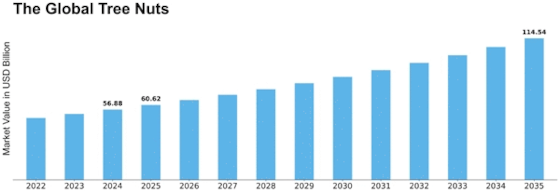

Tree Nuts Market Size Graph
Author
Author Profile
Harshita Gorde
Research Analyst

Harshita Post graduate MBA in Business Administration from Welingkar Institute, Mumbai and 5 years of experience in the field of product market research. As a Research Analyst, I have cross-domain experience in packaging, and industrial Automation & Equipment. I am currently looking after the research process of packaging, logistics & transportation, and industrial automation & equipment at Market Research Future Reports. My responsibilities at the organization involve handling syndicate and custom reports as well as responding to client inquiries, and organize, co-ordinate with a group of 5 to 6 persons to manage all workflows.

Leave a Comment

FAQs

What is the current valuation of The Global Tree Nuts as of 2024?

<p>The Global Tree Nuts was valued at 56.88 USD Billion in 2024.</p>

What is the projected market valuation for The Global Tree Nuts in 2035?

<p>The market is projected to reach 114.54 USD Billion by 2035.</p>

What is the expected CAGR for The Global Tree Nuts during the forecast period 2025 - 2035?

<p>The expected CAGR for The Global Tree Nuts during 2025 - 2035 is 6.57%.</p>

Which companies are considered key players in The Global Tree Nuts?

<p>Key players include Olam Group, Blue Diamond Growers, Wonderful Pistachios, and others.</p>

What are the main types of tree nuts in the market and their valuations?

<p>Almonds, cashew nuts, and walnuts are prominent, with valuations ranging from 5.0 to 30.0 USD Billion.</p>

How is The Global Tree Nuts segmented by form?

<p>The market is segmented into whole, splits, and others, with whole nuts valued at 22.75 to 45.0 USD Billion.</p>

What applications drive the demand for tree nuts?

<p>Key applications include direct consumption, bakery & confectionery, and snacks, with valuations from 3.0 to 30.0 USD Billion.</p>

What distribution channels are prevalent in The Global Tree Nuts?

<p>The market is divided into B2B and B2C channels, with B2B valued at 34.14 to 70.0 USD Billion.</p>

What is the valuation range for pistachios in The Global Tree Nuts?

<p>Pistachios are valued between 10.0 and 20.0 USD Billion.</p>

How do the valuations of tree nuts compare across different types?

<p>Almonds lead with 15.0 to 30.0 USD Billion, while macadamia nuts range from 2.0 to 4.0 USD Billion.</p>

Market Summary

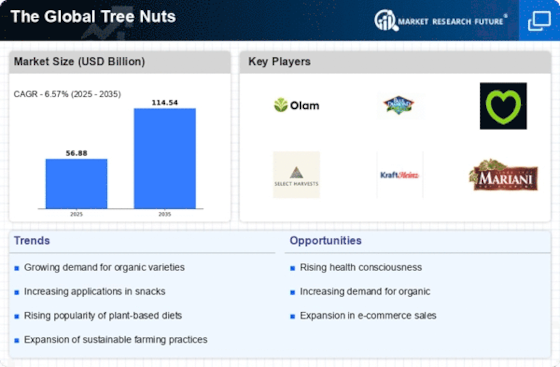
As per Market Research Future analysis, the Global Tree Nuts market, also referred to as the tree nuts market, was estimated at 56.88 USD Billion in 2024. The tree nuts market size is projected to grow from 60.62 USD Billion in 2025 to 114.54 USD Billion by 2035, exhibiting a compound annual growth rate (CAGR) of 6.57% during the forecast period 2025 - 2035.

Key Market Trends & Highlights

The Global Tree Nuts Market is experiencing robust growth driven by health trends and innovative practices.

  • The North American region remains the largest market for tree nuts, primarily driven by increasing health consciousness among consumers. In contrast, the Asia-Pacific region is emerging as the fastest-growing market, fueled by rising disposable incomes and changing dietary preferences. Almonds continue to dominate as the largest segment, while cashew nuts are witnessing the fastest growth due to their versatility and health benefits. Market drivers such as health consciousness and sustainable practices are significantly influencing the demand for whole and split nut products.

Market Size & Forecast

2024 Market Size 56.88 (USD Billion)
2035 Market Size 114.54 (USD Billion)
CAGR (2025 - 2035) 6.57%
Largest Regional Market Share in 2024 Asia Pacific

Major Players

Olam Group (SG), Blue Diamond Growers (US), Wonderful Pistachios (US), Select Harvests (AU), Kraft Heinz (US), Mariani Nut Company (US), Sun-Maid Growers of California (US), Sunkist Growers (US)

Market Trends

The Global Tree Nuts Market is currently experiencing a dynamic evolution, driven by shifting consumer preferences and increasing health consciousness. As individuals become more aware of the nutritional benefits associated with tree nuts, demand across the tree nuts market appears to be on the rise. This trend is further supported by the growing popularity of plant-based diets, which often incorporate tree nuts as a primary source of protein and healthy fats. Additionally, the market is witnessing a surge in innovative product offerings, including nut-based snacks and dairy alternatives, which contribute to the expanding tree nuts market share globally.  Moreover, The Global Tree Nuts Market is influenced by various factors such as sustainability and ethical sourcing, which are increasingly shaping tree nut marketing strategies adopted by key players. Consumers are increasingly seeking products that align with their values, prompting companies to adopt more transparent supply chains and environmentally friendly practices. This shift not only enhances brand loyalty but also positions businesses favorably in a competitive landscape. As the  Tree Nuts Market continues to evolve, it is likely that these trends will shape the future of tree nut consumption, leading to new opportunities and challenges for stakeholders across the industry.

Health and Wellness Focus

The emphasis on health and wellness is reshaping consumer choices, with tree nuts being recognized for their nutritional advantages. This trend supports long-term growth across regional markets including the China tree nuts market and japan tree nuts market, where health awareness is rising steadily.

Sustainable Sourcing Practices

There is a growing demand for sustainably sourced tree nuts, especially in export-driven segments such as the Brazil tree nuts market, as consumers increasingly prioritize environmental responsibility. This trend indicates that companies are likely to enhance their sourcing practices to meet consumer expectations and promote ethical consumption.

Innovative Product Development

The market is witnessing a wave of innovation, with new products such as nut-based snacks and dairy alternatives gaining traction across the global tree nuts market. This trend implies that manufacturers are exploring creative avenues to cater to evolving consumer preferences and dietary needs.

Tree Nuts Market Market Drivers

Health Consciousness

The increasing awareness of health and wellness among consumers appears to be a primary driver for The Global Tree Nuts Industry. As individuals seek healthier dietary options, tree nuts are often recognized for their nutritional benefits, including high levels of protein, fiber, and healthy fats. According to recent data, the consumption of tree nuts has surged, with almonds and walnuts leading the market due to their perceived health benefits. This trend is likely to continue, as more consumers incorporate tree nuts into their diets as snacks or as ingredients in various dishes. The health-conscious demographic, particularly millennials and Gen Z, seems to be driving demand, thereby influencing product offerings and marketing strategies within the industry.

Global Trade Dynamics

The dynamics of international trade play a pivotal role in shaping The Global Tree Nuts Industry. Trade agreements and tariffs can significantly influence the availability and pricing of tree nuts across different regions. For instance, countries that are major producers, such as the United States and Australia, benefit from favorable trade conditions, allowing them to export their products more efficiently. Conversely, regions facing trade barriers may experience supply constraints, affecting market prices and availability. The ongoing evolution of trade policies and agreements is likely to impact the competitive landscape, as companies navigate these complexities to optimize their supply chains and reach global markets.

Sustainable Practices

Sustainability has emerged as a crucial factor influencing consumer choices, thereby impacting The Global Tree Nuts Industry. As environmental concerns grow, consumers are increasingly favoring products that are sourced sustainably. This shift has prompted many producers to adopt eco-friendly practices, such as organic farming and responsible sourcing. Data indicates that the market for organic tree nuts is expanding, with consumers willing to pay a premium for sustainably sourced products. This trend not only aligns with consumer values but also enhances brand loyalty. Companies that prioritize sustainability in their operations are likely to gain a competitive edge, as they appeal to a growing segment of environmentally conscious consumers.

Rising Disposable Incomes

The increase in disposable incomes in various regions is contributing to the growth of The Global Tree Nuts Industry. As consumers have more financial flexibility, they are more inclined to spend on premium food products, including tree nuts. This trend is particularly evident in emerging markets, where a burgeoning middle class is driving demand for healthier snack options. Market data indicates that regions with rising disposable incomes are witnessing a surge in tree nut consumption, as consumers seek quality and variety. This economic shift suggests that the market may continue to expand, as more individuals incorporate tree nuts into their diets as a source of nutrition and indulgence.

Innovative Product Offerings

Innovation in product development is a significant driver for The Global Tree Nuts Industry. Manufacturers are increasingly introducing new flavors, blends, and formats to cater to diverse consumer preferences. For instance, the rise of flavored and coated nuts has attracted a broader audience, while the introduction of nut-based snacks and spreads has expanded market reach. Recent market data suggests that the demand for value-added products, such as nut butters and snack mixes, is on the rise. This trend indicates that consumers are not only looking for traditional tree nuts but are also interested in innovative applications that enhance convenience and taste. As a result, companies that invest in research and development are likely to thrive in this competitive landscape.

Market Segment Insights

By Type: Almonds (Largest) vs. Cashew Nuts (Fastest-Growing)

In The Global Tree Nuts Market, Almonds hold the largest market share, contributing substantially to overall tree nuts market size. Cashew Nuts are rapidly gaining traction, particularly in Asia-Pacific markets such as the China tree nuts market. They are predominantly consumed in various forms, including snacks, flour, and milk, appealing to health-conscious consumers. Cashew Nuts, while smaller in share, are rapidly gaining traction due to their unique flavor profile and increasing popularity in vegan and plant-based diets. Other notable segments include Walnuts and Pistachios, which also command significant shares but are growing at a more moderate pace compared to Cashew Nuts.

Almonds (Dominant) vs. Cashew Nuts (Emerging)

Almonds are the dominant force in The Global Tree Nuts Market, prized for their rich nutrient profile, including fiber, protein, and healthy fats. Their versatility allows them to be utilized in a plethora of products, from nut <a href="https://www.marketresearchfuture.com/reports/butter-market-4393" target="_blank" rel="noopener">butter</a> to dairy alternatives, driving their widespread appeal. Cashew Nuts, on the other hand, emerge as a growing segment, characterized by their creamy texture and distinct flavor. Increasing awareness of their health benefits and incorporation into dishes such as vegan <a href="https://www.marketresearchfuture.com/reports/cheese-market-2213" target="_blank" rel="noopener">cheese</a> are fueling interest. With rising demand in Asia and beyond, Cashew Nuts are poised for rapid growth as consumers seek diverse and nutritious snacking options.

By Form: Whole (Largest) vs. Splits (Fastest-Growing)

In The Global Tree Nuts Market, the by form segment is characterized by three main categories: whole, splits, and others. Whole tree nuts dominate the tree nuts market, while splits are emerging due to changing snacking habits and evolving tree nut marketing approaches focused on convenience. Splits have gained traction due to their appeal as a snack option and their use in various food products, making them a significant player in market distribution. Others, while contributing to the overall form segment, represent a smaller niche that caters to specific product requirements and preferences. Growth trends in the tree nuts Market by form segment indicate that splits are emerging as the fastest-growing category, driven by a shift in consumer preferences towards healthier snacking options. The increasing awareness of the nutritional benefits of tree nuts plays a pivotal role in boosting the demand for whole varieties as well. Additionally, the rise in innovative product launches incorporating tree nut forms further enhances  Tree Nuts Market dynamics, driving overall growth across the segment as consumers seek diverse choices.

Whole (Dominant) vs. Splits (Emerging)

Whole tree nuts are the dominant form in the  Tree Nuts Market, prized for their natural state and versatility in cooking and snacking. They are often preferred for their superior flavor and texture, making them a staple in both household and commercial culinary applications. In contrast, splits are an emerging category that has captured consumer interest due to their convenient size and ease of use in recipes and as on-the-go snacks. The growth of splits is fueled by the increasing trend of health-conscious consumers preferring portion-controlled snack sizes, making them a strong competitor to whole nuts. Together, these segments reflect the diverse preferences and ongoing innovations in The Global Tree Nuts Market.

By Application: Direct Consumption/Culinary Purpose (Largest) vs. Snacks (Fastest-Growing)

Direct Consumption remains the dominant application in the tree nuts market, while the Snacks segment is expanding rapidly, contributing positively to global tree nuts market share growth. This category appeals to health-conscious consumers, driving a strong market share due to the rising demand for raw and roasted nuts for nutritional benefits and culinary versatility. Meanwhile, the Snacks segment is rapidly gaining traction as consumers seek convenient, healthy snack options, positioning itself as an emerging leader in this market segment.

Snacks: Emerging vs. Direct Consumption/Culinary Purpose: Dominant

The Direct Consumption and Culinary Purpose segment remains the dominant player in The Global Tree Nuts Market, largely due to its established preference among consumers who prioritize health and nutrition. This segment encompasses products utilized in various cuisines and dietary applications, such as salads, desserts, and as standalone snacks. Conversely, the Snacks segment, which is growing rapidly, is capitalizing on the trend of healthy snacking. Companies are innovating with flavored and mixed nut blends that cater to on-the-go lifestyles. The emerging popularity of nuts as a guilt-free alternative to traditional snacks is contributing to the dynamic changes within this segment.

By Distribution Channel: B2B (Largest) vs. B2C (Fastest-Growing)

The Global Tree Nuts Market is primarily characterized by a significant share held by the B2B distribution channel, which caters to large-scale buyers including food manufacturers and wholesalers. This segment dominates the  Tree Nuts Market due to its ability to meet bulk demands and its established supply chains. On the other hand, B2C distribution has emerged as a rapidly growing segment, driven by the increasing trend of online shopping and the preference for direct consumer engagement, which is reshaping traditional buying patterns.

Distribution Channel: B2B (Dominant) vs. B2C (Emerging)

The B2B distribution channel in The Global Tree Nuts Market serves as the cornerstone of trade, facilitating large transactions and long-term contracts with commercial buyers. This segment benefits from established relationships and logistical efficiencies that allow for the consistent supply of tree nuts to various industries. Conversely, B2C distribution is gaining traction as consumers become more health-conscious and seek convenience. The rise of e-commerce platforms and specialty retailers is enhancing the accessibility of tree nuts for end-users. This segment reflects a shift toward personalized purchasing experiences, which is vital for capturing the interests of a diverse consumer base.

Get more detailed insights about Tree Nuts Market Research Report-Global Forecast till 2035

Regional Insights

North America : Market Leader in Tree Nuts

North America remains a leading contributor to the global tree nuts market share, driven by high consumer awareness and established distribution networks. The region's growth is driven by increasing health consciousness among consumers, leading to higher demand for nutritious snacks. Regulatory support, including food safety standards and agricultural subsidies, further catalyzes Tree Nuts Market expansion. The U.S. is the primary contributor, followed by Canada, which is experiencing a growing interest in tree nut consumption. The competitive landscape in North America is robust, featuring key players such as Blue Diamond Growers, Wonderful Pistachios, and Kraft Heinz. These companies leverage innovative marketing strategies and product diversification to capture consumer interest. The presence of established distribution channels and a strong retail network enhances market accessibility. As health trends continue to rise, the demand for tree nuts is expected to sustain its upward trajectory in this region.

Europe : Emerging Market for Tree Nuts

Europe is emerging as a significant region in the tree nuts market, supported by health-driven consumption and regulatory support for sustainable sourcing. The region's growth is fueled by increasing consumer awareness of the health benefits associated with tree nuts, including their role in heart health and weight management. Regulatory frameworks, such as the EU's Common Agricultural Policy, support sustainable farming practices, enhancing the appeal of tree nuts in the Tree Nuts Market. Leading countries in this region include Germany, France, and the UK, which are witnessing a surge in tree nut consumption. The competitive landscape features both local and international players, with companies like Select Harvests and Mariani Nut Company making notable inroads. The growing trend of plant-based diets and snacking is further driving demand, positioning Europe as a key player in The Global Tree Nuts.

Asia-Pacific : Rapid Growth in Tree Nuts

Asia-Pacific is rapidly expanding, with strong growth in the China tree nuts market and japan tree nuts market, driven by changing dietary preferences and rising disposable incomes. The region's growth is driven by rising disposable incomes and changing dietary preferences, with consumers increasingly seeking healthy snack options. Countries like China and India are leading this trend, supported by favorable government policies promoting agricultural exports and health initiatives that encourage nut consumption. The competitive landscape in Asia-Pacific is evolving, with both local and international brands vying for Tree Nuts Market Share. Key players such as Olam Group are expanding their operations to meet the growing demand. The region's diverse culinary traditions also contribute to the increasing incorporation of tree nuts in various dishes, further enhancing Tree Nuts Market potential. As awareness of health benefits continues to rise, the tree nuts market in Asia-Pacific is poised for significant growth.

Middle East and Africa : Untapped Potential in Tree Nuts

The region shows untapped potential, contributing steadily to the overall tree nuts market size through rising health awareness. The growth is primarily driven by rising health awareness and the increasing popularity of tree nuts as a snack option. Additionally, government initiatives aimed at boosting agricultural production and exports are creating a favorable environment for market expansion. Countries like South Africa and the UAE are at the forefront of this growth, capitalizing on the health trends. The competitive landscape is characterized by a mix of local producers and international brands. Key players are beginning to establish a stronger presence in the region, focusing on product innovation and marketing strategies tailored to local tastes. The growing trend of healthy eating and snacking is expected to further propel the demand for tree nuts in this region, making it an area of significant potential for future growth.

Key Players and Competitive Insights

The Global Tree Nuts Market is characterized by competitive strategies focused on sustainability, innovation, and enhanced tree nut marketing efforts aimed at strengthening brand presence and expanding tree nuts market share. Key players such as Olam Group (SG), Blue Diamond Growers (US), and Wonderful Pistachios (US) are strategically positioned to leverage these trends. Olam Group (SG) focuses on sustainability and innovation, emphasizing its commitment to responsible sourcing and environmental stewardship. Meanwhile, Blue Diamond Growers (US) has been enhancing its product portfolio through innovative almond-based products, catering to the rising demand for plant-based alternatives. Wonderful Pistachios (US) continues to expand its market presence through aggressive marketing campaigns and partnerships, thereby solidifying its position in the competitive environment. In terms of business tactics, companies are increasingly localizing manufacturing and optimizing supply chains to enhance efficiency and reduce costs. The market structure appears moderately fragmented, with several key players exerting significant influence. This fragmentation allows for niche players to thrive, while larger companies leverage economies of scale to maintain competitive pricing. The collective influence of these key players shapes the market dynamics, as they engage in strategic collaborations and partnerships to enhance their market reach. In August 2025, Olam Group (SG) announced a partnership with a leading agricultural technology firm to develop precision farming techniques aimed at improving yield and sustainability in nut production. This strategic move underscores Olam's commitment to innovation and positions the company to better meet the growing demand for sustainably sourced products. The integration of advanced agricultural technologies is likely to enhance operational efficiency and reduce environmental impact, aligning with consumer preferences for eco-friendly products. In September 2025, Blue Diamond Growers (US) launched a new line of almond-based snacks that cater to health-conscious consumers seeking convenient and nutritious options. This product expansion reflects the company's strategy to diversify its offerings and tap into the growing snacking trend. By introducing innovative products, Blue Diamond Growers (US) not only strengthens its market position but also addresses the evolving preferences of consumers, thereby enhancing brand loyalty. In October 2025, Wonderful Pistachios (US) unveiled a new marketing campaign focused on the health benefits of pistachios, aiming to increase consumer awareness and drive sales. This initiative highlights the company's focus on education and consumer engagement, which is crucial in a competitive market where health claims can significantly influence purchasing decisions. By positioning itself as a leader in health-oriented marketing, Wonderful Pistachios (US) is likely to capture a larger share of the market. As of October 2025, current competitive trends in The Global Tree Nuts include a strong emphasis on digitalization, sustainability, and the integration of artificial intelligence in supply chain management. Strategic alliances are increasingly shaping the landscape, as companies collaborate to enhance product offerings and market reach. Looking ahead, competitive differentiation is expected to evolve, with a shift from price-based competition to a focus on innovation, technology, and supply chain reliability. This transition may redefine market dynamics, as companies that prioritize these aspects are likely to gain a competitive edge.

Key Companies in the Tree Nuts Market include

Industry Developments

April 2022: Olam food ingredients (“ofi”) announces acquisition to expand its private label capabilities in North America

December 2021: With this acquisition, ADM adds an experienced and successful team of 60 colleagues who serve a growing list of food and beverage customers across Latin America and the Caribbean with a wide range of flavor ingredients and solutions from two state-of-the-art manufacturing facilities in Panama and Colombia.

Future Outlook

Tree Nuts Market Future Outlook

The Global Tree Nuts Market is projected to grow at a 6.57% CAGR from 2025 to 2035, driven by rising health awareness, increasing demand for plant-based proteins, and expanding applications in food and cosmetics.

New opportunities lie in:

  • <p>Development of premium organic tree nut products for health-conscious consumers. Expansion into emerging markets with tailored marketing strategies. Investment in sustainable farming practices to enhance supply chain resilience.</p>

By 2035, the tree nuts market share is expected to expand significantly across emerging and developed regions.

Market Segmentation

Tree Nuts Market Form Outlook

  • Whole
  • Splits
  • Others

Tree Nuts Market Type Outlook

  • Cashew Nuts
  • Walnuts
  • Almonds
  • Pistachios
  • Hazelnuts
  • Chestnuts
  • Brazil Nuts
  • Macadamia Nuts
  • Others

Tree Nuts Market Application Outlook

  • Direct Consumption/Culinary Purpose
  • Bakery & Confectionery
  • Breakfast Cereals
  • Snacks
  • Flavored Drinks
  • Butter & Spreads
  • Dairy Products
  • Others

Tree Nuts Market Distribution Channel Outlook

  • B2B
  • B2C

Report Scope

MARKET SIZE 2024 56.88(USD Billion)
MARKET SIZE 2025 60.62(USD Billion)
MARKET SIZE 2035 114.54(USD Billion)
COMPOUND ANNUAL GROWTH RATE (CAGR) 6.57% (2025 - 2035)
REPORT COVERAGE Revenue Forecast, Competitive Landscape, Growth Factors, and Trends
BASE YEAR 2024
Market Forecast Period 2025 - 2035
Historical Data 2019 - 2024
Market Forecast Units USD Billion
Key Companies Profiled Olam Group (SG), Blue Diamond Growers (US), Wonderful Pistachios (US), Select Harvests (AU), Kraft Heinz (US), Mariani Nut Company (US), Sun-Maid Growers of California (US), Sunkist Growers (US)
Segments Covered Product Type, Form, Application, Distribution Channel, Region
Key Market Opportunities Growing consumer demand for plant-based snacks drives innovation in The Global Tree Nuts.
Key Market Dynamics Rising consumer demand for healthy snacks drives innovation and competition in the tree nuts market.
Countries Covered North America, Europe, APAC, South America, MEA

FAQs

What is the current valuation of The Global Tree Nuts as of 2024?

<p>The Global Tree Nuts was valued at 56.88 USD Billion in 2024.</p>

What is the projected market valuation for The Global Tree Nuts in 2035?

<p>The market is projected to reach 114.54 USD Billion by 2035.</p>

What is the expected CAGR for The Global Tree Nuts during the forecast period 2025 - 2035?

<p>The expected CAGR for The Global Tree Nuts during 2025 - 2035 is 6.57%.</p>

Which companies are considered key players in The Global Tree Nuts?

<p>Key players include Olam Group, Blue Diamond Growers, Wonderful Pistachios, and others.</p>

What are the main types of tree nuts in the market and their valuations?

<p>Almonds, cashew nuts, and walnuts are prominent, with valuations ranging from 5.0 to 30.0 USD Billion.</p>

How is The Global Tree Nuts segmented by form?

<p>The market is segmented into whole, splits, and others, with whole nuts valued at 22.75 to 45.0 USD Billion.</p>

What applications drive the demand for tree nuts?

<p>Key applications include direct consumption, bakery & confectionery, and snacks, with valuations from 3.0 to 30.0 USD Billion.</p>

What distribution channels are prevalent in The Global Tree Nuts?

<p>The market is divided into B2B and B2C channels, with B2B valued at 34.14 to 70.0 USD Billion.</p>

What is the valuation range for pistachios in The Global Tree Nuts?

<p>Pistachios are valued between 10.0 and 20.0 USD Billion.</p>

How do the valuations of tree nuts compare across different types?

<p>Almonds lead with 15.0 to 30.0 USD Billion, while macadamia nuts range from 2.0 to 4.0 USD Billion.</p>

  1. SECTION I: EXECUTIVE SUMMARY AND KEY HIGHLIGHTS
    1. | 1.1 EXECUTIVE SUMMARY
    2. | | 1.1.1 Market Overview
    3. | | 1.1.2 Key Findings
    4. | | 1.1.3 Market Segmentation
    5. | | 1.1.4 Competitive Landscape
    6. | | 1.1.5 Challenges and Opportunities
    7. | | 1.1.6 Future Outlook
  2. SECTION II: SCOPING, METHODOLOGY AND MARKET STRUCTURE
    1. | 2.1 MARKET INTRODUCTION
    2. | | 2.1.1 Definition
    3. | | 2.1.2 Scope of the study
    4. | | | 2.1.2.1 Research Objective
    5. | | | 2.1.2.2 Assumption
    6. | | | 2.1.2.3 Limitations
    7. | 2.2 RESEARCH METHODOLOGY
    8. | | 2.2.1 Overview
    9. | | 2.2.2 Data Mining
    10. | | 2.2.3 Secondary Research
    11. | | 2.2.4 Primary Research
    12. | | | 2.2.4.1 Primary Interviews and Information Gathering Process
    13. | | | 2.2.4.2 Breakdown of Primary Respondents
    14. | | 2.2.5 Forecasting Model
    15. | | 2.2.6 Market Size Estimation
    16. | | | 2.2.6.1 Bottom-Up Approach
    17. | | | 2.2.6.2 Top-Down Approach
    18. | | 2.2.7 Data Triangulation
    19. | | 2.2.8 Validation
  3. SECTION III: QUALITATIVE ANALYSIS
    1. | 3.1 MARKET DYNAMICS
    2. | | 3.1.1 Overview
    3. | | 3.1.2 Drivers
    4. | | 3.1.3 Restraints
    5. | | 3.1.4 Opportunities
    6. | 3.2 MARKET FACTOR ANALYSIS
    7. | | 3.2.1 Value chain Analysis
    8. | | 3.2.2 Porter's Five Forces Analysis
    9. | | | 3.2.2.1 Bargaining Power of Suppliers
    10. | | | 3.2.2.2 Bargaining Power of Buyers
    11. | | | 3.2.2.3 Threat of New Entrants
    12. | | | 3.2.2.4 Threat of Substitutes
    13. | | | 3.2.2.5 Intensity of Rivalry
    14. | | 3.2.3 COVID-19 Impact Analysis
    15. | | | 3.2.3.1 Market Impact Analysis
    16. | | | 3.2.3.2 Regional Impact
    17. | | | 3.2.3.3 Opportunity and Threat Analysis
  4. SECTION IV: QUANTITATIVE ANALYSIS
    1. | 4.1 Food, Beverages & Nutrition, BY Type (USD Billion)
    2. | | 4.1.1 Cashew Nuts
    3. | | 4.1.2 Walnuts
    4. | | 4.1.3 Almonds
    5. | | 4.1.4 Pistachios
    6. | | 4.1.5 Hazelnuts
    7. | | 4.1.6 Chestnuts
    8. | | 4.1.7 Brazil Nuts
    9. | | 4.1.8 Macadamia Nuts
    10. | | 4.1.9 Others
    11. | 4.2 Food, Beverages & Nutrition, BY Form (USD Billion)
    12. | | 4.2.1 Whole
    13. | | 4.2.2 Splits
    14. | | 4.2.3 Others
    15. | 4.3 Food, Beverages & Nutrition, BY Application (USD Billion)
    16. | | 4.3.1 Direct Consumption/Culinary Purpose
    17. | | 4.3.2 Bakery & Confectionery
    18. | | 4.3.3 Breakfast Cereals
    19. | | 4.3.4 Snacks
    20. | | 4.3.5 Flavored Drinks
    21. | | 4.3.6 Butter & Spreads
    22. | | 4.3.7 Dairy Products
    23. | | 4.3.8 Others
    24. | 4.4 Food, Beverages & Nutrition, BY Distribution Channel (USD Billion)
    25. | | 4.4.1 B2B
    26. | | 4.4.2 B2C
    27. | 4.5 Food, Beverages & Nutrition, BY Region (USD Billion)
    28. | | 4.5.1 North America
    29. | | | 4.5.1.1 US
    30. | | | 4.5.1.2 Canada
    31. | | 4.5.2 Europe
    32. | | | 4.5.2.1 Germany
    33. | | | 4.5.2.2 UK
    34. | | | 4.5.2.3 France
    35. | | | 4.5.2.4 Russia
    36. | | | 4.5.2.5 Italy
    37. | | | 4.5.2.6 Spain
    38. | | | 4.5.2.7 Rest of Europe
    39. | | 4.5.3 APAC
    40. | | | 4.5.3.1 China
    41. | | | 4.5.3.2 India
    42. | | | 4.5.3.3 Japan
    43. | | | 4.5.3.4 South Korea
    44. | | | 4.5.3.5 Malaysia
    45. | | | 4.5.3.6 Thailand
    46. | | | 4.5.3.7 Indonesia
    47. | | | 4.5.3.8 Rest of APAC
    48. | | 4.5.4 South America
    49. | | | 4.5.4.1 Brazil
    50. | | | 4.5.4.2 Mexico
    51. | | | 4.5.4.3 Argentina
    52. | | | 4.5.4.4 Rest of South America
    53. | | 4.5.5 MEA
    54. | | | 4.5.5.1 GCC Countries
    55. | | | 4.5.5.2 South Africa
    56. | | | 4.5.5.3 Rest of MEA
  5. SECTION V: COMPETITIVE ANALYSIS
    1. | 5.1 Competitive Landscape
    2. | | 5.1.1 Overview
    3. | | 5.1.2 Competitive Analysis
    4. | | 5.1.3 Market share Analysis
    5. | | 5.1.4 Major Growth Strategy in the Food, Beverages & Nutrition
    6. | | 5.1.5 Competitive Benchmarking
    7. | | 5.1.6 Leading Players in Terms of Number of Developments in the Food, Beverages & Nutrition
    8. | | 5.1.7 Key developments and growth strategies
    9. | | | 5.1.7.1 New Product Launch/Service Deployment
    10. | | | 5.1.7.2 Merger & Acquisitions
    11. | | | 5.1.7.3 Joint Ventures
    12. | | 5.1.8 Major Players Financial Matrix
    13. | | | 5.1.8.1 Sales and Operating Income
    14. | | | 5.1.8.2 Major Players R&D Expenditure. 2023
    15. | 5.2 Company Profiles
    16. | | 5.2.1 Olam Group (SG)
    17. | | | 5.2.1.1 Financial Overview
    18. | | | 5.2.1.2 Products Offered
    19. | | | 5.2.1.3 Key Developments
    20. | | | 5.2.1.4 SWOT Analysis
    21. | | | 5.2.1.5 Key Strategies
    22. | | 5.2.2 Blue Diamond Growers (US)
    23. | | | 5.2.2.1 Financial Overview
    24. | | | 5.2.2.2 Products Offered
    25. | | | 5.2.2.3 Key Developments
    26. | | | 5.2.2.4 SWOT Analysis
    27. | | | 5.2.2.5 Key Strategies
    28. | | 5.2.3 Wonderful Pistachios (US)
    29. | | | 5.2.3.1 Financial Overview
    30. | | | 5.2.3.2 Products Offered
    31. | | | 5.2.3.3 Key Developments
    32. | | | 5.2.3.4 SWOT Analysis
    33. | | | 5.2.3.5 Key Strategies
    34. | | 5.2.4 Select Harvests (AU)
    35. | | | 5.2.4.1 Financial Overview
    36. | | | 5.2.4.2 Products Offered
    37. | | | 5.2.4.3 Key Developments
    38. | | | 5.2.4.4 SWOT Analysis
    39. | | | 5.2.4.5 Key Strategies
    40. | | 5.2.5 Kraft Heinz (US)
    41. | | | 5.2.5.1 Financial Overview
    42. | | | 5.2.5.2 Products Offered
    43. | | | 5.2.5.3 Key Developments
    44. | | | 5.2.5.4 SWOT Analysis
    45. | | | 5.2.5.5 Key Strategies
    46. | | 5.2.6 Mariani Nut Company (US)
    47. | | | 5.2.6.1 Financial Overview
    48. | | | 5.2.6.2 Products Offered
    49. | | | 5.2.6.3 Key Developments
    50. | | | 5.2.6.4 SWOT Analysis
    51. | | | 5.2.6.5 Key Strategies
    52. | | 5.2.7 Sun-Maid Growers of California (US)
    53. | | | 5.2.7.1 Financial Overview
    54. | | | 5.2.7.2 Products Offered
    55. | | | 5.2.7.3 Key Developments
    56. | | | 5.2.7.4 SWOT Analysis
    57. | | | 5.2.7.5 Key Strategies
    58. | | 5.2.8 Sunkist Growers (US)
    59. | | | 5.2.8.1 Financial Overview
    60. | | | 5.2.8.2 Products Offered
    61. | | | 5.2.8.3 Key Developments
    62. | | | 5.2.8.4 SWOT Analysis
    63. | | | 5.2.8.5 Key Strategies
    64. | 5.3 Appendix
    65. | | 5.3.1 References
    66. | | 5.3.2 Related Reports
  6. LIST OF FIGURES
    1. | 6.1 MARKET SYNOPSIS
    2. | 6.2 NORTH AMERICA MARKET ANALYSIS
    3. | 6.3 US MARKET ANALYSIS BY TYPE
    4. | 6.4 US MARKET ANALYSIS BY FORM
    5. | 6.5 US MARKET ANALYSIS BY APPLICATION
    6. | 6.6 US MARKET ANALYSIS BY DISTRIBUTION CHANNEL
    7. | 6.7 CANADA MARKET ANALYSIS BY TYPE
    8. | 6.8 CANADA MARKET ANALYSIS BY FORM
    9. | 6.9 CANADA MARKET ANALYSIS BY APPLICATION
    10. | 6.10 CANADA MARKET ANALYSIS BY DISTRIBUTION CHANNEL
    11. | 6.11 EUROPE MARKET ANALYSIS
    12. | 6.12 GERMANY MARKET ANALYSIS BY TYPE
    13. | 6.13 GERMANY MARKET ANALYSIS BY FORM
    14. | 6.14 GERMANY MARKET ANALYSIS BY APPLICATION
    15. | 6.15 GERMANY MARKET ANALYSIS BY DISTRIBUTION CHANNEL
    16. | 6.16 UK MARKET ANALYSIS BY TYPE
    17. | 6.17 UK MARKET ANALYSIS BY FORM
    18. | 6.18 UK MARKET ANALYSIS BY APPLICATION
    19. | 6.19 UK MARKET ANALYSIS BY DISTRIBUTION CHANNEL
    20. | 6.20 FRANCE MARKET ANALYSIS BY TYPE
    21. | 6.21 FRANCE MARKET ANALYSIS BY FORM
    22. | 6.22 FRANCE MARKET ANALYSIS BY APPLICATION
    23. | 6.23 FRANCE MARKET ANALYSIS BY DISTRIBUTION CHANNEL
    24. | 6.24 RUSSIA MARKET ANALYSIS BY TYPE
    25. | 6.25 RUSSIA MARKET ANALYSIS BY FORM
    26. | 6.26 RUSSIA MARKET ANALYSIS BY APPLICATION
    27. | 6.27 RUSSIA MARKET ANALYSIS BY DISTRIBUTION CHANNEL
    28. | 6.28 ITALY MARKET ANALYSIS BY TYPE
    29. | 6.29 ITALY MARKET ANALYSIS BY FORM
    30. | 6.30 ITALY MARKET ANALYSIS BY APPLICATION
    31. | 6.31 ITALY MARKET ANALYSIS BY DISTRIBUTION CHANNEL
    32. | 6.32 SPAIN MARKET ANALYSIS BY TYPE
    33. | 6.33 SPAIN MARKET ANALYSIS BY FORM
    34. | 6.34 SPAIN MARKET ANALYSIS BY APPLICATION
    35. | 6.35 SPAIN MARKET ANALYSIS BY DISTRIBUTION CHANNEL
    36. | 6.36 REST OF EUROPE MARKET ANALYSIS BY TYPE
    37. | 6.37 REST OF EUROPE MARKET ANALYSIS BY FORM
    38. | 6.38 REST OF EUROPE MARKET ANALYSIS BY APPLICATION
    39. | 6.39 REST OF EUROPE MARKET ANALYSIS BY DISTRIBUTION CHANNEL
    40. | 6.40 APAC MARKET ANALYSIS
    41. | 6.41 CHINA MARKET ANALYSIS BY TYPE
    42. | 6.42 CHINA MARKET ANALYSIS BY FORM
    43. | 6.43 CHINA MARKET ANALYSIS BY APPLICATION
    44. | 6.44 CHINA MARKET ANALYSIS BY DISTRIBUTION CHANNEL
    45. | 6.45 INDIA MARKET ANALYSIS BY TYPE
    46. | 6.46 INDIA MARKET ANALYSIS BY FORM
    47. | 6.47 INDIA MARKET ANALYSIS BY APPLICATION
    48. | 6.48 INDIA MARKET ANALYSIS BY DISTRIBUTION CHANNEL
    49. | 6.49 JAPAN MARKET ANALYSIS BY TYPE
    50. | 6.50 JAPAN MARKET ANALYSIS BY FORM
    51. | 6.51 JAPAN MARKET ANALYSIS BY APPLICATION
    52. | 6.52 JAPAN MARKET ANALYSIS BY DISTRIBUTION CHANNEL
    53. | 6.53 SOUTH KOREA MARKET ANALYSIS BY TYPE
    54. | 6.54 SOUTH KOREA MARKET ANALYSIS BY FORM
    55. | 6.55 SOUTH KOREA MARKET ANALYSIS BY APPLICATION
    56. | 6.56 SOUTH KOREA MARKET ANALYSIS BY DISTRIBUTION CHANNEL
    57. | 6.57 MALAYSIA MARKET ANALYSIS BY TYPE
    58. | 6.58 MALAYSIA MARKET ANALYSIS BY FORM
    59. | 6.59 MALAYSIA MARKET ANALYSIS BY APPLICATION
    60. | 6.60 MALAYSIA MARKET ANALYSIS BY DISTRIBUTION CHANNEL
    61. | 6.61 THAILAND MARKET ANALYSIS BY TYPE
    62. | 6.62 THAILAND MARKET ANALYSIS BY FORM
    63. | 6.63 THAILAND MARKET ANALYSIS BY APPLICATION
    64. | 6.64 THAILAND MARKET ANALYSIS BY DISTRIBUTION CHANNEL
    65. | 6.65 INDONESIA MARKET ANALYSIS BY TYPE
    66. | 6.66 INDONESIA MARKET ANALYSIS BY FORM
    67. | 6.67 INDONESIA MARKET ANALYSIS BY APPLICATION
    68. | 6.68 INDONESIA MARKET ANALYSIS BY DISTRIBUTION CHANNEL
    69. | 6.69 REST OF APAC MARKET ANALYSIS BY TYPE
    70. | 6.70 REST OF APAC MARKET ANALYSIS BY FORM
    71. | 6.71 REST OF APAC MARKET ANALYSIS BY APPLICATION
    72. | 6.72 REST OF APAC MARKET ANALYSIS BY DISTRIBUTION CHANNEL
    73. | 6.73 SOUTH AMERICA MARKET ANALYSIS
    74. | 6.74 BRAZIL MARKET ANALYSIS BY TYPE
    75. | 6.75 BRAZIL MARKET ANALYSIS BY FORM
    76. | 6.76 BRAZIL MARKET ANALYSIS BY APPLICATION
    77. | 6.77 BRAZIL MARKET ANALYSIS BY DISTRIBUTION CHANNEL
    78. | 6.78 MEXICO MARKET ANALYSIS BY TYPE
    79. | 6.79 MEXICO MARKET ANALYSIS BY FORM
    80. | 6.80 MEXICO MARKET ANALYSIS BY APPLICATION
    81. | 6.81 MEXICO MARKET ANALYSIS BY DISTRIBUTION CHANNEL
    82. | 6.82 ARGENTINA MARKET ANALYSIS BY TYPE
    83. | 6.83 ARGENTINA MARKET ANALYSIS BY FORM
    84. | 6.84 ARGENTINA MARKET ANALYSIS BY APPLICATION
    85. | 6.85 ARGENTINA MARKET ANALYSIS BY DISTRIBUTION CHANNEL
    86. | 6.86 REST OF SOUTH AMERICA MARKET ANALYSIS BY TYPE
    87. | 6.87 REST OF SOUTH AMERICA MARKET ANALYSIS BY FORM
    88. | 6.88 REST OF SOUTH AMERICA MARKET ANALYSIS BY APPLICATION
    89. | 6.89 REST OF SOUTH AMERICA MARKET ANALYSIS BY DISTRIBUTION CHANNEL
    90. | 6.90 MEA MARKET ANALYSIS
    91. | 6.91 GCC COUNTRIES MARKET ANALYSIS BY TYPE
    92. | 6.92 GCC COUNTRIES MARKET ANALYSIS BY FORM
    93. | 6.93 GCC COUNTRIES MARKET ANALYSIS BY APPLICATION
    94. | 6.94 GCC COUNTRIES MARKET ANALYSIS BY DISTRIBUTION CHANNEL
    95. | 6.95 SOUTH AFRICA MARKET ANALYSIS BY TYPE
    96. | 6.96 SOUTH AFRICA MARKET ANALYSIS BY FORM
    97. | 6.97 SOUTH AFRICA MARKET ANALYSIS BY APPLICATION
    98. | 6.98 SOUTH AFRICA MARKET ANALYSIS BY DISTRIBUTION CHANNEL
    99. | 6.99 REST OF MEA MARKET ANALYSIS BY TYPE
    100. | 6.100 REST OF MEA MARKET ANALYSIS BY FORM
    101. | 6.101 REST OF MEA MARKET ANALYSIS BY APPLICATION
    102. | 6.102 REST OF MEA MARKET ANALYSIS BY DISTRIBUTION CHANNEL
    103. | 6.103 KEY BUYING CRITERIA OF FOOD, BEVERAGES & NUTRITION
    104. | 6.104 RESEARCH PROCESS OF MRFR
    105. | 6.105 DRO ANALYSIS OF FOOD, BEVERAGES & NUTRITION
    106. | 6.106 DRIVERS IMPACT ANALYSIS: FOOD, BEVERAGES & NUTRITION
    107. | 6.107 RESTRAINTS IMPACT ANALYSIS: FOOD, BEVERAGES & NUTRITION
    108. | 6.108 SUPPLY / VALUE CHAIN: FOOD, BEVERAGES & NUTRITION
    109. | 6.109 FOOD, BEVERAGES & NUTRITION, BY TYPE, 2024 (% SHARE)
    110. | 6.110 FOOD, BEVERAGES & NUTRITION, BY TYPE, 2024 TO 2035 (USD Billion)
    111. | 6.111 FOOD, BEVERAGES & NUTRITION, BY FORM, 2024 (% SHARE)
    112. | 6.112 FOOD, BEVERAGES & NUTRITION, BY FORM, 2024 TO 2035 (USD Billion)
    113. | 6.113 FOOD, BEVERAGES & NUTRITION, BY APPLICATION, 2024 (% SHARE)
    114. | 6.114 FOOD, BEVERAGES & NUTRITION, BY APPLICATION, 2024 TO 2035 (USD Billion)
    115. | 6.115 FOOD, BEVERAGES & NUTRITION, BY DISTRIBUTION CHANNEL, 2024 (% SHARE)
    116. | 6.116 FOOD, BEVERAGES & NUTRITION, BY DISTRIBUTION CHANNEL, 2024 TO 2035 (USD Billion)
    117. | 6.117 BENCHMARKING OF MAJOR COMPETITORS
  7. LIST OF TABLES
    1. | 7.1 LIST OF ASSUMPTIONS
    2. | | 7.1.1
    3. | 7.2 North America MARKET SIZE ESTIMATES; FORECAST
    4. | | 7.2.1 BY TYPE, 2025-2035 (USD Billion)
    5. | | 7.2.2 BY FORM, 2025-2035 (USD Billion)
    6. | | 7.2.3 BY APPLICATION, 2025-2035 (USD Billion)
    7. | | 7.2.4 BY DISTRIBUTION CHANNEL, 2025-2035 (USD Billion)
    8. | 7.3 US MARKET SIZE ESTIMATES; FORECAST
    9. | | 7.3.1 BY TYPE, 2025-2035 (USD Billion)
    10. | | 7.3.2 BY FORM, 2025-2035 (USD Billion)
    11. | | 7.3.3 BY APPLICATION, 2025-2035 (USD Billion)
    12. | | 7.3.4 BY DISTRIBUTION CHANNEL, 2025-2035 (USD Billion)
    13. | 7.4 Canada MARKET SIZE ESTIMATES; FORECAST
    14. | | 7.4.1 BY TYPE, 2025-2035 (USD Billion)
    15. | | 7.4.2 BY FORM, 2025-2035 (USD Billion)
    16. | | 7.4.3 BY APPLICATION, 2025-2035 (USD Billion)
    17. | | 7.4.4 BY DISTRIBUTION CHANNEL, 2025-2035 (USD Billion)
    18. | 7.5 Europe MARKET SIZE ESTIMATES; FORECAST
    19. | | 7.5.1 BY TYPE, 2025-2035 (USD Billion)
    20. | | 7.5.2 BY FORM, 2025-2035 (USD Billion)
    21. | | 7.5.3 BY APPLICATION, 2025-2035 (USD Billion)
    22. | | 7.5.4 BY DISTRIBUTION CHANNEL, 2025-2035 (USD Billion)
    23. | 7.6 Germany MARKET SIZE ESTIMATES; FORECAST
    24. | | 7.6.1 BY TYPE, 2025-2035 (USD Billion)
    25. | | 7.6.2 BY FORM, 2025-2035 (USD Billion)
    26. | | 7.6.3 BY APPLICATION, 2025-2035 (USD Billion)
    27. | | 7.6.4 BY DISTRIBUTION CHANNEL, 2025-2035 (USD Billion)
    28. | 7.7 UK MARKET SIZE ESTIMATES; FORECAST
    29. | | 7.7.1 BY TYPE, 2025-2035 (USD Billion)
    30. | | 7.7.2 BY FORM, 2025-2035 (USD Billion)
    31. | | 7.7.3 BY APPLICATION, 2025-2035 (USD Billion)
    32. | | 7.7.4 BY DISTRIBUTION CHANNEL, 2025-2035 (USD Billion)
    33. | 7.8 France MARKET SIZE ESTIMATES; FORECAST
    34. | | 7.8.1 BY TYPE, 2025-2035 (USD Billion)
    35. | | 7.8.2 BY FORM, 2025-2035 (USD Billion)
    36. | | 7.8.3 BY APPLICATION, 2025-2035 (USD Billion)
    37. | | 7.8.4 BY DISTRIBUTION CHANNEL, 2025-2035 (USD Billion)
    38. | 7.9 Russia MARKET SIZE ESTIMATES; FORECAST
    39. | | 7.9.1 BY TYPE, 2025-2035 (USD Billion)
    40. | | 7.9.2 BY FORM, 2025-2035 (USD Billion)
    41. | | 7.9.3 BY APPLICATION, 2025-2035 (USD Billion)
    42. | | 7.9.4 BY DISTRIBUTION CHANNEL, 2025-2035 (USD Billion)
    43. | 7.10 Italy MARKET SIZE ESTIMATES; FORECAST
    44. | | 7.10.1 BY TYPE, 2025-2035 (USD Billion)
    45. | | 7.10.2 BY FORM, 2025-2035 (USD Billion)
    46. | | 7.10.3 BY APPLICATION, 2025-2035 (USD Billion)
    47. | | 7.10.4 BY DISTRIBUTION CHANNEL, 2025-2035 (USD Billion)
    48. | 7.11 Spain MARKET SIZE ESTIMATES; FORECAST
    49. | | 7.11.1 BY TYPE, 2025-2035 (USD Billion)
    50. | | 7.11.2 BY FORM, 2025-2035 (USD Billion)
    51. | | 7.11.3 BY APPLICATION, 2025-2035 (USD Billion)
    52. | | 7.11.4 BY DISTRIBUTION CHANNEL, 2025-2035 (USD Billion)
    53. | 7.12 Rest of Europe MARKET SIZE ESTIMATES; FORECAST
    54. | | 7.12.1 BY TYPE, 2025-2035 (USD Billion)
    55. | | 7.12.2 BY FORM, 2025-2035 (USD Billion)
    56. | | 7.12.3 BY APPLICATION, 2025-2035 (USD Billion)
    57. | | 7.12.4 BY DISTRIBUTION CHANNEL, 2025-2035 (USD Billion)
    58. | 7.13 APAC MARKET SIZE ESTIMATES; FORECAST
    59. | | 7.13.1 BY TYPE, 2025-2035 (USD Billion)
    60. | | 7.13.2 BY FORM, 2025-2035 (USD Billion)
    61. | | 7.13.3 BY APPLICATION, 2025-2035 (USD Billion)
    62. | | 7.13.4 BY DISTRIBUTION CHANNEL, 2025-2035 (USD Billion)
    63. | 7.14 China MARKET SIZE ESTIMATES; FORECAST
    64. | | 7.14.1 BY TYPE, 2025-2035 (USD Billion)
    65. | | 7.14.2 BY FORM, 2025-2035 (USD Billion)
    66. | | 7.14.3 BY APPLICATION, 2025-2035 (USD Billion)
    67. | | 7.14.4 BY DISTRIBUTION CHANNEL, 2025-2035 (USD Billion)
    68. | 7.15 India MARKET SIZE ESTIMATES; FORECAST
    69. | | 7.15.1 BY TYPE, 2025-2035 (USD Billion)
    70. | | 7.15.2 BY FORM, 2025-2035 (USD Billion)
    71. | | 7.15.3 BY APPLICATION, 2025-2035 (USD Billion)
    72. | | 7.15.4 BY DISTRIBUTION CHANNEL, 2025-2035 (USD Billion)
    73. | 7.16 Japan MARKET SIZE ESTIMATES; FORECAST
    74. | | 7.16.1 BY TYPE, 2025-2035 (USD Billion)
    75. | | 7.16.2 BY FORM, 2025-2035 (USD Billion)
    76. | | 7.16.3 BY APPLICATION, 2025-2035 (USD Billion)
    77. | | 7.16.4 BY DISTRIBUTION CHANNEL, 2025-2035 (USD Billion)
    78. | 7.17 South Korea MARKET SIZE ESTIMATES; FORECAST
    79. | | 7.17.1 BY TYPE, 2025-2035 (USD Billion)
    80. | | 7.17.2 BY FORM, 2025-2035 (USD Billion)
    81. | | 7.17.3 BY APPLICATION, 2025-2035 (USD Billion)
    82. | | 7.17.4 BY DISTRIBUTION CHANNEL, 2025-2035 (USD Billion)
    83. | 7.18 Malaysia MARKET SIZE ESTIMATES; FORECAST
    84. | | 7.18.1 BY TYPE, 2025-2035 (USD Billion)
    85. | | 7.18.2 BY FORM, 2025-2035 (USD Billion)
    86. | | 7.18.3 BY APPLICATION, 2025-2035 (USD Billion)
    87. | | 7.18.4 BY DISTRIBUTION CHANNEL, 2025-2035 (USD Billion)
    88. | 7.19 Thailand MARKET SIZE ESTIMATES; FORECAST
    89. | | 7.19.1 BY TYPE, 2025-2035 (USD Billion)
    90. | | 7.19.2 BY FORM, 2025-2035 (USD Billion)
    91. | | 7.19.3 BY APPLICATION, 2025-2035 (USD Billion)
    92. | | 7.19.4 BY DISTRIBUTION CHANNEL, 2025-2035 (USD Billion)
    93. | 7.20 Indonesia MARKET SIZE ESTIMATES; FORECAST
    94. | | 7.20.1 BY TYPE, 2025-2035 (USD Billion)
    95. | | 7.20.2 BY FORM, 2025-2035 (USD Billion)
    96. | | 7.20.3 BY APPLICATION, 2025-2035 (USD Billion)
    97. | | 7.20.4 BY DISTRIBUTION CHANNEL, 2025-2035 (USD Billion)
    98. | 7.21 Rest of APAC MARKET SIZE ESTIMATES; FORECAST
    99. | | 7.21.1 BY TYPE, 2025-2035 (USD Billion)
    100. | | 7.21.2 BY FORM, 2025-2035 (USD Billion)
    101. | | 7.21.3 BY APPLICATION, 2025-2035 (USD Billion)
    102. | | 7.21.4 BY DISTRIBUTION CHANNEL, 2025-2035 (USD Billion)
    103. | 7.22 South America MARKET SIZE ESTIMATES; FORECAST
    104. | | 7.22.1 BY TYPE, 2025-2035 (USD Billion)
    105. | | 7.22.2 BY FORM, 2025-2035 (USD Billion)
    106. | | 7.22.3 BY APPLICATION, 2025-2035 (USD Billion)
    107. | | 7.22.4 BY DISTRIBUTION CHANNEL, 2025-2035 (USD Billion)
    108. | 7.23 Brazil MARKET SIZE ESTIMATES; FORECAST
    109. | | 7.23.1 BY TYPE, 2025-2035 (USD Billion)
    110. | | 7.23.2 BY FORM, 2025-2035 (USD Billion)
    111. | | 7.23.3 BY APPLICATION, 2025-2035 (USD Billion)
    112. | | 7.23.4 BY DISTRIBUTION CHANNEL, 2025-2035 (USD Billion)
    113. | 7.24 Mexico MARKET SIZE ESTIMATES; FORECAST
    114. | | 7.24.1 BY TYPE, 2025-2035 (USD Billion)
    115. | | 7.24.2 BY FORM, 2025-2035 (USD Billion)
    116. | | 7.24.3 BY APPLICATION, 2025-2035 (USD Billion)
    117. | | 7.24.4 BY DISTRIBUTION CHANNEL, 2025-2035 (USD Billion)
    118. | 7.25 Argentina MARKET SIZE ESTIMATES; FORECAST
    119. | | 7.25.1 BY TYPE, 2025-2035 (USD Billion)
    120. | | 7.25.2 BY FORM, 2025-2035 (USD Billion)
    121. | | 7.25.3 BY APPLICATION, 2025-2035 (USD Billion)
    122. | | 7.25.4 BY DISTRIBUTION CHANNEL, 2025-2035 (USD Billion)
    123. | 7.26 Rest of South America MARKET SIZE ESTIMATES; FORECAST
    124. | | 7.26.1 BY TYPE, 2025-2035 (USD Billion)
    125. | | 7.26.2 BY FORM, 2025-2035 (USD Billion)
    126. | | 7.26.3 BY APPLICATION, 2025-2035 (USD Billion)
    127. | | 7.26.4 BY DISTRIBUTION CHANNEL, 2025-2035 (USD Billion)
    128. | 7.27 MEA MARKET SIZE ESTIMATES; FORECAST
    129. | | 7.27.1 BY TYPE, 2025-2035 (USD Billion)
    130. | | 7.27.2 BY FORM, 2025-2035 (USD Billion)
    131. | | 7.27.3 BY APPLICATION, 2025-2035 (USD Billion)
    132. | | 7.27.4 BY DISTRIBUTION CHANNEL, 2025-2035 (USD Billion)
    133. | 7.28 GCC Countries MARKET SIZE ESTIMATES; FORECAST
    134. | | 7.28.1 BY TYPE, 2025-2035 (USD Billion)
    135. | | 7.28.2 BY FORM, 2025-2035 (USD Billion)
    136. | | 7.28.3 BY APPLICATION, 2025-2035 (USD Billion)
    137. | | 7.28.4 BY DISTRIBUTION CHANNEL, 2025-2035 (USD Billion)
    138. | 7.29 South Africa MARKET SIZE ESTIMATES; FORECAST
    139. | | 7.29.1 BY TYPE, 2025-2035 (USD Billion)
    140. | | 7.29.2 BY FORM, 2025-2035 (USD Billion)
    141. | | 7.29.3 BY APPLICATION, 2025-2035 (USD Billion)
    142. | | 7.29.4 BY DISTRIBUTION CHANNEL, 2025-2035 (USD Billion)
    143. | 7.30 Rest of MEA MARKET SIZE ESTIMATES; FORECAST
    144. | | 7.30.1 BY TYPE, 2025-2035 (USD Billion)
    145. | | 7.30.2 BY FORM, 2025-2035 (USD Billion)
    146. | | 7.30.3 BY APPLICATION, 2025-2035 (USD Billion)
    147. | | 7.30.4 BY DISTRIBUTION CHANNEL, 2025-2035 (USD Billion)
    148. | 7.31 PRODUCT LAUNCH/PRODUCT DEVELOPMENT/APPROVAL
    149. | | 7.31.1
    150. | 7.32 ACQUISITION/PARTNERSHIP
    151. | | 7.32.1

Food, Beverages & Nutrition Market Segmentation

Food, Beverages & Nutrition By Type (USD Billion, 2025-2035)

  • Cashew Nuts
  • Walnuts
  • Almonds
  • Pistachios
  • Hazelnuts
  • Chestnuts
  • Brazil Nuts
  • Macadamia Nuts
  • Others

Food, Beverages & Nutrition By Form (USD Billion, 2025-2035)

  • Whole
  • Splits
  • Others

Food, Beverages & Nutrition By Application (USD Billion, 2025-2035)

  • Direct Consumption/Culinary Purpose
  • Bakery & Confectionery
  • Breakfast Cereals
  • Snacks
  • Flavored Drinks
  • Butter & Spreads
  • Dairy Products
  • Others

Food, Beverages & Nutrition By Distribution Channel (USD Billion, 2025-2035)

  • B2B
  • B2C
Infographic

Free Sample Request

Kindly complete the form below to receive a free sample of this Report

Get Free Sample

Customer Strories

Compare Licence

×
Features License Type
Single User Multiuser License Enterprise User
Price $4,950 $5,950 $7,250
Maximum User Access Limit 1 User Upto 10 Users Unrestricted Access Throughout the Organization
Free Customization
Direct Access to Analyst
Deliverable Format
Platform Access
Discount on Next Purchase 10% 15% 15%
Printable Versions